ISSN: 1992-8645 www.jatit.org E-ISSN: 1817-3195
THE RESTORATION OF DEFOCUS IMAGES WITH LINEAR
CHANGE DEFOCUS RADIUS
1LUOYU ZHOU 1
College of Electronics and Information Engineering, Yangtze University, Jingzhou, Hubei 434023, China
E-mail: [email protected]
ABSTRACT
T A novel approach is proposed to restore the defocus image with the linear change defocus radius. Firstly, by studying the space-invariant defocus blurring model, the space-variant defocus blurring model with the linear change defocus radius is obtained. Then, a nonlinear coordinate transforms for blurred image is used to convert the space-variant images blurring into space-invariant blurring images, which is easier restored. The experimental results demonstrate the restoration image has more details and fewer ringing. The restoration effect of the proposed method reveals its practicability in the space-variant defocus image restoration.
Keywords: Defocus Image, Linear Change Defocus Radius, Space-Variant Blurring, Nonlinear Coordinate Transforms
1. INTRODUCTION
A Defocus blurred images are produced when the focus is not accurate in the processing of shooting process. Defocus blur is one of the most important blur. So the defocus blurred image restoration is particularly important [1-2].
Image point spread to spot while image plane is out of focal plane, which result in out of focus. These spread are described by PSF(point spread function). The PSF is space invariant when image plane is parallel with focal plane. Conversely, the point spread variant following a point on the image surface. At this time, the defocus blur is space-variant. All this time many scholars, both at home and abroad, have made great efforts to space-invariant defocus blur and worked out a lot of achievement [3-5]. However, because of the complexity of space-variant defocus blur, there is no effective restoration algorithm for space-variant defocus blur.
Considering the cause of defocus blur, due to arbitrariness of location of image plane and focal plane, the PSF of space-variant defocus blur is very complex. So it is very difficult to restore the space-variant defocus images. The blind restoration algorithm is mostly used to solve the restoration problem in many domestic and foreign literatures. However, the restoration result is often very poor because of little prior knowledge [6-7]. In order to simplify the problem, in this paper we only consider a simple space-variant defocus blur, namely there
has an angle between the image plane and focal plane, by this time, the defocus radius of the blurred image is linear change. By studying the PSF of space-invariant defocus blur, this article first derives the PSF of space-variant defocus blur with the image plane is not parallel with focal plane. Then the restoration algorithm is proposed for this space-variant defocus blur images so as to solve the restoration problem that the image plane is not parallel with focal plane.
This paper is organized as follows. In Section 2, we present the PSF model of space-variant defocus image with linear change defocus radius. In Section 3, we present a novel restoration method of the above defocus image. Experiments are demonstrated in Section 4, and conclusion is presented in Section 5.
2. PSF MODEL OF SPACE-VARIANT DEFOCUS BLUR
2.1 Image Plane is Parallel with Focal Plane
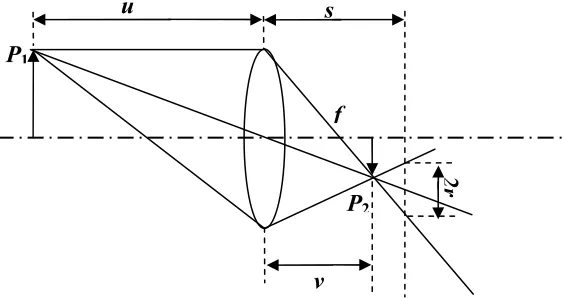
A simple optical imaging system consisting of lens is illustrated in Fig.1 [8]. Where p1 represents object point, p2 represents image point, u represents object distance and v represents image distance, s
denotes the distance from the len to the image sensor, f denotes the focal length. So the Gaussian imaging formulas is:
1
+ =
1
1
ISSN: 1992-8645 www.jatit.org E-ISSN: 1817-3195 when s=v, the point p1 is imaging in the point p2,
which is called focusing. When
s
≠
v
, the image point p2 will spread in the image sensor. According to the principle of geometrical optics, the image point p2 spread into the circular with the radius r,which results in the defocus blur of the image. Apparently, the greater the distance between s and v is, the more serious the focal is. And so the image is more blurring.
[image:2.612.162.443.178.327.2]Figure.1 Optical Imaging System Schematic Diagram When The Image Plane Is Parallel With Focal Plane
Figure.2 Optical Imaging System Schematic Diagram When The Image Plane Is Not Parallel With Focal Plane
Figure 3. The Method Of Nonlinear Transform
And then through the geometrical relation of Fig.1, to be seen
1
1
−
=
=
−
r
s
v
s
a
v
v
s
(2) From formula (2), as long as the focal plane is parallel with the image plane, the focal radius rwould not change. This is the so-called space-invariant defocus blurring. Its PSF is able to use a simple disk model to simulate. Then the restoration result is perfect by using the existing restoration algorithm such as Wiener filtering.
u
v
f
s
P
1P
2Q
θ
J
u
v
f
s
2
r
P
1P
2Nonlinear transform algorithm
Space-invariant blurred image
restoration
nonlinear inversion algorithm
[image:2.612.161.442.381.530.2]ISSN: 1992-8645 www.jatit.org E-ISSN: 1817-3195
2.2 Image Plane is not Parallel with Focal Plane
When the image plane is not parallel with focal plane, as illustrated in Fig.2, Suppose the angle between image plane and focal plane is θ. The intersection of image plane and optical axis is J, s
denotes the distance from J to the center of optical axis. Q represents any point in the image plane and
z represents the distance from J to Q. The defocus radius of point Q is deduced by the formula (2).
0
1
1
=
−
r
as
v
s
(3)(
)
0
1
1
1
1
1
1
=
−
−
=
−
−
−
= +
r
a s
z
v
s
as
a
z
v
s
v
s
r
kz
cos
cos
θ
θ
(4)where
=
1
−
1
k
a
v
s
cos
θ
,so when there has only one angle between image plane and focal plane, the defocus radius is linear change. Similarly, according to the space-invariant PSF, the current PSF model is:(
)
2 2 01
1
=
=
+
PSF
r
r
kz
π
π
(5)The next step is to study how to implement the restoration of defocus image with the above PSF.
3. THE RESTORATION OF DEFOCUS IMAGE WITH THE LINEAR CHANGE DEFOCUS RADIUS
The mathematical model is [9-10]
(
,)
=∫∫
(
,) (
, ; ,)
+(
,)
g x y f α β h x α y β α βd d n x y
(6)
Considering the defocus radius is linear change and the PSF is simultaneously related to the location between the image plane and the scene plane, the mathematical model is the space-variant model. So the model cannot be further simplified as a convolution model.
For space-variant model, there are two methods. The one is that the image is divided into many blocks so as to make every image blocking approximate to space-invariant mode, along with
much obvious artificial trace in the connection part among image blocks. The other is to make a nonlinear transform for blurred image so that the variant blurring is converted into space-invariant blurring. The process is shown as in Fig.3
For linear variety defocus radius r(z)=r0+kz, we do non-uniform sampling in interval [0,Z]. In any point z, if the sampling points are the same in interval r, the scale of space-variant PSF is irrelevant to the spatial location of the resulting sample sequence. In other words, the resulting sample sequence represents the space-invariant blurred image. So we can convert the space-variant PSF into the space-invariant PSF by using a non-uniform sampling.
After a non-uniform sampling, we get the following formula,
( ) ( )
=
p z r z
A
(7) where p(z) denotes density function, A is constant. If λ(z) represents the distribution function of p(z), then by the theory of probability knowledge,p(z)=dλ /dz, so there will be,
( )
0=
=
+
d
A
A
dz
r z
r
kz
λ
(8)
Then:
( )
z
=
c
1ln
(
r
0+
kz
)
+
c
2λ
(9)After nonlinear transformation, the size of images needs to remain the same, that is, λ(0)=0,
λ(Z)=Z, so the coefficient can be obtained,
(
)
1 01
=
+
Z
c
kZ r
ln
/
,c
2= −
c
1ln
r
0 (10)In order to obtain uniform sampling interval, the inverse function of λ(z) is obtained by formula (9)
2 0 1
1
−
=
−
c
z
r
k
exp
c
λ
(11)
This is the nonlinear transformation function which converts space-variant defocus blurring with the linear change defocus radius into space-invariant defocus blurring with the changeless defocus radius. The equivalent of the changeless defocus radius is
0
2
= +
k
r
λr
Z
(12ISSN: 1992-8645 www.jatit.org E-ISSN: 1817-3195 So the restoration image is obtained by the
restoration algorithm of the space-invariant defocus image[11-12]. And at last, by using the inverse function of formula (9), the restoration image is converted into the images in original coordinates.
For defocus radius, if the linear coefficient k are less than zero, formula (4) should be rewritten as
r=|r0+kz|. When nonlinear coordinate transforma-tion is used, we have to compute the value of z
which meets r0+kz=0, denoted as z0. Taking z0 as the boundary, the image is divided into two blocks. When r0+kz are greater than zero, namely r0+kz, the image is converted and restored by the above method. When r0+kz are less than zero, the formula is rewritten as r=-r0-kz, the image is also converted and restored by the above method. Finally, the restored image is the combination of these two pieces of images.
The following is the verification in experiment.
4. THE EXPERIMENTAL RESULTS AND DISCUSSION
4.1 Linear Change Defocus Image Simulation and Their Restoration Results
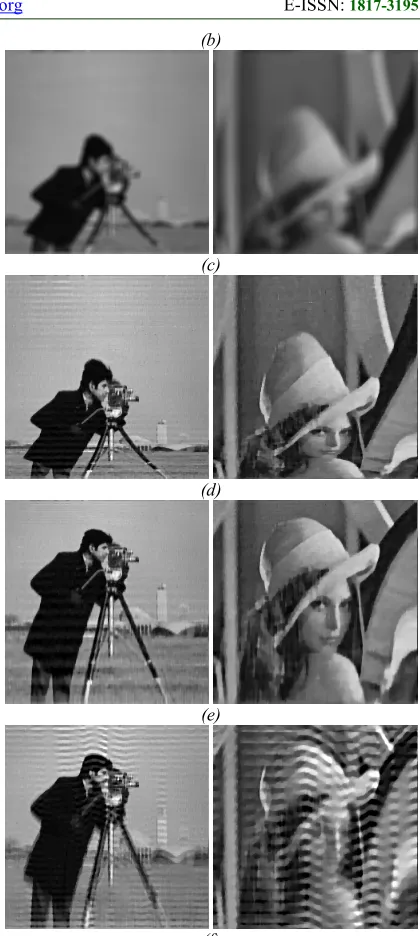
To demonstrate the validity of the proposed method, we tried some experiments on some synthetically focus images and real focus images. The image “Cameraman” and image “Lena” are derived from image database and their defocus radius are respectively r(z)=1+0.06z and
r(z)=3+0.1z. For synthetically focus images, We compare our algorithms with the other restoration algorithms[12], namely conventional restoration algorithm with the equivalent radius in formula (12). The restoration results are all displayed in Fig.4.
(a)
(b)
(c)
(d)
(e)
(f)
[image:4.612.312.522.79.547.2]Figure.4 Restoration results of the conventional restoration algorithm and our algorithm (a)original image (b) defocus blurred image (c) space-invariant defocus image after nonlinear transform (d) the restored image of (c); (e) the restored image after nonlinear inversion transform from (d); (f) the restored image using conventional method from (a)
Table 1 PSNR of the two methods
Restoration results PSNR/dB
Cameraman Lena Fig.4(f), Conventional
restoration method 19.51 17.58
[image:4.612.91.300.519.734.2] [image:4.612.312.523.647.717.2]ISSN: 1992-8645 www.jatit.org E-ISSN: 1817-3195 From restoration results, if the linear change
defocus images are restored by using conventional restoration algorithm for space-invariant images, the ringing effect is very serious. Moreover, the greater the linear change is (the greater the value of coefficient k), the more serious the ringing effect is and the worse the restoration result is.
However, by using our algorithms, the ringing effect of restoration image apparently reduce. The PSNR of the restoration results are shown in Table 1, which also demonstrate our method is better than the conventional space-invariant method, especially for great linear change coefficient k.
4.2 The Restoration of Linear Change Defocus Image with The Negative Coefficient k We choose the barche image for testing the algorithm for the negative coefficient k. The defocus radius is set r(z)=10-0.1z. According to the algorithm proposed in this paper. First, the image is divided two piece and then block processing. The restoration images are shown in Fig.5
From Fig.5(b), due to linear change defocus radius, the center of the image is clear than the other parts of the image. After restoration, compared the blurred image, the restoration image is clearer, shown in Fig.5(c). So this experiment showed our method performs well with the negative coefficient k
(a)
(b)
(c)
Figure.5 The Restoration Of Linear Change Defocus Image With The Negative Coefficient K:(A) Original
Image (B) Defocus Image (C) Restored Image
4.3 Real Defocus Image Restoration with Linear Change Defocus Radius
In order to test the algorithm for the real defocus image with linear change defocus radius. We build the optical imaging system, shown in Fig.2. The restoration results are displayed in Fig.6. From the restoration images, the words are clearly identified, but in the blurred images, the words are hardly identified. So this experiment demonstrated our method performed well for the real defocus image with linear change defocus radius.
(a)
(b)
(c)
Figure.6 Real Defocus Image Restoration: (A) Real Defocus Image; (B) Restored Image Using The Method In The Text; (C) Restored Image Using The Conventional
ISSN: 1992-8645 www.jatit.org E-ISSN: 1817-3195
5. CONCLUSION AND FUTURE WORK
After the summarization of defocus blurring model, this paper proposes a novel approach to restore the image with the linear change defocus radius. The success of our method benefits from two aspects. Firstly, based on space-invariant defocus blurring model, we extended to the space-variant defocus blurring model with the linear change defocus radius. Then, a nonlinear coordinate transforms for blurred image is used to convert the variant blurring into space-invariant blurring. Compared with the conventional restoration method, the presented method performs apparent advantages under most circumstances.
However, the space-variant defocus blurring is very simply only with the linear change defocus radius. So a future research direction would be to consider more complex space-variant defocus blurring.
ACKNOWLEDGEMENT
This work is supported by Science and Technology Research Project of Hubei Provincial Department of Education(Grant No. Q20151302)
REFRENCES:
[1] Yang Cao, Shuai Fang, Zengfu Wang. Digital Multi-Focusing From a Single Photograph Taken With an Uncalibrated Conventional Camera[J]. IEEE Transactions on image processing, vol. 22, no. 9, September 2013. [2] Wei Wang. Single-Image based Learning for
Blur Removal and Quality Evaluation[D]. University of Science and Technology of China, 2014.
[3] Xiang Zhu,Scott Cohen,Stephen Schiller,Peyman Milanfar.Estimating Spatially Varying Defocus Blur From A Single Image[J]. IEEE Transactions on image processing, vol. 22, no. 12, December, 2013.
[4] Liu Zi-wei, Zhao Peng. Parameters identification for blur image combining motion and defocus blurs using BP neural network[J]. Image and Signal Processing (CISP), 2011 4th International Congress on, 2011.
[5] Chunhe Song; Xiaodong Lin. Natural image splicing detection based on defocus blur at edges[J]. Communications in China (ICCC), 2014 IEEE/CIC International Conference on, 2014.
[6] Nakamura, R.; Mitsukura, Y.; Hamada, N. Iterative PCA approach for blind restoration of
single blurred image[J]. Intelligent Signal Processing and Communications Systems (ISPACS), 2013 International Symposium on, 2013.
[7] Wang Lu, Hu Xiyuan, Peng Silong. Partition-Based Global Deblurring of Space-variant Shake-blurred Image[J]. Journal of Computer-Aided Design & Computer Graphics, Vol.24, No.6, 2012.
[8] Stokseth P A. Properties of a defocused optical system[C]. J Opt Soc Am, 1969, 59: 1314-1321. [9] Zou Mouyan. Deconvolution and Signal Recovery[M]. National Defence Industry Press. 2004.
[10] Wai Lam Fong; Ng, M.K. On selection of spatial-varying regularization parameters in total variation image restoration[J]. Multidimensional (nD) Systems (nDs), 2011 7th International Workshop on, 2011.
[11]. Coumar, S.O.; Rajesh, P.; Sadanandam, S. Image restoration using filters and image quality assessment using reduced reference metrics[J]. Circuits, Controls and Communications (CCUBE), 2013 International conference on, 2013.