JUDGMENT ANALYSIS ON INFORMATION AND
COMMUNICATION TECHNOLOGY BASED ON ENGLISH
TEACHING
SHUYING HAN, LI JING
School of Foreign Languages, Handan College, 056005 Handan, Hebei, China, [email protected]
ABSTRACT
As an important branch of modern science and technology, information and communication technology plays an increasingly important role in the modernization of education strategy and has also been widely used in modern English teaching. This paper discusses the basic concepts of information and communication technology and its application in the teaching of English. Then, based on mathematical model, the paper analyzes the application of information and communication technology in the scientific judgment of English teaching. Finally, it gets a conclusion that the application of information and communication technology is useful to modern society by the contrast of traditional English teaching and modern English teaching.
Keywords: English Teaching, Information And Communication Technology, Mathematical Model,
Judgment Analysis
1. INTRODUCTION
Communication and exchange among humans are the major information exchange. In primitive societies, information exchange among humans mainly expressed as the language and body movements. With the continuous development of human society, people gradually mastered a variety of modes of communication. For example, people transferred messengers by horses and pigeons and flames of smoke signals. All of these are the ways of people to transmit information[1]. With the invention of electromagnetic waves, telephone and satellite communications, the development of mobile communications technology became more and more intelligent, digital and networking. Because of the convenience of information and communication technology, it has been widely used and affected on various industries and all walks of life. For example, in the paper of the influence of information and communication technology on higher education, Martin Castro and Yunchao Chen pointed out that the emergence of the information and communication technologies accelerates the fuzzy boundaries of knowledge and university educational institutions and accelerates the democratization of higher education which put forward a severe challenge to the nature and
survival of the university[2]. In the paper of Study
on multiple interactive teaching mode of college
English based on IT environment, Shanjun Zhang
stated and discussed multiple interactive teaching modes of college English by using the theory of foreign language teaching and proposed a mode which is leaded by teachers, subjected by students and applied to English teaching of non-English
majors in the university. In the paper of Study on
the influence and countermeasures of rapidly developed modern information technology on
higher education teaching, Dong Han pointed out
that the development and wide application of modern information technology had a profound impact on higher education. This effect showed the diversity of higher education[3]. Talent values of colleges and universities, teaching content, teaching methods, teaching management system have undergone profound changes. In the paper of Talk about the influence of modern information
technology on higher education, Tingting Dong,
ISSN: 1992-8645 www.jatit.org E-ISSN: 1817-3195
2. BASIC CONCEPT OF INFORMATION
AND COMMUNICATION TECHNOLOGY
Information and communication technology refers to the information technology and communication technology. They represent two different areas at the beginning of the development of information technology and communication technology. IT focuses on the encoding or decoding of a variety of information, and
communication technology focuses on the
dissemination of information transmission technology[4]. With the development of science and technology, the contact of these two technologies is closer. They slowly blend into a category.
2.1 The Concept Of Communication System
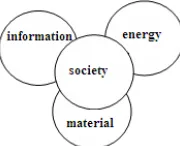
[image:2.612.153.243.378.451.2]Communication and exchange of information are the basic needs of human life. Information is an important social resource. Development and use of information is a sign of the development of the productive forces of modern society. Information, matter, energy are the three basic elements of the society, which is shown in Figure 1.
Figure 1: Schematic Diagram Of Social Elements
Information and communication technology can achieve the transmission and conversion of information. It primarily uses the information communication network of various information transmission media and information conversion
mechanism. It achieves transmission and
conversion of the information through two terminals and constitutes a complete information communication system, which is shown in Figure 2.
Figure 2: Diagram Of Information And Communication System
A complete communication system includes the following components: the sender, interference source, receiving terminal. Sender is composed by information source and the necessary transmission equipment, and the receiving terminal is composed by receiving equipment and Information sink.
Figure 3: Communication System Models
Information source means a person or device that sends out information which can convert the initial information into an electrical signal. The main function of the transmission device is to convert the information transmitted by the information source into the appropriate information form transmitted in channel by amplifying the signal and transform spectrum. Channel refers to transmission media which has the shape of wireless and wired. The function of receiving equipment is contrary to the function of sender. Information sink is the terminal of information. Interference sources occur in the various aspects of the communication system which is unavoidable.
2.2 The Concept Of The Amount Of Information
The amount of information is the main object of information and communication technology, which refers to the number of information. The amount of information I and probability of information appeared P (x) has a function relationship: When the information probability increases, the amount of information will be reduced. On the contrary, when the information probability decreases, the amount of information will increase. Function relationship is[5]:
) ( )
( 1
log
log
pxx p I
a a =−
=
(1) Generally, a discrete information source can pass a lot of independent information. The occurrence probability of the information is different, so the amount of information they contain is different. So, we should consider entropy of information. Entropy can be calculated by the amount of information through weight and sum of the occurrence probability. The formula is shown as follows:
) ( ) ( )
(
log
2
1
x
x
in
i i p p
x
H
∑
= − =
(2) The process of the amount of information is a crucial issue with the development of information and communication technology. The transmission amount of information of the communication system is the constant pursuit of the people.
Limiting transmission of information in
3. APPLICATION OF INFORMATION
AND COMMUNICATION TECHNOLOGY IN ENGLISH
TEACHING
With the continuous development of modern
society, information and communication
technology is increasingly important in the development and progress of science and technology. Modern society is a technology-driven society which has the growing demand for scientific talents[6]. Highly information-oriented society has put forward higher requirements for teaching in schools also. The application of information and communication technology in modern teaching is the complement and enhancement of the traditional classroom teaching. The combination of modern information and communication technology and traditional classroom teaching is a direction of the development of China's education.
3.1 Application status of information and communication technology in English teaching
Penetration of information and communication technologies in various fields of social life brings a lot of changes to the lives of people, so as the modern education. Information and communication technology widely used in modern English teaching has changed the teaching method and philosophy. This paper investigates English teaching molds of several universities and middle schools in China's central region. The results are shown in Table 1.
From Table 1, we can see that the information and communication technology has been widely used in universities and secondary schools currently. But it is used in university more common than secondary school. This indicates that the education sector in China attaches great importance to the application of modern technology. At the same time, we can see that because of the weakness of primary school teachers, there are limitations on the use of modern technology which requires a common concern of the government and the community to the construction and development of the primary and secondary schools.
Table 1: The Survey Of Usage Of Modern Information Technology In Central China
3.2 Contrast Between Modern English Teaching And Traditional English Teaching
Information and communication technology has a positive role in the application of modern English teaching for teaching of teachers and learning of students[7]. It can save a lot of teaching time, increase the teaching capacity of a single class and stimulate students' enthusiasm of learning. Although there are a lot of advantages in the use of information and communication technology in the modern English teaching, the traditional English teaching is not without merit. This paper compares the effect of the two teaching methods using analytic hierarchy process.
The main factors affect the effectiveness of teaching: teaching method, teaching content and teaching object. Assuming these main factors indicators as X = (X1, X2, X3) and weight set is A = (a1, a2, a3). Defined sub-factors layer refers to
)
(
,
,...
2
1
X
X
X
X
K= K K KS ,(k=1,2,3) and weight set is)
(
,
,...
2
1
a
a
a
A
K= K K Ks . Assuming that contrast setis W=(
W
1,W
2,W
3,W
4) . The comparativeresults are excellent, good, fair, and poor.
Assuming that slave vector
B
K of contrast set Won main influencing factors
X
K , so,b
b
b
b
R
A
B
K= K. K= K1. K2.
K3. K4. This is recorded asfollows[8]: = =
b
b
b
b
b
b
b
b
b
b
b
b
B
B
B
R 34 33 32 31 24 23 22 21 14 13 12 11 3 2 1 (3) So,[ ] [bbbb ]
R A R A R A B B B a a a A R A
B 1 2 3 41
3 3 2 2 1 1 3 2 1 3 2 1 = • • • ⋅ = ⋅ = ⋅ = (4) We can establish the matrix of influence of main factors and secondary factors on modern English
University class teaching class using
the information technology
teaching class not using the information
technology
total class utilization rate of
information technology
one class university 100 0 100 100%
Two class university 98 2 100 98%
private university 98 2 100 98%
higher vocational colleges 95 5 100 95%
vocational schools 90 10 100 90%
senior middle school 87 13 100 87%
ISSN: 1992-8645 www.jatit.org E-ISSN: 1817-3195 language teaching and the traditional English
teaching which is shown in Table 2.
Table 2: Table Of Primary And Secondary Factors
X_1 X_2 X_3
X_1 1 2 4
X_2 1/2 1 2
X_3 1/4 1/2 1
After we get the matrix list, we can calculate the weight set of main factors based on the MATLAB software is A=[0.5716,0.2854,0.1425]. We can get B=[0.1796,0.3325,0.2374,0.2493] through the substitution of A=[0.5716,0.2854,0.1425] into the above model. We can see from the results that information and communication technology is superior to the traditional English teaching methods in modern English teaching. Of course, traditional teaching methods cannot be completely denied, and the effect of the effective combination of the two will be more obvious.
Information and communication technology represents a new multimedia technology which includes computer software, CD-ROM, Internet, mobile phone, TV, movies and Internet based on project work, email, chat, blogs, wikis, podcasts, etc. A large quantity of studies have been done that, information and communication technology has better effect in the use of language on students' language learning and understanding, it also increase the enthusiasm of the students and achievement in the use of information and communication technology[9,10]. In addition, the study also found that, if the students think the information and communication technology could help them in their long-term future, they will spend more time using information and communication technology. Information and communication technologies can help promote students, simply, enhance their language learning in communication skills and self-confidence, information and communication technologies can also improve students' computer literacy, enhance their cultural awareness, and develop their social identity in the target culture.
Information and communication technology in English teaching not only can increase visual and auditory ability of students on English Teaching, but also achieve the sound in one effect, enhance image, video and text as one of the fusion[11-13]. Because the specialty of intensive reading materials in English teaching has been made great popularity, especially, there are more and more universities or private, public schools, which use readily available materials for English teaching, and follow preferences of the administrative and teaching staff to provide and prepare the syllabus.
At the same time, it also should have certain criteria to evaluate these methods. When it has different standards to choose, the actual factors should be taken into account, such as teaching reference in order to adapt to the new era. In this context, the use of information and communication technologies can effectively arouse students' enthusiasm in English teaching, strengthen students' interest, create a good, relaxed and lively English atmosphere, effectively improve the efficiency and quality of teaching, and better promote students' English competence.
4. JUDGEMENT ANALYSIS OF
INFORMATION AND COMMUNICATION TECHNOLOGY
BASED ON THE ANALYSIS OF MATHEMATICAL MODEL
With the development of information and communication technology, it brings great convenience for people in all walks of life. However, everything has two sides and information and communication technology also produced a number of troublesome issues when it brought convenience for people[14]. This paper takes modern English language teaching as example and analyzes the pros and cons of the information and communication technology using a mathematical model which is shown as follows.
Assuming that information and communication technology is judgment object P. Factor set
affecting its pros and cons is U={
u
1,u
2,...u
m},and judge level set isV={
v
1,v
2,...v
m}. We canevaluate and analyze factors impacting the pros and cons of the information and communication technology based on different levels of indicators of the evaluation set. We can get evaluation matrix of information and communication technology which is shown as follows[15]:
=
r
r
r
r
r
r
r
r
r
nm n
n
m m
R
... ... ...
2 1
2 22
21
1 12
11
(5)
In the matrix (5),
r
ij is subordinate degree ofinfluencing factors set
u
i to judge levelindicators
v
j. So, we can get the evaluation model(U,V,R) of information and communication technology. We can report the weight coefficient
met
∑
==
n
i1
a
i1
and merged and simplified
asB={
b
1,b
2,...b
m}.In evaluation model (U,V,R), each factor rij in
the matrix R is determined by score of each judger. Through the investigation of the above-mentioned
formula (1), we can get { , ,... }
1 k k k
c
c
c
i i imby regulate the judgment of k judgers
and n i k m j ij
c
, 1,2,...,1
= =
∑
= . k
c
ijis subordinate degree of
ui to judge level indicators
v
j.When we determine index weight coefficients of various impact factors, we can analyze the judgment result of the information and communication technology carried according to the weight coefficient of the judged level. For the N judged levels, we can divide the interval average. When N is 4, the four intervals are [0,0.25][0.25,0.50][0.50,0.75][0.75,1.0]. We can
get
[
,]
_[ ]1
a
b
a
b
d
j ji i N i ij k
∑
= by the sum of j index
coefficients[
a
1j,a
2j,...a
kj].d
ij is the amount of[
a
i,b
i]
in array set [a
1j,a
2j,...a
kj].When 2( )
1
b
a
j jj= +
ξ
, we can substitute j=1,2,3,…n into the above formula and get
ξ
ξ
ξ
1,
2,... n and A={a
1,a
2...a
n} after processing.When ξj∈[ai,bi] , evaluation results of
a
i isk dij
.Judgment result set is{
c
1,c
2...c
n}.Assuming
c
1,
c
2 are two evaluation results.They can be compounded as[16]:
2 } ){ 1 ( } ,
min{
c
1c
2c
1c
2C=∈ + −∈ + (6)
2 } ){ 1 ( } ,
max{
c
1c
2c
1c
2C=∈ + −∈ +
(7)
When ∈=1−min{
c
1,c
2},m i n j ji i ni i i i
i (1 ) , 1,2,...
1 } ,... , max{ 1 2
1 + − =
=∈ ∈∑ =
θ
θ
θ
θ
β
(8) And , n jr
c
r
c
j ji j j ji jji=
∈
min( , )+(1−∈
)( + ) 2, =1,2,...θ
(9)We can get the evaluation result of the information and communication technology through the calculations of above formula:
)} , ),...( , ( ), , {( 2 2 1
1
β
b
β
b
mβ
mb
B=(10) We can substitute the results of the investigation into the above formulas and can conclude through the operation that the convenience brought by the
application of information and communication technology to modern society is far greater than the disadvantages[17]. The convenience of information and communication technology is more and more popular in various fields of modern society.
ISSN: 1992-8645 www.jatit.org E-ISSN: 1817-3195
5. CONCLUSION
With the continuous development of the information society, information and communication technology as new science and technology has widely affected all walks of life in modern society and changed people's lives and the ways of communication. This paper took the application of information and communication technology in the modern English language teaching as an example and described the convenience and change of modern society brought by information and communication technology through mathematical model. Because the continuously improvement of modern society demands and the science and technology, information and communication technology will continue to be developed and applied.
ACKNOWLEDGEMENTS
The work was supported by Research Project of Social Science Development in Hebei Province in 2012 with the project number 201202013 and the
project name Research on How to Widen
Employment Channels of College Graduates in Hebei Province under the New Situation.
REFERENCES:
[1] Sami Sahin, “Pre-service teachers'
perspectives of the diffusion of information and communications technologies (ICTs) and the effect of case-based discussions (CBDs) ”, Computers & Education, Vol. 59, No. 4, 2012, pp. 1089-1098.
[2] Emelia A. Rahman Sidek, Melor Md.Yunus,
“Students’ Experiences on using Blog as
Learning Journals”, Social and Behavioral
Sciences, Vol. 67, No. 11, 2012, pp. 135-143.
[3] Okim Kang, “Relative salience of
suprasegmental features on judgments of L2
comprehensibility and accentedness”, System,
Vol. 38, No. 2, 2010, pp. 301-315.
[4] Ya-Ting Carolyn Yang, Yachin Chuang,
Lung-Yu Li, Shin-Shang Tseng, “A blended learning environment for individualized English listening and speaking integrating
critical thinking”, Computers & Education,
Vol. 63,No. 4, 2013, pp. 285-305.
[5] Ya-Ting C. Yang, Chiaying Chan,
“Comprehensive evaluation criteria for English learning websites using expert validity
surveys”, Computers & Education, Vol. 51,
No. 1, 2008, pp. 403-422.
[6] Per-Olof Erixon, “School subject paradigms
and teaching practice in lower secondary Swedish schools influenced by ICT and
media”, Computers & Education, Vol. 54, No.
4, 2010, pp. 1212-1221.
[7] Yufeng Lan, Peiwei Tsai, Shih-Hsien Yang,
Chun-Ling Hung, “Comparing the social knowledge construction behavioral patterns of problem-based online asynchronous discussion in e/m-learning environments”, Computers & Education, Vol. 59, No. 4, 2012, pp. 1122-1135.
[8] Kathryn Barnes-Burroughs, William Y. Lan,
Elizabeth Edwards, Noël Archambeault, “Current Attitudes Toward Voice Studio Teaching Technology: A Bicoastal Survey of
Classical Singing Pedagogues”, Journal of
Voice, Vol. 22, No. 5, 2008, pp. 590-602.
[9] Matt Bower, John G. Hedberg, “A quantitative
multimodal discourse analysis of teaching and learning in a web-conferencing environment-The efficacy of student-centred learning
designs”, Computers & Education, Vol. 54,
No. 2, 2010, pp. 462-478.
[10] C.A. DeCoursey, “Trialing cartoons:
Teachers’ attitudes towards animation as an
ELT instructional tool”, Computers &
Education, Vol. 59, No. 2, 2012, pp. 436-448.
[11] Pep Simo, Vicenc Fernandez, Ines Algaba,
Nuria Salan, Mihaela Enache, Maria Albareda-Sambola, Edna R. Bravo, Albert Suñe, Daniel Garcia-Almiñana, Beatriz Amante, Manuel Rajadell , “Video stream and teaching channels: quantitative analysis of the use of low-cost educational videos on the
web”, Procedia-Social and Behavioral
Sciences, Vol. 2, No. 2, 2010, pp. 2937-2941.
[12] Mehrak Rahimi, Maral Katal, “The role of
metacognitive listening strategies awareness and podcast-use readiness in using podcasting for learning English as a foreign language”, Computers in Human Behavior, Vol. 28, No. 4, 2012, pp. 1153-1161.
[13] Leslie Jarmon, Tomoko Traphagan, Michael
Mayrath, Avani Trivedi, “Virtual world teaching, experiential learning, and assessment: An interdisciplinary communication course in
Second Life”, Computers & Education, Vol.
[14] Marina Papastergiou, “Enhancing Physical Education and Sport Science students’ self-efficacy and attitudes regarding Information and Communication Technologies through a
computer literacy course”, Computers &
Education, Vol. 54, No. 1, 2010, pp. 298-308.
[15] Kamau Oginga Siwatu, “Preservice teachers’
culturally responsive teaching self-efficacy
and outcome expectancy beliefs”, Teaching
and Teacher Education, Vol. 23, No. 7, 2007, pp.1086-1101.
[16] Anne T. Ottenbreit-Leftwich, Krista D.
Glazewski, Timothy J. Newby, Peggy A. Ertmer, “Teacher value beliefs associated with using technology: Addressing professional and
student needs”, Computers & Education, Vol.
55, No. 3, 2010, pp. 1321-1335.
[17] Lisa M. PytlikZillig, Christy A. Horn, Roger
Bruning, Stephanie Bell, Xiongyi Liu, Kamau O. Siwatu, Mary C. Bodvarsson, Doyoung Kim, Deborah Carlson , “Face-to-face versus computer-mediated discussion of teaching cases: Impacts on preservice teachers’ engagement, critical analyses, and
self-efficacy”, Contemporary Educational
Psychology, Vol. 36, No. 4, 2011, pp. 302-312.
[18] Shiaoyun Chiang, “Pursuing a response in