AN OPTIMIZATION MODEL AND ALGORITHM OF
STUDENTS' PHYSICAL FITNESS TEST SEQUENCE
1JINSONG ZHANG, 2SHUWEI ZHANG
1, 2Liaoning University of Technology, Jinzhou 121001, Liaoning, China
E-mail: [email protected] , [email protected]
ABSTRACT
In this paper, on the basis of full understanding of the model and the algorithm of solving combinatorial mathematics bin-packing problem and production planning processes arrangements, in accordance with the characteristics of the students' physical fitness test to determine the two-stage method for solving the problem. The first stage, simplify the model into a bin-packing problem, and thus get the minimum time period, assign the class to each time according to the total number of physical fitness test to the principle of the optimal balance. The second stage, in order to simplify the calculation, take the student as little as possible total waiting time as the objective function to simplify the problem into the process arrangements model, the model for different rationality makes a better evaluation, adaptability is strong and have a certain value of popularization and application.
Keywords: Physical Fitness Test, Waiting Time, Approximation Algorithm, Bin-Packing Problem
1. INTRODUCTION
In China at present, the school understand the student's physical condition though physical test methods. The test including height and weight, standing long jump, vital capacity, grip and step test, the five all by electronic instrument automatic measurement, record and store information [1-5]. We assume that the school has 3 height and weight measuring instruments, 1 standing long jump, 1 vital capacity measurement instrument each, 2 grip strength and 2 step test measuring instruments [6-8]. Height and weight, standing long jump, vital capacity, the grip four projects each instrument each student's average test (including students conversion) time is 10 seconds, 20 seconds, 20
[image:1.612.94.520.569.720.2]seconds, 15 seconds, and the step test each instrument test 5 students needs 3 minutes and 30 seconds. Before test each item every student need to take an average of five seconds to record the personal information, that student number. Make sure that student number connected only need to input the one time. School arrange for daily testing time is 8:00 to 12:10 and 13:30 to 16:45[2]. The five tests is hold in small places which contain a maximum of 150 students, the test project has no fixed order of seniority [9-10]. The number of each class participate in physical fitness test seen Table 1. Under the conditions of the least entire test period, minimizing the waiting time of students. And we put forward relevant suggestions for school physical test.
Table 1: The Number Of Each Class Participate In Physical Fitness
Class
Number 1 2 3 4 5 6 7 8 9 10 11 12 13 14 15 Total
Number 41 45 44 44 26 44 42 20 20 38 37 25 45 45 45 Class
Number 16 17 18 19 20 21 22 23 24 25 26 27 28 29 30 Total
Number 44 20 30 39 35 38 38 28 25 30 36 20 24 32 33 Class
Number 31 32 33 34 35 36 37 38 39 40 41 42 43 44 45 Total
Number 41 33 51 39 20 20 44 37 38 39 42 40 37 50 50 Class
Number 46 47 48 49 50 51 52 53 54 55 56 Total
2. PROBLEM ANALYSIS AND SYMBOLIC DESCRIPTION
2.1. Problem Analysis
This problem requires the same class all students must complete the testing of all items in the same period of time, and the required time period the least number of conditions throughout the test, and minimize the students waiting time. To this end, we put all participate in physical fitness test class section, idealized the conditions as much as possible, as the class a unit, only to calculate re-record time between the classes. With the increasing of the number of classes, time can be used to complete the test will be reduced. Therefore, we use this relationship as a constraint condition to arrange the classes of the same time period, the process we give it to the computer to complete, specific procedures see attachment. After arrange the same time classes for arrange test order of the same time period class. According to various instruments with different instruments can be divided into different priority, first consider the high priority instrument arrangement, in consideration of the back of the students to wait in front of the students in the testing process, in the back row of class to wait in front of the class, so these students can be arranged for other tests in waiting time. The shortest waiting times formula can be calculated out, and then arrange personnel to complete the test.
2.2. Symbol Description
ts
: The beginning of the period of time;te
: The end of the period of time;tc
: Each test needs time;r
: Each instrument the number of each test;s
: The number of test machine;tw
: Each test project minimizes wait time: Classnumber*5;
t
: Period of time equal to te-ts(s);w
: The average class size is equal to [2036/56];n
: Class number;j i
bend
, : The end time of classes i at the jinstrument;
j i
bst
, : The beginning time of classes i at the jinstrument;
j i
mark
, : i student measuring at j instrument;C1: Height and weight test 1 instrument Numbers;
C2: Height and weight test 2 instrument Numbers;
C3: Height and weight test 3 instrument Numbers;
C4: The standing long jump test instrument Numbers;
C5: Vital capacity test instrument Numbers; C6: Grip strength test 1 instrument Numbers; C7: Grip strength test 2 instrument Numbers; C8: Step test 1 instrument Numbers;
C9: Step test 2 instrument Numbers.
3. MODEL ASSUMPTION
Basic assumptions: After all the tests done, the students can leave the scene; do not need to wait all the students of the class finish test; No abnormal condition: No students were late, do not participate, the students strictly abide by the time discipline according to plan arrangement; In tests, all machines working properly;
Other assumptions: To do the test, a class as a unit, according to the student number sequence test, do not allow this or any other class cut in line. The first students finish and arrange the student (according to the first hypothesis is actually the whole class) to other instruments do test. After all the tests done, the students can leave the scene, do not need to wait all the students of the class finish test.
4. THE ESTABLISHMENT OF THE MODEL AND THE SOLUTION
4.1. The Whole Idea of Solving the Problem
This problem is actually a plan time problem, need to solve the following questions: Make sure all students complete the physical fitness test with a minimum period of time, and solve a minimum number of time periods; Reasonably arrange the known classes (56 classes) for each time period; In a period of time, the physical fitness test class is known, the reasonable arrangement of various classes of test time as far as possible to make the students minimum waiting time.
4.2. The First Stage of Basic Model and Conclusion
The first stage of the basic model can be simplified as: Known for each time period starting time and ending time, each instrument average test time and entry conversion time of not consecutive number of the students' information, find the
minimum number of period and the class arrangements for each time period.
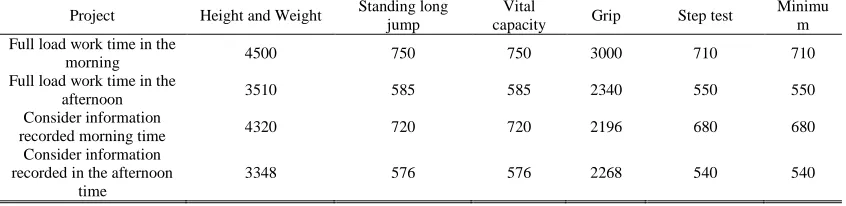
[image:3.612.96.519.211.314.2]Conclusion 1: Morning time arrangement number up to 710, the number of arrangement in the afternoon time up to 550 people. Conclusion 1 testifies: According to each physical testing projects and equipment number, we get the following Table 2:
Table 2: The Number Of Testing Students In Test Project Of Full Load Work Each Period
Project Height and Weight Standing long jump
Vital
capacity Grip Step test
Minimu m Full load work time in the
morning 4500 750 750 3000 710 710
Full load work time in the
afternoon 3510 585 585 2340 550 550
Consider information
recorded morning time 4320 720 720 2196 680 680 Consider information
recorded in the afternoon time
3348 576 576 2268 540 540
Above data calculation formula: Full load work time in the morning: [15000/tc]*r*s. Full load work time in the afternoon: [11700/tc]*r*s. Consider
information recorded morning time:w*n
≤[(15000-n*5)/tc]*r*s Obtained the minimum number of classes *w. Consider information recorded in the
afternoon time: w*n≤[(11700-n*5)/tc]*r*s
Obtained the minimum number of classes *w. Thus we have the conclusion that morning time can accommodate up to 710 people, the afternoon time for 550. The physical testing is a total 2036 people, if all the time in the morning, so, the ideal situation for the minimum time number 3 (morning); taking into account of the actual situation, working arrangements is as days for the unit, the time period must be continuous, and therefore, we must use 2 day four time to arrange the above personnel finish fitness test. So, we have the following conclusion:
Conclusion2: The problem of fitness test time at least for 2 days at least four periods (Continuous morning and afternoon time each 2 times).
In order to more accurately determine the number of time periods and class arrangements, we constructed the following mathematical model. Box model: (The mathematical model of time segment number and the class time period arrangement). According to the time sequence of each time can accommodate the number of people:
1
,
2,
3,...
zr zr zr
, The number of each
class:
br
1,
br
2,
br
3,...,
br
m, Arrange m classes tothe time period are
zr
1,
zr
2,...,
zr
k , Get theminimum time segments K. The problem is actually a bin-packing problem, so we called box problem. It is as if the different sizes of stones in order of different size box, each box with a different number of stones, solve the minimum number of boxes. This problem is a NP complete problem, we use the approximate algorithm to calculate the least number of time segments and arrange the class.
Box model approximation algorithm:
Step1: Divide the class according to the number
of descending sort, assumebr1≥br2≥br3≥...≥brm
Step 2:According i=1,2,…sequence test class with each time period, The principle of the i time period arrangement as following: scan one time of
m
br
br
br
br
1,
2,
3,...,
, If the class has been arranged or arrangements to go into more than the total number of the class, so don't arrange the class, otherwise arrange for the class to the time period.
Table 3: Preliminary Class Section Time Schedule
Periods of time Class The Number of Class Number Total Capacity of Students The first day
morning
54,33,44,45,02,13,14
15,50,03,04,06,16,37,18 15 701 710 The first day
afternoon
47,07,41,46,49,51,01
31,48,42,19,34,25 13 524 550 The second day
morning
40,53,10,21,22,39,11,38,24,28,43,26,20,3
0,32,29,23,05,12,08 20 658 710 The second day
afternoon 09,17,27,35,36,52,55,56 8 153 550
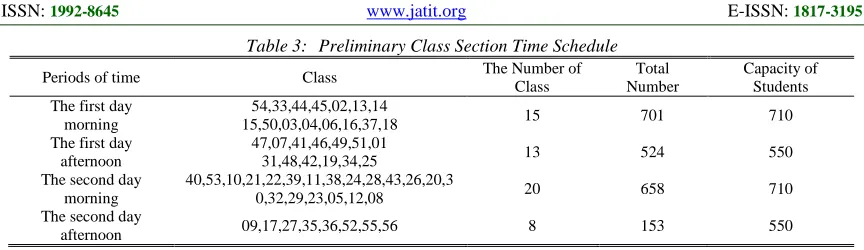
We can see from the Table3: Physical fitness test can be arranged for 2 days 4 times, and the fourth time nearly two-thirds of the time surplus. Therefore, we have the following conclusion:
Conclusion 3: The minimum period of time for physical fitness test is 2 days 4 times.
The above arrangement of each class has obvious shortcomings as follows: The first period has the largest number of people and the classes of most people are concentrated in the period of time, so if classes are not divided, venues maximum seating capacity of 150 people, is not conducive to optimize specific testing time for each class.
Much difference the degree of saturation of each time period, 701 people test the first time, almost require full load, while the 4th period, almost has 2/3 free time.
In order to solve the above problem, we put forward the modified model and algorithm.
4.3. The First Phase of the Improved Mathematical Model and Algorithm
The improved model: (class arrangement mathematical model)
According to the time sequence known four periods, it can hold the number of students are:
4 3 2 1,zr,zr,zr
zr , existing m classes, the number of
students are: br1,br2,br3,...,brm, arrange m classes to
the time period of zr1,zr2,zr3,zr4, Make the students quantity rate most close for each time period. Balance than calculation formula: The period of time can accommodate number-Arrangement. The period of time can accommodate number Balance number rate is close; the fact is the work saturation close.
Solution of model algorithm:
Step1: Divide the class according to the number
of descending sort, assumebr1≥br2≥br3≥...≥brm.
Step2: Divide br1≥br2≥br3≥...≥brm into four
parts:
,...} ,
, {
1 br1 br5 br9
s =
,
s
2
=
{
br
2,
br
6,
br
10,...}
,,...} ,
, {
3 br3 br7 br11
s = ,
,...} , , {
4 br4 br8br12
s = , then, s1,s3 reordering
according to the ascending.
Step 3:According i=1,2,…sequence test class with each time period, The principle of the i time period arrangement as following: scan one time of
m br br
br
br1, 2, 3,..., , If the class has been arranged
or arrangements to go into more than the total number of the class, so don't arrange the class, otherwise arrange for the class to the time period.
The algorithm is practical in the case of ensure the least time period, collocate the classes of big difference in students quantity with each other together, so that make the remaining time of each time period more closer.
[image:4.612.90.522.76.201.2]Table 4: Class time section schedule
Periods of time Class The Number of Class Total Number Capacity of Students The first day
morning
36,33,55,45,09,13,27,15,12
03,28,06,18,37,23,07,20,24 18 609 710 The first day
afternoon
46,32,51,11,31,43,42,10,34
22,53 11 426 550
The second day morning
19,21,40,39,01,38,48,26,41
30,49,29,16,25,47 15 575 710 The second day
afternoon
05,50,04,08,02,17,14,35,54
52,44,56 12 426 550
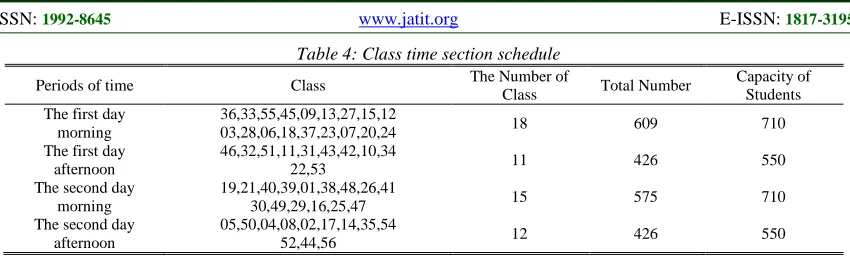
Results: To observe the results found that the number of four time arrangement is close, and each time the number of classes with a neat, each time the remaining time is average.
4.4. The Second Stage Mathematical Model and Algorithm
The second stage of the model can be simplified as: Known the time period and arranged classes, solving students waiting time as short as possible actionable classes physical fitness test schedule.
(1) Basic symbol and assumptions
Assume that the time parameters: start time: ts, end time: te, Period of time: t=te-ts (seconds for the unit); Set the time class number is m, the number of
each class respectively are
br
1,
br
2,
br
3,...,
br
m;number test items according to the following ways:
q1: Height and weight test: Three instruments C1,C2,C3, every time 1 person, the average test time 10 seconds; q2: The standing long jump test: One instrument C4, every time 1 person, the average test time 20 seconds; q3: Vital capacity test: One instrument C5, every time 1 person, the average test time 20 seconds; q4: Grip strength test: Two instruments C6, C7, every time 1 person, the average test time 15 seconds; q5: Step test: Two instruments C8,C9,every time 5 person, the average test time 210 seconds.
The instrument of the average test time:test test1, 2,test3 10= , test4=20, test5=20,
6, 7 15
test test = , test test8, 9=42
Determine the start time: The start time of the class students whose number is 1 test on a single instrument, after these students test one project, immediately into another test.
Determine the end time: The end time is the class last student finish the test on one instrument, after the class last student finishing the test, the instrument can be used by other students.
(2) The calculation of class waiting time
The basic calculation formula:
Students waiting time = Students complete the last project time–the students enter time–test time
Test time =10+20+20+15+210s
Class waiting time =∑ the class every student
waiting time In accordance with the above assumptions, we can get the class waiting time calculation formula:
The i class waiting time:
, ,
1 9
1 9
(max{ } min{ }) *
i i j i j i i
j j
wait bend bst br w
≤ ≤ ≤ ≤
= − −
Among them, (test time)
= + = − ≤ − = 9 , 8 , 5 4 0 * 2 ) 1 0 ( 0 7 k number, apparatus the of end the is k * 2 ) 1 ( k br br test br br test br br w i i k i i k i i i
So, the total waiting time is:
∑
= = m i i wait Swait 1(3) The class arrangement of solving model:
Known the number of each class and the physical testing time, satisfy the following conditions, find out the class start time, so that minimize the sum of the class waiting time, namely
Min{
∑
== m i i wait Swait 1 }
The necessary satisfy condition:
(a)Feasibility conditions: Any time the same
, , , ,
j, i,
j k i k j k k
k k
bst bst end orbst
bst end
≤ ≤
machine can’t have more than two classes of students in the test, so that does not exist i, j make:
(b)Test requirements: Each student must do
five different tests, and don't allow a test to do more than twice.
Such as class i do the test on the j instrument.
1
,j
=
imark
, otherwise,
mark
i,j=
0
, then, thetest requirements is:
5
, 9
1
=
∑
= ij
j
mark
(c)Site conditions: Any time t, no more than
150 students on the test. Define class i field
function
h
i(t
)
:
≤ ≤
= ≤≤ ≤≤
others 0
} {
max }
{ min 1 )
( 1 j 9 i,j 1 j 9 i,j
i
bend t
bst t
h
Then, site conditions can be expressed as follows:
150 ) (
1
≤ ×
∑
=m
i
i
i h t
br
So as to obtain the mathematical model:
The mathematical model of class’s arrangement at the period of time:
Min{
∑
== m
i i wait Swait
1 } .
(4) Solution of the model algorithm
This is similar to the arrangements of production planning process, is an NP-complete problem which can only be solved by approximate algorithm, we design a simulation algorithm, set the selective priority, high priority during the simulation priority greedy principle.
Algorithm principle:(1)Order each test from
slow to fast, must ensure that the slowest equipment
isn’t idle, and then ensure slower, arrangements for
the test project priority; (2)When a class the first
personal finish, then the student can arrange for the
second project; (3)The class must be entirety
into the test site.
Simulation algorithm: Simulate the entire testing process, choose the priority greedy algorithm.
Step 1: Divide the class into two groups and make the total number of two groups close. (Graph theory has a special algorithm). And order the two groups of people according to the number from small to large, 1, 2 groups of each class are fixed to the 1,2 device on the 5 test project
Step 2:Initial arrangement: The two classes order front the group 1 and 2 respectively arranged to do the test in 5 individual test items 1,2 device, under the premise of the total number is lower 150 and the rest of class 2 components as possible as equally, according to the project's priority to arrange other classes to test.
Step 3: When a class 1 personal done a test, can arrange the class to do the second test, choose the second test project principle is: According to the priority, first do the high priority project (machine of slow test speed), only if high priority project of waiting time enough to all our students finish a lower priority project, so, choose the lower priority projects as the next priority project.
Step 4: When students have finished compute the quantity of students, when the number reaches to a class without waiting time, then select a class with step1 sort order and ensure two groups have similar remaining number. The new entering class uses the step3 principle select test project.
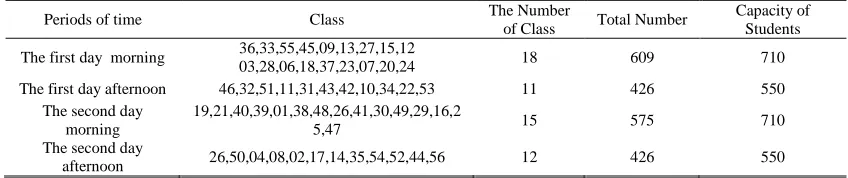
Final results
[image:6.612.93.517.602.691.2](1) The classes time arrangement Table 5:
Table 5: Class Section Time Schedule
Periods of time Class The Number
of Class Total Number
Capacity of Students
The first day morning 36,33,55,45,09,13,27,15,12 03,28,06,18,37,23,07,20,24 18 609 710
The first day afternoon 46,32,51,11,31,43,42,10,34,22,53 11 426 550 The second day
morning
19,21,40,39,01,38,48,26,41,30,49,29,16,2
5,47 15 575 710
The second day
afternoon 26,50,04,08,02,17,14,35,54,52,44,56 12 426 550
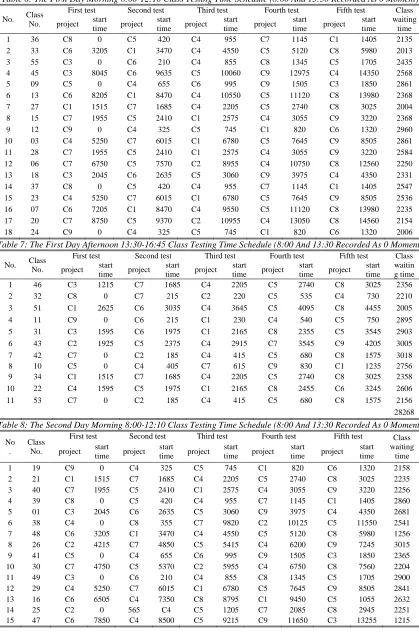
Table 6: The First Day Morning 8:00-12:10 Class Testing Time Schedule (8:00 And 13:30 Recorded As 0 Moment)
No. Class No.
First test Second test Third test Fourth test Fifth test Class waiting
time project start
time project start
time project start
time project start
time project start time
1 36 C8 0 C5 420 C4 955 C7 1145 C1 1405 2135 2 33 C6 3205 C1 3470 C4 4550 C5 5120 C8 5980 2013 3 55 C3 0 C6 210 C4 855 C8 1345 C5 1705 2435 4 45 C3 8045 C6 9635 C5 10060 C9 12975 C4 14350 2568 5 09 C5 0 C4 655 C6 995 C9 1505 C3 1850 2861 6 13 C6 8205 C1 8470 C4 10550 C5 11120 C8 13980 2368 7 27 C1 1515 C7 1685 C4 2205 C5 2740 C8 3025 2004 8 15 C7 1955 C5 2410 C1 2575 C4 3055 C9 3220 2368 9 12 C9 0 C4 325 C5 745 C1 820 C6 1320 2960 10 03 C4 5250 C7 6015 C1 6780 C5 7645 C9 8505 2861 11 28 C7 1955 C5 2410 C1 2575 C4 3055 C9 3220 2584 12 06 C7 6750 C5 7570 C2 8955 C4 10750 C8 12560 2250 13 18 C3 2045 C6 2635 C5 3060 C9 3975 C4 4350 2331 14 37 C8 0 C5 420 C4 955 C7 1145 C1 1405 2547 15 23 C4 5250 C7 6015 C1 6780 C5 7645 C9 8505 2536 16 07 C6 7205 C1 8470 C4 9550 C5 11120 C8 13980 2235 17 20 C7 8750 C5 9370 C2 10955 C4 13050 C8 14560 2154 18 24 C9 0 C4 325 C5 745 C1 820 C6 1320 2006
Table 7: The First Day Afternoon 13:30-16:45 Class Testing Time Schedule (8:00 And 13:30 Recorded As 0 Moment)
No. Class No.
First test Second test Third test Fourth test Fifth test Class waitin g time project start
time project start
time project start
time project start
time project start time 1 46 C3 1215 C7 1685 C4 2205 C5 2740 C8 3025 2356 2 32 C8 0 C7 215 C2 220 C5 535 C4 730 2210 3 51 C1 2625 C6 3035 C4 3645 C5 4095 C8 4455 2005 4 11 C9 0 C6 215 C1 230 C4 540 C5 750 2895 5 31 C3 1595 C6 1975 C1 2165 C8 2355 C5 3545 2903 6 43 C2 1925 C5 2375 C4 2915 C7 3545 C9 4205 3005 7 42 C7 0 C2 185 C4 415 C5 680 C8 1575 3018 8 10 C5 0 C4 405 C7 615 C9 830 C1 1235 2756 9 34 C1 1515 C7 1685 C4 2205 C5 2740 C8 3025 2358 10 22 C4 1595 C5 1975 C1 2165 C8 2455 C6 3245 2606 11 53 C7 0 C2 185 C4 415 C5 680 C8 1575 2156 28268
Table 8: The Second Day Morning 8:00-12:10 Class Testing Time Schedule (8:00 And 13:30 Recorded As 0 Moment)
No .
Class No.
First test Second test Third test Fourth test Fifth test Class waiting
time project start time project start time project start time project start time project time start
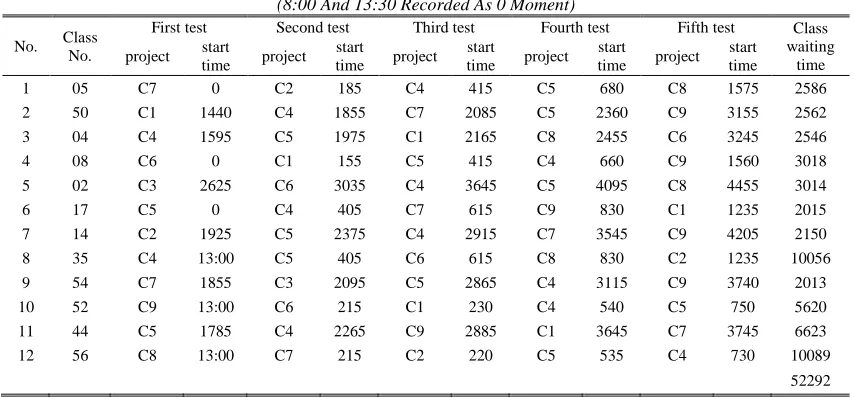
Table 9: The Second Day Afternoon 13:30-16:45 Class Testing Time Schedule (8:00 And 13:30 Recorded As 0 Moment)
No. Class No.
First test Second test Third test Fourth test Fifth test Class waiting
time project start
time project start
time project start
time project start
time project start time
1 05 C7 0 C2 185 C4 415 C5 680 C8 1575 2586 2 50 C1 1440 C4 1855 C7 2085 C5 2360 C9 3155 2562 3 04 C4 1595 C5 1975 C1 2165 C8 2455 C6 3245 2546 4 08 C6 0 C1 155 C5 415 C4 660 C9 1560 3018 5 02 C3 2625 C6 3035 C4 3645 C5 4095 C8 4455 3014 6 17 C5 0 C4 405 C7 615 C9 830 C1 1235 2015 7 14 C2 1925 C5 2375 C4 2915 C7 3545 C9 4205 2150 8 35 C4 13:00 C5 405 C6 615 C8 830 C2 1235 10056 9 54 C7 1855 C3 2095 C5 2865 C4 3115 C9 3740 2013 10 52 C9 13:00 C6 215 C1 230 C4 540 C5 750 5620 11 44 C5 1785 C4 2265 C9 2885 C1 3645 C7 3745 6623 12 56 C8 13:00 C7 215 C2 220 C5 535 C4 730 10089
52292
The total waiting time: Through the calculation get total waiting time: 159186s=44.2h.
5. CONCLUSION
The advantage of this model is that it grasps the relationship between the number of classes and total time, and obtains reasonable time section and class distribution by using the relationship. Another highlight of the model is using the greedy algorithm sort classes for the same time period in the second stage of the model. Moreover, it makes a better evaluation of the reasonableness of the different programs, strong adaptability and better integrated with the objective reality.
REFERENCES:
[1] Liang Kaifu, “Study on properties of knapsack
problem”, Mathematical theory and
applications, Vol. 20, No. 2, 2000, pp. 58-63.
[2] Sun Jinguang, “Design and analysis of
knapsack problem”, Journal of Liaoning
Technical University, Vol. 4, 2002, pp. 45-50.
[3] Christian H. S et al, “Arena Football das neue
Gesicht des American Football in Europa”, Sport-Orthopädie - Sport-Traumatologie - Sports Orthopedics and Traumatology, Vol.27, No.2, 2012, pp.80-85.
[4] Richard G. E, “The National Football League
and Concussion: Leading a Culture Change in
Contact Sports”, World Neurosurgery, Vol.74,
No.6, 2010, pp. 560-565.
[5] Hongju Shi, Xifeng Qu, “The principle and
application of reasonable defense in football
games”, Science & Technology Information,
Vol.21, 2009, pp.125-132.
[6] Binfeng Huang, “On the Defensive Statics in
Modern Soccer Competition”, Science &
Technology Information, Vol. 5, 2010, pp.598-599.
[7] Gang Yi, “Football Players' Overall Mixed
Defense Ability in Colleges of Heilongjiang
Area”, The Science Education Article Collects,
Vol.15, 2010, pp.151-152.
[8] Xiaolu Zhang, Gang Lu, “A Review of the
Studies on Modern Football’s Defensive Tactical System from Multidimensional
Perspectives”, Journal of Zhao tong Teacher’
s College, Vol.34, No.5, 2012, pp.49-52.
[9] Ziyong Ling, Zeyong Hu, “To See Modern
Football Defensive Pattern from the goals
Conceded of the 19th World Cup”, Sports
Science Research, Vol.15, No.6, 2011, pp.30-36.
[10]Jian Huang, Xuezhen Ge, Wei Li, “The
Application of Defensive Tactics in the
Football Match”, Journal of Gannan Medical