IMPLEMENTATION WITH MULTITHREADING PROCESS
USING EMBEDDED SYSTEM
1K R JAYACHITRA, 2Dr. L C SIDDANNA GOWD
1
Research Scholar, St.Peter’s University, Avadi, Chennai, India.
2
Professor, ECE, GRT Institute of Engineering and Technology, Tiruttani, India
Email: [email protected], [email protected]
ABSTRACT
In Embedded system based applications, the evolution of multicore architectures offers many performance enhancements like speed, concurrency, real-time implementation support etc. However, design issues like critical section handling, selecting optimal number of threads, racing condition avoidance, concurrent tasks handling etc. needs to be addressed. In this work, these issues are implemented for multicore architecture using openMP tool. Barrier region limitations are removed to exploit concurrency and demonstrated applications include are, (i) array filling multitasking (ii) sorting of number, and (iii) sorting of strings. In all the above examples, the performance of multicore is enhanced compared to single core.
Keyword: Multicore, Openmp, Racing, Multithreading, Embedded System.
1. INTRODUCTION
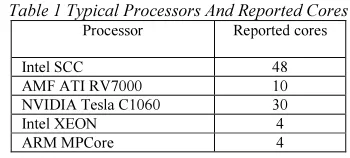
[image:1.595.100.275.436.515.2]Parallel programming models are required to exploit multicore architecture and eliminate performance handicapped languages [2,7]. Typical examples of multicore processor are listed in Table 1.
Table 1 Typical Processors And Reported Cores Processor Reported cores
Intel SCC 48
AMF ATI RV7000 10
NVIDIA Tesla C1060 30
Intel XEON 4
ARM MPCore 4
1.1 Power reduction in multiple cores
The power dissipation in single is related as
where F number of times /
second the circuit is oscillated [14,15]. In a multicore, the power dissipation is reduced [10] and
is given by . A processor with
two cores has the frequency of oscillation influenced as in Figure 1.
Fig. 1 Example Of Two Cores
For the dual core processor, the frequency of oscillation is only half of the total oscillation and hence, power loss is reduced [9]. The two important performance enhancement factor and parallelism (multiple tasks actually active at one time) and parallelism (multiple tasks actually active at one time) are handled effectively to avoid limiting issues like racing, redundant threads, barrier region etc. In this work, the OpenMP (an API for writing multithreaded application with a set of compiler directives and library routines) suited for parallel processing is used [3,4,5,6]. The architecture of OpenMP is given in Figure 2.
1.2 Multithread Implementation
Threads are light weight processes and share process state among multiple threads and reduce the cost of switch context [8]. Threads interact through reads/writes to a shared address space. The synchronization among threads requires a scheduler and shall determine when to run which threads [16]. The use of multithreads offer performance enhancement [11], but certain issues such as racing avoidance, critical section handling, barrier region, etc. needs to ensure yield correct results.
2. RACE CONDITION IN
MULTITHREADING
conflicts (or) change how data is accessed to minimize the excessive use of synchronization [1]. In this paper, fork-join parallelism model is used to transform a sequential algorithm into a parallel one. The code to create multithreads ‘N’is listed below: omp_set_num_threads [n]
#progma OMP parallel {
int ID=omp_ge, thread _num); }
The omp_set_num_threads and _get_thread_num are runtime function and used to request a certain number of threads [11,13] and returning a thread ID respectively. The first tread is int exe from ‘o’, and the last thread to N-1. Also, only N-1 threads are
created since the Nth Parallel section can be invoked
from the parent thread and a thread Pool exists to minimize cost of threads and a thread creation and
destruction is eliminates for each parallel region.
Barrier region refer to the waiting time due to some threads waiting for all the other threads to finish before proceeding.
3. IMPLEMENTATION OF THE WORK 3.1 Array Filling
In this case, an array is to be filled with elements both using single core single thread and multicore multithread [12,17].
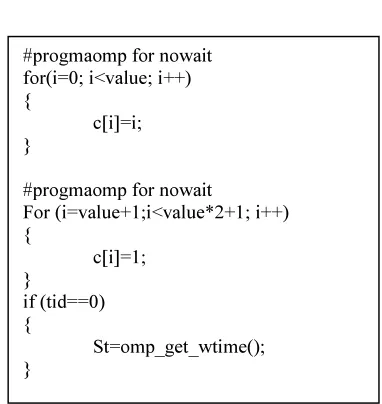
The implementation code is listed in Figure 2.
[image:2.595.315.506.137.339.2]Fig. 2 Progmaomp master (Fork-Join parallelism model) The threads are implemented as shown in Figure 3.
Fig. 3 Threads Implementation
[image:2.595.80.512.387.703.2]The meaning of different shared variable in this application is given in Table 2.
Table 2 Different Shared Variable Application NR_THREADS No. of multithreads
Value size of the array i.e. the No. of Multithreads
array to be handled by one thread tolarrsize represents the total array size C array of size “tolarrsize” Tid Thread identifier
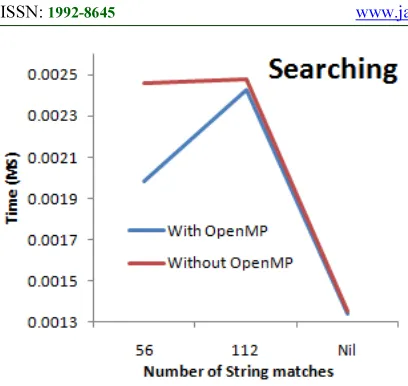
The results are given in Figure 4 and Figure 5.
Fig. 4 Array Filling #progmaomp for nowait for(i=0; i<value; i++) {
c[i]=i; }
#progmaomp for nowait
For (i=value+1;i<value*2+1; i++) {
c[i]=1; }
if (tid==0) {
St=omp_get_wtime(); }
#pragma omp parallel shared © private (I,tid)
Num_threads (NR_THREADS)
{
tid=omp_get_thread_num();
if (tid==0
{
nthreads=omp_get_num_threads();
printf(“Starting array filling with %d
hreads\n”,nthreads);
[image:2.595.295.504.407.683.2]Fig. 5 Searching of Numbers and String
3.2 Sorting of Numbers
In this application, numbers are to be sorted in either ascending or descending order using multithread implementation. For comparison, a non multithread implementation is also considered. The obtained results are shown in Figure xx.
3.2.1 Multithread Implementation of Sorting Numbers in Ascending Order
if (choice==1) {
ifp = fopen (readfile, "r"); st=omp_get_wtime();
#pragma omp shared(a,tsortno) private(i,count) {
if ((ifp) == NULL) {
printf("Error in logfile1.txt file \n"); }
fscanf (ifp,"%d", &i);
while (!feof (ifp)) {
a[count]=i; count=count+1;
//printf("count value is %d\n",count) ; //printf ("%d\n ", i);
fscanf (ifp,"%d", &i); }
fclose (ifp);
#pragma omp nowait {
ascend(a,tsortno); }
}
ed=omp_get_wtime();
printf("\nTotal time taken for to ascend by Core: %f\n",ed-st);
fprintf(logfile_1,"\nTotal time taken for to ascend by Core is :");
fprintf(logfile_1,"%f",ed-st); fprintf(logfile_1," for "); fprintf(logfile_1,"%ld",tsortno); fprintf(logfile_1," input "); }
3.2.2 Non-multithread Implementation of Sorting Numbers in Ascending Order if(choice==1)
{
ifp = fopen (readfile, "r"); st=omp_get_wtime(); {
if ((ifp) == NULL) {
printf("Error in logfile1.txt file \n"); }
fscanf (ifp, "%d", &i);
while (!feof (ifp)) {
a[count]=i; count=count+1;
fscanf (ifp, "%d", &i); }
fclose (ifp); {
ascend(a,tsortno); }
}
ed=omp_get_wtime();
printf("\nTotal time taken for to ascend by CPU: %f\n",ed-st);
fprintf(logfile_1,"\nTotal time taken for to ascend by Cpu is :");
fprintf(logfile_1,"%f",ed-st); fprintf(logfile_1," for "); fprintf(logfile_1,"%ld",tsortno); fprintf(logfile_1," input "); }
4.RESULTS AND DISCUSSION
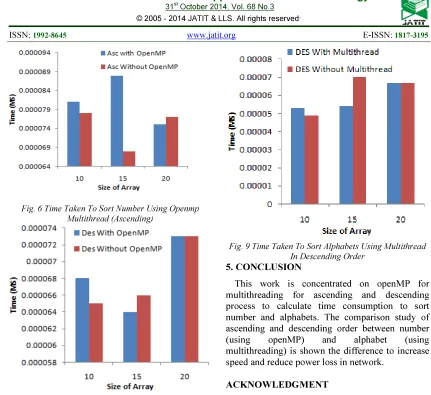
In this work, results described the consumed
times to sort numbers using OpenMP
Fig. 6 Time Taken To Sort Number Using Openmp Multithread (Ascending)
Fig. 7 Time Taken To Sort Number Using Openmp Multithread Descending)
[image:4.595.89.318.107.471.2]Figure 8 and Figure 9 described the consumed time to sort alphabets using multithread in ascending and descending order respectively.
Fig. 8 Time Taken To Sort Alphabets Using Multithread In Ascending Order
Fig. 9 Time Taken To Sort Alphabets Using Multithread In Descending Order
5. CONCLUSION
This work is concentrated on openMP for multithreading for ascending and descending process to calculate time consumption to sort number and alphabets. The comparison study of ascending and descending order between number
(using openMP) and alphabet (using
multithreading) is shown the difference to increase speed and reduce power loss in network.
ACKNOWLEDGMENT
I acknowledge the help and facility offered by
M/s MicroLogic Systems to carryout the
multithreading process and embedded system studies with hardware environment.
REFERENCES
[1] Ryo Mizutani and Kenji Ohmori, “A Design
and Implementation Method for Embedded Systems Using Communicating Sequential Processes with an Event-Driven and Multi-Thread Processor”, International Conference
on Cyberworlds, Darmstadt, Germany,
September 25 -September 27, Germany, 2012.
[2] Umar Hamid, Haroon Shahzad and
Muhammad Irfan, “Parallel Implementation of 1-D Complex FFT Using Multithreading and Multi-Core Systems”, International Journal of Computer and Communication Engineering, Vol. 2, No. 2, March 2013.
[3] Spiros N. Agathos, Vassilios V.
[image:4.595.87.301.540.714.2][4] V. V. Dimakopoulos, E. Leontiadis and G. Tzoumas, “A portable C compiler for OpenMP
V.2.0”, in Proceeding on EWOMP, 5th
European Workshop on OpenMP, Aachen, Germany, pp. 5–11, September 2003.
[5] M. Sato, Y. Nakajima, Y. Ojima and Y. Hotta,
“OpenMP Implementation and Performance on
Embedded Renesas M32R Chip
Multiprocessor”, in Proceeding of 6th European
Workshop on OpenMP (EWOMP’04), pp. 37– 42, 2004.
[6] W.C. Jeun and S. Ha, “Effective OpenMP
Implementation and Translation For
Multiprocessor System-On-Chip without Using
OS”, in Proceeding of ASP-DAC ’07, 12th Asia
and South Pacific Design Automation
Conference, IEEE Computer Society,
Yokohama, Japan, pp. 44–49, 2007.
[7] B. Chapman, L. Huang, E. Biscondi, E.
Stotzer, A. Shrivastava and A. Gatherer,
“Implementing OpenMP on a high
performance embedded multicore MPSoC,” in Proceeding of IPDPS ’09, IEEE International
Symposium on Parallel & Distributed
Processing, Rome, Italy, pp. 1–8, May 2009.
[8] Greg Hoover, Forrest Brewer, Timothy
Sherwood, “A Case Study of Multi-Threading in the Embedded Space”, CASES’06, Seoul, Korea, October 23–25, 2006.
[9] A. Snavely, L. Carter, J. Boisseau, A.
Majumdar, K. S. Gatlin, N. Mitchell, J. Feo, and B. Koblenz, “Multi-processor performance on the tera mta”, In ACM/IEEE Conference on Supercomputing (CDROM), pp. 1–8, 1998.
[10]Bernhard H.C. SPUTH, Oliver FAUST and
Alastair R. ALLEN, “Portable CSP Based Design for Embedded Multi-Core Systems”, Communicating Process Architectures, Peter Welch, Jon Kerridge, and Fred Barnes, IOS Press, 2006.
[11]Shah Bhatti, James Carlson, Hui Dai, Jing
Deng, Jeff Rose, Anmol Sheth, Brian Shucker, Charles Gruenwald, Adam Torgerson and Richard Han, “MANTIS OS: An Embedded Multithreaded Operating System for Wireless Micro Sensor Platforms”, Mobile Networks and Applications, Vol. 10, No. 4, pp. 563–579, 2005.
[12]R. Kumar, V. Zyuban and D.M. Tullsen,
“Interconnections in Multicore Architectures: Understanding Mechanisms, Overheads, and
Scaling”, Proceeding in International
Symposium, on Computer Architecture
(ISCA05), 2005.
[13]M. Lee, B. Whitney and N. Copty,
“Performance and Scalability of OpenMP
Programs on the Sun FireTM E25K
Throughput Computing Server”, WOMPAT, pp. 19-28, 2004.
[14]Y. Zhang, M. Burcea, V. Cheng, R. Ho and M.
Voss, “An Adaptive OpenMP Loop Scheduler fro Hyperthreded SMPs”, in Proceeding of International Conference on Parallel and
Distributed Systems (PDCS-2004), San
Francisco, CA, September 2004.
[15]Simon Schliecker, Mircea Negrean, Rolf Ernst,
“Reliable Performance Analysis of a Multicore
Multithreaded System-On-Chip”, in
Proceeding CODES+ISSS, ACM, 2008.
[16]P. Crowley and J.L. Baer, “Worst-Case
Execution Time Estimation for Hardware-assisted Multithreaded Processors”, in
Proceeding 2nd Workshop on Network
Processors, 2003.
[17]M.A. Kinsy, M. Pellauer and S. Devadas,
“Heracles: Fully Synthesizable Parameterized
MIPS-Based Multicore System”, in 21st
International Conference on Field