RESEARCH ON JOB-SHOP SCHEDULING PROBLEM BASED
ON IMPROVED PARTICLE SWARM OPTIMIZATION
1ZUFENG ZHONG
1 School of Business, ZhanJiang Normal University,Zhanjiang,524048,China
E-mail: [email protected]
ABSTRACT
Considering the standard particle swarm optimization (PSO) has the shortcomings of low convergence precision in job shop scheduling problems, the job shop scheduling solution is presented based on improved particle swarm optimization (A-PSO). In this paper, the basic theory of A-PSO is described. Also, the coding and the selection of parameters as well as the decoding of A-PSO are studied. It uses the maximum flow time which is minimized to evaluate the performance of the algorithm, and applies it to solve a typical scheduling problem. A large number of simulation results show that this algorithm has good feasibility and effectiveness in job-shop scheduling problem.
Keywords: Particle Swarm Optimization; Coding; Job-Shop Scheduling Problem; Intelligence
Optimization Algorithms
1. INTRODUCTION
Job-shop scheduling aims to meet some performance indices by optimizing the allocation of shared resources and the arrangement of productive jobs within a certain period. Job-shop scheduling problem as one of the typical production scheduling problem requires strong engineering background, and transforms with many real engineering problems. Effective job-shop scheduling technologies are very important in production because they can intervene or adjust production and operation, and improve efficiency by rationalizing resource allocation. Job-shop scheduling problem is also a NP-hard problem, so efficient algorithms are very important in its scheduling and optimization.
2. LITERATURE REVIEW
So far, many algorithms have been used in job-shop scheduling problem. Sarin and Potts used mathematical programming [1, 2], which seeks the most accurate solution by using an enumerative technique called branch and bound, based on branch rules, bound mechanism and upper bound production. Wang and Luh used Lagrangian relaxation algorithm [3, 4] which quantitatively evaluates the suboptimality of the solutions, but is restricted by low efficiency in solving dual problems. Chen et al. employed genetic algorithm [5] which finds the minimized makespan of flexible
job-shop scheduling problem, and simulates chromosomes by graph theory, where chromosome coding consists of the definition of route strategy and the procedures on machine. Hon et al. [6] held that special design was necessary for solving GA chromosome of flexible job-shop scheduling problem, and presented two standards to evaluate the performance of chromosome. Najid et al. [7] solved minimized makespan by integrating simulated annealing of nearby functions. Mohammad and Parviz [8] presented a two-step tabu search which targets at the sequence with minimized makespan and depends on the setting.
3. INTRODUCTION INTO JOB-SHOP
SCHEDULING PROBLEM
In practical shop, there is one flexible shop scheduling problem, which refers to the job-shop scheduling where machines can be selected [9, 10]. In comparison with traditional job-shop scheduling problem, it is superior in breaking the uniqueness of resources, and allowing selecting several machines to complete each procedure. Therefore, flexible job-shop scheduling is more suitable for real working environment and has theoretical and practical meanings.
processed on several machines, and each machine takes specific processing time. Flexible job-shop scheduling problem reduces the constraint of machinery, extends the search coverage of feasible solutions, and increases complexity.
Flexible job-shop scheduling problem can be
described as: [11,12] with n independent jobs,
J
j(j=1,2,…,n) refers to the jth job; each job consists
of
n
j procedures,O
ij indicates the ith procedurefor job
J
j; M is a machine set composed of mmachines, where
M
k is the kth machine; eachprocedure
O
ij can be processed by a machine set,which can be expressed as
M
ij ;}
,...
2
,
1
{
m
M
ij∈
; the processing timet
ijk ofprocedure
O
ijon machine k is predetermined.Each job contains one or more procedures, which are predetermined; each procedure can be processed on several machines, and its processing time varies with the performance of machines.
Moreover, the processing should meet the following constraint conditions:
(1) Only one part can be processed on one machine at one moment;
(2) One job can only be processed on one machine at one moment, and an operation cannot be stopped midway.
(3) Procedure constraints exist within one job, but not among different jobs;
(4) Different jobs have the same priority.
Scheduling aims to determine the best machine for each procedure, find the best sequence and starting time for each job on one machine, and to optimize some performance indices.
4. STANDARD PSO
PSO was proposed in 1995 and its modeling and simulation were inspired by bird foraging. Gird foraging was used to replace the principle of selection in intelligent algorithms, and swarm cooperation was used to solve optimizing problems.
In PSO, a foraging bird swarm was considered as an optimization problem to be solved; each particle sought by PSO iteration was treated as a foraging individual, and the searched food was the solution.
Let each individual in an optimization problem be a point with two independent variables: position and speed. Supposing a swarm has m particles, where m is called swarm size and large m will reduce operating and searching speeds. The two independent variables of one particle change with the positions of itself and other particles. Let
T iD i
i
i
z
z
z
z
=
(
1,
2,...,
)
be the D-dimensionposition vector of the ith particle (i =1,2,…,m). According to the predetermined adaptive value function which is related to the problem to be solved, the current adaptive value of i can be
calculated and evaluated.
T iD i
i
i
v
v
v
v
=
(
1,
2,...,
)
is the flying speed of particle i, which is the drift when the particle changes its position. Any particle is aware of itscurrent best position
p
i=
(
p
i1,
p
i2,...,
p
iD)
T, orBest
p
, as well as the best positionT gD g
g
g
p
p
p
p
=
(
1,
2,...,
)
, org
Best of thewhole swarm. In each iteration, a particle changes its position and speed by locking these two extremums and based on the following two updating formulae:
1 1
2 2
( 1) ( ) ( ( ))
( ( ))
id id aid id
bgd id
v k wv k c r p z k
c r p z k
+ = + −
+ − (1)
)
1
(
)
(
)
1
(
k
+
=
z
k
+
v
k
+
z
id id id (2)where i =1,2,…,m, d =1,2….D; k is the number of
iterations,
r
1andr
2 change randomly within [0, 1],so it maintains the diversity of the swarm;
c
1 and2
c
are called the accelerating factors, which allowthe particle to learn from itself or other better particles, so it gets closer to a better position it or
the swarm has passed [13, 14].
z
id(
k
))
refers to thecurrent position of the searching particle;
))
1
(
k
+
z
id is the updated position after iteration;)
(
k
v
id is the current speed of the searchingparticle;
v
id(
k
+
1
)
is the updated speed afteriteration;
p
id andp
gd are the best speeds of theparticle
p
Bestand the swardg
Best, respectively; wis inertia weight, which balances the searching in small range or the whole range. w is calculated
as max min max max
*
k
w
w
k
w
and
w
min are the maximum and minimum weighting coefficients, respectively, k is the currentnumber of iterations,
k
max is the predeterminedupper limit of iterations.
5. IMPROVED PARTICLE SWARM
OPTIMIZATION AND SOLUTION FOR FLEXIBLE JOB-SHOP SCHEDULING
5.1 Improved PSO
In solving job-shop scheduling problem, though standard PSO has some effect, it still has defects of low convergence speed, and trapping into local extremum. In practice, a swarm clusters by some rules as flying around the "head bird" to the position where food is. Meanwhile, regarding the properties of a species-based evolutionary algorithm, when at low diversity, the swarm traps into local extremum, thus losing the ability to explore new regions. In premature or global convergence, particles in a swarm will "cluster", indicating that lack of diversity will lead to premature convergence. Therefore, it is important to increase operational efficiency by searching a strategy to increase diversity. Therefore, a new algorithm based on excellent particles clustering subgroup and k-means algorithm was proposed to construct optimum point. Experiments prove that this algorithm has higher optimizing ability than standard PSO. By introducing the dynamic nonlinear ω, the position updating formula is the same, but the speed updating formula is:
1 1 2 2
(
1)
( )
(
( ))
(
( ))
id id id id
bgd id
v
k
wv
k
c r p
z
k
c r
p
z
k
+ =
+
−
+
−
(3)where pbgd =(p1gd+p2gd...+pbgd) /b (4) is the
order of all the particles in the swarm, is the average position of the b particles before the optimum position.
5.2 Coding
Swarm algorithms were first used to optimize continuous functions. Job-shop scheduling problems are scattering, dynamic and multivariate. PSO coding has difficulty in job-shop sorting, and in finding a natural expression.
Based on the features of FJSP, a sequence-based coding pattern was designed to code the particles. By considering sorting and coding as the sequence of procedures, each particle presents a sorting plan. All procedures of the same job are assigned a job label, then each element in a particle corresponds to
the job label. The procedure of this job can be determined according to the order of the job label in this procedure. For instance, a particle (121322313) in a 3×3 machine scheduling problem, each job contains 3 procedures, so this job label reappears 3 times. Here the 1st gene indicates the 1st procedure of job 1, because it's the 1st time "1" appears. The 3rd gene indicates the 2nd procedure of job 1, and so on.
5.3 Steps for the solution of job-shop scheduling
Based on the ordered operation table of scheduling plans, the target is to minimize the maximum makespan of all machines, and the steps are:
1) After analysis of the problem and understanding the properties of the solution, predetermine the particle swarmsize N, the
maximum of iterations
T
max, the current number ofiterations t.
2) Initialize particle swarm by random function,
so the position
X
i and speedV
i are generatedrandomly.
3) Sort the components in the position vector. Code each particle with the method proposed in this study, and produce the ordered operation table by combining the constraint conditions of job processing.
4) Decode the ordered operation table, find a scheduling plan, calculate the adaptive value of each particle, and record the average of b particles
best b
G
.−
with the largest global optimal value, as
well as individual optimal value
P
best.5) Update the speed and position of the particles according to Eqs. (2-4).
6) Decide whether t is the maximum of iterations
max
T
, if not, t=t+1, return to Step 3, otherwise go toStep 7.
7) Output the process sequence of the particle
corresponding to global optimal value
G
b.best−
. This is the optimal sorting result.
6. SIMULATED RESULTS AND ANALYSIS
6.1 Test case and parameter setting
parameters of PSO are set as: The number of original population is 50, the maximum evolution number is 200, c1= c2= 2, the original inertia weight ws= 1, the terminal inertia weight we= 0.4; All experiments were conducted on a CPU of 3.0 GHz, memory of 2G, hard disk of 80G, Windows XP, and VC++.
6.2 Comparison of calculation results with other algorithms
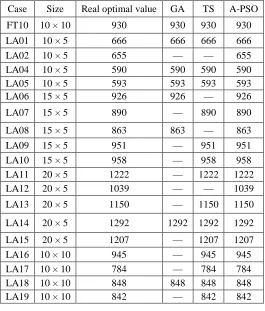
[image:4.612.174.439.248.559.2]To validate its validity and superiority, genetic algorithm (GA) and taboo search (TS) were used for comparative experiments. The results are listed in Table 1. From the 20 FJSP standard testing data of the three algorithms (Table 1), the number of optimal solutions is 20 for this algorithm, is 16 for TS, and only 8 for GA. This indicates that the algorithm in this paper increases searching speed and avoids local optimal solution.
Table 1. Comparison Of Calculation Results Between Different Algorithms
Case Size Real optimal value GA TS A-PSO
FT10 10 × 10 930 930 930 930
LA01 10 × 5 666 666 666 666
LA02 10 × 5 655 — — 655
LA04 10 × 5 590 590 590 590
LA05 10 × 5 593 593 593 593
LA06 15 × 5 926 926 — 926
LA07 15 × 5 890 — 890 890
LA08 15 × 5 863 863 — 863
LA09 15 × 5 951 — 951 951
LA10 15 × 5 958 — 958 958
LA11 20 × 5 1222 — 1222 1222
LA12 20 × 5 1039 — — 1039
LA13 20 × 5 1150 — 1150 1150
LA14 20 × 5 1292 1292 1292 1292
LA15 20 × 5 1207 — 1207 1207
LA16 10 × 10 945 — 945 945
LA17 10 × 10 784 — 784 784
LA18 10 × 10 848 848 848 848
LA19 10 × 10 842 — 842 842
7. CONCLUSIONS
Job-shop scheduling problem is a hot issue in manufacturing system and combinatorial optimization, and needs to be immediately solved in practice. Targeting at the difficulties in the current job-shop scheduling problem, a solution plan based on A-PSO was proposed. It solves the sorting of complex job-shop working by using the advantages of PSO, and its searching efficiency is higher than other algorithms. Simulation cases apply PSO into the solution of typical FJSP, and the scheduling results indicate that it has better scheduling results and higher validity.
REFERENCES
[1] Sarin S C, Ahn S. An improved branching scheme for the branch and bound procedure of Scheduling n jobs on m machine to minimize total weighted flow time. Internal Production Res,1988,26:1183-1191
[2] Potts C N. A branch and bound algorithm for the total weighted tardiness Problem. Operation Research, 1985, 33: 363-377
[4] Luh P B, Hoitomt D J. Scheduling of manufacturing systems using the lagrangian relaxation technique. IEEE Transactions on Automatic Control, 1993, 38(7): 1066-1080 [5] Chen H., thlow J., Lehlnann C. May 1999.A
genetic algorithm for flexible job-shop scheduling [C]. Proceedings of the 1999 IEEE International Conference on Robotics & Automation.
[6] HON.B., Tay J.C.2004.GENACE:an efficient cultural algorithm solving the flexible job shop Problem [C]. Proceedings of Congress on Evolutionary Computation, 1759-1766.
[7] NajidN.M., Dauzere-peres5.,zaidat A. 2002. A modified simulated annealing method for flexible job shop scheduling Problem[C]. Proceedings of the IEEE International Conference on Systems Man and Cybemeties. NJ, USA, IEEE, PP. 89-94
[8] Mohammed S. M., Parviz F. May 2006. Flexble job shop scheduling with tabu search algorithms [J].International Journal of Advanced Manufacturing Technology,32(5-6):563-570. [9] G.K. Deb, R.B. Agrawal. Simulated Binary
Crossover for Continuous Search Space, Complex Systems. 1995: 115-148
[10] M. Gen, R. Cheng. Genetic Algorithms and Engineering Optimization. NY: John Wiley & Sons. 2000
[11]Brandimarte P. Routing and scheduling in a flexible job shop by tabu search. Annals of Operations Research,1993,22:158~183
[12] Gu Feng, Chen Pinghua, Lu Bingyuan, et al, Particle Swarm Optimization For Flexible Job Shop Scheduling, Systems Engineering, 2005, 23(9): 20-23 (in Chinese).
[13] Kennedy,J.,Eberhart,R.C.A Discrete Binary
Version of the Particle Swarm Algorithm.On
Systems,Man,andCybernetics .Piscataway.
IEEE Service Center.1997:4104~4109