LOGIC MODELLING AND MATHEMATICAL MODEL IN
DEVELOPING A TREE SPECIES SELECTION PROTOTYPE
1KAMARUDIN SHAFINAH, 2NORAIDAH SAHARI, 3MOHD HASAN SELAMAT, 4RUSLI
ABDULLAH, 5RIZA SULAIMAN, 6MOHAMMAD MOHD IKRAM
1,2Center of Artificial Intelligence Technology, Faculty of Information Science and Technology, Universiti
Kebangsaan Malaysia (UKM), 43600 Bangi, Selangor, Malaysia. 1
Faculty of Agriculture and Food Sciences, Universiti Putra Malaysia Bintulu Sarawak Campus (UPMKB), Nyabau Road, P.O. Box 396, 97008 Bintulu, Sarawak, Malaysia.
3,4Faculty of Computer Science and Information Technology, Universiti Putra Malaysia (UPM), 43400
UPM Serdang, Selangor, Malaysia. 5
Institute of Visual Informatics, Universiti Kebangsaan Malaysia (UKM), 43600 Bangi, Selangor, Malaysia.
6Faculty of Science, Universiti Putra Malaysia (UPM), 43400 UPM Serdang, Selangor, Malaysia.
E-mail: [email protected] , [email protected] , [email protected] , 4
[email protected] , [email protected] , [email protected]
ABSTRACT
Logic modeling and mathematical model can aid system analysts, system developers and programmers to construct a system during a system development process. Logic modeling and mathematical model are the techniques used in the system analysis phase. In the midst of the most common logic modeling, are decision tables and structured English. These techniques help the person in charge to develop a system through illustrations in order to give better understanding and for solving a problem specification. In this article, we briefly describe on decision tables, structured English and mathematical model. The article aims to explain the use of decision tables, structured English and mathematical model for the development of a tree species selection prototype for Malaysian forest plantation. The algorithms related to the analysis of the systems prototype were also presented in this article. Overall, the techniques are capable of supporting the data acquisition and presentation from the context of the given problem specification.
Keywords: Logic Modeling, Decision Tables, Structured English, Mathematical Model, Prototype, Tree
Species
1.
INTRODUCTIONThe system analysis phase is among the intricate phases involved in a system development process. In system analysis phase, system analysts, system developers and programmers of an organization are acquired to understand the requirements of a system such as the structuring of the system logic requirement. One of the techniques used to understand the structuring of system logic requirement is logic modeling. Logic modeling is able to describe logical linkages of program resources, activities, outputs, audiences and outcomes related to a specific problem or situation (McCawley, 2011). In addition, logic modeling is also known as a thought process program evaluator which presents a plausible and sensible model in presenting the logical flow for a system (EERE, 2008). This logic modeling is able to illustrate a certain condition that is aimed to solve a problem
specification (McCawley, 2011). Among the most well-known logic modeling used in the process of developing a system are decision tables and structured English. In the meantime, mathematical model can be applied to analyze the logic requirement of a system. The term ‘mathematical model’ describes any model based on a system of equations that summarizes observed data with a goal to predict an outcome of interest (Mishra et al., 2010). Further, a mathematical model is indispensable in many applications and successful in various extended applications (Neumaier, 2003
)
. Mathematical model has been applied in many fields like financial, medical science, physiology artificial intelligence, etc.structured English and mathematical model that were applied in the system analysis phase for the development of a tree species selection prototype. The algorithms showing the interpretation from the implemented decision tables, structured English and mathematical model in order to solve the problem specification of this prototype were also presented and elaborated.
2.
DECISION TABLES, STRUCTUREDENGLISH AND MATHEMATICAL
MODEL
2.1 Decision tables
Decision tables are a graphical-oriented presentation (Huysmans et al., 2011). To our knowledge, previous literatures related to decision tables began as early as the 1960’s (i.e. Cantrell et al., 1961; Kirk, 1965). Research works accomplished in the late 1970’s were much focused on the construction and conversion of decision tables into optimal computer programs or interchangeable form. The application of decision tables related to expert systems only began in the late 1980’s (Hewett & Leuchner, 2003).
Decision tables are a matrix representation of the logic of a decision; specifying the possible conditions for the decision and the resulting actions (Hoffer et al., 1996; Witlox et al., 2009; Huysmans et al., 2011). Basically, decision tables contain rows and columns and are divided into four separate quadrants (Figure 1(a)). The upper left quadrant contains the conditions and the upper right quadrant contains the condition alternatives. The lower left quadrant contains the actions to be taken and the lower right quadrant contains the action rules for executing the decision (Kendall & Kendall, 2005; Witlox et al., 2009; UWE, 2011). Figure 1(b) and Figure 1(c) depicts an example of decision tables with the dash symbol (-) presenting the irrelevant values, while the “X” symbol presents the correct conclusion to be made if the condition leading to that column is satisfied.
A detailed literature concerning decision tables were given in Pooch (1974), whom also listed the advantages of decision tables (Table 1). Decision tables have the ability to check for contradictions, inconsistencies, incompleteness and redundancy in a problem specification (Vanthienen & Wets, 1994; Hewett & Leuchner, 2003). On one hand decision tables are concise, comprehensive, rigorous, easy to use and understandable, and can be a mechanism for machine translation or in other terms for system analysts, system developers and programmers to
convert directly their action rules from decision table to executable codes that can be implemented in the system (Baker, 2004).
Table 1. The Advantages Of Decision Tables, Structured English And Mathematical Model.
Technique Advantages
Decision tables (Pooch, 1974)
• Clear enumeration of all operations performed.
• Clear identification of the sequence of operations.
• Easily learned.
• Effective means of communication between people in and out of the data processing field; i.e. not limited to computer applications. • Concise and compact form of
definition and description use in analysis, programming and documentation.
• Easy to construct, modify and read. • Can be used to document applications involving complex interactions of variables.
• When applied to computer systems, decision tables’ foster better use of subroutines, promote efficiency of computer runtime, and provide a complete data check for debugging. • Directly adapted (and possibly converted directly) to computer operations through symbolic logic and computer programs.
• Compared with narratives, decision tables are more concise and precise.
• Easier visualization of relationships and alternatives.
Structured English (Kendall & Kendall, 2010; Kress-Gazit et
al., 2007)
• Capable in clarifying the logic and relationships found in human languages.
• An effective communication tool, it can be taught to and understood by users in the organization.
• Can offer representation of temporal logic formulas (Kress-Gazit et al., 2007).
• Minimizes the problems that are introduced in the system due to ambiguities inherent in natural language (Kress-Gazit et al., 2007). Mathematical
models (Neumaier,
2003)
• Gives precision and direction for problem solution.
• Enable a thorough understanding of the system modeled.
• Prepared the way for better design or control of a system.
On the other hand, decision tables are confronted with the difficulties to handle real problems because the table grows exponentially to great number of attributes and may have up to millions of rows when solving a specific problem. Therefore, decision tables inevitably face issues of storing and managing information. Decision tables could lack in the providence of a concise and complete explanation of a decision (translated from reasoning mechanism) to decision makers (Fernández del Pozo et al., 2005).
(A) The Standard Format Used For Presenting A Decision Table (Kendall & Kendall, 2005)
Conditions Condition Alternatives
Actions Action Entries
(B) Single-Hit Table (Huysmans Et Al., 2011)
INCOME
AGE -
ACCEPT X
REJECT X X
(C) Multiple-Hit Table (Huysmans Et Al., 2011)
INCOME -
AGE -
ACCEPT X
[image:3.612.320.526.191.403.2]REJECT X X
Figure 1. Decision tables with its examples.
2.2 Structured English
Structured English is a modified form of the English language which is used to specify the logic of the information system process (Hoffer et al., 1996). Structured English is synonym with the propositional if-then rules. The condition part of a propositional rule encompasses a combination of conditions on the input variables. The condition part can contain conjunctions, disjunctions and negations (Huysmans et al., 2011). The structured English is an attempt to allow the use of natural language stripped of ambiguity as well as to express actions to be taken under particular conditions. Structured English can be accomplished by choosing a simple subset of natural language verbs and nouns, and defining constructs to express sequence, selection and iteration (Baker, 2004). Table 1 depicts some of the advantages of structured English.
There are various types of structured English which are commonly used including decision
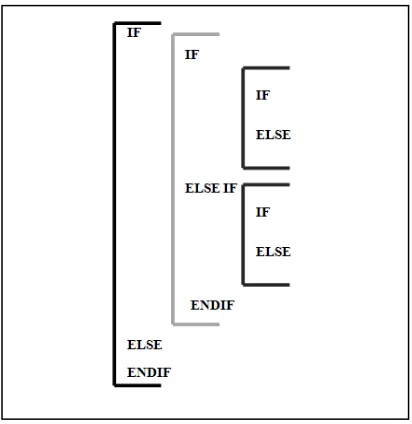
structure, sequential structure, case structure and iteration (Kendall & Kendall, 2005). Figure 2 shows an example of structured English with a nesting block. The structured English with a nesting block is the type of decision structure. This logic modeling is a viable alternative for decision analysis (Kendall & Kendall, 2005).
Figure 2. Structured English With Nesting Block (Kendall & Kendall, 2005)
From Figure 2, the statements of the decision structure type are as follows:
IF Condition A is True
THEN implement Action A
ELSE implement Action B
ENDIF
2.3 Mathematical Model
Mathematical model can either be presented as a physical mathematical concept or mathematical reality. Examples of physical mathematical concept are the reproductions of aircrafts (i.e. planes) and solid geometric figures of cardboards. Meanwhile, the mathematical model for reality is a representation of anything in the physical or biological ambient environment that can be described through mathematical expression like a computer simulation to calculate atmospheric patterns.
[image:3.612.91.306.247.444.2]specification during the system development process. Mathematical model is known as a process to create a mathematical representation of some phenomenon in order to gain a better understanding of the phenomenon. It is a process of attempts to match observation with symbolic statement (ASPIRE, 2006) and requires theorist to be accurate and definite (Mazur, 2006). Mathematical model is also competent to provide accurate predictions for an extensive amount of data. Table 1 shows the few advantages of mathematical model. Table 2 lists the steps that outline the general approach to the mathematical modeling process.
Table 2. General steps to the mathematical modeling
process (ASPIRE, 2006).
• Identify the problem, define the terms in the problem, and draw a diagram where appropriate. • Begin with a simple model, stating the
assumptions that focus on the particular aspects of the phenomenon.
• Identify important variables and constants, and determine the relationships between these variables and constants.
• Develop the equations that express the relationships between the variables and constants.
In pertinent to the ample advantages of logic modeling and mathematical model, it is with this light that a tree species selection prototype was developed through integrations of the several mentioned techniques. This was also done to complement the major flaws that might exist within a singular analysis technique.
3.
IMPLEMENTATION AND DISCUSSIONThe prototype was developed in 2007. The problem specification of the prototype is to select a predominant tree species between four chosen species namely Azadirachta excelsa, Acacia
mangium, Hevea brasiliensis and Tectona grandis
to be planted for Malaysian forest plantation. Selections for the most suitable tree species were made upon the consideration of nine environmental parameters which were topography, soil type, wind exposure, soil depth, sun exposure, soil moisture, soil pH, rainfall distribution (mm/year) and average temperature (°C) (Shafinah et al., 2007).
Decision tables were designed and implemented to compile the information collected for each of the selected tree species. The decision tables were also
used to produce the total possible combination for a tree species tolerance towards the nine aforementioned environmental parameters.
A mathematical model in accordance to decision tables was used to generate the suitability percentage for each of the tree species. Structured English was used to find and suggest the most suitable tree species to be planted to the user based on the highest suitability percentage attained. These were among the implementation process given in brief for the development of this prototype. Explanation on the incorporation process of decision tables, mathematical model and structured English were adapted as part of the methodology for this article.
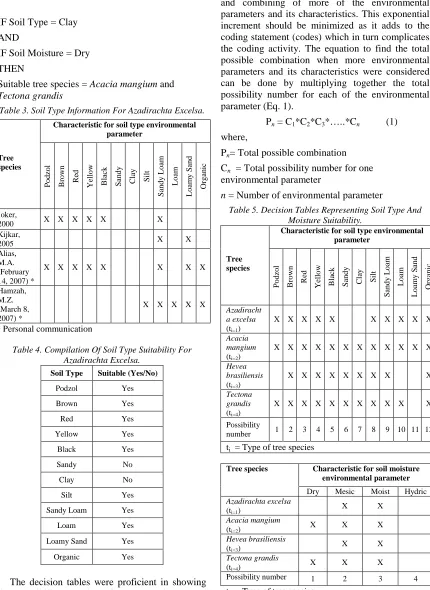
For the initial designing of decision tables, information related to the tree species and their tolerance against an environmental parameter was referred and collected from books, journals, internet sources and personal interviews. Operator Boolean OR was subsequently used to compile the information related to the selected tree species, where if any of the references denoted that a particular tree species is capable of tolerating with a certain characteristic of an environmental parameter, thus it would be delineated that the tree species was suitable in relation to that particular characteristic of that particular environmental parameter. Table 3 shows an example on the information collected regarding the suitable soil type for the tree species Azadirachta excelsa. It was shown from Table 3 that there were two references marked ‘X’ for Azadirachta excelsa, for podzol which is one of the characteristics for the soil type environmental parameter. This in consequence signified that Azadirachta excelsa is a tree species that could be capable of tolerating with the podzol soil type. The podzol soil type was then marked with the statement ‘Yes’ such as depicted in Table 4. This table is an example representing the compilation outcome on the soil type suitability for
Azadirachta excelsa using Boolean OR and in
conjunction to the references provided in Table 3.
capability of producing results by using decision tables alone:
IF Soil Type = Clay
AND
IF Soil Moisture = Dry
THEN
Suitable tree species = Acacia mangium and
[image:5.612.96.526.120.710.2]Tectona grandis
Table 3. Soil Type Information For Azadirachta Excelsa.
Tree species
Characteristic for soil type environmental parameter P o d zo l B ro w n R ed Y el lo w B la ck S an d y C la y S il t S an d y L o am L o am L o am y S an d O rg an ic Joker,
2000 X X X X X X
Kijkar,
2005 X X
Alias, M.A. (February 14, 2007) *
X X X X X X X X
Hamzah, M.Z. (March 8, 2007) *
X X X X X
* Personal communication
Table 4. Compilation Of Soil Type Suitability For Azadirachta Excelsa.
Soil Type Suitable (Yes/No)
Podzol Yes
Brown Yes
Red Yes
Yellow Yes
Black Yes
Sandy No
Clay No
Silt Yes
Sandy Loam Yes
Loam Yes
Loamy Sand Yes
Organic Yes
The decision tables were proficient in showing the possibility number for an environmental parameter and each of its various characteristics.
Furthermore, it is noted here that the total possible combination will increase upon the consideration and combining of more of the environmental parameters and its characteristics. This exponential increment should be minimized as it adds to the coding statement (codes) which in turn complicates the coding activity. The equation to find the total possible combination when more environmental parameters and its characteristics were considered can be done by multiplying together the total possibility number for each of the environmental parameter (Eq. 1).
Pn = C1*C2*C3*…..*Cn (1)
where,
Pn= Total possible combination
Cn = Total possibility number for one
environmental parameter
n = Number of environmental parameter
Table 5. Decision Tables Representing Soil Type And Moisture Suitability.
Tree species
Characteristic for soil type environmental parameter P o d zo l B ro w n R ed Y el lo w B la ck S an d y C la y S il t S an d y L o am L o am L o am y S an d O rg an ic Azadiracht a excelsa (ti=1)
X X X X X X X X X X
Acacia mangium (ti=2)
X X X X X X X X X X X X
Hevea brasiliensis (ti=3)
X X X X X X X X X
Tectona grandis (ti=4)
X X X X X X X X X X X
Possibility
number 1 2 3 4 5 6 7 8 9 10 11 12
ti = Type of tree species
Tree species Characteristic for soil moisture environmental parameter
Dry Mesic Moist Hydric
Azadirachta excelsa (ti=1)
X X
Acacia mangium
(ti=2) X X X
Hevea brasiliensis
(ti=3) X X
Tectona grandis (ti=4)
X X X
Possibility number 1 2 3 4
For example, in Table 5, the total possible combination, Pn was calculated to be 48 possible
combinations. This calculation was achieved via the multiplying of the total possibility number of two environmental parameters (Eq. 1) which were soil type and soil moisture (Table 5) by the equation 12 x 4 = 48 possible combinations (Eq. 1) where, 12 is the total possibility number for soil type, C1 and 4 is the total possibility number for soil moisture, C2. The total possible combination, Pn for instance the 48 possible combinations
previously attained can be used as the rules argument or condition during the coding activity.
However, in the case of developing this tree species selection prototype, the use of Eq. 1 was exempted since it was mentioned earlier that a decrement in the total possible combination was important in order to reduce the coding statement during the coding activity. Moreover, the actual development of this prototype had procured more of the environmental parameters and its characteristics which consequently increased its total possible combination. For that reason, the uses of operator multiply [x] such as in Eq. 1 was instead substituted with operator add [+] and shown as the following (Eq. 2):
Pn = C1₊C2₊C3₊…..₊Cn (2)
where,
Pn = Total possible combination
Cn = Total possibility number for one
environmental parameter
n = Number of environmental parameter
Hence, the equation to find the total possible combination using operator add [+] with the example and consideration of two environmental parameters which were soil type and soil moisture (Table 5) was achieved by the equation 12 + 4, producing a calculated 16 possible combinations (Eq. 2) and thereby reducing the number of possible combination from 48 to just 16 possible combinations. This operator add [+] was used to find the total possible combination, Pn for the nine
environmental parameters in the development of this prototype. The total possible combination achieved was also used as the rules argument in the coding activity and later applied as part of a mathematical model (Eq. 3) to generate the suitability percentage for each of the tree species.
A mathematical model (Eq. 3) was used to generate the suitability percentage (Sti)for each of
the tree species. The mathematical model is shown as the following (Eq. 3):
100
*
/
V
St
1
i
n
n
n n
=
∑
=
(3)
where,
S = Total percentage of tree species
ti = Type of tree species i
Vn = Value for environmental parameter n
n = Number of environmental parameter
The total value for parameter n,
∑
=
n
n n
1
V
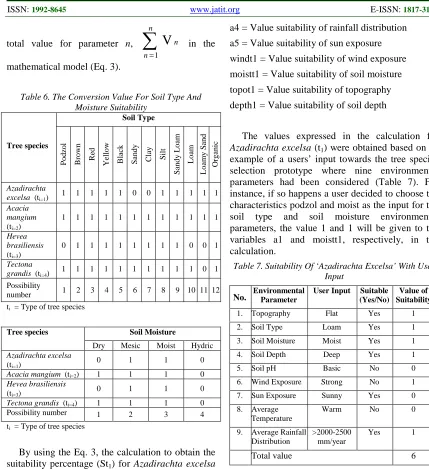
in themathematical model (Eq. 3) was obtained from the rules argument in addition to the information adopted from the decision tables of the nine environmental parameters. The decision tables were an essential function intended to serve as a simplified guide during the process of implementing the mathematical model (Eq. 3). On concerns of the requirement to use the rules argument (Eq. 2), the value 1 was given in the boxes of the decision tables to replace the symbols that were initially marked with the ‘X’ symbol. Whilst in contrast, the value 0 was given in the boxes of the decision tables that were initially unmarked with the ‘X’ symbol. The value 1 again signified that a tree species is capable of tolerating with a characteristic of an environmental parameter whereas the value 0 indicated vice versa. Table 6 shows an example of this conversion procedure for two environmental parameters which were soil type and soil moisture.
Variables were then created to hold the value for parameter n, Vn where this value was assigned as
the value of a tree species suitability towards an environmental parameter and its characteristics. For example, variables a1 and moistt1 were created to hold the value for parameter n, Vn towards the soil
total value for parameter n,
∑
= n n n 1V
in the [image:7.612.87.516.72.542.2]mathematical model (Eq. 3).
Table 6. The Conversion Value For Soil Type And Moisture Suitability Tree species Soil Type P o d zo l B ro w n R ed Y el lo w B la ck S an d y C la y S il t S an d y L o am L o am L o am y S an d O rg an ic Azadirachta
excelsa (ti=1) 1 1 1 1 1 0 0 1 1 1 1 1
Acacia mangium (ti=2)
1 1 1 1 1 1 1 1 1 1 1 1
Hevea brasiliensis (ti=3)
0 1 1 1 1 1 1 1 1 0 0 1
Tectona
grandis (ti=4) 1 1 1 1 1 1 1 1 1 1 0 1
Possibility
number 1 2 3 4 5 6 7 8 9 10 11 12
ti = Type of tree species
Tree species Soil Moisture
Dry Mesic Moist Hydric
Azadirachta excelsa (ti=1)
0 1 1 0
Acacia mangium (ti=2) 1 1 1 0
Hevea brasiliensis (ti=3)
0 1 1 0
Tectona grandis (ti=4) 1 1 1 0
Possibility number 1 2 3 4
ti = Type of tree species
By using the Eq. 3, the calculation to obtain the suitability percentage (St1) for Azadirachta excelsa (t1) is shown as the following:
St1 = (a1+a2+a3+a4+a5+windt1+moistt1+ topot1+ depth1)/9*100
St1 = (1+0+0+1+0+1+1+1+1)/9 *100
St1 = 66.67%
where,
S = Percentage of tree species suitability
t1 = Azadirachta excelsa
a1 = Value suitability of soil type
a2 = Value suitability of soil pH
a3 = Value suitability of average temperature
a4 = Value suitability of rainfall distribution
a5 = Value suitability of sun exposure
windt1 = Value suitability of wind exposure
moistt1 = Value suitability of soil moisture
topot1 = Value suitability of topography
depth1 = Value suitability of soil depth
The values expressed in the calculation for
Azadirachta excelsa (t1) were obtained based on an example of a users’ input towards the tree species selection prototype where nine environmental parameters had been considered (Table 7). For instance, if so happens a user decided to choose the characteristics podzol and moist as the input for the soil type and soil moisture environmental parameters, the value 1 and 1 will be given to the variables a1 and moistt1, respectively, in the calculation.
Table 7. Suitability Of ‘Azadirachta Excelsa’ With User Input
No. Environmental Parameter User Input (Yes/No) Suitable Suitability Value of
1. Topography Flat Yes 1
2. Soil Type Loam Yes 1
3. Soil Moisture Moist Yes 1
4. Soil Depth Deep Yes 1
5. Soil pH Basic No 0
6. Wind Exposure Strong No 1
7. Sun Exposure Sunny Yes 0
8. Average Temperature
Warm No 0
9. Average Rainfall Distribution
>2000-2500 mm/year
Yes 1
Total value 6
The value 1 was given to both the variables a1 and moistt1 because the tree species Azadirachta
excelsa (t1) was capable of tolerating with the podzol and moist characteristics of the soil type and soil moisture environmental parameters, respectively. This was exemplified from the information provided in Tables 6 and 7. The value 1 will also be given to the remaining variables (environmental parameters) if in circumstances
Azadirachta excelsa was found compatible with
When a user inserts their input into the prototype, the prototype commences an immediate response to search the value of parameter n, Vn for
each of the existing environmental parameters. The value of parameter n, Vn will be added together to
obtain the total number of parameter n,
∑
=
n
n n
1
v
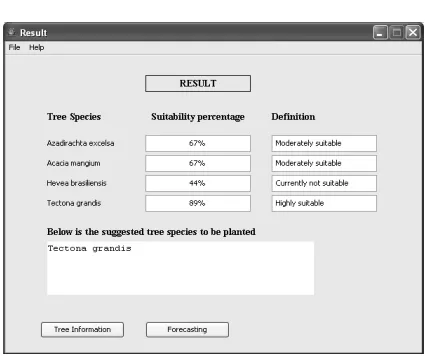
suchas shown in the demonstrated calculation of Eq. 3 for the tree species Azadirachta excelsa (t1). The eventual outcome for the calculation of Eq. 3 produces the suitability percentage of a tree species. The former demonstrated calculation of Eq. 3 showed that the suitability percentage for the tree species Azadirachta excelsa (St1) against the nine environmental parameters achieved a value of 66.67%. The suitability percentage attained is then rounded to be later shown to the user in the form of a non-decimal format (67%) through the interface of the prototype (Figure 4). This calculation process is simultaneously executed to find the suitability percentage for all the tree species (Sti) that were considered within the prototype.
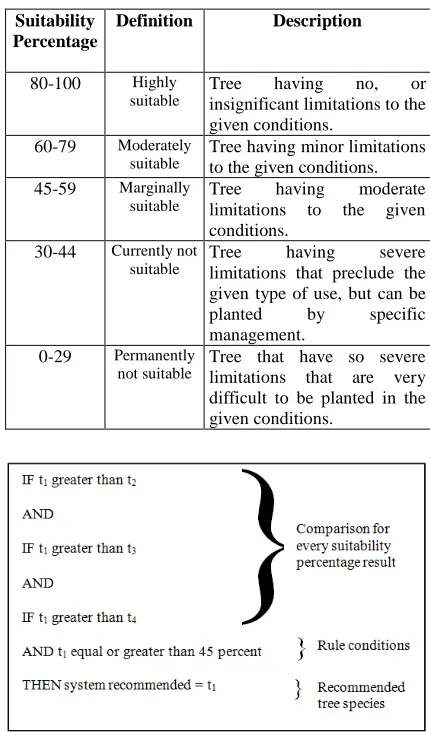
As soon as the suitability percentages for the entire tree species were acquired, each percentage value will be ranked according to Table 8 and using structured English. The definition depicted in Table 8 is distinguished apart based on the different suitability percentage ranges. The definition will appear as part of the result on the interface of the prototype (Figure 4). The definition also informs the user about the tree species suitability towards the nine environmental parameters where the algorithms were shown in Figure 8.
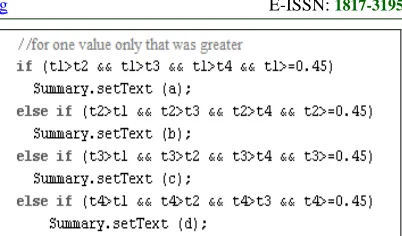
Structured English was later used to suggest the most suitable tree species to be planted to the user. The suggestion of the most suitable tree species must fulfill two conditions; (1) the tree species must have the highest suitability percentage, and (2) the suitability percentage of the tree species must be equal or more than 45%. Figure 3 shows an example on the use of structured English in the process to recommend the most suitable tree species via comparison and rules argument, where t1 = Azadirachta excelsa, t2 = Acacia mangium, t3 =
Hevea brasiliensis and t4 = Tectona grandis. In Figure 3, it was shown that the tree species
Azadirachta excelsa will be recommended to the
[image:8.612.314.529.114.480.2]user on the condition that its suitability percentage was greater than other tree species in addition to being equal or greater than 45%. This part is repeated for the remaining tree species and applied in the algorithms shown in Figure 9.
Table 8. Suitability Percentage Definition And Description
Suitability Percentage
Definition Description
80-100 Highly suitable
Tree having no, or insignificant limitations to the given conditions.
60-79 Moderately suitable
Tree having minor limitations to the given conditions. 45-59 Marginally
suitable
Tree having moderate limitations to the given conditions.
30-44 Currently not suitable
Tree having severe
limitations that preclude the given type of use, but can be planted by specific management.
0-29 Permanently not suitable
[image:8.612.314.531.118.480.2]Tree that have so severe limitations that are very difficult to be planted in the given conditions.
Figure 3. Examples Of Comparison And Rules Argument
Figure 4 shows an example of the interface of the result for the prototype given to a user’s input. The displayed result showed the suitability percentage for each of the tree species as,
Azadiractha excelsa = 67%, Acacia mangium =
67%, Hevea brasiliensis = 44% and Tectona
grandis = 89%. The tree species Tectona grandis
mathematical model in the development of this tree species selection prototype.
Figure 4. Example Of The Tree Species Selection Result Interface
4.
THE PROTOTYPE’S ALGORITHMSJava programming language and Oracle JDeveloper Studio version 10131 were used in the development of the tree species selection prototype to code the program.
Figure 5 shows the algorithms used to search the value of parameter n, Vn for each of the tree species
that were compatible to the characteristics of the soil type environmental parameter example. Variables were again used to hold the suitability values for the tree species where variables a1, b1, c1 and d1 were designated for Azadiractha excelsa,
Acacia mangium, Hevea brasiliensis and Tectona grandis, respectively. The algorithms in Figure 5
were coded according to the information interpreted from the decision tables such as shown in Table 6. This algorithm approach was then replicated for the other eight remaining environmental parameters.
Once a user input matches the tree species suitability towards a characteristic of an environmental parameter, the value 1 will be given to the variables of the tree species. The value 1 given will be used for the calculation process of the mathematical model (Eq. 3) to obtain the tree species suitability percentage.
Figure 5. Example Of Algorithms For Soil Types.
Figure 6 shows the algorithms used to calculate the suitability percentage, where variables t1, t2, t3 and t4 were created to hold the suitability percentage for each of the tree species. The algorithms in Figure 6 were coded according to the mathematical model of Eq. 3. The algorithms depicted in Figure 7 were used to display the result that shows the user the suitability percentage for each of the tree species on the interface of the prototype (Figure 4).
Meanwhile, the algorithms depicted in Figure 8 were used to show the user the definition for each of the tree species suitability percentage. The definition will also appear on the interface of the result for the prototype (Figure 4). Finally, structured English was used to compare and define the suitability percentage achieved by a tree species in contemplation to its planting recommendations to the users of the prototype (Figure 9).
[image:9.612.93.309.126.304.2]the prototype. The numeral 0.45 was used in the algorithms to represent the 45% because the value of t1, t2, t3 and t4 uses a format which requires the expression to be in decimal number.
Conclusively, the algorithms which were used in tandem with decision tables, structured English and mathematical models can substantially help system analysts, system developers and programmers to ameliorate a prototype. The development of this so called prototype is anticipated to be of practical reference for other similar future works.
Figure 6. Algorithms For Calculating The Average Of The Suitability Percentage
Figure 7. Algorithms To Display The Tree Species Suitability Percentage
[image:10.612.323.524.79.197.2]Figure 8. Algorithms To Show The Definition
Figure 9. Algorithms For Suggested One Tree Species
5.
CONCLUSIONThis article views in general the use of decision tables, structured English and mathematical models for the development of a tree species selection prototype. The three predominant techniques that were applied in the prototype helped to facilitate specific analysis and to effectively yield results in the form of suggestions to the user. The incorporation of mathematical model in conjunction with decision tables was proficient in reducing the total possible combination as compared to using decision tables alone. Structured English was particularly useful during the construction stages of the comparison and rules argument. Additionally, structured English was able to complement the limitations of decision tables, whereby giving a more precise and thorough explanation regarding a decision outcome to decision makers. Nonetheless, the mathematical model in this work did not put into assessment about the priority values of an environmental parameter needed during tree species planting. This was due to the lack of information attained for the prioritization of environmental parameters that are required for field planting. Future studies are intended and recommended to extend the use of this priority values within the mathematical model as to improve the accuracy of the suggestion results. This might be achieved by collecting information on the priorities according to forestry expert’s opinion. Finally, it is hoped that the explanation given concerning the implementation of logic modeling and mathematical model for the development of this tree species selection prototype will provide baseline knowledge for further enhancement and line benefit the forestry sector in other respects.
ACKNOWLEDGEMENTS
wishes to acknowledge sincere thanks and appreciation to all forest expertise for their involvement and cooperation during the interview sessions. Special gratitude also goes to Dato’ Prof. Dr. Nik Muhamad Nik Abdul Majid, Prof. Dr. Awang Noor Abd. Ghani, Dr. Romeo M. Lomoljo, Dr. Mohd Zafri Hassan and Mohd. Faisal Mohd Aris for rendering their technical support and assistance. The authors also thank the anonymous reviewers for their helpful comments.
REFRENCES:
[1] ASPIRE, ‟Mathematical Modeling”, 2006, retrieved 5 May 2007 from aspire.cs.uah.edu/aspire/modeling/modeling.ht ml.
[2] D.R. Baker, ‟A Decision Table Based Methodology for the Analysis of Complex Conditional Actions”, Methods and Tools, Vol. 12, No. 3, 2004, pp. 23-35.
[3] N.H. Cantrell, J. King, and F.G.H. King, ‟Logic structure tables”, Communications of the ACM, Vol. 4, No. 6, 1961, pp. 272-275.
[4] EERE, ‟Program Logic”, 2008, retrieved 4 January 2011 from www1.eere.energy.gov.
[5] J.A. Fernández del Pozo, C. Bielza, and M. Gómez, ‟A list-based compact representation for large decision tables management”,
European Journal of Operational Research,
Vol. 160, No. 3, 2005, pp. 638-662.
[6] R. Hewett, and J. Leuchner, ‟Restructuring decision tables for elucidation of knowledge”,
Data and Knowledge Engineering, Vol. 46, No.
3, 2003, pp. 271-290.
[7] J.A. Hoffer, J.F. George, and J.S. Valacich,
‟Modern System Analysis and Design”, (2nd ed.), 1996, United States of America, Wesley Longman Inc.
[8] J. Huysmans, K. Dejaeger, C. Mues, J. Vanthienen, and B. Baesens, ‟An empirical evaluation of the comprehensibility of decision table, tree and rule based predictive models”,
Decision Support Systems, Vol. 51, No. 1, 2011,
pp. 141-154.
[9] D. Joker, ‟Seed Leaflet: Azadirachta excelsa (Jack) M. Jacobs”, 2000, retrieved 8 March
2007 from
http://www.sl.kvl.dk/upload/azadirachta_excels a_int.pdf.
[10]K.E. Kendall, and J.E. Kendall, ‟International Edition: Systems Analysis and Design”, (6th ed.), 2005, New Jersey, Prentice Hall.
[11]K.E. Kendall, and J.E. Kendall, ‟Systems Analysis and Design”, (8th ed.), 2010, Upper Saddle River, New Jersey, Prentice Hall.
[12]S. Kijkar, ‟Azadirachta excelsa (Jack) Jacobs”, 2005, Thailand, Association of South-East Asian Nations (ASEAN) Forest Tree Seed Centre.
[13]G.W. Kirk, ‟Use of decision tables in computer programming.”, Communications of the ACM, Vol. 8, No. 1, 1965, pp. 41-43.
[14]H. Kress-Gazit, G.E. Fainekos, and G.J. Pappas,
‟From structured english to robot motion”,
Intelligent Robots and Systems, 2007. IROS 2007. IEEE/RSJ International Conference on.
Oct. 29 2007-Nov. 2 2007, 2007, pp. 2717-2722.
[15]J.E. Mazur, ‟Mathematical Models and the Experimental Analysis of Behavior”, Journal of
the Experimental Analysis of Behavior, Vol. 86,
No. 2, 2006, pp. 275–291.
[16]P.F. McCawley, ‟The Logic Model for Program Planning and Evaluation”, 2011, retrieved 4
January 2011 from
www.uiweb.uidaho.edu/extension/LogicModel. pdf.
[17]S. Mishra, D.N. Fisman, and M.-C. Boily, ‟The ABC of terms used in mathematical models of infectious diseases”, Journal of Epidemiology
and Community Health, Vol. 65, No. 1, 2010,
pp. 87-94.
[18]A. Neumaier, ‟Mathematical Modeling”, 2003, retrieved 12 December 2012 from
www.mat.univie.ac.at/~neum/ms/model.pdf. [19]U.W. Pooch, ‟Translation of Decision Tables”,
Computer Surveys, Vol. 6, No. 2, 1974, pp.
125-151.
[20]K. Shafinah, M.H. Selamat, R. Abdullah, A.M. Nik Muhamad, and A.G. Awang Noor,
‟Decision Support System (DSS) Model for Forest Management”, MySec’07 The 3rd
Malaysian Software Engineering Conference,
Kuala Lumpur. 3-4 December 2007, 2007, pp. 251-256.
[21]UWE, ‟Decision Tables”, 2011, retrieved 25
January 2011 from
[22]J. Vanthienen, and G. Wets, ‟From decision tables to expert system shells”, Data and
Knowledge Engineering, Vol. 13, No. 3, 1994,
pp. 265-282.
[23]F. Witlox, M.A.P. Bogaert, P.D. Maeyer, B. Derudder, and T. Nuetens, ‟Introducing functional classification theory to land use planning by means of decision tables”, Decision