STATISTICAL LINE BASED PALMPRINT RECOGNITION
USING ELLIPTICAL GABOR FILTERS
S.ASHA1, C.CHELLAPPAN2
1 Assistant Professor, VIT Unviersity, Chennai 2
Professor, DCSE, Anna University, Chennai
1[email protected], 2[email protected]
ABSTRACT
Most of the previous research using palmprint as a biometric trait for personal authentication has concentrated on enhancing accuracy. In this paper, to speed up the recognition process, we propose a novel method using the statistical line based approach to improve the efficiency of the Palm Code. Normally, palm codes from different palm images are similar. The structural similarities between palmprints will reduce the performance of the palmprint identification system. Hence, to avoid the correlation between the palm codes, two elliptical Gabor filters with different orientations are used to extract the phase information, and two elliptical Gabor filters are used for the Fusion Code and the Orientation Code. After the Fusion Code and the Orientation Code have been obtained, they are fused to obtain a single feature vector, Palmprint Phase Orientation Code. The similarity between two palm images is measured, using the normalized hamming distance. Using the Hong Kong PolyU palmprint database our experimental results show that the proposed method gives a promising result.
Keywords: Authentication, Palmprint Recognition, Gabor Filter, Palmcodes.
1. INTRODUCTION
Currently, a number of biometric based technologies are in use and hand-based person identification is one of these technologies mainly used. This technology provides a reliable, low cost and user-friendly solution for a range of access control applications (Kumar and Zhang 2003). Some features related to a human hand are relatively invariant and distinctive to an individual. Among these features, the palmprint modality has been systematically employed for human recognition, using the palm patterns. The rich texture information of a palmprint offers one of the powerful means in personal identification (Fang and Maylor 2004). In contrast to other modalities, like the face and iris, hand based biometric recognition offers some distinct advantages. Firstly, data acquisition is simple using off the shelf low-resolution cameras, and its processing is also relatively simple. Secondly, hand based access systems are highly suitable for several usages. Finally, hand features are more stable over time and are not susceptible to major changes (Sricharan and Reddy 2006).
Many features of a palmprint can be used to uniquely identify a person, including (a) Geometry
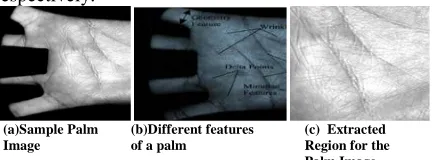
Features: According to the palm's shape, the corresponding geometrical features, such as the width, length and area can be easily obtained. (b) Principal Line Features: Both the location and form of the principal lines in a palmprint are very important physiological characteristics for identifying individuals, because they vary little over time. (c) Wrinkle Features: In a palmprint, there are many wrinkles, which are different from the principal lines in that they are thinner and more irregular. (d) Delta Point Features: The delta point is defined as the center of a delta-like region in the palmprint. Usually, there are delta points located in the finger-root region. (e) Minutiae Features: A palmprint is basically composed of ridges, allowing the minutiae features to be used as another significant measurement. Figures 1 a, b and c show the sample palm image, different features of a palm, and the extracted region of the palm image respectively.
(a)Sample Palm Image
(b)Different features of a palm
[image:1.612.318.534.638.718.2]There are two types of palmprint recognition research, the (i) high resolution and (ii) low resolution approach. The high resolution approach employs high resolution images, and is suitable for forensic applications, such as criminal detection, while the low resolution approach employs low resolution images, and is more suitable for civil and commercial applications such as access control. In general, high resolution refers to 400 dpi or more, and low resolution refers to 150 dpi or less. In high resolution images, researchers can extract ridges, singular points and minutia points as features while in low resolution images, they generally use principal lines, wrinkles and texture. At the beginning of the palmprint research, the high-resolution approach was the focus (Shu and Zhang 1998, Duta et al 2002), but almost all current research is focused on the low resolution approach, because of its potential applications. The Hong Kong Polytechnic University PolyUPalmprint Database is the most commonly used palmprint database; it is used in this research work, also.
2. EXISTING APPROACHES
Gabor filters, being widely used in fingerprint recognition algorithms (Hong et al 1998, Lee and Wang 1999, Jain et al 2000), are also used in palmprint recognition algorithms. David Zhang et al (2003) proposed an approach, utilizing the 2-D Gabor filter in order to extract features. They used the normalized Hamming distance to measure the similarity between palmprints. They achieved an EER of 0.6% in the verification tests.
Wu et al (2003) reported an identification rate of 99.55% in a database with 3,000 images from 300 different palms based on LDA (Wu et al 2003). Lu et al (2003) reported an identification rate of 99.15% in a database with 3056 images from 382 palms based on PCA. However, Jing et al (2004) reported identification rates of only 71.34% for PCA and 90.91% for LDA, from a database with 3040 images from 190 palms. It should be noted that Jing et al’s implementations are slightly different from Wu et al.’s and Lu et al.’s. However, the major performance differences are due to the difference in their evaluation schemes. Jing et al.’s database contains palmprints collected on two occasions, but Wu et al. and Lu et al. employ palmprints collected on the same occasion. In actual applications, input palmprints and templates in a database are always collected on different occasions. For reliable performance evaluation,
palmprint systems should be examined by palmprints collected from different occasions. Moreover, potential imposters would not provide their palmprints to train the systems in actual applications; so, palmprints for training systems and for evaluation should be collected from different palms.
Ajay Kumar and Helen C. Shen (2004) proposed an approach, in which the Gabor filter was used. The experimental results show that they reached an EER of 3.03 % when the total number of classes considered was 80; that is, the left and right palms of each individual are counted as two different classes. This result proves the uniqueness of the palmprint texture even between the two hands of the same individual.
Fang Li et al (2004) proposed an approach utilizing the Line Edge Map (LEM) of a palmprint as the feature, and the Hausdorff distance as the distance matching algorithm. In their study, the Line segment Hausdorff distance (LHD) and Curve segment Hausdorff distance (CHD) are explored to match two sets of lines and two sets of curves. They carried out an identification experiment on the Hong Kong Polytechnic University Palmprint Database. 200 palm images, i.e., 2 palm images for each person, were randomly selected in order to test the system performance. They reserved one palm image of each individual as a template, and used the remaining palm images as test images to be identified. A matching rate of 95% was achieved by the LEM method.
Xiang-Qian Wu et al (2005) presented an approach based on the valley features. The ROC curve of this approach has an EER of 2%. Han et al (2003) on the other hand, utilized the Sobel and morphological operations in order to enhance the lines on a palm. They then divided the palmprint into several sub-blocks and a feature vector was obtained from the mean of the pixel values in each sub-block. The ROC curve of this method has an EER of 14%.
and line segment generation steps, each line on a palm is represented using several straight line elements. Finally, the MLHD is used in order to measure the similarity between two palm images. They are able to yield 100% identification accuracy and 0% EER, using the public PolyUPalmprint palmprint Database.
Li Shang et al (2010) suggested the usage of the Radial Basis Probabilistic Neural Network (RBPNN). A fast fixed-point algorithm was used for the independent component analysis and the RPBNN was trained by the orthogonal least square algorithm (OLS), and its structure was optimized by the recursive OLS algorithm (ROLSA). The Hong Kong Polytechnic University Palmprint Database was used to test the developed palmprint recognition algorithm, and recognition rates between 95% and 98% were obtained.
A multilevel framework for personal authentication that efficiently combines 2D and 3D palmprint features, proposed by Zhang et al (2010), results in significant performance improvement over the case, when either 2D or 3D features alone are employed. Multiple templates per subject were proposed to facilitate fast and accurate palmprint identification, which shows that the speedup would increase with the number of templates per subject, and the number of subjects in the database by Feng Yue et al (2011).
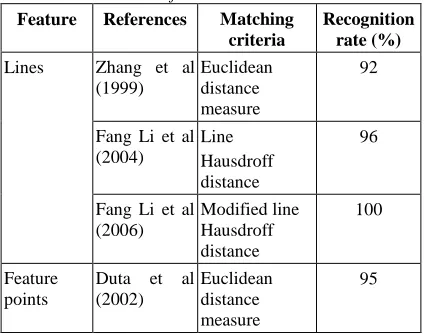
[image:3.612.311.525.70.218.2]Table 1 gives the comparison of different palmprint identification methods, and Table 2 gives the summary of the statistical approach adopted by different researchers. A summary of the subspace of approaches indicated in literature, is given in Table 3.
Table 1 Comparison Of Different Palmprint Identification Methods
Feature References Matching criteria
Recognition rate (%)
Lines Zhang et al (1999)
Euclidean distance measure
92
Fang Li et al (2004)
Line Hausdroff distance
96
Fang Li et al (2006) Modified line Hausdroff distance 100 Feature points
Duta et al (2002)
Euclidean distance measure
95
Texture You et al (2002) Energy difference and Hausdroff distance 91
Curves Fang Li et al (2007) Curve Hausdroff distance 92 Geometric features
[image:3.612.88.306.560.727.2]Li Shang et al (2010) Radial basis probabilistic neural network (RBPNN) 95
Table 2 Summary Of The Statistical Approach For Palmprint Recognition
Reference Feature extraction Statistical feature Shape of small regions Classifier Noh and Rhee (2003)
Hu and Otsu binarisation
Global statistics
Euclidean distance
Lu et al (2002), Kumar et al (2003) Direction mask Standard deviation
Square Cosine
similarity
Pang et al (2003)
Nil Global
statistics
Euclidean L1 norm
Han et al (2004)
Sobel filter, morphological operators
Mean Square and
rectangle Back propagation neural network Kumar et al (2004)
Gabor filter Mean and
standard deviation
Circular Cosine
similarity
Zhang and Zhang (2004)
Wavelet Global
statistics
Sum of individual percentage error
Dai et al (2004) M_band Wavelet Global statistics Euclidean distance
Poon et al (2004) Directional line detector, Gabor Haar wavelet Mean energy, number of line pixel Rectangle, segments in elliptical half ring L1 norm
Table 3 Summary Of The Subspace Of The
Approach For Palmprint Recognition
Reference Feature extraction
Subspace Classifier
Kumar and Zhang (2003)
Nil PCA, ICA Euclidean
Distance
Wu et al (2003)
Nil LDA Euclidean
Distance
Lu et al (2003)
Nil PCA Weighted
Euclidean Distance
Lu et al (2004)
Wavelet ICA Euclidean
Distance
Jing and Zhang (2004)
DCT Improved Fisher
face
Zuo et al (2005)
Nil Bi-directional
PCA
Assembled matrix distance metric
Li et al (2006)
Nil Kernel PCA Maximum a
posteriori classifier
Chang et al (2006)
Nil ICA Radial basis
Probabilistic neural network
Feng et al (2006)
Nil Kernel PCA +
Locality preserving projections
Euclidean Distance
Chu et al (2007)
Gabor Filter + Boosting Algorithm
LDA Cosine distance
Shang et al (2006)
Nil Winner take all
network based on ICA
Radial basis Probabilistic neural network
Ekimci et al (2007)
Wavelet, DCT, FFT
Kernel PCA Support vector
machine, Weighted Euclidean Distance Linear Euclidean Distance
Yang et al (2007), Deng et al (2008)
Nil Unsupervised
discriminant project
Euclidean cosine measure
In this paper, the statistical line based approach, using elliptical gabor filters for feature extraction, and a normalised hamming distance measure for matching palmprint, are used.
3. PROPOSED METHOD
Although fusion is an effective way to increase accuracy, it generally increases the computation cost and template sizes, and reduces user acceptance. In this research work, a statistical line based approach is proposed for improving the efficiency of the Palm Code. Normally, palm codes from different palm images are similar. The structural similarities between palmprints will reduce the performance of the palmprint identification system. Hence, to avoid the correlation between the palm codes, two elliptical Gabor filters with different orientations are used to extract the phase information, and two elliptical Gabor filters are used for the Fusion Code and the Orientation Code. After the Fusion Code and the Orientation Code have been obtained, they are fused to obtain a single feature vector, Palmprint Phase Orientation Code. The similarity between two palm images is measured, using the normalized hamming distance.
[image:4.612.318.522.247.404.2]A palmprint recognition system generally consists of four parts: palmprint scanner, preprocessing, feature extraction and matcher. The palmprint scanner is to collect palmprint images. Preprocessing is to setup a coordinate system to align the palmprint images, and to segment a part of the palmprint image for feature extraction. Feature extraction is to obtain effective features from the preprocessed palmprints. Finally, a matcher compares the two palmprint features. The block diagram of the proposed algorithm is presented in Figure 2.
Figure 2 Block Diagram Of The Proposed Palmprint Recognition Method
3.1 Preprocessing
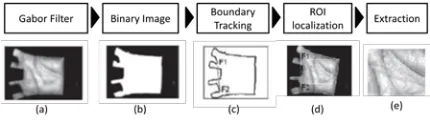
Preprocessing is used to align different palmprint images, and to segment the central parts for feature extraction. Most of the preprocessing algorithms employ the key points between fingers to set up a coordinate system. It generally involves five common steps, (a) binarizing the palm images, (b) extracting the contour of the hand and/or fingers, (c) detecting the key points, (d) establishing a coordination system and (e) extracting the central parts. Figure 3a to 3 e shows the various steps in a typical region of interest extraction algorithm.
Figure 3 Various Steps In A Typical Region Of Interest Extraction Algorithm. (A) The Filtered Image,
(B) The Binary Image, (C) The Boundaries Of The Binary Image And The Points For Locating The ROI
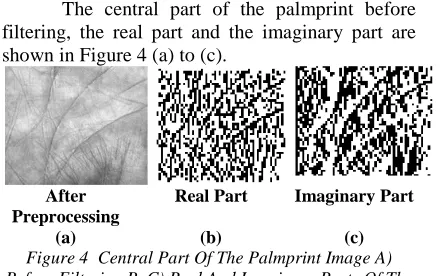
[image:4.612.316.531.604.667.2]The central part of the palmprint before filtering, the real part and the imaginary part are shown in Figure 4 (a) to (c).
After Preprocessing
Real Part Imaginary Part
(a) (b) (c)
Figure 4 Central Part Of The Palmprint Image A) Before Filtering B, C) Real And Imaginary Parts Of The
Feature Vectors After Filtering
The preprocessing block has been modified in order to adopt changes in the acquired palm images. Converting an 8-Bit RGB Image to Grayscale using Matlab is as follows:
I = 0.2989*rgb_img(:,:,1) + 0.5870*rgb_img(:,:,2) + 0.1140*rgb_img(:,:,3)
(1)
where I is the grayscale image and rgb_img(:,:,1), rgb_img(:,:,2) and rgb_img(:,:,3) represent the red, blue and green components of the RGB image, respectively.
The execution time for the preprocessing block is reduced to 50 milliseconds after simplifications, which results in significant decreases both in the total verification time and in the total identification time. The slight modification is that, the convolution result of the Gabor filter and the central palm area is divided into sub-blocks of 9x9 instead of 3x3, and the mean value of the corresponding 81 pixels is calculated, to be compared with the same threshold value of 0.2. This small difference in the feature extraction and the coding block has no effect on the accuracy of the algorithm, and merely aims to decrease the size of the templates to be stored in the database.
3.2 Feature Extraction and Matching
Feature extraction algorithms can be classified into five categories, (i) principal line-based, (ii) subspace line-based, (iii) local statistical-based,
(iv) global statistical-based and (v) coding-based approaches. However, some of them cannot be classified. Line-Based Approach Palm lines are obvious features in palmprints. The extracted palm lines are either matched directly or represented in
other formats for effective matching. Although at the beginning of the palmprint research, more researchers concentrated on the line-based approach. In this research work, the palmprint identification system is based on the principal lines. It uses the PolyU Palmprint Database for the experiment as it is renowned in the palmprint biometric area. The initial image is obtained by finding the central point of the palm, and then cropping a Region of Interest (ROI) of size 150×150.
After the initialization step, the feature extraction can be divided into five major steps (Zhang et al, 2003) as follows: Firstly, smoothing filter, a type of low-pass filter, is applied to smoothen the image to reduce high frequency noise. In the second step, two gradient operators are implemented for filtering the image to detect the edges. There are two versions of gradient operators: horizontal and vertical operators in window form, whose dimensions are 2x2, as shown in Figure 5. Such operators are used to enhance the edge, and the magnitude of these two gradients is defined as:
Gradient magnitude = ��𝐺𝑥2+ 𝐺𝑦2� (2)
where Gx and Gy are two image gradients in two directions, obtained by applying two gradient operators.
-2 -2 -2 2
2 2 -2 2
[image:5.612.89.309.95.233.2]Gx Gy
Figure 5 Masks Of Size 2×2 In The Horizontal And Vertical Directions
3.3 Proposed Matching Algorithm
The palmprint image preprocessing algorithm comprises the following procedure:
1. Use a threshold to convert the original grayscale image into a binary image, and then use a low-pass filter to smooth the binary image. 2. Trace the boundary of the gaps between fingers (H1 and H2).
3. Compute the common tangent of the boundaries of the gaps H1 and H2. T1 and T2 are the tangent points of H1 and H2, respectively. 4. Align T1 and T2 to determine the Y-axis of the palmprint coordination system, and make a line passing through the midpoint of the two points (T1 and T2), which is perpendicular to the Y-axis, to determine the origin of the system. 5. Extract the central part of the image to be used for feature extraction.
The proposed method uses magnitude to be a fusion condition, combining different PalmCodes generated by the four Gabor filters. This coding method is represented by a set of bits. Figure 6 illustrates the steps in palmcode generation.
(a) (b) (c)
Figure 6 Steps In Palmcode Generation (A) Original Images (B) Real Part Of The Palmcode (C)
Imaginary Part Of The Palmcode
3.4 Palmprint Matching
Identifying a palm from a large database in real-time is a major challenge in designing matching algorithms. Some have tried to exploit hierarchical and classification approaches (Zhang & Zhang 2004, Zhang et al. 2002.) to increase the matching speed, but have sacrificed accuracy. Biometric recognition systems generate matching scores, that represent the degree of similarity (or dissimilarity) between the input and the stored template. Cumulative Match Curves (CMC) is another method of showing the measured accuracy performance of a biometric system operating in the closed-set identification task. Templates are compared and ranked, based on their similarity. The CMC shows how often the individual’s template appears in the ranks based on the matching rate. The normalized hamming distance measure is used to find the matching of the palmcodes.
4. EXPERIMENTAL RESULTS
The performance measure of any biometric recognition system for a particular application can be explained by two values, FAR and FRR. The value of the FAR, is the ratio of the number of instances of different feature pairs of the traits found, that match the total number of counterpart attempts, and the value of the FRR, is the ratio of the number of instances of the same feature pairs of the traits found, that do not match the total number of counterpart attempts. However, decreasing any one involves increasing the other and vice versa. The system threshold value is obtained using the EER criteria, when FAR = FRR. This is based on the rationale that both rates must be as low as possible for the biometric system to work effectively. Another performance measurement is obtained from FAR and FRR, which is the Genuine Acceptance Rate (GAR). It represents the identification rate of the system. In order to visually describe the performance of a biometric system, Receiver Operating Characteristics (ROC) curves are usually drawn. An ROC curve shows how the FAR values are changed relatively to the values of the GAR and vice-versa (Jain & Ross, 2004).
The EER of the proposed algorithm obtained is 3.82%, which is better compared to that of the existing palmprint recognition algorithms in the literature, which ranges from 0.3% to 14%. Further, the identification accuracy obtained on the same database even with one template, 94.4%, is also comparable to that of the existing palmprint recognition algorithms, which ranges from 90% to 99%. In addition to speed and accuracy, the palm codes are compared with the palm-line feature texture method, and the performance is better in the case of the palm codes. Table 4 gives the comparison of the recognition accuracy of the proposed method with various methods. The size of the palmprints and the size of the database of the proposed method are similar to that of the existing methods.
Table 4 Comparison Of The Recognition Accuracy With Other Methods
Methods
Database size (palmprint)
Recognition accuracy (%)
Proposed method 3860 98.53
DCT 1600 98.93
Hierarchical method 3860 97.82
Fuzzy logic 3860 98.13
Considering the various thresholds for the five palmprint images and ten palmprint images, the FAR and FRR of the proposed method is shown in Table 5. It is observed from the Table 5 that the FAR increases and FRR decreases, with an increase in the threshold value, irrespective of the number of images taken.
Table 5. False Acceptance Rates (Fars) And False Rejection Rates (Frrs) Associated With Different
Threshold Values For The Proposed Palmprint Recognition Method
Threshold Registered palmprint image = 5
Registered palmprint image =
10
FAR(%) FRR(%) FAR(%) FRR(%)
0.30 2E-07 8.98 8E-07 6.78
0.32 3E-06 8.15 1.2E-05 5.12
0.34 0.0009 4.02 0.0016 2.18
0.36 0.011 1.94 0.017 0.86
0.38 0.096 1.05 0.15 0.43
0.40 0.68 0.59 1.03 0.19
For a sample size of 800, the FAR and FRR of the proposed method are shown in Table 6. It is observed from the Table 6, that the FAR increases and FRR decreases with an increase in the threshold value, irrespective of the number of images taken. Also it is observed from tables 5 and 6 that if the size of the template is small the performance is better. It may be due to the processing speed of the system. If the speed of the system is increased, then the accuracy of the proposed method may increase. The execution time of the proposed method is shown in Table 7.
Table 6 False Acceptance Rates (Fars) And False Rejection Rates (Frrs) Associated With The Dynamic
Threshold Values For The Proposed Palmprint Recognition Method
Threshold FAR in (%) FRR in (%)
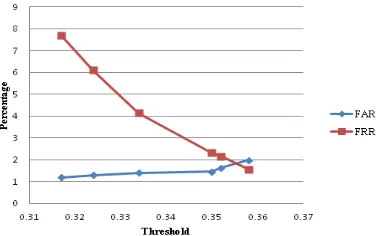
0.317 1.2 7.7
0.324 1.3 6.1
0.334 1.4 4.14
0.35 1.45 2.32
0.352 1.64 2.16
0.358 1.98 1.56
Table 7 Execution Time Of The Proposed Palmprint Recognition System
Operation Time in milli seconds
Preprocessing 2.6
Feature extraction and matching
1.7
Matching 0.7
[image:7.612.84.301.191.364.2]It is observed from Figure 7 that when the value of the threshold increases, the false acceptance rate increases, whereas the false rejection rate decreases. However, the motive of this thesis is to decrease the false rejection rate. Hence, a higher threshold value is considered for palmprint matching. Using the higher threshold value, the result of the proposed method is compared with the palm-line direction field texture method as shown in Figure8. With the increase in the number of samples, the recognition rate reduces observably in the existing method, whereas in the proposed method the reduction of the accuracy rate is slower than that of the existing method.
Figure 7 Palmprint Verification Results Using The Dynamic Threshold Values
[image:7.612.326.516.380.498.2] [image:7.612.89.531.553.691.2]4. EXPERIMENTAL DATABASE
The Hong Kong Polytechnic University Palmprint Database is the most commonly used palmprint database. Experiments were conducted, using the multi-spectral palmprint database from the Hong Kong polytechnic university (PolyU palmprint Database 2003). The database contains images captured with visible and infrared light. Multi-spectral palmprint images were collected from 250 volunteers, including 195 males and 55 females. The age distribution is from 20 to 60 years. It has a total of 6000 images obtained from about 500 different palms. These samples were collected in two separate sessions. In each session, the subject was asked to provide 6 images for each palm. Therefore, 24 images of each illumination from 2 palms were collected from each subject. The average time interval between the first and the second sessions was about 9 days.
5. CONLCUSION
It is observed that the elliptical Gabor filters perform better than the circular Gabor filters, for palm code generation. Also an optimum threshold for palmprint matching is obtained using the dynamic threshold. The total execution time is about 0.5 seconds, which is fast enough for real time applications. The matching time of the proposed algorithm is quite less compared to the preprocessing stage, which may be controlled with better preprocessing algorithms.
REFERENCES:
[1] Ajay Kumar, Helen, C. & Shen 2004, ‘Palmprint Identification using PalmCodes’, Proceedings of the Third International Conference on Image and Graphics.
[2] Chu, R, Lei, Z, Han, Y & Li, SZ 2007, ‘Learning Gabor magnitude features for palmprint recognition’, ACCV, pp. 22–31. [3] Dai, Q, Bi, N, Huang, D, Zhang, D & Li, F 2004, ‘M-band wavelets applications to palmprint recognition based on texture features’, Proceedings of the Conference on Image Processing, vol. 2, pp. 893–896. [4] David Zhang, Vivek Kanhangad, Nan Luo
& Ajay Kumar 2010, ‘Robust palmprint verification using 2D and 3D features’, Pattern Recognition, vol.43, no.1, pp. 358-368.
[5] David Zhang, Wai-Kin Kong, Jane You & Michael Wong 2003, ‘Online PalmprintIdentification’, IEEE Transactions on Pattern Analysis and
Machine Intelligence,vol. 25, no. 9, pp 1041-1050.
[6] Deng, W, Hu, J, Guo, J, Zhang, H & Zhang, C 2008, ‘Comment on Globally maximizing locally minimizing: unsupervised discriminant projection with applications to face and palm biometrics’, IEEE Transactions on Pattern Analysis and Machine Intelligence, vol. 30, no.8, pp 1503–1504.
[7] Duta, N, Jain, AK & Mardia, KV 2002, ‘Matching of palmprints’, Pattern Recognition Letters, vol. 23, no. 4, pp 477–485.
[8] Ekinci, M & Aykut, M 2007, ‘Palmprint recognition by applying wavelet subband representation and kernel PCA’, Lecture Notes in Artificial Intelligence, pp. 628– 642.
[9] Fang Li, Maylor, KH, Leung & Xiaozhou Yu 2006, ‘Palmprint matching using line
features’, proceedings of ICA0T2006, pp. 1577 – 1582.
[10]Fang Li, Maylor, KH, Leung, Larree & Sim, TG 2007, ‘ Palmprint matching using pairwise relative angle histogram’, Proceedings of the Sixth International Conference on Machine Learning and Cybernetics, Hong Kong, pp 151 – 155. [11]Fang Li, Maylor, KH Leung & Xaozhou
Yu 2004, ‘Palmprint identification using Hausdorff Distance’, proceedings of IEEE International Workshop on Biomedical Circuits & Systems, vol.3, pp. 5-8.
[12]Fan Yang & Baofeng Ma 2006, ‘A New Mixed-Mode Biometrics Information Fusion Based-on Fingerprint, Hand-geometry and Palm-print’, IEICE Transaction on Information and Systems, vol.89, no.1, pp 689 – 692.
[13]Feng Yue, Wangmeng Zuo, David Zhang
& Bin Li 2011, ‘Fast palmprint identification with multiple templates per subject’, Pattern Recognition Letters, vol. 32, no.8, pp. 1108-1118.
[15]Han, CC, Cheng, HL, Lin, CL & Fan, KC 2003, ‘Personal authentication using palm-print features’, Pattern Recognition, vol. 36, no. 2, pp 371–381.
[16]Jain, AK 2010, ‘Fundamentals of Digital Image Processing’, Prentice Hall of India. [17]Jain, AK, Flynn, P & Ross, A 2008,
‘Handbook of Biometrics’, Springer, New York.
[18]Jing, XY, Yao YF, Yang, JY, Li M & Zhang, D 2007, ‘Face and palmprint pixel level fusion and kernel DCVRBF classifier for small sample biometric recognition’, Pattern Recognition, vol. 40, no.3, pp.3209–3224.
[19]Wu, X, Zhang, D, Wang, K & Huang, B 2004, ‘Palmprint classification using principal lines’, Pattern Recognition, vol. 37, no.10, pp 1987–1998.
[20]Wu, X, Zhang, D & Wang, K 2003 ‘Fisher palms based palmprint recognition’, Pattern Recognition Letters, Vol. 24, No.15, pp 2829–2838.
[21]Xiang-Qian Wu, Kuan-Quan Wang & David Zhang 2005, ‘Palmprint Recognition Using Valley Features’, Proceedings of the Fourth International Conference on Machine Learning and Cybernetics, Guangzhou.
[22]Xiangqian Wu, Kuanquan Wang,
Fengmiao Zhang & David Zhang 2005, ‘Fusion of Phase and Orientation Information for Palmprint Authentication’.
[23]Yang, J, Zhang, D, Yang, JY & Niu, B 2007, ‘Globally maximizing locally minimizing: unsupervised discriminant projection with applications to face and palm biometrics’, IEEE Transactions on
Pattern Analysis and Machine
Intelligence, vol. 29, no. 4, pp 650–664. [24]You, J, Li, WX & Zhang, D 2002,
‘Hierarchical Palmprint Identification via Multiple Feature Extraction’, Pattern Recognition vol. 35, no. 4, pp 847-859.
[25]Zhang, L & Zhang, D 2004,
‘Characterization of palmprints by wavelet signatures via directional context modeling’, IEEE Transactions on Systems, Man and Cybernetics, Part B vol. 34, no. 3, pp 1335–1347.
[26]Zhang, D & Shu, W 1999, ‘Two Novel Characteristics in Palmprint Verification: Datum Point Invariance and Line Feature
Matching’, Pattern Recognition, vol 33, no. 4, pp 691-702.