(
In this report:
Mechanical
Characteristics ... 2
Interchange
Circuits ... 2
Standard Interfaces for Selected
Configurations ... 5
Summary of Electrical
Characteristics ... 6
DATAPRO
Data Networking 2740Standards
Electronic Industries
Association (EIA)
RS-232-C Interface
Standard
Synopsis
Editor's Note
The subject of this report is consid-ered as a mature standard. No signifi-cant developments are anticipated, but because of its importance in the industry, coverage is being continued.
Copies of the RS-232-C standard can be obtained from the Electronic In-dustries Association, Engineering Department, 2001 I Street NW, Washington, DC 20006. A compan-ion publicatcompan-ion, "Applicatcompan-ion Notes for EIA Standard RS-232-C," is also available.
-By Algis V. Salciunas Product Manager
Report Highlights
RS-232-C is a set of specifications that applies to the transfer of data between data terminal equipment (DTE) and data circuit-terminating equipment (DCE). It defines the in-terface circuit functions and their corresponding connector pin assign-ments. It is the most common DTE to DCE interface used in the United States. Full- or half-duplex opera-tions are supported for synchronous or asynchronous transmissions at speeds up to 20K bps.
1
~ 1991 McGraw-Hili, Incorporated. Reproduction Prohibited. Oatapro InformatIOn ServlOes Group. Delran NJ 08075 USA
2 2740 Standards
Analysis
The Electronic Industries Association (EIA) Stan-dard RS-232-C defines the electrical and mechani-cal characteristics of the interface for connecting data terminal equipment (DTE) and data circuit-terminating equipment (DCE) using serial binary data communications. In the United States, RS-232-C is the most widely used DTE to DCE inter-face. It applies to all classes of service: private line, dial-up, point-to-point, multipoint, switched, nons-witched, two-wire, and four-wire service. Asyn-chronous and synAsyn-chronous data transmission is supported at speeds up to 20K bps in full- or half-duplex mode. RS-232-C is a single-ended or unbal-anced interface; all of the interchange signals share a common electrical ground.
RS-232-C is functionally compatible with the International Telegraph and Telephone Consulta-tive Committee (CCITT) Recommendation V.24. Another similar interface, ISO IS211 0, has been adopted by the International Organization for Standardization (ISO). Both the EIA RS-232-C and the ISO IS2II 0 specify a 25-pin connector. Pin incompatibilities exist, however, because of the diagnostic features outlined in RS-232-C.
RS-232-C coexists with another EIA standard for DTE to DCE interface, RS-449, which specifies requirements for expanded transmission speeds, longer cable lengths, and additional functions. Equipment meeting RS-232-C standards can be made compatible with equipment meeting RS-449 standards by using an interface converter.
As the terms relate to this interface, data ter-minal equipment (DTE) is business machine hard-ware such as teleprinters, CR Ts, front-end ports, CPUs, etc.; data circuit-terminating equipment (DCE) is hardware such as modems, limited dis-tance data sets, or the data service units (DSUs).
Mechanical Characteristics
The physical connection between DTE and DCE is made through plug-in, 25-pin connectors. The con-nectors are keyed with 13 pins on the top row and
MAY 1991
Electronic Induatrl . . Aaaoclation (EIAI RS·I32-C Interface Standard
Data Networking
12 pins on the bottom row to prevent improper connection. The male connector is always ated with the DTE, and the female is always associ-ated with the DCE. The cable is provided by the DTE. The use of short cables, each less than 50 feet or 15 meters, is recommended. Use oflonger ca-bles is permissible, however, provided that load capacity requirements are met. Longer cables are used with the length restricted by the data rate (in synchronous applications, the clock leads generally run twice as fast as the data leads), and by the envi-ronment. Proximity to heavy rotating machinery or other noisy/radiating devices will limit the prac-tical cable length.
Pin assignments are explicit and unalterable, unless unassigned. Special functions not specifi-cally defined should be allotted to unassigned pins. For example, pin 25 (unassigned) is sometimes used to "busy out" a connected modem that is as-sociated with a switched application. This causes the modem to go "off hook," thus preventing an incoming call from being connected/answered. Be-cause some pins are unassigned, and beBe-cause all the functions defined by RS-232-C are not neces-sarily required for a specific application, all 25 pins are not usually used. Contact the DTE vendor to determine the specific configuration.
Interchange Circuits
An interchange circuit is defined as a circuit be-tween the data terminal equipment and the data circuit-terminating equipment. RS-232-C describes the four categories of interchange circuits that ap-ply generally to all systems. They are ground or common return, data, control, and timing circuits. Twenty-two circuits are specified by possible func-tions, and three are unassigned. See Table 1.
Ground Circuits
The ground interchange circuits are Protective Ground (AA) and Signal Ground (AB). Protective Ground is electrically bonded to the equipment frame; it can be connected to an external ground (e.g., the ground pin of an electrical power plug). Signal Ground establishes a common reference for all interchange circuits, except Protective Ground.
Data Circuits
Two types of data circuits are described. A primary
channel is a data transmission channel that has the
(
Data Networking Electronic Indu.trl •• A •• ociatlon lElA) RS-232-C Interface Standard
2740 Standards
3
Table 1. EIA RS·232·C Interface Connector Pin Assignments
Data Signal Control Signal Timing Signal
from from from CCITT
Pin Number Function Circuit DCE DTE DCE DTE DCE DTE Equivalent·
1 Protective ground AA 101
2 Transmitted data BA X 103
3 Received data BB X 104
4 Request to send CA X 105
5 Clear to send CB X 106
6 Data set ready CC X 107
7 Signal ground/common return AB 102
8 Received line signal detector CF X 109
9 Reserved for data set testing
10 Reserved for data set testing
11 Unassigned
12 Secondary received line signal detector SCF X 122
13 Secondary clear to send SCB X 121
14 Secondary transmitted data SBA X 118
15 Transmission signal element timing (DCE) DB X 114
16 Secondary received data SBB X 119
17 Receiver signal element timing (DCE) DO X 115
18 Unassigned
19 Secondary request to send SCA X 120
20 Data terminal ready CD X 108.2
21 Signal quality detector CG X 110
22 Ring indicator CE X 125
23 Data signal rate selector CH/CI X X 111/112
24 Transmit signal element timing (DTE) DA X 113
25 Secondary clear to send SCB X
DCE = Data Communication Equipment DTE = Data Terminal Equipment
Pin Number Assignments
2 3 4 5 6
14 15 16 17 18
Equivalents are outlined in CCITT Recommendation V.24.
highest signaling rate of all channels sharing a com-mon interface connector.
The secondary channel has a lower signaling rate than the primary channel in a system where two channels share a common interface connector. RS-232-C defines two types of secondary channels:
auxiliary, whose direction of transmission is
inde-pendent of the primary channel and is controlled by the appropriate set of secondary control inter-change circuits; and backward, whose direction of transmission must always be opposite that of the primary channel.
Secondary channels are established because in some communications systems, greater channel efficiency can be achieved by using a lower speed
@ 1991 McGraw-Hili. Incorporated. Reproduction Prohibited. Datapro Information Services Group. Delran NJ 08075 USA
19
7 8 9 10 11 12
20 21 22 23 24 25
subchannel to carry control responses. Signals usu-ally flow in opposite directions to one another: pri-mary in one direction at a higher speed, and secondary in the reverse direction at a lower speed.
RS-232-C accommodates primary and ondary arrangements with separately defined sec-ondary interchange circuits for Transmitted Data, Received Data, Request to Send, Clear to Send, and Received Line Signal Detector. Secondary cuits may be independent of other interchange cir-cuits in terms of direction and speed. The
secondary interchange circuits, however, are addi-tional circuits that function in the same manner as their basic counterparts and follow the same condi-tions that govern corresponding basic circuits (see Tables 1,2, and 3). For the DTE to transmit data on the secondary channel, an ON condition must
4 2740 Standards
be present on the following four circuits: SCA (Sec-ondary Request to Send); SCB (Sec(Sec-ondary Clear to Send); CC (Data Set Ready); and CD (Data Termi-nal Ready).
When the data circuits are idle, they are in a mark hold condition (binary "ones"). Data is transferred in bipolar fashion. A binary "one" (mark) is represented by a voltage more negative than -3 volts; a binary "zero" (space) is repre-sented by a voltage more positive than + 3 volts.
Control Circuits
Control signals are used to enable and disable data transmission and reception, and to indicate the operational status and condition of the DTE and DCE. A control function is considered to be in the ON condition when the voltage is more positive than + 3 volts; it is considered to be in the OFF condition when the voltage is more negative than
- 3 volts. These control circuits include Request to Send (RTS), Clear to Send (CTS), Data Set Ready (DSR), Data Terminal Ready (DTR), Received Line Signal Detector (carrier detect, CD), and Ring (RI). Assuming a half-duplex transmission between DTE/DCE-1 and DTE/DCE-2 is run over the pub-lic switched network, the control sequence might be as follows:
1. All control circuits OFF.
2. DTE/DCE-1 places a call to DTE/DCE-2; DCE-1 turns DSR ON to DTE-1, DTE-l turns DTR ON to DCE-I.
3. DCE-2 turns RI ON to DTE-2.
4. DTE-2 turns DTR ON to DCE-2.
5. DCE-2 goes "off hook" and turns DSR ON to DTE-2.
6. DTE-2 turns RTS ON to DCE-2.
7. DCE-2 turns CTS ON to DTE-2 (ENQ trans-mitted), DTE/DCE-2 turns OFF RTS and CTS.
8. DCE-l turns CD ON to DTE-I.
9. DTE-l decodes ENQ, turns ON RTS.
10. DCE-1 turns ON CTS; DTE-1 transmits re-sponse.
The four basic control signals relating to transmis-sion are:
1. Request to Send (RTS)-Circuit CA
MAY 1991
Electronic Industllea
Auocilltlon (EIA)
RS·232-C Inte~ Standard
Data Networking
• Conditions the local DCE for data transmis-sion.
• Controls the direction of transmission on half-duplex channels, maintains transmit, and inhib-its receive.
• Maintains the DCE in the transmit mode on duplex or one-way only channels; otherwise, holds it in nontransmit.
• RTS transition (OFF to ON) causes the DCE to enter transmit mode and turn CTS ON.
• RTS transition (ON to OFF) causes the DCE to complete the data transmission, enter the re-ceive or nontransmit mode, and turn CTS OFF.
2. Clear to Send (CTS)-Circuit CB
• Indicates to the DTE that data can be transmit-ted (CTS ON) or cannot be transmittransmit-ted (CTS OFF).
• CTS ON is delayed until the remote DCE is ini-tialized.
• When RTS is not implemented, CTS must be ON continuously.
3. Data Set Ready (DSR)-Circuit CC
• Indicates the local data set status.
• ON indicates that the data set is connected to the communications channel ("Off Hook" or switched service) and is not in test, talk (alter-native voice/data), or dial mode. The ON con-dition of this circuit should not be interpreted as either the status of any remote station equip-ment or an indication that a communication channel has been established to a remote data station.
• ON indicates completed timing functions, if any, required for call establishment (switched service).
• ON indicates completed transmission of a dis-creet answer tone, the duration of which is con-trolled by the local data set.
• OFF, occurring during transmission, indicates that the connection has been lost. A new trans-mission must be originated.
4. Data Terminal Ready (DTR)-Circuit CD
• Used to control switching ofthe DCE to the communications channel.
@ ,1991 McGraw-HUI, Incorporated. Reproduction Prohibited.
(
Data Networking Electronic Industries Associlition (EIAI RS·232·C Interface Standard
• The ON condition prepares the data set to con-nect and maintain concon-nection to the communi-cations channel.
• With automatic answering equipment, connec-tion to the communicaconnec-tions channel occurs when both the Data Terminal Ready and the Ring Indicator circuit are in the ON condition. The OFF condition of the Data Terminal Ready circuit does not disable the Ring Indicator sig-nal.
• In switched systems, Data Set Ready must be OFF before Data Terminal Ready is turned ON again.
Other control interchange circuits include the fol-lowing.
The Ring Indicator, Circuit CE, indicates that a ring (call) signal is being received on the commu-nications channel through the switched network. The circuit is in an ON condition during ringing and in an OFF condition between rings or when ringing is not present.
The Received Line Signal Detector, Circuit
CF, presents an ON condition to indicate that data signals are being received, and that they are accept-able for demodulation. An OFF condition indi-cates that data signals are not being received, or that they are not acceptable for demodulation. The OFF condition causes the Received Data (Circuit BB) to be held in a binary one (marking) condition.
The Signal Quality Detector, Circuit CG, indi-cates whether there is a high probability of error in received data. The ON condition is maintained, unless a high probability of error has occurred. Probable error is indicated by the OFF condition. This condition can be used to effect retransmis-sion.
Data Signal Rate Detector, Circuit CH or CI
.
'IS used to select between two signaling rates when
the data set or data terminal accommodates dual rates. The ON condition selects the higher rate or range of rates. Circuit CH indicates that the data terminal provides the selection signal. Circuit CI indicates that the data set provides the selection signal. Selection is between two asynchronous rates or between two synchronous rates.
Timing Circuits
Two circuits are used to provide Transmitter Sig-nal Element Timing.
@ 1991 McGraw·HIII, Incorporated. Reproduction Prohibited. Datapro Information Services Group. Delran NJ 08075 USA
2740
Standards
5
Circuit DA provides signal element timing information to the transmitting signal converter, the DCE. The ON-OFF transition indicates the occurrence of the center of the data element. The DTE normally provides timing information on this circuit when the DTE is powered ON. If Circuit CA (Request to Send) is OFF, timing information on Circuit DA may be withheld by the DTE for short periods.
Circuit DB provides signal element timing to the DTE. A data signal on Circuit BA (Transmitted Data) is provided from the DTE in which the tran-sition between signal elements occurs at the time of the OFF-ON transition in Circuit DB. If Circuit CC (Data Set Ready) is OFF, it is permissible for the DCE to withhold timing information for short periods. The performance of maintenance tests within the DCE, for example, may require the withholding of timing information.
Receiver Signal Element Timing, Circuit DD, provides timing to the data terminal from the data set. The ON-OFF transition indicates the center of the received data elements.
Standard Interfaces for Selected Configurations
EIA RS-232-C describes a selected set of data transmission configurations or interfaces. A provi-sion is made for the addition of custom configura-tions. Determining factors in the selection of an interface type are whether the DTE transmits, re-ceives, or does both; whether the mode of opera-tion is half or full duplex; and whether a secondary channel is used. The interface designations do not relate to which terminal originates or answers the call, but rather to the data transmitted.
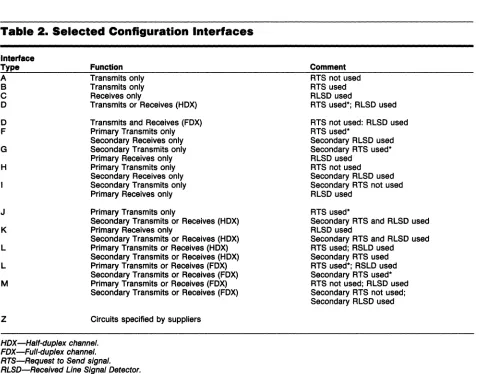
RS-232-C defines selected interface types by letter designation. These types are described in Ta-ble 2, where the direction of data transfer pertain-ing to the interface is stated (function), and the use of Request to Send and Received Line Signal De-tector interchange circuits is stipulated (comment). This list indicates that interfaces A and B, which are one-way only transmissions, differ only in terms of the use ofRTS. Interface D is normally employed with half-duplex operation using R TS, and interface E is normally employed with full-duplex operation without using RTS. When inter-face D is used in full-duplex operation, however, R TS is used with special significance.
8 2740
Standards
Electronic Induatrt . . _ _ elation lElA)
RS-232-C Interface Standard
[image:6.612.76.555.47.421.2]Data Networking
Table 2. Selected Configuration Interfaces
Interface
Type A B C
o
o
F
G
H
J
K
L
L
M
z
Function
Transmits only Transmits only Receives only
Transmits or Receives (HOX)
Transmits and Receives (FOX) Primary Transmits only Secondary Receives only Secondary Transmits only Primary Receives only Primary Transmits only Secondary Receives only Secondary Transmits only Primary Receives only
Primary Transmits only
Secondary Transmits or Receives (HOX) Primary Receives only
Secondary Transmits or Receives (HOX) Primary Transmits or Receives (HOX) Secondary Transmits or Receives (HOX) Primary Transmits or Receives (FOX) Secondary Transmits or Receives (FOX) Primary Transmits or Receives (FOX) Secondary Transmits or Receives (FOX)
Circuits specified by suppliers
HDX-Half-duplex channel. FDX-Full-duplex channel. RTS-Request to Send signal. RLSD-Received Line Signal Detector.
Comment
RTS not used RTS used RLSO used
RTS used·; RLSO used
RTS not used: RLSO used RTS used·
Secondary RLSO used Secondary RTS used· RLSO used
RTS not used Secondary RLSO used Secondary RTS not used RLSO used
RTS used·
Secondary RTS and RLSO used RLSO used
Secondary RTS and RLSO used RTS used; RSLO used
Secondary RTS used RTS used·; RSLO used Secondary RTS used· RTS not used; RLSO used Secondary RTS not used; Secondary RLSO used
"Indicates the Request to Send Circuit in a one-way (transmit) of duplex arrangement where RTS might not ordinarily be expected.
It might be used to Indicate a nontransmlt mode to the DCE or to permit the DCE to remove a line signal or to send
synchroniza-tion signals as required.
Interfaces E, F, G, and H define two-way transmission, where both the primary and second-ary directions are one-way only.
Interfaces J, K, L, and M define less restric-tive primary and secondary arrangements.
Interface Z simply allows a special arrange-ment to be established.
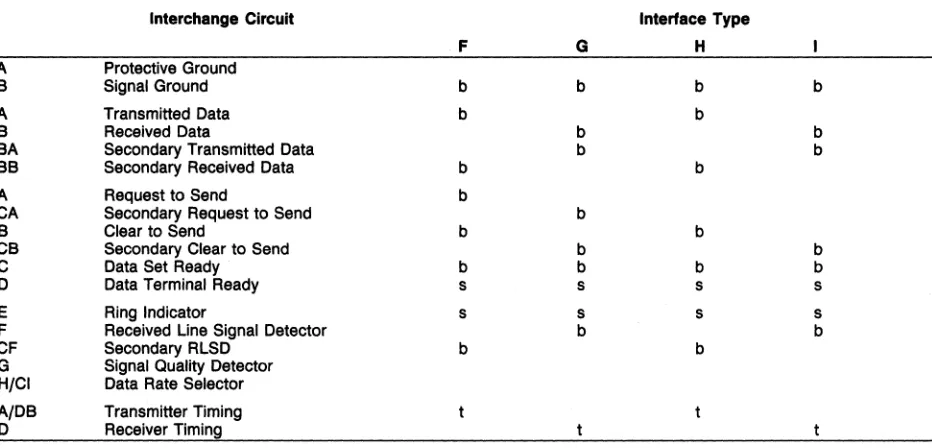
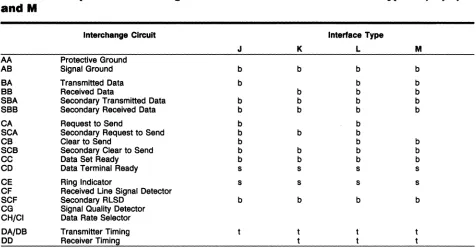
The complete relationship of interchange cir-cuits to standard interface types is depicted in Ta-bles 3a, 3b, and 3c.
Summary of Electrical Characteristics The EIA RS-232-C standard prescribes bipolar-voltage serial data transmission between communi-cating devices. Within the EIA RS-232-C standard, transmitted data is represented by the mark condi-tion for binary one and the space condicondi-tion for bi-nary zero. A data signal on an interchange circuit is
MAY 1991
in the mark condition when the voltage at the in-terface point is more negative than - 3 volts with respect to signal ground (Circuit AB). When the data signal at the interface point is more positive than + 3 volts, with respect to signal ground, the data signal is in the space condition. The area be-tween - 3 and + 3 volts is the transition region. In the transition region, the signal state is not defined.
On timing or control interchange circuits, the signal is considered OFF when the voltage at the interface point is more negative than - 3 volts with respect to signal ground. It is considered ON if the voltage at the interface point is more positive than + 3 volts with respect to signal ground. The func-tion is not defined for voltages in the transifunc-tion region between - 3 and + 3 volts.
Mandatory Interchange Circuit conditions follow (see Figure 1):
r
\
(
Data Networking Electronic Industrl . . Association lElA)
RS·232-C Interface-Standard
2740 Standards
[image:7.612.71.537.389.613.2]7
Table 3a. Required Interchange Circuits for Standard Interface Types A, B, C. D. and E
Interchange Circuit Interface Type
A B C D E
AA Protective Ground
AB Signal Ground b b b b b
BA Transmitted Data b b b b
BB Received Data b b b
CA Request to Send b b
CB Clear to Send b b b b
CC Data Set Ready b b b b b
CD Data Terminal Ready s s s s s
CE Ring Indicator s s s s s
CF Received Line Signal Detector b b b
CG Signal Quality Detector CH/CI Data Rate Selector
DA/DB Transmitter Timing DO Receiver Timing
b-Basic interchange circuits required. s-Requlred for switched network operation. t-Required for synchronous operation.
Table 3b. Required Interchange Circuits for Standard Interface Types F, G, H, and I
Interchange Circuit
AA Protective Ground AB Signal Ground
BA Transmitted Data BB Received Data
SBA Secondary Transmitted Data SBB Secondary Received Data
CA Request to Send
SCA Secondary Request to Send CB Clear to Send
SCB Secondary Clear to Send CC Data Set Ready
CD Data Terminal Ready
CE Ring Indicator
CF Received Line Signal Detector SCF Secondary RLSD
CG Signal Quality Detector CH/CI Data Rate Selector
DA/DB Transmitter Timing DO Receiver Timing
b-Basic interchange circuits required. s-Requlred for switched network operation. t-Required for synchronous operation.
• Open circuit driver voltage (YO), with respect to signal ground, must not exceed 25 volts with respect to ground.
• The potential at the interface point must not be less than 5 volts nor more than 15 volts in mag-nitude when the terminator resistance (RL) is
@ 1991 McGraw-Hili. Incorporated. Reproduction Prohibited. Datapro Information Servtces Group. Delran NJ 08075 USA
F b
b
b
b
b
b
s
s
b
G
b
b b
b
b b
s
s
b
Interface Type
H
b
b
b
b
b
s
s
b
b
b b
b b s s b
between 3000 and 7000 ohms, and the termina-tor open voltage (EL) is zero.
• The effective shunt capacitance (CL), associated with the terminator, must not exceed 2500 pico-farads at the interface point.
8 2740
Standards
Electronic Industries
AssocIation (EIA) RS·232-C Interface Standard
[image:8.612.79.555.76.326.2]Data Networking
Table 3c. Required Interchange Circuits for Standard Interface Types '"" K, L, andM
AA AB BA BB SBA SBB CA SeA CB SCB CC CD
CE CF SCF CG CHICI DA/DB DO
Interchange Circuit
Protective Ground Signal Ground
Transmitted Data Received Data
Secondary Transmitted Data Secondary Received Data
Request to Send
Secondary Request to Send Clear to Send
Secondary Clear to Send Data Set Ready
Data Terminal Ready
Ring Indicator
Received Line Signal Detector Secondary RLSD
Signal Quality Detector Data Rate Selector
Transmitter Timing Receiver Timing
b-Baslc Interchange circuits required. s-Requlred for switched network operation. t-Required for synchronous operation.
• The open circuit terminator voltage (EL) must not exceed 2 volts.
Request to Send (CA), Data Set Ready (CC), Data Terminal Ready (CD), and Secondary Request to
Figure 1.
Interchange Equivalent Circuit
T
o
V
e
MAY 1991
'b - Open circu~ driver Voltage. AO - Driver internal DC resistance.
Co - Total effective capackance associated with the driver. V1 - Voltage at interface point
C L - Total effective espaounce associated with the terminator. '\. - Terminator load DC resistance.
EL - Open circuk terminator voltage (bias).
'\. ~
m
j
n
a t o
J
b
b
b b
b b b b b s s b
Interface Type
K L M
b b b
b b
b b b
b b b
b b b
b
b b
b b
b b b
b b b
s s s
s s s
b b b
Send (SCA), where implemented, are used to de· tect the power-off condition or the disconnection of the interconnecting cable.
Certain limitations apply to all interchange signals (data, control, and timing):
• All interchange signals entering transition must proceed to the opposite signal state, and may not reenter the transition region until the next significant change in signal condition.
• The direction of voltage must not change while in the transition region.
• The time required for a control signal to pass through the transition region must not exceed one millisecond.
• The time required for a data or timing signal to pass through the transition region must not ex-ceed one millisecond or 4 percent of the normal duration of a signal element on that interchange circuit, whichever is the lesser.
• The maximum instantaneous rate of voltage must not exceed 30 volts per microsecond . •