Technology (IJRASET)
Multi-View Video System for Wireless Channel
Shaik Khaja Mastanvali1, M.Baby2
1
M.Tech Student, 2Assistant Professor, Bapatla Engineering College, Bapatla, Andhra Pradesh
Abstract: With the advent in display technology, the 3DTV will provide a new viewing experience without the need of wearing special glasses to watch the 3D scenes. One of the key elements in 3DTV is the multi-view video coding, obtained from a set of synchronized cameras; capture the same scene from different viewpoints. The video streams are synchronized and subsequently used to exploit the redundancy contained among video sources. A multi-view video consists of components for data acquisition, compression, transmission and display. This paper outlines the design and implementation of a multi -view video system for transmission over a wireless channel. Synchronized video sequences acquired from four separate cameras and coded with H.264/AVC. The video data is then transmitted over a simulated Rayleigh channel through Digital Video Broadcasting –Terrestrial (DVB-T) system with Orthogonal Frequency Division Multiplexing (OFDM).
Keywords: Multi-view video, multi-camera, H.264/AVC, prediction structure, wireless channel.
I. INTRODUCTION
The demand for multi-view video coding is driven by the development in new 3D display technologies and the growing use of multi-camera arrays. A variety of companies Are starting to produce 3D display technologies that do not require special glasses and can be viewed by multiple people simultaneously. This technology provides a good platform for new applications to emerge such as 3D scene communication even with 2D displays, multi-camera arrays are increasingly being used to capture a scene from many angles. The resulting multi-view data sets allow the viewer to observe a scene from any viewpoint and serve as another application of multi-view video compression. Multiple camera views of the same scene require a large amount of data to be stored or transmitted to the user. Furthermore for real-time multi-view video processing it demand extensive processing capabilities. Multi-view video data is also predicted to consume a large portion of the Band width available in the future Therefore, efficient compression techniques are essential. Independently using a state-of-the-art video codec such as H.264/AV However, this is inefficient as it does not exploit the correlation or inter-view statistical dependencies that exist in the multi-views. As the video data is taken from the same scene, the correlations of the multi-view scenes can be exploited for efficient compression. The correlations and redundancies can be categorized into two types, interview redundancy between adjacent camera views and temporal redundancy between temporal successive images of each video. These redundancies can be exploited, where images are not only predicted from temporal neighboring images but also from corresponding images in adjacent views, referred to as multi-view video coding (MVC). A multi-view video system for wireless applications will be presented. The system consists of components for data acquisition, compression, transmission and display. The main features of the system includes wireless video transmission system for up to four cameras, by which videos can be acquired, encoded and transmitted wirelessly to a receiving station. The video streams can be displayed on a single 3D or on multiple 2D displays. The encoding for the multi-view video through inter-view and temporal redundancies increased the compression rates. The H.264/AVC multi-view compression techniques has been exploited and tested during the implementation process. One of the highlight in this paper is the low cost implementation of a multi-view video system, which using only a typical web cameras attached to a single PC.
II. MULTI VIEW VIDEO COMPRESSION
Technology (IJRASET)
exists among frames. The redundancy in multi-view video streams consists of inter-view redundancy (between adjacent camera views) and temporal redundancy (between temporally successive frames of each video)These types of redundancy can be exploited to obtain a combined temporal/interview prediction. Other types of redundancy include transform redundancy and redundancy of human visual system Encoding and decoding separately each view of a multi-view video data separately can be done with any existing standard, such as with H.264/AVC, where each camera view of the sequence is coded independently, just like a normal video stream. This technique is referred to as simulcast coding this would be a simple, but inefficient way to compress multi-view video sequences, because inter-view statistical properties are not taken into consideration. In multi-view coding, correlations between adjacent cameras are exploited in addition to temporal correlations Within each sequence. The multi-view video coding adds another compression dimension on the top of single-view. Therefore, for this research, the multi -view video coding has been selected due to the fact that this technique provides a high Coding: the inter-view direction. Exploiting redundancies among the multi-view video images is the key to efficient compression compression rates compared to technique provides a high compression rates compared to the simulcast coding. The video data will be compressed with H.264/AVC algorithms before transmitted over the wireless channel. In the next section, the implementation and system architecture of multi-view video for wireless channel will be described.
III. SYSTEM ARCHITECTURE
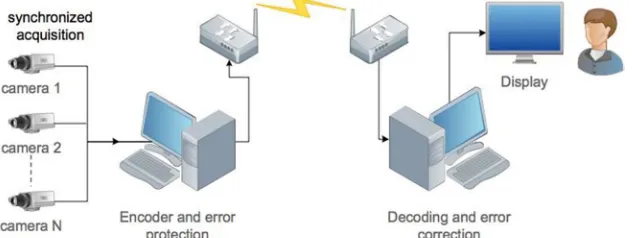
[image:3.612.169.485.429.548.2]The proposed multi-view video system mainly consists of four video cameras, one acquisition PC, multi-view codec with error protection and correction, transmission, reception and display. These components can be classified into four modules: acquisition, data encoding and decoding, error protection and correction, and lastly the display. The acquisition stage consists of an array of hardware synchronized cameras. All the cameras are connected to a single PC through the USB connection. The PC captured live and uncompressed video streams through Mat lab environment. The captured video streams can be played within the Mat lab player. The video streams encoded by using standard H.264/AVC. The compressed video streams can be broadcast on separate channels over a transmission on network. In this project, it was transmitted over the wireless channel. Error protection and correction was simulated through the DVB-T standard with Rayleigh channel. For initial implementation, each video streams will be encode/decode in the same PC and displayed at 2D display due to the limitation of the equipment.
Figure 1: General scheme of the proposed system
A. Test Sequences
Technology (IJRASET)
system is JM H.264/AVC software version 10, which is the reference Software for MVC. It uses prediction structure of hierarchical B pictures for each view in temporal direction The multi-frame referencing is the key property of theH.264/264/AVC standard that enables prediction of blocks of a P frame being coded using a previous I-frame of multiple previous coded P-frames. The fact that there are high correlations among different views of a multi-view sequence led the development of a H.264/AVC based on multi-view video coding technique with 5 modes of operation by MMRG H.264 Multi-view Extension Codec developed by the team of Multimedia Research Group at METU.
B. Compression, Transmission and Display
[image:4.612.180.469.338.496.2]The system developed not in a real time implementation. Therefore, the whole process from acquisition to display could be divided into several steps; each of it could be implemented in a software module written in Mat lab. The steps identified within the process were acquisition of two to four synchronized video streams, encoding of the video streams using multi-view with the H.264/AVC format, error Protection applied to the single video stream as defined in DVB-T standard, transmission (with the simulation of the effect of a Rayleigh channel on the error protected data stream), error correction in the received data stream, decoding of video stream received and display the video streams. The whole system can be simplified as shown in Figure which consist all the modules. The system divided into several modules for some practical reasons. Such modules match naturally the functions provided by real devices used in a real implementation of the system. The division of a major problem into a set of smaller problems reduces design and implementation complexity of the original problem. By defining self-contained modules, it helped the debugging process and allows reusability. In addition, it also simplifies code maintenance and modification.
Figure 2: Block diagram of system design
IV. MULTI VIEW MODES OF OPERATION
Technology (IJRASET)
Figure 3: Multi-view video coding prediction structure
Multi-view video coding prediction structure The multi-frame referencing is the key property of the H.264/AVC standard that enables prediction of blocks of a P frame being coded using a previous I frame of multiple previous coded P-frames There are high correlations among different views of a multi-view sequence led the development of a H.264/AVC based on multi-view video coding technique with 5 modes of operation by MMRG H.264 Multi-view Extension Codec.
A. Five Different Mode of Operation
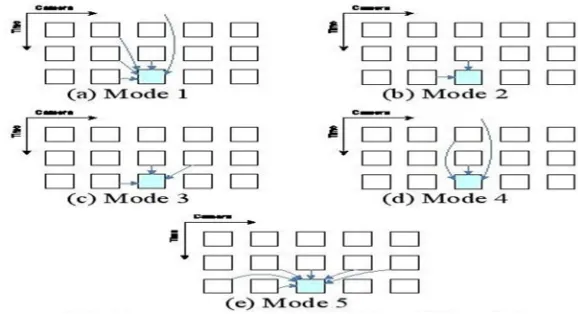
[image:5.612.166.455.430.587.2]H.264/AVC based on Multi -view video coding block diagram of Mode 1 of operation is shown1 (a), where the previous frames of closest camera sequence in Addition to previous frames of the encoded camera sequence .Figure 1(b) shows Mode 2 operation, where the latest frame from one nearby Camera and latest frame from encoded camera sequence are used. For Figure 1(c), the latest frames From two nearby cameras and latest frame from encoded Camera sequence are used. Meanwhile Figure 1(d) illustrates The only the previous frames of the encoded camera sequence used in Mode 4. Lastly, in Mode5 Figure 1(e), the latest frames from all the cameras in addition To one more frame from one of the closest cameras are used.
Figure 4: Reference modes in H.264/AVC multi-view Extension codec
V. RESULTS AND DISCUSSION
Technology (IJRASET)
from ‘Book’ sequences With H.264 Analyzer released by MMRG team, the output of the coded multi-view video the tool simply labels the macro blocks with selected colors to distinguish which camera sequence.
Table 1 provides the simulation results for the Book sequences by using simulcast coding and Table 2 for different reference modes of the multi-view video coding H.264/AVC. Four input files (from four different camera inputs) with the YUV 4:2:0 formats coded with the search range of the macro block by 16. The result for the simulcast coding in Table 1 obtained from each camera views where the video coded independently. The total encoding time is between 720 to 800 seconds for each camera views.
[image:6.612.135.479.261.340.2]The results obtained based on the multi-view video Coding for different reference modes. The Different parameter Used between the result of Table1 and Table2 is the total number of frames. In simulcast coding, the total number of frames for each camera views is 50 frames. Meanwhile, for multi-view video coding, the total number of frames is 200 frames for each mode, which is by combining all frames of the four cameras (50 frames for each view). From the results, that different reference mode yields a difference performance. The bit rate for the Mode 4 higher compared to the remaining mode, even though the SNR of each mode almost similar.
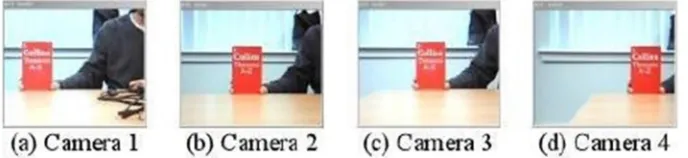
[image:6.612.143.472.376.458.2]Figure 5: Frame 25 of the four cameras from book sequences
[image:6.612.149.463.493.570.2]Figure 6 : Output of the coded multi-view video with H.264 Analyzer at frames 25
Table 1: simulation results for simulcast coding
Table 2- Simulation Results for Multi-view coding with different Modes
[image:6.612.146.466.603.681.2]Technology (IJRASET)
sequence. The total number of bits will increase due to the summation of all the compressed data 4 views to transmit or storage. This is inefficient way to compress the multi-view video because it did not exploits the redundancies between the multiple views.
VI. CONCLUSION
A multi-view video coding simulation based on H.264/AVC for wireless channel has been presented. The coding scheme processed the frames of sequences captured by multiple cameras from a scene. The codec is based on the JM H.264/AVC software version 10. Five modes of operation are simulated based on the MMRG H.264 Multi-view Extension. The acquisition stage consists of an array of synchronized cameras that are connected to a single PC through the USB connection. The implementation cost for this system is quite low since it used a typical web camera attached to the PC. The system can be upgraded to higher state with better specification of the equipment from acquisition to Display.
REFERENCES
[1] M. Filer and B. Gird, "Multi -view Video Compression," Signal Processing Magazine, IEEE, vol.24, pp. 66-76, 2007.
[2] P. Markel, A. Smock, K. Muller, and T. Weigand,"Efficient Prediction Structures for Multi-View Video Coding," IEEE Transactions on Circuits and Systems for Video Technology, 2007.
[3] H. Schwarz, D. Marpe, and T. Wigand, "Analysis of Hierarchical B Pictures and MCTF," International Conference on Multimedia and Expo, 2006. [4] I. Ahmad, “Multi-view Video: Get Ready for Next Generation Television,” Distributed Systems Online, IEEE, vol. 8, pp. 6-6, 2007.