6
I
January 2018
The Survey of Object Recognition Component and
Shape Based Method in JPEG Images
Jaspreet Kaur1, Parvinder Kaur2 1
Research Scholar, 2Assistant Professor, Computer Science and Engineering, SUSCET (Tangori)
Abstract: Object recognition is apprehensive with responsible the individuality of an object being observed in the image from a set of known labels. Oftentimes, it is assumed that the object being observed has been detected or there is a single object in the image. Important efforts have been compensated to develop symbol systems and procedures aiming at distinguishing generic objects in images taken under different imaging conditions (e.g., viewpoint, illumination, and occlusion). Within a limited scope of distinct objects, such as handwritten digits, fingerprints, faces, and road signs, substantial success has been achieved. Object recognition is also related to content-based double recovery and multimedia indexing as a number of generic objects can be recognized. In addition, significant progress towards object categorization from images has been made in the recent years. Most work stated in the works focuses on competent methods for object appreciation and its applications. A single object can be easily detected in an image. Multiple objects in an image can be detected by using different object detectors simultaneously. The paper converses numerous techniques for object recognition and a method for numerous object discovery in an image. Object recognition is one of the most fascinating abilities that humans easily possess since childhood. Object recognition is one of the methods of digital image processing where we can procedure any image by relating some of the operation. It actually depends on human perception that what sort of output he needs, based on that, one can apply a particular technique.
Keywords: Object recognition, Content base images, illumination, texture and deformation.
I. INTRODUCTION
The modern world is enclosed with gigantic masses of digital visual information. To analyse and organize these devastating ocean of visual information image analysis techniques are major requisite. In particular useful would be methods that could automatically analyse the semantic contents of images or videos. The content of the image determines the significance in most of the potential uses. One important aspect of image content is the objects in the image. So there is a need for object recognition techniques [1]. Object recognition is an important task in image processing and computer vision. It is concerned with defining the identity of an object being experimental in an image from a set of known tags. Humans can identify any object in the real world easily without any efforts; on contrary machines by itself cannot recognize objects. Algorithmic imageries of recognition task are applied on apparatuses; which is an intricate task. Thus object recognition techniques need to be developed which are less complex and efficient [2].
Category recognition and detection are 2 parts of object recognition. The objective of category recognition is to classify an object into one of several predefined categories. The goal of detection is to distinguish objects from the background. There are various object recognition challenges [3].
II. RELATEDWORK
Hui Wei et al., 2016[4] defined that the Shape-based object recognition is one of the most challenging problems in computer vision. Learning a structural representation using graphical models is a new trend in object recognition. This paper tries to apply graphical models to learn a shape representation and proposes a pipeline of shape-based object recognition. First, a Bayesian Network represents the shape knowledge of a type of object. Second, an evidence accumulation inference with Bayesian Network is developed to search for the region of interest which is most likely to contain an object in an image. Finally, a spatial pyramid matching approach is used to verify the hypothesis to identify objects and to refine object locations.
Liming Wang et al., 2007[5] advanced an object detection method joining top-down recognition with bottom-up image segmentation. There are two main steps in this method: a hypothesis generation step and a verification step. In the top-down hypothesis group step, we design an better-quality Shape Background feature, which is more robust to object deformation and background clutter. The improved Shape Context is used to generate a set of hypotheses of object locations and figure ground masks, which have high recall and low precision rate. In the confirmation step, we first compute a set of feasible divisions that are consistent with top-down object hypotheses, then we propose a False Positive Pruning(FPP) procedure to prune out false positives. We exploit the fact that false positive regions typically do not align with any feasible image segmentation.
Pedro F. Felzenszwalb [6] 2005 presented a computationally efficient framework for part-based modelling and recognition of objects. Our work is motivated by the pictorial structure models introduced by Fischler and Elschlager. The basic idea is to represent an object by a collection of parts arranged in a deformable configuration. The entrance of each part is modelled separately, and the deformable formation is represented by spring-like connections between twosomes of parts. These models allow for qualitative descriptions of visual appearance, and are suitable for generic recognition problems. They discourse the problematic of using pictorial structure models to find instances of an object in an image as well as the problem of learning an object model from training examples, presenting efficient algorithms in both cases.
Sukanya C.M et al., 2016 [7] considered as difficult one in Image Processing. Object gratitude is an important part of processer vision because it is carefully related to the success of many computer vision applications. A number of object recognition algorithms and systems have been proposed for a long time in order to address this problem. This paper offerings a survey of different techniques in the field of processer vision and object recognition. Largely this paper is to evaluation and study of the different methods of object detection. In this survey we discuss contextual subtraction, optical flow, point detector, frame differencing to perceive objects.
III. ISSUESINOBJECTRECOGNITION
A. Lighting
[image:3.612.176.435.515.603.2]The lightning conditions may differ during the course of the day. Also the weather conditions may affect the lighting in an image. In-door and outdoor images for same object can have varying lightning condition. Shadows in the image can affect the image light. Whatever the lightning may be the system must be able to recognize the object in any of the image [8].
Figure 1. Objects with different lightning
B. Positioning
Position in the image of the object can be changed. If template matching is used, the system must handle such images uniformly.
C. Rotation
D. Mirroring
The mirrored image of any object must be recognized by the object recognition system.
E. Occlusion
[image:4.612.198.413.161.293.2]The condition when object in an image is not completely visible is referred as occlusion. The image of car shown in a box in fig.3 is not completely visible.
Figure 3. Occlusion Car
F. Scale
Change in the size of the object must not affect the correctness of the object recognition system. [9]
IV. METHODSINOBJECTRECOGNIITON
A. Colour Based Method
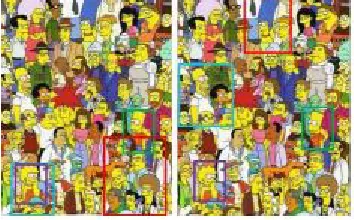
Color provides potent information for object recognition. A simple and efficient object detection scheme is to represent and match images on the basis of color histograms. the use of color attributes as an explicit color representation for object detection. The color information is extended in two existing methods for object detection, the part-based detection framework and the Efficient Sub window Search approach . The three main criteria which should be taken into account when choosing an approach to integrating color into object detection are feature Combination, photometric invariance and compactness [10].
Figure 4. Find the Simpsons. On the left, the conventional part based approach fails to detect all four members of Simpsons. On the right, our extension of the part-based detection framework with color attributes can correctly classify all four Simpsons.
B. Template Matching
Template matching Template matching is a technique for finding small parts of an image which match a template image. It is a straightforward process. In this technique template images for different objects are stored. When an image is given as input to the system, it is matched with the stored template images to determine the object in the input image. Templates are frequently used for recognition of characters, numbers, objects, etc. It can be performed on either color or gray level images. Template matching can either be pixel to pixel matching or feature based. In feature based the features of template image is compared to features of sub-images of the given input image; to determine if the template object is present in the input image.
C. Active and Passive
[image:4.612.226.403.430.540.2]The window-sliding approach: It uses passive scanning to check if the object is present or not at all locations of an evenly spaced grid. This approach extracts a local sample at each grid point and classifies it either as an object or as a part of the background [12]. The part-based approach: It uses passive scanning to determine interest points in an image. This approach calculates an interest value for local samples at all points of an evenly spaced grid. At the interest points, the approach extracts new local samples that are evaluated as belonging to the object or the background.
D. Shaped Based
Recently, shape features have been extensively explored to detect objects in real-world images. The shape features are more striking as compared to local features like SIFT because most object categories are better described by their shape then texture, such as cows, horses and cups and also for wiry objects like bikes, chair or ladders, local features unavoidably contain large amount of background mess. Thus shape features are often used as a replacement or complement to local features.
V. VARIOUSCOMPONENTINOBJECTRECOGNITION
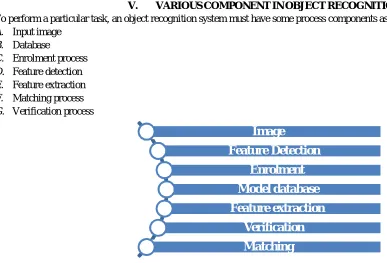
To perform a particular task, an object recognition system must have some process components as-:
A. Input image
B. Database
C. Enrolment process
D. Feature detection
E. Feature extraction
F. Matching process
[image:5.612.46.433.230.493.2]G. Verification process
Figure 5. Object Recognition Components.
The above block diagram shows the interactions among the components and the flow of information among them. The database is consists of the entire models that are known to the system. This model or database is actually consists of the information based on the recognition technique and approach applied. If the method for object recognition is based on features then it may consists the techniques of determining the size, shape, colour etc. It is not sure that the system always uses the same techniques but it depends on the type of object that has to be recorded in an image. Hence an appropriate tools and techniques must be selected by the system for the object recognition.
1) Database or Model Representation: The very basic concept here is that how the object should be presented in the database. It actually depends on the important attributes and features of the object in the image. In some images colour can be the best feature, for some size would be the best one, for some shape would be the best one or so on [14].
2) Feature Detection: It is simply related to the concept of finding some of the interesting points or we can say features in an image and on the basis of that we can make local decisions at the point of every image.
3) Feature extraction: It deals with the representation of the interesting points for the purpose of comparing then with that of the other interesting point in an image [15].
4) Matching Process: Once the image is captured, the features of the object in an image are detected and extracted; now we have to recognize the actual object present in the image. For this, the process is done that is matching. Now the interesting points or the features that has been extracted are matched with the database model.
VI. CONCLUSIONANDFUTURESCOPE
In this review paper all the main lexicon of object detection have been talked. These include object detection methods, feature selection and object classification. Most commonly used and well recognized methods for these phases have been explained in details. Different methods for object detection are like frame difference, optical flow and background subtraction. The expansion onward article of methods behind the object recognition container is achieved by two main feature types like edge-based feature type and patch based feature type. We have discussed various object detection techniques. The template matching technique requires large database of image templates for correct object recognition. Hence it must be used only when limited objects are to be detected. These techniques help in easy access of the images. They also find their application in fields such as biometric recognition, medical analysis, surveillance, etc. A method for multiple object detection is also presented. As human can simply recognize the object and even can distinguish, but for appliance it is not an easy task, hence the work can be done with the help of the concept of artificial intelligence.
As object recognition is the concept of identifying the object in an image or video. It can be used for specific application for enhancing the features of an application for example, machine vision, and industrial vision and so on.
REFERNCES
[1] T. Gao, B. Packer, D. Koller, “A Segmentation-aware Object Detection Model with Occlusion Handling”, In IEEE International Conference on Computer Vision and Pattern Recognition (CVPR), June 2011.
[2] W. Hu, A.M.Gharuib, A.Hafez, “Template Match Object Detection for Inertial Navigation Systems,” Scientific research (SCIRP), pp.78-83, May 2011. [3] E.Shectman, M.Irani, “Matching Local Self-Similarities across Images and Videos,” In IEEE International Conference on Computer Vision and Pattern
Recognition, pp. 1-8, 2007.
[4] Wei, Hui, Qian Yu, and Chengzhuan Yang. "Shape-based object recognition via Evidence Accumulation Inference." Pattern Recognition Letters 77 (2016): 42-49.
[5] Wang, Liming, Jianbo Shi, Gang Song, and I-Fan Shen. "Object detection combining recognition and segmentation." In Asian conference on computer vision, pp. 189-199. Springer, Berlin, Heidelberg, 2007.
[6] Felzenszwalb, Pedro F., and Daniel P. Huttenlocher. "Pictorial structures for object recognition." International journal of
[7] Sukanya, C. M., RoopaGokul, and Vince Paul. "A Survey on Object Recognition Methods." International Journal of Science, Engineering and Computer Technology 6, no. 1 (2016): 48.
[8] Khurana, Khushboo, and ReetuAwasthi. "Techniques for object recognition in images and multi-object detection." International Journal of Advanced Research in Computer Engineering & Technology (IJARCET) 2, no. 4 (2013): pp-1383.
[9] Belongie, Serge, Jitendra Malik, and Jan Puzicha. "Shape matching and object recognition using shape contexts." IEEE transactions on pattern analysis and machine intelligence 24, no. 4 (2002): 509-522.
[10] Kinjal A Joshi, Darshak G. Thakore A Survey on Moving Object Detection and Tracking in Video Surveillance System International Journal of Soft Computing and En- gineering (IJSCE) ISSN: 2231- 2307, Volume-2, Issue-3, July, 2012.
[11] W.T. Lee and H. T. Chen, ”Histogram-based interest point detectors,” in Proceedings of the IEEE Conference on Computer Vision and Pattern Recognition, 2009, pp. 1590-1596.
[12] A. Berg, T.Berg , J. Malik, “Shape Matching and Object Recognition using Low Distortion Correspondences,” In IEEE International Conference on Computer Vision and Pattern Recognition (CVPR), pp. 26 – 33, 2005
[13] F. Khan, R. Muhammad , et.al., “Color Attributes for Object Detection,” In IEEE International Conference on Computer Vision and Pattern Recognition, pp. 3306 – 3313, 2012
[14] C.Hemalatha et al, A Survey on Real Time Object Detection, Tracking and Recognition in Image Processing, International Journal of Computer Applications, Volume 91-No. 16, April 2014.