Technology (IJRASET)
Digital Data Storage in DNA
A. D. Venkhat Balaji
MNM Jain Engineering College
Abstract: Demand for data storage is growing exponentially, but the capacity of existing storage media is not keeping up. Using DNA to archive data is an attractive possibility because it is extremely dense, with a raw limit of 1 Exabyte/mm3 (109 GB/mm3), and long-lasting, with observed half-life of over 500 years. This paper presents architecture for a DNA-based archival storage system. It is structured as a key-value store, and leverages common biochemical techniques to provide random access. We also propose a new encoding scheme that offers controllable redundancy, trading off reliability for density. We demonstrate feasibility, random access, and robustness of the proposed encoding with wet lab experiments involving 151 kB of synthesized DNA and a 42 kB random-access subset, and simulation experiments of larger sets calibrated to the wet lab experiments. Finally, we highlight trends in biotechnology that indicate the impending practicality of DNA storage for much larger datasets
I. INTRODUCTION
The demand for data storage devices is increasing day by day as more and more data is generated every day. Total information in digital format in the year 2012 was about 2.7 zettabytes. Presently devices such as optical discs, portable hard drives, and flash drives are used to store data. But silicon and the other non biodegradable materials used in data storage pollute the environment. Also, they are available in limited quantities. Thus, they would be exhausted one day. The linear density of digital storage device is 10 kb per square mm. Hence, newer technology is needed for data storage and archival process. As the data increases, the current data storage technology would not be enough to store data in future as data is growing every day. Even potentially important information can get lost due lack of storage space. One of the most common causes of data loss is accidental deletion of files without backup. Every day many people lose important data because of deleting files accidently because they do not have proper backup systems. Poor handling of the optical disk can cause data loss in them. Data loss can occur due to damage of hard drive. Mechanical damage to the hard drive is common as it contains a lot of fragile parts moving at very high speed. Hard drives can get damaged due to accidental drop of computers. Hard drives can get damaged if any liquid enters it. Liquids can cause damage to electronic parts of drive making it difficult to recover data. The hard disk can get damaged due to fire. Solid State Drive has a limited number of write cycles. Thus after write cycle limit, it is not possible to write data on them. A printed book has better life expectancy than best of the data storage method.
A. Importance of DNA as storage medium 1) High capacity
2) High data storage density
3) Withstand extreme environmental conditions
4) High memory space
5) Secure as invisible to human eye
B. Structure of DNA
1) DNA consisting of Adenine, Guanine, Cytosine and Thymine. (A,G, C and T)
2) Paired into nucleotide base pairs A-T and G-C
3) Single nucleotide can represent 2 bits of information.
4) High memory space due to 3D structure
C. Encoding Models 1) Microvenus project
Technology (IJRASET)
4) Alignment based encoding5) Church and Goldman model
6) Rewritable RAM
7) Next generation sequencing model
D. Codes for encoding 1) The Huffman Code
2) The Comma Code
3) The Alternate Code
4) Comma Free Code
5) Improved Huffman Coding
6) Perfect Genetic Code
E. DNA secret writing algorithms
Steganography technique using DNA hybridization
F. DNA secret writing algorithms
Technology (IJRASET)
G. Comparison of codes used for encodingII. DATA PREPARATION
A. Context Information Generation
Technology (IJRASET)
transformation.
B. Compression of Text File
We used statistical compression method to compress the data obtained after transformation. The chosen statistical compression scheme was Huffman encoding. Input consists of alphabet A and set W represented in equation (1) and (2) respectively. Output is a set of binary sequence in equation (3), which must satisfy the goal (4) for all the codes with the given condition.
A = {a1, a2…, an} 1
W = {w1, w2…, wn} 2
wi = weight (ai ), 1<i< n
C (A, W) = {c1, c2…, cn} 3
III. MAPPING FUNCTION
A. Mapping Table
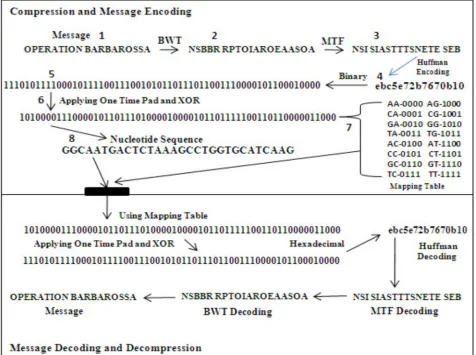
Mapping table consists of binary bits and nucleotides. Binary value is represented as 0 and 1. Nucleotides are represented as A, C, G and T. Four binary bits are represented by two nucleotide base pairs resulting in sixteen such combinations as shown in Mapping Table. The reason for choosing four bits for two nucleotides is that the output of Huffman encoding here is Hexadecimal value (radix =16). So we need sixteen such combinations to represent this in binary and then nucleotides.
Binary - nts Binary - nts Binary - nts Binary - nts
0000 - AA 0100 -AC 1000 -AG 1100 -AT
0001 -CA 0101-CC 1001-CG 1101-CT
0010-GA 0110-GC 1010-GG 1110-GT
0011-TA 0111-TC 1011-TG 1111-TT
B. Encryption
The encoded message must be encrypted in order to maintain its security. For this purpose One time pad encryption is used. The requirement for one time pad is that the number of bits of random key must be the same length as of the message to be encoded. The encryption is processed character by character. The secrecy property of the encrypted message depends upon the generated random pad and the decryption of the message is impossible without knowing the true random key and makes it mathematically unbreakable.
IV. MESSAGE ENCODING AND RETRIEVAL
[image:5.612.56.561.336.405.2]Technology (IJRASET)
[image:6.612.70.546.103.458.2]implementing the biological protocols to insert the sequence in genome of bacteria.
Fig. 1. Message encoding and decoding scheme in nucleotides.
V. PERFORMANCE
Technology (IJRASET)
encoding message.
VI. CONCLUSION
This paper describes a data encoding method to achieve high volume data density by reducing the number of nucleotides. The primary focus of this study was to encode data for les of very small size. Data encoding method was performed into two steps. The first step was to compress the original text message. This was achieved using transformation and compression algorithm. Second step was introduction of mapping table, which finally maps the binary strand to nucleotide sequence. The contributions of this study are summarized as follows. First, while majority of previous experiments just mapped the binary strand to nucleotide sequence, this study reduced the number of nucleotides to represent the same in-formation, finally reducing the cost factor for artificially synthesizing nucleotide strand in laboratory. Second, this study uses transformation on original text message prior to compression to achieve better context information, resulting in a compression factor of 2.37. This scheme may be useful for many applications which need to store small message for long period of time, e.g. military implications , signatures of living modified organism (LMOs) and as valuable heritable media. Future work may focus on modification of transformation algorithm and designing other mapping function for encoding nucleotide sequence.
REFERENCES
[1] “Extracting Value from Chaos” (IDC, Framingham, MA, 2011), http://www.emc.com/collateral/analyst-reports/idc-extracting-value-fromchaos-ar.pdf. [2] Information on materials and methods is available on Science Online.
[3] C. Bancroft, T. Bowler, B. Bloom, C. T. Clelland, Long-term storage of information in DNA. Science 293, 1763 (2001). doi:10.1126/science.293.5536.1763c Medline
[4] E. M. LeProust et al., Synthesis of high-quality libraries of long (150mer) oligonucleotides by a novel depurination controlled process. Nucleic Acids Res. 38, 2522 (2010). doi:10.1093/nar/gkq163 Medline