Technology (IJRASET)
Performance Parameters Evaluation of
Energy-Efficient LEACH Routing Protocol
Mrs. Vaishali Rajeshirke1, Mrs. Shoba Krishnan2
1
P.G student, 2HOD
Department of Electronics and Telecommunication, V.E.S. Institute of Technology, Chembur
Abstract: Wireless sensor network (WSN) consists of a very large number of dispersed and dedicated sensors in order to sense the physical conditions or parameters of the environment like sound, temperature, humidity, pollution levels and pressure and so on. Routing protocols in WSNs are broadly classified as, Hierarchical routing protocols (HRP), Quality of service based routing protocols, Location Based routing protocols and Flat based routing protocols. Hierarchical routing is an efficient method to less energy consumption within a cluster and by performing data collection and fusion in order to limit the number of transmitting messages to the BS. LEACH and PEGASIS are the hierarchical based routing protocols. PEGASIS is a chain based routing protocol, which is an enhancement of LEACH protocol. It saves a huge amount of energy compared with the LEACH by upgrading the delivery method of information.
Keywords: HRP, LEACH, WSN, PEGASIS
I. INTRODUCTION
[image:2.612.193.408.538.709.2]Technology (IJRASET)
Figure1shows the components of a sensor network in which sensor nodes are indicated as small circles. The sensor nodes consist of the four components such as: Sensor unit, Central processing unit (CPU), Power unit & Communication unit.
Each component performs different tasks. The sensor unit is responsible for collecting information as the ADC requests and returning the analog data it sensed. The sensor unit consists of sensor and ADC (Analog to Digital Converter). ADC is used to inform CPU that what the sensor unit has sensed, and also to instruct the sensor unit to perform next step.
The sensors are classified into three categories:
A. Passive, Omni Directional Sensors
Passive sensors sense the data without actually manipulating the environment by active probing. They are self powered i.e. energy is needed only to amplify their analog signal. There is no motion of “direction” involved in these measurements.
B. Passive, narrow-beam sensors
These sensors are passive but they have well-defined motion of direction of measurement. Typical example is ‘camera’.
C. Active Sensors
These groups of sensors actively probe the environment, for example, a solar or radar sensor or some type of seismic sensor, which generate shock waves by small explosions.
Communication unit is used to receive command or query from and transmit the data from CPU to the outside world. CPU is the most complex unit. It Interprets the command or query to ADC monitors and controls power if necessary, processes received data, computes the next hop to the sink, etc. Power unit supplies power to sensor unit, processing unit and communication unit. Each node also consists of the two optional components like Location finding unit and Mobilizer. If the user requires the knowledge of location with high accuracy then the node should get information from Location finding system and Mobilizer.
The basic goals of a WSN’s are to determine the value of physical variables at a given location, detect the occurrence of events of interest, and estimate parameters of the detected event or events and classify a detected object, track an object.
Thus the important requirements of a WSN’s are use of a large number of sensors, attachment of stationary sensors, low energy consumption, collaborative signal processing, self-organization capability, and querying ability.
These WSNs may consist of heterogeneous and mobile sensor nodes; the network topology may be as simple as a star topology. The scale and density of a network varies depending on the application. To meet all the requirements the following are the important design issues of the sensor network have to be considered [2]
1) Fault Tolerance
2) Scalability
3) Production Costs
4) Operating Environment
5) Power Consumption
6) Data Delivery Models
7) Data Aggregation/Fusion
8) Quality Of Service (QoS )
9) Data Latency And Overhead
10) Node Deployment
The characteristics of sensor networks and application requirements have effect on the network design objectives with respect to network capabilities and network performance. As compared to the traditional wireless communication networks such as mobile ad hoc network (MANET) and cellular systems, wireless sensor networks have the following unique characteristics and constraints:
a) Battery-powered sensor nodes
b) Dense sensor node deployment
c) Sensor node’s energy, its computation and storage constraints
d) Self-configurable
e) Data redundancy
f) Many-to-one traffic pattern
Technology (IJRASET)
h) Application specific
II. CLASSIFICATION OF ROUTING PROTOCOLS
The routing algorithms for WSNs can classify in many different ways. Routing protocols are classified as: Table 1: Classification of routing protocol [3]
Based on data collection Based on response Based on intitation Based on the sensor network architecture Location-aware (geo-centric) ---- ---- ----
QoS based routing protocols ---- ---- ----
Node centric Reactive routing protocol Destination initiated (Destination- Initiated) Homogeneous node
Data-centric Proactive routing protocol
Source initiated
(Source- initiated) Heterogeneous node
Most of the Ad-hoc network routing protocols are node-centric protocols where destinations are specified based on the numerical addresses (or identifiers) of nodes. In WSNs, node centric communication is not a commonly expected communication type. Therefore, routing protocols designed for WSNs are more data-centric or geocentric.
A. In data-centric routing
The sink sends queries to certain regions and waits for data from the sensors located in the selected regions. Since data is being requested through queries, attribute based labeling is necessary to specify the properties of data. Here data is usually transmitted from every sensor node within the deployment region with significant redundancy.
B. In location aware routing
Nodes know where they are in a geographical region. Location information can be used to improve the performance of routing and to provide new types of services.
C. In QoS based routing protocols
The data delivery ratio, latency and energy consumption are mainly considered to get a good QoS (Quality of Service), the routing protocols must possess more data delivery ratio, less latency and less energy consumption.
Routing protocols can also be classified based on whether they are reactive or proactive. A proactive protocol sets up routing paths and states before there is a demand for routing traffic. Paths are maintained even there is no traffic flow at that time. In reactive routing protocol, routing actions are triggered when there is data to be sent and disseminated to other nodes. Here paths are setup on demand when queries are initiated.
Routing protocols are also classified based sensor network architecture. Some WSNs consist of homogenous nodes, whereas some consist of heterogeneous nodes. Based on this concept we can classify the protocols whether they are operating on a flat topology or on a hierarchical topology.
In Flat routing protocols all nodes in the network are treated equally. When node needs to send data, it may find a route consisting of several hops to the sink. A hierarchical routing protocol is a natural approach to take for heterogeneous networks where some of the nodes are more powerful than the other ones. The hierarchy does not always depend on the power of nodes. In Hierarchical (Clustering) protocols different nodes are grouped to form clusters and data from nodes belonging to a single cluster can be Combined (aggregated).
Routing protocols are also classified based on whether they are destination-initiated (Destination-initiated) or source-initiated (Source-initiated). A source-initiated protocol sets up the routing paths upon the demand of the source node, and starting from the source node. Here source advertises the data when available and initiates the data delivery. A destination initiated protocol, on the other hand, initiates path setup from a destination node.
Technology (IJRASET)
III. ROUTING PROTOCOLS IN WSN
Routing used in wireless sensor networks differs from conventional routing which is used in fixed networks in various ways. In WSNs, there is no infrastructure, wireless links are unreliable, sensor nodes may fail, and routing protocols have to meet strict energy saving requirements. There are many routing protocols used for routing the data to base station. Among them hierarchical routing protocol is energy efficient. Examples are: LEACH, PEGASIS, TEEN and APTEEN. This paper focuses on performance parametric evaluation of LEACH routing protocol
IV. LEACH PROTOCOL
Low energy adaptive clustering hierarchy (LEACH) is routing algorithm proposed to collect and deliver data to the sink, called a base station. The main purposes of LEACH are:
A. Expansion of network lifetime
B. Reduced energy consumption by each network sensor node
[image:5.612.231.381.257.494.2]C. Use of data aggregation to reduce the number of communication messages.
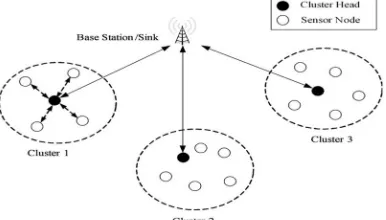
Figure 2 Hierarchical approach of LEACH protocol
To achieve these purposes LEACH adopts a hierarchical approach to arrange the network into a group of clusters. Each cluster is managed by a chosen cluster head. The cluster head has the responsibility to carry out multiple tasks. The first task is the periodic collection of data from members of the cluster. After gathering data, the cluster head aggregates it to remove redundancy among correlated values. The second task of CH is to transmit the aggregated data directly to the base station. The transmission of the aggregated data is takes place over a single hop.
[image:5.612.196.389.595.705.2]Technology (IJRASET)
The network model used by LEACH is as shown in figure 3. The third main job of the cluster head is to create a TDMA-based schedule whereby each node of the cluster is assigned a time slot so that it can be use for transmission of data. The cluster head advertises TDMA schedule to its cluster members through broadcasting. To reduce the collisions among sensors within and outside the cluster, LEACH node use a code division multiple access-based scheme for communication.
Many routing algorithms were developed for wireless networks in general. There are some hierarchal protocols in WSN like LEACH and PEGASIS
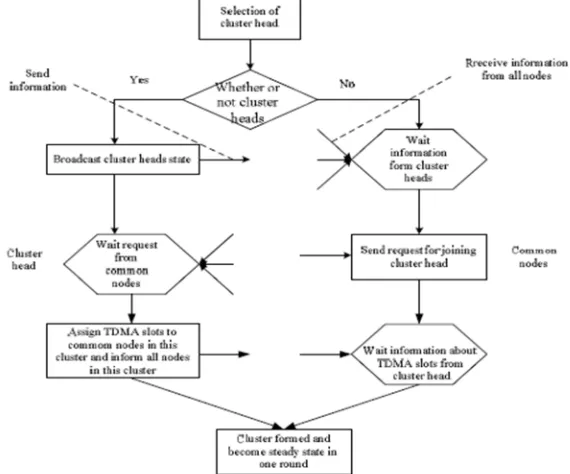
[image:6.612.48.563.261.404.2]The basic operations of LEACH are structured in two different phases. These phases are as shown in figure 4.The first phase called set up phase, consists of two steps, cluster head selection and cluster formation. The second phase called the Steady state phase which focuses on data collection, aggregation and delivery to the base station. The duration of the set up is assumed to be relatively shorter than the steady state phase to minimize the protocol overhead. At the start of the set up phase, a cluster-head selection starts. The cluster-head selection process role rotates among sensor nodes, by distributing energy consumption evenly across all network nodes. To determine each the sensor node turn to become a cluster head, a node ‘n’ generates a random number v between 0 and 1 and compares it to the cluster head selection threshold T (n).
Figure 4: LEACH operation Phase cycle
The CH selection threshold is calculated to ensure with high probability that a predetermined fraction of nodes, P is chosen cluster heads at each round. Further, the threshold ensures that nodes which served in the last 1/P rounds are not selected in the current round.
[image:6.612.167.452.464.701.2]Technology (IJRASET)
To meet these necessities, the threshold T (n) of a competing node n can be expressed as follows: T (n) = 0 if n € G
= P/1-P(r mod (1/p)) ¥ n € G
[image:7.612.118.473.166.544.2]The variable G represent the set of nodes that have not been selected as cluster heads in the last 1/P rounds and r denotes the existing round. The predefined parameter, P represents the cluster-head probability. It is obvious that if a node has functioned as a cluster head in the last 1/P rounds then it will not be chosen in this round.
Figure 6: Different processes of nodes in LEACH protocol
During the completion of the cluster-head selection process, every node which was selected to become a cluster-head advertises its new role to the remaining of the network. After receiving the CH advertisements, each remaining node selects a cluster to join. The selection criterion is based on the received signal strength. The nodes then inform their selected cluster head of their wish to become a member of that cluster
After cluster formation, each cluster head creates and distributes the time slots allocated for each member of the cluster in TDMA schedule. Each CH also selects a CDMA code and distributed to all members of its cluster. The code is selected cautiously so as to reduce intercluster interference. The completion of the set up phase signals there is beginning of the steady state phase. During this phase, nodes collect information and use their allocated slots to transmit to the cluster head the data collected. This data collection is performed periodically.
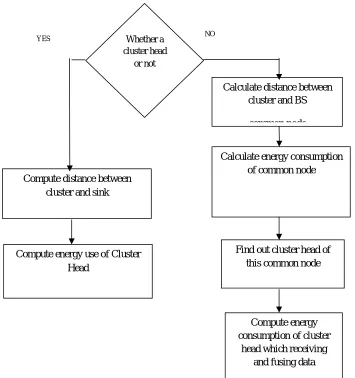
Whether a cluster head
or not
Compute distance between cluster and sink
Compute energy use of Cluster Head
Calculate distance between cluster and BS
common node
Calculate energy consumption of common node
Find out cluster head of this common node
Compute energy consumption of cluster
head which receiving and fusing data
Technology (IJRASET)
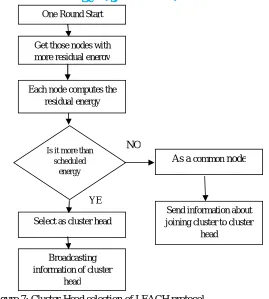
Figure 7: Cluster-Head selection of LEACH protocol
Simulation result shows that LEACH achieves significant energy savings. These savings depend primarily on the data aggregation proportion achieved by CHs. It also outperforms conventional routing protocols including direct transmission and multihop routing.
V. SIMULATION RESULTS AND ANALYSIS
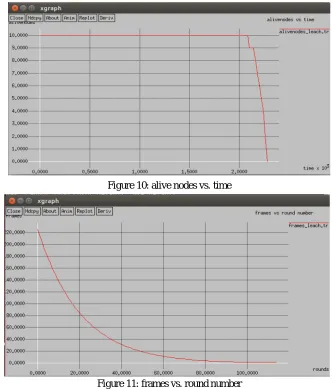
NS 2.35 simulation software is used for simulating different hierarchical routing protocols. This section describes the simulation tool, simulation parameters and simulation results. The performance of routing protocol was evaluated on the basis of three performance metrics: Bits from cluster, Number of frames per round number and number of alive nodes.
Simulation Tool: NS2 (Network Simulator version 2) [5] [6] [7], is a packet level discrete event simulator; developed by UC Berkeley is a widely used tool for computer simulations. It's becoming one of the first selected software to implement network simulation in the academic field. NS2 is a software package including some basic components like Tcl/Tk, OTcl, NS2, Tclcl, etc.
One Round Start
Get those nodes with more residual energy
Each node computes the residual energy
Is it more than scheduled
energy
Select as cluster head
Broadcasting information of cluster
head
As a common node
Send information about joining cluster to cluster
head
NO
[image:8.612.138.463.522.713.2]Technology (IJRASET)
Figure 10: alive nodes vs. time
Figure 11: frames vs. round number
VI. CONCLUSION
In the first scenario using NS-2.35 simulator we ran the simulations to determine the number of bits from cluster with respect to time it is found that as time increases the number of bits from cluster is increased. In the second scenario, it shows that the number of nodes alive is limited to certain number of rounds according to simulation parameter set. Whereas in third case it is observed that the number of frames transmitted is decreased due to packet drop as the number of rounds is increased. All this performance parameter could be varied based on energy required during transmission of data and energy of cluster. Thus LEACH is suited for applications which involve constant monitoring and periodic data reporting.
REFERENCES
[1] J.N Al-Karaki and A.E. Kamal, “Routing Techniques in wireless sensor networks: a survey”, IEEE Wireless Communications, Vol. 11, No. 6, pp.6-28, December 2004
[2] Vhatkar, M.Atique, “Design Issues, Characteristics and Challenges in Routing Protocols for Wireless Sensor Networks”, International Journal of Computer Applications (0975 – 8887) International Conference and Workshop on Emerging Trends in Technology 2013.
[3] R. V. Biradar, V. C. Patil, Dr. S. Sawant, and Dr. R. R. Mudholkar, “Classification and comparison of routing protocols in Wireless sensor networks”, UbiCC Journal, Vol.4
[4] W.R. Heinzelman, A. Chandrakasan, and H. Balakrishnan “Energy-efficient Communication Protocol for Wireless Micro Sensor Networks” in IEEE Computer Society Proceedings of the Thirty Third Hawaii International Conferences on System Sciences (HICSS '00), Washington DC, USA, , vol. 8, pp.8020, Jan. 2000. [5] Y. Bin, S. Bin, W. Nuan, "NS2 and Network Simulation" Beijing: Posts & Telecom Press, 2007
![Figure 1: Components of a wireless sensor network [1]](https://thumb-us.123doks.com/thumbv2/123dok_us/8577097.859717/2.612.193.408.538.709/figure-components-wireless-sensor-network.webp)