5
II
February 2017
Technology (IJRASET)
Experimental Study on Concrete Containing
Cement Kiln Dust
Aayush Choure1, Dr. Rajeev Chandak2
1M.E.-scholar, (structural engineering), department of civil engineering, Jabalpur Engineering College Jabalpur India
2
Head of the Department, Department Of Civil Engineering, Jabalpur Engineering College Jabalpur India
Abstract: India is a country which uses tonnes of cement due to production of concrete and it generally emits carbon di-oxide on hydration as the process is exothermic in nature. Cement kiln dust is a waste material obtained from the manufacturing of cement and it has similar fineness as of cement and reduces the heat of hydration. In this project, a detailed experimental study is carried on various compositions of Cement Kiln dust. Concrete specimens were prepared with 5%, 10%, 15% and 20% CKD as a replacement of cement weight, The most important mechanical property of concrete is compressive strength and it is evaluated on 150X150X150 mm cubes by The compressive strength is obtained for 28 day strength and results are analyses.
Keywords: cement kiln dust, Ordinary Portland cement (O.P.C.), Compressive strength.
I. INTRODUCTION
A large quantity of dust, commonly known as cement kiln dust (CKD), is produced during the production of Portland cement. The bulk of this dust, mostly with high alkali contents, filled land with a significant financial loss to the local cement industry in terms of the value of raw materials, processing, energy consumption during preprocessing, dust collection and disposal with modern manufacturing techniques, But considering the use of cement on the environmental impact and their production cost, it is required to reduce its usage in the concrete. Hence cement replacement materials are required to attain better concrete properties and at the same time, the use of cement replacement material should be better economically viable. There are many minerals admixtures like fly ash, silica fume, slag, rice husk ash, metakaolin, bentonite slag which are used as cement replaced material and studies have proven their positive impact on the properties of the concrete with few drawbacks.
This project presents the impact of CKD as a cement replacement material on the properties of concrete. Cement Kiln Dust is a by-product obtained during manufacturing of cement, which shall be replaced with cement in the concrete. CKD is generally reused in the production of cement. However the quantity of CKD reused is less due to the impurities present in it which restrict its reusability in the production of cement. Hence CKD is mostly land filled for disposal which causes considerable economic losses to the cement plant in terms of cost of processing and disposal. By effectively using this waste material without affecting the properties of the concrete, the environmental impact and the cost for the production of the concrete is reduced. there has been a trend of utilizing CKD in soil stabilization, treatment of sewage,… etc. Also, attempts were made at utilizing it in cement products. Most of the studies conducted so far have been restricted to assessing the properties of cement mortars.
II.LITERATUREREVIEW
a. some of the early researches have examined the use of cement kiln dust (ckd) in concrete
Ravindrarajah (1982) reported that kiln dust could be used in masonry and concrete blocks without loss of strength or workability. His study showed that up to 15% of the Portland cement could be replaced with CKD. If higher percentages of dust were used, the setting was retarded, workability was reduced, and water demand was increased.
Daugherty and Funnell (1983) reported that the use of up to 10% CKD did not have any adverse effects on the setting time, soundness or shrinkage of the final Portland cement concrete. However, the strength results varied, most likely attributed to the changing dust composition.
Remarkrishnan (1986) used this industrial waste in concrete and found that although its addition slightly retarded the setting time of cement, the fresh concrete properties of CKD blended cement concrete mixes were almost the same as the properties of plain concrete.
Technology (IJRASET)
cement was replaced with CKD.Maslehuddin et al. (2009) evaluated the properties of cement kiln dust (CKD) blended cement concretes. The percentages of CKD were 0%, 5%, 10% and 15%, replacing cement. The results showed that the compressive strength of concrete specimens decreased with the quantity of CKD. However, there was no significant difference in the compressive strength of 0 and 5% CKD cement concretes. A similar trend was noted in the drying shrinkage strain. The chloride permeability increased and the electrical resistivity decreased due to the incorporation of CKD. The performance of concrete with 5%, CKD was almost similar to that of concrete without CKD. Therefore, they suggested to limit the amount of CKD in concrete to 5%, since the chloride permeability and electrical resistivity data indicated that the chances of reinforcement corrosion would increase with 10% and 15% CKD.
III.EXPERIMENTALPROGRAM
Materials Used: The various material used in the preparation of concrete are cement, sand, cement coarse aggregates, cement kiln dust (CKD) and water.
A. Cement Kiln Dust
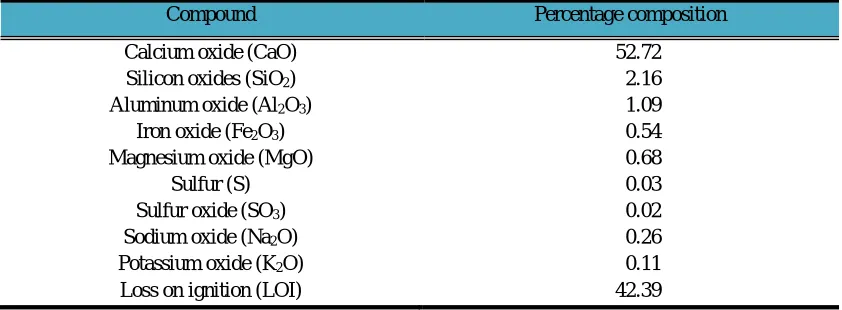
[image:3.612.77.522.344.426.2]Cement kiln dust (CKD) is a significant by-product of the cement manufacturing process. Over the past years, dramatic changes have been made in the management and use of cement kiln dust, thus reducing its dependency on landfill disposal. It is a waste material obtained from the manufacture of Reliance cement factory, maihar. It is a fine powdery material similar in appearance to portland cement. The principal constituents of CKD are compounds of lime, silica, and alumina, and iron. The physical and chemical properties are listed in table 1 and table 2 respectively
TABLE 1
Typical Physical Properties of CKD
Property Value
Gradation (75% passing) Maximum particle size
Specific surface (cm2/g)
Specific gravity
0.030mm (no. 450 sieve) 0.300mm (no. 50 sieve)
4600–14000 2.6–2.8
TABLE 2
Typical Chemical Composition of CKD
B. Cement
Ordinary Portland Cement “Birla gold” (43 Grades). Which is available in market is used.
C. Fine Aggregate
The natural river sand available in local market which passes through 4.75mm sieve with specific gravity of 2.62. Conforming to Zone II.
Compound Percentage composition
Calcium oxide (CaO)
Silicon oxides (SiO2)
Aluminum oxide (Al2O3)
Iron oxide (Fe2O3)
Magnesium oxide (MgO) Sulfur (S)
Sulfur oxide (SO3)
Sodium oxide (Na2O)
Potassium oxide (K2O)
Loss on ignition (LOI)
[image:3.612.96.517.476.631.2]Technology (IJRASET)
D. Coarse Aggregate
Crushed granite conforming to IS 383 - 1987 is used in this study. Coarse aggregate passing through 20mm and retained on 16 mm sieve and specific gravity 2.82 was used.
E. Water
Water is an important ingredient of concrete as it actively participated in chemical reaction with cement, clean portable water which is available in our college campus is used.
F. Mix Proportions
The mixture proportion for the controlled concrete of M30 grade was arrived from the trial mix as per IS 10262-2009.
TABLE 3 Mix proportions
S.no. % of cement
replace by cement kiln dust
Cement
(Kg/m3)
Cement kiln dust
(Kg/m3)
Fine aggregate
(Kg/m3)
Coarse aggregate
(Kg/m3)
Water
(Kg/m3)
w/c ratio
1. 0 423.25 0 656 1222 182 0.43
2. 5 402.08 21.17 656 1222 182 0.43
3. 10 308.92 42.32 656 1222 182 0.43
4. 15 359.76 63.48 656 1222 182 0.43
5. 20 338.60 84.65 656 1222 182 0.43
IV. METHODOLOGY
Replacement levels of OPC by CKD of 0, 5, 10, 15 and 20 % were chosen for this research work. Batching was carried out by
weighing as per calculated amount of each concrete constituent according to the mix ratio of 1:1.54:2.88 and M-30 grade of
concrete was adopted. The constituents were then mixed thoroughly until a uniform mix was obtained. Water was then added and the mix was repeated. The fresh concrete mix was then placed in a mold of size 150 mm, compacted, and left for 24 h before testing Compressive specimens were tested at the ages of 7 and 28 days.
V.RESULTANDDISCUSSION
A. Compressive strength:
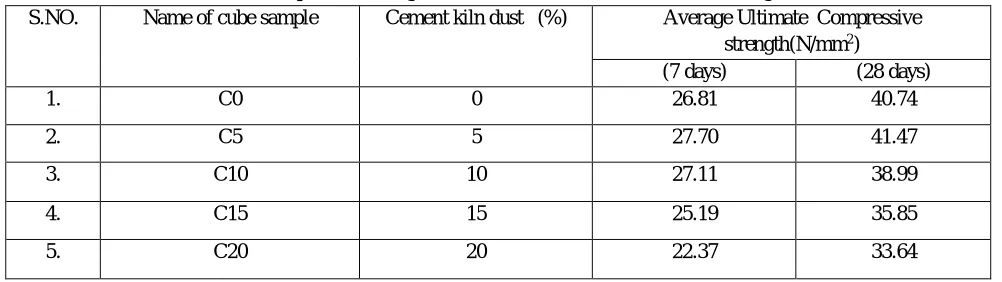
The results of compressive strength presented in Table 4. The test was carried out obtain compressive strength of concrete at the age of 7 and 28 days. The cubes were tested using Compression Testing Machine (CTM) of capacity 2000KN available in structures lab. From Fig1 the compressive strength is up to 27.70 N/mm2 and 41.47 N/mm2 at 7 and 28 days. The maximum compressive strength is observed at 5% replacement of cement kiln dust. If higher percentages of dust were used, then compressive strengths decreased. There is a significant the impurities present in CKD like free lime, loss on ignition and other raw minerals.
TABLE 4
Compressive strength test result of CKD concrete at different ages.
S.NO. Name of cube sample Cement kiln dust (%) Average Ultimate Compressive
strength(N/mm2)
(7 days) (28 days)
1. C0 0 26.81 40.74
2. C5 5 27.70 41.47
3. C10 10 27.11 38.99
4. C15 15 25.19 35.85
[image:4.612.58.529.227.356.2] [image:4.612.48.549.565.706.2]Technology (IJRASET)
2 6 .8 1 2 7 .7 2 7 .1 1 2 5 .1 9 2 2 .3 7 4 0 .7 4 4 1 .4 7 3 8 .9 9 3 5 .8 5 3 3 .6 40 % 5 % 1 0 % 1 5 % 2 0 %
co m pr e ss iv e s tr eng th N /m m 2
percentage of cement kiln dust
GR A PH I C A L R E PR E S E N TA I O N O F
C O M PR E S S I V E S T R E N G T H O F C KD
7 days 28 days
Figure 1.: Relationship between compressive strength and different percentage of CKD. at age of 7 and 28-days
VI.CONCLUSION
In this study series of the experiments have been conducted on concrete with the addition of cement kiln dust as partial replacement of OPC. In the CKD was used as partial replacement of OPC in different percentage that is 0%, 5%, 10%, 15% and 20% of the dry weight of the cement. the experiments were conducted on M-30 grade of concrete as per relevant IS-code practice based on the test results obtained from this study the following conclusion can be drawn.
1.From the compressive strength test results, it is found that the higher strength is observed for the conventional concrete.
2.There is strength reduction with the addition of CKD due to the impurities present in CKD like free lime, loss on ignition and othe raw minerals.
3.However the strength attained with the mix of CKD complies with the target strength up to a replacement of 10%. 4.When the CKD addition is greater than 10%, the strength produced by the concrete gets reduced than the target strength. 5.Compressive strength of mix up to 5% replacement is equivalent to conventional concrete.
REFERENCES
[1] Felix F. Udoeyo1 and Abdul Hyee2 Strengths of Cement Kiln Dust Concrete Journnal Of Materials In Civil Engineering © Asce November/December 2002 . [2] Piyush Chaunsali and Sulapha Peethamparan Novel Cementitious Binder Incorporating Cement Kiln Dust:Strength and Durability ACI Materials
Journal/May-June 2013
[3] Kejin Wang1; Alexander Mishulovich2; and Surendra P. Shah3 Activations and Properties of Cementitious Materials Made with Cement-Kiln Dust and Class F Fly Ash Journal Of Materials In Civil Engineering © Asce / January 2007
[4] Charles E. Pierce, Himanshu Tripathi, and Travis W. Brown Cement Kiln Dust in Controlled Low-Strength Materials ACI Materials Journal/November-December 2003
[5] IEEE-IAS Cement Industry Committee Wayne S. Adaska, P.E., Director, Public Works, Portland Cement Association Donald H. Taubert, Director, Promotion & Technical Service, Capitol Cement Beneficial Uses Of Cement Kiln Dust Presented at 2008 IEEE/PCA 50th Cement Industry Technical Conf., Miami, FL, May 19-22, 200