Technology (IJRASET)
Improvement in AODV Routing Protocol to reduce
Link Failure Problem in ADHOC network
Arjot Kaur1, Er. Manpreet Kaur(Assistant Professor) 2 Electronics and Communication Engineering Department Yadavindra College of Engineering, Talwandi Sabo, Punjab, India
Abstract- The wireless ad hoc network is the self-configuring network; where mobile nodes can leave or join the network when they want. There are various types of routing protocol in ADHOC Network; by using these protocols communication can be possible. I use the AODV protocol for the transferring data. But there is a problem in AODV routing protocol i.e. link failure problem which is responsible for degrade the performance of the network. So we proposed a new method is knowledge based learning algorithm. In our proposed technique we follow new path which has highest signal strength. Second assumption is based upon the hop count similar as AODV protocol. The path which has the minimum hop count is considered as the final path. Third assumption is based upon the sequence number. The experimental results show that, proposed technique has minimum packet loss, less energy consumption, minimum delay and highest throughput in the network. Compare the results of link failure and KBL technique.
Keywords: AODV, Link failure, MANET, Routing protocols.
I. INTRODUCTION
A network is a group of two or more communication systems which are linked together for the exchange of information. The physical connection between networked communication devices is established using either cable media or wireless media. When number of devices are joined together to exchange information they form networks and
Share resources. Networking is used to share information like data communication. Sharing resources can be software type or hardware types. A network can be wired or wireless. Wired network is that which used wires for communicates with each other’s and wireless network is that which communicate without the use of wires through a medium. Medium is like radio frequency. Wireless Network term is refers to a kind of networking that does not require cables to connect with devices during communication. The transmission is take place with the help of radio waves at physical level. Wireless Networking is a technology in which two or more devices communicate with each other using standard network protocols and without the using of cables. It is also known as Wi-Fi or WLAN. With the help of this network, devices can be joined easily with the help of radio frequency without wires to sharing information. The wireless network offers certain advantages over the wired networks that are as follows:
It is very easy and fast to set up a wireless system and it eliminates the need for wires and cables.
Wireless networks can be extended to the places that cannot be wired.
It adapt easily and more flexible to changes in the configuration of the network.
MANET is a mobile ADHOC network. It is self-configuring network which is infrastructure less in nature. In MANET different mobiles are connected through wireless link. Each mobile are free to move i.e. no central controller available. It is one of the types of ADHOC network. There are mainly two types of routing protocol available. These are as following:
A. Proactive Routing Protocol ( Table-driven)
B. Reactive Routing Protocol (On- demand)
C. Hybrid
Technology (IJRASET)
II. BACKGROUND AND RELATED WORK
Wireless networks are increasing in popularity with current advances technology, the architecture of such networks is not based on centralized base station but on each node is act like a router and forward packet data to other nodes in the network. The movement of the nodes is the important characteristic of the ADHOC network [2]. Due to the mobility of any node or source node cause a result of link failure in the network. This problem can be solving by using local repair procedure for path updating using NS2 simulator [3]. The ADHOC network has many types like WSN, MANET and MESH Networks. MANET also having different types likes VANET and other sensor networks [6]. What are the design possibilities for AODV implementation? Development of the on demand routing protocols all this discuss by IAN D.CHAKERE [9]. MANET or ADHOC network having many applications in the fields of communication, mass media and military areas [11]. Problem occurs during the data transfer that is link failure. ACO technique is used to overcome this problem routing table at each node will collect the additional information of next two nodes, which can be updated by RREP. In case of link failure an alternate route for next to next node can be search by using ACO. Using this method END TO END delay can be least and throughput is maximum. Control of packets using forward and backward ants (RREPs and RREQs)[12].Problem in MANET is movement of nodes is very big by this the performance of the network is disturb. So to overcome this problem they address the new technique that is Ant Colony Algorithm that is inspired from the social insects [14]. This technique is ACO and further used by many researchers.
III. LINK FAILURE IN AODV
Link failure is a main problem in AODV which is responsible for the performance degradation and packet lost. Suppose we have number of nodes in our network. Source is host node from where data has to be send and destination node is final node. Any active node, which is responsible for the updating of table entry. When source node move, new route discovery initiated. If intermediate nodes or the destination move then following conditions possible:
[image:3.612.206.407.426.527.2]1. The next hop links break resulting in link failures. 2. Routing tables are updated when link failure occurs. 3. All active neighbors are informed by Route Error message.
Fig.1: Link failure Problem
Link between node3 and node8 breaks. Now node3 invalidate route node8 in the route table. Node3 creates Route Error message and lists all destinations that are now unreachable and sends to upstream neighbor this messages.
[image:3.612.198.413.595.693.2]Technology (IJRASET)
IV. RESULTS AND SIMULATIONS
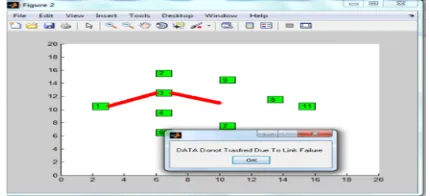
[image:4.612.196.421.293.441.2]I proposed a KBL technique for the better performance of the ADHOC Network. In our proposed work, enhancement of AODV protocol by using knowledge based learning. In our proposed work we have consider a new path for transferring data. In case of MANET nodes are free to move anywhere. There is no central controller in the system. Data transfer from source to destination. In AODV protocol, with the help of RREQ message data is broadcast. RREP message is sent back from destination to source as a response. Header part is added within RREQ message which helps to find out the destination. To find out the best path first assumption is based upon the signal strength. Source node check the visibility of the adjacent nodes and those nodes further checks the visibility of their adjacent nodes. After that source find out the average of the path. The path which has the maximum average value is selected as the final path. This value lies 1 to 10. So this will overcome the problem of link failure. We will follow that path only which has the highest signal strength. Second assumption is based upon the hop count similar as AODV protocol. The path which has the minimum hop count is considered as the final path. Third assumption is based upon the sequence number. The fresh sequence number nodes path will be select as final path. So in this way with the help of signal strength best path will be select in enhanced AODV. This will help to improve the performance of system than simple AODV. So we consider the path through node1, node3, node7 and node 11(destination node) by KBL technique. These nodes have the highest signal strength. So best path is consider for the improved performance of the AODV protocol.
Fig. 3: data is send by using KBL
A. Experimental Results
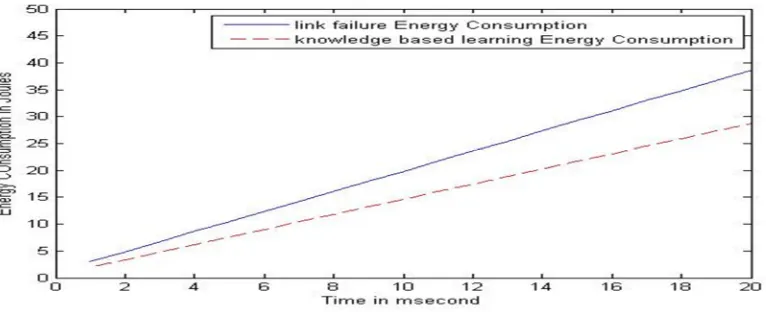
As illustrate in fig. 3, in case of link failure consume more energy as more messages are exchange between them. New technique consumes less energy.
[image:4.612.112.495.529.685.2]Technology (IJRASET)
[image:5.612.116.477.133.279.2]During link failure problem packet loss occur in old AODV. But this problem can be overcome signal strength in enhanced AODV. Graph shows that in case of link failure large number of packet loss as compared to new proposed technique. This shows that packet loss is less in new AODV as compared to old AODV.
Fig. 5: Packet loss
[image:5.612.109.504.334.487.2]Delay graph represents that old AODV has more delay than new AODV. Thus transmission is fast in new AODV which helps to improve performance.
Fig. 6: Delay
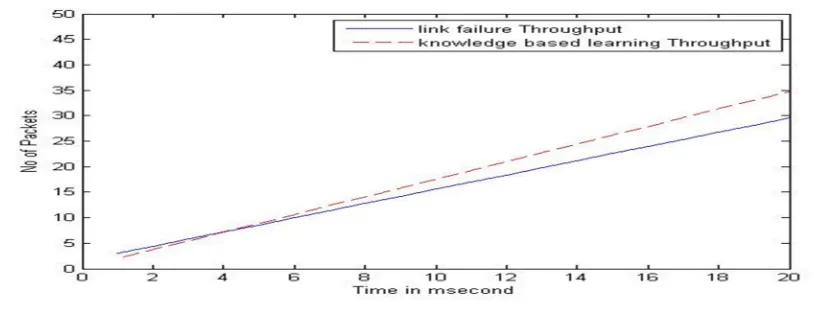
During link failure the throughput is very less. When new proposed technique is used then improvement in the throughput. Throughput is increased in case of enhanced AODV protocol. Throughput is 1000bytes per second.
[image:5.612.96.503.542.700.2]Technology (IJRASET)
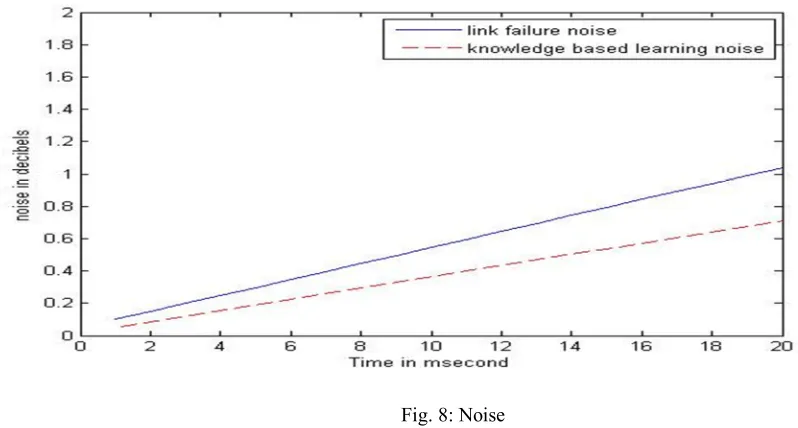
[image:6.612.99.498.122.336.2]Noise is also less in case of improved AODV protocol. So by using knowledge based learning technique all parameters are improved.
Fig. 8: Noise
V. CONCLUSION AND FUTURE WORK
AODV is used to find out the path of the data transfer. But simple AODV has the problem when the nodes move. Enhancement in AODV is required so that to overcome the problem of link failure during data transfer from host to destination. First of all mutual authentication is required between the mobile nodes to prevent the various inside and outside attacks. When the mobile nodes are mutually authenticated, it leads to the reliable data transmission between the mobile nodes. But the main problem occurs during the failure of the link. Due to link failure packet is lost easily. In proposed work, enhancement in AODV concept is important. This protocol is designed to provide best path according to signal strength. The path which has maximum signal strength will choose as a final path. This work will helps to reduce the problem occur in link failure and packet lost problem. Now the performance degradation problem will also improve. In new AODV, route selection is based upon the signal strength. The maximum signal strength nodes are considered as final routes.
In future more efficient protocols can be used rather than AODV protocol. Noise can be more efficient. Number of nodes can be more.
REFERENCES
[1] Hamid, thesis, “Analysis and simulation of wireless adhoc networks routing protocols”, 2004.
[2] A. S. Bhatia and Rupinder Kaur Cheema ,“Analysing and Implementing the Mobility over MANETS using Random Way Point Model” , International Journal of Computer Applications (0975 – 8887) Volume 68– No.17, April 2013.
[3] A. Ambaikar, H.R. Sharma, V. K. Mohabey , “ Improved AODV for Solving Link Failure In Manet” , International Journal of Scientific & Engineering Research, Vol. 3, Issue 10, October-2012 1 ISSN 2229-5518 2012.
[4] C. Tang “An Efficient Mobile Authentication Scheme for Wireless Networks”, 2006.
[5] D. Sumyla, “ Mobile Adhoc Networks” , IEEE Personal Communications Magazine, April 2003, pp. 46-55. [6] A.K Verma , “ Mobile Adhoc Networks: An Introduction”, 2003.
[7] E. G. Nilsson and K. Stolen , “Ad Hoc Networks and Mobile Devices in Emergency Response – a Perfect Match” .
[8] H. Bakht, “Survey of Routing Protocols for Mobile Ad-hoc Network” , Vol.1 No. 6, October 2011 ISSN-2223-4985 International Journal of Information and Communication Technology Research.
[9] Ian D. Chakeres and Elizabeth M. Belding-Royer, “AODV Routing Protocol Implementation Design”, 2004.
[10] J. Hoebeke, I. Moerman, B. Dhoedt and P. Demeester , “ An overview of Mobile Adhoc Networks: Applications and challenges”, Sint Pietersnieuwstraat 41, B-9000 Ghent, Belgium ,2005.
Technology (IJRASET)
[12] J. Jain, R. Gupta and T.K. Bandhopadhyay, “Ant Colony Algorithm in MANET-Local link repairing of AODV” , IEEE, 2011. [13] Karthikeyan U and Rajni, “Security Issues Pertaining to Ad-Hoc Networks”, 2004.
[14] M. Heissenbüttel, T. Braun,” Ants-Based Routing in Large Scale Mobile Ad-Hoc Networks”.