5
VIII
August 2017
Oscillation suppression of interconnected
multi-source power systems aimed with controlling by
HANFISC-SSSC based on MOPSO and BFO
Techniques
Shaik. Sabina yasmin1, C. Kumar2
EEE Department, Prasad V. Potluri Siddhartha institute of technology, Vijayawada, India
Abstract: In the power system, any sudden load variations cause the deviation of tie-line power exchange and the frequency fluctuations. The load frequency control (LFC) is an issue in power system operation and control of supplying sufficient and reliable electric power with good quality. In this paper Hybrid artificial neural networks Fuzzy interface system (HANFIS) based controller is presented to the Load frequency control of a two area interconnected power system. The load-frequency control (LFC) based on multi objective particle swarm optimization is compared with Bacterial Foraging optimization (BFO), in that BFO improved power system dynamic performance. The proposed optimization techniques are implemented in MATLAB/SIMLINK
Keywords: Hybrid Artificial Neural Network Fuzzy Interface System (HANFIS), Load Frequency Control (LFC), Automatic Generation Control (AGC),Multi Objective particle swarm Optimization(MOPSO), Bacterial Foraging optimization (BFO)
I. INTRODUCTION
The organizations are responsible for providing electrical power with great reliability, availability and efficiency. In present time the demand for electrical power and load is not constant but kept on changing. The power generations must change accordingly to match the load perturbations. A power system consists of a number of interconnected subsystems. For each subsystem it becomes compulsory to fulfill the requirements usually include matching system generation to system load and the associated system losses and then regulating system frequency and tie line power exchanges. This is usually known as load frequency control, also called Automatic Generation Control (AGC) problem and is very important in the operation of power systems [1,2].The main purpose of AGC is to maintain system frequency very close to a specified nominal value, to keep the correct value of tie line power between different areas. To maintain the system at a normal operating state different types of controllers based on classical linear control theory have been developed in the past[3-5]. Most load frequency controllers are primarily composed of an integral controller. The integrator gain is set to a level that compromises between fast transient recovery and low overshoot in the dynamic response of the overall system [6-7]. This type of controller is slow and does not allow the designer to take into account possible non-linearites in the generator unit. In recent years, modern control techniques, especially adaptive control configurations, are applied to load-frequency control.
The applications of artificial neural networks, genetic algorithms, fuzzy logic and optimal control to LFC have been reported in [8-15]. Artificial neural network (ANN) controller, which is an advance adaptive control configuration, is used because the controller provides faster control than the others. The beginning of artificial intelligence (AI) techniques persisting of neural networks has elucidated many problems. This technology mainly helps in those kinds of systems which are operating nonlinearly over the operating range. ANN has also been used in frequency controller design for multi area AGC scheme in deregulated electricity market. These networks have been used for pattern recognition, function approximation, time series prediction and classification problems for quite some time. Even, ANNs have been, successful applied for AGC. Load–frequency control is one of the important power system control problems for which a lot of studies have been made in the last two decades [1–3]. The main goal of LFC is to maintain zero steady state errors for frequency deviation and good tracking load demands in a multi-area power system, it is also treated as an ancillary service essential for maintaining the electrical system reliability at an adequate level [4].
the above robust and optimal methods need some information of the system states, which are very difficult to know completely. On the other hand, the order of the robust controllers is as high as that of the plant. This gives rise to complex structure, complex state-feedback or high-order dynamic controllers and reduces their applicability [10].Then despite the potential of robust control techniques with different structures, they are not practical for industry practices and power system utilities prefer the online tuned PI controller’s because of the ease of tuning and the lack of assurance of the stability and easy implementation.
In this paper occurrence of Step Load Perturbation (SLP) has affected the aforementioned power systems so that the efficiency and robustness of both MOPSO and BFO based HANFISC–SSSC is evaluated. It is noted that, the SLP is happening in all areas of both the interconnected, multi-source power systems, the simultaneous optimization scheme has been subsequently settled. To sum up, the simulation results have transparently confirmed the high performance of BFO based HANFISC–SSSC as compared to MOPSO based HANFIS- SSSC in both the multi-area interconnected power systems.
II. TWO-AREALOADFREQUENCYCONTROLMODEL
A self-commutated voltage-source switching converters is generally embedded in SSSC to provide an AC three-phase voltage in quadrature with the line current, and also imitates a capacitive or an Inductive reactance to control and modulate the power flow in
the transmission lines. By modifying and regulating the magnitude and polarity of injected voltage (Vq), the compensation level can be dynamically controlled, and also operation in both the capacitive and inductive mode can be subsequently obtained. A single-line diagram of two-area from an interconnected multi area power system has been selected to carry out the linearization process with presence of SSSC in series with the tie-line in Fig.1. Due to trivial value of the tie-line’s resistance with respect to tie-line’s inductance, its value is neglected. Anyway, SSSC can be employed to suppress the area frequency oscillations by fast controlling the tie-line power. In accordance with the given equivalent circuit of the studied power system in Fig. 2, SSSC is typically presented by a connected series voltage source (Vs) along with a transformer leakage reactance Xs. Meantime, the related phasor diagram of the engaged system considering the operating conditions of the SSSC is given in Fig. 3. It must be noted that, the SSSC voltage (Vs) regulates only magnitude of the current without any change in its angle.
m m V
sssc V
mn
MN jQ
P
N N v
Fig1:Basic Block Diagram of two area interconnected system
m m
V
N N
v
Fig2: equivalent circuit of the studied power system with series connected SSSC
A two area interconnected power system [18] is chosen and load frequency control of this system is made by an ANN controller [19], [20], [21]. The areas are interconnected by tie-lines. From experiments on power system, it is seen that each area needs its system frequency to be controlled [22], [23], [24]. The reason for the proposed technique is that firstly it adapts to changing operating points and calculates optimal control commands, it can also perform effectively with nonlinearities, it can function even if system inputs are temporarily lost or errors are introduced. ANN controller continues to function without needing any decision support software in case of a failure. For comparison, the AGC of considered power system is accomplished using:
1) Conventional integral controller 2) ANN Controller
A. Modelling with conventional integral controller
In two area system, two single area systems are interconnected via tie-line. Interconnections established increases the overall system reliability. Even if some generating units in one area fail, the generating units in the other area can compensate to meet the load demand. The basic linearized diagram of two area interconnected power system is shown in Fig.9.
The power transfer through tie line for the model is given by:
1 2 0 0
, 1 1 2
1 2 | | | |
s i n ( )
t i e
V V
P
X
1, 2 = power angles (angle between rotating magnetic flux & rotor) of equivalent machines of the two areas
Ptie, 1(p u) = T12 (1 - 2)
Where
0 0 1 2
1 2 1 2
1 1 2
| | | |
c o s ( )
r
V V
T
P X
Fig4: Turbine model
A conventional integral controller is used on a reheat power system model. The integral controller improves steady state error simultaneously allowing a transient response with little or no overshoot. As long as error remains, the integral output will increase causing the speed changer position, attains a constant value only when the frequency error has reduced to zero. The turbine model of two area interconnected power system is shown in Fig4
( ) 1 1 1 1 1 )] ( ) ( [ ) ( 4 2 2 1 S S T K S T S T s T s T K s s S T s P i sssc v m mn
mn
P
mn(
s
)
P
mn(
s
)
P
sssc0 ( ) 1 1 1 1 1 )] ( ) ( [ ) ( 4 2 2 1 S S T K S T S T s T s T K s s S T s P i sssc v m mn
mn
In the SSSC controller’s dynamic structure for the frequency suppression, ω∆ can be selected as the input signal of this conventional
III. ANNCONTROLLERS
Neuro-fuzzy hybridization results in a hybrid intelligent system that synergizes these two techniques by combining the human-like reasoning style of fuzzy systems with the learning and connectionist structure of neural networks. Neuro-fuzzy hybridization is widely termed as fuzzy neural network (FNN) or neuro-fuzzy system (NFS) in the literature. Neuro-fuzzy system (the more popular term is used henceforth) incorporates the human-like reasoning style of fuzzy systems through the use of fuzzy sets and a linguistic model consisting of a set of IF-THEN fuzzy rules. The main strength of neuro-fuzzy systems is that they are universal approximators with the ability to solicit interpretable IF-THEN rules. The strength of neuro-fuzzy systems involves two contradictory requirements in fuzzy modelling interpretability versus accuracy. In practice, one of the two properties prevails. The neuro-fuzzy in fuzzy modelling research field is divided into two areas: linguistic fuzzy modelling that is focused on interpretability, mainly the Mamdani model; and precise fuzzy modelling that is focused on accuracy, mainly the Takagi-Sugeno-Kang (TSK) model.
Although generally assumed to be the realization of a fuzzy system through connectionist networks, this term is also used to describe some other configurations including:
Deriving fuzzy rules from trained RBF networks.
Fuzzy logic based tuning of neural network training parameters. Fuzzy logic criteria for increasing a network size.
Realising fuzzy membership function through clustering algorithms in unsupervised learning in SOMs and neural networks. Representing fuzzification, fuzzy inference and defuzzification through multi-layers feed-forward connectionist networks.
It must be pointed out that interpretability of the Mamdani-type neuro-fuzzy systems can be lost. To improve the interpretability of neuro-fuzzy systems, certain measures must be taken, wherein important aspects of interpretability of neuro-fuzzy systems are also discussed.
A. Hierarchical Adaptive Neuro Fuzzy Inference System Controller–Static Synchronous Series Compensator (HANSFIC-SSSC)
A neoteric model of hierarchical fuzzy structure based on ANFIS controller is suggested to enhance dynamic performance of SSSC i.e. HANFISC–SSSC presented in Fig5. Using this hierarchical structure, the performance of controller is enhanced without exponential growth in the rule. As can be seen, this structure is constructed by two ANFIS subsystems that each subsystem is fed by two inputs. ∆
Table 1 Lookup table of fuzzy rules
B. Objective Function Of HANFIS-SSSC_MOPSO
Hitherto, a number of techniques have been employed by scholars to deal with the proficiency of a control system, such as: Integral of Time weighted Absolute value of Error (ITAE), Integrated Absolute Error (IAE), Integral of Squared Error (ISE), and Integral of Time weighted Squared Error (ITSE). Despite that, an effective strategy is suggested to simultaneous optimal tune both controllers aimed at verifying high efficiency of HANFISC–SSSC.
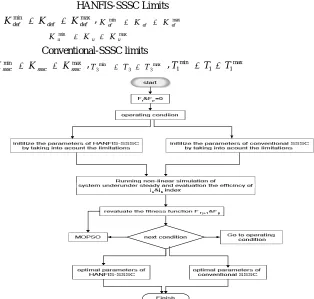
The flow chart of the optimization problem based on simultaneous adjustment with considering 1% SLP in all areas of both the
under studied power systems is presented in Fig6
HANFIS-SSSC Limits min max
def def
def K K
K , min max
ef ef
ef K K
K
min max
u u
u K K
K
Conventional-SSSC limits min max
sssc sssc
sssc K K
K , max
3 3 min
3 T T
T , 1 1max
min
1 T T
T
Fig6: Flowchart of the optimization problem based on MOPSO technique
ΔP/ PVdc
NL
NM
NS
EZ
PS
PM
PL
NL NL NL NL NL NM NS NL
NM NL NL NL NM NS EZ NM
NS NL NL NM NM EZ PS NS
EZ NL NM NS EZ PS PM EZ
PS NM NS EZ PS PM PL PS
PM NS EZ PS PM PL PL PM
J
p tt tsim(
|
f
i|)
t
.
dt
0
J
p tt tsim(
|
P
tiei j|)
t
.
dt
, ,0
p N i i p f J F 1 ,
p N i i p P J F 1 ,Where, NP and tsim are the number of SLPs and simulation time period as well as Jf and JP are two prominent benchmarks in line with control the system stability. The Ff and FP are suggested functions related to carrying out the simultaneous optimal scheme in order to mitigate the low frequency power oscillations and the tie-line power exchange deviations. Eventually, the problem is formulated as the following optimization problem:
IV. BACTERIALFORAGINGALGORITHM
In case of BFO technique each bacterium is assigned with a set of variable to be optimized and are assigned with random values [
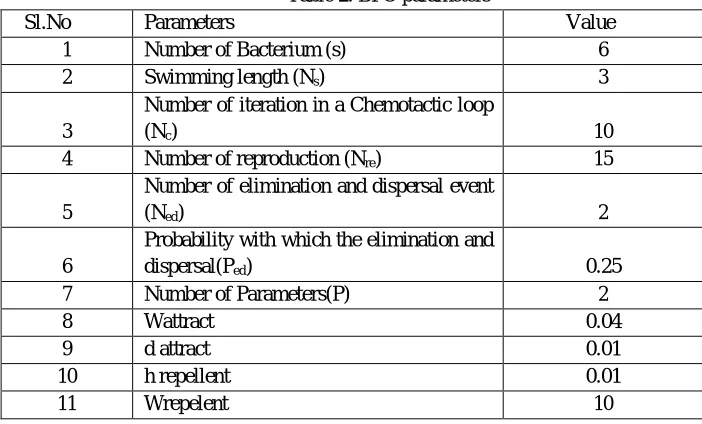
] within the universe of discourse defined through upper and lower limit between which the optimum value is likely to fall. In the proposed method integral gain KIi(i=1,2) scheduling, each bacterium is allowed to take all possible values within the range. In this study, the BFO algorithm reported in [31] is found to have better convergence characteristics and is implemented as followsTable 2. BFO parameters
Sl.No Parameters Value
1 Number of Bacterium (s) 6
2 Swimming length (Ns) 3
3
Number of iteration in a Chemotactic loop
(Nc) 10
4 Number of reproduction (Nre) 15
5
Number of elimination and dispersal event
(Ned) 2
6
Probability with which the elimination and
dispersal(Ped) 0.25
7 Number of Parameters(P) 2
8 Wattract 0.04
9 d attract 0.01
10 h repellent 0.01
11 Wrepelent 10
Step1: Initialize the parameters S, Nc, Ns, Nre, Ned, Ped and the C(i) ,(i=1,2,…,S). Choose the initial value for the
(
i
)
.
i,i=1,2….S.These must be done in areas where an optimum value is likely to exist. The control variables (
(
i
)
,
i) are reactive power (forSSSC). They are randomly distributed across the domain of the optimization space. After computation of
(
i
)
,
i,is completed, thevalue of P (position of each member in the population of the S bacteria) is updated automatically and termination test is done for maximum number of specified iterations.
Step2: Elimination-Dispersal loop: l= l+1 Step3: Reproduction loop :k=k+1
[image:7.612.130.481.375.587.2]For i= 1, 2,….,S take a chemo tactic step for bacterium ‘i’ as follows: Compute cost J(i, j, k, l).
Let J(i ,j, k, l)=J(i, j, k, l)+Jcc(
(
i
)
,
i )(j, k, l),P(j, k, l))Let Jlast=J(i,j,k,l) to save this value since find better cost via a run Tumble:
Generate a random vector Rpwith each element m=1, 2,…., p a random number on[-1,1]. Where R is a real number.
)
(
)
(
)
(
)
(
)
,
,
(
)
,
,
1
(
i
i
i
i
c
l
k
j
l
k
j
i Ti
This results in a step of size C(i) in a direction of the tumble for bacterium i
Compute J (i,j+1,k,l) The load flow analysis using N-R method is carried out. The values of FVSI or L-index, real power loss and the total cost are calculated. If the cost function or loss is minimum the next step can be carried out else go to step (iii)
Swim, Let m=0(counter for swim length)
Go to next bacterium(i+1) if I > =S
Step5: If j<Nc go to step3. In this case, continue chemotaxis, since the life of the bacteria is not over.
Step6: ReproductionThe Sr bacterium with the highest Jhealth values die and the other Sr bacteria with the best values split. Step7: If k<Nre, go to step2. In this case we have not reached the number of specified reproduction steps.
Step8: Elimination-Dispersal For i=1,2,…..,S with probability Ped, eliminate and disperse each bacterium. Eliminate a bacterium and disperse one to a random location on the optimization domain. If l<Ned, then go to step1, otherwise end. Else, let m=Ns.End of while statement
Fig.7: Flow Chart for bacterial foraging algorithm
Fig7: shows the two-area interconnected power system with a configuration of BFO used for the proposed control design
V. LINEARIZED MODEL OF MULTI SOURCE POWER SYSTEM
Fig.8: Linearized model of two-area power system without controller
As previously explained, AGC can only control the normal load change in which are slow and small. Thus, nonlinear dynamical equations of the power system can be linearized during small load changes around an operating point. However, the schematic of linearized interconnected power system with taking into account a SSSC in series with the tie-line is presented in Fig. 9. Owing to the negligible value of the tie-line’s resistance with respect to tie-line’s inductance, its value is ignored. Generation Rate Constraint (GRC) is considered 10%/ min for thermal area and 270%/min for raising generation and 360%/min for lowering generation in the hydro area are considered. The power system introduces two generating areas with different capacities (Area 1: 1800 MW and Area 2:1200 MW). Both areas consist of two hydraulic generation units. The other relevant parameters’ data are given in Appendix.
Fig.9: Linearized model of two-area power system with controller
VI. SIMULATION RESULTS AND COMPARATIVE ANALYSIS
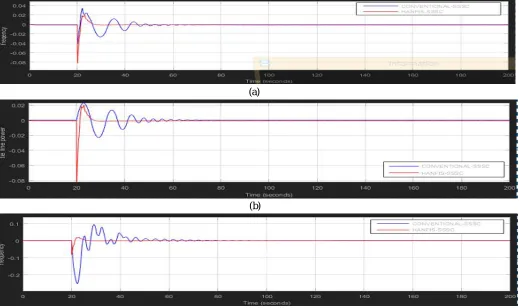
the two-area interconnected system have been shown in fig 10-11. From fig 12, it is evident that the dynamic responses had improved significantly with the use of BFO based HANFIS-SSSC as compared with MOPSO based HANFIS-SSSC, and it can be found that the controller designed for two area thermal reheat power system reduces over voltages, under voltages and dynamic stability and also ensure better stability. As the MOPSO and BFO based HANFIS-SSSC units, suppresses the peak frequency deviations of both areas, governor system continue to eliminate the steady state error of frequency deviations as expected.
(a)
(b)
(c)
Fig:10. Response of two area power system without controller (a, c) Frequency response for area1 and area2, (b) Tie-Line power
(a)
(c)
Fig.11:.Response of two area power system with MOPSO based HANFIS-SSSC, (a, c) Frequency response for area1 and area2, (b) Tie-Line power.
(a)
(b)
[image:11.612.49.568.235.543.2](c)
Fig.13: Response of two area power system with BFO based HANFIS-SSSC (a, c) Frequency response for area1 and area2, (b) Tie-Line power.
Table 3: Comparison of the system performance for the two case studies Two area interconnected
power system
Feedback gain (Kt)
Settling time in seconds Peaks over / under shoot
F1
F2
Ptie
F1 Hz
F2 Hz
Ptie MW Case1:HANFSI-SSSC-MOPSO 1.0748 27.19 20.34 25.18 0.0206 0.02662 0.0087 Case2:
HANFISC-SSSC-BFO 1.0658 21.25 21.13 22.43 0.0118 0.01381 0.0080
VII. CONCLUSION
[image:11.612.65.545.593.695.2]rating SSSC units are connected in series to the two areas interconnected power system through a tie-line and the obtained responses shows that they are capable of consuming the oscillations in area frequency deviations and tie-line power deviations of the power system. Further SSSC units reduce the over/under shoot and settling time of the output responses. Hence, it can be concluded that HANFIS-SSSC-BFO unit is efficient and effective for improving the dynamic performance of load frequency control of interconnected power systems than that of the system with HANFIS-SSSC-MOPSO unit.
A. Appendix
Nominal parameters of the system investigate dF=60Hz,Tg1=Tg2=Tg3=Tg4=Tg5=0.08s,
Tr1=Tr2=Tr3=Tr4=Tr5=10s,H1=H2=H3=H4=H5=5,Tt1=Tt2=Tt3=Tt4=Tt5=0.3sKr1=Kr2=Kr3=Kr4=Kr5=0.5Hz/puMW,Ptiemax= 200MW,Tps1=Tps2=Tps=Tps3=Tps4=Tps5=20s,Kp=Kps1=Kps2=Kps3=Kps4=Kps5=120Hz/p.uMW;T12=0.08674;
Ki=0.1,Ts=0.01,
REFERENCES
[1] ASHMO;E PH, BATTEBURY DR, BOWDLER RK. POWER-SYSTEM MODEL FOR LARGE FREQUENCY DISTURBANCES. PROCEEDINGS OF THE IEEE 1974; 121(7):601–8.
[2] PAN CT, CM. AN ADAPTIVE CONTROLLER FOR POWER SYSTEM LOAD–FREQUENCY CONTROL. IEEE TRANSACTIONS ON POWER SYSTEMS 1989;4(1):122– 8
[3] ANDERSON PM,FOUAD AA.POWER SYSTEM CONTROL AND STABILITY.AMES,IA:IOWA STATE UNIVERSITY PRESS,1977 [4] DEBS AS.MODERN POWER SYSTEMS CONTROL AND OPERATION.NORWELL,MA:KLUWER-NIJHOFF PUBLISHERS,1988.. [5] WOOD AJ,WOLLENBERG BF.POWER GENERATION, OPERATION AND CONTROL.NEW YORK:WILEY,1984.
[6] ELGERD OE.ELECTRIC ENERGY SYSTEM THEORY.NEW YORK:MCGRAW HILL,1982.
[7] MURTY PSR.POWER SYSTEM OPERATION AND CONTROL.NEW DELHI:TATA MCGRAW HILL,1984.
[8] SHAYEGI H,SHAYANFAR HA,MALIK OP.ROBUST DECENTRALIZED NEURAL NETWORKS BASED LFC IN A DEREGULATED POWER SYSTEM.ELECTR POWER SYST RES 2007;77:241–51.
[9] PAN CT,LIAW CM.AN ADAPTIVE CONTROL FOR POWER SYSTEM LFC.IEEETRANS POWER SYST 1989;4(1):122–8. [10] TALAQ J,AL-BASRI H.ADAPTIVE FUZZY GAIN SCHEDULING FOR LFC.IEEETRANS POWER SYST 1999;14(1):145–50.
[11] KOCAARSLAN _ILHAN,C¸ AM ERTUG˘ RUL.FUZZY LOGIC CONTROLLER IN INTERCONNECTED ELECTRICAL POWER SYSTEMS FOR LOAD-FREQUENCY CONTROL. INT JELECTR POWER ENERGY SYST 2005;27(8):542–9.
[12] ANAND B,EBENEZER JEYAKUMAR A.LOAD FREQUENCY CONTROL WITH FUZZY LOGIC CONTROLLER CONSIDERING NON-LINEARITIES AND BOILER DYNAMICS. ICGST-ACSEJ2009;8(III).
[13] Sˇ IJAKTOMISLAV,KULJAOGNJEN,KULJALJUBOMIR,TESˇNJAKSEJID.DESIGN OF FUZZY REGULATOR FOR POWER SYSTEM SECONDARY LOAD FREQUENCY CONTROL.IN:PROCEEDINGS OF THE 10TH MEDITERRANEAN CONFERENCE ON CONTROL AND AUTOMATION –MED2002,LISBON,PORTUGAL,2002.
[14] C¸ AM ERTUG˘ RUL.APPLICATION OF FUZZY LOGIC FOR LOAD FREQUENCY CONTROL OF HYDRO ELECTRICAL POWER PLANTS.ENERGY CONVERS MANAGE 2007;48(4):1281–8
[15] NARENDRA, K.S., AND S. MUKHOPADHYAY, “ADAPTIVE CONTROL USING NEURAL NETWORKS AND APPROXIMATE MODELS,” IEEE TRANS. NEURAL NETWORKS,VOL.8, PP.475-485,1997.
[16] H.DEMUTH ,M.BEALE,M.HAGAN.,NEURAL NETWORK TOOLBOX USER’S GUIDE.
[17] J.NANDA S.MISHRA "A NOVEL CLASSICAL CONTROLLER FOR AUTOMATIC GENERATION CONTROL IN THERMAL AND HYDROTHERMAL POWER ELECTRONICS, DRIVES AND ENERGY SYSTEMS(PEDES)6,2010
[18] J .A. JALEEL, T.P.I.AHAMMED, "SIMULATION OF ANN CONTROLLER FOR AUTOMATIC GENERATION CONTROL OF HYDROELECTRIC POWER SYSTEM", TENCON-2008,PP.1-4,2008
[19] I.A..CHIDAMBARAM,R.FRANCIS,"AUTOMATIC GENERATION CONTROL OF A TWO AREA REHEAT INTERCONNECTED SYSTEM BASED ON CPS USING FUZZY NEURAL NETWORK",EMERGING TRENDS IN ELECTRICALAND COMPUTER TECHNOLOGY (ICETECT), PP.200-205,2011
[20] LIVINGSTONE DAVID.J.ARTIFICIAL NEURAL NETWORKS
[21] C.S.CHANG,WEIHUIFU,AREA LOAD FREQUENCY CONTROL USING FUZZY GAIN SCHEDULING OF PI CONTROLLERS ,ELECTRIC POWER SYSTEMS RESEARCH, VOL.42,1997, PP.145-52
[22] K.P.SINGH PARMAR,S.MAJHI AND D.P.KOTHARI,AUTOMATIC GENERATION CONTROL OF AN INTERCONNECTED HYDROTHERMAL POWER SYSTEM,IEEE CONF. PROCEEDINGS,INDICON2010,KOLKATA,INDIA
[23] PASSINO.K.M,“BIOMIMICRY OF BACTERIAL FORAGING FOR DISTRIBUTED OPTIMIZATION AND CONTROL”, IEEECONTROL SYSTEM MAGAZINE,VOL.22,NO.3, PP.52-67,2002
[24] MISHRA.S AND BHENDE.C.N,“BACTERIAL FORAGING TECHNIQUE-BASED OPTIMIZED ACTIVE POWER FILTER FOR LOAD COMPENSATION”,IEEETRANSACTIONS ON POWER DELIVERY,VOL.22,NO.1, PP.457-465,2007
[25] ELGERD.O.I.,ELECTRIC ENERGY SYSTEMS THEORY AND INTRODUCTION,2ND EDITION,NEW DELHI, INDIA;TATA MCGRAW-HILL,1983 [26] SHYKIN“NEURAL NETWORK „MAC MILLER NY1994.
[27] D.M.VINOD KUMAR "INTELLIGENT CONTROLLERS FOR AUTOMATIC GENERATION CONTROL"IEEE TRANSACTIONS PP.557-574,1999
[28] NARENDRA,K.S., AND S.MUKHOPADHYAY,“ADAPTIVE CONTROL USINGNEURAL NETWORKS AND APPROXIMATE MODELS,” IEEE TRANS. NEURALNETWORKS, VOL.8, PP.475-485,1997.
[29] H.DEMUTH ,M.BEALE,M.HAGAN.,NEURAL NETWORK TOOLBOX USER’SGUIDE.