Heterogeneity in Mobile Cloud Computing:
Taxonomy and Open Challenges
Zohreh Sanaei,
Member, IEEE,
Saeid Abolfazli,
Member, IEEE
, Abdullah Gani,
Senior Member, IEEE
and
Rajkumar Buyya,
Senior Member, IEEE
Abstract—The unabated flurry of research activities to aug-ment various mobile devices by leveraging heterogeneous cloud resources has created a new research domain called Mobile Cloud Computing (MCC). In the core of such a non-uniform environment, facilitating interoperability, portability, and inte-gration among heterogeneous platforms is nontrivial. Building such facilitators in MCC requires investigations to understand heterogeneity and its challenges over the roots. Although there are many research studies in mobile computing and cloud com-puting, convergence of these two areas grants further academic efforts towards flourishing MCC. In this paper, we define MCC, explain its major challenges, discuss heterogeneity in convergent computing (i.e. mobile computing and cloud computing) and networking (wired and wireless networks), and divide it into two dimensions, namely vertical and horizontal. Heterogeneity roots are analyzed and taxonomized as hardware, platform, feature, API, and network. Multidimensional heterogeneity in MCC results in application and code fragmentation problems that impede development of cross-platform mobile applications which is mathematically described. The impacts of heterogeneity in MCC are investigated, related opportunities and challenges are identified, and predominant heterogeneity handling approaches like virtualization, middleware, and service oriented architecture (SOA) are discussed. We outline open issues that help in identi-fying new research directions in MCC.
Index Terms—Mobile Cloud Computing, Vertical and Hori-zontal heterogeneity, Mobile computation offloading, Interoper-ability, PortInteroper-ability, Seamless communication.
I. INTRODUCTION
T
HE popularity and availability of mobile devices such as smartphones, which are offering ubiquitous communica-tion and informacommunica-tion services, are creating such a dependency that one does not leave home without them. Smartphones possess a likelihood of one-upmanship from notebooks and desktops [1]. These smart handheld computers will generate 150.6-billion-dollar benefits by the end of 2014, while devices like PDAs will bring in 2.7 billion dollars comparatively [2]. Hence, with the increasing ubiquity of smartphones, the greater demand for heavier applications with high quality ofManuscript received May 5, 2012; revised November 14, 2012 and February 28, 2013; accepted April 20, 2013. This work is funded by the Malaysian Ministry of Higher Education under the University of Malaya High Impact Research Grant - UM.C/HIR/MOHE/FCSIT/03.
Zohreh Sanaei, Saeid Abolfazli, and Abdullah Gani are with the Department of Computer System & Technology, The University of Malaya, Kuala Lumpur, Malaysia (e-mail:{sanaei,abolfazli}@ieee.org; [email protected]).
Rajkumar Buyya is with the Cloud Computing and Distributed Systems (CLOUDS) Laboratory, Department of Computing and Information, The University of Melbourne, Parkville, Melbourne, VIC 3010, Australia, Email: [email protected].
experience is gaining ground. However, smartphones’ minia-ture naminia-ture, lightness, and mobility impose intrinsic limits on their processing abilities, battery lifetime, storage capacity, and visualization power (e.g. screen size and rendering capability). These restraints impede executing resource-intensive tasks and storing large amount of data on smartphones.
To overcome some of these limitations, Satyanarayana [3] proposes cyber foraging approach. In this approach, mobile augmentation is achieved via offloading applications (entirely or partially) to resource-rich, non-mobile computing devices in the vicinity called surrogates to provide heavy functionality and to conserve local resources, especially energy. Proposals similar to Spectra [4] and Scavenger [5] are aimed to augment mobile devices leveraging cyber foraging. However, safety and reliability are the major challenges for migrating codes to the surrogates in the absence of authorities supervising functionality, performance, and the reliability of surrogates [6]. Alternatively, cloud computing [7]–[9] as a distributed com-puting paradigm has recently obtained momentous ground in augmenting mobile devices. MAUI [10], CloneCloud [11], and Elastic Applications [12] are some efforts that exploit clouds infrastructures to mitigate resource poverty of mobile devices. ABI Research forecasts that by the end of 2015 more than 240 million mobile business users will utilize cloud services driving nearly $5 billion in revenues [13]. Deploying cloud resources is a complex task that obliges programmers to acquire specific skills. To mitigate such design and program-ming overhead, cloud computing software platforms such as Eucalyptus [14] was developed to facilitate cloud deployment and management in IT business.
development for deployment in real augmentation scenarios. MCC is a convergent technology comprised of three cor-nerstone heterogeneous technologies, namely mobile comput-ing, cloud computcomput-ing, and networking. Such heterogeneity aggregation complicates MCC and decelerates its success. In the mobile computing landscape, the vast variety of mobile devices with different operating systems(OSs), platforms, and wireless network standards is making mobile application de-velopment a major challenge for developers [17]. Also, from the mobile user perspective, application and data migration incur redundant monetary and temporal costs in the case of shifting from one platform to another.
In the cloud ecosystem, the rapid development of cloud computing in the absence of early standards beside fragmented business policies have created various types of heterogeneity (e.g. hardware and platform) that give rise to new problems such as vendor lock-in. Vendor lock-in problem is the state when code and data cannot (easily) be moved from one cloud to another because of dissimilarities among underlying ar-chitectures and programming languages. Though the problem might be attractive in business competition [18], it causes sev-eral challenges particularly data integrity, interoperability, and portability. Hence, cloud-users become vulnerable to problems like (i) reliability if the service provider stops serving requests, (ii) data extraction from the hosting server(s), and (iii) a price hike.
Furthermore, the convergence of heterogeneous wireless networks (e.g. WLAN and cellular) and wired networks makes MCC more challengeable than cloud computing. Intermittency, low security, and a high probability of signal interception in wireless networks are factors that degrade communication quality and increase application response time. These chal-lenges are intensified when mobile users cross the Internet channel to utilize cloud services.
To actuate MCC vision, essential requirements like (i) man-aging distributed data between heterogeneous cloud servers [19], (ii) unifying network connectivity, (iii) utilizing IP-based wireless systems [20], and (iv) establishing common application programming interface (API) standards for mobile services (e.g. GSMA OneAPI [21]) as well as cloud services (e.g. OCCI [22] and OVF [23]) should be met. Furthermore, underpinning requisitions i.e. ubiquity, energy efficiency, and trust can enhance user experience quality toward unleashing the power of MCC [24].
To address the challenges within MCC, academic and in-dustrial communities are bound together. Academic proposals particularly Cloudlet [25], Mirage [26], RASIC [27], and Cloud Mobile Hybrid (CMH) Applications [28] are sought to mitigate heterogeneity-caused problems by leveraging ap-proaches particularly virtualization, middleware, semantic, Service Oriented Architecture (SOA), and Domain Specific Language (DSL). In industry, Marmalade [29] and PhoneGap [30] are some of the cross-platform toolkits that aim to reduce developers’ workload by automatically transiting the mobile application code to the required platform (e.g. Android1 and
1http://www.android.com/
Blackberry2). However, building cloud-mobile applications in two widely divergent environments (i.e. mobile and cloud) is maturating and necessitates further research. Surveys such as [31], [32] provide extensive overview of MCC including some challenges and advantages that sufficiently reflect the current trend in MCC. However, comprehensive study on heterogeneity in MCC as a root of great number of challenges is lacking.
This article provides a comprehensive study on MCC het-erogeneity, presents MCC definition, and describes challenges that are either caused or intensified by heterogeneity. Taxon-omy of heterogeneity roots in MCC is devised according to the fragmentation in mobile computing, cloud computing, and networking environments. Heterogeneity in MCC is analyzed and classified into vertical and horizontal aspects based on heterogeneity raised in mobile devices, clouds, and wireless networks. Furthermore, application and data fragmentation are described and the impacts of heterogeneity in MCC are presented. The survey ends by reviewing major heterogeneity handling techniques and describing few open issues as future research directions. In the burgeoning heterogeneous MCC domain, the comprehension and settlement of fundamental problems in the early development stages leads to the success of MCC. Considering the dominating popularity of smart-phones compared to other mobile devices, this article studies smartphones as the main mobile computing devices. The terms mobile devices and smartphones are used interchangeably with the same notion.
The remainder of this paper is organized as follows. The next Section presents an overview of MCC and discusses its major challenges. Section III devises taxonomy of hetero-geneity roots and describes heterohetero-geneity dimensions (vertical and horizontal) in MCC. Impacts of heterogeneity in MCC is identified in Section IV. Technologies and techniques for alleviating the challenges of heterogeneity are discussed in Section V. Finally, Section VI highlights open issues and the paper concludes in Section VII.
II. MOBILECLOUDCOMPUTING(MCC)
Resource poverty is a major shortcoming of mobile comput-ing. Recently, the connotation of MCC has arisen in order to overcome the resource deficiency of mobile devices, especially smartphones. In order to bring a clear understanding of MCC and its challenges, we examine the respective definitions of mobile computing, ubiquitous computing, cloud, and cloud computing.
A. Definitions
There are several definitions in mobile computing [33], [34], ubiquitous computing [35], [36], cloud [7], and cloud computing [8]. Here are some of the definitions deemed generic enough to understand the fundamentals.
Mobile Computing. The design of small, powerful devices enables mobility in wireless networks that supports a trend toward computing on the go, known as mobile computing.
Satyanarayana [37] describes the vision of mobile comput-ing as “information at fcomput-ingertips anywhere, anytime”, while Imielinski and Korth [33] discuss that “The mobile computing no longer requires users to maintain a fixed and universally known position in the network and enables almost unrestricted mobility”.
Ubiquitous Computing.Mark Weiser [35] defines ubiquitous computing as “the method of enhancing computer use by making many computers available throughout the physical environment, but making them effectively invisible to the user”.
Cloud. Cloud is a rich computing resource. Buyya, Yeo, and Venugopal [7] propose one of the most popular definitions for cloud as “a type of parallel and distributed system consisting of a collection of interconnected and virtualized computers dynamically provisioned and presented as one or more unified computing resources based on service-level agreements estab-lished through negotiation between the service provider and consumers”.
Cloud Computing.Cloud computing is a computing technol-ogy that leverages cloud’s resources for “enabling ubiquitous, convenient, on-demand network access to a shared pool of con-figurable computing resources (e.g., networks, servers, storage, applications, and services) that can be rapidly provisioned and released with minimal management effort or service provider interaction”, as NIST [8] describes.
Based on these definitions and our observation of the essence of what and how MCC landscape is deemed, the following definition is proposed.
Mobile Cloud Computing is a rich mobile computing tech-nology that leverages unified elastic resources of varied clouds and network technologies toward unrestricted functionality, storage, and mobility to serve a multitude of mobile devices anywhere, anytime through the channel of Ethernet or Internet regardless of heterogeneous environments and platforms based on the pay-as-you-use principle.
B. Vision
MCC is the state-of-the-art mobile computing technology that aims to augment a multitude of mobile devices, especially smartphones and alleviate their resource poverty. Mobile users can have access to their applications, data, and cloud services through the Internet by leveraging mobile web [31]. This futuristic accomplishment will be employed in several areas like healthcare (e.g. telemonitoring and telesurgery), educa-tion, IT Business, rural and urban development, and social networking. In our previous work [38], smartphone augmen-tation approaches are reviewed and a taxonomy is defined which is depicted in Figure 1. Technological advancement in manufacturing high-end mobile resources is slower than the ever-growing expectations of mobile users and application requirements. Hence, soft resource augmentation is necessary for delivering user-centric computing capabilities [3] equal to user expectations. We advocated that cloud computing is the predominant technology recently deployed to augment smart-phones by reducing application resource requirements. Several efforts such as [10], [12], [39]–[42] deploy cloud computing technology to enhance the capability of smartphone.
Moreover, cloud computing is beneficial in enhancing infor-mation safety and security. Storing data in smartphones local storage is a hazardous practice due to their susceptibility to theft, loss, and physical damage. Cloud data storage is envi-sioned to enhance data safety and security, provide pervasive accessibility, and facilitate data portability and synchronization among several devices (e.g. smartphones and PCs). DropBox3, SugarSync4, and Box5 are examples of cloud storage services. People exploit such huge data warehouses to store and retrieve their data (bulk data) which are accessible from various devices. Users can even access their data through the Internet by utilizing public devices and providing unique credentials.
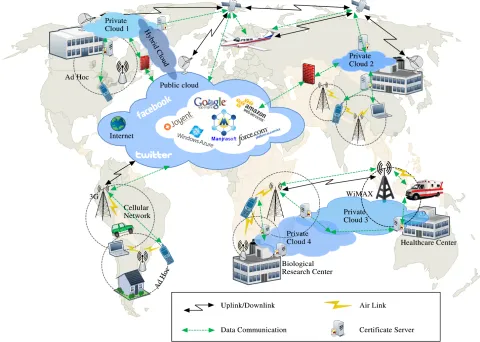
The advent of MCC has advanced into a technological revolution providing profitable opportunities for several do-mains such as healthcare, e-learning, and the tourism industry. It connotes the impression to reduce development cost and stimulate execution of resource-intensive mobile applications by leveraging distant rich resources to enhance the quality of user experience. Figure 2 illustrates a conceptual view of MCC and depicts its usability in several domains such as healthcare, social networking, urban development, and vehicular tech-nology. It shows the possibility of utilizing geographically distributed private clouds (e.g. medical and biological research groups), public clouds (e.g. Google6 and Facebook7), and hybrid clouds (that can be generated by converging private and public clouds) in global roaming. It is notable that authorized mobile users can utilize more than one private cloud simultane-ously. Furthermore, Figure 2 illustrates heterogeneity in MCC among varied mobile devices, communication networks, and clouds. Although heterogeneity has been existing in mobile and cloud computing domains, accumulated intensity and complexity make it a unique, challenging feature within MCC that necessitates a comprehensive study.
C. Heterogeneity
Heterogeneity in MCC is the existence of differentiated hardware, architectures, infrastructure, and technologies of mobile devices, clouds, and wireless networks. The cutting edge technologies are expected to initiate and facilitate collab-oration among these heterogeneous computing devices toward unrestricted mobile computing.
Heterogeneity in Mobile Devices: Software, hardware, and technology variation among mobile devices cause heterogene-ity in this domain. Moreover, increasing popularheterogene-ity of smart-phones creates a dynamic and demanding market that disperse them to different dimensions, e.g. brand, hardware, OS, fea-ture, and communication medium. Consequently, device-level collaboration becomes more challenging in MCC.
Heterogeneity in Clouds: Numerous cloud vendors provide different services with custom-built policies, infrastructures, platforms, and APIs that make the cloud landscape heteroge-neous. Such variations cause interoperability and portability
Fig. 1. Taxonomy of Smartphone Augmentation Approaches.
[43] as major challenges in cloud computing. There is a notion [18] that business competition also diversifies cloud providers with their heterogeneous frameworks, exacerbating heterogeneity on the cloud side.
Heterogeneity in Wireless Networks: In MCC, the majority of communications take place in the wireless network envi-ronment which is a heterogeneous communication medium. Variations in wireless networks and their related technologies impact the delivery of cloud services and affect mobility, augmentation, and usability of smartphones [38].
D. Challenges
In the MCC landscape, an amalgam of mobile computing, cloud computing, and communication networks (to augment smartphones) creates several complex challenges. This part describes challenges either stemmed or intensified by hetero-geneity. Although some of these challenges such as seamless connectivity, vendor lock-in, and security and privacy are common with mobile computing and cloud computing, we aim to highlight how different are these traditional challenges and in what extent they increase the complexity in MCC.
• Mobile Computation Offloading: Leveraging heteroge-neous cloud resources to augment computing limitations of multitude of mobile devices towards realizing the vision of unrestricted functionality, storage, and mobility in current diverse communication environment is a non-trivial task. Realizing cloud-based augmentation vision is impeded by multi-dimensional overhead of identifying and efficiently partitioning resource intensive compo-nents, VM (Virtual Machine) creation and migration, and monitoring the overall outsourcing process [44]. More-over, a plethora of hurdles in utilizing cloud resources such as latency, heterogeneity, security (both offloaded code and cloud permanent software), code portability, and cloud-mobile interoperability intensifies the situation. Although several efforts such as CloneCloud [11], MAUI [10], Cloudlet [25], SAMI [45], and MOMCC [46] are facilitating and promoting cloud-based computation of-floading, still research and development in this domain remains a top priority.
• Seamless Connectivity: Wireless networks are charac-terized by low-bandwidth, intermittent, and less-reliable
transmission grounds compared with the wired networks. Establishing and maintaining seamless sessions between nomadic MCC users (leveraging cloud computation or storage) and other entities (e.g. smartphones and clouds) in a wireless medium composed of heterogeneous net-work technologies are critical issues to fully unleash the power of MCC [24]. The intermittent connectivity causes several challenges such as dismissal of always-on connec-tivity, excessive consumption of limited mobile resources, and disproportionate delaying of application execution that sharply degrade quality of computing services. Seamless connectivity in heterogeneous MCC envi-ronment demands reliable inter-system signal handoff schemes along next generation wireless networks [47]. Unstable wireless bandwidth, low wireless network se-curity, and the high probability of signal interception are challenges likely intensified by crossing the Internet channel in order to utilize the cloud services for mobile augmentation.
• Long WAN Latency: Latency adversely impacts on the
energy efficiency [48] and interactive response [49] of cloud-mobile applications by consuming excessive mo-bile resources and raising transmission delays. In cellular communication, distance from the base station (near or far) and variation in bandwidth and speed of various wireless technologies affect the energy efficiency and usability of MCC devices. For example, data transfer bit-rate consumes comparatively more energy in cellular net-works than WLAN. The higher the transmission bit-rate, the more energy efficient the transmission [48]. Moreover, leveraging wireless Internet networks to offload mobile intensive applications to distant cloud resources creates a bottleneck. Consequently, the long WAN latency is increased while the quality of user experience is de-creased. To reduce interaction latency, proposals such as Cloudlet, MOMCC, and SAMI are proposed to create a proximate cloud to access nearby remote resources, but further advancement to achieve crisper response is required.
mo-Fig. 2. A Conceptual View of Mobile Cloud Computing.
bility pattern, and user service requirements [20]. To achieve the converged wired, mobile, and broadband communication not only accurate and efficient mobility management schemes are prerequisite, but also seamless integration and interoperation of mobility management approaches to address intrasystem and especially intersys-tem mobility is mandatory in MCC environment. Hence, an adaptive protocol suit similar to AdaptNet [50] is essential to alleviate a plethora of heterogeneity-made issues, particularly rate adaptation and congestion control, and provide interoperation among various networks. In-tegration and interoperation of converged heterogeneous networks in MCC demand lightweight, resource- and cost-effective, sustainable, and user-friendly approaches with optimized performance to address seamless mobility. Realizing such vital need with least signal traffic and latency can significantly enrich quality of cloud-mobile user experience.
• Context-Processing: Contemporary mobile devices are capable of gathering extensive context and social infor-mation, specifically available cloud resources, network bandwidth, weather conditions, and users’ voice and gestures from their surrounding environment [51], [52]. Exponential growth in context and social information
(considering environment dynamism and mobility of mobile clients) creates several challenges such as stor-ing, managstor-ing, and processing information on resource-constraint smartphones. Although cloud infrastructures are connoted to be a suitable platform for context storage, management, and processing [53], the need for an energy-efficient, reliable, and robust cloud-mobile data migration and communication is unavoidable.
[image:5.612.64.544.62.404.2]experience in MCC. Researchers [10]–[12] endeavoured to mitigate application offloading challenges by exploit-ing secure, reliable, elastic cloud resources instead of insecure, limited surrogates resources. However, cloud-based application offloading cannot always save energy with current developments and demands further efforts [6], [60], [61]. Therefore, the energy constraint of mobile nodes remains a challenge in MCC.
• Vendor/data Lock-in:Variety of cloud servers and mobile devices beside a silo of varied OSs and applications on one hand and non-uniformity of APIs in the absence of underpinning standards on the other hand, intensify data lock-in problem in MCC that bounds customers to a specific mobile device and cloud provider. For example, if cloud-mobile users utilize Apple iCloud8 as an automatic cloud-based storage service developed and dedicated to Apple products, no data fetch from non-Apple devices is addressable. Alleviating vendor lock-in problem lock-in MCC is more challenglock-ing compared with cloud computing. Vendor lock-in solutions need to be applied in both mobile and cloud sides in an interoperable manner (different mobile nodes can communicate with different cloud vendors) which is excessively challenging. • Security and Privacy: A drastic hike in cyber crimes and Internet threats [62], mandates restricted security provisions for publicly accessible cloud resources, es-pecially storage. At a cursory glance, security is only an issue for requesters, but in a deep view, service providers need to set up tighter security provisions to protect their properties and clients privacy. Ensuring user privacy and security of varied mobile applications running on different mobile devices that utilize heterogeneous cloud resources are the most challenging tasks in MCC. Security and privacy in MCC become more volatile compare to cloud computing due to the insecure nature of wireless communication medium. Hence, the absence of adaptive, rationalized, and rigorous security arrangements is a potential challenge with catastrophic consequences for service providers and requesters in MCC.
• Elasticity: Cloud providers confront situations in which there are more demands than available resources. Adverse impact of cloud-resource unavailability and service inter-ruption for MCC clients is more severe than stationary clients connected to the wall power and fixed network. Frequent suspension of energy-constraint mobile clients due to resource scarcity, not only shrinks usefulness of cloud outsourcing for MCC end-users, but also divests privilege of intensive computation anytime, anywhere from mobile users.
Therefore, several challenging tasks (e.g. resource pro-visioning without service interruption, quick disaster re-covery, and high service availability) need to be realized since service unavailability and interruption prolong ex-ecution time, increase monitoring overhead, and deplete smartphones’ local resources, especially battery. Emerg-ing solutions such as Reservoir [63] can be employed
8http://www.apple.com/icloud/
to expand and contract cloud resources on demand with main focus on mobile clients.
• Cloud Policies for Mobile Users:Cloud service providers apply certain policies to restrain service quality to a desired level by imposing specific limitations via their intermediate applications like Google App Engine bulk loader9. Also, service provisioning, controlling, balanc-ing, and billing are often matched with the requirements of desktop clients rather than mobile users. Considering the great differences in wired and wireless communi-cations, disregarding mobility and resource limitations of mobile devices in design and maintenance of cloud structures can significantly impact on feasibility of MCC solutions. Metrics such as bandwidth quota and number of API calls per day limit clients and impact on user experience [64]. Hence, it is essential to amend restriction rules and policies to meet MCC users requirements and realize intense mobile computing on the go.
• Service Execution and Delivery: Cloud-mobile users, require an efficient monitoring means to measure and evaluate the quality of service they receive. SLA as a formal contract is employed and negotiated in advance to enforce certain level of quality against a fee. During negotiation phase, the terms of services are defined, while the real-time performance is screening during monitoring phase. However, considering MCC dynamism, several network challenges such as inconsistent bandwidth and packet delivery ratio, delay, jitter, and network blips ham-per service delivery, raise ambiguity, and increase dispute between cloud vendors and MCC end-users. Therefore, current static SLA can be fleshed out with more powerful, dynamic representation and monitoring techniques estab-lished in heterogeneous wireless environment for cloud-mobile users.
• MCC Billing:Client mobility in the rapidly changing en-vironment diverges the cloud billing system in MCC from cloud computing. Designing an appropriate billing sys-tem for MCC with dynamic heterogeneous environment requires considering additional parameters compared with cloud computing. Interception latency, jitter, session re-establishment delay, bandwidth capacity, and quality of security are examples of major parameters in designing a MCC billing system.
Designing an appropriate billing system for cloud-mobile users that continuously adapts to the heterogeneity and dynamism of MCC environment requires considering additional parameters compared with cloud computing. Interception latency, jitter, session re-establishment delay, bandwidth capacity, and quality of security are examples of major parameters in designing a MCC billing system.
Review of challenges in MCC highlights that heterogeneity has remarkable impacts on mobile computation offloading, seamless connectivity, long WAN latency, mobility manage-ment, and vendor/data lock-in which encumber resource-intensive computing on the go and necessitate in-depth anal-ysis. Also, managing billing systems and SLAs in MCC
become more complex considering heterogeneity among var-ied entities which demand upfront consideration on several parameters. Hence, mitigating the impact of heterogeneity can significantly enhance quality of MCC and extend usability of mobile devices to more resource-intensive computing areas. Due to its vital influence, we comprehensively analyze roots of heterogeneity in the following section.
III. TAXONOMY OFHETEROGENEITY INMCC In this section, we comprehensively study heterogeneity in MCC by analyzing roots and dimensions of heterogeneity. We identify heterogeneity roots as hardware, platform, fea-ture, API, and network and devise a taxonomy depicted in Figure 3. We further scrutinize heterogeneity and realize that heterogeneity in MCC can be classified into two categories, namely verticalandhorizontal that is shown in Figure 6.
A. Heterogeneity Roots in MCC
Being heterogeneous is neither a new paradigm nor limited to a specific domain. If we look around we may capture: (i) people speak different languages, but can talk to each other by using a translator (human or tools) or through a common language; (ii) all body parts are intrinsically heterogeneous, but cooperate very concisely and consciously to keep the body fully operational. Similarly, three various components (i.e. mobile devices, clouds, and wireless networks) in MCC should seamlessly cooperate and communicate with each other to benefit mankind, however, some causes make the situation difficult to flourish MCC vision that we examine them as follows.
1) Hardware Heterogeneity: Variety of hardware with dif-ferent inward architecture between mobile devices, cloud servers, and network infrastructures (e.g. access points, radio transceivers, and routers) trigger hardware heterogeneity in MCC.
In the cloud environment, cloud providers maintain different infrastructures and architectural design to enhance quality of their service. Servers use X86 CISC (Complex Instruction Set Computer) architecture with two variations of 32-bit and 64-bit. Moreover, cloud infrastructures gradually grow more heterogeneous due to upgrade and replacement. The emerging growth of cloud computing will increase the number of ge-ographically distributed cloud nodes that intensifies hardware heterogeneity among cloud providers.
The inward architecture and resource specifications of mobile devices such as processor speed, internal memory, radio specification, and battery capacity vary widely among different brands and models. The majority of smartphones are built based on 32-bit ARM RISC (Reduced Instruction Set Computer) processor architecture, but there is a large variation in terms of speed, number of cores, and amount of processor cache which suits them in specific domains. For instance, among recent Cortext series processors, Cortex-A is ideal for computing intensive multi user applications while Cortex-R is more suitable for real-time data processing scenarios [65]. In the near future, the 64-bit ARM processors are expected to increase the heterogeneity among smartphones [66].
Hardware and architectural heterogeneity among mobile devices and cloud servers hamper direct deployment of cloud resources and services in mobile devices and leads to several problems as below.
• Imbalanced quality and performance:Variation in com-puting resources and their implementations diversify per-formance and quality of cloud services. Although such variation triggers business competition towards improved services and avoids service monopoly, it negatively af-fects the business cooperation among cloud providers and complicates user’s decision making in choosing the most appropriate vendor among available options. To facilitate the user’s decision making, a comprehensive study and comparison among reputed cloud vendors is presented in [67]. Users can compare and contrast the service quality of each vendor from various aspects.
• Data management and integrity:The increasing number of very large scale geographically distributed data ware-houses and the non-similarity of data structures compli-cate data management. Integrating huge distributed data and providing virtually unified storage for mobile users is becoming more complicated with the ever increasing heterogeneity in MCC [19].
• Interoperation: Data interoperation is the ability of con-necting heterogeneous systems (based on wired or wire-less), understanding geographical information resources, and exchanging data between/across two or more hetero-geneous systems [68]. However, in MCC infrastructure diversity among various clouds on one hand and dissim-ilarities between cloud and mobile infrastructures with existence of wired against wireless network hardware systems on the other hand, have created data integration and interoperation problems in the absence of interface’s standards and uniform platforms. For example, when Alice moves from current city to another while utilizing a nearby cloud ’A’ via her Android mobile device, remote data (in part or whole) might be migrated to a nearer cloud ’B’ for the sake of performance. In this situation, if the cloud ’B’ fails to connect to the cloud ’A’, if cloud ’B’ cannot understand cloud ’A’ database information after establishing a connection, or fail to exchange data with cloud ’A’, the Alice computing experience will be degraded because of data interoperation problem. • Portability:Codes are not easily movable and executable
to/on heterogeneous hosts and the privilege of “write once run anywhere” is divested from developers. For instance, the application written for quad-core processor is not executable on dual-core processor due to architectural and hardware dissimilarities. Similarly, the applications developed for the ARM architecture cannot be executed on X86 without code modification and re-configuration. • Accurate energy estimation: One of the most important
Fig. 3. Taxonomy of Heterogeneity Roots in MCC.
save energy or not [61]. If the remote execution can save energy, then the offloading is performed, otherwise the application is either terminated or executed locally. How-ever, estimating energy efficiency of offloading is a non-trivial task due to heterogeneity of wireless technologies and infrastructures. Metrics such as power and bit-rate of wireless modems, activating time of interface, activation and deactivation delay of interface, and traffic pattern complicate accurate energy estimation. Also, varied hard-ware technologies and implementations are different in terms of power consumption [69]. Therefore, precise estimation of required energy for application execution is difficult in different platforms.
• Cloud-mobile application development: Developing
cross-platform components (i.e. cloud, mobile, and hybrid) for cloud-mobile application is a complicated task. Mobile components should be able to move among various smartphones while cloud components must be portable to all cloud infrastructures. The hybrid components should easily travel among various smartphone and cloud platforms.
To address these problems, Stone et al. [70] propose OpenCL as a parallel programming standard for heterogeneous computing devices. OpenCL enables developers to create desktop applications executable on various types of computing elements like multicore CPU, GPU, and other accelerators. The same approach can be maintained in the cloud which shrinks hardware heterogeneity. Applications developed for certain architectures using OpenCL can be ported to other architectures with guaranteed correct functionalities. Using multiple programming strategies, the application can query hardware specifications and capabilities of the hosting machine and choose an appropriate kernel to increase correctness and compatibility. However, developing and managing several kernels incur extra cost and encumbrance beside occupying lots of space.
To dilute the impact of hardware variety in the cloud and smartphones, Madhavapeddy et al. [71] propose a cloud OS called Mirage, based on virtualization technology. Mirage runs
on top of a hypervisor to produce cross-platform applications that are portable to a plethora of mobile devices and cloud servers. In the Mirage, applications are developed on normal OS like Linux and then compiled into a kernel that is able to run directly on mobile devices and virtual clouds. Figure 4 depicts the layered architecture of Mirage that links the microkernel to an application on top of the hypervisor. Mirage microkernel leverages Xen hypervisor to lessen the impact of architecture heterogeneity of mobile and PCs on mobile applications. However, creating, maintaining, and destroying VM over a smartphone consume local resources and shorten battery life.
Huerta-Canepa and Lee [72] create a virtual cloud com-puting platform in the absence of a real cloud to augment mobile devices using an ad-hoc network of mobile phones. In this approach impact of hardware heterogeneity is mitigated by leveraging smartphones as remote servers instead of using desktop machines or cloud servers. Similarly, Marinelli [73] propose a MCC platform composed of Android smartphones called Hyrax to lessen the architectural impact of non-ARM (X86) devices. However, using smartphones as cloud providers is hindered by two main challenges. Firstly, giant cloud processing resources are exchanged for limited resources of smartphones. Secondly, the lack of appropriate security and billing mechanisms for individual smartphone owners, discour-age the sharing of scarce resources. However, mutual benefits of individual smartphone clients will likely encourage resource sharing in this context.
2) Platform Heterogeneity: Platform heterogeneity is the availability of various OSs, programming languages, and data structures in MCC. Currently, a plethora of heterogeneous mobile OSs such as Google’s Android and Apple’s iOS, each with multiple versions, developed to provide rich, compelling services to end-users. Each platform supports different com-binations of programming language and data structures. For instance, Android offers Java language, native code with JNI, and C/C++, while iOS supports Objective-C [17].
cloud providers such as Amazon Web Service (AWS)10, Google App Engine11, and Microsoft Azure12 offer different OSs, programming languages, and data structures. Windows Azure supports a multiple choice of languages like .NET, PHP, Ruby, Phyton, and Java [74], whereas Google App Engine supports Java and its products plus Ruby and Python. AWS supports most developing languages and offers SDK for Android and iOS smartphones [75]. Azure is built on the SQL, while the App Engine datastore includes GQL, and Amazon’s Dynamo system [76] has a different structural design and partitioning scheme. Cloud providers enforce restrictions in databases to provide more flexible services.
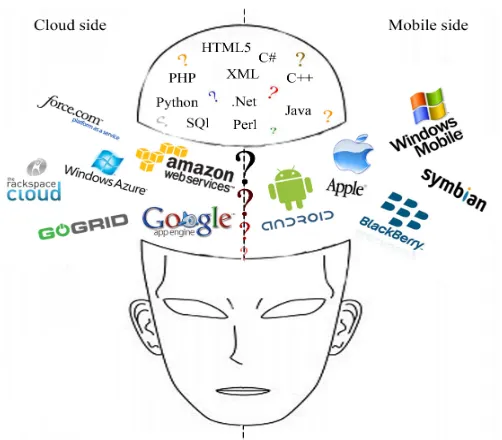
Such non-uniformity makes an irksome impediment for cloud-mobile users and application developers. Portability and data integrity problems are also exacerbated in MCC and porting data to different clouds imposes extra monetary and temporal costs. The costs may include downloading data from the current cloud, performing required modification and conversion, and uploading data to the new cloud. Therefore, mobile users, especially corporate mobile users with bulk sensitive data face problems in transferring a huge amount of data between heterogeneous clouds because it is a costly, time consuming, and risky process [77]. Millions of records stored in a cloud database cannot be utilized in another cloud without compromising privacy and integrity when there is a difference between file systems and encryption techniques. Figure 5 depicts heterogeneous platforms and programming technologies in the cloud and mobile domains, and challenges for application programmer in selection of a suitable develop-ment environdevelop-ment or a programming language.
Furthermore, application development is a complex task due to platform heterogeneity. Developers need to acquire exten-sive knowledge of various mobile and cloud programming languages to be able to migrate the application from one platform to another. To mitigate the impact of platform hetero-geneity on application portability, several cloud-ready appli-cation transition solutions such as Marmalade and PhoneGap are proposed to automatically generate compatible codes for various platforms. Though these approaches reduce the impact of heterogeneity on the application development process, the effort is not congruous with the definition of portability offered by the InterNational Committee for Information Technology Standards (INCITS) [78] as portability is the capability of transferring one application from one device to a wide range of devices with little or no modification and conversion.
For MCC applications, we need a unified application envi-ronment similar to Aneka [79], which allows one to develop cloud applications and deploy them on multiple cloud infras-tructures such as AWS, Azure, and GoGrid13 in a seamless manner. Although Aneka was developed to serve stationary clients, minor extensions and modifications (depending on the needs of client applications) can be performed to leverage Aneka in mobile environments.
[image:9.612.383.493.52.136.2]10http://aws.amazon.com 11https://appengine.google.com/ 12http://www.windowsazure.com 13http://www.gogrid.com/
Fig. 4. Mirage Approach with Statistically-linked Kernel and App. [71]
3) Feature Heterogeneity: Feature heterogeneity in MCC is a result of feature variations in the mobile and cloud domains. Feature heterogeneity in smartphones is due to variation in native features like multimedia, sensing, and interaction tools, visualization area, and networking technologies. For instance, HTC Sensation14 possesses an 8MP camera while BlackBerry Curve 852015 provides 2MP camera. Hence, the development process and performance of applications on various devices are different. For example, the bar code reader application whose functionality depends on the quality of captured image may not offer similar functionality in HTC Sensation and BlackBerry Curve 8520.
Differentiation in sensing apparatuses and interaction fea-tures intensify application portability and usability. Recently, sensing tools such as tilting sensors have received noticeable attention from academia and the industry to enhance the quality of interaction in smartphones. In various proposals [80], [81] authors exploit sensing tools such as accelerometer to augment the interaction capabilities of smartphones towards delivering rich user experience. However, feature variation and lack of feature upgrading facility in smartphones obscure usability of feature-dependent applications on various devices. Moreover, variation in the data visualization area remains a challenge for developers to design and deliver a common user interface for all smartphones. Omitting redundant and less important data according to the preference and context of individual users is an approach in some proposals like event-based semantic image adaptation scheme [82]. Authors identify important objects in an image and collect user pref-erence using a simple feedback mechanism. An adaptation algorithm integrates important objects with user preferences to produce a suitable version for target mobile devices. This approach not only reduces the volume of presentation data by omitting non-important objects, but also offers a superb feeling of customization to mobile users.
Similarly, Chen et al. [83] propose a page split method to adapt web content for mobile devices. This approach is implemented inside the mobile browser to adapt the web page content according to the screen size and semantics of the content. However, components like page analysis, content detection, page splitting, and index page generation consume a high volume of local resources. Programming level solutions such as screen support APIs in Android 3.2 provides more control to developers to adapt screen content for different Android devices with varied screen sizes [84].
Feature heterogeneity in the cloud domain arises from vari-ations in the services (e.g. infrastructure, platform, software and security as a service) offered by different vendors. For example, Google App Engine (PaaS vendor) and Microsoft Windows Azure (PaaS) provide dissimilar security features; though they offer paid backup storage service, critical data privacy is only offered by Azure [67]. Therefore, users, especially corporate users, face difficulties in moving from one vendor to another.
4) API Heterogeneity: Application Programming Interface (API) is an interface supplied by OS vendors or service providers that allows an application written in a high-level language to access specific data or functions from the API distributor. Programmers, including mobile application devel-opers, are usually in a hurry, while mobile users are increas-ingly demanding a rich computing experience. Therefore, APIs play an important role in delivering a rich experience to mobile users. Mobile platforms such as Android, BlackBerry, and iOS offer a gigantic number of APIs to assist programmers with developing rich mobile applications without direct access to the kernel. However, application portability has become an irksome practice for developers due to inward dissimilarities of APIs. Tarkoma and Lagerspetz [17] study the role of APIs in mobile devices and argue that “The marketplace has a clear need for a common API that unifies network connectivity, energy awareness, and the user experience”.
Similarly, on the cloud side, the majority of cloud providers develop and deploy their own proprietary APIs to describe syntax of specific operations to be utilized by their clients. A drastic growth in the number of cloud providers has created a huge silo of different APIs that intensifies the difficulty of developing applications due to interpreting semantics of data and operations. This outlook, results in API variation intensifying interoperability and portability issues. To mitigate the impact of API heterogeneity on the cloud, several regula-tory and research unions endeavour to provide common cloud APIs through, including the European Telecommunications Standards Institute Technical Community (ETSI TC Cloud)16, DMTF17, and Cloud Audit18.
5) Network Heterogeneity: The composition of various
wireless technologies such as Wi-Fi, 3G, and WiMAX makes MCC more complicated compared to cloud computing. Unlike desktop computers, smartphones utilize wireless communica-tion which is comparatively more intermittent and unreliable while offers lower bandwidth. Client mobility among varied network environments intensifies communication deficiencies and stems complex issues like signal handover. Inappropriate decision making during the handover process like (i) less appropriate selection of network technology among available candidates and (ii) transferring the communication link at the wrong time, increases WAN latency and jitter which directly degrade the quality of mobile cloud services, especially for de-lay sensitive content and services [85]. Consequently, quality of cloud-mobile user experience is degraded.
16http://www.etsi.org/WebSite/Technologies/GRID CLOUD.aspx 17http://www.dmtf.org
[image:10.612.314.565.49.269.2]18http://cloudaudit.org/CloudAudit/Home.html
Fig. 5. Platform Heterogeneity in MCC and Challenges for Application Developers.
To tackle these challenges, the concept of seamless con-nectivity among heterogeneous wireless technologies plays a vital role that necessitates reliable intra-system and inter-system handoff schemes [47]. Intra-inter-system handover is a less challenging task due to inward homogeneity of engaging technologies, while addressing inter-system handover is more complicated due to signal transmission difficulties between heterogeneous environments. To realize seamless connectivity across heterogeneous wireless networks, the burgeoning con-cept of next generation wireless networks [20] with the notion of all IP-based infrastructures is emerging. In the absence of seamless connectivity, the quality of user experience is decreased because of decrements in communication quality and increments in code execution and application response time.
NGH is an advance approach to provide mobile network optimization by offering Wi-Fi as a side mechanism for secure mobile access of data traffic, while aims to enrich the user experience. SAMI is an architecture providing service-based arbitrated multi-tier infrastructure for MCC. The major strengths of this architecture are the existence of SOA-based mobile applications and multi-tier infrastructure layer to lever-age infrastructures from three main sources of clouds, MNOs, and MNOs authorized dealers. On top of the infrastructure layer, an arbitrator layer is designed to classify Services and assign them the suitable resources to them based on several factors such as resource requirement, latency, and security. The solution not only provides an opportunity to employ mobile network operators in sundry supervisory activities, but also hikes the MNOs revenue, facilitates development and deploy-ment of service-based platform-neutral mobile applications for cloud-mobile application developers, and enhances quality of user experience by minimizing latency. MNOs not only act as a well-established carriers in heterogeneous wireless networks, but also can perform as an adaptor in two different edges; wired (connectible to other clouds like Google) and wireless (connectible to mobile devices). Therefore, MNOs can facilitate data interoperation in MCC.
In MOMCC, MNOs are employed as a trusted authority to authorize mobile application programmer, and govern a cloud of decentralized mobile users to enhance computing capabilities of mobile users. Here, MNOs play different roles such as UDDI (Universal Description, Discovery and Integra-tion) and security server authenticating and authorizing varied engaged entities such as mobile service host and mobile end-user. Programmers can develop mobile computational services and store them in MNO servers to be called by MCC users for execution. Although, such operational extension can dras-tically increase MNOs data revenues, but capital investment in infrastructure and architecture is unavoidable.
B. Heterogeneity dimensions in MCC
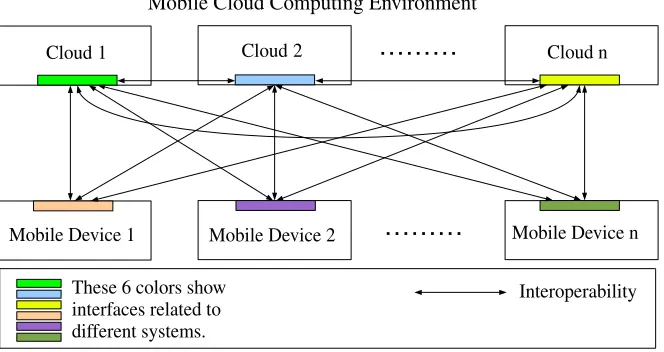
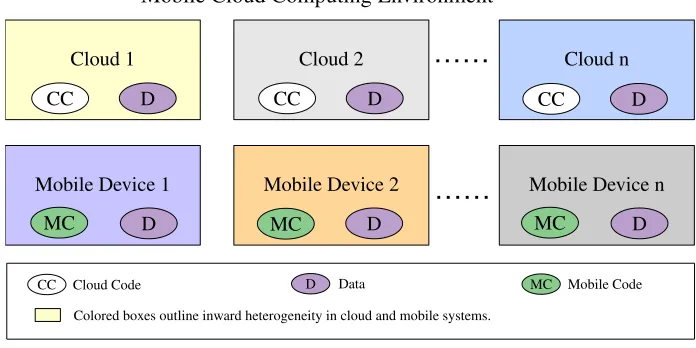
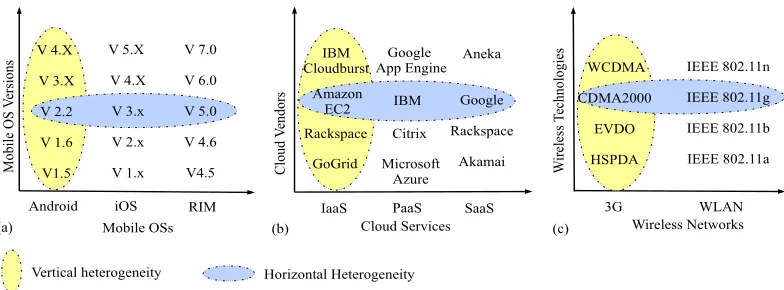
Analysing roots of heterogeneity in MCC results significant differentiation in silo of mobile devices, cloud, and wireless networks. Thus, we describe and taxonomize heterogeneity dimensions in MCC into two categories of verticaland hor-izontal. The proposed taxonomy depicted in Figure 6 shows how three underlying MCC components are influenced by two dimensions of heterogeneity. Figure 7 shows three examples of vertical and horizontal heterogeneity in MCC.
1) Vertical Heterogeneity: When differentiation is within a single type of mobile OS, cloud service, or wireless network it is named vertical heterogeneity.
• Mobile Devices: Among mobile devices, vertical
het-erogeneity appears within a similar family of products. Different flavors of the OSs offer some unique features and services that are not compatible with other versions. The vertical oval shape in Figure 7(a) shows vertical heterogeneity within different flavors of Android OS. An-droid 4.0.3 offers social, calendar, and visual voice mail APIs which are totally new compared to Android 3.x [88]. Similarly, in various BlackBerry mobile products, differ-ent features and hardware specifications are deployed that
prevent the application portability among devices from the same manufacturer. Moreover, deprecating program-ming elements by OS vendors such as Google19 and Ap-ple20, and discouraging mobile programmers from using such elements further highlights vertical heterogeneity. Although utilizing deprecated methods is currently pos-sible, developers require employing extra mechanisms to ensure compatibility among various OS versions, which cannot satisfy portability principles described by INCITS [78]. Therefore, the application developed for an OS version and deployed in one specific product may not be portable to the same family of products with different versions of the same OS with no or less configuration and modification.
• Clouds:In the cloud, vertical heterogeneity occurs within a single type of clouds that provides similar services, e.g. IaaS (Infrastructure as a Service) or PaaS (Platform as a Service). The vertical oval shape in Figure 7(b) shows vertical heterogeneity within various IaaS service vendors. Though Amazon EC2 and Rackspace are IaaS clouds, they are built on different pillars: internal infras-tructures, technologies, and business policies. Therefore, demand for switching between these two cloud services incurs redundant cost, even though both vendors provide IaaS. It also creates data and application portability issues and hinders easy code and data migration within a single type of clouds. Cloud users are forced to adhere to spe-cific cloud service provider(s) [89]. However, standard-ization efforts like the Open Virtualstandard-ization Format (OVF) [23] are emerging to alleviate problems and facilitate the deployment of virtual appliances in various clouds. • Wireless Networks: Among different wireless
technolo-gies, horizontal handoff is a well-known phenomenon caused due to vertical heterogeneity in mobile wireless environments including MCC. In MCC, horizontal hand-off happens in the situations when a cloud-mobile user is moving across heterogeneous access points within a sin-gle type of wireless network to access cloud services. For instance, this happens when cloud-mobile user is moving between IEEE 802.11a and IEEE 802.11g WLAN, or between CDMA 2000 and WCDMA 3G technologies. In majority of offloading algorithms in MCC, the network characteristics highly influence on offloading decision [6]. Hence, any change in networking technologies directly impacts on efficiency and effectiveness of the offloading decision and overall process. The vertical oval shape in Figure 7(c) shows vertical heterogeneity within var-ious cellular technologies. Data transmission in cognitive wireless access networks [90] which is configured with a set of different Radio Access Technologies (RATs) and Frequencies (F) is an illustrious example of vertical heterogeneity. When an application or data is tended to change the environment, the transceiver may need to change RAT and F, just change RAT and maintain F, or
19http://developer.android.com/reference/java/lang/Deprecated.html
20http://developer.apple.com/library/ios/#documentation/uikit/reference/UIDevice
Fig. 6. Heterogeneity Dimensions in MCC.
reverse. Ultimately, the user session is maintained con-tinuously and consistently during mobility by leveraging horizontal handoff process [47].
2) Horizontal Heterogeneity: When differentiation is across different types of mobile OSs, cloud services, or wireless networks it is named horizontal heterogeneity.
• Mobile devices: Among mobile devices, horizontal het-erogeneity appears between different platforms: two or more OSs (e.g. Android and RIM) or brands (e.g. Sam-sung and Nokia). The horizontal oval shape in Figure 7(a) shows horizontal heterogeneity between different OSs. For instance, the application developed for BlackBerry Torch21 (RIM V6.0) is not executable in Android V3.x products.
Horizontal heterogeneity is usually more challenging compared with the vertical heterogeneity. Portability is exacerbated when development of applications such as CMH applications is concerned. To develop CMH ap-plications, developers should design the application for the cloud as well as the mobile side. This development process must be repeated for various platforms, which is an exasperating effort for the developer [28]. Developers should consider various mobile platforms, cloud vendors and supporting programming languages to decide how to develop the application which is an irksome impediment. • Clouds: In the cloud, horizontal heterogeneity occurs between different types of clouds that provide hetero-geneous services, like IaaS and PaaS. The horizontal oval shape in Figure 7(b) shows horizontal heterogeneity between various types of cloud services. In a scenario that some PaaS vendors offer free limited storage, if a new application utilizes such storage that is incidentally coupled with specific data structure like Google App Engine22(the only Google Query Language (GQL)-based PaaS cloud), such dependency locks the application in the cloud. Hence, porting rapidly growing data to an IaaS cloud (for less hosting cost) which is non-GQL-based IaaS (e.g. SQL-based cloud) is hardly possible and inflicts upfront investment.
This type of heterogeneity, similar to the mobile side,
21http://us.blackberry.com/smartphones/blackberrytorch/ 22https://developers.google.com/appengine/
is more difficult to address as compared with vertical heterogeneity because of switching difficulties between various service providers with different patterns, archi-tectures, APIs, and business policies.
• Wireless Networks: Horizontal heterogeneity in wireless networks occurs when a mobile client is travelling across various networks like cellular and WLAN. Changing network node and supporting mobility, termed “vertical handoff”, highlighting a dilemma in horizontal heteroge-neous wireless network, which is a more challenging task with presence of different infrastructure. In this situation, signal handoff processes are more difficult than vertical heterogeneity due to the switching process between dif-ferent types of network [47]. Unlike the decision making algorithm in vertical handoff that relies on several pa-rameters (like energy efficiency, Received Signal Strength (RSS), accessible bandwidth, security, financial cost, and user preference), decision in horizontal handoff is made based on the RSS only [85]. Such increased complexity obliges vertical handoff optimization toward seamless connectivity in MCC which will enhance on-demand services and increase the quality of user experience. The horizontal oval shape in Figure 7(c) shows horizontal heterogeneity between various types of networks.
IV. IMPACTS OFHETEROGENEITY INMCC
Variations in smartphones, clouds, and networking tech-nologies breed several opportunities and challenges that are discussed in this section.
A. Opportunities
The opportunities arising from heterogeneity in MCC are explained as follows:
Fig. 7. Vertical and Horizontal Heterogeneity in Three Aspects within MCC: (a) mobile OSs and their versions, (b) cloud services and vendors, and (c) wireless networks and related technologies.
2) Performance Gain: User perceived performance from
online mobile applications is highly influenced by computing performance of server and wireless networks in MCC [91]. While it is financially impossible to avoid infrastructure het-erogeneity within a single cloud (due to maintenance, update, and technological advancements), cloud service providers use such heterogeneity as an opportunity to enhance performance and cost of their services. Rosenberg and Chiang [92] study two clusters of computers with identical mean speed. In one cluster, all CPU speeds are similar while in the other one, heterogeneous CPUs are utilized. The authors analyze execution performance of both clusters and mathematically demonstrate that the cluster with heterogeneous CPU speed outperforms another cluster with homogeneous CPUs. More-over, because varied applications have different architectural preferences, combination of heterogeneous processors with dissimilar architectural features (e.g., pipeline depth, in-order versus out-of-order execution, and superscalar width) can effi-ciently meet application preferences toward better performance [93] (further explanation is out of the scope of this paper). For instance, Amazon leverages dissimilar processing entities such as Intel Xeon E550723 and AMD Opteron 2218HE 24 for creating an instance of VM to fulfill various comput-ing requirements of different mobile applications with least possible cost. Exploiting heterogeneous computing resources in creating VM instances enhances execution performance of online applications in MCC [92]–[94].
Moreover, researchers and industrialists can leverage ben-efits of heterogeneous communication and networking tech-nologies such as 2G and 3G towards efficient communication. In enterprise organization, running communication-intensive cloud-mobile applications on 3G-ready devices and rest of the applications on 2G devices can reduce capital and operational costs of buying 3G-enabled mobile device and long-lasting batteries [95]. In academia, researchers [96] study execution time and cost of code offloading in MCC. They exploit heterogeneous communication technologies to access remote computation resources located near/far to/from the mobile
23http://ark.intel.com/products/37100?wapkw=e5507
24http://http://products.amd.com/(S(iecvm0y4bbazo4ujjdtjcl55))/pages/
OpteronCPUDetail.aspx?id=350&AspxAutoDetectCookieSupport=1
users and could remarkably enhance application performance and responsiveness by leveraging both 3G and WiFi. The authors propose a multi-tiered cloud infrastructure consist of distant clouds and nearby cloudlets aiming to alleviate effectiveness and efficiency of computation offloading process. They leverage Wi-Fi technology to save energy while commu-nicating with nearby cloudlets and use 3G to access distant giant clouds. The authors report 32% lower delay and 40% cost-reduction in offloading computation-intensive tasks to two-tiered cloud with heterogeneous infrastructure compare to single-tiered cloud. Thus, heterogeneous co-existence of vari-ous communication technologies can originate a performance-energy trade off which can benefit mobile clients, cloud vendors, and network operators. Future mobile communication technologies will likely enable mobile nodes to negotiate with network infrastructures for optimized communication technol-ogy. Therefore, heterogeneous selection of infrastructures in mobile-cloud environment provides a higher performance and service range to MCC community.
3) Enhanced Application Response Time: Reducing cloud-mobile application response time is one of the most important requirements of MCC which is likely achievable by enhanced performance of leveraging heterogeneous resources while out-sourcing computation. Heterogeneous computation hardware in the cloud datacenters, remarkably decreases computation delay in server side resulting less cloud-mobile execution latency and better overall response time. Researchers in [93] explore that leveraging combination of three heterogeneous processor architectures can reduce response time violation by 12X leading to crisp application response which is critical in MCC. Therefore, leveraging heterogeneous computing re-sources can increase application responsiveness in MCC.
2011-2012 and explore that Amazon EC2 leverages various processors in creating a single VM to reduce costs and achieve efficiency. For example, in large VM instances, heterogeneous CPU models, namely Intel Xeon E5507, E5430, E5645, and AMD Opteron 2218HE and 270 are being used. Experimental analysis of CPU, memory, and disk performance of various VM instances resulted different performance outcomes in varied computation loads. The authors conclude that efficient selection of service instance from pool of heterogeneous instances, can deliver up to 30% cost saving to Amazon end-users. Therefore, by assuming rich computing capabilities in cloud and seamless high bandwidth connectivity between mobile and cloud, mobile application responsiveness, local resource consumption, and utilization cost could be enhanced towards more efficiency.
B. Challenges
Several important challenges resulting from, or intensified by heterogeneity are explained below.
1) Application Fragmentation: MCC applications have al-ready been fragmented because of heterogeneity roots ex-plained in section III. For instance, application developed for iPhone cannot run on Android mobile devices. The remedy to this situation is two-folds. Firstly, handling existing het-erogeneity; because generating multiple versions of contents for various mobile and cloud platforms is not feasible due to the monetary and temporal costs. Secondly, decelerating fragmentation growth via standardization and common API. Mobile manufacturers endeavour to enhance user experience by utilizing high-end resources and technologies such as multi-core Samsung Exynos 5 processor25 and the face unlock feature of Android 4.026. Although these accomplishments enrich computing quality, they intensify heterogeneity and impose extra cost on end-users as well as developers. Porting a platform-dependent application to a new platform levies monetary and temporal cost on the user. Similarly, developing multiple versions of a single application is frustrating and a time consuming practice for developers, that also goes against the “write once, run anywhere” principle. Hence, application portability and interoperability are exacerbated. However, application fragmentation differs in web, online, and native applications.
• Web applications: In web applications, data and logic layers are device-agnostic because data storage and code execution take place on the web, whereas presentation layer is naturally device-dependent. Hence, fragmenta-tion in web applicafragmenta-tions stems from variafragmenta-tions in the visualization area and screen rendering capabilities of different mobile devices (excluding feature-dependent components). Several content adaptation approaches [82], [83], [97] are proposed to identify, extract, and adapt essential contents from web pages to the variety of mobile devices. However, successful content adaptation in smartphones needs existing issues (such as functional,
25http://www.samsung.com/global/business/semiconductor/minisite/
Exynos/index.html
26http://developer.android.com/sdk/android-4.0-highlights.html
structural, and semantical analysis of content, analyzing the screen’s building blocks, and applying user prefer-ences) to be addressed.
• Online applications:Similar to web applications, online applications such as cloud-mobile applications [40] and rich mobile applications are distributed according to the client-server concept. Computing and storage intensive components of cloud-mobile applications are likely ex-ecuted inside cloud resources while native components are executed locally [40]. Hence, fragmentation in on-line applications is more severe than web applications. Separating the screen rendering from the presentation layer is a significant effort [41] in which screen rendering tasks are performed in the cloud where data and logic layers are located. This approach not only conserves local smartphone resources, but also adapts screen contents according to the target device which is deemed to al-leviate heterogeneity problems in application fragmenta-tion. In a cross platform cloud-mobile application, cloud components are required to be portable to various cloud vendors, and mobile components should be executable on a multitude of mobile devices.
• Native applications:Unlike web and online applications, native applications are monolithic, meaning they are entirely installed and run locally. Hence, developing cross-platform native applications is comparatively the most expensive and time consuming process. Developing cross-platform application not only requires developers to acquire programming skills in multiple languages, but also inflicts extra temporal and financial costs due to redundant work of porting the application to various platforms. To have a clear understanding of what portability challenge is, we use a mathematical model as follows.
If the development process of a mobile application A is composed of n phases (e.g. creation, deployment, and testing) and each phase imposes a differing development cost Ci, then:
CDA= n
∑
i=1
Ci (1)
where CDA is the total cost for developing A for the primary mobile platform andCiis the cost of developing phase i.
To generate a cross-platform application executable on
m new platforms, developers need to transit the appli-cationA tomnew platforms (e.g. Android, iPhone, and BlackBerry) via code regeneration from the scratch (in the worst case) or partial code conversion/modification. Therefore,
CT A= m
∑
j=1
CT j (2)
Fig. 8. Titanium Cross-Platform Project [98].
platforms andCT jis the cost of transiting the application to mobile platform j.
From (1) and (2), we drive:
CCA = n
∑
i=1
Ci+ m
∑
j=1
CTj =CDA+CT A (3)
where CCA is the total cost of developing a cross-platform application for m+1 cross-platforms.
In practice, if the portability problem is addressed, the cost of developing a cross-platform application will be as low as (3) which is the real taste of “write once, run anywhere”. However, according to the definition of porta-bility by INCITS [78], for cross-platform applications,
αis feasible as a little modification or conversion cost. Therefore, we will have:
CCA = n
∑
i=1
Ci+α=CDA+α (4)
According to (4), it is observed that cross-platform solu-tions omit transition cost form platforms if the applica-tion is deployable and executable onm+1platforms. This cost includes coding charges, electricity, maintenance, time, and sundry charges. Furthermore, if developing cloud components is required, the development process becomes excessively complicated and costly. To reduce the burden of building cloud-mobile applications, Manju-natha et al. [28] utilize Domain Specific Language (DSL) to auto-generate communication interfaces for mobile and cloud target platforms.
Moreover, to alleviate the fragmentation problem, in-dustrial toolkits such as Appcelerator Titanium [98], PhoneGap, and Marmalade aim to auto-generate cross-platform mobile applications. Figure 8 depicts the lay-ered architecture of Titanium. However, these toolkits
convert the source code to the destination platforms by creating an abstraction on top of the source code. Also, these tools cannot be a generic solution for de-veloping cross-platform mobile applications, especially for background processing and complex business logics. Because JavaScript API in PhoneGap which exposes native functionality to the browsers JavaScript code is a resource-intensive and slow process compared to the native code [99]. Similarly usability of Titanium Appcel-erator is hindered by newly released mobile platforms APIs. Implementing new APIs in Titanium middleware is a time consuming process while end-users are not patient enough to wait till the API is implemented in Titanium. In general, usability of these transition solutions is hindered by some issues explained below.
• No dynamic alteration: Even though cross-platform
toolkits are likely suitable for business applications, they are unable to fully alleviate the feature heterogeneity in MCC. Cross-platform tools do not generate customized codes for destination platforms, but convert the source code to a new format. For instance, applications devel-oped on traditional mobile devices cannot utilize special features of contemporary devices like GPS. Similarly, applications which depend on accelerometer functionality are unusable in a device without a tilting sensor. • Further enhancements required: Application transition


![Fig. 4.Mirage Approach with Statistically-linked Kernel and App. [71]](https://thumb-us.123doks.com/thumbv2/123dok_us/8648359.866929/9.612.383.493.52.136/fig-mirage-approach-statistically-linked-kernel-app.webp)

![Fig. 8.Titanium Cross-Platform Project [98].](https://thumb-us.123doks.com/thumbv2/123dok_us/8648359.866929/15.612.149.458.57.286/fig-titanium-cross-platform-project.webp)