T h e e ff e c t s of e x p e c t a ti o n o n t h e
p e r c e p ti o n of s o u n d s c a p e s
B r u c e , N S a n d D a vi e s, WJ
h t t p :// dx. d oi.o r g / 1 0 . 1 0 1 6 /j. a p a c o u s t . 2 0 1 4 . 0 3 . 0 1 6
T i t l e T h e eff e c t s of e x p e c t a tio n o n t h e p e r c e p ti o n of s o u n d s c a p e s
A u t h o r s B r u c e , N S a n d D avi e s, WJ
Typ e Ar ticl e
U RL T hi s v e r si o n is a v ail a bl e a t :
h t t p :// u sir. s alfo r d . a c . u k /i d/ e p ri n t/ 3 1 8 7 3 / P u b l i s h e d D a t e 2 0 1 4
U S IR is a d i gi t al c oll e c ti o n of t h e r e s e a r c h o u t p u t of t h e U n iv e r si ty of S alfo r d . W h e r e c o p y ri g h t p e r m i t s , f ull t e x t m a t e r i al h el d i n t h e r e p o si t o r y is m a d e f r e ely a v ail a bl e o nli n e a n d c a n b e r e a d , d o w nl o a d e d a n d c o pi e d fo r n o
n-c o m m e r n-ci al p r iv a t e s t u d y o r r e s e a r n-c h p u r p o s e s . Pl e a s e n-c h e n-c k t h e m a n u s n-c ri p t fo r a n y f u r t h e r c o p y ri g h t r e s t r i c ti o n s .
The effects of expectation on the perception of soundscapes
Neil. S. Brucea William J. Daviesa
a
Acoustics Research Centre, Newton Building, University of Salford, Salford M5 4WT, UK, email: [email protected]
Corresponding author: Dr Neil S. Bruce
Acoustics Research Centre Newton Building
University of Salford Salford M5 4WT UK
Abstract
This paper explores how expectations of a place and its soundscape can affect our
perception of that soundscape. Previous soundscape research has included expectation
as one possible element of the context in which soundscape evaluation takes place.
This work aimed to focus on expectation and unpack it to improve understanding of
its different components and how it works. A combination of soundwalks, interviews,
focus groups and an interactive soundscape simulation were used in the investigation.
A linked series of locations in Manchester and London were studied. It was found that
participants’ perceptions of a soundscape, both real and simulated, were affected by
expectation in several different ways. Participants expected certain types of sound to
be present in a particular space. Participants distinguished between whether a sound
was expected and whether it sounded pleasant. It was also possible to distinguish
between the expectation of particular sound sources and the expectation of the
soundscape as a whole. The latter was found to be driven significantly by prior
experience of similar spaces and also by perceived loudness. Participants also had
expectations about the type of activity they could undertake in a particular
soundscape, the behaviour of other people as expressed in the soundscape, and the
degree of control they might have over their own exposure to the sound. These
findings suggest that expectations of a soundscape are based on prior experience in a
way which is consistent with Truax’s notion of soundscape competence. The results
have been used to produce a new model for soundscape expectation which is
expressed as a flowchart.
Keywords: soundscape, soundwalk, expectation, context, competence, perception,
1. Introduction
“Soundscape” is a term originally attributed to R. Murray Schafer, and soundscape
research is growing in quantity and influence, to the extent that the term now has a
proposed definition from an ISO working group [1]: the “perception and
understanding of an acoustic environment, in context, by the individual, or by a
society”.
Existing soundscape studies have investigated subjective response to
soundscapes using a number of techniques, including qualitative interviews, rating
scales and questionnaires in the field [2, 3, 4, 5] and by the playback of field
recordings in the laboratory [6, 7]. There is now a strong focus on the use of
interdisciplinary collaboration as part of soundscape research [8, 9, 10]. However,
relatively few studies integrate the two methods of in-situ subjective work and
laboratory based reproduction.
Community noise control often suggests that reducing noise levels is beneficial,
although it has been shown that sound level is not necessarily the main factor
affecting soundscape perception [12, 13]. For example, Kang suggests acoustic
comfort evaluation where types of sound sources, users of a space, and social factors
play a role in perception [14] Combining these factors could form a “context”, a
concept that Botteldooren suggests is crucial in a cognitive approach to soundscapes
[15]. If spaces have a context, then it is possible that the individual’s expectation of a
context is a key factor in their perception of that space. It follows that design and
planning regulations should consider perception and that they should be “based on the
Context can be defined as the “circumstances that form the setting for an event,
statement, or idea, and in terms of which it can be fully understood and assessed”
[16]. Context and meaning in soundscapes have been explored by a number of
researchers [5, 17, 18]. Dubois found that context (the type of noise, type of source
and the meaning attributed to it) were more important than noise level in soundscape
evaluations [19].
It is clear that the term context covers a range of factors that potentially affect
soundscape perception. One of these is expectation: listeners have expectations of
how a location or source will sound. Botteldooren and De Coensel [18] proposed
expectation as part of a framework of cognition and emotion when perceiving
soundscape contexts [18].
Expectation can be defined as “A strong belief that something will happen or be
the case in the future, or the series of events which are anticipated prior to an
experience” [20]. Expectation is used in this paper in regard to the likelihood of
events happening, and the anticipation of the occurrence of events, in relation to the
soundscape context. Huron in his work on the psychology of expectation likens
expectation to a cliché; a stereotype for a context or situation [21].
Our expectations for the soundscape of a location must have a basis. A plausible
basis for expectation is the concept of soundscape “competence” proposed by Truax
[22]. Truax describes soundscape competence as “tacit knowledge” that a person has
about the structure of a soundscape as they experience it [22]. Tacit knowledge is
subjective knowledge, which is related to an individual’s experiences, and is
comprised of factors such as their personal beliefs, perspective, ideals, values,
such cannot be easily identified, but they shape the way we perceive the world around
us.
Soundscape competence suggests that soundscape structures, which comprise of
all the acoustic elements which form a soundscape are learnt through experience, and
that this forms a relationship between sound and its associated meaning [22]. These
structures relate to the context of a space in which a person is present. There is little
existing research explicitly addressing the effects of expectation on the perception of a
soundscape, though the concept of auditory expectation is not new in the study of
music [19, 24].
The literature discussed above suggests that context is important in soundscape
evaluation, and that expectation might form a significant part of this context. Truax’s
notion of soundscape competence is one possible explanation for how previous
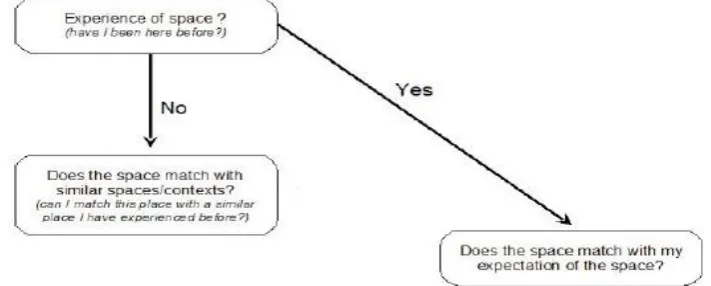
experience is codified into a cognitive structure to produce expectation. Figure 1 is a
simple process flow diagram which suggests how expectation may work in practice to
influence evaluation of a soundscape.
<<< Fig 1 about here >>>
There is little existing research on soundscape expectation to suggest whether
expectation itself has more than one component or factor (and, if so, which are the
most important). It seems possible that expectation is more complex than Fig 1
suggests. If expectation has an influence, then we might ask: Do people have
expectations of sound sources, sound categories, whole soundscapes, or all three?
How does expectation of a place or location (visual etc) influence expectation of its
soundscape (and vice versa)? How does expectation vary with (type of) place? Are
expectations of social factors like behaviour and activity related to soundscape
of soundscape competence? The work described in this paper aimed to answer these
questions.
2. Method
To investigate expectation thoroughly a combination of field and laboratory methods
were used. Field research consisted of soundwalks in Manchester and London.
Laboratory research used two techniques: focus groups and soundscape simulation.
2.1 Soundwalks
Soundwalking is a method where participants partake in a walk through a space or
series of spaces, and answer questions based on their experience [25]. The traditional
Schaferian soundwalk, with an hour’s walk and discussion at the end was found to be
less effective than a method involving regular stops. [25, 26]. An enhanced
soundwalking methodology was developed and used in this work. The method
required the participant to walk in silence over the course of a predefined route,
observing the soundscape and the environment. Throughout the walk, the participants
were subjected to semi-structured interviews, which took place at specific locations.
During the soundwalk interviews, conducted in Manchester and London in 2008
and 2009, participants were asked questions relating to a set of specific locations they
visited. Upon embarking on the walk, the group or individual walks for 5 to 10
minutes, and was then asked to stop and listen to the new environment for one minute.
This procedure was to enable participants to acclimatise themselves to the space. The
soundwalk interviews were recorded and then later transcribed, the transcription
process allowed for content analysis [27, 28] via coding taking place on the text.
Participants were recruited from a variety of sources. Recruitment sources
by direct contact. 42 soundwalk participants aged between 22 to 65 years old took
part in soundwalks in London and Manchester.
<<< Table 1 about here >>>
Prior to the soundwalk, a walking route was designed. This process required the
researcher to walk around a chosen city looking for a number of contrasting listening
locations, to provide what could be seen to be different contexts [18], to test if there
was any similarity between perceptions of certain types of space, and if there was any
correlation between perceptions of the spaces. Table 1 shows that the soundwalk
routes were similar in that each featured one public square, one green space, and so
on. This was to allow comparison of responses between Manchester and London.
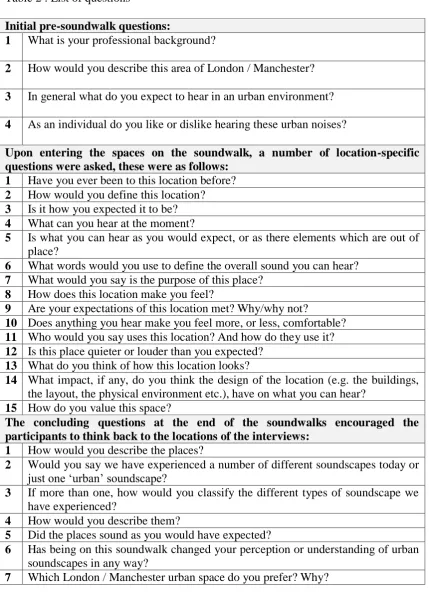
Figure 2 shows the soundwalking locations used and Table 2 lists the interview
questions.
<<< Table 2 about here >>>
<<< Fig 2 about here >>>
2.2 Focus groups
As well as the soundwalks, four focus groups were conducted. A focus group is
simply a discussion on a specific issue facilitated by a researcher. Naturalistic
discussion allows ideas to emerge and be tested by the group, so that the researcher
can potentially capture detailed and relatively unbiased opinions. This method is well
suited to explore how people understand sound in the urban environment and the way
when compared to soundwalks. Soundwalks capture participant response to a real
environment at the time of exposure. Focus groups allow for reflection on previous
experience of soundscapes and testing of the ideas expressed, as well as the potential
for producing an agreed group response. The four focus groups used different
participants: adults aged 18–25, adults aged 60 or older, adults with moderate to
severe hearing loss, and design professionals. The prompt questions for the focus
groups started from the soundwalk interview questions, but were extemporised as the
group discussion evolved.
2.3 Soundscape simulation
In contrast to the field research, the project also exposed participants to a controlled
and interactive soundscape in the laboratory. The system used in this project
constructed a simple synthesis of a soundscape by combining and manipulating
recordings of sounds made in the field. Separate recordings were made of the
background ambient soundscape (with a four-channel soundfield microphone) and
individual foreground sources, such as footsteps (with a close mono microphone).
Foreground sounds were identified from the soundwalk interview transcripts and the
soundwalk locations in Table 2 were used to make ambient background recordings.
Recordings were made throughout the day to get an ambience with the least amount
of activity, and also throughout the year to get a wide variety of sources. The field
recordings in London and Manchester took place over between 2008 and 2009, and
over the course of a complete day, to ensure each of the locations was thoroughly
recorded[29]. Field recording varied in length from a few minutes to up to an hour for
ambient recordings. The LAeq was measured at the same time as every recording was
For playback, an eight-loudspeaker first-order ambisonic system was used in a
semi-anechoic chamber, with a pantophonic (horizontal) configuration. The
foreground sounds are each looped as appropriate, mapped to a specific location and
layered over the background track. It is important to note that the foreground sources
are not limited to the loudspeaker positions but can appear at any point around the
listener. This arrangement allowed for the amplitude and position of each sound
source to be controlled independently. Additional processing, such as reflection and
reverberation could also be applied to each source independently. These parameters
could all be varied in real time during playback, allowing direct interaction with the
synthesised soundscape. The participant controlled the system with the small mixing
desk shown in figure 3. As the participant changed the position of each control on the
mixing desk, the value of this parameter was continuously recorded, so the user
choices and changes were all available for analysis.
In the experiments reported here, there were 20 participants, aged 20-37, and all
were naïve listeners. One soundscape was synthesised by each participant. The
participants were told to imagine they were in an urban location. The experiment
consisted of two tasks: selecting or deselecting each sound source (a binary variable)
and adjusting the level of each source (a continuous variable). The participant was
first presented with just the ambient background sound and could then introduce each
foreground sound individually. After listening to each of the individual sound sources,
the participant was asked if they wished to include or exclude the sound source from
their soundscape simulation. The following questions are also presented at this point:
Why did you choose to include/exclude this sound? Would you expect this sound to
After selecting the foreground sounds, the participant was asked to adjust the
level of each sound in relation to the ambient background track and to a level that they
thought was acceptable. They were also asked to adjust the global level of the whole
soundscape to what they felt to be the correct level. The sounds started off at the
correct level measured in the field when the recordings were made. The section of the
controller used to adjust levels is in Figure 3. The material was looped as many times
as it is necessary for the participant to be satisfied with their levels. Finally,
participants were asked to rate the pleasantness of each foreground sound on a
nine-point integer scale.
3. Analysis
Initial data from the soundwalk interviews were analysed as part of a grounded theory
methodological approach to inform and develop themes and codes for the analysis of
the subsequent soundwalks and focus group interviews. The results show what the
expected elements within that space are, and how qualitative data was enumerated
from the soundwalks, looking both at binary response questions and from the codes
themselves.
Qualitative data analysis (QDA) [27], was used to examine the meaning and
symbolic content of the soundwalk data. The analysis of the transcribed soundwalk
data attempts to identify themes relating to competence, expectation and context
within the soundscape. Themes are extracted by examining a participant’s
interpretation of the soundscape, and the justifications for the responses given. Codes
were then applied to all the data and the resulting analysis was derived. Interviewing
meaning [30] within their answers. Interviews were recorded using an audio recorder
during each soundwalk and then transcribed at a later stage.
Participants’ interview transcripts were read and analysed by coding each
relevant sentence looking for connections relating to a theme, or for the development
of a new theme. The analysis of the data was conducted on each interview transcript
in sequence, but when new themes or categories were formed from a transcript, the
previous interview transcripts were revisited for evidence or further insight of the
newly identified theme.
The first phase of data coding applied a-priori codes to the data and also
extracted additional rough themes which would be applied at the next stage of coding.
The first phase of coding was also a time to read through the data and gain an
understanding of the reasoning behind the responses provided by the participants in
response to the interview questions. The reading process also allowed for an insight
into the nuances in the data to be achieved. The first coding stage was important as it
enabled an overall definition of a number of the themes; these were then explored to
give a general context to the space. After the second phase of coding, thematic
analysis stopped and the data was re-processed to assign the results into specific
semantic categories. For example, terms which participants used, such as ‘from A to
B’, ‘moving through the space’, were first coded under the ‘purpose of the space’
theme. In this phase all the terms for usage were examined and were then further
coded relating to the type of usage, the ‘transitory’ category, for example.
4. Results and discussion
Table 3 shows the codes and themes that resulted from the analysis described above.
There are five themes, one of which is explicitly concerned with expectation
(expected sound sources) but two of the other themes also contain elements of
expectation about what the space is for and what the users of the space might (or
should) do. Because the soundwalk interviews included direct questions about
expected sound sources, these are a significant feature in coding of the transcripts.
Generally, categorisation of sound sources was relatively straightforward, with
sources resolving into the broad categories. For example, the use of the term ‘people
talking’, resolves in the category people, and likewise, the use of the term ‘air
conditioning’, resolves to the category of utility, as the sound is emitted by a
utilitarian source. Difficulty arose with sound sources such as siren or alarm. The
sound of sirens and alarms is difficult to categorise. Sirens became designed features,
because they have the ability to be designed at source, they could also fall into the
people category as they are used as information, and relate to people based activity,
but alternatively could be categorised utility. One could argue that sirens, whilst
mechanical, fall into a category of information sound as their purpose is to inform
people of the presence of an emergency vehicle. These results showed six constructed
categories of sound source categorisation were expected in an urban environment, and
expanding on these categories showed that there are a limited number of sound
sources which are expected in an urban environment.
<<Table 3 about here >>
Figure 4 shows the results from enumerating the textual answers in the
to hear in an urban space, and those that they actually heard in-situ. Figure 4 also
shows the additional category of noise. The category of noise has been included in the
graph, as it does not fall into one of the constructed categories. Noise was used as a
semantic descriptor at the end of participant’s descriptions of sound sources, such as
traffic noise, people noise, but noise was also used as a descriptor in its own right. A
semantic difficulty arises at it is unclear what is explicitly meant by the usage of the
term noise when used on its own.
<< Figure 4 about here >>
The soundwalk interviews showed that participants could express views on
whether different sound sources were expected in a particular place. The soundscape
simulator experiment followed this by offering participants more control: they could
choose whether to include a sound source in their soundscape. Figure 5 shows the
relationship between the results for expectation and inclusion of the sound source in
the spaces. The graph shows that there was high expectation and inclusion for people
sounds and designed features which include the fountain, clock and traffic light.
Construction sounds are third in terms of expectation, with nature sounds not being as
highly expected but with a high inclusion rating. These finding would suggest that for
an urban square that a mixed of designed features and people sounds would be
expected and accepted in the space along with other urban sounds such as
construction and utility sounds. Figure 6 shows the ratings of the sound sources
placed into their categories, as above. Nature, people sound and designed featured
<< Figure 5 about here >>
<< Figure 6 about here >>
4.2 Expected places
As well as source expectation, the interview transcripts also provide data on whether
the overall space is as the participants expected. Combining the data from the two
locations, Figure 7 shows that over 70% of respondents had experienced and thus had
a predetermined expectation of the spaces on the soundwalk in London and
Manchester, and that overall over 80% of the participants thought that the spaces
sounded as they would expect. Interestingly this is higher in Manchester where 95%
of spaces sounded expected, to only 80% in London. Overall, the high score of
expectation is reinforced with participant responses discussing their expectations of
the spaces visited:-
“My experience and expectation are met by this space” - Lon-SW2
“They sound as I would expect if I saw a picture of them.” – Man-SW5
“This background is quiet, it fits, I would expect that type of noise Man
-SW10
“….we've heard all the things I expect to hear in central London, so it's all to me expected” - Lon- SW5
Participants did not always view the spaces visited positively, for example a
participant who grew up in the countryside found the context of the urban setting
annoying, even though they had experienced the spaces before.
“I used to think I'd love the city life, got to the city, don't like it at all” - Lon- SW6
“no it's a city and that's what you would expect, noisy traffic, noisy people,
noisy buses, people footsteps....it's what you'd expect in the city centre” -
Man-SW4
Although analysing the other responses from Lon-SW6 shows that even with this
negative view of the urban space on the whole, that their expectation for the spaces
was met.
“It’s pretty much what I’d actually expect, but I’d actually expect it to be
louder at like this particular point in London.” - Lon- SW6
“it’s quiet….that is what I expected” - Lon-SW6
<< Figure 7 about here >>
<< Figure 8 about here >>
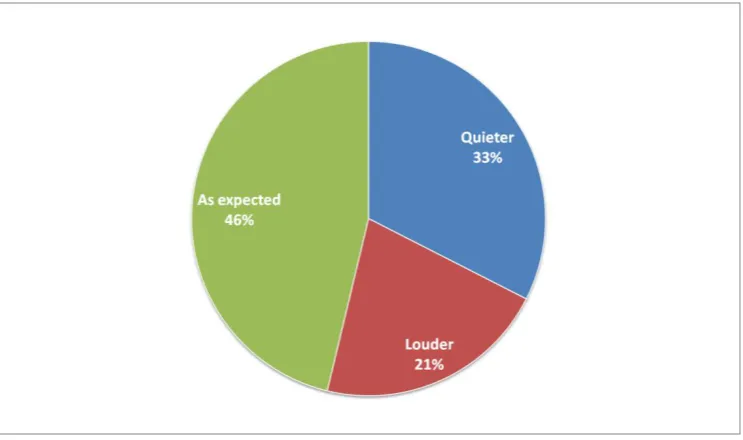
Loudness often featured as part of the participants’ response to whether the place
sounded as expected. Figure 8 shows the combined results from all spaces on
loudness expectation. The chart shows that for all space, there is a 46% perception
that the level is as the participant would have expected, and that 33% of the
participants thought that the level was quieter than they expected, with only 21% of
participants feeling that the space was louder than they expected. This is an interesting
finding, particularly that for what might be called a ‘loud’ city centre environments,
that 79% of participants felt that the spaces were as expected or quieter. This finding
is consistent with the literature discussed earlier, to the extent that context was found
to be more significant than level in soundscape evaluations.
One factor on expectation and the perception soundscape is in answering the
subjective questions; does the space conform to a set of “rules” which the listener has
experienced from similar spaces? These “rules” not only relate to perceptual features
for all the senses, but also rules relating to activity, context, competence, place and
social norms and users of the space. Crucial to these factors is the participant’s ability
to control their activity within the soundscape; can they remove themselves or
particular sounds from the current soundscape space or have the ability to control
their interaction with the space?
There also seemed to be an expectation of 'controllability', for example subjects
could not control the 'noisy, dirty' traffic on London's Oxford Street, but they could
remove themselves from Oxford Street and use 'quieter' back streets. Though such a
change in space still led to an expectation of how the new space should sound. For
example in an urban square (Soho Square, less than 100m from Oxford Street), the
expectation is still to be hearing the traffic noise, albeit at a reduced level. This traffic
noise in this instance was sometimes seen as a positive, “traffic noise in the distance
makes me feel that I am still part of the city and can re-enter at any point”, once again
this type of statement suggests the importance of control. Likewise, in Soho Square
space, the expectation of users and control had an effect on perception, the
participants could not control the behaviour of the 'drunks' in the park, but they could
leave the park or ask them to be quiet. Annoyance seems to stem from spaces where
the subject cannot easily leave (e.g. train carriage, bus, and home) and has no
influence over the sound-maker (either a person or machine).
“I don't like traffic noise; in fact as I get older because it interferes with my
ability to talk to people and hear them, they become increasingly
4.4 Expected behaviour
The annoyance discussed above suggests there is an expectation of the behaviour of
other users of the space. In particular, does the behaviour of other users conform to
the subject’s expectation of the space? A visual annoyance can be removed by
looking away, but an auditory annoyance cannot, without having to leave the space or
move further away. Some degree of annoyance also arises from the situation where a
subjects feels that “I am conforming to the rules” for this location (e.g. quiet zone on a
train, not shouting in a park) so why can’t others, this also goes along with the idea of
rudeness and other subjective anti-social behaviours, results showed the following
negative perception to the presence of anti-social behaviours
I wouldn‟t say I kind of have a…I mean I think the kind of like the screaming teenagers, that doesn‟t really and I don‟t think anyone likes
that, and people on a night, kind of like the drunken behaviour is
something, but I mean construction vehicles, the whole thing, I think you
have to kind of expect that, you can‟t, you know, in some, ways, you can‟t, that‟s why I moved out of the city centre because you can‟t have that city
centre lifestyle and expect peace and quiet really. – Man-SW6
“if I couldn't get away (from drunks in the park) then certainly I'd feel
badly about the space...as it happens I know that all I need to do is go off
into the back streets” - Lon-SW5
”I dislike it if people are drunk and I feel threatened by that…otherwise I
quite like it” - Man-SW7
“if I hear people being aggressive and rude..that can make me feel
uncomfortable' - Man-SW8 .
This not only applies people but to mechanical/construction sources, but with
these sources the expectation leads to a greater degree of acceptance, for example.
“I dislike the sound of a street cleaner, but I know that it will only last for a
“that constant hum of air con that's sort of a little bit stressful..I think you'd
notice it when it wasn't there as being absent” - Man-SW9
This example has the positive association with a number of subjects of a process
which keeps the location clean and expectation leads to the fact that the source will be
temporal, and thus is accepted. The same goes from construction noise, “I don’t like
it, but it is progress and has to happen” but conversely there is the expectation of time
constraints applying to the soundscape. A subject may accept the source in the day,
but would not expect and therefore accept it at night.
“the sound of the van unloading wouldn't be much of a surprise...given the time of day” - Man-SW10
“I guess it is what I would expect because it is a city garden square, so
apart from the heavy truck which will move and leave the square” -
Man-SW4
4.5 Expected activity
As well as expectation relating to the structure of the soundscape of the space,
expectation extends to a subject’s activity within the space. Activities in the spaces
researched range from spaces where a person would pass through to those where a
person can retreat from the urban noise. In the 'transitory' spaces, such as the corner of
Oxford Street and Soho Street, the soundscape has a low impact on annoyance,
although these spaces were noted as sounding as expected. In the 'oasis' spaces, such
as Soho Square, the soundscape has a high impact on annoyance, where expectation is
higher, although again these spaces were noted as sounding as expected. Other
statements from subjects seem to give an indication of acceptance and expectation of
soundscape which is independent of sound level measurements (LAeq), which were
work in the soundwalk areas which were subject to levels of 75 dBA or greater, were
“I choose to live, to come here” therefore 'I accept' the higher level of noise. Other
example statements are “I would come here to....relax, shop, get away from the hustle
and bustle, meet friends, have my lunch” Lon-SW7. The majority of responses have
comments in line with the following, in that the space “meets my expectation” -
Lon-SW7.
4.6 Expected information
A combination of activity and source expectation relates to an expectation of
obtaining information. An example of this is how traffic noise prevents
hearing-impaired people having a conversation, “I have to go somewhere quieter to hear
conversation”. Other examples of prevention of information are “I can’t hear my
phone ring”, “I can’t hear the station announcement”, these are forms of information
transfer to which the soundscape has an impact on.
“I don't like traffic as it masks conversation hard to understand”- Lon-SW5
4.7 Expectation and competence
Analysis of sound source expectation shows that sound sources that were expected
from the simulator generally coincide with those expected and then heard on the
soundwalk. On the whole, the data from the soundwalks has shown that most spaces
sounded as the subject expected and the level was as expected for the given
space/context and there was an understanding of how the space impacted on what was
being heard. This suggests a learnt competence for spaces, as well as behavioural
expectation for those spaces. Crucially, as highlighted above, expectation extends
as well as expected 'rules' which govern the space. This suggests that expectation and
competence should be taken into account as part of the context to be addressed when
undertaking subjective evaluations of the soundscape.
4.8 Model of expectation
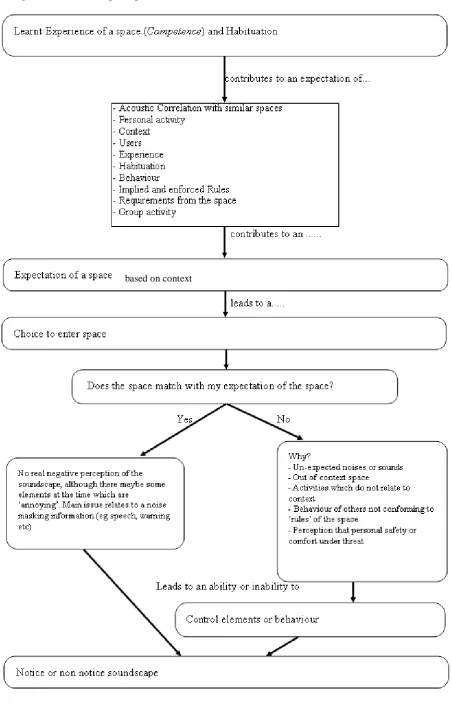
These results suggest that the process flow model provided in Figure 1 could be
developed into the soundscape expectation model proposed in Figure 9. The model
shows how a person’s competence of a space from learnt experience leads to the
expectation of a context. This expectation is made up of an expectation about a
number of factors within that space and this then leads to a choice to enter that space.
Upon entering the space there is a choice made about whether or not the space
matches the expectation that the person has about the context from their competence.
If the space matches the person’s expectation then there is no negative perception of
the space and the soundscape is generally not noticed.
If, on the other hand the person’s expectation is not met, this may be due to a
conflict in or mismatch of factors shown in figure 9. If the person feels that they can
control the sound source or element then there is a positive association, whereas if
there is a feeling that they cannot control the source, then there is a negative
perception and the soundscape becomes noticed.
<< Figure 9 about here >>
In support of the model, participant responses reinforced how expectation of a space
plays a role in their perception of the space, how they feel in the space and their
“I like the buzz of being in London and hearing all this stuff going on
around me, it's quite reassuring” - Lon-SW1
“I like oxford street, the hustle and bustle and the noise of it, it's the
essence of what London is about, it's people and noise and activity” -
Lon-SW1
“i like the hustle and bustle” - Man-SW8
“This is a focal point of London, and I feel comfortable, I just don't like being on the road” - Lon-SW4
Conversely, the responses explore how a space maybe tolerated and that when things
are our side of the norm then annoyance may occur or feelings if comfort and safety
may arise.
“I wonder if we tolerate it because it is the norm and when it's something
out of the norm like the drill or something I think that's when we get
annoyed.” – FG_12.49-50
'it's almost a comforting thing for people to be walking around talking to
each other' - Man- SW8
“if there weren't people sounds it would sound like a ghost city' -
Man-SW10
5. Conclusions
This project used a mixed methods approach to investigate the effect of expectation
on the perception of soundscapes. A combination of soundwalks, semi-structured
interviews, focus groups and a soundscape simulator was used. It was found that
participants’ perceptions of a soundscape, both real and simulated, were affected by
expectation in several different ways. Participants expected certain types of sound to
be present in a particular space. This was expressed in their opinions on real
soundscape. Participants were also able to distinguish between whether a sound was
expected and whether it sounded pleasant. It was also possible to distinguish between
the expectation of particular sound sources and the expectation of the soundscape as a
whole. The latter was seen to be driven significantly by prior experience of similar
spaces and also by perceived loudness. Behaviour and control were also significant to
soundscape expectations. Participants had expectation about the behaviour of other
people as expressed in the soundscape and the degree of control an individual has to
their exposure to sound. Both factors seem to be based partly on an acquired set of
social rules or norms. Finally, people’s activity and sonic information were also
factors that influenced expectation of soundscapes. Participants expected to be able to
use a particular soundscape for a particular activity (such as relaxing) and also to
obtain certain information within it (such as hearing a phone ring).
These findings suggest that our expectations of a soundscape are based on our
prior experience which may be codified in the way suggested by Truax’s notion of
soundscape competence. This is expressed in the suggested new model for
soundscape expectation in Fig. 9. Our expectation of a soundscape influences our
behaviour and our evaluation of both soundscape and location. While the overall
sound level in a location certainly forms a part of our response, if the loudness is as
expected then other factors such as behaviour and activity may become more
significant in driving soundscape perception.
This work has shown that there is a need for a greater understanding of attitudes
toward events that occur in a context. The soundscape is something that is always
present, but generally goes unnoticed and thus like a film sound track, both reaffirms
and enhances the visual narrative. Our reaction to the soundscape depends largely on
through experience, and this forms competence, which affects our unique perception
of a space in that specific moment of time and through competence and context we
form an expectation of a space, and it is through this expectation that we make
decisions about the positive or negative evaluation of the environment we are in.
Acknowledgments
This work was supported by a studentship as part of the Positive Soundscapes
Project. The Positive Soundscape Project was wholly funded by the UK Engineering
REFERENCES
[1] A.L. Brown, J.A. Kang, T. Gjestland, Towards standardization in soundscape preference assessment, Applied Acoustics 72(6) (2011) 387-392.
[2] Berglund ,B. (2007) "Soundscape psychophysics in place‟, In Inter-noise, Istanbul, Turkey, pp. 161-161.
[3] Brambilla, G. and Maffei, L. (2006) "Responses to noise in urban parks and in rural quiet areas‟, Acta Acustica United With Acustica, S. Hirzel Verlag, 92(6), p. 881–886.
[4] Schulte-Fortkamp, B. and Fiebig, A. (2006) "Soundscape Analysis in a Residential Area: An Evaluation of Noise and People‟s Mind‟, Acta Acustica United With Acustica, 92, pp. 875-880.
[5] Raimbault, M. and Dubois, D. (2005) "Urban Soundscapes : Experiences and Knowledge‟, Cities : The International Journal of Urban Policy and Planning, 22(5), pp. 339-350.
[6] Lavandier, C. and Defreville, B. (2006) "The Contribution of Sound Source Characteristics in the Assessment of Urban Soundscapes‟, Acta Acustica united with Acustica, 92(6), pp. 912-921.
[7] Guastavino, C. and Dubois, D. (2005) "Ecological Validity of Soundscape Reproduction‟, Acta Acustica United with Acustica, 91(3), pp. 333-341.
[8] Kang, J. and Zhang, M. (2010) "Semantic differential analysis of the soundscape in urban open public spaces‟, Building and Environment, Elsevier Ltd, 45(1), pp. 150-157.
[9] W.J. Davies, M.D. Adams, N.S. Bruce, M. Marselle, R. Cain, P. Jennings, J. Poxon, A. Carlyle, P. Cusack, D.A. Hall, A. Irwin, K.I. Hume, C.J. Plack, Perception of soundscapes: An interdisciplinary approach, Applied Acoustics 74(2) (2013) pp 224-231.
[10] Davies, W., Adams, M., Bruce, N. and Marselle, M. (2009) "The positive soundscape project: a synthesis of results from many disciplines‟, In Inter-noise, Ottawa, Canada.
[11] Lercher, P. and Schulte-Fortkamp, B. (2003) "The relevance of soundscape research for the assessment of annoyance at the community level‟, In International Congress on Noise as a Public, Rotterdam, NL, ICBEN, p. 225–231.
[12] Schulte-Fortkamp, B. and Nitsch, W. (1999) "On soundscapes and their meaning regarding noise annoyance measurements‟, In Proceedings of Inter-noise, Fort Lauderdale, Florida, USA.
[13] Schulte-Fortkamp, B. (2007) "Soundscape : An approach to rely on human perception and expertise in the post-modern community noise era‟, Acoustics Today.
[14] Kang, J. (2007) "A systematic approach towards intentionally planning and designing soundscape in urban open public spaces‟, In Inter-noise, Istanbul, Turkey, pp. 161-165.
[15] Botteldooren, D., De Coensel, B., Van Renterghem, T., Dekoninck, L. and Gillis, D. (2008) "The Urban Soundscape; A Different Perspective‟, In Duurzame mobiliteit Vlaanderen de leefbare stad, University of Ghent, pp. 177-204.
[16] Burke, Peter. "Context." New Dictionary of the History of Ideas. 2005. Retrieved June 02, 2011 from Encyclopedia.com: http://www.encyclopedia.com/doc/1G2-3424300165.html
[17] Stanley, R. and Schomer, P. (2009) "A case for the importance of context for soundscape research in parks and protected areas.‟, The Journal of the Acoustical Society of America, ASA, 125(4), p. 2716.
[19] Dubois, D., Guastavino, C. and Raimbault, M. (2006) „A cognitive approach to urban soundscapes: using verbal data to access everyday life auditory categories‟, Acta Acustica united with Acustica, S. Hirzel Verlag, 92(6), pp. 865-874.
[20] Oxford Dictionaries (2010) „definition of expectation from Oxford Dictionaries Online‟, Oxford
Dictionaries Online, [online] Available from:
http://oxforddictionaries.com/definition/expectation?region=us (Accessed 2 June 2011), Oxford University Press.
[21] Huron, D. (2007) Sweet Anticipation : Music and the Psychology of Expectation, First. Massachusetts, MIT Press.
[22] Truax, B. (2001) Acoustic Communication, 2nd ed. Westport, Connecticut, Ablex Publishing.
[23] Nonaka, I. & Takeuchi, H. (1995). The knowledge-creating company. New York: Oxford University Press
[24] Bissell, A.D. (1921) The role of expectation in music: a study in the psychology of music, Yale University.
[25] Bruce, N.S. and Davies, W.J. (2009) "Expectation as a factor in the perception of soundscapes‟, In Euronoise, Edinburgh, Scotland.
[26] Adams, M., Bruce, N., Davies, W., Cain, R., et al. (2008) "Soundwalking as a methodology for understanding soundscapes‟, In IOA Summer Conference.
[27] Silverman, D. (2006a) Interpreting qualitative data : methods for analyzing talk, text and interaction, SAGE.
[28] Neuendorf, K. (2002) „The Content Analysis Guidebook Online‟, [online] Available from: http://academic.csuohio.edu/kneuendorf/content/ (Accessed April 2009).
[29] Bruce, N.S. and Davies, W.J. (2009) "Development of a soundscape simulator tool‟, In Inter-noise 2009, Ottawa, Canada.
Figure 3 : Soundscape simulator controller, showing controls for sound source
Figure 9: Soundscape expectation model
Table 1 : Soundwalk
locations
[image:37.595.80.533.99.806.2]Table 2 : List of questions
Initial pre-soundwalk questions:
1 What is your professional background?
2 How would you describe this area of London / Manchester?
3 In general what do you expect to hear in an urban environment?
4 As an individual do you like or dislike hearing these urban noises?
Upon entering the spaces on the soundwalk, a number of location-specific questions were asked, these were as follows:
1 Have you ever been to this location before?
2 How would you define this location?
3 Is it how you expected it to be?
4 What can you hear at the moment?
5 Is what you can hear as you would expect, or as there elements which are out of place?
6 What words would you use to define the overall sound you can hear?
7 What would you say is the purpose of this place?
8 How does this location make you feel?
9 Are your expectations of this location met? Why/why not?
10 Does anything you hear make you feel more, or less, comfortable?
11 Who would you say uses this location? And how do they use it?
12 Is this place quieter or louder than you expected?
13 What do you think of how this location looks?
14 What impact, if any, do you think the design of the location (e.g. the buildings, the layout, the physical environment etc.), have on what you can hear?
15 How do you value this space?
The concluding questions at the end of the soundwalks encouraged the participants to think back to the locations of the interviews:
1 How would you describe the places?
2 Would you say we have experienced a number of different soundscapes today or just one ‘urban’ soundscape?
3 If more than one, how would you classify the different types of soundscape we have experienced?
4 How would you describe them?
5 Did the places sound as you would have expected?
6 Has being on this soundwalk changed your perception or understanding of urban soundscapes in any way?
Table 3 : Themes and associated categories
Theme Coding Category
Expected sound sources Traffic, Construction, People, Nature, Utility, Designed Feature
Description of space Historical, Open, Oasis, Social, Urban, Garden, Square, Park,
Commercial, Junction, Thoroughfare
Purpose of space (usage) Transitory, Relaxation, Shopping, Socialising
Users of space General, Workers, Shoppers, Socialisers, Students, Tourists,
Diners, People in Transit, Residents
Mood Comfortable, Uncomfortable, Moving, No feeling, Positive,