media : a simulationbased interface as a
dynamic score
Choi, I
http://dx.doi.org/10.4108/ct.1.1.e5
Title
Advancing performability in playable media : a simulationbased interface
as a dynamic score
Authors
Choi, I
Type
Article
URL
This version is available at: http://usir.salford.ac.uk/42357/
Published Date
2014
USIR is a digital collection of the research output of the University of Salford. Where copyright
permits, full text material held in the repository is made freely available online and can be read,
downloaded and copied for noncommercial private study or research purposes. Please check the
manuscript for any further copyright restrictions.
EAI Endorsed Transactions on Creative Technologies 01 -10 2014 | Volume 1 | Issue 1 | e5
EAI Endorsed Transactions
on
Creative Technologies
Research Article
Advancing Performability in Playable Media:
A Simulation-based Interface as a Dynamic Score
I. Choi
,*
1Columbia College Chicago, 600 S. Michigan Ave., Chicago, IL 60605
Abstract
When designing playable media with non-game orientation, alternative play scenarios to gameplay scenarios must be accompanied by alternative mechanics to game mechanics. Problems of designing playable media with non-game orientation are stated as the problems of designing a platform for creative explorations and creative expressions. For such design problems, two requirements are articulated: 1) play state transitions must be dynamic in non-trivial ways in order to achieve a significant level of engagement, and 2) pathways for players’ experience from exploration to expression must be provided. The transformative pathway from creative exploration to creative expression is analogous to pathways for game players’ skill acquisition in gameplay. The paper first describes a concept of simulation-based interface, and then binds that concept with the concept of dynamic score. The former partially accounts for the first requirement, the latter the second requirement. The paper describes the prototype and realization of the two concepts’ binding. “Score” is here defined as a representation of cue organization through a transmodal abstraction. A simulation based interface is presented with swarm mechanics and its function as a dynamic score is demonstrated with an interactive musical composition and performance.
Keywords: playability, playable media, performability, simulation-based interface, dynamic score, sound mechanics, prolonged engagement model, creative exploration, creative entertainment, interactive performance
Received on 11 May 2014, accepted on 21 September 2014, published on 14 October 2014
Copyright © 2014 Insook Choi, licensed to ICST. This is an open access article distributed under the terms of the Creative Commons Attribution licence (http://creativecommons.org/licenses/by/3.0/), which permits unlimited use, distribution and reproduction in any medium so long as the original work is properly cited.
doi: 10.4108/ ct.1.1.e5
*Corresponding author. Email:[email protected]
1. Introduction
Advances in novel interfaces present potentially a wide range of playable platforms for human players. Contemporary users and players adapt to many areas of engagement from the use of mobile phones to the play of games. Performance and artistic venues are at the forefront of advancing interface technologies. Experimental design of interface configurations can facilitate interactive multimodal playability in a media experience that can be an alternative to standard gameplay. Gameplay scenarios have been matured with various game mechanics supporting the prolonged engagement of players. In game development a set of design directives is rigorously exercised in highly targeted ways. These often involve level design, scoring, level of difficulty, resource acquisition and expenditure, and
strategy planning with shaped nuances by the charters to which the games are presented. Game players are aware of their roles and can become more rehearsed as they play more.
state transitions with no winning or losing and no overarching scoring system to dictate the play transitions. This paper proposes that a simulation based interface can provide an alternative platform for creative explorations in the absence of targeted game directives, and even speculates that, perhaps the creative explorations are better left in less targeted ways as to avoid an aggressive entrainment of players to game-delimited goals. This work identifies and integrates example elements to sustain play and social engagement without extensive rules, fictional characters, scenic contents, externalized conflicts, and explicit valorization mechanisms that often characterize computer-based games. We then put forward a new paradigm, simulation based interface as dynamic score and attempts to demonstrate that such paradigm not only affords a sustained engagement also yields the transformative pathway from creative exploration to creative expression, from playable media to performable media. The discussion will unfold from the play scenario of simulation-based interface to the performance scenario of “Mutandrum” [1], a composition that integrates interaction, simulation, and sounds as a creative expression. Before we venture into the two scenarios, the remainder of this introduction prepares readers with a background understanding of performance through music tradition.
1.1. Musical Performance: Collective
Memory. Mental Model, and Musical
Expectation
The essence of musical performance is in producing sounds informed of musical literacy. The performance literacy in music history has been mostly implicit through the development of instruments and corresponding literatures to master them. The literature in music often connotes the repertoire for certain instrument or an ensemble of instruments and is denoted as “Violin Sonata Number 10” or “Piano Trio in A minor”. This triadic relationship of literature, repertoire, and instruments is grounded in a collective memory that shapes mental models of performers and audience who in turn attribute certain musical expectations. Conventional references provide styles and deviations through which recurring instances of performances can be celebrated. In this context, performability in music has a deep historical perspective that we can retrospect in light of contemporary understanding of audience engagement and their social orientations, especially when encountering novel platforms.
There are two kinds of engagement in musical performances. In a concert setting an audience engages music as an artifact or commodity. In a jam session, players engage music by musical dialog exchanged through coordinated performance, rehearsal and improvisation, which are in effect social interaction. To some extent, the latter is also a form of exchanging musical artifacts among performers such that the artifacts are spontaneously and proactively created on the fly and woven into musical dialogues as evolving structure in a temporal dimension.
The act of proactive musical exchanges is anchored in players’ ability to listen to each other. However, how much that has been heard will be hard to measure. This is not unique to the measure of musical dialogues. Everyday conversations often go by without verifying whether what has been uttered has been listened to. It will be even harder, if not impossible, to measure how collective musical memory establishes certain musical style, which entails listeners’ and players’ literacy and even physical structures of concert halls. Between memory and imagination music serves a varying degree of social interaction where listening renders the interaction.
Taking these altogether, musical dialog requires listeners’ cognitive faculties equipped not only with the ability to remember also with the ability to assess the references to the remembrances in collective memory. Such cognitive capacity serves a mental model to which listeners consult how to listen. The mental model provides a pool of grounded musical sense, a general knowledge base for conducting musical dialogues. Performers require a mental model to consult what kinds of sounds to produce and to assess the means to produce them.In terms of performance mechanics, the idea of interface is at the heart of tone production. Physical forms of musical interfaces such as keyboard, fingerboards, and reeds serve as interfaces to introduce human energy into the system of musical instruments. Through centuries of developmental history, musical instruments became in many ways the extensions of the human body, fit and adapted to ergonomics of performers who then naturalize the instruments through a lifetime of rehearsals and practice.
Common practice in music also generates a large body of literature that is unique to each instrument, so that a repertoire is substantiated through the stability between an instrument and its coevolving literature. It is this missing element, the collective memory of a triadic relationship, where novel technological interfaces do not seem to live up to musical expectations, which are also left obscured due to lacking certain mental models. Then the question becomes how novel interfaces can live up to musical expectations with no mental models to support them in the absence of the collective memory associated to that class of interfaces. Since this seems to become an impossible question to resolve, we limit our question to whether a novel interface can enable a musical play experience for both novice and expert players, while foregoing the form factors of traditional musical instrument interfaces.
1.2. Design Directives
simplicity of musical instruments often affords the wide range and variety of tone quality. At the same time, musical instruments are playable by novice as well as virtuoso. This section presents the three design orientations: human, system, and platform configuration, with corresponding design directives.
1.2.1. Designing Kinesthetic Experience
The simplicity of musical instruments and the complex world of musical literature cannot be directly translated into design directives for developing a novel performance platform. However, the often-neglected design factor in novel performance interfaces is a kinesthetic experience design. Kinesthetic experience with the interface facilitates the auditory experience of sound qualities with respect to players’ actions. The kinesthetic experience also extends to listeners. This is analogous to the theory of efforts in Laban system [2]. Listeners observing a musical performance engage in playability by relating what they see, a performer’s actions and what they hear, the resulting sounds [3]. By designing kinesthetic experience, performability extends playability by evoking play experiences through audience’s kinesthetic intelligence. To facilitate playability and performability, the performance system architecture must not only facilitate an interactive performance but also facilitate the communicative performance to foster an audience’s meaningful auditing experience.
1.2.2. Designing Performance and Sound Mechanics
In terms of establishing performance mechanics for novel platforms, there are three factors to consider: 1) an interface to characterize performance interaction, 2) state transition characteristics to convey coherent properties of the system under exploration, and 3) score and notation to orient performers’ navigation. One of the propositions of this work is to leverage the properties of a complex system in order to keep interfaces simple yet dynamical. This proposition presumes two underlying requirements for corresponding sound mechanics: 1) sound mechanics afford a wide range of expressivity and variety of tone quality subjected to players’ interactions and 2) computational implementations of sound mechanics generate procedural sounds that carry the information about the system under exploration.
1.2.3. Designing a Platform
Design directives of the novel platform presented in this paper are summarized: 1) the system can be used in a concert setting – this is to present exemplars to demonstrate full system capacity explored by skilled performers. The virtuoso presentation is an attempt to assist novice performers to construct a mental model for the system’s capacity; 2) the system can be used by multiple performers collaborating – this is to encourage social interaction nourishing musical dialogues and vice versa; 3) the system hosts tangible aids both in the form of graphics and physical constructs – this is to provide the function of a score with the function of musical instrument that relates visual representations to sounds; and 4) the system deploys the
simulation algorithm that can provide mechanics of playfulness.
1.3. Relationship to Prior Work
The pool of prior work this paper can discuss is vast. We discuss only a few references that intimately relate to this work in three paradigmatic areas: interface, score, and simulation.
1.3.1. Performance Interface
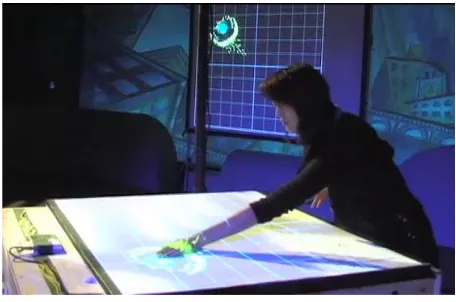
[image:4.595.305.533.376.527.2]Leon Theremin originated capacitive sensing for music performance by direct and touch-free tone control [4]. The touch surface repertoire of interface paradigms opens other retrospective references to analog electronic interfaces with tone generators, such as systems constructed by Buchla or Martirano [5]. These physical systems presented unique capacitive control surfaces coupled to logic control gates and function generators for tactile transformation of sound synthesis. Along this line our experimental interface engages upper body movements guided by human hands to interact with swarm agents graphically projected on the playable surface as shown in figure 1.
Figure 1. Dynamic Score performance application in a concert setting [1]. (Performance video is available at
http://insookchoi.com/projects/playable-media/ .)
1.3.2. Score
Controller-based interfaces impose constraints upon players’ modes of interaction and are not well suited to realize a dynamic score function. Our approach applies emergent patterns in a performance interface through which the interaction with the computational dynamics are made possible, and the relationship between emergent patterns and audible events are designed as sound mechanics.
1.3.3. Simulation
The type of simulation adopted for this project has been applied in relation to biological research for understanding social behaviors of the kind known as flocking behavior, one of the simplest behaviors seen in nature revealing social and collective dynamics among interacting agents. This model is described as self-organizing because the collective behavior is governed by a set of simple rules applied to each agent and there is no hierarchical control agent. This model is also observed as exhibiting emergent behavior as its evolving patterns are unknown to each agent and there is no high level prescription dictating the resulting complexity. Mathematical modeling of swarms has been implemented in numerous versions and applied to many areas of study. The model usually combines Reynolds’ [10] “boids” algorithm and a self-propelled particle model described by Vicsek et al. [11]. These two methods combined make an excellent application to interactive and evolutionary play scenarios. While the boids algorithm provides microstructure of global patterns, the self-propelled particle model provides a lively oscillatory quality, and more importantly, an opportunity to introduce a high-level agent into the system, such as a human-controlled agent, as an influencing force to the global dynamics of swarms (see section 2.2). This type of high-level influence evokes swarm behavior such as encountering predators [12], and provides a means to introduce human energy into the interactive pathway of swarm dynamics. Flocking behavior and evolutionary algorithms are widely explored in computer-generated graphics, and have been developed to the extent of applications in commercial production including film special effects and computer game characters—the latter notably in Will Wright’s Spore [13].
1.3.4. Approaches to controlling sound
Researchers have previously applied swarm simulations to control sound computation, most commonly for automated music generation, in some cases to sonify swarm dynamics for observers’ analyses. These approaches are best summarized by method of extracting control data, rather than method of sound generation, which can vary enormously. The most common approach is data extracted from individual agents to control individual sound sources [14,15,16,17,18]. This approach has been termed a direct [18] or literal mapping [19] of data to sound. Each agent makes sound independently based upon absolute position in the swarm phase space. Alternately a single sound source may be controlled by extracting data from behaviours of multiple agents, to enable independent scalability of sound sources and agents. Physics-based methods for this approach
are discussed in [17,18] and statistical feature extraction [20] is discussed in this paper.
2. Application of a Dynamical Simulation
as a Playable Interface
Visualization of data from a dynamic simulation provides the basis for its application as an interface. In the present example a swarm simulation affords an interface capacity due to its feedback design, where the current positions of swarm agents determine possible future positions according to the distances measured between each pair of agents (see section 2.1). External perturbation of agents’ positions will alter the simulation state, influencing future positions. Given the affordance for direct manipulation of a simulation, a playable interface may incorporate visualization of simulation data in the following configuration: 1) the visualization represents states of the simulation as graphical objects; 2) the display is coupled to a sensor that can detect external forces in relation to the graphical objects; and 3) the graphical objects are coupled to the simulation state as a feedback mechanism and can introduce perturbation from an external source.
Aligned with the design directives in section 1.2, two basic requirements can be stated for applying simulation in an interface: visualization and direct manipulation. The visualization of the simulation dynamics conveys the system states while providing visual feedback for a performer. The direct manipulation capacity for simulation mechanics must be facilitated by performance and sound mechanics; whereas for direct manipulation in swarm mechanics, swarm agents behave according to a set of rules within limited perceptual ranges (see section 2.1). A feedback cycle is designed to introduce a human agent’s direct manipulation to the system. The feedback is presented as state changes that follow the direct manipulation so to inform the human agent that the external perturbation to the swarm agents’ positions will alter the simulation state, influencing future positions. With direct manipulation to the simulation mechanics, a playable interface incorporates visualization of data in the following configuration: 1) the visualization represents states of the simulation as graphical objects; 2) the graphical display is aligned to a sensor that can detect external forces in relation to the graphical objects; and 3) the sensor couples the graphical objects to the simulation state as a feedback mechanism and can introduce perturbation from an external source.
2.1. Agent Properties and Evolutionary
Design of Swarms
detecting the positions and velocities of other agents. Swarm agents consult all other agents in their perceptual range at each discrete time step, according to the following rules:
Outside of an agent’s perceptual range:
•
Straying: Agents move randomly if there are no other agents within perception range.Within an agent’s perceptual range:
• Cohesion: an agent moves toward the average
position of local agents
• Alignment: an agent moves towards the average
velocity of local agents
• Separation: an agent avoids collision with local
agents
• Whim: an agent moves randomly with a given
probability
• Pace keeping: each agent approximates its speed to its own normal speed.
[image:6.595.40.277.411.507.2]Agents’ awareness within their perceptual ranges determines individual position updates with only decentralized control. The simple kinetic interactions among agents result in spontaneous large-scale pattern formation.
Table 1. Kinetic parameters used to simulate agent behaviour, from Sayama [22]
Name Mi
n Max Meaning Unit
Ri Vi n Vi
m ci
1 ci
2 ci
3 ci
4 ci
5
0 0 0 0 0 0 0 0
300 20 40 1 1 100 0.5 1
Radius of perceptual range Normal speed
Maximum speed Strength of cohesive force Strength of aligning force Strength of separating force Random steering probability Tendency of pace keeping
pixel pixel step-1 pixel step-1
step-2 step-1 pixel2 step-2
- - - - - -
Kinetic parameters of simulated agent behaviour are enumerated in Table 1 [22]. Each agent i is assigned a set of unique values to define its dynamic properties. The pixel is the atomic unit of spatial coordinates for agent position and movement. Tendency is an agent’s rate of approximation of its current speed to its own normal speed. Maximum values were determined heuristically and are arbitrary for implementation purposes. A set of these parameter values is referred to as a recipe. Multiple agents that share a common
recipe are referred to as a species. Heterogeneous swarms are composed of multiple species.
2.2. Creating a Playable Media Configuration
To enable data visualization as an interface the graphical display must be coupled to a sensor capable of detecting external forces applied to the graphical objects. We embedded Sayama’s simulation as a simulation mechanics in a platform that provides a graphical play surface. A capacitive panel that detects multiple players’ hands as conductive objects is used as a graphic display area. To align players’ hands as play agents with swarm agents in simulation space, we scale the projected swarm image to fit the capacitive play surface area. Touch points are calibrated in a 1:1 ratio with graphic alignment points in the surface area. Boundary conditions implemented in the swarm simulation align with the pixel range of the capacitive projection area, so that swarms reaching the edge of the capacitive surface are reflected from an invisible barrier and maintained within the playable surface area. Figure 2 shows a player interacting with agents on the capacitive surface.
Hand position data is determined at the center of each area where a hand is detected, and transmitted to the corresponding position in the swarm simulation. Each hand position is represented in the simulation as a “super agent”. A super agent is directly controlled by a player’s hand, and is not influenced by the other kinetic rules. Swarm agents do not recognize super agents as different from any other agents; they respond to super agents as they do to all other agents, by proximity-based kinetic rules. “Player control” is in this way an emergent property of a simulation where a control agent moves independently of the kinetic rules of swarm agents. Acting as super agents, players’ hands perturb swarm shapes by introducing deformation and extrusion, and causing separation and combination of agents’ subgroups known as clusters (see section 4.1). Performers engage a swarm’s emergent behavior but cannot directly determine individual agents’ positions, nor will the swarm achieve formations independent of agents’ social relations. This social engagement extends an indirect comprehensive level of interactive control over the evolution of procedural sounds, with levels of details determined by the designed sound mechanics responding to data from the simulation. Playability of social agents differs from direct control of musical instruments’ tone production
[image:6.595.57.536.643.744.2]and establishes novel approaches to prolongation of players’ engagement with sounds.
3. Path from Simulation-based Interface to
Dynamic Score
One objective of this project is to create a path from playability to performability by extending a shared architecture and infrastructure. The system must support performances of compositions utilizing the play components for a soloist who can develop expert performance techniques and virtuosic interpretations, as well as supporting play experiences for novice players. The same playing with sound scenario is provided alike to novice and to expert performers, but experts may come with more advanced planning and overall a projected evolutionary path for the performance presentation. Unlike a dramaturgy of traditional composition there is no overarching goal dictating state transitions during the performance. Instead the dramaturgy is generated in combination of the events that have been planned and the events emerging through the sustained engagement between the system dynamics and the performer and through the prolongation of relationships between tone production and associated visual transformation. Prior to public presentation, the performer would comprehensively explore the state space of sounds and corresponding visual patterns by numerous rehearsals until she reaches satisfactory plans with suitable combination of pre-planned and open-ended possibilities. Both cases, players engage the state of affairs in which something is going on. The level of autonomy is unambiguous in the system and performance comprises intervention and perturbation by introducing external energy into the system. Therefore the meaning of rehearsal changes from the traditional rehearsals. Rehearsal with this kind of system is a process of developing interaction repertoire by learning the system responses and projecting musical correspondences until the performer reaches the competence level to the extent what variety may evolve she is prepared with requisite responses guided by her informed musical criteria.
3.1. Performance Interfaces
Musical performance has been traditionally presented as to create a venue where social interaction with audiences may occur. There is an intimate social interaction embedded in the production of musical forms among performers. There are yet other layers of interaction with respect to musical instruments coupled with bodily engagement to reflect upon the intricate network of perceived inflections and expressions in coordinated tone production, which in turn feeds to the circuitry of social interaction in a larger context including the visual and auditory engagement of a listening audience. Musical instruments are refined and fit to the human scale: the detailed interactive gestures between performers and their instruments are intimate, and limited in
visibility to audiences. Performance gestures call attention to musical sounds and structures, at the same time the gestures are amplified through the corresponding tones as musical expressions [23].
Performance interfaces define performability, enabling refined tone production (virtuosity) and also enabling kinesthetic experiences of novice players. Consistent with properties of enactive interfaces [24] our prior work explores various novel configurations to accentuate and visualize performers’ tone producing gestures, making the relationship of action to system more accessible to observers [25]. Extending previous research, the current project prioritizes the design criteria to configure the system so that each performer’s movement is clearly visible and visualized in a responsive system. Sound production is synchronized to the interactive dynamics of the visualization, which serves to enhance basic and extensible listening and enactive movements. As discussed in section 1.2, the perceived kinesthetic energy of performers is an important aspect of musical reception [3]. Rudolf Laban has similarly articulated this through the theory of effort applied to dance performance, discussed in [26] and [27].
3.2. Dynamic Score and Play Agents
Score is defined as a representation of cue organization through a transmodal abstraction. Western cultural tradition emphasizes the cues as representations of sounds to be produced. A score may be a set of instructions such as common music notation, or a data-flow representation such as graphical interfaces described in section 1.3. Here dynamic score is defined as a coupling between procedural sound generation and real-time visualization of simulation data that is applied to generate sound control messages. In this project the dynamic score is generated when data visualization of the swarm evolutionary algorithm is coupled to sound production. The swarm agents are play agents, low-level autonomous entities with their behaviors displayed using a simple visual technique, each agent represented by a graphic primitive composed of a few pixels moving as a unit. The play scenario binds them with sound properties. Deformations and dynamics of graphical patterns are related to the composition of sound synthesis control messages. By guiding the dynamics and emerging social behaviors of swarm agents, performers’ movements drive activation of sound production and transformation. Sound generators are coupled to swarm agents’ group behaviors, responding indirectly to the movements of players’ hands.
thus engages social behaviors of several classes of agents: simulated agents of graphically-depicted swarm dynamics, play agents of players’ hands engaging swarms, and sound-producing agents’ composed framework of responses to emerging behaviors of the other social groups. This concept of three agent classes creates extensible responses across social behaviors of simulated systems and social engagements among multiple players.
3.3. Dynamic Score and the Path from
Exploration to Expression
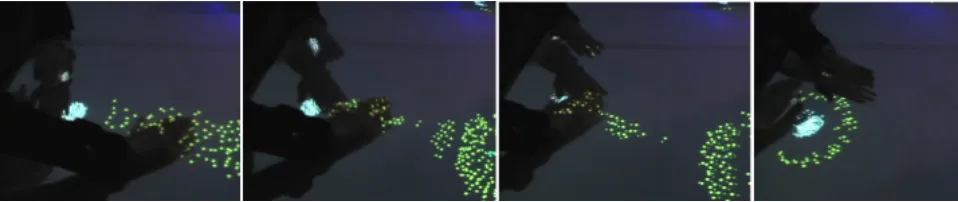
The transformative pathway from creative exploration to creative expression is analogous to pathways for game players’ skill acquisition in gameplay. The dynamic score is applied to enable this pathway. The design challenge for extending exploration is to provide a model for prolongation of play experience without extensive rules for competitive valorization. The dynamic score contributes to the prolongation model by illustrating the evolutionary and emergent conditions of the data that are generating the audible tone patterns. This graphical annotation of sounds aids players’ mental models of the sound production capacity with respect to past states and potential future states of the simulation. Players and audiences can speculate and ascertain the varieties and repertoire of swarm states and related sounds. Graphical annotation facilitates social engagement between performers and behaviors of three classes of agents described in section 3.2: swarm agents, sound agents, and play agents. A performer may extend this relationship as an emergent dramaturgy through engagement in simple tasks. For example in figure 3a, given a double circle aggregation of agents, novice players undertake to separate the inner group of agents from the outer group. Initially players attempt to apply forces such as pushing and pulling and speedy actions. These attempts are not successful and generate unexpected emergent consequences in the swarm and its generated sounds. By rehearsed interactions players learn that the play agents respond to the positions of hands not to physical forces. The players come to recognize the computational intelligence of agents following rules for inherent group behavior. Players come to realize they can influence the behavioral patterns not by directly controlling but by understanding the rules behind
the pattern formation. Figure 3b, the lower sequence, illustrates the cluster separation achieved along with the players’ exploration and learning process.
Anecdotally we observer that players (college students) required 20 to 30 minutes of practice to acquire enough experience to be able to control transformations of the swarm. Verbal instructions do not greatly accelerate learning; demonstrations are more effective. Players learn by imitation and experimentation. In a group of players, one person is likely to discover successful movements that the other players then imitate. The amount of time required to learn to control sound is determined by the complexity of the sound generating procedure.
Players’ acquisition of modes of engagement enables further cooperative or competitive relationships and roles, and cluster separation and aggregation become techniques mastered and then applied in planning and performance of more complex tasks. Interplay of roles and gestures in tandem with the evolutionary capacity of swarm simulation can be adopted in models of prolonged engagement, and performers can apply prolongations to systematize expressions to facilitate audiences’ mental models and imaginations. This enriched space of transformations concerning roles and play, gestures, sounds, and emergent states may be adopted as canvas and palette for composition and performance. Mastery of the constraints of the agents’ behaviors and their emergent patterns, coupled to the designed procedural sounds, represents the pathway of transformation from creative exploration to creative expression.
In the above example the simple task of cluster separation is a social relationship at the level of swarm simulation agents and is extended by three additional social relationships: from players to swarm agents, among the ensemble of multiple players, and from players and swarms to other listeners who watch a performance based upon sequences of sounds evolving with respect to sequences of social interactions. A dynamic score enhances these social relationships by annotating sounds and illustrating the structures of data that are coupled to procedural sound.
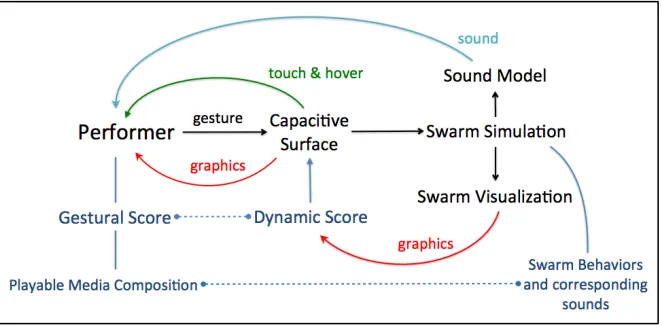
[image:8.595.57.533.621.758.2]Figure 4 depicts these relationships with arrows indicating flow of data and dotted lines indicating analogies designed as parallel structures. Audiences in a performance engage in the kinaesthetic and visual relationships that the performer demonstrates. Visualization of the agents as a
score helps illustrate gestures that indirectly guide tone production by influencing the agents’ behaviours. Section 5 presents the application of the dynamic score coupled with a Gestural score for performance of the composition Mutandrum.
4. Procedural Sound Integration with a
Simulation-based Dynamic Score
Players attune to swarm dynamics through graphics display coupled to kinesthetic sensation with auditory feedback. The performance function of a dynamic score requires a method to extract simulation state date and apply the data to enrich play experiences. Control strategies for sound mechanics are adapted to use data of features extracted from emergent behaviors in swarm simulations. To test these adaptations,
m:n data maps are established between sets of emergent swarm states and sets of procedural sound parameter states. Because emergent patterns are not known precisely in advance, the maps provide associations of parameter regions so that emerging patterns of swarm agents will generate corresponding sounds in anticipated regions that have not been mapped in detail. In this way evolutionary swarm patterns enable exploration of new sound patterns.
The application of emergent swarm patterns as sound control data presents a significant challenge, due to the absence of predictive data such as control parameter values or feature variables. The simulation code carries no a priori
representations of the patterns that can be readily applied to sound mechanics. This is consistent with emergent behavior from complex systems that results from changes applied to
unspecific control parameters [28]. The swarm simulation is defined in terms of unspecific control parameters. Patterns recognized by human observation are not represented directly in the simulation. To obtain relevant control data we perform data extraction based upon visible features of swarms, and apply the feature data to procedural sound mechanics. Below we discuss the primary salient features of swarms that provide data for sound control.
4.1. Recognizing Clusters
Swarm denotes the total agents in a simulation. Cluster refers to a visibly coherent aggregate of agents. The relevance of cluster formation is that agents in a cluster are responding to mutual proximity, whereas agents in separate clusters are mutually unaware unless the clusters are in close proximity. Clusters are a primary feature to recognize and measure: they are emergent and temporary. Their spontaneous subdivisions and formations provide a highly configurable and playable dynamic. Players tend to focus attention on clusters and how to merge them or separate them, as well as moving them across regions in the play space. Figures 2 and 3 illustrate a player inducing a deformation where one cluster is divided into two.
[image:9.595.123.454.558.721.2]Clusters are independent of species and recipes: in a swarm composed of multiple species, a cluster may be comprised of heterogeneous or homogenous agents. Membership of agents in clusters changes over time, so clusters are identified and tracked only by persistence. We examine the position of each agent at each time step and compare it to the positions of all other agents. A proximity threshold determines when an agent is a member of a cluster or a free agent roaming between clusters. At each time step an agent may be a member of only one cluster. For all agents in a common cluster we determine the average center position and provide this data for use in sound synthesis control. Shape is not a consideration in identifying a cluster. When two clusters’ agents have sufficiently close proximity they are considered merged, regardless of shape. When a cluster is generated it is assigned an integer identifier for the duration it persists autonomously. When two clusters merge one identifier prevails and the other is returned to the pool for re-use. Run time parameters specify the maximum number of simultaneous clusters that can be recognized, and the minimum number of agents that are required to recognize a cluster (a minimum of six agents in this work). The number of agents in a cluster is transmitted for sound control. Agents’ individual cluster memberships are tracked but not transmitted for sound control.
4.2. Detecting Emergent Features
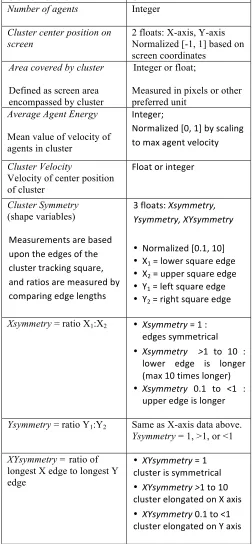
A cluster’s expressive features are shape and internal distribution of agents. Rings, elongations, “dumbbell” or “twin star” shapes, and internal rotation patterns are often prominent features. These emerging patterns are not represented in the simulation and must be detected as features by measuring the positions and velocities of swarm agents. In distinction to shape recognition, we determined the essential approach responds to displacement or perturbation. We arrived at this approach by observing that clusters do not achieve a wide range of shapes in terms of geometric primitives, and clusters cannot be forced into shapes other than their stable and emergent properties. We determined to tune sounds in a range corresponding from stable or symmetrical clusters to unstable or distorted clusters. This approach was selected rather than tuning sounds for target shapes unrelated to a cluster’s inherent properties. We adopted this initial approach from Sayama’s decision [22] to avoid the use of fitness evaluation methods. Direct counts and statistical measures are applied to detect swarm properties. Separate statistics are provided as sources of sound control data: 1) measured across the entire swarm, 2) measured by species regardless of cluster, and 3) measured by cluster. Table 2 presents the extracted data available for sound control, discussed in detail in [20].
4.3. Procedural Sound Attunement with the
Dynamic Score
Swarms’ relationships to sounds are relative to the initial tunings and the corresponding ranges of transformations. Ranges of sound transformations are designed to correspond to player’s actions inducing emerging properties of swarms. To achieve this, individual swarm control parameters do not correspond to individual sound control parameters. An abstraction layer is created where swarm simulation feature data is mapped to a manifold of a sound synthesis parameter control space [29]. The abstraction layer of the shared manifold connects the domain of a swarm’s emergent behaviors to a range of sound transformations. Data selection for m:n maps is based on extraction of salient features described in sections 4.1 and 4.2. The process of establishing initial correspondences may be thought of as “tuning” the interface. To achieve an interactive exploration of a simulation state space through sounds, we introduce the concept of attunement as an a priori process for conditioning a playable space for an auditory display [30]. Attunement in the present example is the method of calibrating the relationship between swarms’ dynamics and procedural sound mechanics. As a simple example, positional data of swarm clusters in the play area is applied to generate localization of positions of sound sources in a spatial audio display.
[image:10.595.299.551.126.670.2]Data from a swarm simulation must be combined with other data to control sound generators to create coherent sound patterns. Coherent sounds have audible characteristics that are consistent and easy to identify as swarm data varies.
Table 2. Data Extracted for Procedural Sound Control
Cluster-level data Units
Number of agents Integer
Cluster center position on screen
2 floats: X-axis, Y-axis Normalized [-1, 1] based on screen coordinates
Area covered by cluster
Defined as screen area encompassed by cluster
Integer or float;
Measured in pixels or other preferred unit
Average Agent Energy
Mean value of velocity of agents in cluster
Integer;
Normalized [0, 1] by scaling to max agent velocity
Cluster Velocity
Velocity of center position of cluster
Float or integer
Cluster Symmetry (shape variables)
Measurements are based upon the edges of the cluster tracking square, and ratios are measured by comparing edge lengths
3 floats: Xsymmetry, Ysymmetry, XYsymmetry
• Normalized [0.1, 10] • X1 = lower square edge
• X2 = upper square edge
• Y1 = left square edge
• Y2 = right square edge
Xsymmetry = ratio X1:X2 • Xsymmetry = 1 : edges symmetrical
• Xsymmetry >1 to 10 :
lower edge is longer (max 10 times longer)
• Xsymmetry 0.1 to <1 :
upper edge is longer
Ysymmetry = ratio Y1:Y2 Same as X-axis data above.
Ysymmetry = 1, >1, or <1
XYsymmetry = ratio of longest X edge to longest Y edge
• XYsymmetry = 1
cluster is symmetrical
• XYsymmetry >1 to 10
cluster elongated on X axis
• XYsymmetry 0.1 to <1
cluster elongated on Y axis
Pattern, which is a unique set of preconfigured control data that creates an audible framework for interactive sound control data.
4.3.1. Example of Procedural Sound Attunement Several techniques were developed to enable reliable correspondences of sounds with highly variable behaviours of clusters. In one approach [31] local deformations of clusters were uniformly applied to modify formant characteristics of sounds. (A formant is a resonance at a fixed frequency band that is invariant with respect to the fundamental frequency of the sound [32].) This technique may be applied to many classes of sounds. It involves modifying the vowel-like qualities of “openness” and “tightness” of a sound. With this technique the effects of a player’s hand deforming a cluster are immediately reflected in the local tone quality of a sound, without disrupting the composed pitch and rhythmic structure of the sound.
Sound sources are not associated one-to-one with clusters. The number and persistence of cluster instances is highly unpredictable. Clusters are local variations and are not structurally analogous to the organization of voices in a musical score. A method is required to manage a limited number of sound voices to correspond to an unknown number of clusters. The method is extensible to greater and fewer numbers of sound sources, reflecting composition techniques that are consistent for both solo and ensemble literature. For an initial number of clusters, new voices are introduced as the clusters form. Within the set number of voices, as clusters are instanced and terminated or merged, cluster data is transmitted to an accompanying voice. However the number of clusters is unpredictable and will often exceed the number of voices. Beyond the set number of sound sources, cluster data is assimilated by the tone patterns of a single voice, and the spatial position of clusters is reflected by spatial distribution of sound source localization. The number of voices is constant but the data they integrate and their localization is mobilized to statistically reflect cluster positions.
In summary, integration of procedural sound mechanics with a simulation-based dynamic score requires feature data extracted from the simulation and applied to an attunement process for transforming procedural sound design patterns.
5. Dynamic Score Enabling a Playable
Media Composition and Performance
The swarm-based dynamic score was incorporated into a prototype playable media system and interactive platform and utilized in the composition of Mutandrum, music for interactive concert performance. Figure 1 shows the performance configuration including a separate large-format image projection so the audience could see the dynamic score as the performer engages the swarm simulation to transform sounds. The orientation of the image display was rotated so that the spatial positions of sound sources and swarm clusters corresponded. The composition presented a scheduled series of swarm mutations, with extended periods
of play to induce cluster deformations, separations, combinations, and rotation patterns. During the composition process the sound was designed to reflect the density and level of activity of the clusters, by exploring the patterns of simulation recipes and making adjustments to those recipes and to corresponding sound mechanics of sound design patterns.
The transformative pathway from creative exploration to creative expression is embodied in the process of composing for a playable medium, then rehearsing and performing for an audience. This transformation requires a profound context shift. Creative exploration invokes an individual sense of discovery through intimacy of direct sensation that reinforces a mental model. Creative expression involves externalization of the individual sense through choreographed representations of the discovery process. Externalized representations enable audiences to develop analogous experiences that appeal to their mental models about tone production, without the intimacy of direct kinesthetic engagement, also without the labor-intensive rehearsal process.
5.1. Dynamic Score Enabling Gestural Score
and Procedural Score
A musical score is evidence of a composition: a premeditated cue organization that guides performers by transmodal abstraction to generate sounds, drawing upon grounded mental models where the cues are incomplete. Transmodal abstraction formalizes the incompleteness of cues to achieve essential efficiency for guidance, as the information required for tone production in live performance cannot be specified entirely in a score. In a dynamic score the efficiency of abstraction enables a focus on transformation of procedural sound design patterns, rather than focus on tone generation.
5.1.1. Gestural Score
While representing emergent properties a dynamic score does not depict a fixed composition plan. A separate gestural score represents Mutandrum to a performer. The gestural score is hand-drawn by the composer, indicating a sequence of gestures to be performed with a series of scheduled swarm recipes. The gestural notation indicates types of deformations to be applied to the simulation and degrees of exploration to be extended by a performer. The dynamic score complements the gestural score, providing feedback as gestures are enacted with the simulation. The levels of details and responsive qualities of the dynamic score enhance the static abstractions of the gestural score, differentiating a temporal dimension of gestural notation.
5.1.1. Procedural Score
design patterns. The sequence and synchronization of recipes with procedural sound mechanics is specified in a machine-readable procedural score that is processed by the computational system hosting the Mutandrum performance. The python programming language represents the scheduled data as sets of control parameter values. Some of the scheduled data are automated but the majority is determined in time by the performer.
The combination of gestural score and procedural score integrates evolutionary aspects combined with composed aspects intended for performance. A dynamic score enables listeners to join in exploratory sensation combined with composed and performed consequences, which cannot be experienced by mere playability and individual exploration.
5.2. Dynamic Score for Prototyping Gestures
and for Prolonged Engagement in Expressive
Performance
The dynamic score was necessary in the process of composing Mutandrum, enabling exploration and discovery of swarm states and responses to types of gestures. Composing swarm recipes with procedural sound design patterns also requires the dynamic score for development of combination of swarms and sounds, and for prototyping gestures with respect to the playability and performability of emergent and evolutionary properties of the swarm. The process of composition-prototyping involves assessing and fine-tuning the simulation for affordances for generating features, then fine-tuning procedural sound mechanics and sound design patterns under the simulation’s conditions, then applying gestures in composed sequences. Essentially this iterative process consults with the dynamical score to prototype the data to schedule in the procedural score and the gestures to formalize in the gestural score.
Prolongation is a compositional technique for engaging listeners’ anticipation of transformations and prediction of outcomes of performed sequences and extended events [33]. As noted above the distinction between playable media and expressive performance is the externalization of exploration and kinesthetic feedback. Prolongation is a technique for externalization, providing cues and representations for observers to imagine the current and immediately future actions of a performer. The dynamical score creates a visual narrative of the sound performance, and the graphic illustration of simulation states expands audiences’ understanding the range of possibilities for immediate and long-term outcomes of actions.
Two techniques in Mutandrum were developed using the dynamical score to enable prolongation. The first technique was the introduction of a new swarm species synchronized with the introduction of a new sound design pattern, while preserving the previous sound design patterns and previous swarm species in the performance area. The result was an instructive form of polyphonic playability, where the visual presence of new species helped the identification of parallel evolving sound patterns. The coordination of multiple layers of sound and their interplay, each providing a simple pattern
that greatly enriches the summative auditory pattern, derives from a technique known as species counterpoint developed from the 13th century in the very early era of common music
notation [34]. Prolongation is realized by simple variation of a single layer at a time, and with a dynamic score each of these layers and their enacted variation are visible. A second technique is the gradual and separation or merger of clusters, accompanied by clear changes to timbre and pitch when the clusters are pulled apart or joined. The performer can approach these transformations in playful phases and the audience can measure visually the stretching and deformation or the near collision of clusters. Performers an rehearse the Shepherding of swarms to make the most of the timing of events where listeners’ are able to anticipate and follow transformations and predict their outcomes.
6. Summary and Concluding Remarks
Contemporary practice with novel interfaces lacks the rich history and references of a genealogy of a common kind, presenting a challenging scenario for generating meaningful values and experiences. This is especially the case when designing a platform for non-game oriented playable media. In the absence of common practice to provide grounded mental models, the repeating scenario is that the play experience either decays or cannot survive through the novelty of new interfaces beyond the initial novel attraction. In response we identified a research and development inquiry focused on exploration of sonic elements’ prolonged engagement with new approaches to, and adaptations of, interface and score in an attempt to demonstrate a sustainable interactivity in musical time dimension in the absence of a grounded mental model.
that enable individual players to elaborate a musical expression while maintaining the identity of a musical work. There are numerous musical examples in popular and classical literature that are performed by solo players and also by small to large ensembles, and these performances maintain the identity of a musical work under extreme variation of players’ social configurations. The stable relationship between musical composition and performance can provide a kind of resilient structure that is very desirable for forms of playability. These resilient structures may be applied to address constraints and improve adaptive play models as alternatives to the relatively brittle structures of many computer games based upon scoring and winning.
6.1. Musical Instrument Play and Gameplay
A game is played; musical instruments are also played. Procedural composition affords a bridge between two families of play: play involving rules and valorization with symbolic execution for “playing by the rules;” and play involving principles of tone production with symbolic execution that may include both “playing from a score” and procedural sound generation. (A traditional musical instrument may be classified as an analog procedural sound generator.) Imagine a kind of game with rules that generate emergent structures that are sensory and expressive when played. Instead of winning and losing players pursue pathways for expression. Compositions of such procedures identify and encode play relationships between game and music. These relationships may be described and analyzed in terms of prolongation of expression.
Design problems for sustainable engagement in a non-game oriented novel platform are stated as the problems of designing a platform for creative explorations and creative expressions. The transformative pathway from creative exploration to creative expression is analogous to pathways for game players’ skill acquisition in gameplay. Skill acquisition is also well established in music. Looking through the discipline of music practice, we have described how the triadic relationship between literature, repertoire, and instruments is grounded in a mental model to support the skill acquisition. Attempts to broaden musical literature have been a major endeavor of composers in music history. Physical structures of instruments contribute to the notation of a literature. For example guitar tablature is an instrument specific notation system evolved in the early 14th century
designed as iconic representation of the fingerboard [35]. In that era the guitar became widely adopted as a playable platform of an emerging literature and virtuoso technique. It is worthwhile to emphasize that there is a co-evolving relationship between the soft and hard: when the notation and literature evolve, the instrument is often redesigned by altering its physical shape to accommodate the newly required scope imposed by extended compositional techniques.
6.2. Composition and Performance of Play
Composition and performance for playable media may be approached as a contemporary analog to the renaissance guitar and other musical instruments in their formative and adoptive periods. Due to computational integration of multiple subsystems, a playable medium may include a capacity for self-annotation in the form of data visualization. The shifting roles of signals—sounds and graphics—that are generated by automation and transformed by human actions is a signature of contemporary postindustrial labor and social techno-economy.
With this experimental system, a compositional task begins by encoding the social behavior of the swarm. The ranges of swarm behaviors are mapped to the ranges of expressions of sound-producing agents. Swarm clustering, coherence and energy levels translate to changes in sound density, coherence and intensity. As a dynamic score the swarm properties are also generative. Musical patterns are not arbitrarily separable from the states and transitions of swarms. Performers guide their actions by listening as well as anticipating swarm trajectories and states and responding to emerging states. Audiences are engaged in this process through a dynamic score. Everything players do is within a domain of making music in a composed framework of swarm behavior. Kinesthetic acts emerge as performance gestures with respect to tasks for engaging swarms.
This dynamic recalls the compositional process gesture under stress developed by Brun [36]. Gesture is requisite expression of intention in a task-driven perception-guided performance system. Stress is the resulting musical expression. Applying the interpretation to this project: Swarms are agents of origin of graphic and sound events, but are also responsive agents, transformed by actions of players who are watching and also listening. Indirectly the resulting sounds also carry agency to influence ongoing transformation of swarms, by providing feedback to performers and by externalization to audiences. This is a performance example of three agents’ interactions: simulated agents (swarms), play agents (performers and audiences), and sound-producing agents (sound mechanics and procedural sound design patterns governed by a compositional design). The dynamic score is partly auditory, partly visual, and partly kinetic, and enables performers’ and listeners’ engagement in a dynamic social network of relationships and agency.
Acknowledgements.
We wish to thank Hiroki Sayama for sharing his code base to develop the playable implementation. Arthur Peters debugged the capacitive surface and data transmissions and coded the playable simulation version and authoring environment. Michael Chladil configured the projection system and performance implementation.
References
[1] Choi, I. (2010) Mutandrum: Interactive Composition for Playable media, capacitive sensing panel, and evolutionary algorithm. http://insookchoi.com/projects/playable-media/ [2] Laban, R. (1956) Laban’s Principles of Dance and Movement
[3] Choi, I. (1997) Interactivity vs. Control: Human-Machine performance basis of emotion. In Camurri, A. [ed.] Kansei, the Technology of Emotion (Proceedings of the AIMI
International Workshop). Genoa, Italy, Oct. 3-4, 1997
(Genoa: Associazione di Informatica Musicale Italiana), 24-35.
[4] Theramin, L. S. (1925) Signaling Apparatus. United States Patent 1,658,953. US Patent Office.
[5] Roads, C. and Strawn, J. (1988) Foundations of Computer
Music (Cambridge: MIT Press).
[6] Gérard, M., Raczinski J-.M, and Serra, M-H. (1990) The New UPIC System. In ICMC Proceedings of the 1990 International
Computer Music Conference. Glasgow, 1990 (San Francisco:
International Computer Music Assoc.), 249-252.
[7] Jordà, S. (2010) The Reactable: Tangible and Tabletop Music Performance. In CHI 2010: Proceedings of the 28th ACM
Conference on Human Factors in Computing Systems.
Atlanta, 10-15 April, 2010 (Association of Computing Machinery), 2989-2994.
[8] Choi, I., Zheng, G. and Chen, K. (2000) Embedding a sensory data retrieval system in a movement-sensitive space and a surround sound system. In Proceedings of the 2000
International Computer Music Conference. Berlin, 2010 (San
Francisco: International Computer Music Assoc.), 141-144. [9] Ableton, Inc. (n.d.) Ableton Live software. Available at:
https://www.ableton.com/en/live/ (Accessed on May 5, 2014).
[10]Reynolds, C. (1987) Flocks, herds and schools: A distributed behavioral model. In SIGGRAPH '87: Proceedings of the 14th annual conference on computer graphics and interactive
techniques. Anaheim, July 27-31, 1987 (Association for
Computing Machinery), 25-34.
[11]Vicsek, T., Czirok, A., Ben-Jacob, E., Cohen, I. and Shochet, O. (1995) Novel type of phase transition in a system of self-driven particles. Physical Review Letters 75: 1226–1229 [12]Reynolds, C. Boids. (n.d.) Available at:
http://www.red3d.com/cwr/boids/ (Accessed on 20 April, 2012).
[13]Robertson, M. (2008) ‘The Creation Simulation.’ Seed Magazine, September 8, 2008. Available at:
http://seedmagazine.com/content/article/the_creation_simulati on/ (Accessed on April 21 2012).
[14]Blackwell, T. (2003). Swarm music: improvised music with multi-swarms. In Artificial Intelligence and the Simulation of Behaviour. University of Wales.
[15]Unemi, T. and Bisig, D. (2005). Music by Interaction among Two Flocking Species and Human. In Proceedings of the Third International Conference on Generative Systems in Electronic Arts, pages 171-179. Melbourne, Australia. [16]Davis, T. and Karamanlis, O. (2007). Gestural control of sonic
swarms: Composing with grouped sound objects. In 4th Sound and Music Computing Conference, Lefkada, Greece.
[17]Bisig, D. and Neukom, M. (2008). Swarm based computer music-towards a repertory of strategies. In GA2008,
Proceedings of the 11th Generative Art Conference.
[18]Huepe, C. Cadiz, R. F. and Colasso, M. (2012). Generating
music from flocking dynamics. American Control
Conference, pages 4339-4344.
[19]Choi, I. and Bargar, R. Between Music and Games: Interactive Sonic Engagement with Emergent Behaviors. In Reidsma, D., Haruhiro, K., and Nijholt, A. (eds.) Advances in Computer Entertainment, Lecture Notes in Computer Science.
8253: 519-523.
[20]Choi, I. and Bargar, R. (2014) Sounds Shadowing Agents Generating Audible Features from Emergent Behaviors. In
Proceedings of Alife 14: The Fourteenth International Conference on the Synthesis and Simulation of Living
Systems. New York, July 30–August 2, 2014 (to appear).
[21]Sayama, H. (2006) Teaching emergence and evolution simultaneously through simulated breeding of artificial swarm behaviors. In Proceedings of the Sixth International
Conference on Complex Systems (ICCS2006). Boston, June
25-30, 2006. http://necsi.org/events/iccs6/proceedings.html
(Retrieved April 21 2012).
[22]Sayama, H. (2007) Decentralized Control and Interactive Design Methods for Large-Scale Heterogeneous Self-organizing Swarms. In F. Almeida e Costa et al., (eds.) ECAL
2007, LNAI 4648. (Berlin: Springer-Verlag), 675–684.
[23]Wanderley, M. and Depalle, P. (2004) Gestural Control of Sound Synthesis. In Johannsen, G. (ed.) Proceedings of the IEEE Special Issue on Engineering and Music - Supervisory
Control and Auditory Communication. 92 (4): 632-644
[24]Luciani, A. (3d.) (2004) Enactive Interfaces. Project IST-2004-002114-ENACTIVE. Available at: http://www-acroe.imag.fr(Accessed May 5, 2014).
[25]Choi, I. (2000) Gestural Primitives and the context for computational processing in an interactive performance system. In Battier M. and Wanderly, M. (eds.) Trends in
Gestural Control of Music (CD-ROM). (Paris: IRCAM).
[26]Camurri, A., Lagerlof, L. and Volpe, G. (2003) Recognizing Emotion from Dance Movement: Comparison of Spectator Recognition and Automated Techniques. International
Journal of Human Computer Studies59 (1-2): 213-225.
[27]Newlove, J. (1993) Laban for Actors and Dancers: Putting
Laban's Movement Theory into Practice. (London: Nick Hern
Books).
[28]Haken, H. (1990) Synergetic Computers and Cognition. (Berlin: Springer-Verlag).
[29]Choi, I. 2000. A Manifold Interface for Kinesthetic Notation in High-Dimensional Systems. In Trends in Gestural Control
of Music. In Battier M. and Wanderly, M. (eds.) Trends in
Gestural Control of Music (CD-ROM). (Paris: IRCAM).
[30]Choi, I. (2014) A Priori Attunement for Two Cases of Dynamical Systems. In Proceedings of the 2014 International
Conference on Auditory Display. New York, June 22-25, 2014
(to appear).
[31]Choi, I., and Bargar, R. (2011) A Playable Evolutionary Interface for Performance and Social Engagement. In
Proceedings 4th International ICST Conference on Intelligent Technologies for Interactive Entertainment (INTETAIN
2011). Genova, Italy, May 25-27, 2011, LNICST 78, A.
Camurri and C. Costa (Eds.) (Heidelberg: Springer), 170-182. [32]Chowning, J. (1989) Frequency Modulation Synthesis of the Singing Voice. In Mathews, M. and Pierce, J. (eds.) Current
Directions in Computer Music Research. (Cambridge: MIT
Press), 57-64.
[33]Schenker, H. (1954) Harmony (orig. New Musical Theories
and Fantasies – by an Artist (1906)).Borgese, E. M. (trans.),
Jones, O. (ed.) (Chicago: University of Chicago Press). [34]Fux, J.J. (1725) Gradus ad Parnassum, Mann, A. (trans.) as
The Study of Counterpoint (1943) (New York: W.W. Norton).
[35]Apel, W. (1953). The Notation of Polyphonic Music. (Cambridge, Mass.: Medieval Academy of America). [36]Brun, H. (1986) My Words and Where I Want Them. (Urbana: