O p ti m a x 2 0 1 6 : p e e r o b s e r v a ti o n
of f a cilit a tio n
Ro bi n s o n , L, C o w a r d , J, D e L a b o u c h e r e , S, Lo w e , J, M e r c e r, C E,
P al m q vi s t, C a n d Tak a v ol, P
T i t l e
O p ti m a x 2 0 1 6 : p e e r o b s e r v a ti o n of f a cilit a tio n
A u t h o r s
Ro bi n s o n , L, C o w a r d , J, D e L a b o u c h e r e , S, Lo w e, J, M e r c er,
C E, P al m q vi s t, C a n d Tak av ol, P
Typ e
M o n o g r a p h
U RL
T hi s v e r si o n is a v ail a bl e a t :
h t t p :// u sir. s alfo r d . a c . u k /i d/ e p ri n t/ 4 2 1 7 9 /
P u b l i s h e d D a t e
2 0 1 7
U S IR is a d i gi t al c oll e c ti o n of t h e r e s e a r c h o u t p u t of t h e U n iv e r si ty of S alfo r d .
W h e r e c o p y ri g h t p e r m i t s , f ull t e x t m a t e r i al h el d i n t h e r e p o si t o r y is m a d e
f r e ely a v ail a bl e o nli n e a n d c a n b e r e a d , d o w nl o a d e d a n d c o pi e d fo r n o
n-c o m m e r n-ci al p r iv a t e s t u d y o r r e s e a r n-c h p u r p o s e s . Pl e a s e n-c h e n-c k t h e m a n u s n-c ri p t
fo r a n y f u r t h e r c o p y ri g h t r e s t r i c ti o n s .
OPTIMAX 2016: Peer observation of facilitation
Leslie Robinson, Jo Coward, Stephanie De Labouchere, Joanna Lowe, Claire Mercer, Charlotte Palmqvist Parvin Tavakol,
Introduction
In August 2016, a 3-week research Summer School was delivered at University of Salford. The Summer School, known as ‘OPTIMAX’ was in its fourth year of delivery. Previous iterations were held in the Netherlands (2015), Portugal (2014) and Salford (2013).
The purpose of OPTIMAX is to facilitate collaborative international and interdisciplinary research between university academics and students. This offers an exceptional opportunity not only for students, but also for tutors who want to develop their facilitation skills.
The project reported here used tutor observers (i.e. tutors who attend the summer school, in an observational capacity only, to develop their own skills as teachers) to observe, identify and reflect on a range of facilitation practices for managing the diverse OPTIMAX research groups. The project presents a description of the peer-observation method we used and highlights a number of findings related to facilitator strategies that appeared to influence group dynamics and learning. These observations are then used to make recommendations about how OPTIMAX tutors can be prepared for their facilitation experience.
Background
Education literature regarding Peer Observation of Teaching (PoT) suggests this method of training new teachers is more effective than de-contextualised didactic approaches (Martin and Double 1998). This is perhaps not surprising since new teachers witness real-life examples of teaching in action rather than reading about them in textbooks.
Nevertheless, PoT is not without its problems. Those being observed can feel intimidated and respond negatively if they feel their practice is being judged. This is particularly true when PoT is undertaken by more experienced peers for the purpose of Quality Assurance (Cockburn 2005). Although the aim of our study was not to review the quality of facilitation but to support new teachers to learn from examples of good practice it was still very important to prepare everyone appropriately to ensure a collaborative approach was achieved.
In order to facilitate this we positioned the study within an Appreciative Inquiry framework
(Cooperrider & Whitney 2005). In Appreciative Inquiry observers are only permitted to identify and celebrate good practice. The principle is that by identifying what it is that makes something good, these ideas can be used to move forward, rather than concentrating on a deficiency model of what doesn’t work, where people are required to let go and be coerced to change.
We used Siddiqui et al (2007) 12 tips for peer observation of teaching to guide the process, as this provides a useful overview for considering the PoT process from the perspectives of all involved.
template by amending the standard PoT form used at the University of Salford (University of Salford 2016/17) to include qualities identified in the literature as being supportive of group facilitation. These covered being supportive of group (peer-to-peer) learning interactions, managing group dynamics and managing conflict (Bosworth 1994, Barkley, Howell Major, Cross 2014, Johnson, Johnson & Smith 2014) (see Appendix 1).
Purpose of our work
To explore new tutors’ reflective observations of small group facilitation learning activities, in order to:
1. develop a tool for the peer-observation of small group facilitation
2. develop a set of tutor guidelines on small group facilitation in a multicultural context 3. make recommendations to the OPTIMAX organising committee about preparation of tutors
Participants
All new tutors who had registered to attend the summer school for the purposes of improving their facilitation skills were invited to take part in the study as tutor-observers. Six out of seven agreed; the seventh was required to participate as an ‘experienced’ group tutor as she had specific statistics skills which were needed to support the research. She felt this would influence her ability to step back into the role of ‘inexperienced’ tutor and would therefore bias her observations.
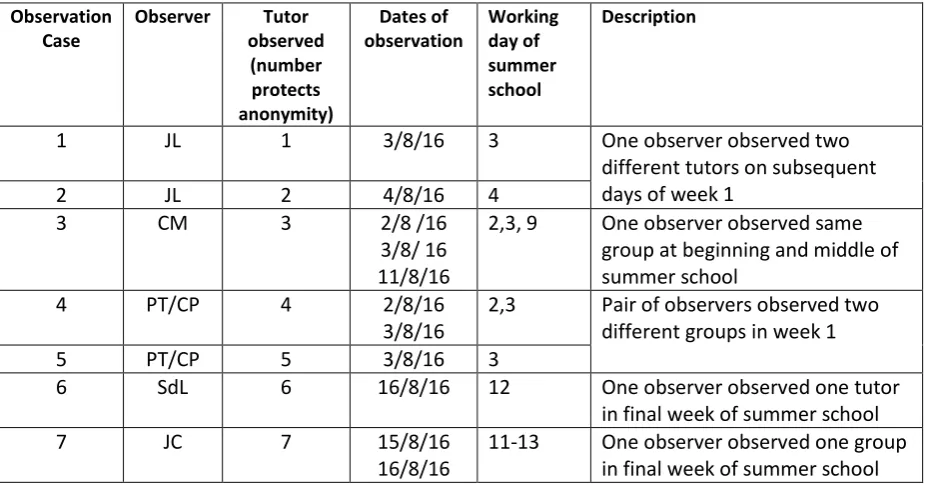
[image:3.595.67.530.520.762.2]Of the 6 participants, two were from Sweden, two from the UK, one from Ireland and one from Switzerland. Observation took place through a number of permutations: paired; singly; during week one only; during week 3 only and over the length of OPTIMAX (see table 1). This helped limit the influence of intra and inter-observer differences, group dynamics, and changes in facilitator behaviour over time. Tutor-observers did not observe tutors from their own place of work. All experienced tutors consented to being observed.
Table 1 Configuration of Observations
Observation Case
Observer Tutor observed (number protects anonymity) Dates of observation Working day of summer school Description
1 JL 1 3/8/16 3 One observer observed two
different tutors on subsequent days of week 1
2 JL 2 4/8/16 4
3 CM 3 2/8 /16
3/8/ 16 11/8/16
2,3, 9 One observer observed same group at beginning and middle of summer school
4 PT/CP 4 2/8/16
3/8/16
2,3 Pair of observers observed two different groups in week 1
5 PT/CP 5 3/8/16 3
6 SdL 6 16/8/16 12 One observer observed one tutor
in final week of summer school
7 JC 7 15/8/16
16/8/16
17/8/16 over 3 days
Method
Stage 1: Information and consent
Experienced tutors being observed and tutor-observers were informed about the project and asked for consent to participate on-line before the tutors attended the summer school.
Stage 2: Teaching about group facilitation and peer observation
Tutor-observers were briefed via a tutorial with the project lead (who has teaching and research experience and published on small and intercultural group learning (Robinson 2015, Robinson, Harris and Burton 2015, Schillemans and Robinson 2016)) about what is considered good practice in small group facilitation. This helped them understand the observation tool. Tutor-observers were also made aware of the principles of peer-observation and the requirement for good ethical conduct during the process.
Stage 3: Observation
Tutor-observers were allocated to a group to carry out observation. This was based on pragmatic issues related to the length of time the tutor-observer was available for the summer school. To avoid difficulties an observer may have had in feeding back to a more experienced colleague they were placed with a tutor form a different country. This also kept the field ‘anthropologically strange’ maximising the ability to detect new and unfamiliar practices (Delamont 2014).
Stage 4: Interview and debrief with tutor
Tutor-observers then met with the tutor/s they had observed for feedback and discussion about the observations. This is good practice in peer-observation (HEA 2006) but also enabled the tutor-observer to explore any further issues such as why a particular intervention was or was not undertaken, i.e. enriching their notes with an emic perspective.
Stage 5: Reflective write-up
Tutor-observers then wrote a reflective account of their observations. As well as supporting their own development as tutors the reflective report formed the main document for data analysis.
Stage 6: Tutor observer analysis, discussion and consensus meeting
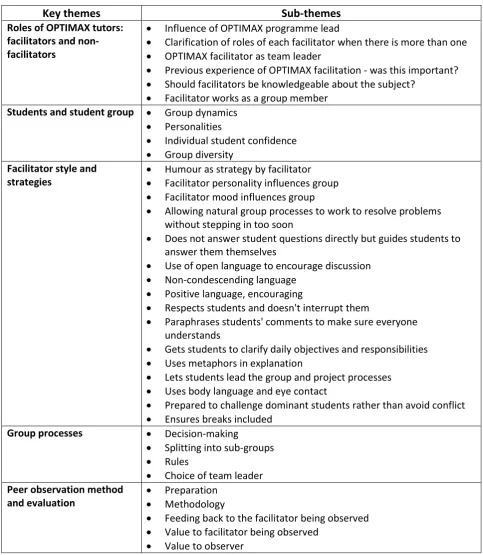
Finally, all tutor-observers met to compare their notes and thereby identify important themes and sub-themes emerging from the reflective accounts (see Table 2). These themes formed the basis of a framework analysis.
Analysis
project leader compared and contrasted these comments to arrive at the study findings and recommendations.
Results and discussion
[image:5.595.65.549.215.771.2]In order to propose a set of guidelines and recommendations to prepare tutors for OPTIMAX facilitation we first highlighted the good practices observed in terms of supporting learning interactions in groups and managing group dynamics.
Table 2 Key themes and sub themes
Key themes
Sub-themes
Roles of OPTIMAX tutors: facilitators and non-facilitators
Influence of OPTIMAX programme lead
Clarification of roles of each facilitator when there is more than one
OPTIMAX facilitator as team leader
Previous experience of OPTIMAX facilitation - was this important?
Should facilitators be knowledgeable about the subject?
Facilitator works as a group member
Students and student group Group dynamics
Personalities
Individual student confidence
Group diversity
Facilitator style and strategies
Humour as strategy by facilitator
Facilitator personality influences group
Facilitator mood influences group
Allowing natural group processes to work to resolve problems without stepping in too soon
Does not answer student questions directly but guides students to answer them themselves
Use of open language to encourage discussion
Non-condescending language
Positive language, encouraging
Respects students and doesn't interrupt them
Paraphrases students' comments to make sure everyone understands
Gets students to clarify daily objectives and responsibilities
Uses metaphors in explanation
Lets students lead the group and project processes
Uses body language and eye contact
Prepared to challenge dominant students rather than avoid conflict
Ensures breaks included
Group processes Decision-making
Splitting into sub-groups
Rules
Choice of team leader
Peer observation method and evaluation
Preparation
Methodology
Feeding back to the facilitator being observed
Value to facilitator being observed
Other
Student versus tutor centred
OPTIMAX is designed to be student-led. Experienced tutors were seen to facilitate this through the use of open language which was encouraging and non-condescending; they were respectful towards the students and attempted to position themselves as equal members of the team rather than being in a position of power.
They were also seen to encourage the students to think for themselves by using open questions in response to requests for information and by paraphrasing and reflecting the question back to the group for other members to help resolve. One particular good example was a tutor who used an approach that forced students to summarise the project progress and their own understanding rather than attempting to summarise the learning for them. For example instead of asking “is everyone clear on this”, the tutor would ask “tell me what you understand about what you have found” (tutor 4).
Encouraging participation
The more experienced tutors were not afraid of silences, allowing the group to resolve issues for themselves rather than stepping in too early. The tutor-observers who witnessed more than one facilitation style were able to contrast this with tutors who stepped in to fill a silence, the consequence of which was subsequent student reliance on the tutor to direct the learning.
One experienced tutor was shown to make effective used of body language to engage all students in the discussion by making eye contact with each student individually in order to encourage
participation.
Group Dynamics
Experienced tutors demonstrated a range of strategies to positively influence group harmony. In particular, some tutors used humour to good effect ensuring there was a congenial atmosphere despite the pressure of the learning task. One tutor took a more proactive approach by ensuring breaks were scheduled and including social activities during this time.
The tutor mood was observed to have a strong influence on the group dynamic. A number of experienced tutors purposefully chose to demonstrate a calm and relaxed demeanour and the groups were consequently calm and relaxed, whereas tutors who were stressed or unenthusiastic (only occasionally seen) appeared to transfer these qualities to the group.
Group Processes
There were a number of challenges identified by the observers which, whilst managed well by the tutors, could have been avoided or better supported through adherence to group management processes. As part of the preparation for their OPTIMAX research project, the groups were
were only observed in the initial set-up (week 1) but rarely returned to throughout the project. The observers felt this was a missed opportunity.
For example, in one incident of conflict (where two students dominated one particular group and ignored advice from the tutor), the tutor managed the problem by remaining calm, and using strategies to retain group harmony. The research output was not negatively influenced. However, the tutor had a less than satisfactory experience of OPTIMAX. Returning to the ground rules and agreed decision-making strategy may have helped to address the problem in a more satisfactory way.
In other groups, dynamics changed when new tutors joined half way through the summer school, and when groups were split into smaller groups to divide up the tasks. This left the students unclear about everyone’s roles, positions and responsibilities. Again, returning to the ground rules would have been useful to aid clarification.
Group make-up was identified as being a potential barrier to progress despite effective facilitation strategies. For example, in some groups the tutor was also nominated the group leader. This tended to happen because the students’ personality styles 1did not favour the leadership role. In order to
progress the research the tutor therefore stepped into the role. Although this did not appear to affect the quality of the group’s work, it would have limited the opportunity for students to practice leadership skills.
Groups that were diverse appeared to be more dynamic. This included a mix of personality types, ages, qualifications and countries, as well as having two tutors, rather than one, who each brought different qualities to the group. Tutor-observers suggested that considering these things before the make-up of each group was determined might be useful, i.e. to purposefully configure the group to maximise diversity.
Objective 2: Guidelines and recommendations for OPTIMAX facilitation
From the above observations we make the following recommendations
1. Groups could be configured before the start of OPTIMAX to ensure a diverse mix with regard to age, qualification, discipline, country of study, personality type, research and associated skills. This could be achieved through the development of a registration form which requests the above demographic and personality details. Students would need to complete the Myers-Biggs test prior to OPTIMAX attendance.
2. Student groups to be introduced online before commencement of OPTIMAX using an appropriate Social Media platform.
3. There should be two tutors per group and where possible one of these should have group management skills/experience. The tutors should agree their roles before meeting with the students.
4. Tutors should be provided with a handbook on i) facilitating group learning and ii) managing groups before commencing OPTIMAX.
5. Effective strategies for facilitating group learning to be included in the handbook include:
1 On day 1, all OPTIMAX participants (staff and students) complete a Myers-Briggs (Malpascoe Team Dynamics
a. Asking students to lead process and clarify daily tasks b. Asking students to articulate their own understanding
c. Praising and encouraging students, and helping students who have not been understood by the others to re-phrase their statements/questions
d. Establishing equal power through use of supportive and non-condescending language
e. Proactively engaging students who are not participating
f. Using silence to provide students the opportunity to think through solutions g. Being mindful of actions which threaten group learning such as lack of task
clarification, especially when sub-groups are used
6. Effective strategies for managing groups to be included in the handbook include:
a. Having daily reflective report on progress of task but also each person’s contribution (including tutor)
b. Establishing ground rules, roles and responsibilities and referring to these regularly c. Considering the social development of the group by identifying opportunities for
doing ‘off-task’ activities
d. Being mindful of tutor mood on the dynamic and development of the group
Objective 3: developing a tool for the peer-observation of small group facilitation
As Martin and Double (1998) also reported in their work, both tutor-observers and expert tutors found the experience useful for professional development. The observers highlighted strategies such as effective use of silences, eye contact and humour as things they would take away and embed within their own practices. Those being observed appreciated feedback and confirmation that their practices were supportive of student learning.
The template was a useful guide. The tutor-observers felt that the only additional information that could be captured might be detail about the experienced facilitator’s previous experiences of facilitation and any aspects of their practice they would like feedback on. Tutor-observers also felt they would like to have had a pre-observation interview with their experienced tutor in order to identify specific issues to look out for. This is certainly identified as good practice in most PoT schemes (HEA 2006) but may have rendered this research project less valid since being directed to specific issues may have meant the observers were biased in what they observed. Nevertheless, future recommendations would include a pre-observation interview with new tutor learners, along with a space to capture this information on the template.
Observers did suggest that students could be better informed about the PoT scheme so that the students did not feel they were being assessed in any way. This was also recommended by
Siddiqui,
Jonas-Dwyer and Carr (2007
).Tutor-observers felt that maximum benefit would be gained from attending the full three weeks since they could identify changes in the group dynamics and the ways the experienced tutors managed this.
This has been a descriptive overview of the reflections and observations of less experienced tutors. We have not attempted to qualify their observations against student or group outcomes to
determine whether what they suggested was good practice could be verified as such. However, the template used was derived from pedagogical theory on group facilitation and this therefore goes some way to supporting the assumptions made. The multiple permutations of paired, repeated and longitudinal observations, observer consensus meetings and comparison of notes has provided a rich data set which demonstrates data saturation around most practices observed and reported here. Finally, the observers were asked to verify their interpretations with the expert facilitators at the post-observation meeting adding trustworthiness to the data.
References
Barkley EF, Howell Major C, Cross, KP (2014) Collaborative Learning Techniques: a handbook for
college faculty Jossey-Bass. San Francisco, Ca
Bosworth K (1994) Developing collaborative skills in college students. In K.Bosworth & SJ Hamilton (eds) Collaborative learning: Underlying processes and effective techniques (pp25-32) New Directions in Teaching and Learning no 59. San Francisco: Jossey-Bass.
Cooperrider, D.L. & Whitney, D (2005) A positive revolution in change: Appreciative inquiry. In Cooperrider, D. L. Sorenson, P., Yeager, T. & Whitney, D. (eds.) Appreciative Inquiry: Foundations in
Positive Organization Development (pp.9‐33). Champaign, IL: Stipes.
Creswell, J. W. (2009). Research Design. Thousand Oakes, California, Sage.
Delamont Sara (2014) Key themes in the ethnography of education. London. Sage,
HCPC (2016) Standards of Conduct, Performance and Ethics [available at] http://www.hpc-uk.org/aboutregistration/standards/standardsofconductperformanceandethics/
HEA (2006) Peer Observation [available at] http://escalate.ac.uk/resources/peerobservation/05.html
Hogg H and Lança L (eds) (2014) Erasmus Intensive Programme OPTIMAX#2014 Radiation dose and
image quality optimisation in medical imaging Lisbon, Portugal
Hogg, P, Blakeley, C and Buissink, C 2015 OPTIMAX 2015 : Multicultural team-based research in
radiography, a holistic educational approach. University of salford, Groningen, the Netherlands
Johnson DW Johnson RT & Smith KA (2014) The power of cooperative learning for university classes:
The interrelationship among theory, research, and practice. Journal on Excellence in College Teaching
(25) 4
Malpascoe Team Dynamics using MBTI Leadership Development Series
http://www.slideshare.net/malpascoe/mbti-team-dynamics [accessed 18/12/16]
Morse, J. M. and Field, P. A. (1996). Nursing Research the Application of Qualitative Approaches. Cheltenham, Nelson-Thornes.
Ritchie J, Spencer L (1994) Qualitative data analysis for applied policy research in Analyzing
Qualitative Data Eds Bryman A and Burgess RG (pp 173-194). Taylor and Francis Books Ltd
Robinson L., Harris S., Burton R. (2015) Saving face: Managing rapport in a Problem-Based Learning group Active Learning in Higher Education March 16: 11-24, doi:10.1177/1469787415573355
Robinson L. (2015) Age difference and face-saving in an inter-generational Problem Based Learning group Journal of Further and Higher Education
Schillemans Kitty and Robinson Leslie (2016) Team and project management skills in
OPTIMAX 2015 : Multicultural team-based research in radiography, a holistic educational approach.
Hogg, P, Blakeley, C and Buissink, C (Eds) University of Salford, Groningen, the Netherlands [available at] http://usir.salford.ac.uk/38008/
Siddiqui Zarrin Seema., Jonas-Dwyer Diana., Carr Sandra E (2007) Medical Twelve tips for peer observation of teaching Teacher 2007; 29: 297–300
University of Salford (2016/17 version) Observation of Teaching Optional Template [available at]
Appendix 1
Context details
Name of tutor/s being
observed
Name of peer observer
Name of group being
observed
Date and time of observation
Observation Notes
Whilst observations are not a process of checking against a checklist, which cannot
encompass all the complexities of the teaching situation, there are some common features
that do exist and therefore can be used as a guide to provide feedback. The session should
focus on the student learning experience as facilitated by the teaching approach. The
observer’s role is not to focus on the academic content of the session.
Introducing the activity
Task clarification
Explain/remind the students
about the activity
Clarify objectives for the
session/day
Outline the procedure
Provide the prompts/examples
Check the students for
understanding
Process clarification
Remind group of the rules for
group interaction
Check group has considered
time limits for the session/day
Supporting learning
Be available to clarify
instructions, review procedures,
and answer questions
Paraphrase or ask a question to
clarify what a student has said
Compliment the student on an
interesting or insightful
comment/contribution
Elaborate on a student’s
statement or suggest a new
perspective
Energise by using humour or by
asking for additional
contributions
Gently disagree with a comment
or contribution when necessary
learning/support the group
leader in doing this
Managing group
interactions
Help group to use decision
making techniques
Ensure all students participate
Encourage equal participation
Bring in quiet, disengaged
students
Manage students who dominate
the group
Managing conflict
Encouraging the group to solve
their group difficulties
Mediate between students
Additional notes:
References: Items on this template have been adapted from
Barkley E.F., Howell Major C. and Cross K.P. (2014) Collaborative Learning Techniques. A
handbook for College Faculty. Chapter 6 Facilitating Student Collaboration p90-94 & Chapter
8 Avoiding and Resolving Common Problems. Jossey-Bass San Francisco, CA.
After the observation
Following the observation it is important for both tutor and observer to take
some time to reflect on how the session went, and to prepare for the
post-observation discussion.
Please use the following interview guide (which has been approved by the University of Salford Research, Innovations and Academic Egagement Ethical Approval Panel
Peer observation interview schedule
1. Thank you for allowing me to observe your practice.
2. I would like to feedback my comments.
3. (Go through peer-observation sheet)
a) Introducing the activity
b) Supporting the learning
c) Managing group Interactions
d) Managing conflicts
4. Could you comment on my observation and interpretation of what I saw?
5. Is there anything else you would like to highlight about this group or session/s that I have
observed that you think I have missed?
6. Thank you for your time