International Journal of Emerging Technology and Advanced Engineering
Website: www.ijetae.com (ISSN 2250-2459, ISO 9001:2008 Certified Journal, Volume 4, Issue 5, May 2014)
1
Effect of Elements, Order of Approximation and Gauss
Quadrature Points in Finite Element Method for Study of
Rectangular Waveguides
M.M. Nagare
1, S.K Popalghat
21Department of Physics, MSS’s Arts, Science and Commerce College, Ambad, Jalna-431203, MS, India.
2Research Center, Post Graduate Department of Physics, JES College Jalna-421203, MS, India.
Abstract— The main objective of this paper is to study the effect of number of elements, order of approximation and gauss quadrature points in finite element method for rectangular waveguide, which is the level at which the engineer is most interested in. By discretizing the cross-section of the waveguide into a number of rectangular elements, an eigenvalue problem is solved and electric field is plotted. Results are compared to analytical solutions and convergence of solution with increase in number of element, order of approximation and gauss points are clearly shown in graphs.
Keywords— Finite element, Waveguide, Microwave, Rectangular element, Order of approximation, Gauss point, FEM.
I. INTRODUCTION
The Finite Element Method (FEM) has been widely used in electromagnetic problem because it is an effective and accurate numerical method that is suitable for complex structures and material properties. The accuracy of solution in finite element method is depends upon discretization of mesh, order of approximation of shape functions and Gauss quadrature points used for line, surface and volume integration.
In Finite element method, the domain has to discretize with finite element such as Delaunay triangulation (for complex structure), but this paper is deal with the regular domain (Rectangular Waveguide) and hence rectangular element has been used in this study. Many researchers have developed numerical technique to study the numerical solution for regular as well as irregular domain [1,2,3,4]. Emphasize made in this work, to study the effect of elements, order of approximation and gauss quadrature points in finite element method to study the rectangular waveguides. In this work finite element solver has been developed in Java and automatic mesh generation program in Flash. The problem of domain is homogeneous hallow rectangular waveguide used for X band for the range of frequency 2.2 to 12.4 GHz.
II. TWO DIMENSIONAL PROBLEM FORMULATIONS
For a homogeneous isotropic medium, the scalar
potential function satisfies the Helmholtz equation with
wave number
…1
This is a strong form of the scalar Helmholtz equation [1]. In a strong form, the unknown appears within the second order differential operator. To make the equation suitable for numerical solution, it can be converted into ―Weak‖ form by multiplying both side with a test function
and by integrating over the surface ; that is
….2
First term of equation 2 can be written as
…3
The following vector identities can be used to modify equation 3
…4
And …5
Equation 2 can be now written as
… 6
Where is the normal derivative of along the
boundary the term on the right hand side vanishes
because for PEC boundary, =0 for TM mode and
International Journal of Emerging Technology and Advanced Engineering
Website: www.ijetae.com (ISSN 2250-2459, ISO 9001:2008 Certified Journal, Volume 4, Issue 5, May 2014)
531
Hence, equation 6 can be written as,
…7
This is the weak form.
III. DISCRETIZATION
The problem domain is discretized with the rectangular element with the help of mesh generation program written
in as2 script in Flash. The purpose to use flash is the
simplest way to manipulate rich graphics.
IV. SHAPE FUNCTION
Where p is the order of approximation, k is the element
number, i and j are node numbers. This one dimensional
shape function can be used to generate two dimensional rectangular shape functions by taking tensor product [1]
Pros: Extremely easy to determine the interpolating polynomial.
Cons: Lagrangian form of the polynomial more expensive to evaluate than monomial form. Also more difficult to integrate, differentiate, etc.
In the standard Galerkin method, test function is
and approximate function is
… 10
If we put these values in equation 7, the system of linear equation is achieved, which in matrix form can be written as
…11
Where called as stiffness
matrix and called as mass matrix
After assembling, equation 11 becomes
… 12
Where K and M are global matrices of order
where n is the total number of nodes.
Equation 12 is generalized eigenvalue equation which is
solved for in MFEM, with the help of jblas.jar linear
algebra pack for java (Originally developed by Mikio L.
Braun) [18] . The cutoff wave number is given by .
V. FIELD COMPUTATION FROM SCALAR POTENTIAL
Once the scalar potential is calculated at every node, the electric field could be calculated for both TE and TM modes by the following formulation [1].
…13
And
…14
VI. BOUNDARY CONDITIONS:TEMODES
For TE modes, represents the axial magnetic field, Hz,
and the boundary condition is the Neumann
condition , where n is normal to the perfectly
conducted boundary [4]. In FEM, this is a natural boundary condition and need not be imposed. Thus, the Values at the boundary are considered to be unknown and the eigenvalue equation (12) is solved using the MFEM.
VII. BOUNDARY CONDITIONS:TMMODES
For TM modes, represents the axial electric field Ez,
and the boundary condition for the perfectly conducted
boundary is, = 0. This is the Dirichlet condition, which must be strictly imposed in the FEM. It can be done by
(i) Omitting differentiation with respect to the known boundary nodes. This can be done by simply deleting the
rows of Stiffness and Mass matrices corresponding to the
boundary nodes. This technique will reduce the dimension of Global matrices.
International Journal of Emerging Technology and Advanced Engineering
Website: www.ijetae.com (ISSN 2250-2459, ISO 9001:2008 Certified Journal, Volume 4, Issue 5, May 2014)
532
VIII. NUMERICAL RESULT AND DISCUSSION
Rectangular Waveguide
The cutoff frequency and field distribution for TE10 and TE20 modes for hallow rectangular waveguide of dimension a=2.4 cm and b=1.2 cm is calculated and result is compared with analytical value. The convergence of
solution assessed with element effect, order of
approximation and gauss points are shown in tables. The
exact value of TE10=6.245676 GHz and
[image:3.612.89.243.270.355.2]TE20=12.491352GHz [17].
[image:3.612.318.570.319.692.2]Figure 1 Dimension of hallow rectangular waveguide
Figure 2 Rectangular mesh generated in flash
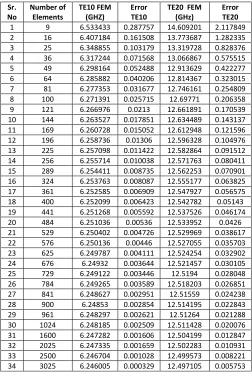
For the order of approximation 1 and gauss points 3, the cutoff frequency and error of first two dominant modes, TE10 and TE 20 are calculated by increasing elements from 9 to 3025 as shown in table 1.
It is observed that, solution converges to exact solution for more than 400 elements for first order approximation.
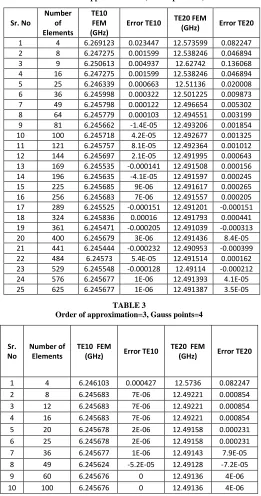
For the order of approximation 2 and gauss points 3, the cutoff frequency and error of first two dominant modes TE10 and TE20 are calculated by increasing elements from 4 to 625 as shown in table 2 and it observed that solution converges for more than 25 elements.
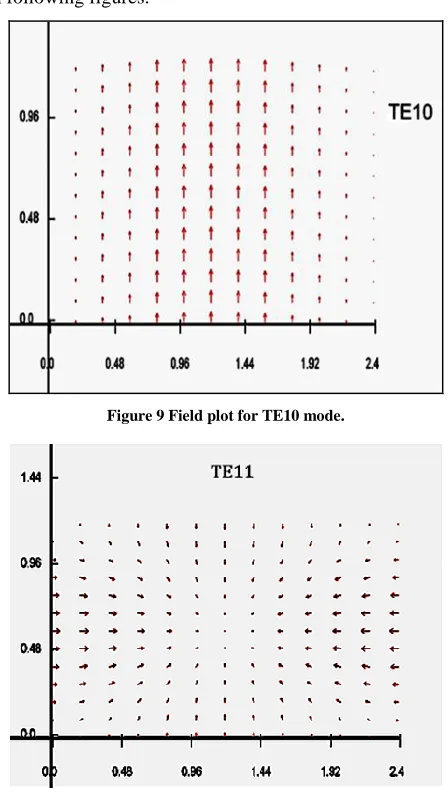
For the order of approximation 3 and gauss point 4, the cutoff frequency and error of TE10 and TE20 are calculated by increasing elements from 4 to 100 and it observed that solution converges very rapidly only from eight elements.
From tabulated values it clear that, TE20 mode required more element than TE10 mode for all order of approximation.
While doing work, surprising thing has been observed in numerical surface integration, which is stated as follows.
Theoretically it is well known that, any polynomial of
order 2 can be integrated exactly using nth order
gauss quadrature [5], it means that for 2 gauss quadrature
points 3rd order polynomial would have given exact answer
and there would have no problem in getting finite element answer in solver.
But while studying effect of gauss quadrature points in solution, it is observed that, for degree of polynomial n, the minimum required gauss quadrature points are n+1.
Less than above condition will cause non positive definite mass matrix.
TABLE 1
Order of Approximation=1, Gauss Points=3
Sr. No
Number of Elements
TE10 FEM (GHZ)
Error TE10
TE20 FEM (GHz)
Error TE20
1 9 6.533433 0.287757 14.609201 2.117849
2 16 6.407184 0.161508 13.773687 1.282335
3 25 6.348855 0.103179 13.319728 0.828376
4 36 6.317244 0.071568 13.066867 0.575515
5 49 6.298164 0.052488 12.913629 0.422277
6 64 6.285882 0.040206 12.814367 0.323015
7 81 6.277353 0.031677 12.746161 0.254809
8 100 6.271391 0.025715 12.69771 0.206358
9 121 6.266976 0.0213 12.661891 0.170539
10 144 6.263527 0.017851 12.634489 0.143137
11 169 6.260728 0.015052 12.612948 0.121596
12 196 6.258736 0.01306 12.596328 0.104976
13 225 6.257098 0.011422 12.582864 0.091512
14 256 6.255714 0.010038 12.571763 0.080411
15 289 6.254411 0.008735 12.562253 0.070901
16 324 6.253763 0.008087 12.555177 0.063825
17 361 6.252585 0.006909 12.547927 0.056575
18 400 6.252099 0.006423 12.542782 0.05143
19 441 6.251268 0.005592 12.537526 0.046174
20 484 6.251036 0.00536 12.533952 0.0426
21 529 6.250402 0.004726 12.529969 0.038617
22 576 6.250136 0.00446 12.527055 0.035703
23 625 6.249787 0.004111 12.524254 0.032902
24 676 6.24932 0.003644 12.521457 0.030105
25 729 6.249122 0.003446 12.5194 0.028048
26 784 6.249265 0.003589 12.518203 0.026851
27 841 6.248627 0.002951 12.51559 0.024238
28 900 6.24853 0.002854 12.514195 0.022843
29 961 6.248297 0.002621 12.51264 0.021288
30 1024 6.248185 0.002509 12.511428 0.020076
31 1600 6.247282 0.001606 12.504199 0.012847
32 2025 6.247335 0.001659 12.502283 0.010931
33 2500 6.246704 0.001028 12.499573 0.008221
[image:3.612.77.259.381.488.2]International Journal of Emerging Technology and Advanced Engineering
Website: www.ijetae.com (ISSN 2250-2459, ISO 9001:2008 Certified Journal, Volume 4, Issue 5, May 2014)
[image:4.612.323.581.151.296.2]533
TABLE 2
[image:4.612.39.300.152.648.2]Order of approximation=2, Gauss points=3,
TABLE 3
Order of approximation=3, Gauss points=4
Sr. No
Number of Elements
TE10 FEM
(GHz) Error TE10
TE20 FEM
(GHz) Error TE20
1 4 6.246103 0.000427 12.5736 0.082247
2 8 6.245683 7E-06 12.49221 0.000854
3 12 6.245683 7E-06 12.49221 0.000854
4 16 6.245683 7E-06 12.49221 0.000854
5 20 6.245678 2E-06 12.49158 0.000231
6 25 6.245678 2E-06 12.49158 0.000231
7 36 6.245677 1E-06 12.49143 7.9E-05
8 49 6.245624 -5.2E-05 12.49128 -7.2E-05
9 60 6.245676 0 12.49136 4E-06
10 100 6.245676 0 12.49136 4E-06
IX. GRAPHS
5.8 6 6.2 6.4 6.6 6.8 7
4 16 36 64
100 144 196 256 324 400 484 576 676 784 900 1024 2025 3025
F r e q u e n c y
G H Z
Elements
[image:4.612.42.300.158.653.2]TE10 Exact TE10 FEM
[image:4.612.321.579.328.456.2]Figure 3 Convergence of solution as element increases for TE10 mode for first order approximation
Figure 4 Convergence of solution as element increases for TE20 mode for first order approximation
Figure 5 Convergence of solution as element increases for TE10 mode for second order approximation
Sr. No
Number of Elements
TE10 FEM (GHz)
Error TE10 TE20 FEM
(GHz) Error TE20
1 4 6.269123 0.023447 12.573599 0.082247
2 8 6.247275 0.001599 12.538246 0.046894
3 9 6.250613 0.004937 12.62742 0.136068
4 16 6.247275 0.001599 12.538246 0.046894
5 25 6.246339 0.000663 12.51136 0.020008
6 36 6.245998 0.000322 12.501225 0.009873
7 49 6.245798 0.000122 12.496654 0.005302
8 64 6.245779 0.000103 12.494551 0.003199
9 81 6.245662 -1.4E-05 12.493206 0.001854
10 100 6.245718 4.2E-05 12.492677 0.001325
11 121 6.245757 8.1E-05 12.492364 0.001012
12 144 6.245697 2.1E-05 12.491995 0.000643
13 169 6.245535 -0.000141 12.491508 0.000156
14 196 6.245635 -4.1E-05 12.491597 0.000245
15 225 6.245685 9E-06 12.491617 0.000265
16 256 6.245683 7E-06 12.491557 0.000205
17 289 6.245525 -0.000151 12.491201 -0.000151
18 324 6.245836 0.00016 12.491793 0.000441
19 361 6.245471 -0.000205 12.491039 -0.000313
20 400 6.245679 3E-06 12.491436 8.4E-05
21 441 6.245444 -0.000232 12.490953 -0.000399
22 484 6.24573 5.4E-05 12.491514 0.000162
23 529 6.245548 -0.000128 12.49114 -0.000212
24 576 6.245677 1E-06 12.491393 4.1E-05
[image:4.612.332.556.488.622.2]International Journal of Emerging Technology and Advanced Engineering
Website: www.ijetae.com (ISSN 2250-2459, ISO 9001:2008 Certified Journal, Volume 4, Issue 5, May 2014)
534
12.48 12.5 12.52 12.54 12.56 12.58 12.6 12.62 12.64
0 100 200 300 400 500 600 700
F r e q u e n c y
G H Z
Elements
[image:5.612.51.297.132.277.2]TE20 Exact TE20 FEM
Figure 6 Convergence of solution as element increases for TE20 mode for second order approximation
6.2456 6.2457 6.2458 6.2459 6.246 6.2461 6.2462
0 20 40 60 80 100 120
F r e q u e n c
y G H Z
Elements
[image:5.612.331.555.181.577.2]TE10 Exact TE10 FEM
Figure 7 Convergence of solution as element increases for TE10 mode for third order approximation
Figure 8 Convergence of solution as element increases for TE20 mode for third order approximation
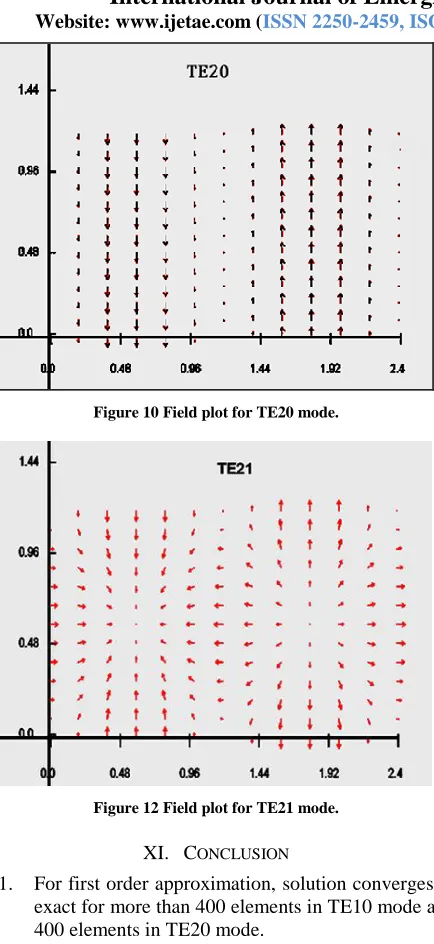
X. ELECTRIC FIELD DISTRIBUTION IN RECTANGULAR WAVEGUIDE
First four modes of electric field plots have been shown in following figures.
[image:5.612.50.297.315.450.2]Figure 9 Field plot for TE10 mode.
[image:5.612.51.288.475.599.2]International Journal of Emerging Technology and Advanced Engineering
Website: www.ijetae.com (ISSN 2250-2459, ISO 9001:2008 Certified Journal, Volume 4, Issue 5, May 2014)
[image:6.612.60.277.114.586.2]535
[image:6.612.316.566.138.679.2]Figure 10 Field plot for TE20 mode.
Figure 12 Field plot for TE21 mode.
XI. CONCLUSION
1. For first order approximation, solution converges to
exact for more than 400 elements in TE10 mode and 400 elements in TE20 mode.
2. For second order approximation, solution converges
rapidly for more than 16 elements in TE10 mode and more than 58 elements in TE20 mode.
3. For third order approximation, solution converges
on more than 4 elements in TE10 mode and more than 8 elements in TE20 mode.
4. The minimum required gauss quadrature points for
finite element method are for nth order of
polynomial shape functions. Above this, there is no effect found in accuracy of solution, and less than this, causes non positive definite mass matrix.
REFERENCES
[1 ] Reddy, C. J, Manohar D. Deshpande, C. R. Cockrell, and Fred B. Beck, ―Finite Element Method for Eigenvalue Problems in Electromagnetics‖ NASA Technical Paper 3485, 1994.
[2 ] Liu J. and Lin G. ― Analysis of a Quadruple Corner-Cut Ridged/Vane-Loaded Circular Waveguide using Scaled Boundary Finite Element Method‖ Progress In Electromagnetics Research M, Vol. 17, 113-133, 2011.
[3 ] Vaish A. and Parthasarathy H ― Analysis of a Rectangular Waveguide using Finite Element Method‖ Progress In Electromagnetics Research C, Vol. 2, 117–125, 2008
[4 ] Rahaman, B.M.A, ―Finite Element Analysis of Optical Waveguide‖ progress in Electromagnetic Research, PIER 10, 187-216, 1995. [5 ] Uppadhay, C.S, ―Mechanical - Finite Element Method‖ by nptelhrd ,
Department of Aero Space IIT Kanpur 2013. URL: http://www.youtube.com/view_play_list?p=A4CBD0C55B9C3878 [6 ] Haldar, M. K, ―Introducing the Finite Element Method in
electromagnetics to undergraduates using MATLAB, Department of Electrical and Computer Engineering, National University of Singapore.
[7 ] Peter J. Olver "Finite Element method", 2012
[8 ] Lifang Wang, "Convex Mesh free Solution for arbitrary Waveguide Analysis in electromagnetic Problems" Progress In Electromagnetics Research B, Vol. 48, 131149, 2013.
[9 ] Hopfer S, ‗Design of Ridged Waveguides‘, IRE Trans. Microwave. Theory. Tech., 3 (1955), 20–29.
[10 ]Helszain, J, ―Ridge Waveguides and Passive Microwave Components.‖ Published by the institute of engineering and technology, London, United Kingdom 2000.
[11 ]Francisco-Javier Sayas "A gentle introduction to the Finite Element Method"2008.
[12 ]Germund Dalquist and Ake Bjorck "Numerical Methods in Scientific Computing, Volume1" Siam, Socity for Industrial and applied Mathematics 3600 Market Street, 6 th floor, Philadelphia 2008.
[13 ]Reddy, J.N, "An Introduction to the Finite Element Method" McGraw-Hill Book 1984.
[14 ]Pelosi, Giuseppe. Quick Finite Elements for Electromagnetic Waves (2nd Edition), 2009. http://site.ebrary.com/id/10359080?ppg=19 [15 ]Keith W. Whites, ―Laboratory for Applied Electromagnetics and
Communications Department of Electrical and Computer Engineering South Dakota School of Mines and Technology‖. 2013 [16 ]Liu, G. R. ―Finite Element Method: A Practical Course‖.
http://site.ebrary.com/id/10169772?ppg=7, 2013.
[17 ]Pozar D.M ―Microwave Engineering -4th editions‖ Copyright C_ 2012, 2005, 1998 by John Wiley & Sons, Inc.