International Journal of Emerging Technology and Advanced Engineering
Website: www.ijetae.com (ISSN 2250-2459,ISO 9001:2008 Certified Journal, Volume 4, Issue 5, May 2014)
755
Power Measurement of Computers: Analysis of the
Effectiveness of the Software Based Approach
Girish BEKAROO
1, Chandradeo BOKHOREE
2, Colin PATTINSON
3 1Middlesex University (Mauritius Branch Campus), Vacoas, Mauritius
2 University of Technology, Mauritius, La Tour Koenig, Mauritius
3Leeds Metropolitan University, Leeds, UK
Abstract— The increasing dependence of human beings on technology has not only made ICT a growing power consumer, but also a rising contributor to the adverse effects of global climate change. In light of the growing power consumption by ICT, accurate measurement techniques are required since leaders cannot manage what cannot be measured. One of the emerging power measurement techniques is via the use of software power meters, which offer visibility of power consumption of computers without the need for external hardware, as was often the case in the past. Although different software power meters have begun to emerge on the market, studies have rarely compared their effectiveness as well as the accuracy of their readings. This work critically compares key software power meters presently available and contrasts their effectiveness with hardware power meters, before making recommendations on their future, based on identified limitations.
Keywords— Computer Power Measurement Software, Power Management, Software Power, Wattmeter, ICT.
I. INTRODUCTION
The enormous increase in computer use among businesses and individuals during previous years has turned Information and Communication Technologies (ICT) into a power drainer [1]. ICT contributes to approximately 2% of global carbon emissions, similar to the airline industry [2]. This figure represents approximately 830 MtCO2e released to the atmosphere per year [3] and adversely affects the natural environment in the main form of global warming, which in turn causes climate change. Furthermore, as human beings become increasingly dependent on technology, carbon emissions from ICT is expected to significantly increase by 72% to reach roughly 1,430 MtCO2e by 2020 [3][4]. This implies an even more significant impact on climate change. Studies [3][4] also showed that the biggest current contributor to the overall carbon footprint of ICT is technological devices, in the form of computers and associated peripheral devices including printers. Technological devices contribute to 57% of the overall ICT carbon footprint and reducing the carbon footprint of ICT devices can help to diminish the negative effects of ICT on climate change.
Research efforts have actively been focusing on the development of environmentally sustainable ICT tools and techniques. However, one of the biggest challenges to environmental sustainable ICT solutions is the lack of effective measurement solutions [5][6]. Leaders cannot manage what cannot be measured and for this reason, accurate measurement techniques are necessary [5][7]. Taking cognizance of this problem, different approaches have been conceptualised and developed in the past with the aim to measure and keep track of power consumed during active use of computers and associated peripheral devices. These mechanisms include:
1.Use of utility sub-meter
Electric submeters are typically used to measure power consumption of a building or part of it. These devices are installed by building owners or residents and are not related to the utility company supplying electricity. Common
examples of such electric submeters include Cent-a-Meteri
and Power Cost Monitorii, which could be used for
improved power consumption visibility of computer or server rooms.
2. Power measurement at UPS
Although uninterruptible power supply (UPS) primarily aims at providing emergency power to connected computing devices, power consumed by the connected loads can be read from many models of UPS today. However, to be able to benefit from this technique, a UPS first needs to be purchased as an extra device. Unfortunately, one of the observed problems is that UPS can give approximate readings due to power inefficiencies [8].
3. Power measurement of racks
International Journal of Emerging Technology and Advanced Engineering
Website: www.ijetae.com (ISSN 2250-2459,ISO 9001:2008 Certified Journal, Volume 4, Issue 5, May 2014)
756
4. Power measurement of electronic devices
Computers and electronic devices can be individually connected to an electronic wattmeter for measuring the supply rate of electrical energy to the connected device(s) in Watts. Utilising an electronic wattmeter involves power measurement directly from the wall socket. Common
examples of electronic wattmeter include Kill A Wattiii,
Watts Up Proiv and Eco-worthyv wattmeter and these
devices can tell users about how much power is being consumed by appliances and electronics plugged to the meter.
5. Power measurement using software
Power consumed by various components of a computer system including its central processing unit, screen, disk,
virtual machines, individual pieces of software
applications, among others, can be measured using software tools [10]. This innovative approach to power measurement is beneficial to computer users as real-time power related information can be obtained without the need to purchase external hardware.
The first four mechanisms described above can be categorised as hardware based power measurement approach where external hardware, in the form of UPS, sub-meter or electronic wattmeter is required. The use of external hardware also implies extra costs to be incurred and this factor might not be a key purchasing argument for end-users. Also, the hardware-based approach has some overhead, where power has to be supplied to the device for it to operate. Furthermore, extra hardware also means more physical space needed for storage and proper disposal mechanisms implemented, so as to reduce the impact of these devices on the growing e-waste problem in the world [11], especially after their usage lifetime. E-waste is known to contain hazardous constituents which can harm both the environment and human health if not managed properly [12][13].
On the other hand, the software approach does not require purchase of external hardware. This can be beneficial to both end-users and the environment in the form of reduced costs and electronic waste respectively. As a cheaper solution, this innovative technique has a huge potential to attract a wider computer user population as price performance has been a key purchasing motivation factor for customers in the past [14]. However, due to its newness, the major question which arises is whether currently available software are as effective and accurate as existing hardware-based approach (for example, use of UPS and external electronic wattmeter) to measure power consumption of computers.
If yes, then what are the limitations and what could be done in order to overcome them? This paper critically reviews and evaluates the accuracy and effectiveness of key software power meters presently available before making recommendations on this relatively new technique based on identified limitations.
II. LITERATURE SURVEY
Effective measurement of computer power has been a major challenge for software designers in the past due to the number of associated variables involved [15]. This resulted in much research effort focusing on methods and models to link these variables and in the process, different approaches have been found to efficiently measure power consumption [16]. Such methods and technologies are being adopted and implemented by different stakeholders including computer manufacturers and software vendors to release software based power measurement tools on the market for computer users.
For instance, Microsoft Research recently released its own software utility for computer power measurement
called Joulemetervi. This software can be downloaded
freely and aims to estimate power consumption of different resources of a computer system including CPU utilisation, individual processes and applications, screen brightness, among others. To estimate power consumption of a computer, Joulemeter uses automatically learned power models during the calibration process when the software is first launched. These power models relate the resource usage of the computer and the power state of associated hardware including utilisation of disk and processor, screen brightness and state, processor frequency to power drawn. The internal processes of the model have however been kept private by Microsoft Research. Joulemeter can operate in two distinct modes, namely, with and without the use of an external electronic wattmeter (e.g. Watts Up Pro). For computers running on batteries, the power estimation can be done directly after the calibration process and without Watts Up Pro. However, for desktop computers, an external electronic wattmeter is required in the calibration process.
Similarly, computer manufacturers and vendors are embedding their own power management software with power measurement features embedded within their products. For instance, Hewlett-Packard (HP) has a utility
called HP Power Assistantvii which provides a set of tools
International Journal of Emerging Technology and Advanced Engineering
Website: www.ijetae.com (ISSN 2250-2459,ISO 9001:2008 Certified Journal, Volume 4, Issue 5, May 2014)
757 The HP Power Assistant tool uses a different private approach to estimate power consumed as compared to Joulemeter and its environmental calculations are based on
U.S. EPA eGridviii 2007 data. This software is however
limited for use to a group of HP computers only.
Likewise, Intel has got its own software based power
estimation tools including Intel Power Gadgetix for
Windows platforms and Intel Power Checker for mobile platforms. The Windows based application from Intel runs as a sidebar gadget and during execution mode of the software, power consumed by the processor is measured and displayed. This tool however works only on Intel based processors and is limited only to measurement of CPU power.
Besides the above tools developed by large
manufacturers and vendors, attempt has been made to estimate power consumption of a computer system and its processor via the use of performance counter data [17]. In the process, a linear power model was developed and power consumption estimation functions derived, which could be used for future applications [17]. On the other hand, different tools have also been proposed which aim to either estimate or profile energy consumption. For instance, web-based software for estimation of energy consumption called JouleTrack was developed to predict energy consumption after avoiding unambiguous categorization of instruction energy consumption [18]. Similarly, as a solution to the challenge of power estimation within virtualised data centres due to the increasing diversity between applications, Koller et al. [6] proposed an application-level power meter for shared data centres called WattApp.
The above literature confirms the newness of this area and research efforts rarely concentrated on analysis and evaluation of the accuracy and effectiveness of software-based power meters. As the number of computers and portable devices to handle computing is increasing [19] and the visibility on proper measurement mechanisms of power consumption of these devices is limited, the need of this study is confirmed.
III. METHODOLOGY
To evaluate the effectiveness and accuracy of the emerging software-based approach to measure computer power, an experimental-based approach was adopted. This involved analysis of power measurements from identified key software power meters.
Two software-based power measurement tools namely Joulemeter (version 1.2) and HP Power Assistant (version 2.1.0.6) were chosen since these software give a complete estimate of power consumption of the computer as compared to Intel Power Gadget, which only measures CPU power. An HP Probook laptop with Windows 7 was used for the experiment as both tools require Windows platform and also HP Power Assistant necessitates HP-based laptops. Joulemeter could be freely downloaded from Microsoft Research website for installation and HP Power Assistant was already available on the laptop used. A laptop was chosen rather than a desktop computer since Joulemeter requires the presence of a battery for the power calibration process as discussed earlier. After installing both software power meters, required pre-configuration was conducted on the chosen laptop. For instance, proper calibration had to be performed for Joulemeter to choose the appropriate power model and work properly. This process took approximately 15 minutes under battery-mode with power cord disconnected. On the other hand, HP Power Assistant did not require such pre-configuration. Pre-installed power saving features of the laptop was disabled during the experiment and the screen brightness was set to maximum after setting the power profile of the laptop to 'High Performance'. Additionally, the number of processes running was kept minimal. These configurations were made on the laptop so as to establish a standard test environment and minimise fluctuations in CPU utilisation and power as far as possible.
International Journal of Emerging Technology and Advanced Engineering
Website: www.ijetae.com (ISSN 2250-2459,ISO 9001:2008 Certified Journal, Volume 4, Issue 5, May 2014)
758 TABLE I
OPERATIONS PERFORMED DURING EXPERIMENT
No. Operation Description O1. Computer
Start-up
Involved switching on the laptop from a completely turned-off state until the welcome screen is shown.
O2. Idle Mode During idle mode when the laptop is visually displaying the desktop and that no activity is being performed.
O3. File-Management Operation I
Involved copying a large file of approximately 20 GB from one location to another on the same internal hard disk of the laptop.
O4. File-Management Operation II
Involved copying the same large file as in the previous operation but this time from an external hard disk connected to the laptop to a location on the internal hard disk of the laptop.
O5. Surfing the web This involved actively surfing on the website of Middlesex Universityx to look for prospective courses using Internet Explorer as web browser.
O6. Playing a browser game
Involved playing an online browser game on Miniclipsxi website using Internet Explorer as web browser.
O7. Listening to Music
Involved listening to music (an MP3 file) by using Windows Media Player while volume set as 50%.
O8. Watching a video
Involved watching a video clip on Windows Media Player.
O9. Playing a computer game
Involved playing a computer game. For this, Virtual Villagers, which is already available in HP games, was chosen.
O10. Antivirus scanning
Involved an active-scan using the installed antivirus on the laptop.
O11. Using an Office tool
Involved using the Word package to actively write a document.
O12. Chatting using a Messenger
Involved chatting with another contact using Skype.
O13. Reading a PDF Involved reading a PDF manual. O14. Standby mode Switching the computer to stand-by mode. O15. Computer shut
down
Involved switching off the laptop from the idle state.
At the end of the experiment, the collected results were then analysed via the use of a statistical package, namely, SPSS.
IV. RESULTS &DISCUSSIONS
Brief analysis of the software power meters used showed
that Joulemeter provides more detailed power
measurements than HP Power Assistant. It displays the power consumed by the CPU, monitor, disk and base, and the total power consumed by the computer is equal to the power consumed by these four components. On the other hand, HP Power Assistant only gives the total power measurement of the computer, similar to the electronic wattmeter used.
In terms of precision, Joulemeter gives readings to 1 decimal place similar to Eco-Worthy wattmeter and HP Power Assistant measures to the nearest integer.
One of the innovative features of Joulemeter is the ability to measure power consumed by individual applications or processes during run-time. Different software are known to consume different amount of power [20][21] and this feature could be used in software
development for evaluating and reducing power
consumption of application software and processes within computers. Although the application power measurement feature is not present within HP Power Assistant and the electronic wattmeter, a subtractive approach could be used to achieve the same. This would involve subtracting the power consumed during idle mode from the total power consumed when running the application on the same computer. However, this approach introduces a margin of error unlike Joulemeter. The feature comparison of both software power meters is summarised in Table II.
TABLE II COMPARISON OF FEATURES
Feature Joulemeter
HP Power Assistant
Monitor power X
Application power X
CPU power X
Disk power X
Total power consumption Save power data
History of power usage X
Refresh rate Every second Periodically
Reading precision 1 decimal place Nearest integer
International Journal of Emerging Technology and Advanced Engineering
Website: www.ijetae.com (ISSN 2250-2459,ISO 9001:2008 Certified Journal, Volume 4, Issue 5, May 2014)
759 TABLE III
EXPERIMENTATION RESULTS
No. Operation
Power Measurement (Watts)
Joulemeter HP Power Assistant
Electronic Wattmeter O1. Computer Start-up N/A N/A 31.4
O2. Idle Mode 11.8 17 17.2
O3. File-Management Operation I
14 23 23.8
O4. File-Management Operation II
14.4 26 26.9
O5. Surfing the web 12.9 22 22.6
O6. Playing a browser game
18.3 27 28.1
O7. Listening to Music 12.3 19 19.5
O8. Watching a video 13.6 23 24.2
O9. Playing a computer game
13.9 25 26.1
O10. Antivirus scanning 18.6 32 33.4
O11. Using an Office tool
12.2 18 18.3
O12. Chatting using a Messenger
12.4 18 19
O13. Reading a PDF 13.6 22 22.6
O14. Standby mode N/A N/A 2.0
O15. Computer shut down
N/A N/A 29.2
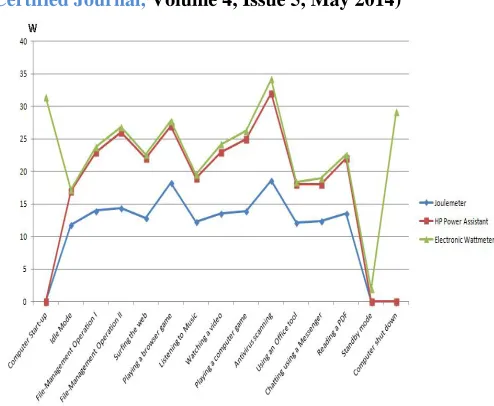
[image:5.612.334.581.125.328.2]Moreover, during the same experiment, both software power meters could not measure power consumption when the computer is being switched on (O1), turned off (O15) or when on stand-by mode (O14). This is because both Joulemeter and HP Power Assistant require the operating system in order to function and display values to the end user. However, the electronic wattmeter treated the same three operations like others and easily measured their power consumption. This experiment also confirms that computers consume electricity when on stand-by mode (2.0 W in this experiment), which is becoming a growing concern globally [22]. The same results in Table III are presented in Figure I for further analysis.
Figure I - Line Graph showing power measured by the meters
The line graph in Figure I shows that both Joulemeter and HP Power Assistant deviate from the values given by the electronic wattmeter. Although both software power measurement tools were able to produce results for most of the planned operations, Joulemeter deviated more from the electronic wattmeter by an approximate average of 9.5W per operation. This could be due to the improper choice of power model for the laptop used during the calibration process by Joulemeter. Results from Table 3 also show that the accuracy of Joulemeter is 59.5% and 96.4% for HP Power Assistant, compared to the electronic wattmeter. Moreover, measurement values from both Joulemeter and HP Power Assistant showed to be under-estimates which could be due to unmeasured variables by both programs.
[image:5.612.47.287.149.444.2]International Journal of Emerging Technology and Advanced Engineering
Website: www.ijetae.com (ISSN 2250-2459,ISO 9001:2008 Certified Journal, Volume 4, Issue 5, May 2014)
760 In other words, Joulemeter could not accurately measure the extra amount of power required by the external disk, whereas HP Power Assistant gave similar measurements as the electronic wattmeter. This illustrates the capability for HP Power Assistant to estimate power consumption of external devices connected to the computer running the software, unlike Joulemeter.
The results of this study were limited by different factors: the first one being the accuracy of the presented results, due to background processes running within the system. The inability to maintain a standard load led to fluctuation in power consumption during the different repetitions of the experiment. This also introduced small errors of approximately 1% in the measured cumulative power, which roughly equals to 0.2 W if compared to idle mode power. Another limitation of this study is the hardware used during the experiment. A single laptop was used for running all the tests and this could be the reason for the big deviation showed by Joulemeter. As a solution, different laptops and also desktop computers could be used for further improving the reliability of results. Similarly, a single electronic wattmeter was used and all the tests relied on the measurements given by the single meter. Again, multiple meters could be used to improve the experiment, in addition to the use of other hardware-based power measurement mechanisms (for example, UPS) for the benchmark.
Even though HP Power Assistant showed to be more accurate and effective than Joulemeter in the conducted experiment, this tool is limited for use in a group of HP computers. On the other hand, Joulemeter being less accurate, is more accessible in the way that it could be freely downloaded and installed on Windows 7 based computers. Overall, the software approach is shown to be effective to estimate power consumption without requiring any external hardware. Research efforts should however focus on better power models to improve accuracy of power measurements. If the existing limitations present within software based power measurement tools are overcame, this mechanism has a huge potential to replace the use of electronic wattmeter for measuring power consumption of different types of computers.
A. Recommendations
Although software power meters have recently been developed and that work is actively being done by key stakeholders including researchers and manufacturers, the experiment conducted in this study helped to identify some key improvements which could drive this power measurement mechanism to success in the future. These key recommendations include:
1.Standardised power models made public
Literature showed that both Joulemeter and HP Power Assistant used different approaches or models for measuring power, and the experiment showed a difference in end-results due to this factor. Therefore, a standardised power measurement approach or model is recommended, which not only gives accurate results, but which can also be easily implemented by software developers or software development firms. In the process, researchers and manufacturers including Microsoft, Intel, HP among others, could make the approach and model used for power estimation public so as to attract a larger community to use the same and provide feedback for further improvement of the publicised approach or model.
The shift to public models can also lead to the development of Application Programming Interfaces (API) and libraries within programming platforms including Java and .NET, among others. Eventually, the availability of APIs and libraries could benefit the programming community and help in the development of diverse power-related software to further help in diminishing the contribution of ICT to the adverse effects of global climate change.
2.Factory Settings
Manufacturers have been key stakeholders in raising awareness of energy efficiency and computer power management. Today, most office equipment including computers, monitors and printers have power management features integrated [23] and having these factory settings has been a good initiative to reduce power consumption of ICT devices [24] resulting in financial benefits during operational lifetime. Similar to the HP Power Assistant, a software power meter could be pre-installed by all manufacturers of ICT devices before being released to market. Implementation of software meter as factory settings can increase the visibility of power consumption when using computers without any need to purchase separate and external meters.
3.Tracking features
International Journal of Emerging Technology and Advanced Engineering
Website: www.ijetae.com (ISSN 2250-2459,ISO 9001:2008 Certified Journal, Volume 4, Issue 5, May 2014)
761 In addition to power tracking, intelligent techniques could be embedded so as to recommend to end users on how computer power could be further reduced based on power history. Such features could help users to reduce power consumption and save costs during computer use.
V. CONCLUSIONS
This paper reviewed, analysed, compared and evaluated the emerging software approach to measure computer power consumption. Based on the experiments conducted utilising two software power meters namely Joulemeter and HP Power Assistant, it could be deduced that even though an external hardware power meter is still the most accurate solution, the use of the software approach can still give a close estimation (approximately 96.4% accurate) of the power consumed by a computer. If the accuracy of software power meters are improved and newer features for tracking and advisory capabilities integrated, this emerging approach for computer power measurement could play a key role towards environmental sustainability. In other words, software power meters could become a key mechanism in helping to track and reduce power consumption of computers while at the same time benefitting human beings in the form of reduced electricity bills and the environment in the form of reduced carbon emissions.
This study has also identified limitations within existing power measurement software presently available and to overcome these limitations, this study can be further developed. A thorough review of existing power models could be performed before conceptualising and developing a new model to accurately compute power measurement without use of external hardware. Based on the new model, a platform independent power management tool could then be developed to permit accurate power measurement and tracking while at the same time intelligently advising end users on how to reduce their consumption during both active and idle mode.
REFERENCES
[1] Procaccianti, G., Ardito, L., and Morisio, M. 2011. Profiling power consumption on desktop computer systems. In Proceedings of the First international conference on Information and communication on technology for the fight against global warming (ICT-GLOW'11), Kranzlmüller, D. and Toja, A.M. (Eds.), Springer-Verlag, Berlin, Heidelberg, pp. 110-123, 2011.
[2] Gartner. 2007. Gartner Estimates ICT Industry Accounts for 2 Percent of Global CO2 Emissions [Online], Available at: http://www.gartner.com/it/page.jsp?id=503867
[3] Climate Group. 2008. SMART 2020: Enabling the Low Carbon Economy in the Information Age [Online], Available at: http://www.gesi.org/LinkClick.aspx?fileticket=tbp5WRTHUoY%3d &tabid=60
[4] GeSI. 2012. GeSI SMARTer2020: The Role of ICT in Driving a Sustainable Future [Online], Available at: http://gesi.org/SMARTer2020
[5] Curtis, L. 2008. Environmentally Sustainable Infrastructure Design, Green Computing. The Architecture Journal. Microsoft. Vol. 18. pp. 2-8.
[6] Koller, R.., Verma, A. and Neogi, A. 2010. WattApp: an application aware power meter for shared data centers. In Proceedings of the 7th international conference on Autonomic computing. ACM. pp. 31-40. [7] Kavvadias, N., Neofotistos, P., Nikolaidis, S., Kosmatopoulos, C. A., and Laopoulos, T. 2004. Measurements analysis of the software-related power consumption in microprocessors. Instrumentation and Measurement, IEEE Transactions on, 53(4), 1106-1112.
[8] Chan, H. and More, G. 2009. The Whys and Hows of Measuring Power in your Data Center. Green Biz. Available at: http://www.greenbiz.com/news/2009/04/14/whys-and-hows-measuring-power-your-data-center
[9] Economou, D., Rivoire, S., Kozyrakis, C., and Ranganathan, P. 2006. Full-system power analysis and modelling for server environments. International Symposium on Computer Architecture-IEEE.
[10] Narayanan, D. 2005. Software Power Measurement [Online], Microsoft Research, Available at: http://research.microsoft.com/pubs/70166/tr-2005-51.pdf
[11] Widmer, R., Oswald-Krapf, H., Sinha-Khetriwal, D., Schnellmann, M., and Böni, H. 2005. Global perspectives on e-waste. Environmental Impact Assessment Review, 25(5), 436-458. [12] Nnorom, I. C., and Osibanjo, O. 2008. Overview of electronic waste
(e-waste) management practices and legislations, and their poor applications in the developing countries. Resources, conservation and recycling, 52(6), 843-858.
[13] Bekaroo, G., and Bokhoree, C. Towards Emerging Green Information and Communication Technologies: A Review. Proceedings of the International Conference on Information and Knowledge Engineering (IKE'11), 428-433.
[14] Poess, M., and Nambiar, R. O. (2008. Energy cost, the key challenge of today's data centers: a power consumption analysis of TPC-C results. In Proceedings of the VLDB Endowment, 1(2), 1229-1240. [15] Tiwari, V., Malik, S., and Wolfe, A. 1994. Power analysis of
embedded software: a first step towards software power minimization. Very Large Scale Integration (VLSI) Systems, IEEE Transactions on, 2(4), 437-445.
[16] Sun, Y., Wanner, L., and Srivastava, M. 2012. Low-cost estimation of sub-system power. In Green Computing Conference (IGCC), 2012 International (pp. 1-10). IEEE.
[17] Singh, K., Bhadauria, M., and McKee, S. A. 2009. Real time power estimation and thread scheduling via performance counters. ACM SIGARCH Computer Architecture News, 37(2), 46-55.
International Journal of Emerging Technology and Advanced Engineering
Website: www.ijetae.com (ISSN 2250-2459,ISO 9001:2008 Certified Journal, Volume 4, Issue 5, May 2014)
762 [19] Somavat, P., and Namboodiri, V. 2011. Energy consumption of
personal computing including portable communication devices. Journal of Green Engineering, 1(4), 447-475.
[20] Gurumurthi, S., Sivasubramaniam, A., Irwin, M. J., Vijaykrishnan, N., and Kandemir, M. 2002. Using complete machine simulation for software power estimation: The softwatt approach. In High-Performance Computer Architecture, 2002. Proceedings. Eighth International Symposium on (pp. 141-150). IEEE.
[21] Bekaroo, G., Bokhoree, C., and Pattinson, C. 2012. Towards Green IT Organisations: A Framework for Energy Consumption and Reduction. International Journal of Technology, Knowledge & Society, 8(3).
[22] Ross, J. P., and Meier, A. 2001. Whole-house measurements of standby power consumption. In Energy Efficiency in Household Appliances and Lighting (pp. 278-285). Springer Berlin Heidelberg. [23] Energy Star. 2012, [Online], Major Breakthrough Reached in Power
Management Technology, Available at:
http://www.energystar.gov/ia/partners/manuf_res/power.pdf [24] Bianchini, R., and Rajamony, R. 2004. Power and energy
management for server systems. IEEE Computer, 37(11), 68-74.
i Cent-a-meter (2013), Want cheaper power bills?[Online], Available: http://centameter.co.nz/
ii Blue Line Innovations (2013), Power Cost Monitor[Online], Available: http://www.bluelineinnovations.com/
iii P3 International. 2013. Kill a Watt - Empowers you to save $100's on electric bills![Online], Available at: http://www.p3international.com/products/p4400.html
iv Watts Up. 2013. Watts Up Meters [Online], Available at: https://www.wattsupmeters.com/secure/index.php
v Eco-Worthy . 2013. AU style Energy Power Voltage Watt Electricity meter [Online], Available at: http://www.eco-worthy.com/catalog/style-energy-power-voltage-watt-electricity-meter-p-191.html
vi Microsoft Research. 2014. Joulemeter [Online], Available at: http://research.microsoft.com/en-us/downloads/fe9e10c5-5c5b-450c-a674-daf55565f794/
vii HP. 2014. HP Power Assistant [Online], Available at: http://h20566.www2.hp.com/portal/site/hpsc/template.PAGE/public/psi/s wdDetails/?lang=en&cc=us&sp4ts.oid=4021367&swItem=ob_76641_1
viii
U.S. Environmental Protection Agency. 2014. eGRID [Online], Available at: http://www.epa.gov/cleanenergy/energy-resources/egrid/index.html
ix Intel. 2014. Intel Power Gadget [Online], Available at: http://software.intel.com/en-us/articles/intel-power-gadget-20
x Middlesex University (2014), Courses [Online], Available: http://www.mdx.ac.uk/courses/index.aspx