A system engineering perspective to
knowledge transfer: A case study
approach of BIM adoption
Arayici, Y and Coates, P
http://dx.doi.org/10.5772/51052
Title
A system engineering perspective to knowledge transfer: A case study
approach of BIM adoption
Authors
Arayici, Y and Coates, P
Type
Book Section
URL
This version is available at: http://usir.salford.ac.uk/23581/
Published Date
2012
USIR is a digital collection of the research output of the University of Salford. Where copyright
permits, full text material held in the repository is made freely available online and can be read,
downloaded and copied for noncommercial private study or research purposes. Please check the
manuscript for any further copyright restrictions.
© 2012 Arayici and Coates, licensee InTech. This is an open access chapter distributed under the terms of the Creative Commons Attribution License (http://creativecommons.org/licenses/by/3.0), which permits unrestricted use, distribution, and reproduction in any medium, provided the original work is properly cited.
A System Engineering Perspective
to Knowledge Transfer: A Case Study
Approach of BIM Adoption
Yusuf Arayici and Paul Coates
Additional information is available at the end of the chapter
http://dx.doi.org/10.5772/3333
1. Introduction
The building industry is under great pressure to provide value for money, sustainable infrastructure, etc. and this has propelled the adoption of Building Information Modelling (BIM) technology (Mihindu and Arayici, 2008). Owners can anticipate greater efficiency and cost savings in the design, construction and operation of facilities with the adoption of BIM. From an architectural point of view the consequences of BIM depends on how the technology is implemented and integrated into the firm’s business model. BIM offers many new financial and creative opportunities for most construction related organizations (e.g. architectural companies), but to realize these benefits firms will need to embrace the integration of design and construction that BIM will promote. This will require changes in project delivery methods and in the composition of the firm’s staff. Properly implemented, BIM may also change the role of professions (e.g. architectural) an expanded role in the AEC/O industry. To realize the BIM benefits, an active role in guiding its implementation must be taken (Arayici et al, 2009) (Bernstein and Pittman, 2004).
The productivity increases promised by BIM would seem to make it attractive to architects and other design professionals, contractors as well as to owners. The intensely competitive nature of building industry makes it likely that most if not all of any productivity gains realized by BIM will be passed through to owners and clients. This is what happened with CAD (Oakley, 2007).
In some countries such as Finland, Denmark, Norway and the USA, the use of BIM has been endorsed (Aouad & Arayici, 2010) by the government of these states for the state project, while some other countries have progressed toward it. A fuller analysis of the external influences which have promoted BIM adoption in these countries may provide an indication of how development of the use of BIM in the UK might be stimulated. Such factors in the UK might include the attitudes of market constituents affecting adoption and standards such BS16001 and the use of BIM in compliance.
2. The construction industry and its features
In the past decade, construction companies spent a great deal of effort and resources in improving their business processes. New forms of innovative project management, supported by recent IT developments, appeared in response to ever-growing pressure from owners to complete projects on time and deliver high quality buildings. Although many sectors such as automotive, manufacturing and the service sectors have improved their competitiveness from IT, the construction industry has had some difficulties, resulting in the construction industry lagging behind the other sectors. The constraints the construction industry has experienced can be outlined as follows (Aouad and Arayici, 2010):
The Nature of Information and its Flow: Construction projects consist of many interrelated processes and sub-processes, often carried out by different professionals at different locations. Most of the tasks involved in construction processes are mainly about exchanging information between project stakeholders. All construction researchers addressed the need to improve the poor cross-disciplinary communications.
The Fragmented Supply Chain of the Construction Industry: One of the main features of the construction industry is the high fragmentation in its supply chain. However, despite the increasing trends towards multi-disciplinary practical arrangements between construction firms, such as partnering, the construction industry still consists of hundreds of small and medium size firms that offer undifferentiated products and services.
The Culture of the Construction Industry: The widespread culture of the construction industry is a claiming, confrontational one, which has underpinned the inefficiency and the ineffectiveness of its processes. The strong resistance to change could be partly attributed to the strong and rigid culture of the construction industry.
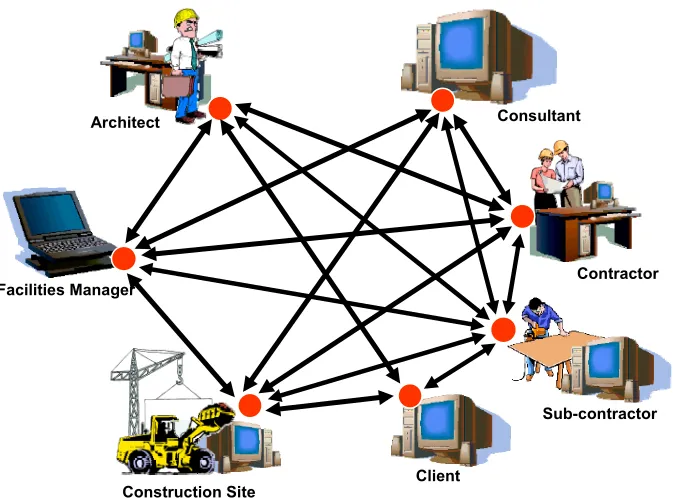
Figure 1. Illustrates the current work environment in the construction industry (Aouad and Arayici, 2010)
Figure 1 above depicts the traditional practices in construction projects. The construction industry is fragmented by nature. Added to this fragmentation between the construction stakeholders, a high level of complexity of the work flow resulting from a high number of companies working on the same project increases the inefficiency of construction projects. For example, repeated processes or functions and duplications due to the lack of communication and standardisation that causes waste and lead times in the project lifecycle, and extra cost to the client for non value added activities.
For example, clients and some stakeholders such as local authorities and residents have an incorrect perception, or lack of understanding the 2D architectural and engineering drawing. The design team cannot fully understand the client’s needs due to a lack of communication, a shared platform, and an understandable Virtual Reality (VR) tool by both the client and the architect. Eventually these constraints will bring about client dissatisfaction (Aouad and Arayici, 2010).
3. Building Information Modelling and its benefits
In the past, researchers used IT tools for providing numerous decision support systems for the professionals of the industry. However, these systems have created islands of
Sub-contractor
Construction Site Architect
Contractor
Client Facilities Manager
automation and are far from achieving an acceptable level of integration across disciplines and across the design and construction processes. It is recognised that greater benefits can be obtained and the constraints can be considerably reduced if a complete integration based on VR tools is achieved. In this respect, major benefits of a desired integrated VR environment are considered as follows (Aouad and Arayici, 2010);
Improving the coordination and communication between the client, design team
members, and construction professionals, by using standard formats, and intuitive VR tools that ease communication and information sharing.
Since VR tools allow the design team to have quick and high quality feedback on the
project, in terms of architectural, technical, financial and environmental aspects, the design may be evaluated at the very early stages of the project lifecycle.
Looking at “what if” scenarios at the detailed design stage, to assess the design solution
in lighting, acoustic and thermal aspects.
Closing the gap between the design team and the construction team and providing
them with an integrated platform through which they can collaborate for the best buildability and appropriate construction planning.
The use of past project knowledge and information for new developments.
Furthermore, visualisation in conjunction with integrated model driven construction systems can be expected to:
Enable designers, developers and contractors to use the VR system and virtually test a
proposed project before construction actually begins.
Offer “walk-through” views of the project so that problems can be found and design
improvements can be made earlier.
Provide a free flow of information between CAD systems and other applications work
packages, in order to minimise misinterpretation between project participants.
Facilitate the selection of alternative designs, by allowing different plans to be tested in the same virtual world.
Due to its potential, Building Information Modelling has become an internationally recognized concept. BIM can be described as the use of the ICT technologies to streamline all the processes that require a building infrastructure and its surroundings, to provide a safer and more productive environment for its occupants; and to assert the least possible environmental impact from its existence; and more operationally efficient for its owners throughout the life cycle of the building infrastructure (Aouad and Arayici, 2010).
BIM as a lifecycle evaluation concept seeks to integrate processes throughout the entire life cycle of a construction project. The focus is to create and reuse consistent digital information by the stakeholders throughout the life cycle. Some advantages are (i) model based decision making, (ii) design and construction alternatives, (iii) costs, energy and lifecycle analysis, the automated building code checking (Cheng, 2005) or thermal load calculations (Kam et al, 2003) or environmental impact assessment (e.g. CO2 emission), etc. can be performed by using these models for design changes and use of alternative material types over the infrastructure life cycle.
Some attributes of BIM include; robust geometry, comprehensive and extensible objects properties, semantic richness, integrated information and ability to support the infrastructure life cycle (Schevers et al, 2007).
BIM incorporate a methodology based around the notion of collaboration between stakeholders to exchange valuable information throughout the life cycle. Such collaboration can be seen as the answer to the fragmentation that exists within the building industry which has caused various inefficiencies. The above scenarios show the expected stakeholder collaboration and the aim of using BIM. Although BIM is not the salvation of the construction industry, a great deal of effort has gone into address those issues which have remained unattended far too long (Jordani, 2008).
The Implementation of BIM systems requires dramatic changes in current business practices, which will lead to the development of new and sustainable business process models. The rest of the chapter discusses the BIM implementation from the systems engineering perspective through best practices and a case study of the BIM implementation.
4. The priory scoping study for the BIM adoption
Finland is seen as a leader in BIM use and implementation in the construction sector. They have a clear vision of BIM implementation at both governmental and operational levels. In order to capture the best practices in Finland, interviews were conducted with three academics and five industrialists in Finland to obtain the in-depth understanding about many years of experience in BIM adoption, challenges, barriers and also strategies for solutions against these challenges and barriers.
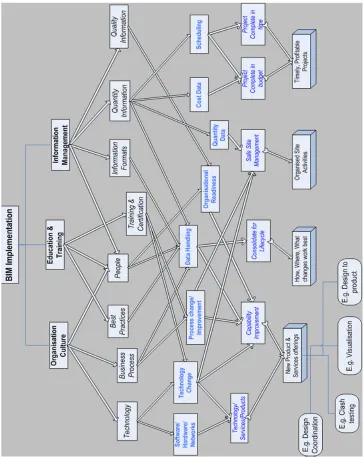
Findings from the interviews have provided a focus on three predominant themes; organisational culture, education and training, and information management. This shows that the BIM implementation for an organisation should fundamentally address its impact on culture, personnel, and the organisation’s use of technologies. That is to say, the focus is not only on technology but also on process and people.
4.1. Organization culture
As noted the organisational culture is predominantly created and practiced by everyone involved in the organisations. Further it is an aspect that is inherited as the organisation changes, grows and merges. Its effects can be identified within the business process, technologies used and people’s work practices. While these aspects ultimately contribute towards the organisational readiness to accept BIM, peoples’ ability, their understanding of the new process, and the availability of the required support including governance are to provide the necessary environment for achieving a successful implementation process. BIM implementation has forced technology change and process change within the organisations, which will force much improvement of the organisational capabilities or services offered. In most cases, this also involves integration or discontinuation of software and hardware systems within the organisation.
New systems can also provide challenges in data handling, which require training within the whole organisation. Due to the nature of BIM, consolidation of data throughout the lifecycle of a given project will be a reality. Therefore many other applications will be able to access such data streams to provide further services, e.g. asset management and demolition management during the lifecycle. In addition, such changes will create new opportunities and improvements, e.g. design coordination, clash testing, virtualisation services and streamlined design to product workflows, which can become a part of the core business process model of the organisation.
4.2. Education and training
4.3. Information management
BIM is seen as an efficient information management methodology within construction projects. It heavily involves people’s perspectives, firstly as creators or collectors of data from the site and other sources, and secondly as users of processed data, i.e. information or knowledge from the building models. Different BIM technologies available to date may provide different organisational capabilities and hence the stakeholders are required to assess currently available technologies on the market with necessary concerns. This will allow the organisation to select the suitable technology with a futuristic vision, perhaps further services that the organisation is willing to provide in the future. Similarly in some circumstances multiple tools may be required to achieve specific outcomes. Due to the variety of software and tools being used many different types of files formats are involved. Here, greater simplicity can be achieved by using integrated products, e.g. Vicosoft and Tocosoft (Tocoman, 2008), (Tekes, 2008). Since such tools provide various features with different complexities stakeholders should investigate their recommendations with appropriate future goals. Quantity and quality management has been an important part of such product listings. Quantity data can also assist the appropriate site management feature, e.g. site safety and minimising onsite storage. Costing and scheduling can provide timely project completions with maximum profits/savings.
Overall, successful adoption of BIM should incorporate strategies considering technology, process and people. As indicated in the concept map, technology, process and people aspects can be covered under i) organisation culture, ii) education and training and iii) information management headings. However, each category implies different strategies to the BIM implementation. Therefore, complementary strategies should be adopted coherently, which can be characterised as people oriented, information and process driven.
5. The case study project of BIM adoption
This case study BIM adoption and implementation has been undertaken under a DTI funded Knowledge Transfer Partnership (KTP) scheme. It aims not only to implement BIM and therefore assess the degree of the successful implementation, but rather to position this within the context of value-add offerings that can help the company place itself at the high-end knowledge-based terrain of the sector. Therefore, it adopts a socio-technical view of BIM implementation in that it does not only consider the implementation of technology but also considers the socio-cultural environment that provides the context for its implementation.
5.1. The case study company: John McCall’s Architects (JMA
)
the design through to building construction process and the associated information is very fragmented. Projects in which JMA are involved are typically of 2½ years duration, involving many stakeholders and requiring considerable interoperability of documentation and dynamic information.
5.2. BIM implementation and adoption strategy for JMA
Based on the vision in the KTP project and taking into considerations in the scoping study in section 2 for successful BIM implementation and reengineering JMA’s processes, the following strategies are employed;
Soft system methodology, for user led system implementation
Information engineering, predominantly data driven
Process innovation, driven by processes and technology
The priorities and focus in the BIM implementation change through the BIM adoption process. Further, from the scoping study, it is confirmed that the BIM implementation strategy should be comprehensive enough to coherently consider people, process and technology parameters. Therefore, a combination of human centred, information and process driven system implementation strategies have been employed in the project.
5.2.1. Soft System Methodology (SSM)
SSM comprises seven steps, which underpin the methodology (Checkland and Poulter, 2010). These are
Step 1. a problem situation is acknowledged in its unstructured form
Step 2. the problem situation is expressed (this often entails the development of a ‘rich picture’)
Step 3. root definitions of relevant system are provided
Step 4. conceptual models of the purposeful activities are developed
Step 5. the conceptual models are compared with the real world
Step 6. changes are proposed- these should be systematically desirable but culturally feasible and
Step 7. action to improve the situation is taken
5.2.2. Information Engineering (IE)
This methodology commences with a top-down approach and begins with a top management overview of the enterprise as a whole. This enables an overall strategic approach to be adopted. As the steps are carried out in an iterative manner, more and more details are derived and decisions are made for continuous development (Finkelstein, 1992).
5.2.3. Process Innovation (PI)
Process innovation is a methodology which ties Business Process Redesign (BPR) with Information Systems (IS) or Information Technologies (IT). Importantly, PI is an approach to information systems which takes into account strategic aspects of BPR. The essence of BPR is a radical change in the way in which organisations perform business activities (Voss, 2006).
The fundamental rethinking and radical redesign of business process to achieve dramatic improvements in critical, contemporary measures of performance, such as cost, quality, and service and speed. Redesign determines what an organisation should do, how it should do, and what its concerns should be as opposed to what they currently are. Emphasis is placed on the business processes and therefore IS/IT enables the change, and also encompasses managerial behaviour, work patterns and organisational structure (Grint & Willcocks, 2007). The following steps of process redesign are crucial to the success of re-engineering processes with IT (Betts, 1999).
Step 1. the organisational strengths and weaknesses need to be identified, along with the market analysis for opportunities and threats.
Step 2. identification of the processes to be reengineered. Processes, which are of high impact, of great strategic relevance or presently conflict with the business vision, are selected for consideration and a priority attached to them.
Step 3. understanding and measuring existing processes. The present processes must be documented. This will help to establish shared understanding and also help to understand the magnitude of change and the associated tasks. Understanding the existing problems should help ensure that they are not repeated. It also provides measures, which can be used as based for future improvements.
Step 4. identification of IT levers that will help push the changes: This methodology proposes that an awareness of IT capabilities can influence process redesign and should be considered at the early stages.
Step 5. Design and build prototype of the new process: in this final stage, the process is designed and the prototype built through successive iterations.
5.3. BIM adoption and implementation process
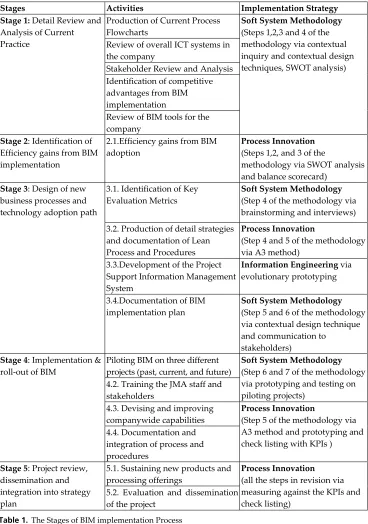
Stages Activities Implementation Strategy
Stage 1: Detail Review and
Analysis of Current Practice
Production of Current Process Flowcharts
Soft System Methodology
(Steps 1,2,3 and 4 of the methodology via contextual inquiry and contextual design techniques, SWOT analysis) Review of overall ICT systems in
the company
Stakeholder Review and Analysis Identification of competitive advantages from BIM implementation
Review of BIM tools for the company
Stage 2: Identification of
Efficiency gains from BIM implementation
2.1.Efficiency gains from BIM adoption
Process Innovation
(Steps 1,2, and 3 of the
methodology via SWOT analysis and balance scorecard)
Stage 3: Design of new
business processes and technology adoption path
3.1. Identification of Key Evaluation Metrics
Soft System Methodology
(Step 4 of the methodology via brainstorming and interviews)
3.2. Production of detail strategies and documentation of Lean Process and Procedures
Process Innovation
(Step 4 and 5 of the methodology via A3 method)
3.3.Development of the Project Support Information Management System
Information Engineering via
evolutionary prototyping
3.4.Documentation of BIM implementation plan
Soft System Methodology
(Step 5 and 6 of the methodology via contextual design technique and communication to
stakeholders)
Stage 4: Implementation &
roll-out of BIM
Piloting BIM on three different projects (past, current, and future)
Soft System Methodology
(Step 6 and 7 of the methodology via prototyping and testing on piloting projects)
4.2. Training the JMA staff and stakeholders
4.3. Devising and improving companywide capabilities
Process Innovation
(Step 5 of the methodology via A3 method and prototyping and check listing with KPIs ) 4.4. Documentation and
integration of process and procedures
Stage 5: Project review,
dissemination and integration into strategy plan
5.1. Sustaining new products and processing offerings
Process Innovation
(all the steps in revision via measuring against the KPIs and check listing)
[image:12.482.58.426.69.593.2]5.2. Evaluation and dissemination of the project
The stages and the activities within those stages are mapped out with the implementation strategies in the table below and explained accordingly.
5.3.1. Detail review and analysis of current practice
1. Production of Current Process Flowcharts
Firstly the methods of communication in the organization were analyzed and flow diagrams produced. The main methodology for mapping the current process workflow was the contextual design technique (Beyer & Holtzblatt, 1998), which prescribes modelling techniques such as flow diagrams, sequence diagrams, artefact modelling, and physical environment modelling and culture modelling to understand and examine the current practice, needs and requirements for improvement via contextual inquiry. For example, the communication flow diagrams in pictorial nature were made easily legible and formed a good basis for discussions and interviews with the members of staff and obtained feedback from them. As part of the contextual design approach as a methodology, storyboarding technique was adopted to find out how the members of staff carried out their activities at John McCall Architects and identify the correct needs and user requirements through contextual inquiry: This was undertaken by a series of interviews of members of staff in their working situation where possible examples and demonstrations were asked for. Flowcharts and rich picture diagrams by storyboarding were produced from the investigations (Aouad & Arayici, 2010).
2. Review of overall ICT systems in the company
The IT System at John McCall Architects is integral with the production processes undertaken by the practice. The standard server PC (Personal Computer) model was adopted with intranet connections. The software adopted can be broken up by usage such as document production, presentation production and drawing and graphic production. Bespoke software is used for accounting and resource monitoring processes. All the different software result in a lot of duplication of data in different file formats. In some cases the data is fragmented such as reference files to allow multiple members of staff to contribute to one drawing or brochure.
Unifying all activities is a standard electronic filing system. Packaging and transmission of information represents a time consuming activity for many of the staff, who are generally proficient software users. The IT System is overseen by the computer manager and CAD management is devolved to the team members. The IT system is on a rolling program of upgrade subsequently staff skills are upgraded while hardware and software is upgraded.
of working with brick dimensions would be a real bonus. In evaluating the appropriateness of the BIM tools to be adopted, it is important to understand the present skill set of the staff.
The level of presentational output from the BIM system will be expected. Additional rendering engines may be used. The way multiple users interact with a single model is also important. The methods of sharing outputs and interaction with other consultants within the building team are also critical. How models can be recombined and clash and warning mechanisms are also important. The level of support and training provided by the software vendor also needs to be considered. The other question is whether to adopt a BIM system that runs on top of 2D software or to purely adopt a BIM system. Another consideration is the level of bidirectional interoperability the BIM software has.
3. Stakeholder Review and Analysis
An important part of the success of the project has been the buy-in by senior member of staff. However, the BIM implementation will affect both internal and external stakeholders. Using contextual design techniques how the existing stakeholders interact with the present process was observed. An area of particular interest was how internal stakeholders maintain the consistency of the drawing set. An area where BIM could make considerable saving in maintaining the dimensional consistency of between representations (drawings) was noted.
External stakeholders may demand intelligent or non intelligent outputs from the BIM system. In this sense there should be a flexibility of output, but this does not degrade the output to the stakeholders compared with the output from the existing CAD systems. The primary need of the external stakeholders is to facilitate the built objective. Though the multifaceted forms of output and analysis from the BIM model is possible, new and more appropriate artefacts can be created and tailored to the building design process. The stakeholder review and need analysis has involved discussion with clients, consultants and contractors. A simplified questionnaire was produced and discipline specific presentations have been given. At this stage, it is recognized that the full benefits of this project will only be realized if the BIM process is integrated and utilized by the other disciplines in the building process.
4. Identification of competitive advantages from BIM implementation
By envisioning the future trends, it is possible to better predict how BIM will be used in the company. It is also possible to predict for what type of project the BIM process will be used. The competitive advantages in the SWOT report were identified as cost leadership, differentiation, cost focus, differential focus and collaboration. BIM has the potential to provide advantages in all of these areas. By reducing both the time and the effort to generate architectural information, BIM may give John McCall Architects or its team the opportunity to offer the most competitive bids for projects. By avoiding errors and reducing the need for information requests from site John McCall Architects has the potential to differentiate itself by providing a better service by using BIM.
Cost Focus competitive advantage is gained by carrying out specific parts of the process cheaper than competitors. Sustainability issue is becoming more and more important for housing design. By adopting BIM, John McCall Architects should be able to analysis environmental factors at a lower cost. BIM offers several potential areas for differential focus. For example, using BIM virtual preconstruction analysis and project production storyboarding become more feasible. Secondly the BIM system has a major potential for use in facility management and life cycle management. The major advantage of BIM is by providing a central focus on the collaboration between the building team and through integration and alignment of all the participants within the building process, savings will be made on cost, quality and time.
Whilst the major gains from this KTP project are only be realized in the later stages of the project, several initial gains have already been identified. One of the potential gains coming out of the SWOT analysis is the use of BIM models for rapid prototyping via 3D printers. This has the potential to give yet another understanding of a scheme as it develops. The SWOT analysis also demonstrated how saving could be made through the adoption of Lean principles (Koskela & Ballard, 2006). Initial seminars have been given in the office on “quality” and “lean principles”. The discussion about lean principles; avoiding waste and focusing on value adding processes has provided a good counter balance to the ISO 14000 principles which are also been reviewed by the practice. Meetings have also been setup to discuss how the adoption of BIM can assist in the drive for sustainable design projects. On the other hand, members of staff need to be trained how to use the BIM system and guideline and procedures will be developed. But the important thing is to engender the staff with the attitude of looking for better ways of working and the team mentality of discussing new ideas as an ongoing process development and improvement.
5. Review of BIM tools for the company
architects work. The more exposure members of staff become more knowledge about the new concepts, the easier the transition will be.
5.3.2. Identification of efficiency gains from the BIM implementation
The main characteristics of BIM implementation strategy and the subsequent efficiency gains are clarified after the stage 1: detail review and analysis of current practice. Completion of these diagnostic activities has led to make some decisions to identify the scope and the characteristics of the actual BIM Implementation and adoption strategy. Making these decisions is best facilitated with the use of a scorecard (Malmi, 2001). These decisions have helped determine the roadmap and the resources required for the BIM adoption and subsequently the identification of the efficiency gains from the BIM adoption, which are listed below (Arayici et al, 2009). BIM adoption and implementation will re-engineer the operational and IT processes and broaden the knowledge of existing staff and stakeholders up and down the supply chain
Significant competitive edge over similar sized practices resulting in increased turnover
of at least 10%; increase of 20% more work utilizing a staffing growth of below 10%.
Improved management of the client/contractor/consultant relationships, essential to
support the sales growth, leading to enhanced partnering/framework options.
Better co-ordination, better quality data production and information exchange across
the wide spectrum of information sources utilised and exported to others, including the building model, technical drawings, schedules and specifications.
Enhanced design solutions developed at an earlier stage due to more time and effort
being available to the design team. Improvements in dealing with design changes and change control enabling the practice to react efficiently and proactively to changing client aspirations throughout the design stages.
Savings through improved internal efficiencies and better service delivery to clients
enabling John McCall to position itself at the forefront of international trends.
Development of staff to increase the visible expertise and reputation of the company.
Increased technical staff job satisfaction by the removal of inefficient and repetitive tasks which detract from the core task of the design process.
5.3.3. Design of new business processes and technology adoption path
1. Identification of Key Evaluation Metrics
Does the KPI motivate the right behaviour?
Is the KPI measurable?
Is the measurement of this KPI affordable (cost-effective)?
Is the target value attainable?
Are the factors affecting this KPI controlled by the company?
Is the KPI meaningful?
The following steps have been undertaken in the KPI identification.
Step 1. conducting brainstorming sessions in JMA and interviewing the external stakeholders JMA collaborates:
Step 2. Filling out the KPI design form for all the potential KPIs collated from the brainstorming sessions and the interview with the external partners
Step 3. Evaluation and assessment of the potential KPIs from step 2 to filter them against the checklist above recommended by Gerber & Rice, (2009)
This process has led to finalized identification of the KPIs for the evaluation of the business improvement in JMA and subsequently the assessment and measure the extent of the success of BIM adoption. The following list of KPIs has been identified for JMA’s business.
Man hours spent per project - efficiency with cost per project
Speed of Development
Revenue per head
IT investment per unit of revenue
Cash Flow
Better Architecture
A better product
Reduced costs, travel, printing, document shipping
Bids won or win percentage
Client satisfaction and retention
Employee skills and knowledge development
2. Production of detail strategies and Documentation of Lean Process and Procedures
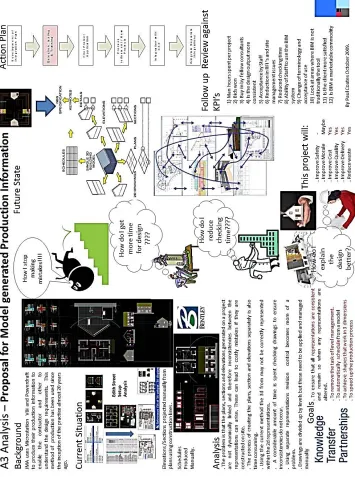
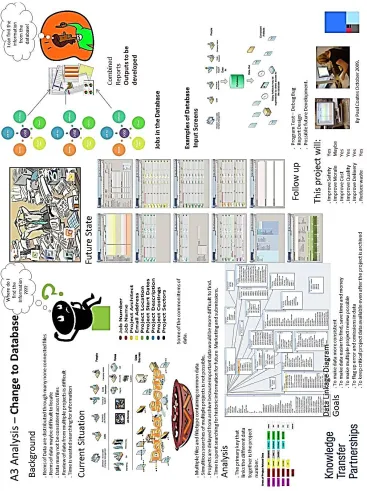
The main approach used for lean improvement in the project is A3 method, which is a proven to be a key tool in Toyota’s successful move towards organisational efficiency and effectiveness and improvement (Durward and Sobek, 2008), (Koskela, 2003). For example, it has been used for i) improvements achieved via storing project support information in the new knowledge database, ii) improvements achieved in email handlings, iii) improvements achieved in mail scanning and digitisation, iv) Improvements achieved via BIM based product information documentation, etc. The Figure 3 and subsequent table 2 show an example for BIM based product information documentation and for storing project support information in the new knowledge database.
1.Background
JMA uses Microstation V8i and Powerdraft to produce their production information to enable the contractor and the stakeholders to understand their design requirements. This method of production has been used since the inception of the practice almost 20 years ago. 2D representations are created to illustrate 3D forms.
Situation before the BIM tool Adoption
Elevations/Sections projected manually from plans using construction lines. Schedules produced manually.
Analysis
The problem is that the plans, sections and elevations generated on a project are not dynamically linked and therefore inconsistencies between the representations can arise. These can lead to costly mistakes if they are constructed on site. The process of creating the plans, section and elevations separately is also time consuming. Using the current method the 3D from may not be correctly represented within the 2D representations. A considerable amount of time is spent checking drawings to ensure inconsistencies do not occur. Using separate representations revision control becomes more of a problem. Drawings are divided up by levels but these need to be applied and managed manually.
Goals
To ensure that all representations are consistent and remain consistent and accurate when any representations are altered.
To remove the task of level management.
To automatically generate schedules from the BIM model. To achieve shapes that work in 3 dimensions.
To speed up the production process.
Situation after the BIM tool Adoption and the Lean Efficiency Gains Achieved
Using BIM software to create 3D models from which 2D representations and schedules can be generated automatically. Furthermore, construction planning, costing, energy and thermal analysis, daylight and acoustic analysis can be carried out in a fast and accurate to ensure sustainable design outputs. Efficiency gains are 1) The consistent and better quality design outputs, 2) reduction in RFI (Request For Information) and site management issues 3) Reduced checking time 4) Ability of Staff to use the BIM system and capacity improvement 5) pinpointing other areas where BIM is not traditionally the tool for improvement but still requires improvement, 6) Reduced costs, travel, printing and document shipping.
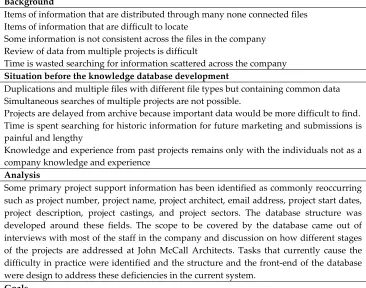
Background
Items of information that are distributed through many none connected files Items of information that are difficult to locate
Some information is not consistent across the files in the company Review of data from multiple projects is difficult
Time is wasted searching for information scattered across the company
Situation before the knowledge database development
Duplications and multiple files with different file types but containing common data Simultaneous searches of multiple projects are not possible.
Projects are delayed from archive because important data would be more difficult to find. Time is spent searching for historic information for future marketing and submissions is painful and lengthy
Knowledge and experience from past projects remains only with the individuals not as a company knowledge and experience
Analysis
Some primary project support information has been identified as commonly reoccurring such as project number, project name, project architect, email address, project start dates, project description, project castings, and project sectors. The database structure was developed around these fields. The scope to be covered by the database came out of interviews with most of the staff in the company and discussion on how different stages of the projects are addressed at John McCall Architects. Tasks that currently cause the difficulty in practice were identified and the structure and the front-end of the database were design to address these deficiencies in the current system.
Goals
To make project support information more consistent To make data easier to find, save time and money
To make multiple project review possible and obtain lessons learnt from past projects To flag up error and omissions in data
To keep critical project data available even after the project is archived
Situation after the knowledge database development and lean efficiency gains achieved
Database can be accessible to all JMA staff to input and obtain project related information. The JMA staff can also refer to past projects in similar kinds to learn and apply to their current and future projects.
[image:21.482.58.424.76.364.2]In addition, lean efficiency gains obtained are 1) reduced waiting time, 2) improved quality in dealing with project support information and external stakeholders, 3) facilitating audit and reviews, 4) improved quality of service to JMA partners and clients, and 5) allows archiving and learning from past projects 6) retaining key knowledge and experience from projects for the company not only with individual JMA staff.
3. Development of the Knowledge Database
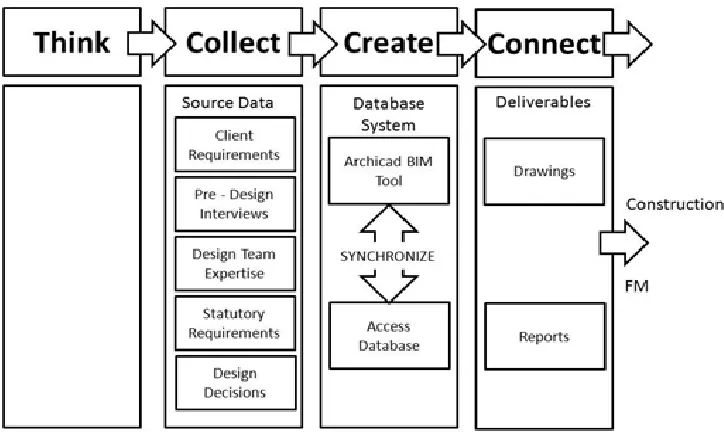
[image:22.482.61.423.226.445.2]The major advantage of BIM is to input to a single information model and the multiple representations and extraction of that single information model. In the project, it was decided to apply these principles for the project support information residing outside of the BIM graphical model such as client names, address, dates etc. For this purpose, critical data that is commonly duplicated in spreadsheets, word documents and emails has been reviewed and developed into a relational database used by all members of staff in the company. This has provided a platform to record, share and interrogates project support information internally across the company. The particular benefits of this knowledge database are that information is retained in the same database even when projects are archived.
Figure 5. Combined model for project information with BIM and project support information with the knowledge database
Also the database has become particularly useful for marketing purposes. Further links with the graphical BIM model and other processes at John McCall Architects are also being investigated as illustrated in figure 5. The resultant schema that is being worked towards is as to capture knowledge and experiences from past projects and from experienced staff via this knowledge database in the future.
4. Documentation of BIM implementation plan
up skilling staff is also planned at this stage. The preparation and planning of the actual BIM implementation is primarily prescribed by three factors; i) the financial restrictions on the speed with which the BIM software could be purchased, ii) finding appropriate projects on which to use the BIM orientated approach and iii) the speed with which members of staff could be trained to use the BIM authoring software. Particular consideration in the planning process was given to when and how the BIM object libraries and also office BIM standards were to be developed.
5.3.4. Implementation and roll out of BIM
1. Piloting BIM on three different projects (past, current, and future) and Training
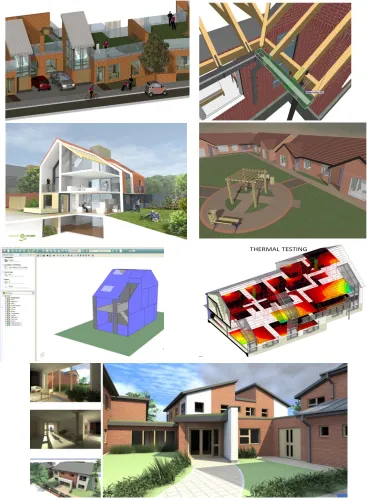
The adopted BIM software was experimented on the “Grow Home” project; an award winning design previously produced by JMA. This exercise proved positive in some respects. For example, reproducing this project in BIM has highlighted the specific order of decisions that are required to produce BIM models. The Grow Home project had not been taken through the production information phase, which resulted in some materials used and the construction methods remained undefined in BIM modeling for the Grow Home project. This raised issues about the requirements for accurate and complete information when developing BIM models. Figure 6 below shows some example views from the BIM models.
The other project undertaken was the Millachip Phase 3 project; a series of sheltered housing bungalows. A 2D set of CAD drawings had already been developed on this project and BIM models with associated plans sections and elevations were rapidly produced. Objects were built from scratch on this project. It helped to match the generated 2D drawings from the BIM model with the previously produced 2D drawings to observe the accuracy, consistency, speedy and timely maintenance of such drawings and finally to establish a good communication with the client. Finally this project will form the basis of the BIM object libraries for JMA in its practice in housing and regeneration. However, future piloting projects will be defined once the core training activities for the JMA staff are fully completed. Furthermore, it will be determined on a project which can benefit from eco analysis in line with the sustainable design vision being developed as a result of new BIM led infrastructure in the company.
Those benefits below are also realized from those projects above via BIM adopted in JMA.
Avoidance of Data Atrophy
Move towards Integrated Project Delivery
Use of Clash Detection and Constrains in Design
Models allowing GPS use on site
Analysis of Site Safety and Site Logistics
Linking the models to Bills of Materials
Output to virtual environments
Better analysis against Code for Sustainable Homes
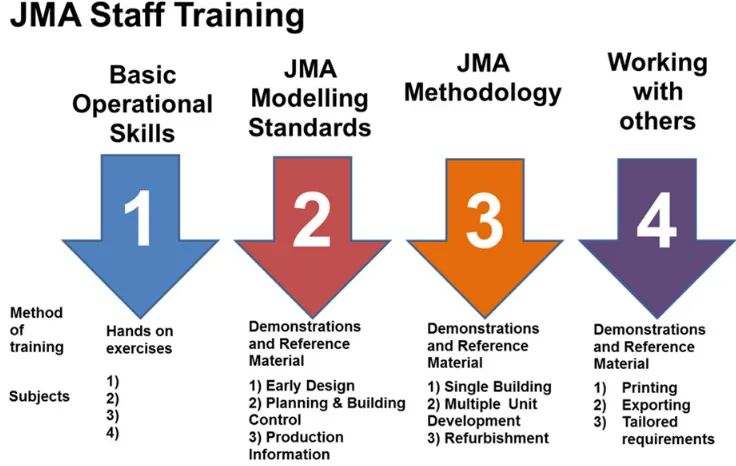
Overall, four areas of training were organised and conducted. These are: 1) Basic Operation Skills, 2) JMA modelling standards, 3) JMA methodology of model construction, 4) How to work with external parties. These are illustrated in figure 7.
Figure 7. BIM Implementation Training programme
2. Devising and improving companywide capabilities & documentation of process and
procedures
5.3.5. Project review, dissemination and integration into strategy plan
The process of project review, dissemination and integration into the strategy plan will occur towards the end of the project. As part of the documentation of the evaluation and review, this BIM adoption and implementation project will be measured and assessed by using a capability maturity model at stage 5 of the project.
In regard to sustaining new products and processing offerings, one new product that has been identified is the production of BIM information to better meet the post completion facility management of the projects. The required research and infrastructure development is ongoing to enable JMA to provide with Facility Management services to its clients. In respect to evaluation and dissemination of the project, a tangible benefits log has been maintained throughout the BIM implementation project. This will form the basis of an evaluation report that is to be written at the conclusion of the project. As part of the dissemination of the project, presentations in different conferences, events and workshops for industrialists and academics, and involving in exhibitions have already been undertaken.
6. Conclusion
The progress on the BIM implementation in JMA is ongoing and this chapter highlighted the strategies and outcomes from the stage 1 to stage 5.
Visit to Finland and obtain lessons learnt from BIM implementation that is represented in the concept map has provided a good basis for setting the strategies for this project will be used in this KTP project. It is understood that the BIM implementation strategy should be comprehensive and employ human centred, data and process driven methodologies because BIM implementation is as much about people and process as it is about technology.
It is envisaged that when the project is completed, it will provide a clearer vision and roadmap with detailed strategies, methods and techniques for successful BIM implementation. Furthermore, based on the current findings and optimistic behaviour and culture evolved during the project, it will re-engineer the operational and IT processes and broaden the knowledge of existing staff and stakeholders up and down the supply chain. The impact of the KTP has already been realised during the project that it has improved JMA’s practice: eliminating the risk of calculation, misinterpretation of design, improve communication, provide interoperability between stakeholders and, ensuring control and sharing of documentation. This is because BIM is the foundation for implementing an efficient process and invariably leads to lean-orientated, team based approach to design and construction.
designs; provide a quicker and cheaper design production; better co-ordination of documentation; more effective change control; less repetition of processes; a better quality constructed product; and improved communication both for JMA and across the supply chain.
Author details
Yusuf Arayici and Paul Coates
The University of Salford, UK Paul Coates The University of Salford, UK
7. References
Arayici, Y., Coates, P., Koskela, L., Kagioglou, M., Usher, C., O'Reilly, K., (2011) "BIM adoption and implementation for architectural practices", Structural Survey, Vol. 29 Iss: 1, pp.7 – 25
Aouad, G., & Arayici, Y 2010, Requirements Engineering for Computer Integrated Environments in Construction, Wiley-Blackwell, Oxford, UK
Arayici, Y., Coates, P., Koskela, L., Kagioglou, M., Usher, C., O’Reilly, K., (2009), “BIM Implementation for an Architectural Practice”, Managing Construction for Tomorrow International Conference, October 2009, Istanbul Turkey
Bernstein, P.G., Pittman, J.H. (2004). “Barriers to the adoption of building information modelling in the building industry”, Autodesk Building Solutions, White paper
Betts M., (1999), “Strategic Management of IT”, ISBN 0 632 04026 2, Blackwell Science
Beyer H, Holtzblatt K, (1998), “Contextual Design, Defining Customer-Centred Systems”,
Morgan Kaufmann Publishers, San Francisco.
Checkland, P., Poulter, J., (2010), “Systems Approaches to Managing Change: A Practical Guide”, Springer London, ISBN 978-1-84882-808-7, 2010-05-11
Cheng Tai Fatt (2005), An IT Roadmap for Singapore’s Construction Industry, IAI Industry Day, Oslo, May 2005
Coates, P., Arayici, Y., Koskela L., Kagioglou, M., Usher C., O’Reilly, K., (2010), “The key performance indicators of the BIM implementation process”, ICCBE 2010, Jun 30 2010, Nottingham
Durward K., Sobek, II, (2008), “Understanding A3 Thinking: A Critical Component of Toyota’s PDCA Management System”, Taylor & Francis Group, New York.
Gerber & Rice,(2009), “The Value of Building Information Modelling: Can We Measure the
ROI of BIM?” AECbytes Viewpoint (Analysis, Research and Reviews of AEC
Technology, Issue 47, (August 2009),
http://www.aecbytes.com/viewpoint/2009/issue_47.html
Grint, K., Willcocks, L., (2007), “Business Process Reengineering in theory and practice: business paradise regained?” New Technology, Work and Employment, Vol. 10, Issue 2, pp. 99-109.
Jordani, D (2008), “BIM: A Healthy Disruption to a Fragmented and Broken Process”, FAIA, Jordani Consulting Group, Journal of Building Information Modeling: Spring 2008, Matrix Group Publishing, Houston
Kam C, Fischer M, Hänninen R, Karjalainen A and Laitinen J (2003), The Product Model and Fourth Dimension project, ITcon Vol. 8, Special Issue IFC - Product models for the AEC arena, pg. 137-166, http://www.itcon.org/2003/12
Koskela, L. J. (2003), 'Theory and Practice of Lean Construction: Achievements and Challenges', in: Proceedings of the 3rd Nordic Conference on Construction Economics & Organisation. Hansson, Bengt & Landin, Anne (eds). Lund University (2003)
Koskela, L J & Ballard, G 2006, 'What is Lean Construction - 2006.', -Construction in the XXI Century: local and global challenges - ARTEC - Rome, Italy
Malmi, (2001), “Balance scorecards in Finnish Companies: A Research note”, Management Accounting Research, Vol.12, Issue 2, pp.207-220.
Mihindu, S., and Arayici, Y. (2008). “Digital construction through BIM systems will drive the re-engineering of construction business practices”, 2008 International Conference Visualisation, IEEE Computer Society, CA, ISBN 978-0-7695-3271-4, P29-34.
Novak, J. D. & A. J. Cañas, The Theory Underlying Concept Maps and How to Construct Them, Technical Report IHMC CmapTools 2006-01 Rev 01-2008, Florida Institute for Human and Machine Cognition, 2008", available at:
http://cmap.ihmc.us/Publications/ResearchPapers/TheoryUnderlyingConceptMaps.p df
Oakley, P. (2007). “CAD Enough?”, CAD User AEC Magazine, Vol 21 No 01, 2008
Schevers, H., Mitchell, J., Akhurst, P., Marchant, D., Bull, S., McDonald, K., Drogemuller, R., Linning , C., “Towards Digital Facility Modelling For Sydney Opera House Using IFC and Semantic Web Technology”, July 2007 at http://itcon.org/2007/24/
TEKES, (2008), “Sara – Value Networks in Construction 2003–2007”, Technology Programme Report 2/2008, Helsinki, ISBN 978-952-457-392-4.
TOCOMAN, (2008), “Benefits”, http://www.tocoman.com/default.asp?docId=13339, [Accessed 20/04/08].