International Journal of Emerging Technology and Advanced Engineering
Website: www.ijetae.com (ISSN 2250-2459, ISO 9001:2008 Certified Journal, Volume 7, Issue 6, June 2017)
366
Improvised LDPC Coding for Reduced Error DVBT
Communication under Fading Based Error
Er. Ankita Parmar
1, Er. Poonam Verma
21M.Tech student, 2Assistant Professor, Electronics & Communication, Shaheed Udham Singh College of Engineering and
Technology, Tangori, Punjab, India
Abstract --- In this new technology world, we must have much more expectations on the basis of electronic system. Our expectation of doing better and in very less time is increasing day by day. We need to enhance much more things to perform better and much better. LDPC coding becomes a hottest topic in coding theory. In this research work. We describe Low density parity check codes (LDPC) and its significance, LDPC codes are very popular on the basis of its error detecting and error correcting methods. We already studied about the LDPC codes and its method. In this research work two ldpc codes are compared with DVBT communication system which is wireless and designing of wireless transreceiver and wireless coder and decoder using OFDM. We design the video data base of colored video under different resolutions. We design ldpc encoder and decoder under based technique and proposed techniques and simulation of video transmissions and reception in order to testing the performance of the system on the basis of PSNR (peak signal to noise ratio) , BER (bit error rate) , power , delay and memory.
Keywords---LDPC, LDPC coding, OFDM, DBVT communication, video transmission, LDPc encoder, LDPC decoder PSNR, BER, power, delay, memory.
I. INTRODUCTION
LDPC codes has been discovered long time ago and rediscovered after invention of turbo codes. These two codes are actors of revolution of error correcting codes theory. Low density parity check decoders has become a hot topic in recent year to meet the have experienced an amazing comeback in the past few years. The design and evolution of digital communication system emphasizing areas of new technology. LDPC (Low density parity – check codes) are the class of linear block codes. LDPC is originate from the feature and quality belonging to of their parity check matrix which contain only ones as compared to the quantity of zero’s. These codes are already equipped with very fast encoding and decoding algorithms. Low density parity check codes actually leads to coding and decoding techniques related to error correction technology which is very close to capacity. LDPC are characterized by sharpness of ones in the parity check matrix. It is a linear error correcting codes that lead to transmission of message over a noisy transmission channel.
II. LITERATURE SURVEY
Hisashi futaki et al. [1] described (LDPC) coded MIMO (Multiple inputs and multiple outputs) Systems with Iterative turbo decoding, in which a new MIMO-LDPC system with iterative TD (turbo decoding) (MIMO-LDPC-TD) using two LDPC encoders and two LDPC decoders to improve the performance of the MIMO-LDPC.
Lu et al. [2] described a class of structured LDPC codes with large girth. Turbo-structured LDPC (TS-LDPC) codes—composed of two sub trees connected by an inter-leaver. TS-LDPC codes with good girth properties are easy to design: careful design of the inter-leaver component prevents short cycles in its Tanner graph.
Byers & Takawira et al. [3] explained non-binary and concatenated LDPC codes for multiple-antenna systems. Coded multiple-antenna systems are a promising solution to the provision of high data rate and bandwidth efficient wireless communications. Low-density parity-check (LDPC) codes achieve excellent coding gains in AWGN channels.
Lu & Maura et al. [4] described PS (partition-and-shift) LDPC (PS-LDPC) code. PS-LDPC codes can be easily designed to have large girth. The code construction is simple to explain. He divided the bit and checked nodes in the Tanner graph into subsets and connected nodes in these subsets according to a set of parameters called shifts.
Zheng & Rao et al. [5] illustrated a LDPC-Coded MIMO Receiver Design over unknown fading channels. In which a soft MIMO detector and two LDPC component soft decoders, without forming any specific channel estimate, that offer an effective trade-off between complexity and performance.
Suresh Dannana et al. [6] described the LDPC encoder is replaced with data encoding schemes in control to reduce the dynamic power consumption in Low Density Parity Check Techniques (LDPC).
International Journal of Emerging Technology and Advanced Engineering
Website: www.ijetae.com (ISSN 2250-2459, ISO 9001:2008 Certified Journal, Volume 7, Issue 6, June 2017)
367
III. PROBLEM FORMULATION
Many attempts have been made to solve the problems of error detecting and reduce the complexity by designing ldpc code. Many decoders have been design to detect and correct the error. But the complexity of ldpc codes are still too high which is major problem to be solve out, till now we are not able to find out that out of these decoder which one will be the best performer so that in future, we will use to perform better on the basis of particular parameter and achieving better result in very less time.
The existing algorithm has loss of performance by decoding complexity. This reduces the time as well as data transmitted/decoded. The existing decoder lacks in perfect communication between DVBT transmitter and receiver, as issues may rise due to interference caused by external factors.
The existing implementation in wireless system issue has not been resolved, which covers the actual performance of the system of broadcast and decoding unit.
LDPC based decoding in Image Processing based data is not covered in previous approach, this results in non-time evaluation of data which is not the case in real-time application.
This research work focuses on designing a LDPC decoder and comparing it with different decoder and communication method to show which one will perform better on the basis of bit error rate, power, delay, memory, peak signal to noise ratio. The motivation behind using this analysis and comparison to find the better decoder to achieve accuracy and reduce complexity in vey less time.
IV. INTRODUCTION TO OFDM
[image:2.595.336.519.156.275.2]Orthogonal frequency division multiplexing scheme used as a digital multi carrier modulation method .It is a form of signal modulation that divides a high data rates modulating stream placing them on to many slowly modulated narrow band.
Fig. 1 Block diagram of OFDM
OFDM is a modulation format that is being used for many of the latest wireless and telecommunication standard. OFDM has also been adopted for a number of broadcast standard and digital video broad cast standard. In wireless communication fading is deviation of the attenuation affecting a signal over certain media, fading may vary with time radio frequency and is often modulated randomly.
V. OBJECTIVE
The research has been focus to achieve these objectives :
To design a Decoder to detect and correct the error coming from data signal of 24 to 64 bits length.
To implement ldpc encoder / decoder with low data
complexity and discrete packet size.
To implement wireless ( DVBT )communication
system for comparing two LDPC codes.
Simulation of wireless distortion as in real time like fading channels using the matlab rf tool kit with Rayleigh and rician type shadowing with different window size.
Simulation of video transmissions and receptions under the given environment of diversity in variable traffic and interference from other video channels.
Testing the performance of the proposed system on
International Journal of Emerging Technology and Advanced Engineering
Website: www.ijetae.com (ISSN 2250-2459, ISO 9001:2008 Certified Journal, Volume 7, Issue 6, June 2017)
368
[image:3.595.81.256.148.531.2]VI. DESIGN AND IMPLEMENTATIONS
Fig. 2 Block diagram for the proposed work
The presented work has been divided into these sections:
1. Designing of video data base of colored video under different resolutions. Divide the video in to frames by applying primary one dimension coding.
2. Conversion of colored frame into gray layer and sampling of 2D gray layer into 1D and applying burst error to the frame data and then bit spread for randomize the data.
3. Addition of zero to the original data encoder using 64 bit value and Designing of wireless transreceiver and wireless coder and decoder using OFDM.
4. The OFDM is simulated with Gaussian channel with the noise mixing with a value up to 15 DB.
5. Merge the two LDPC systems with transceiver
systems.
6. Receive the signal after fading channel techniques under based and proposed techniques. and find the bit error ratio per 6 bit count and Calculate the power required in coding and transmitting the data. After transmitting the signal travel with AWGN noise is received at the receiving decoder where 64 bit description take place and interlever is removed zero and burst error rate is calculated and original frame data is retrieved.
7. Reshaping the frame from 1D to 2Dand Comparison of the performance of existing and proposed system on the basis of parameters like PSNR, BER delay, memory, and power.
VII. RESULT AND DISCUSSION
[image:3.595.321.540.430.565.2]This shows the avaluated output image interm of BER which achieve value of 91.6667 under code rate 2/3 burst error rate 7 and the next evluation is the visual evaluation. The visual evaluation shows output constructed image ssimilar instructure to the input images with minor difference in edge value with high contrast ratio. Due to the reduction in edge values o/p image shows some lossy data. The result image observed for the same image frame in code rate. The difference occurred in the highest code rate ratio which was 7/8.
Fig. 3 GUI representation of videobroadcast model with its various user define variables of set parameters
Result:
Fig. 4 Result of of videobroadcast model with its various user defines variables of set parameters .
[image:3.595.368.494.612.723.2]International Journal of Emerging Technology and Advanced Engineering
Website: www.ijetae.com (ISSN 2250-2459, ISO 9001:2008 Certified Journal, Volume 7, Issue 6, June 2017)
[image:4.595.316.543.120.344.2] [image:4.595.54.283.131.305.2]369
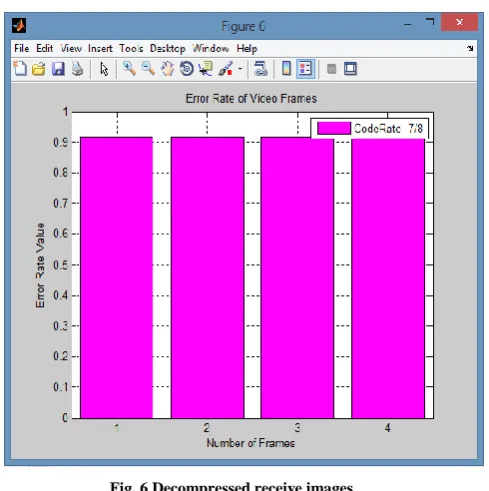
Fig. 5 Coded image for transmissionFig. 6 Decompressed receive images
The output shows visible evaluation of result for 1:4 Frames showing the BER ratio and channel error probability for different frames frames of video under the specified parameter.
Fig. 7 Comparison of BER ratio to power gain for OFDM
In OFDM the frequency user channels are selected for arrangement with respect to each other in orthogonal arrangement while avoiding overlap using different selection channel for multiplexing sub carriersThis will result in heavy carrier modulation .the signal will be mixed together to form single carrier pass through AWGN channel result in addition of noise reducing the decoding efficiencyAdvantahges:The next modulation generate better intercorelation between the subcarriers ,so the ioverall compression and interference is less as
compared to OFDM.
VIII. CONCLUSION
The proposed research work is based on the previous issue concerning delay and SNR ratio from DVBT broadcast under 128 frames. The new system device was to improve the efficiency using BER analysis and SNR The proposed system has also reduce the delay and power consumption ratio with respect to previous approach The experience done both images and video under different dvbt ratio of code parameter like BER code rate.
0 5 10 15
10-2
10-1
100
BER vs SNR in AWGN channel
SNR
BER
[image:4.595.48.293.324.570.2]International Journal of Emerging Technology and Advanced Engineering
Website: www.ijetae.com (ISSN 2250-2459, ISO 9001:2008 Certified Journal, Volume 7, Issue 6, June 2017)
370
REFERENCES[1] Hisashi Futaki, T.O., 2003. Low-Density Parity-Check (LDPC)
Coded MIMO Systems with Iterative Turbo Decoding. IEEE.
[2] Lu, J., Moura, J.M.F.M. & Niesen, U., 2004. A CLASS OF
STRUCTURED LDPC CODES WITH LARGE GIRTH. IEEE.
[3] Byers, G.J. & Takawira, F., 2004. Non-Binary and Concatenated LDPC Codes for Multiple-Antenna Systems. IEEE
[4] Lu, J. & Moura, J.M.F., 2005. Partition-and-Shift LDPC Codes. IEEE.
[5] Zheng, J. & Rao, B.D., 2005. LDPC-Coded MIMO Receiver
Design Over Unknown Fading Channels. IEEE
[6] Myung, S., Yang, K. & Park, D.S., July 2006. A Combining
Method of Structured LDPC Codes from Affine Permutation Matrices. In ISIT 2006, Seattle. USA, July 2006.
[7] Xiao, Y. & Lee, M.H., 2006. Construction of Good Quasi-Cyclic
LDPC Codes. In ICWMMN., 2006.
[8] Gounai, S. & Ohtsuki, T., 2006. Performance Analysis of LDPC Code with Spatial Diversity. IEEE
[9] Lu, J. & Moura, J.M.F., FEBRUARY 2006. Structured LDPC
Codes for High-Density Recording Large Girth and Low Error Floor. IEEE TRANSACTIONS ON MAGNETICS,
[10] Abematsu, D., Ohtsuki, T., Jarot, S.P. & Kashima, T., 2007. Size
Compatible (SC)-Array LDPC Codes. IEEE.
[11] Zhang,C.et al, JANUARY 2010. Flexible LDPC Decoder Design
for Multigiga bit-per-second Applicaions. IEEE
TRANSACTIONS ON CIRCUITS AND SYSTEMS – I: REGULAR PAPERS .
[12] Amador,E,Knopp,R. & Pacalet,R,2010.On-the-fly Syndrome
Check for LDPC Decoders .In Sixth International Conference on Wireless and Mobile Communications,2010
[13] Jeon,S.&Kumar,B.V.K.V.,JUNE2010.Performance and
Complexity of 32 k-bit Binary LDPC codes for Magnetic
Recording Channels. IEEE TRANSACTIONS ON
MAGNETICS.
[14] Tao, X., Zheng, L., Liu, W. & Liu, D., 2011. Recursive Design of
Hogh Girth (2,) LDPC Codes from (k,) LDPC Codes.IEEE
[15] Abu-Surra, S., Pisek, E. & Henige, T., 2011. Gigabit Rate
Achieving Low-Power LDPC Codes Design and