R E S E A R C H
Open Access
Deep sequencing on genome-wide scale reveals
the unique composition and expression patterns
of microRNAs in developing pollen of
Oryza sativa
Li Qin Wei
1,2†, Long Feng Yan
1,2,3†and Tai Wang
1,2*Abstract
Background:Pollen development in flowering plants requires strict control of the gene expression program and genetic information stability by mechanisms possibly including the miRNA pathway. However, our understanding of the miRNA pathway in pollen development remains limited, and the dynamic profile of miRNAs in developing pollen is unknown.
Results:Using next-generation sequencing technology, we pyrosequenced small RNA populations from rice uninucleate microspores to tricellular pollen and control sporophytic tissues at the genome-wide level. We identified 292 known miRNAs, including members of all 20 families conserved in plants, and 75 novel miRNAs. Of the 292 known miRNAs, 202 were expressed, with 103 enriched, in developing pollen. More than half of these novel miRNAs displayed pollen-or stage-specific expression. Furthermore, analyzing the 367 miRNAs and their predicted targets indicated that correlation in expression profiles of pollen-enriched known miRNAs and their targets significantly differs from that of sporophyte-enriched known miRNAs and their targets in some functional terms, while novel miRNAs appeared to negatively regulate their targets. Importantly, gene ontology abundance analysis demonstrated chromatin assembly and disassembly was important in the targets of bicellular pollen-expressed novel miRNAs. Principal component analysis revealed pollen of all three stages was discriminated from sporophytes, largely because of the novel and non-conserved known miRNAs.
Conclusions:Our study, for the first time, revealed the differences in composition and expression profiles of miRNAs between developing pollen and sporophytes, with novel and non-conserved known miRNAs the main contributors. Our results suggest the important roles of the miRNA pathway in pollen development.
Background
MicroRNAs (miRNAs) and small interfering RNAs (siR-NAs) are two types of small non-coding RNAs (20 to 24 nucleotides in length) identified in nearly all eukaryotes. The pool of small RNAs in plants is highly complex, con-sisting primarily of many low-abundant siRNAs and a small number of highly expressed 21-nucleotide sequences; most of the latter are miRNAs [1,2]. Most miRNA loci are encoded by independent transcriptional units in intergenic regions that are transcribed by RNA polymerase II. In
plants, miRNAs are processed from stem-loop regions of long primary transcripts by a Dicer-like enzyme and are loaded into silencing complexes, where they generally direct cleavage of complementary mRNAs. Although miR-NAs were identified in plants just recently, studies have revealed that miRNAs play crucial roles in each major stage of plant development, often targeting the transcrip-tion factors that mediate transitranscrip-tion from one developmen-tal stage to the next [3].
Haploid pollen (also called the gametophyte) is a key regulator of sexual reproduction in flowering plants and is produced from diploid pollen mother cells via meiosis. In contrast to animals, in which products of meiosis directly develop into sperm cells, in plants, the product of meiosis undergoes a unique postmeiotic pollen development pro-cess, finally giving rise to sperm cells. During this propro-cess,
* Correspondence: [email protected] †Contributed equally
1
Research Center for Molecular and Developmental Biology, Key Laboratory of Photosynthesis and Environmental Molecular Physiology, Institute of Botany, Chinese Academy of Sciences, 20 Nanxincun, Xiangshan, Beijing 100093, China
Full list of author information is available at the end of the article
haploid uninucleate microspores (UNMs) generated from meiosis first undergo asymmetric mitosis to generate bicellular pollen (BCP) consisting of a large vegetative cell and a small generative cell enclosed in the vegetative cell. The two types of cells have different fates: the vegetative cell exits the cell cycle and can develop into a polarly growing pollen tube, whereas the generative cell under-goes further mitosis to produce two sperm cells. This postmeiotic pollen development is orderly and precisely regulated [4]; however, the mechanism underlying the main developmental events remains largely unknown.
Recent transcriptomics studies have revealed that the number of genes expressed in pollen greatly decreases from the UNM stage to the tricellular pollen (TCP) stage, whereas stage-specific transcripts showed a‘U-type’ change, with the lowest number at the BCP stage in Oryza sativaandArabidopsis thaliana [5]. These data suggest that fine-tuned gene expression and function are essential to guarantee pollen development. The miRNA pathways in pollen are of interest because previous tran-scriptomic analysis showed key transcripts involved in miRNA pathway, such as those encoding Argonaute (AGO)1, 2, 4 and 7, Dicer-like protein (DCL)1 to 3 and RNA-dependent RNA polymerase 1, 2 and 6, were turned off during pollen development [6]. However, recent research demonstrated that several miRNA path-way genes were expressed and some enriched in pollen grains ofArabidopsis[7-10]. Many miRNAs known to function in somatic development have been identified in Arabidopsismature pollen [9,11]. Using 454 sequencing, Grant-Downtonet al. [10] revealed diverse small RNAs in mature pollen ofArabidopsis, some of which were possibly specific to mature pollen. These studies indicate the existence of an miRNA pathway in pollen. However, mature pollen is terminally differentiated and at a devel-opmental‘standstill’, so the present studies could not define the importance of miRNAs in pollen development. Sequencing small RNAs from developing pollen of differ-ent stages is necessary to obtain a global picture of the temporal dynamics of small RNA diversity [10]. There-fore, genome-wide knowledge about the composition of miRNAs and dynamic changes in the miRNAs during pollen development is important to understand the mechanism of fine-tuned pollen development.
Rice (O. sativa) is one of the most important cereal crops; it feeds half of the world’s population and has been used as an excellent model system for studying monocots afterArabidopsis. Besides the importance of rice, knowl-edge of the molecular mechanisms underlying rice pollen development is essential to manipulate male fertility for heterosis utilization. In this study, we used Solexa high-throughout sequencing technology to sequence the small RNA population from developing rice pollen at the UNM, BCP and TCP stages, with sporophytic tissues-roots,
leaves, and callus cells-used as controls. We obtained millions of high-quality readouts from each sample. Further analyses identified 292 known miRNAs, including members of all 20 families conserved in plants, and 75 novel miRNAs. Most of the known miRNAs (hereafter called kn-miRs) were expressed in developing pollen, and most of the predicted novel miRNAs (nov-miRs) were pollen specific. We also predicted 1,353 genes possibly targeted by the 367 identified miRNAs and correlated the expression profiles of miRNAs and their targets. We sup-ply novel insights into the dynamic profiles of miRNAs in developing pollen.
Results
Sequencing and data analysis
To investigate the miRNA component of small RNAs and the dynamic changes of the miRNAs during pollen development, we purified the cells of UNMs, BCP and TCP from rice and sequenced their small RNAs using Solexa high-throughput technology. As a control, small RNAs of three sporophytic tissues (one-month-old cal-lus and two-week-old roots and leaves) were sequenced simultaneously. Sequencing of the UNM, BCP and TCP libraries generated 6,450,464, 13,497,446 and 14,952,272 raw readouts, respectively. After removing sequences of low quality, adaptor contaminants and RNAs smaller than 18 nucleotides, we obtained 5,513,740, 10,256,852, and 12,212,973 high-quality 18-to 30-nucleotide small RNAs from UNMs, BCP and TCP, respectively, 10,884,533 from callus cells, 10,777,375 from leaves and 10,424,066 from roots (Table 1). These high-quality small RNAs were used for further analysis.
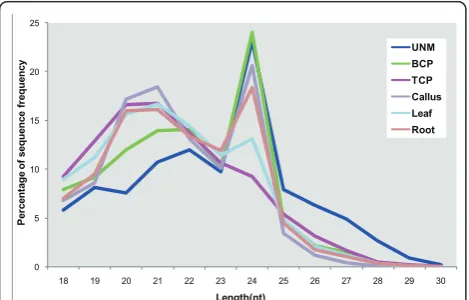
Of the millions of high-quality small RNAs from the individual libraries, 72.4% were 20 to 24 nucleotides in length, which is the typical size range for Dicer-derived products [12]. The major component of small RNAs in UNMs was 24 nucleotides long. Throughout pollen development, the proportion of 24-nucleotide small RNAs decreased and the 21-nucleotide population increased in BCP, while TCP contained mostly 21-nucleotide small RNAs (Figure 1). In the sporophytic samples, although two peaks occurred in all three libraries, 24-nucleotide small RNAs were the most abun-dant in callus cells and roots, and 21-nucleotide small RNAs were the most abundant in leaves (Figure 1).
sequences corresponding to known non-coding RNAs (for example, rRNAs, tRNAs, small nuclear RNAs (snRNAs) and small nucleolar RNAs (snoRNAs); Table 1) and possibly degraded species of mRNAs. Finally, we obtained 1,825,534, 3,383,556 and 1,082,758 small RNAs from UNMs, BCP and TCP, respectively, and 3,866,888, 1,862,254 and 3,044,145 from callus cells, leaves and roots, respectively, which were candidates for identifying miRNAs (including the kn-miRs, repeat-associated small RNAs and un-annotated small RNAs in Table 1).
By mapping these candidates to their precursor sequences in the rice miRNA database available in miR-Base [16-18], we identified 292 kn-miRs in pollen and/ or sporophytic samples (Additional files 1 and 2); 202 of these kn-miRs were expressed in pollen samples, with 141 in UNMs, 152 in BCP and 143 in TCP; 281 were
expressed in sporophytic tissues, with 210 in callus cells, 239 in roots and 223 in leaves. In addition, we detected 20 conserved kn-miR families in these libraries, and 16 of the families, apart from miR394, miR395, miR398 and miR408, were sequenced in developing rice pollen (Additional files 1 and 2). Thus, to a certain extent, our sequencing depth was sufficient to reflect the expression profiles of miRNAs during pollen development, and most of the conserved miRNAs were also expressed in the developing pollen.
Recent studies have revealed that some small RNAs derived from highly repeated elements bind with differ-ent AGO proteins and are involved in important biolo-gical processes, such as chromatin maintenance and transposon control [19,20]. We used RepeatMasker soft-ware to identify small RNAs positioned at repeat loci and annotated them as repeat-associated small RNAs (Table 1). The remaining un-annotated small RNAs were further used to predict nov-miRs.
Prediction of nov-miRs
[image:3.595.59.540.100.303.2]miRNAs are derived from hairpin-like precursors, origi-nating from a single-stranded RNA transcript through sequential processing by Dicer or Dicer-like (DCL) pro-teins [21,22]. miRNA precursors have a characteristic fold-back structure, which is the primary criterion to annotate nov-miRs [23]. Therefore, we predicted nov-miRs as fol-lows. First, by folding the flanking genome sequence of the above un-annotated small RNAs, followed by analysis of structural features, we excluded small RNAs that cannot form the characteristic fold-back structure. Second, recently evolved/evolving miRNAs have a single locus in the genome [24-26], so small RNAs with multiple loci in
Table 1 Statistics of small RNA sequences from the individual libraries
UNM (%) BCP (%) TCP (%) Callus (%) Leaf (%) Root (%)
Total reads 6,450,464 (100) 13,497,446 (100) 14,952,272 (100) 14,009,265 (100) 13,636,372 (100) 12,663,429 (100)
High quality readsa 5,982,567
(92.75) 12,037,307 (89.18) 13,573,834 (90.78) 12,447,058 (88.85) 12,323,660 (90.37) 11,328,710 (89.46) Sequences of 18 to 30 nucleotidesa 5,513,740
(85.48) 10,256,852 (75.99) 12,212,973 (81.68) 10,884,533 (77.70) 10,777,375 (79.03) 10,424,066 (82.32) Sequences matched to the
genomeb
4,415,708 (80.09)
8,857,467 (86.36) 10,855,875 (88.89)
9,007,545 (82.76) 9,576,588 (88.86) 8,563,670 (82.15)
rRNA etc.b 3,302,769
(59.90)
6,424,472 (62.64) 10,721,753 (87.79)
6,752,856 (62.04) 8,556,637 (79.39) 7,154,132 (68.63)
Exon_antisenseb 31,248 (0.57) 56,456 (0.55) 15,122 (0.12) 42,744 (0.39) 22,426 (0.21) 18,385 (0.18) Exon_senseb 317,700 (5.76) 343,714 (3.35) 374,377 (3.07) 144,997 (1.33) 294,639 (2.73) 164,069 (1.57) Intron_antisenseb 12,444 (0.23) 34,657 (0.34) 5,858 (0.05) 34,376 (0.32) 10,330 (0.10) 16,897 (0.16) Intron_senseb 24,045 (0.44) 13,997 (0.14) 13,105 (0.11) 42,672 (0.39) 31,089 (0.29) 26,438 (0.25)
Kn-miRsb 34,930 (0.63) 73,567 (0.72) 23,574 (0.19) 920,584 (8.46) 438,823 (4.07) 383,694 (3.68)
Repeat-associated small RNAsb 651,296 (11.81) 1,665,020 (16.23) 177,549 (1.45) 1,113,638 (10.23) 428,592 (3.98) 912,267 (8.75) Un-annotated small RNAsb 1,139,308
(20.66)
1,644,969 (16.04) 881,635 (7.22) 1,832,666 (16.84) 994,839 (9.23) 1,748,184 (16.77)
a
The percentage to the total reads.b
The percentage to the sequences of 18 to 30 nucleotides.
0 5 10 15 20 25
18 19 20 21 22 23 24 25 26 27 28 29 30
P er ce n ta ge of s eque nc e fr eq ue nc y Length(nt) UNM BCP TCP Callus Leaf Root
[image:3.595.57.292.550.700.2]the rice genome were excluded. Third, to minimize noise, we also eliminated small RNAs of low abundance (with total number of reads fewer than five) and those originat-ing from both strands, which would generate siRNA-like small RNAs. Fourth, all the remaining un-annotated small RNA sequences were subjected to ‘MIREAP’, which recovers most kn-miRs with only a few exceptions whose structures cannot satisfy the common features of an miRNA gene [27]. Finally, to distinguish miRNAs from miniature inverted repeat transposable elements (MITEs), we blasted the precursor and mature sequences of the small RNAs with characteristic fold-back structure against theOryza Repeat Database [28], and the homologs of repetitive sequences were discarded. From the above ana-lyses, our predicated nov-miRs satisfied the following cri-teria: precursors had a characteristic fold-back structure, contained no repetitive sequences, and matched the gen-ome only once, and most were located in the intergenic region; lengths of mature miRNA ranged from 20 to 24 nucleotides, and the number of reads was greater than five; the mature sequences could be sequenced in two or more libraries, or the miRNA* sequence could be identi-fied in at least one library; and the targets of predicted miRNAs could be predicted using an upgraded version of miRU [29].
In total, we obtained 75 predicted nov-miRs (Addi-tional file 3). Of these, 30 were expressed in UNMs, 39 in BCP, and 18 in TCP, and only 14, 18 and 12 in callus cells, leaves and roots, respectively (Additional file 4). Compared with the increased number of kn-miRs expressed in sporophytic tissues, more nov-miRs were identified in developing rice pollen, so more miRNAs still remain to be revealed in gametophytes.
Expression profiles of miRNAs during pollen development
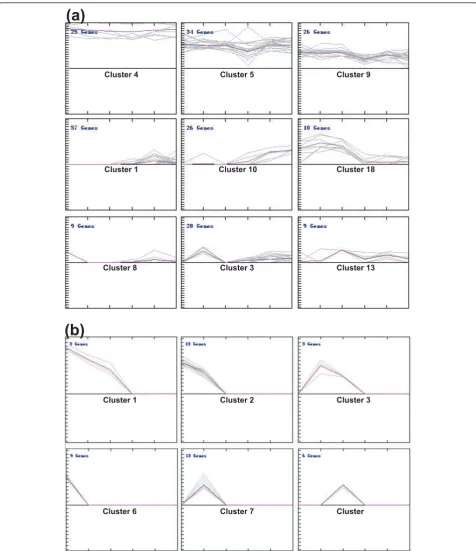
To directly compare the expression patterns of these miR-NAs in the developing pollen and in sporophytes, we nor-malized the counts to 1 million, and the abundance of each miRNA was expressed as transcripts per million (TPM). Using Z-score transformation [5], with ratio > 2.0 and Z-score > 2.0 cutoffs, we identified 103 kn-miRs expressed preferentially in developing pollen and 122 pre-ferentially in sporophytic tissues (Additional file 1). Clus-tering analysis revealed a high proportion of kn-miRs expressed constitutively in all samples (clusters 4, 5 and 9 in Figure 2a) or preferentially in sporophytic tissues (clus-ters 1 and 10 in Figure 2a), and most of the conserved kn-miRs were in these clusters (Additional file 1). However, this analysis also showed some kn-miRs accumulated to a large extent in developing rice pollen or at individual stages of pollen development. For example, the members of clusters 8, 3 and 13 (Figure 2a) displayed UNM-, BCP-and TCP-enriched expression, respectively; BCP-and those in cluster 18 (Figure 2a) accumulated to a greater extent in
pollen than in sporophytic tissues. Moreover, some conserved kn-miRs, such as osa-miR160e, osa-miR162b, osa-miR169e and n/o, osa-miR171a, osa-miR396a/b and osa-miR399h, were also present in pollen-enriched clusters (Additional file 1).
The expression features of these nov-miRs differ from those of kn-miRs (Additional files 5 and 6). More than half of the nov-miRs were expressed only in pollen libraries and some of them only in one pollen library (clusters 1 to 3 and 6 to 8 in Figure 2b). Nov-miRs in clusters 6, 7 and 8 (Figure 2b) displayed UNM-, BCP-and TCP-specific expression, respectively. These should represent a set of pollen-or stage-specific miRNAs. Therefore, in contrast to more kn-miRs being expressed constitutively or preferentially in sporophytic tissues, more nov-miRs were expressed preferentially and even specifically in pollen.
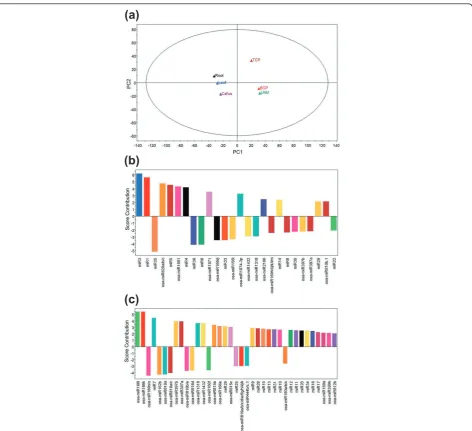
Furthermore, we compared the expression profiles of all miRNAs identified in pollen and sporophytic tissues using principal component analysis. The six samples were clustered into two groups (Figure 3a) that sepa-rated pollen from sporophytic tissues. As shown in the score contribution plot (Figure 3b), nov-miRs and non-conserved kn-miRs were the major contributors for dif-ferentiating the pollen from the sporophytes with regard to miRNA regulation. The miRNAs represented by the positive bars (Figure 3b; including miR3, miR1, miR5, miR4, miR14, miR29 and osa-miR820, osa-miR1881, miR1871, miR1874-3p, miR2106, and osa-miR810b.1) contributed to pollen properties, while the negative-score miRNAs (Figure 3b; including miR35, miR36, miR6, miR8, miR30, miR22 and osa-miR166i/j, osa-miR156l, osa-miR1432, osa-miR1318, osa-miR169h-m, and osa-miR397a and b) contributed to sporophyte properties. Among the developing pollen samples, BCP was clustered with UNMs instead of TCP, which indi-cates that BCP is more similar to UNMs with regard to expression pattern of miRNAs. Also, miRNAs enriched in UNMs and BCP represented by the positive bars and miRNAs enriched in TCP represented by the negative bars (Figure 3c) might help to discriminate UNMs and BCP from TCP.
Cluster 4 Cluster 5 Cluster 9
Cluster 1 Cluster 10 Cluster 18
Cluster 8 Cluster 3 Cluster 13
Cluster 1 Cluster 2 Cluster 3
Cluster 6 Cluster 7 Cluster
(a)
[image:5.595.59.536.87.639.2](b)
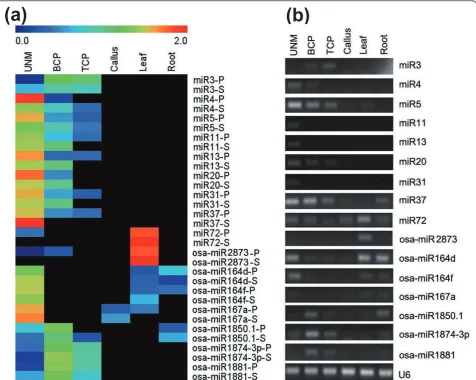
high confirmation rate indicates the reliability of our data and that our computational filters were strict enough for predicting nov-miRs.
Target prediction and function analysis
Finding regulatory mRNA targets is essential for under-standing the biological functions of miRNAs. We predicted targets of all identified miRNAs using the psRNATarget web service [29] and found 1,068 targets for 292 kn-miRs (Additional file 8a) and 285 targets for 75 nov-miRs (Addi-tional file 8b). In total, we predicted 1,353 genes possibly targeted by the identified 367 miRNAs, with an average of
3.7 targets per miRNA, and each kn-miR (292 versus 1,068 targets) and nov-miR (75 versus 285) appeared to have similar numbers of targets on average.
[image:6.595.65.538.86.517.2]enriched kn-miRs revealed terms related to transcription regulation, transcription factor activity and metabolic regulation that were all statistically significant (false discovery rateP< 0.01; Additional file 9). However, hor-mone-signaling-related genes were overrepresented in pollen-enriched kn-miR targets, whereas lignin metabo-lism-related genes were overrepresented in sporophyte-enriched kn-miR targets (Additional file 9).
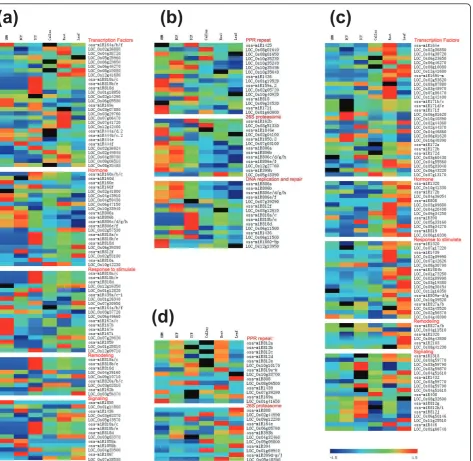
Furthermore, we compared the expression profiles of miRNAs and their targets using recently published tran-scriptome data for developing rice pollen [5] and found that the expression profiles of most of the kn-miRs were negatively correlated with those of their targets (Addi-tional file 10a). In accordance with this result, the expression of most pollen-enriched kn-miRs was nega-tively related to that of their targets involved in tran-scription, hormone regulation, chromatin remodeling
and defense response (Figure 5a), but the expression of about 30% of genes involved in these functions was positively related to their corresponding kn-miRs enriched in sporophytes (Figure 5c). Among targets involved in encoding pentatricopeptide repeat (PPR)-containing proteins and ubiquitin system members and in DNA repair, the expression of about 30% of them was positively correlated with that of corresponding pol-len-enriched kn-miRs (Figure 5b), but the expression of almost all genes involved in these terms was negatively related to that of their sporophyte-enriched kn-miRs (Figure 5d). These data demonstrate the differential cor-relation of expression profiles of sporophyte-enriched and pollen-enriched kn-miRs with their targets for sev-eral GO terms.
However, targets of the nov-miRs were more versatile, with very few transcription factors but more
[image:7.595.61.538.89.469.2](a) (b)
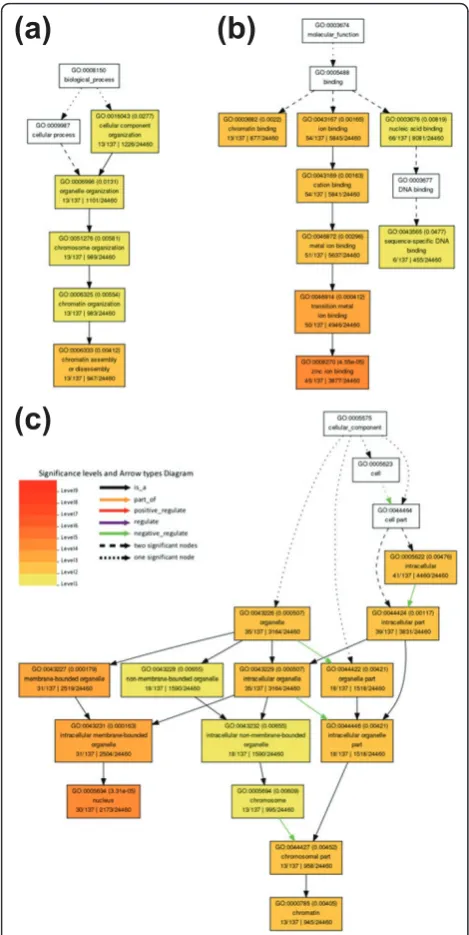
transposable elements and functionally unknown tran-scripts (Additional file 8b) in contrast to the functional terms of targets of kn-miRs (Additional file 8a). Further-more, the expression of most nov-miRs was negatively associated with that of their targets (Additional file 10b); the expression of only a small proportion positively cor-related with that of their targets. Statistical analysis of GO terms demonstrated that terms related to chromatin assembly and disassembly were significant for targets of BCP-expressed nov-miRs (Figure 6), but there were no
significant GO terms associated with targets of UNM-and TCP-expressed nov-miRs. This finding suggests that pollen-expressed nov-miRs may have different roles from pollen-expressed kn-miRs in developing pollen.
miRNA-induced cleavage of predicted targets
Our observation that most of nov-miRs and their targets had negatively correlated expression (Additional file 10b) implies that these nov-miRs have potential cleavage activity. To validate the cleavage events of nov-miRs, we
(a) (b) (c)
[image:8.595.67.541.86.547.2](d)
amplified their predicted target genes using rapid ampli-fication of 5’cDNA ends (5’RACE).
miR52, whose pre-miRNA sequence could form a characteristic fold-back structure and produced the complementary miRNA* sequence, was capable of
cleaving its target Os03g19480(encoding polycomb pro-tein EZ3, namelyOsiEZ1/OsSET1; see Discussion; Figure 7). Among ten sequenced clones (Figure 7c), eight were detected to have the target sequence in their coding sequence and were cleaved between nucleotides 10 and 11 relative to the 5’end of the complementary miR52 (Figure 7b). Transient co-expression of miR52 and OsSET1 in Nicotiana benthamianaleaves showed that the level ofOsSET1was reduced by miR52 (Figure 7d).
Although, to date, the canonical cleavage site of almost all of the kn-miRs was between nucleotides 10 and 11, we unexpectedly found that miR56 and miR58 cleaved targets with high frequency (10 of 10 for miR56, 5 of 16 for miR58) between nucleotides 18 and 19 and 5 and 6, respectively (Additional file 11). These cleavage events were validated by transient co-expression in N. benthamianaleaves (Additional file 11). Furthermore, cleavage of the non-conserved kn-miR osa-miR820 occurred primarily at the canonical position with a fre-quency of nine out of ten in a cDNA pool from seedling and inflorescence [31] or seven out of eight in a mixture of cDNA from panicle and embryogenic calli [32] but infrequently (one of ten) between nucleotides 11 and 12 from the complementary 5’ end of osa-miR820 [31]. However, we found that osa-miR820-mediated cleavage ofOs03g02010was predominantly at nucleotide 7 from the paired 3’end (5 of 14) from the mixed cDNA pool from developmental pollen, and no other degradation fragments were detected with the targeted sequence (data not show). As indicated in a study ofArabidopsis, the cleavage frequency and cleavage sites of targets for several conserved kn-miRs differed between pollen and
(a) (b)
[image:9.595.56.291.88.556.2](c)
Figure 6Gene Ontology term‘enrichment status’for targets of BCP-expressed nov-miRs.(a-c)Targets with GO term‘enrichment status’and‘hierarchy’for (a) biological process, (b) molecular function and (c) cellular component branches. The classification terms and their serial numbers are represented as boxes. For significant terms, the box includes the GO term, adjustedP-value (in parentheses), item number mapping the GO term in the query list and background, and total number of items in the query list and background. The color scale shows theP-value cutoff levels for each biological process; the more statistically significant, the darker and redder the color.
(a)
(b)
[image:9.595.305.539.503.664.2](c) (d)
Figure 7Target cleavage validation of miRNA52.(a)The miRNA hairpin of miR52 shown in bracket notation format. Mature miRNA is in red and miRNA* in blue.(b)Cleavage pattern ofOsSET1by miR52.(c)Gel image showing 5’RACE reaction to detect the miRNA-directed cleavage.(d)Transient co-expression of miR52 and
vegetative tissues [9], which suggests that the differences might account for subtle regulatory mechanism.
Recently developed degradome sequencing is a useful and powerful tool to discover new targets for conserved and non-conserved miRNAs and to validate putative targets of predicted nov-miRs [33-37]. We searched degradome data for 3-week-old seedlings and young inflorescences of rice [36,37] and starBase (sRNA target Base) [38] to identify the cleavage products of nov-miRs. From the degradome data, we found eight predicted targets with only one count each for eight different nov-miRs (Additional file 12), and from starBase, three predicted target fragments for three differ-ent nov-miRs were iddiffer-entified. Among the eleven nov-miRs, three were expressed only in sporophytic tissues and eight were enriched in developing pollen (two in UNMs, two in TCP) or in two successive stages (two in UNMs and BCP), or in both sporophytic tissues and pollen (two of five exam-ined samples except TCP) (Additional file 12). Because of the extremely low frequency of degradation products of the targets mentioned above, detecting them by 5’RACE is almost impossible; indeed, we detected no products for them.
Discussion
Using next-generation high-throughout sequencing tech-nology, we have analyzed small RNAs in developing rice pollen from the UNM to TCP stages at the genome-wide level. This analysis revealed dynamic features of small RNA populations in the developing pollen and expression patterns of pollen-expressed miRNAs. We also revealed a set of target genes of pollen-expressed miRNAs and the possible relationship between pollen-expressed miRNAs and their targets by analysis of their expression patterns. These results provide novel insights into molecular regula-tion mediated by miRNAs of pollen development.
Dynamic changes in small RNA populations in developing pollen
In plants, transcriptional and post-transcriptional gene silencing is directed by genome-encoded 21-to 24-nucleotide small RNAs. miRNAs of 21 24-nucleotides and trans-acting siRNAs of 21 nucleotides function in post-transcriptional gene silencing by guiding mRNA degra-dation or translational repression [1,39-41]. siRNAs of 24 nucleotides are implicated in DNA and histone mod-ifications leading to transcriptional gene silencing [40-43], and 24-nucleotide miRNAs involved in DNA methylation were also reported recently [44]. Recent studies have revealed that the size distribution of small RNAs is tissue-specific in maize [45]. Mature pollen of Arabidopsisloses most 24-nucleotide siRNAs and gains some 21-nucleotide siRNAs, which target silencing in the pollen [7]. Using high-throughout Solexa
sequencing, we obtained more than 5 million high-qual-ity small RNAs from pollen samples at three develop-mental stages and from sporophytic tissues. The size distribution of small RNAs varied with pollen develop-ment. The number of small RNAs of 24 nucleotides, which would be mainly siRNAs, peaked in UNMs and BCP, with more 20-and 21-nucleotide small RNAs (mainly miRNAs) in TCP (Figure 1). This finding sug-gests that the shift in small RNA populations in the developing pollen may represent a mechanism regulat-ing the gene expression program and finally pollen development. Also, transcriptional regulation would be an important mechanism in the early phase, but post-transcription regulation would be prevalent in the late phase of pollen development in rice.
Developing pollen has a unique expression pattern of miRNAs
miRNAs are a highly diverse class of small RNAs; hun-dreds of mature sequences have been registered in miR-Base [16-18]. However, almost all of them, if not all, were identified originally from sporophytes. We knew little about the miRNAs in pollen. miR164 and miR171 were first discovered to be expressed in pollen ofNicotianaby northern blot analysis [46], and miR164 was further identi-fied in pollen ofArabidopsis[47]. Recent studies of Arabi-dopsisrevealed the expression of some kn-miRs in mature pollen [11] and the expression of critical components of small RNA pathways in developing pollen [9-11]. Our study revealed 292 kn-miRs from pollen and sporophytic tissue libraries, 202 of which were expressed in developing pollen. Among the 202 pollen-expressed kn-miRs, many (103) were even pollen enriched (see Results for details). These results indicate that most of the kn-miRs originally identified from sporophytes were also expressed or even enriched in developing pollen. In contrast, most kn-miRs detected inArabidposismature pollen were in low abun-dance [11], possibly because the mature pollen is in a terminal development status ready for fertilization and needs no more miRNAs for regulation. Therefore, the existence and high expression of kn-miRs in developing rice pollen demonstrates their importance during pollen development.
both sporophytic and gametophytic development, and some have house-keeping functions in plant cells.
Although most studies focus on the more conserved and nonspecific miRNA families in plants, given the fast evolution of miRNA sequences, several studies have demonstrated the presence of recently evolved plant species-specific miRNAs [50]. Our work revealed 75 nov-miRs in the 6 libraries. Unexpectedly, more than half of these nov-miRs were expressed only in develop-ing rice pollen (clusters 1 to 3 and 6 to 8 in Figure 2b), and many (clusters 6 to 8 in Figure 2b) were detected only in pollen samples at individual developmental stages, which demonstrates the existence of pollen-spe-cific miRNAs at one or more stages, at least in rice. Vascular plants evolved increasingly complex sporo-phytes with reduced gametophyte complexity and size, and ultimately loss of independence [51], and the game-tophyte in flowering plants has been reduced to just a few cells in pollen grains. The high proportion of nov-miRs specific to pollen may be due to the need for this evolved development of the gametophyte.
Furthermore, we found differential expression of miR-NAs in developing pollen and sporophytic tissues. Prin-cipal component analysis revealed gametophytes are distinct from sporophytes with regard to the expression profiles of miRNAs, with nov-miRs and non-conserved kn-miRs as the major contributors to this distinction (Figure 3). Therefore, miRNA expression features in pol-len differ significantly from those in sporophytic tissues, which suggest a unique regulation program in develop-ing pollen. Consistent with animal sperm cells, plant gametophytes function to faithfully maintain selfish genetic information and developmental potential in establishing the subsequent generation of an individual. Several studies of mammalian organisms have demon-strated that miRNAs enriched in sperm cells are crucial for global regulation of the germ cell developmental program and for keeping selfish genetic elements under strict surveillance [52]. Together, these data demonstrate the involvement of miRNA-mediated gene expression regulation in pollen development.
Roles of miRNAs in pollen development
Post-meiotic pollen development involves a series of fine-tuned, coordinated cellular events associated with unique transcriptomic profiles, along with differential expression of a complex set of transcription factors [5,53], which indicates crucial roles of gene expression regulation in the development. Recent studies have shown the key function of small RNAs, particularly miRNAs and siRNAs, in regulating gene expression in both plant and animal species [1,3,41] and their crucial roles in regulating sperm cell development and main-taining stability of the genetic element of the cell in
mammalian organisms [52]. Many predicted targets encode transcription factors, suggesting that plant miR-NAs are master regulators. Our present work found BCP expressed more miRNAs, including known and novel miRNAs (152 kn-miRs and 39 nov-miRs) than UNMs (141 kn-miRs and 30 nov-miRs) and TCP (143 kn-miRs and 18 nov-miRs), and previous research showed that BCP expressed the smallest number of transcription factors [5], indicating that miRNAs coop-erate with transcription factors to achieve the trait of gene expression during pollen development, with BCP having the smallest number of stage-enriched transcripts during rice pollen development [5].
Furthermore, a growing number of miRNA-target pairs have been confirmed experimentally (reviewed by [3,41]) and play crucial roles in plant development. For example, overexpression of miR159 repressed mRNA levels ofMYB33 andMYB65and induced male sterility as well as delayed flowering under short days [54,55]; expression of miR167-resistantARF6 leads to arrested ovule development and indehiscent anthers [56];NAC1 -miR164 pair mediates auxin signaling in lateral root emergence [57]; TIR1, encoding an auxin receptor, and related F-box genes are regulated by miR393 [58]. Our study identified all of these miRNAs and found some of them were enriched in developing pollen (Additional file 1), and the corresponding targets have already been pre-dicted. We also found that hormone-signaling-related genes were overrepresented in a set of targets of pollen-enriched kn-miRs (Additional file 8a). Hormone signal-ing in pollen plays crucial roles in coordinatsignal-ing pollen development and maturation [59-63]. Numerous studies have revealed crucial roles of PPR proteins and F-box proteins in pollen development and the importance of chromatin remodeling and DNA repair in maintaining genetic element stability [5,64-67]. Genes associated with these functions were also predicted to be targets of pollen-enriched kn-miRs, suggesting their important roles possibly during pollen development. However, the correlation of expression profiles of pollen-enriched kn-miRs with their corresponding targets was significantly different from that of sporophyte-enriched kn-miRs with their targets (Figure 5). It is possible, therefore, that some sporophyte-originated kn-miRs have roles in dif-ferent mechanisms when expressed predif-ferentially in pollen.
processes that are tightly linked to DNA replication and transcription, thus ensuring that cells faithfully duplicate chromosomes. This process is essential for developing pollen to coordinate germ cell development and strict maintenance of genome integrity and stability.
Several mechanisms involve chromatin assembly and disassembly, including chromatin remodeling and modifi-cation of core histones or cytosines in CpG-rich regions of the genome. Recent studies revealed histone remodeling-related genes targeted by miRNAs expressed in mature pollen ofArabidopsis, such as miR778, which targets tran-scripts of two histone methyltransferase genes,SUVH5 andSUVH6 [10,68]. A gene encoding the SET domain protein OsSET1/OsiEZ1 was verified to be the target of BCP-specific miR52 and was negatively regulated by this miRNA (Figure 7). SET-domain proteins, chiefly responsi-ble for lysine methylation of histone H3, such as SDG4/ ASHR3, are involved in pollen development [69]. Further-more, our 5’RACE analysis, in combination with several previous reports [31,32,44], confirmed that osa-miR820, which is enriched in pollen, targeted a DNA cytosine methyltransferase gene (Os03g02010). Our study also revealed that osa-miR827, which is highly expressed in pollen, targetedOs04g11510, which encodes a methyl-CpG binding domain protein (Additional file 11). Both of these proteins are important to regulate the methylation of a genome [70-73]. The epigenetic modification of his-tones and cytosines in the genome of mammalian germ lines is essential for sperm cell development and plays roles in parental imprinting [74,75]. These results indicate that epigenetic regulation of chromatin assembly and dis-assembly may be an important mechanism underlying pol-len development and may involve parental imprinting. Further function studies of genes are needed to clarify these roles.
Conclusions
Using Solexa high-throughout sequencing technology, we sequenced the small RNA population of rice pollen at three sequential developmental stages from microspores to tricellular pollen, with sporophytic tissues-roots, leaves, and callus cells-as controls. We obtained millions of high-quality readouts from each sample and identified 292 kn-miRs and 75 nov-miRs. The miRNA composition and expression pattern of developing pollen were obviously different from those of sporophytes, with more nov-miRs enriched/specifically expressed in pollen while more kn-miRs were enriched/specifically expressed in sporophytes. Principal component analysis revealed that pollen could be differentiated from sporophytes with regard to miRNA expression profiles, with novel and non-conserved known miRNAs the main contributors to this. Furthermore, 1,068 targets were predicted for 292 known miRNAs; although no obvious differences were
found by GO abundance analysis of those targets between pollen-enriched and sporophyte-enriched kn-miRs, correlation of expression profiles of pollen-enriched kn-miRs with their targets significantly differs from that of sporophyte-enriched kn-miRs with their cor-responding targets in terms of transcription, hormone signaling and chromatin remodeling. We identified 285 targets for the 75 nov-miRs, which appeared to be nega-tively regulated. GO terms for chromatin assembly and disassembly were statistically significantly associated with the targets of BCP-expressed nov-miRs, implying that BCP would be the key point of miRNA regulation. Our data reveal for the first time comprehensive and dynamic features of miRNAs in developing pollen.
Materials and methods
Plant materials
Rice cultivar Zhonghua 10 (O. sativaL. ssp. japonica) was planted in a climate chamber under a 12-hour light/12-hour dark cycle at 28°C for 2 weeks, then the roots and leaves were collected. One-month-old callus cells were generated from rice embryos on N6 solid medium containing 2, 4-Dichlorophenoxyacetic acid (2 mg/l) in the dark at 25°C. Pollen at UNM, BCP and TCP stages was obtained as described previously [5].
Small RNA extraction
Total RNA was extracted from sporophytic tissues and pollen at each developmental stage by use of RNAplant reagents (Tiangen Biotech, Beijing, China) according to the manufacturer’s instructions. Total RNA was resolved on a denatured 15% polyacrylamide gel, then the frac-tion from 18 to 30 nucleotides was collected.
Solexa sequencing
The sequencing was performed as described [76]. In brief, purified small RNA molecules were ligated to a pair of Solexa adaptors at the 5’and 3’ends and ampli-fied by use of adaptor primers for 15 cycles to produce sequencing libraries. PCR products were purified and small RNA libraries were sequenced by use of Solexa.
Computational analysis of sequencing data
were considered for subsequent analyses. Sequences matching known rice rRNAs, tRNAs, snRNAs and snoR-NAs in the Rfam RNA family database [79-81] and NCBI GenBank database [82] were discarded. With the available annotation of repeat sequences in the rice genome (TIGR OryzaRepeat Database version 3.3) and use of a parallel overlap finding algorithm, small RNAs positioned at repeat loci were identified and annotated as repeat-associated small RNAs. Degraded species of mRNAs can also be sampled out by Solexa technology, and sequences overlap-ping with gene regions were excluded.
Sequences mapped to miRNA precursors found by BLAST search of the miRBase miRNA Database (v16.0) [16-18] were identified as kn-miRs, with a manual check to delete the false miRNAs. miRNA precursors have a charac-teristic fold-back structure, which can be used to predict nov-miRs. By folding the flanking genome sequence of small RNAs, then analyzing its structural features, we could identify novel miRNA candidates by use of MIREAP [27]. Good candidate sequences were then submitted to a target prediction web server containing plant miRNAs [29].
Principal component analysis of miRNAs
The normalized reads (TPM) of all miRNAs detected and predicted in this study were transformed with use of the log2 scale and analyzed by SIMCA-P+ 12.0 with PCA-X (Ctr scaling) following the PLS-DA model to obtain the principal components. miRNAs with a score contribution more than the absolute value of 2 were illustrated by comparing different samples or tissue types.
Quantitative RT-PCR of miRNAs
Total RNA was isolated from pollen at each developmen-tal stage and from sporophytic tissues. To prepare small RNA, 0.5 M NaCl and 5% PEG8000 were used to precipi-tate and remove high-molecular-weight RNA. Small RNA in the resulting supernatant was pelleted with a 1/ 10 volume of 3 M sodium acetate and 3 volumes of etha-nol [36]. The concentration of small RNAs was deter-mined by use of the Beckman Coulter DU730 Nucleic Acid/Protein Analyzer (Fullerton, CA, USA). cDNA was synthesized in a 10-μl reverse transcription (RT) reaction using of 100 ng purified small RNA, 1 U ReverTra Ace reverse transcriptase (Toyobo, Osaka, Japan), 2μl of 5 × RT buffer, 1 mM dNTPs and 2.4 U Ribnuclease inhibitor (TAKARA SHIZU CO., LTD, Tokyo, Japan), and 50 nM miRNA-specific stem-loop primers (Additional file 13) designed according to Chenet al. [83]. U6 snRNA was chosen as a reference and was reverse-transcribed with reverse primer OsU6R [84,85]. A pulsed RT procedure was used to increase the reaction specification [86]. In brief, the RT reaction mixture was incubated at 16°C for 30 minutes, then 60 cycles for 30 s at 30°C, 30 s at 42°C, and 1 s at 50°C, finally at 95°C for 5 minutes. No RNA or
RT primers or RT controls were set at the same time. SYBR®Green Realtime PCR Master Mix (Toyobo) was used to detect miRNA expression by a Stratagene Max 3000p Detection System (La Jolla, CA, USA). Briefly, cDNAs were diluted 5 times and 1μl diluted product was used as a template in a 10-μl PCR reaction, which contained 5μl 2 × SYBR Green Realtime PCR Master Mix and 0.25μM of an miRNA-specific forward primer and universal reverse primer. The quantitative PCR was conducted in duplicate for 90 s at 95°C, then 40 cycles of 15 s at 95°C and 10 s at 60°C. For each PCR, dissociation curve analysis was carried out to discriminate the specific products from the primer dimers. The fold changes of miRNA in different samples were calculated by the 2Δ ΔCt
method as described [5].
5’RACE of miRNA cleavage
Total RNA (1μg) from pollen of equally mixed UNMs, BCP and TCP was used to synthesize 5’-RACE-ready cDNAs with N-15 random primer mix and BD Smart RACE cDNA Amplification Kit (Clontech, Palo Alto, CA, USA) according to the manufacturer’s instruction. The first round of PCR involved 10 × UPM, outer gene-specific primers and Advantage 2 Polymerase Mix (Clontech). The product was diluted 50 times and then used as a template for the second round of PCR, which involved NUP and outer/inner gene-specific primers. Amplicons were sepa-rated on the gel, cloned into pMD 19-T vector (Takara) and sequenced. The outer and inner gene-specific primers were listed in Additional file 13.
Transient co-expression of miRNAs and their targets in
N. benthamianaleaves
Rice genomic fragments forming fold-back structure for precursors of miR52, miR56, miR58 and osa-miR827a car-rying the miRNA and/or miRNA* duplex were amplified with the primers listed in Additional file 13 and cloned into a binary vector (pTCK303) driven by the maize ubi-quitin promoter. Their corresponding target fragments obtained with primers listed in Additional file 13 were inserted into the same vector. The plasmids carrying pre-cursors of miRNAs and targets were infiltrated with sepa-rate or mixed cells as described [37,87]. The total RNA of infiltrated leaves was isolated after 4-day growth and used to synthesize the first cDNA as templates of semi-quanti-tative real-time PCR as mentioned above.
Additional material
Additional file 1: All identified known miRNAs.
Additional file 2: Small RNA sequences perfectly matching known miRNA hairpins.
Additional file 4: All predicted novel miRNAs.
Additional file 5: Clustering of all known miRNAs by k-means support. The six points from the left to the right in the x-axis represent uninucleate microspores (UNMs), bicellular pollen (BCP), tricellular pollen (TCP), callus cell, root and leaf, respectively; the y-axis represents the log2 value of transcripts per million.
Additional file 6: Clustering of all novel miRNAs by k-means support. The six points from the left to the right in the x-axis represent UNM, BCP, TCP, callus cell, root and leaf, respectively; the y-axis represents the log2 value of transcripts per million.
Additional file 7: Validation of miRNAs by stem-loop real-time quantitative RT-PCR.
Additional file 8: Targets of all known miRNAs and novel miRNAs. (a)Kn-miRs;(b)nov-miRs.
Additional file 9: Gene ontology term‘enrichment status’for targets of pollen-enriched and sporophyte-enriched known miRNAs.
Additional file 10: Expression profiles of known miRNAs and novel miRNAs and their targets.(a)Kn-miRs and targets;(b)nov-miRs and targets.
Additional file 11: Targets cleavage by miRNAs.(a)The predicted fold-back structures of miR56 and miR58. Mature miRNA is in red.(b) Cleavage pattern of targets by corresponding novel miRNAs.(c)Gel image showing 5’RACE reaction to detect the miRNA-directed cleavage. (d)Transient co-expression of miRNAs and their predicted targets inN. benthamianaleaves. As a positive known miRNA, the co-expression of osa-miR827a and its targetLOC_Os04g11510is also shown.
Additional file 12: Predicted target fragments of novel miRNAs from degradome data.
Additional file 13: Primers used in this study.
Abbreviations
AGO: Argonaute; BCP: bicellular pollen; DCL: Dicer-like protein; GO: Gene Ontology; kn-miR: known miRNA; miRNA: microRNA; nov-miR: novel miRNA; PPR: pentatricopeptide repeat; RACE: rapid amplification of cDNA ends; RT: reverse transcription; siRNA: small interfering RNA; snRNA: small nuclear RNA; snoRNA: small nucleolar RNA; TCP: tricellular pollen; TPM: transcripts per million; UNM: uninucleate microspore.
Acknowledgements
This work was supported by grants from the Chinese Ministry of Science and Technology (number 2007CB947601) and the National Natural Science Foundation of China (numbers 30821007 and 31000605).
Author details
1Research Center for Molecular and Developmental Biology, Key Laboratory
of Photosynthesis and Environmental Molecular Physiology, Institute of Botany, Chinese Academy of Sciences, 20 Nanxincun, Xiangshan, Beijing 100093, China.2National Center for Plant Gene Research, 20 Nanxincun Xiangshan Haidianqu, Beijing 100093, China.3Graduate School of Chinese Academy of Sciences, 19A Yuquanlu Shijingshanqu, Beijing 100049, China.
Authors’contributions
TW designed the experiments and wrote the paper. LQW performed most of the experiments and data analysis, and wrote the draft of the paper. LFY carried out the real-time quantification RT-PCR, 5’RACE of miRNA cleavage and principal component analysis of miRNAs. All authors read and approved the final manuscript.
Received: 13 December 2010 Revised: 1 April 2011 Accepted: 16 June 2011 Published: 16 June 2011
References
1. Voinnet O:Origin, biogenesis, and activity of plant microRNAs.Cell2009,
136:669-687.
2. Schwach F, Moxon S, Moulton V, Dalmay T:Deciphering the diversity of small RNAs in plants: the long and short of it.Brief Funct Genomic Proteomic2009,8:472-481.
3. Jones-Rhoades MW, Bartel DP, Bartel B:MicroRNAS and their regulatory roles in plants.Annu Rev Plant Biol2006,57:19-53.
4. Borg M, Brownfield L, Twell D:Male gametophyte development: a molecular perspective.J Exp Bot2009,60:1465-1478.
5. Wei LQ, Xu WY, Deng ZY, Su Z, Xue Y, Wang T:Genome-scale analysis and comparison of gene expression profiles in developing and germinated pollen inOryza sativa.BMC Genomics2010,11:338.
6. Pina C, Pinto F, Feijo JA, Becker D Jr:Gene family analysis of the
Arabidopsispollen transcriptome reveals biological implications for cell growth, division control, and gene expression regulation.Plant Physiol
2005,138:744-756.
7. Slotkin RK, Vaughn M, Borges F, Tanurdzic M, Becker JD, Feijo JA, Martienssen RA:Epigenetic reprogramming and small RNA silencing of transposable elements in pollen.Cell2009,136:461-472.
8. Borges F, Gomes G, Gardner R, Moreno N, McCormick S, Feijo JA, Becker JD:
Comparative transcriptomics ofArabidopsissperm cells.Plant Physiol
2008,148:1168-1181.
9. Grant-Downton R, Hafidh S, Twell D, Dickinson HG:Small RNA pathways are present and functional in the angiosperm male gametophyte.Mol Plant2009,2:500-512.
10. Grant-Downton R, Trionnaire GL, Schmid R, Rodriguez-Enriquez J, Said Hafidh2 SM, Twell D, Dickinson H:MicroRNA and tasiRNA diversity in mature pollen ofArabidopsis thaliana.BMC Genomics2009,10:643. 11. Chambers C, Shuai B:Profiling microRNA expression inArabidopsispollen
using microRNA array and real-time PCR.BMC Plant Biol2009,9:87. 12. Henderson IR, Zhang XY, Lu C, Johnson L, Meyers BC, Green PJ,
Jacobsen SE:DissectingArabidopsis thalianaDICER function in small RNA processing, gene silencing and DNA methylation patterning.Nat Genet
2006,38:721-725.
13. Kato M, de Lencastre A, Pincus Z, Slack FJ:Dynamic expression of small non-coding RNAs, including novel microRNAs and piRNAs/21U-RNAs, duringCaenorhabditis elegansdevelopment.Genome Biol2009,
10:R54.
14. Reddy AM, Zheng Y, Jagadeeswaran G, Macmil SL, Graham WB, Roe BA, Desilva U, Zhang WX, Sunkar R:Cloning, characterization and expression analysis of porcine microRNAs.BMC Genomics2008,10:65.
15. Li R, Li Y, Kristiansen K, Wang J:SOAP: Short Oligonucleotide Alignment Program.Bioinformatics (Oxford)2008,24:713-714.
16. Griffiths-Jones S, Grocock RJ, van Dongen S, Bateman A, Enright AJ:
miRBase: microRNA sequences, targets and gene nomenclature.Nucleic Acids Res2006,34:D140-144.
17. Griffiths-Jones S:The microRNA registry.Nucleic Acids Res2004,32: D109-111.
18. Griffiths-Jones S, Saini HK, van Dongen S, Enright AJ:miRBase: tools for microRNA genomics.Nucleic Acids Res2008,36:D154-158.
19. Girard A, Hannon GJ:Conserved themes in small-RNA-mediated transposon control.Trends Cell Biol2008,18:136-148.
20. Aravin AA, Lagos-Quintana M, Yalcin A, Zavolan M, Marks D, Snyder B, Gaasterland T, Meyer J, Tuschl T:The small RNA profile duringDrosophila melanogasterdevelopment.Dev Cell2003,5:337-350.
21. Kurihara Y, Watanabe Y:Arabidopsismicro-RNA biogenesis through Dicer-like 1 protein functions.Proc Natl Acad Sci USA2004,101:12753-12758. 22. Reinhart BJ, Weinstein EG, Rhoades MW, Bartel B, Bartel DP:MicroRNAs in
plants.Genes Dev2002,16:1616-1626.
23. Meyers BC, Axtell MJ, Bartel B, Bartel DP, Baulcombe D, Bowman JL, Cao X, Carrington JC, Chen XM, Green PJ, Griffiths-Jones S, Jacobsen SE, Mallory AC, Martienssen RA, Poethig RS, Qi Y, Vaucheret H, Voinnet O, Watanabe Y, Weigel D, Zhu JK:Criteria for annotation of plant microRNAs.
Plant Cell2008,20:3186-3190.
24. Fahlgren N, Howell MD, Kasschau KD, Chapman EJ, Sullivan CM, Cumbie JS, Givan SA, Law TF, Grant SR, Dangl JL, Carrington JC:High-throughput sequencing ofArabidopsismicroRNAs: evidence for frequent birth and death of MIRNA genes.PLoS One2007,2:e219.
25. Sunkar R, Zhou X, Zheng Y, Zhang W, Zhu JK:Identification of novel and candidate miRNAs in rice by high throughput sequencing.BMC Plant Biol
26. Rajagopalan R, Vaucheret H, Trejo J, Bartel DP:A diverse and evolutionarily fluid set of microRNAs inArabidopsis thaliana.Genes Dev2006,
20:3407-3425.
27. Zhang G, Guo G, Hu X, Zhang Y, Li Q, Li R, Zhuang R, Lu Z, He Z, Fang X, Chen L, Tian W, Tao Y, Kristiansen K, Zhang X, Li S, Yang H, Wang J, Wang J:Deep RNA sequencing at single base-pair resolution reveals high complexity of the rice transcriptome.Genome Res2010,20:646-654. 28. Ouyang S, Buell CR:The TIGR Plant Repeat Databases: a collective
resource for the identification of repetitive sequences in plants.Nucleic Acids Res2004,32:D360-D363.
29. Zhang YJ:miRU: an automated plant miRNA target prediction server.
Nucleic Acids Res2005,33:W701-W704.
30. Mallory AC, Vaucheret H:Functions of microRNAs and related small RNAs in plants.Nat Genet2006,38:S31-S36.
31. Lu C, Jeong DH, Kulkarni K, Pillay M, Nobuta K, German R, Thatcher SR, Maher C, Zhang L, Ware D, Liu B, Cao X, Meyers BC, Green PJ: Genome-wide analysis for discovery of rice microRNAs reveals natural antisense microRNAs (nat-miRNAs).Proc Natl Acad Sci USA2008,105:4951-4956. 32. Luo YC, Zhou H, Li Y, Chen JY, Yang JH, Chen YQ, Qu LH:Rice
embryogenic calli express a unique set of microRNAs, suggesting regulatory roles of microRNAs in plant post-embryogenic development.
FEBS Lett2006,580:5111-5116.
33. German MA, Pillay M, Jeong DH, Hetawal A, Luo SJ, Janardhanan P, Kannan V, Rymarquis LA, Nobuta K, German R, German R, De Paoli E, Lu C, Schroth G, Meyers BC, Green PJ:Global identification of microRNA-target RNA pairs by parallel analysis of RNA ends.Nat Biotechnol2008,
26:941-946.
34. Addo-Quaye C, Snyder JA, Park YB, Li YF, Sunkar R, Axtell MJ:Sliced microRNA targets and precise loop-first processing of MIR319 hairpins revealed by analysis of thePhyscomitrella patensdegradome.RNA2009,
15:2112-2121.
35. Addo-Quaye C, Eshoo TW, Bartel DP, Axtell MJ:Endogenous siRNA and miRNA targets identified by sequencing of theArabidopsisdegradome.
Curr Biol2008,18:758-762.
36. Wu L, Zhang QQ, Zhou HY, Ni FR, Wu XY, Qi YJ:Rice microRNA effector complexes and targets.Plant Cell2009,21:3421-3435.
37. Li YF, Zheng Y, Addo-Quaye C, Zhang L, Saini A, Jagadeeswaran G, Axtell MJ, Zhang WX, Sunkar R:Transcriptome-wide identification of microRNA targets in rice.Plant J2010,62:742-759.
38. Yang JH, Li JH, Shao P, Zhou H, Chen YQ, Qu LH:starBase: a database for exploring microRNA-mRNA interaction maps from Argonaute CLIP-Seq and Degradome-Seq data.Nucleic Acids Res2010,39:D202-209. 39. Carthew RW, Sontheimer EJ:Origins and mechanisms of miRNAs and
siRNAs.Cell2009,136:642-655.
40. Hamilton A, Voinnet O, Chappell L, Baulcombe D:Two classes of short interfering RNA in RNA silencing.EMBO J2002,21:4671-4679.
41. Chen X:Small RNAs and their roles in plant development.Annu Rev Cell Dev Biol2009,25:21-44.
42. Zilberman D, Cao X, Jacobsen SE:ARGONAUTE4 control of locus-specific siRNA accumulation and DNA and histone methylation.Science2003,
299:716-719.
43. Chan SW, Zilberman D, Xie Z, Johansen LK, Carrington JC, Jacobsen SE:
RNA silencing genes control de novo DNA methylation.Science2004,
303:1336.
44. Wu L, Zhou HY, Zhang QQ, Zhang JG, Ni FR, Liu C, Qi YJ:DNA methylation mediated by a microRNA pathway.Mol Cell2010,38:465-475.
45. Wang X, Elling AA, Li X, Li N, Peng Z, He G, Sun H, Qi Y, Liu XS, Deng XW:
Genome-wide and organ-specific landscapes of epigenetic modifications and their relationships to mRNA and small RNA transcriptomes in maize.
Plant Cell2009,21:1053-1069.
46. Valoczi A, Varallyay E, Kauppinen S, Burgyan J, Havelda Z:Spatio-temporal accumulation of microRNAs is highly coordinated in developing plant tissues.Plant J2006,47:140-151.
47. Sieber P, Wellmer F, Gheyselinck J, Riechmann JL, Meyerowitz EM:
Redundancy and specialization among plant microRNAs: role of the MIR164 family in developmental robustness.Development2007,
134:1051-1060.
48. Zhang BH, Pan XP, Cannon CH, Cobb GP, Anderson TA:Conservation and divergence of plant microRNA genes.Plant J2006,46:243-259. 49. Zhang BH, Pan XP, Anderson TA:Identification of 188 conserved maize
microRNAs and their targets.FEBS Lett2006,580:3753-3762.
50. Morin RD, Aksay G, Dolgosheina E, Ebhardt HA, Magrini V, Mardis ER, Sahinalp SC, Unrau PJ:Comparative analysis of the small RNA transcriptomes ofPinus contortaandOryza sativa.Genome Res2008,
18:571-584.
51. Graham LK, Wilcox LW:The origin of alternation of generations in land plants: a focus on matrotrophy and hexose transport.Philos Trans R Soc Lond B Biol Sci2000,355:757-766, discussion 766-757.
52. Tang F:Small RNAs in mammalian germline: Tiny for immortal.
Differentiation2010,79:141-146.
53. Honys D, Twell D:Transcriptome analysis of haploid male gametophyte development inArabidopsis.Genome Biol2004,5:R85.
54. Achard P, Herr A, Baulcombe DC, Harberd NP:Modulation of floral development by a gibberellin-regulated microRNA.Development2004,
131:3357-3365.
55. Millar AA, Gubler F:TheArabidopsisGAMYB-like genes, MYB33 and MYB65, are microRNA-regulated genes that redundantly facilitate anther development.Plant Cell2005,17:705-721.
56. Wu MF, Tian Q, Reed JW:ArabidopsismicroRNA167 controls patterns of ARF6 and ARF8 expression, and regulates both female and male reproduction.Development2006,133:4211-4218.
57. Guo HS, Xie Q, Fei JF, Chua NH:MicroRNA directs mRNA cleavage of the transcription factor NAC1 to downregulate auxin signals forArabidopsis
lateral root development.Plant Cell2005,17:1376-1386.
58. Jones-Rhoades MW, Bartel DP:Computational identification of plant microRNAs and their targets, including a stress-induced miRNA.Mol Cell
2004,14:787-799.
59. Cecchetti V, Altamura MM, Falasca G, Costantino P, Cardarelli M:Auxin regulatesArabidopsisanther dehiscence, pollen maturation, and filament elongation.Plant Cell2008,20:1760-1774.
60. de Martinis D, Cotti G, Hekker ST, Harren FJM, Mariani C:Ethylene response to pollen tube growth inNicotiana tabacumflowers.Planta2002,
214:806-812.
61. Huang S, Cerny RE, Qi YL, Bhat D, Aydt CM, Hanson DD, Malloy KP, Ness LA:
Transgenic studies on the involvement of cytokinin and gibberellin in male development.Plant Physiol2003,131:1270-1282.
62. Park JH, Halitschke R, Kim HB, Baldwin IT, Feldmann KA, Feyereisen R:A knock-out mutation in allene oxide synthase results in male sterility and defective wound signal transduction inArabidopsisdue to a block in jasmonic acid biosynthesis.Plant J2002,31:1-12.
63. Cheng H, Song SS, Xiao LT, Soo HM, Cheng ZW, Xie DX, Peng JR:
Gibberellin acts through jasmonate to control the expression of MYB21, MYB24, and MYB57 to promote stamen filament growth inArabidopsis.
PLoS Genet2009,5:e1000440.
64. Baker SM, Bronner CE, Zhang L, Plug AW, Robatzek M, Warren G, Elliott EA, Yu JA, Ashley T, Arnheim N, Flavell RA, Liskay RM:Male-mice defective in the DNA mismatch repair gene Pms2 exhibit abnormal chromosome synapsis in meiosis.Cell1995,82:309-319.
65. Komori T, Ohta S, Murai N, Takakura Y, Kuraya Y, Suzuki S, Hiei Y, Imaseki H, Nitta N:Map-based cloning of a fertility restorer gene, Rf-1, in rice (Oryza sativaL.).Plant J2004,37:315-325.
66. Saze H, Kakutani T:Heritable epigenetic mutation of a transposon-flanked
Arabidopsisgene due to lack of the chromatin-remodeling factor DDM1.
EMBO J2007,26:3641-3652.
67. O’Toole N, Hattori M, Andres C, Iida K, Lurin C, Schmitz-Linneweber C, Sugita M, Small I:On the expansion of the pentatricopeptide repeat gene family in plants.Mol Biol Evol2008,25:1120-1128.
68. Le Trionnaire G, Twell D:Small RNAs in angiosperm gametophytes: from epigenetics to gamete development.Genes Dev2010,24:1081-1085. 69. Cartagena JA, Matsunaga S, Seki M, Kurihara D, Yokoyama M, Shinozaki K,
Fujimoto S, Azumi Y, Uchiyama S, Fukui K:TheArabidopsis SDG4
contributes to the regulation of pollen tube growth by methylation of histone H3 lysines 4 and 36 in mature pollen.Dev Biol2008,315:355-368. 70. Ito M, Koike A, Koizumi N, Sano H:Methylated DNA-binding proteins from
arabidopsis.Plant Physiol2003,133:1747-1754.
71. Zemach A, McDaniel IE, Silva P, Zilberman D:Genome-wide evolutionary analysis of eukaryotic DNA methylation.Science2010,328:916-919. 72. Lee TF, Zhai JX, Meyers BC:Conservation and divergence in eukaryotic
DNA methylation.Proc Natl Acad Sci USA2010,107:9027-9028. 73. Zemach A, Grafi G:Characterization ofArabidopsis thaliana
74. Rousseaux S, Caron C, Govin K, Lestrat C, Faure AK, Khochbin S:
Establishment of male-specific epigenetic information.Gene2005,
345:139-153.
75. Trasler JM:Epigenetics in spermatogenesis.Mol Cell Endocrinol2009,
306:33-36.
76. Liu SP, Li D, Li QB, Zhao P, Xiang ZH, Xia QY:MicroRNAs ofBombyx mori
identified by Solexa sequencing.BMC Genomics2010,11:148. 77. ArrayExpress.[http://www.ebi.ac.uk/arrayexpress/].
78. Qi X, Bao FS, Xie Z:Small RNA deep sequencing reveals role for
Arabidopsisthaliana RNA-dependent RNA polymerases in viral siRNA biogenesis.PLoS One2009,4:e4971.
79. Gardner PP, Daub J, Tate JG, Nawrocki EP, Kolbe DL, Lindgreen S, Wilkinson AC, Finn RD, Griffiths-Jones S, Eddy SR, Bateman A:Rfam: updates to the RNA families database.Nucleic Acids Res2009,37: D136-D140.
80. Griffiths-Jones S, Bateman A, Marshall M, Khanna A, Eddy SR:Rfam: an RNA family database.Nucleic Acids Res2003,31:439-441.
81. Griffiths-Jones S, Moxon S, Marshall M, Khanna A, Sr E, Bateman A:Rfam: annotating non-coding RNAs in complete genomes.Nucleic Acids Res
2005,33:D121-D124.
82. GenBank.[http://www.ncbi.nlm.nih.gov/genbank/].
83. Chen C, Ridzon DA, Broomer AJ, Zhou Z, Lee DH, Nguyen JT, Barbisin M, Xu NL, Mahuvakar VR, Andersen MR, Lao KQ, Livak KJ, Guegler KJ:Real-time quantification of microRNAs by stem-loop RT-PCR.Nucleic Acids Res2005,
33:e179.
84. Wang Q, Huang Z, Xue HL, Jin CC, Ju XL, Han JDJ, Chen YG:MicroRNA miR-24 inhibits erythropoiesis by targeting activin type I receptor ALK4.
Blood2008,111:588-595.
85. Bu Y, Lu CH, Bian CJ, Wang JH, Li J, Zhang B, Li ZY, Brewer G, Zhao RC:
Knockdown of Dicer in MCF-7 human breast carcinoma cells results in G1 arrest and increased sensitivity to cisplatin.Oncol Rep2009,21:13-17. 86. Varkonyi-Gasic E, Wu RM, Wood M, Walton EF, Hellens RP:Protocol: a
highly sensitive RT-PCR method for detection and quantification of microRNAs.Plant Methods2007,3:12.
87. Lacombe S, Nagasaki H, Santi C, Duval D, Piegu B, Bangratz M, Breitler J-C, Guiderdoni E, Brugidou C, Hirsch J, Cao X, Brice C, Panaud O, Karlowski WM, Sato Y, Echeverria M:Identification of precursor transcripts for 6 novel miRNAs expands the diversity on the genomic organisation and expression of miRNA genes in rice.BMC Plant Biol2008,8:123.
doi:10.1186/gb-2011-12-6-r53
Cite this article as:Weiet al.:Deep sequencing on genome-wide scale reveals the unique composition and expression patterns of microRNAs in developing pollen ofOryza sativa.Genome Biology201112:R53.
Submit your next manuscript to BioMed Central and take full advantage of:
• Convenient online submission
• Thorough peer review
• No space constraints or color figure charges
• Immediate publication on acceptance
• Inclusion in PubMed, CAS, Scopus and Google Scholar
• Research which is freely available for redistribution