International Journal of Emerging Technology and Advanced Engineering
Website: www.ijetae.com (ISSN 2250-2459, ISO 9001:2008 Certified Journal, Volume 5, Issue 1, January 2015)
272
Voice Controlled Smart Home
Amrutha S
1, Aravind S
2, Ansu Mathew
3, Swathy Sugathan
4, Rajasree R
5, Priyalakshmi S
61Student, Sree Buddha College of Engineering for Women, Pathanamthitta, Kerala, India 2,6Asst.Prof, Sree Buddha College of Engineering for Women, Pathanamthitta, Kerala, India
Abstract— Voice Recognition is the process in which certain words of a particular speaker will automatically recognized that are based on the information included in
individual speech waves. This paper enlightens upon the
invention as well as technological advancement in the field of voice recognition and also focuses upon different steps involved for speaker identification using MATLAB
Programming. Voice controlled wireless smart home system
has been presented for elderly and disabled people. The proposed system has two main components namely (a) voice
recognition system, and (b) wireless system. Each home load
will be having two commands ON and OFF commands. Automation of 2 loads such as fan and light has been tested by giving 4 voice commands through personal computer. When user creates his own profile and automates the load speech recognition accuracy of more than 90% is achieved. Other people who were allowed to automate the load by the user can use user profile and achieve a speech recognition accuracy of 75% in the same personal computer.
Keywords—MATLAB programming, smart home, voice recognition, wireless.
I. INTRODUCTION
Home automation is not a new concept in today‘s world, it is used to provide convenience for user to remotely control and monitor the appliances and it provides a better use of electricity. The efficient use of electricity makes the home automation to play an important role in daily life. As by the growth of PC (personal computers), internet, mobile phone and wireless technology makes it easy for a user to remotely access and controls the appliances. A lot of research has been done and many solutions have been proposed to remotely access the HOME appliances. Some of them used internet, wireless technology to communicate and control home appliances, others used Bluetooth and GSM technology for controlling the home appliances.
Generally, home automation research targeted many needs; some applications fulfill the sophisticated and luxury requirements; other focuses the special needs like elderly and the disabled etc. [2]. In such applications voice recognition technology is used such as in [3-4].
The aim of our system is to build a perfect companion for someone to be at home. Our system is a computer based system that can accept voice as well as direct commands and process them. The system provides us switching any device ON/OFF.
Wireless communication in home automation is centered on low-power RF ZigBee wireless communication modules. Voice commands and GSM messaging are to be used to control the automation of household electrical appliances.
II. LITERATURE REVIEW
Home automation is the automatic or semi-automatic control and monitoring of household appliances and residential house features like doors, gate and even the windows. This is a demonstration of how to design and build a multi-purpose wireless system that can switch OFF and ON any electrical household appliance depending on the voice produced by the user. Thoraya Obaid et al. [1] proposed a voice controlled wireless smart home system for elderly and disabled people. The proposed system has two main components namely voice recognition system, and wireless system. Lab View software has been used to implement the voice recognition system. On the other hand, ZigBee wireless modules have been used to implement the wireless system. Based on the received data at the wireless receiver associated with the appliances desired switching operations are performed. The proposed system is a low cost and low power system because ZigBee is used. Additionally the proposed system needs to be trained of voice command only once.
International Journal of Emerging Technology and Advanced Engineering
Website: www.ijetae.com (ISSN 2250-2459, ISO 9001:2008 Certified Journal, Volume 3, Issue 4, April 2013)
273
The overall system is controlled from a microphone which is connected with HM 2007 speech recognition chip. This chip sends the voice commands in binary sequence to microcontroller. The base station unit takes decision and sends the commands to remote station by ZigBee transceiver.
Khiyal et al. [6] proposed a system for controlling home appliances remotely that is useful for the people who are not at home mostly. The main objective of the system is to provide security and control the home appliances such as AC, lights and alarms. The system is implemented by SMS technology that is used to transfer data from sender to receiver over GSM network. Also Haque et al. [8] proposed a system that controls the home appliances using the personal computer. This system is developed by using the Visual Basic 6.0 as programming language and Microsoft voice engine tools for speech recognition purpose. Appliances can be either controlled by timer or by voice command.
III. PROPOSED METHOD
This method proposes a system which is capable of switching ON/OFF the electrical devices based on the speech (command). This system creates a new era in the automation system. This system integrates human-machine interface. It consists of ZigBee based remote control system that transmits the wireless signals according to the input being selected based on speech commands given by the user through PC using microphone.
A.System Model
The system model consists of the following basic components (i) automatic speech recognition system, (ii) control units, (iii) wireless system, and (iv) application and home appliances. Automatic speech recognition (ASR) system can be defined as an independent and computer‐driven transcription of spoken language that allows a computer to identify the spoken words captured from a microphone or telephone and converts it into written texts. The main components of an ASR are (i) a microphone, (ii) speech recognition software (iii) a computer.
a.Embedded section
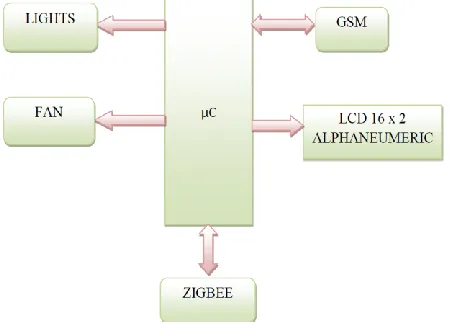
The control unit for the embedded section is any microcontroller. In this we use an ARM based LPC2148 microcontroller. Applications and home appliances are the last step of the proposed system.
[image:2.612.332.557.243.404.2]Each device connected with the network must have a switching circuit to turn it ON/OFF. The status of each device is displayed in the LCD.
Figure 1. Embedded section
b.MATLAB section
Figure 2. MATLAB section
International Journal of Emerging Technology and Advanced Engineering
Website: www.ijetae.com (ISSN 2250-2459, ISO 9001:2008 Certified Journal, Volume 3, Issue 4, April 2013)
[image:3.612.341.544.123.300.2]274
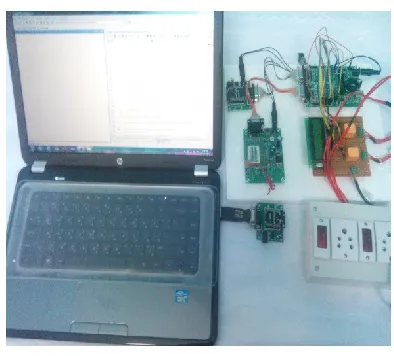
B.Hardware Design and ImplementationFigure 3. Home automation system
The system can be divided into 3 main parts: Audio processing part, Control part and Transmission part. The voice commands will first be captured and processed in MATLAB according to the voice recognition method used. After successful identification of the commands, control characters will be wirelessly sent through the ZigBee transceivers to the microcontroller, which will in turn activate the corresponding relay. As a result, home appliances could be turned on or off depending on the voice command given.
a. Audio processing part
[image:3.612.69.266.147.325.2]The voice commands will first be captured and processed in MATLAB according to the voice recognition method used. The captured the speech is compared with the previously trained words in the database and recognizes the speech using appropriate algorithm. After successful identification of the commands, control characters will be wirelessly sent through the ZigBee transceivers to the control part. The proposed system was implemented using two home loads such as light and fan. So, the database contains five words, they are fan on, fan off, light on, light off and noise. The control characters that send to control part are ‗*a‘, ‗*b‘, ‗*c‘, ‗*d‘ for fan on, fan off, light on, light off respectively. These control characters are given to the transmission part to control the home appliances.
Figure 4. Audio processing part
b. Transmission part
The ZigBee transceivers constitute the transmission part. ZigBee transmitter is connected to the audio processing part and ZigBee receiver is connected to the serial communication port of control part.
Figure 5. Transmission part
There are two different ZigBee kits one is USB compatible kit with PC and other one is RS232 protocol compatible. Using these ZigBee transceivers the control characters reaches the control part.
c. Control part
[image:3.612.367.519.376.504.2]International Journal of Emerging Technology and Advanced Engineering
Website: www.ijetae.com (ISSN 2250-2459, ISO 9001:2008 Certified Journal, Volume 3, Issue 4, April 2013)
[image:4.612.48.293.118.257.2]275
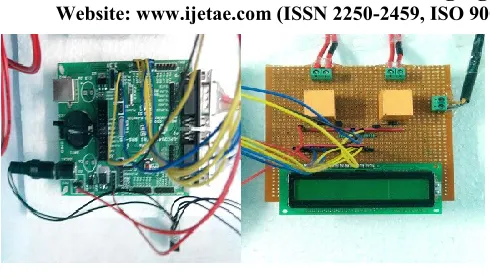
Figure 6. Control partC.Software Design
The software section includes speech recognition software design and embedded software design. Voice recognition is the technology by which sounds, phrases etc. spoken by individuals are converted into electrical signals and these signals are changed into coding patterns to which meaning is allocated. This concept could more generally be called as sound recognition or speech recognition. Human voice is mainly focused here, because we most naturally and most frequently use our voices to communicate our thoughts to others in our immediate environments. There are two major stages within isolated word recognition: a training stage and a testing stage. Training involves teaching the system by building its dictionary, an acoustic model for each word that the system needs to recognize. In the testing stage we use acoustic models of the words to recognize isolated words using a classification algorithm. The training and recognition is done with the help of MATLAB software.
The embedded software is developed with the help of keil for the ARM based LPC2148 microcontroller. The software ported in microcontroller will control the devices according to the control characters.
IV. RESULTS AND CONCLUSION
This system is very useful for the adults and physically disabled persons, who are not able to do various activities efficiently when they are at home and need one‘s assistant to perform those tasks. We used speech recognition system to implement this work. The MATLAB software has been used to implement the voice recognition system.
The main advantage of the system is that it does require training of voices for only one time. At the same time MATLAB software has been used to support human-computer interactions to realize multiple functions. The wireless part of the system has been implemented by using Zigbee RF modules. Hence, the system is highly efficient and it consumes low power. This system can be easily extended to remotely control the home appliances through smart devices like iPhone/ iPod and others phones so that one can remotely check the status of the home appliances and turn ON or OFF the same. The proposed system is for three home appliances. But, it can be easily expanded to include more home appliances.
REFERENCES
[1] Thoraya Obaid, ―Zigbee Based Voice Controlled Wireless Smart Home System,‖ International Journal of Wireless & Mobile Networks (IJWMN), Vol. 6, No. 1, February 2014.
[2] Dhawan S. Thakur and Aditi Sharma, ―Voice Recognition Wireless Home Automation System Based On Zigbee,‖ IOSR Journal of Electronics and Communication Engineering (IOSR-JECE), Volume 6, Issue 1 (May. - Jun. 2013), PP 65-75.
[3] Parameshachari B D et al, ―Study on Smart Home Control System through Speech,‖ International Journal of Computer Applications., Volume 69– No.19, May 2013.
[4] Kailash Pati Dutta, Pankaj Rai and Vineet Shekher, ―Microcontroller based voice activated wireless automation system,‖ VSRD-IJEECE, Vol2 (8), 2012, 642-649.
[5] A.J. Bernheim Brush, Bongshin Lee, Ratul Mahajan, Sharad Agrawal, Stefan Saroiu, Collin Dixon(2011), ―Home Automation in the Wild: Challenges and Opportunities,‖ Proceedings of ACM CHI Conference on Human Factors of Computing System, May 7-12, Vancouver, BC, Canada.
[6] Malik Sikandar, Hayat Khiyal, Aihab Khan, and Erum Shehzadi, ―SMS Based Wireless Home Appliance Control System (HACS) for Automating Appliances and Security,‖ Information Science and Information Technology, Vol 6, Pp. 887-894, 2009.
[7] N.P.Jawarkar, Vasif Ahmed and R.D. Thakare. ―Remote Control using Mobile through Spoken Commands,‖ IEEE - International Consortium of Stem Cell Networks (ICSCN) 2007. 22-24,Pp.622-625, 2007.
[8] S. M. Anamul Haque, S. M. Kamruzzaman and Md. Ashraful Islam, ―A System for Smart-Home Control of Appliances Based on Timer and Speech Interaction,‖ Proceedings of 4th International Conference on Electrical Engineering, pp. 128-131, January, 2006. [9]
http://www.iosrjournals.org/iosr-jece/papres/Vol6-Issue1/K0616575.pdf
International Journal of Emerging Technology and Advanced Engineering
Website: www.ijetae.com (ISSN 2250-2459, ISO 9001:2008 Certified Journal, Volume 3, Issue 4, April 2013)
276
Authors Biographies
Aravind S, Assistant professor in the Department of Electronics and Communication Engineering, Sree Buddha College of Engineering for
Women, Mahatma Gandhi
University, Kerala, India. He obtained M.Tech degree in VLSI and Embedded Systems with Distiction from Govt. College of Engineering Chengannur, Cochin University in 2012. He received his B.Tech Degree in Electronics and Communication Engineering with Distiction from the main campus of Cochin University of Science and Technology, School of Engineering, Kerala, India, in 2009. He has published eleven research papers in various International Journals.He has presented three papers in National Conferences. He has excellent and consistent academic records,very good verbal and written communication skills. He has guided nine projects for graduate engineering students and one project for P.G student .He has academic experince of 3 years and industrial experience of 1.6 years. For Post Graduate students he has handled subjects such as Electronic Design Automation Tools, VLSI Circuit Design and Technology ,Designing with Microcontrollers and Adaptive Signal Processing. He taught subjects such as Network Theory, DSP, Embedded Systems, Digital Electronics, Microcontroller and applications, Computer Organisation and Architecture , Microprocessor and applications, Microwave Engineering ,Computer Networks and VLSI for B.Tech students.
Amrutha S, pursuing final year B.Tech degree in Electronics and Communication Engineering from Mahatma Gandhi University, Kerala, India.
Ansu Mathew, pursuing final year B.Tech degree in Electronics and Communication Engineering from Mahatma Gandhi University, Kerala, India.
Rajasree R, pursuing final year B.Tech degree in Electronics and Communication Engineering from Mahatma Gandhi University, Kerala, India
Swathy Sugathan, pursuing final year B.Tech degree in Electronics and Communication Engineering from Mahatma Gandhi University, Kerala, India.
Priyalakshmi S, Assistant professo in the Department of Electronics and Communication Engineering, Sree Buddha College of Engineering for
Women, Mahatma Gandhi