International Journal of Emerging Technology and Advanced Engineering
Website: www.ijetae.com (ISSN 2250-2459,ISO 9001:2008 Certified Journal, Volume 3, Issue 9, September 2013)
575
A Rational Approach for Formulation of Maintenance Program
for Improving Road Safety Conditions
Pradeep Kumar Agarwal
1, Shivani Garg
2, Uma Bhawsar
31
Professor, 2M.Tech, Student, Department of Civil Engineering, Maulana Azad National Institute of Technology, Bhopal 462051, India
3HOD, Department of Civil Engineering, Oriental College of Technology, Bhopal & Ph.D. Scholar, Department of Civil Engineering, Maulana Azad National Institute of Technology, Bhopal 462051, India
Abstract— This study presents a rational approach for formulation of a rational maintenance program for improving road safety condition of a road network in India. Road safety conditions are degrading at an alarming rate all over the world. Poor maintenance of the roads is one of the important causes of road accidents. Hence, timely and adequate maintenance is very important for improving safety conditions of road network. However, resources available to carry out all the maintenance activities are limited. Further, a critical review of the literature indicated that there are various deficiencies in the present state of art. Most of the studies have not explicitly formulated maintenance program to improve road safety conditions. Therefore, it is required to formulate maintenance program to maximize improvement in road safety within the constraints of resource available. Thus, the scope of this study is to develop a rational approach for formulation of maintenance program for improving road safety conditions in a road network. The proposed rational approach in this study consists of four different stages i.e. stage-I is evaluation of safety hazardous condition, stage-II is determination of improvement in road safety condition, stage-III is priority determination of safety improvement and stage– IV is selection of maintenance activities. The study also identifies the deficiencies in present state of art for each of these stages. This study also presents some basic concepts so that methodology for each stage can be developed. Thus, it is expected that this study will be useful in formulating a rational maintenance program for improving safety conditions of a road network in India.
Keywords— Highway maintenance management system, road safety, maintenance activity, road network, maintenance priority.
I. INTRODUCTION
India has huge road network of 33 lakh Km. and is second largest in the world. The total road network constitutes of 200 km of Expressways, 79,243 km of National Highways, 1,31,899 km of State Highways, 4,67,763 km of Major District Roads, 26,50,000 km of Rural and Other Roads [1]. Such huge network requires proper maintenance to keep them in working condition and safe for the users.
[image:1.612.326.566.542.691.2]However, road accidents are increasing tremendously day by day and lead to various road safety problems on highways. The total of 4,40,123 road accidents occurred in India in the year 2011 [2]. More than 1.2 million people are killed in road accidents, worldwide every year– that’s around 3,000 deaths daily, 500 of them are children. Table 1 show the number of accidents occurring depending upon the type of road [3].These results in up to 3 % of Gross National Product lose in road accidents. 50 million people worldwide are believed to be injured in road crashes each year, 15 million seriously [4]. Accidents results in huge economic and social losses [5] and they are the reason for a major socio economic cost that can typically amount to 1-2% of annual Growth Domestic Product (GDP) in each country. Lack of proper and timely maintenance causes deterioration of road section condition which affects the road safety. Various road distress conditions like big potholes, shoulder drop off, absence of necessary traffic furniture etc. are affecting road safety adversely. Poor maintenance of the roads is one of the important causes of road accidents. Therefore, there is an urgent need of study in this field.
Table I
Number of accidents, persons killed & injured as per road classification in year 2011.
Road Classificat ion
National Highways
State
Highways Other Roads Number (%) Number (%) Number (%) No. of
Accidents 149,732 (30.1) 122,239 (24.6) 225,715 (45.3) No. of
Persons
Killed 52,924 (37.1) 39,033 (27.4) 50,528 (35.5) No. of
Persons
International Journal of Emerging Technology and Advanced Engineering
Website: www.ijetae.com (ISSN 2250-2459,ISO 9001:2008 Certified Journal, Volume 3, Issue 9, September 2013)
576
Substantial funds are required to maintain the road condition at minimum level of service. Mostly the funds available are not sufficient to fulfil all the requirements of maintenance and rehabilitation [6]. Due to lack of resources and fund, proper maintenance of road is not possible therefore; there is a need of a maintenance program to fulfil the demand of road maintenance according to the resources available and with concern to road safety. Thus, developing countries like India, has limitations for carrying out all the maintenance activities on its road network, so selection of activity is very crucial to achieve maximum improvement in safety conditions on the roads.Therefore the main objective of this study is to develop a rational approach for formulation of a maintenance program for improving safety condition of a road network.
This paper consists of four sections. First section introduces this study and describes the road safety scenario. Second section presents the deficiencies in literature in present state of art. Third section of the paper describes the details of the methodology proposed for formulation of a maintenance program to improve road safety. The last section presents the important conclusions drawn on the basis of study and summarizes the needs of maintenance program.
II. LITERATURE REVIEW
A critical review of literature was carried out on the various aspects for formulation of maintenance program i.e. evaluation of road section conditions, determination of priority of improvement in road safety condition, and selection of maintenance activities at different sections. The major deficiencies in present state of art are summarised as follows:
Most of the researchers have evaluated safety conditions based on number of accidents and do not consider other hazardous conditions for improving road safety like adverse geometrical condition, traffic furniture condition etc. [7]
Most of the researchers have evaluated only pavement distress condition like roughness, rut depth etc. [8]. Various other road distress conditions affecting safety like shoulder conditions, slippery surface, traffic furniture conditions etc. are not explicitly included in evaluation of road section condition.
Evaluation of road section condition is carried out using costly and complex equipments like Benkelman Beam, Dynamic cone penetrometer, Roughphometer [9]. Methodologies for evaluations of road section condition at network level are cumbersome and difficult.
There is no comprehensive methodology is available to determine priority of maintenance explicitly for improving road safety [9].
There is no analytical tool available for selection of maintenance activities for improving road safety. [10]
Maintenance activities are generally selected on the basis of maintenance cost and budget and not considering the maintenance effectiveness for improving road safety [11].
III. PROPOSED RATIONAL APPROACH
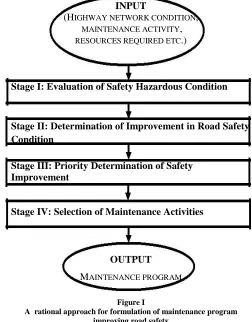
The critical review of the literature indicated that there is a need for formulation of a rational maintenance program to improve safety condition of a road network. This study developed a rational approach for formulation of the maintenance program for improving safety conditions of a road network. Figure 1 presents the rational approach for proposed methodology for maintenance program to improve safety conditions of a road section in the road network.
INPUT
(HIGHWAY NETWORK CONDITION,
MAINTENANCE ACTIVITY,
RESOURCES REQUIRED ETC.)
Stage I: Evaluation of Safety Hazardous Condition
Stage II: Determination of Improvement in Road Safety Condition
Stage III: Priority Determination of Safety Improvement
Stage IV: Selection of Maintenance Activities
OUTPUT
[image:2.612.313.565.384.706.2]MAINTENANCE PROGRAM
Figure I
International Journal of Emerging Technology and Advanced Engineering
Website: www.ijetae.com (ISSN 2250-2459,ISO 9001:2008 Certified Journal, Volume 3, Issue 9, September 2013)
577
Based on this rational approach, various stages for formulation of maintenance program are identified as:
A.Stage I: Evaluation of safety hazardous conditions of a road section
B.Stage II: Determination of improvement in road safety condition due to implementation of an activity
C.Stage III: Determination of priority of improvement in road safety condition
D.Stage IV: Selection of maintenance activities at different sections
Some basic concepts for development of each of the above stages of rational approach for formulation of maintenance program are presented in the following sub section.
A. Stage I: Evaluation of safety hazardous conditions of a road section:
Evaluation of safety hazardous conditions of a road section is the first stage in the development of the maintenance program. This stage presents the basic concepts to determine the safety condition of the road section to identify the need of maintenance to improve safety in the road section. The basic concepts to develop the methodology for evaluation of safety hazardous conditions of a road section are summarised as follows:
There is urgent need to develop a simple methodology so that basic maintenance component can be evaluated in simple manner without complex equipment and should quantify safety hazardous condition.
There is urgent need to develop a methodology for identification of basic maintenance component affecting road safety of the road section.
o The hierarchical structure needs to be developed to identify the basic maintenance component affecting road safety of the road section in the road network.
o Identification of basic maintenance component needs to be done by considering other distress conditions also such as shoulder conditions, traffic furniture conditions etc.
o To evaluate the basic maintenance component condition a simple methodology needs to be developed. Surface condition evaluation is generally done by complicated instruments such as, Benkelman beam, FWD etc.; hence there is requirement to evaluate the safety hazardous condition by simple distress parameters.
o The methodology should directly reflect the road defects and hence helps in identifying maintenance component need of safety improvement.
o
Methodology should be simple, easy and by using minimal equipment.o Methodology for evaluation of safety hazardous conditions should be easy for network level analysis.
B. Stage II: Determination of improvement in road safety condition due to implementation of an activity:
Determination of improvement in road safety condition due to implementation of an activity is the second stage in the development of the maintenance program. There is a need to develop a methodology for determining the improvement made in the road safety condition after the implementation of a maintenance activity. This stage is important to know whether the implementation of a identified maintenance activity is worthy or not with respect to improvement in safety condition of a road network. The basic concepts to develop such a methodology are summarised as follows:
o There is a need to develop a methodology for determination of the (relative importance) weight of the identified maintenance component to decide their relative importance in improving road safety.
o There is a need to develop a methodology to determine effectiveness of various maintenance measures in improving road safety.
C. Stage III: Determination of priority determination of safety improvement
:
The third stage in the formulation of the maintenance program is priority determination of safety improvement identified in earlier stages. In this stage, there is a need to develop a methodology to determine how urgently maintenance should be implemented on different road sections to improve road safety. The basic concepts to develop the methodology for determination of priority determination of safety improvement are summarised as follows:
There is a need to develop a methodology for determination of priority of different maintenance measures with special reference to improvement in safety condition in a road network. The methodology should consider safety hazardous conditions of the road section, the importance of the road sections and political preference etc.
International Journal of Emerging Technology and Advanced Engineering
Website: www.ijetae.com (ISSN 2250-2459,ISO 9001:2008 Certified Journal, Volume 3, Issue 9, September 2013)
578 There is a need to develop a hierarchical structure to
identify the priority factors that are important to decide priority of improving road safety.
There is a need to develop a methodology to determine the (relative importance) weight of the identified priority factors to decide the relative importance of various components in improving road safety.
D. Stage IV: Selection of maintenance activities
Selection of maintenance activities is the last stage in the development of the maintenance program. In this stage there is a need to develop a methodology for the selection of the maintenance activities at different sections within constraints of resources. The basic requirement of the methodology is to select the best combination of activities for different road sections with reference to their safety hazardous conditions and resources available for maintenance. The basic concepts to develop the methodology for selection of maintenance activities are summarised as follows:
Selection of maintenance activity needs to be carried out on the basis of relative improvement in safety condition of network due to an activity at section & within the constraints of resources.
o There is a need to develop an analytical tool for selection of maintenance activities to optimize improvement in safety conditions of the road network within the constraints of available resources.
It is also required to develop a methodology to determine effectiveness of maintenance program for improving safety conditions of a road network. Effectiveness of maintenance program can be determined by comparing network safety condition index before improvement and after improvement.
IV. CONCLUSIONS
The basic objective of this study is to develop a rational approach for formulation of a maintenance program for improving safety condition of a road network. Some of the important conclusions drawn on the basis of this study may be summarised as follows:
Accidents are increasing tremendously and hence decreasing the safety on road in India. Adequate and timely maintenance of the road network is required to improve the road safety conditions. Thus, there is an urgent need to develop a rational approach for formulation of a maintenance program for improving safety condition of a road network.
A critical review of the literature indicated that the safety hazardous conditions of different road sections are generally evaluated based on accident data. However comprehensive accident data is generally not available and even if it is available also it is not possible to identify preventive maintenance measures as quality of accident data is poor.
This study also proposed a rational approach for formulation of maintenance program. The rational approach for maintenance program consists of four stages i.e. evaluation of safety hazardous condition section conditions, improvement in road safety condition due to different maintenance activities, priority of improvement in road safety condition, selection of activities at different sections within constraints of resources.
Some basic concepts for development of each of the stages identified for formulation of a maintenance program for improving road safety are also presented in this study. Some of the important concepts for formulating such a maintenance program are summarized as follows:
o There is a need to develop a simple methodology to evaluate safety hazardous condition considering accident characteristics as well as other safety hazardous conditions like adverse geometrical conditions, improper furniture conditions etc.
o There is a need to develop a methodology to determine improvement in road safety condition due to implementation of a maintenance activity.
o There is a need to develop a methodology to determine priority of safety improvement considering the effectiveness of maintenance measures in improving road safety, cost of the measure and political preferences etc.
International Journal of Emerging Technology and Advanced Engineering
Website: www.ijetae.com (ISSN 2250-2459,ISO 9001:2008 Certified Journal, Volume 3, Issue 9, September 2013)
579
Thus, it is expected that this study will be useful in formulating a rational maintenance program for improving safety conditions of a road network in India.
REFERENCES
[1] NHAI (2013). National Highways Authority of India, Ministry Of Road Transport and Highways, Government of India, Indian Road Network. Available from http://www.nhai.org/roadnetwork.htm. [2] NCRB (2012). National Crime Records Bureau, Ministry of Home
Affairs, Government of India, Accidental Deaths and Suicides in India 2011. Available from http://www.ncrb.gov.in
[3] MORTH (2012). Ministry Of Road Transport and Highways, Transport Research Wing, Government of India, Road Accidents in India 2011. Available from http://www.morth.nic.in/
[4] Bhawsar, U., Agarwal, P.K., & Mehar, R. (2012). Formulation of Maintenance Program for Improving Road Safety: Needs and Basic Concepts. E-Journal, International Journal of Contemporary Practices, I (11), ISSN: 2231-5608, Vol. 1 Issue, pp. 1-11.
[5] Baguley C. (2001). Road Safety Management of the Highway Network. International Symposium on Traffic Safety Strengthening and Accident Prevention. Nanjing. China.
[6] Chakroborty P., Agarwal P.K., & Das A. (2012). Comprehensive Pavement Maintenance Strategies for Road Networks through Optimal Allocation of Resources. Transportation Planning and Technology, Vol. 35, No. 3, pp. 317-339
[7] Bandara, N., & Gunaratne, M. (2001). Current and Future Pavement Maintenance Prioritization based on Rapid Visual Condition Evaluation. Journal of Transportation Engineering, ASCE, 127 (2), pp.116-123.
[8] Kumar P., Chandra S., and Sajid M.D.A. (2010). Performance Study of PMGSY Roads. Journal of Indian Roads Congress, 72(3), The Indian Roads Congress ,New Delhi.,pp.155-168
[9] Muralikrishna ,P., & Veeraragavan A. (2011). Decision Support System for Performance based Maintenance Management of Highway Pavements. Journal of Indian Roads Congress, 72(3), New Delhi: The Indian Roads Congress, pp.155-168.
[10] MORTH (2005). Ministry Of Road Transport and Highways, Transport Research Wing, Government of India,