Cranial shape variation and phylogenetic
relationships of extinct and extant Old
World leafnosed bats
Wilson, LAB, Hand, SJ, LópezAguirre, C, Archer, M, Black, KH, Beck, RMD,
Armstrong, KN and Wroe, S
http://dx.doi.org/10.1080/03115518.2016.1196434
Title Cranial shape variation and phylogenetic relationships of extinct and extant Old World leafnosed bats
Authors Wilson, LAB, Hand, SJ, LópezAguirre, C, Archer, M, Black, KH, Beck, RMD, Armstrong, KN and Wroe, S
Type Article
URL This version is available at: http://usir.salford.ac.uk/39674/
Published Date 2016
USIR is a digital collection of the research output of the University of Salford. Where copyright permits, full text material held in the repository is made freely available online and can be read, downloaded and copied for noncommercial private study or research purposes. Please check the manuscript for any further copyright restrictions.
1
Cranial shape variation and phylogenetic relationships of
extinct and extant Old World leaf-nosed bats
LAURA A. B. WILSON, SUZANNE J. HAND, CAMILO LÓPEZ-AGUIRRE,
MICHAEL ARCHER, KAREN H. BLACK, ROBIN M. D. BECK, KYLE N.
ARMSTRONG, STEPHEN WROE
WILSON, L.A.B., HAND, S.J., LÓPEZ-AGUIRRE, C., ARCHER, M., BLACK, K.H., BECK, R.M.D., ARMSTRONG, K.N. & WROE, S., XXXX. Cranial shape variation and phylogenetic relationships of extinct and extant Old World leaf-nosed bats. Alcheringa XX XX-XX
ISSN 0311-5518
Old World leaf-nosed bats (Hipposideridae and Rhinonycteridae) currently have an Old
World tropical to subtropical distribution, with a fossil record extending back to the middle
Eocene of Europe. The Riversleigh World Heritage fossil site in northwestern Queensland
constitutes a particularly rich archive of faunal diversity for Old World leaf-nosed bats,
having yielded more than 20 species. In this paper we used 2D geometric morphometrics to
quantify cranial shape in hipposiderids and rhinonycterids, with the aim of referring
unallocated fossil species, particularly from Riversleigh, to each family within a phylogenetic
framework, and using a quantitative approach to reconstruct cranial shape for key clades in
these Old World radiations. Our sample comprised 23 extant species and eight extinct species
of hipposiderids and rhinonycterids, in which 31 landmarks were placed in lateral and ventral
2
framework for this study was based on an analysis of 64 discrete morphological characters
from the dentition, cranium and postcranium scored for 42 extant and fossil hipposiderids and
rhinonycterids and five outgroup taxa (rhinolophids and megadermatids). The phylogenetic
analysis was conducted using maximum parsimony, with relationships among selected extant
taxa constrained to match the results of recent comprehensive molecular studies. Our
phylogenetic results suggest that the Riversleigh leaf-nosed bats probably do not represent an
endemic Australian radiation, with fossil species spread throughout the tree and several with
sister-group relationships with non-Australian taxa. Discriminant analyses conducted
separately on each data set resulted in cross-validated classification success ranging from
61.9% for ventral landmarks to 71.4% for lateral landmarks. Classification of the original
grouped cases resulted in success of 81% for each data set. Of the eight fossil taxa included
as unknowns in the discriminant analyses, six were found to be assigned to the same group as
recovered by the phylogenetic analysis. From our results, we assign the Riversleigh Miocene
species Archerops annectens, Brachipposideros watsoni, Brevipalatus mcculloughi,
Rhinonicteris tedfordi and Xenorhinos halli to Rhinonycteridae, and Riversleigha williamsi
and Hipposideros bernardsigei to Hipposideridae. Our results support Pseudorhinolophus
bouziguensis, from the early Miocene of Bouzigues in southern France, as belonging to
Hipposideridae, and probably Hipposideros. The reconstructed ancestor of hipposiderids was
distinguished from the reconstructed ancestor of rhinonycterids by showing a shorter rostrum,
and less distinction between the rostrum and braincase.
Laura A.B. Wilson [[email protected]], Suzanne J. Hand [[email protected]],
Camilo López-Aguirre [[email protected]], Michael Archer
[[email protected]] andKaren H. Black [[email protected]], PANGEA
3 New South Wales, NSW 2052; Robin M.D. Beck [[email protected]], School of
Environmental & Life Sciences, University of Salford, Salford M5 4WT, UK; Kyle N.
Armstrong [[email protected]], Department of Genetics and Evolution,
School of Biological Sciences, The University of Adelaide, Adelaide, SA 5005, Australia
and South Australian Museum, North Terrace, Adelaide, SA 5000, Australia; Stephen
Wroe [[email protected]], School of Environmental and Rural Science, University of
New England, Armidale NSW 2351, Australia
Key words: Riversleigh, systematics, Hipposideridae, Rhinonycteridae, geometric
morphometrics
OLD WORLD leaf-nosed bats (65 extant spp.) have a tropical to subtropical distribution at
present, and a fossil record extending back to at least the early middle Eocene of Europe
(Remy et al. 1987, Eiting & Gunnell 2009, Maitre 2014). They generally have short, broad
wings with a low aspect (Norberg & Rayner 1987) and are slow, weaving fliers that forage
for insects near or within vegetation by hovering and gleaning, hawking from observation
perches, or by aerial pursuit (Findley 1993, Heller & Helversen 1989), although flight in
some species is swift and acrobatic (Bullen & McKenzie 2002). All have a complex noseleaf,
medium to large ears and emit their echolocation calls through the nares rather than the
mouth. Their skulls have variably expanded nasal chambers and petrosals that are associated
with energy transmission and reception (Hartley & Suthers 1988, Heller & Helversen 1989).
These bats are predominantly cave-dwellers and their fossil remains are relatively well
represented in Paleogene and Neogene cave and karst deposits (Eiting & Gunnell 2009).
Until recently, all Old World leaf-nosed bats were referred to the family Hipposideridae
4
external and cranial morphology (e.g., Gray 1866, Tate 1941, Hill 1963, 1982, Koopman
1994, McKenna & Bell 1997, Bogdanowicz & Owen 1998, Hand & Kirsch 1998, 2003,
Simmons 2005, Benda & Vallo 2009). On the basis of multi-gene molecular data, Foley et al.
(2015) recently raised the hipposiderid subtribe Rhinonycterina Gray, 1866 to family status,
assigning to it the four extant genera Rhinonicteris Gray, 1847 (Australia), Cloeotis Thomas,
1901 (Africa), Triaenops Dobson, 1871 (Africa, Madagascar) and Paratriaenops Benda &
Vallo, 2009 (Madagascar), as well as the fossil taxa Brachipposideros Sigé, 1968 and
Brevipalatus Hand & Archer, 2005. Brachipposideros species are known from lower
Miocene to Pliocene sediments in Europe, Oman, Australia and Thailand (Sigé 1968, Sigé et
al. 1982, 1994, Legendre 1982, Ziegler 1993, Mein & Ginsburg 1997, Hand 2006, 2012); the
monotypic Brevipalatus is recorded only from the early Miocene of Australia (Hand &
Archer 2005).
Fossil deposits in the Riversleigh World Heritage Area, located in Boodjamulla (Lawn
Hill) National Park (northwestern Queensland, Australia), occur mostly in limestone karst
and include tufa, cave, fissure-fill and lake deposits (Archer et al. 1989). They range in age
from late Oligocene (ca 25 Ma) to modern (Woodhead et al. 2016), and they sample
palaeohabitats ranging from open forests in the late Oligocene and late Miocene, closed
forests in the early and middle Miocene, and tropical savannah grass- and woodlands in the
Quaternary (Archer et al. 1994, Travouillon et al. 2009). A particularly rich archive of faunal
diversity for bats is present in the Riversleigh deposits: of the around 350 mammal species
represented there are 44 species of bats, and at least half of these are Old World leaf-nosed
bats (Long et al. 2002, Archer et al., 2006, Hand 2006), including, among others, species of
Rhinonicteris, Brachipposideros, Brevipalatus, and Hipposideros.
When the fossil leaf-nosed bats included in this study were described (1968–2005), all
5
their placement in various subfamilial groups and tribes, including the Rhinonycterina (e.g.,
Hand & Kirsch 2003), although several species were assigned only tentatively to these
narrower groups (e.g., Hand 1998a, b). Recognition of family status for Rhinonycteridae
(Foley et al. 2015), description of new extant and extinct leaf-nosed bat genera and species
(e.g., Benda & Vallo 2009), and a revised understanding of relationships within
Hipposideridae and Rhinonycteridae based on molecular data (e.g., Murray et al. 2012)
compels a fresh consideration of the taxonomy of Riversleigh’s fossil leaf-nosed bats.
In this study, we used 2D geometric morphometrics to quantify skull shape in Old World
leaf-nosed bats; to allocate fossil taxa to either Hipposideridae or the recently recognized
Rhinonycteridae; and to assess the utility of morphometric characters for describing and
reconstructing patterns of shape variation in these groups. Geometric morphometric
techniques, based on the analysis of landmark configurations (Bookstein 1991, Dryden &
Mardia 1998, Adams et al. 2013), have been employed to quantify shape and size in a wide
range of studies on mammals (e.g., Goswami 2006, Cardini et al. 2009, Drake & Klingenberg
2010, Wilson et al. 2011, Wilson 2013). Within the Chiroptera, several studies have
investigated patterns of shape evolution, particularly in relation to ecomorphological diversity
in phyllostomids (Nogueira et al. 2009, Monteiro & Nogueira 2010, 2011), the potential
utility of geometric morphometric variables in taxonomy when combined with genetic
markers and other character data sets (e.g., Evin et al. 2008, Sztencel-Jablonka et al. 2009),
and evolutionary changes in shape covariance patterns (Santana & Lofgren 2013,
López-Aguirre et al. 2015).
By focusing on the identification and quantification of cranial shape characteristics using
geometric morphometric methods, we aim to identify features that may guide assigning fossil
bats to Rhinonycteridae or Hipposideridae. At present, this task remains a challenge for
6
are either not observable in the fossil taxa, or else they have not yet been identified. Foley et
al. (2015) described five features of the noseleaf, and a 128bp retrotransposon insertion in the
THY gene fragment that can be used to distinguish Hipposideridae and Rhinonycteridae, but
unique and diagnostic craniodental features were not identified.
Materials and Methods
Study sample
Our morphometric sample comprised adult skulls of 21 extant and eight extinct Old World
leaf-nosed bats (seven from the Miocene of Riversleigh and Pseudorhinolophus bouziguensis
from the Miocene of Europe) and two outgroup taxa (one rhinolophid and one
megadermatid), as follows (see also Appendix A).
Hipposideridae: Anthops ornatus, Asellia tridens, Aselliscus tricuspidatus, Coelops frithi,
Hipposideros armiger, H. ater, H. bicolor, H. caffer, H. cervinus, H. commersoni, H.
diadema, H. galeritus, H. jonesi, H. megalotis, H. pomona, H. semoni, H. speoris, H. stenotis.
Rhinonycteridae: Cloeotis percivali, Paratriaenops furculus, Rhinonicteris aurantius,
Triaenops persicus. Fossil taxa: Archerops annectens, Brachipposideros watsoni,
Brevipalatus mcculloughi, H. bernardsigei, Pseudorhinolophus bouziguensis, R. tedfordi,
Riversleigha williamsi, Xenorhinos halli. Outgroups: Rhinolophus megaphyllus
(Rhinolophidae, horseshoe bats), Macroderma gigas (Megadermatidae, false vampire bats).
Data collection
Specimens were photographed in dorsal, lateral and ventral views using Canon EOS 20D (at
NHM London) and Nikon SLR F50 and DSLR D5100 (at University of New South Wales)
cameras fitted with a macro lens, mounted on a tripod. To prevent error in data collection
7
position such that the specimen was parallel to the photographic plane: this was achieved
using clay and non-invasive support (rigid foam structures).
Morphometric data were collected from raw image files using TPS Dig 2.0 (Rohlf 2010).
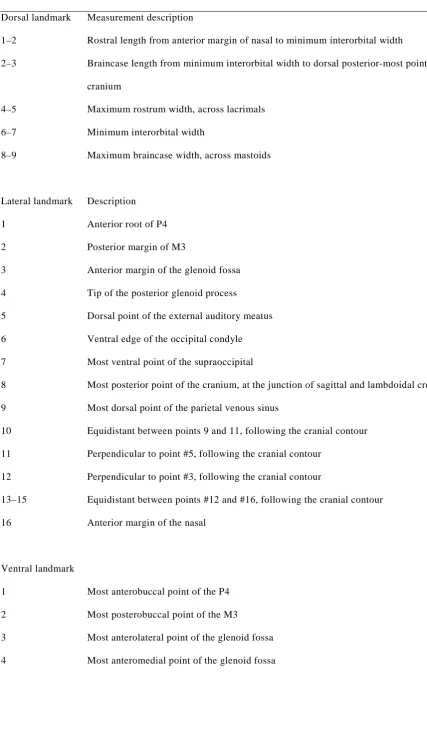
For each specimen, a total of 31 two-dimensional (2D) landmarks were placed in lateral
(N=16) and ventral (N=15) views and five measurements were collected in dorsal view (see
Fig. 1). The dorsal measurements were derived from nine landmarks (see Fig. 1). The lateral
and ventral landmarks partly followed those selected by Santana & Lofgren (2013) in their
study of rhinolophids (Table 1). Most landmarks were type II landmarks, defined by
Bookstein (1991) as curvatures and tips. Type II landmarks were chosen because, unlike
many terrestrial mammals, bats typically have few open sutures in the cranium as adults,
hindering the selection of type I landmarks. Tertiary analyses require complete matrices
without missing data, therefore a subset of landmarks were chosen that could be recorded on
all specimens. As such, several landmarks commonly captured for extant species were not
included in this study, particularly those placed on the anterior margin of the canine, and the
premaxilla, since those regions are commonly broken in fossil crania. Dorsal measurements
(see Fig. 1) follow standard metric characters (Kitchener et al. 1996) (see Table 1).
Dorsal measurements were log transformed prior to further analyses. The lateral landmark
and ventral landmark data sets were each aligned using Procrustes superimposition, which
removes non-shape differences due to rotation, translation and scale (Dryden & Mardia
1998). Centroid size (CS), the square root of the squared distance between each landmark and
the centroid of the landmark configuration and summed across all landmarks (Bookstein
1991), was extracted and saved for each landmark configuration.
In addition to the morphometric data sets, a fourth data set that built upon the
morphological character-taxon matrix of Hand & Kirsch (2003) was used to assess the likely
8
consisted of cranial, dental and postcranial morphological characters, coded in discrete states.
Characters for fossil taxa described since 2003 (Brevipalatus mcculloughi;Hand & Archer
2005) were added to the matrix, together with those from extant rhinolophid species analysed
by Foley et al. (2015). Dental terminology follows Sigé et al. (1982).
Phylogenetic analysis of character data matrix
The augmented matrix from Hand & Kirsch (2003) consisted of 64 characters scored for 47
taxa (Supplementary File S2), including outgroups Rhinolophus megaphyllus, R. euryale and
R. hipposideros and Megaderma spasma and Macroderma gigas (Supplementary File S3).
The fossil species Brachipposideros nooraleebus was included in the phylogenetic analysis
but its cranial remains were too fragmentary to include in the geometric morphometric
analyses. Using this matrix, we constrained the phylogenetic analysis using a backbone
scaffold based on the molecular results of Foley et al. (2015; Fig. 2). Analyses were carried
out using maximum parsimony with all characters unordered, as implemented in
PAUP4.01b10 (Swofford 2003); the tree search was heuristic, comprising 1000 random
addition replicates. Bootstrap values were calculated only for the purpose of providing a
preliminary indication of support for the groupings generated in the analysis. Bootstrap
values should not be interpreted in the usual way because relationships among some extant
taxa were specified a priori by the molecular scaffold.
Data analysis of lateral and ventral landmark
To examine the relationship between shape and size for the lateral and ventral landmark data
sets, a multivariate regression of Procrustes-superimposed landmarks on log centroid size was
9
of independence between shape and size. Regressions were performed using MorphoJ
(Klingenberg 2011).
Each data set was entered into a separate Principal Components Analysis (PCA) to extract
axes of maximum shape variance in the sample. The broken stick model (Jackson 1993) was
used to determine the number of Principal Components (PCs) that captured significant
proportions of the variance for each data set.To further aid visualization of shape patterns,
landmark data were mapped onto the tree derived from the phylogenetic analysis above,
which included fossil and modern representatives of all major clades and was constrained by
the molecular scaffold of Foley et al. (2015). Lateral landmark data were mapped onto the
phylogeny using squared-change parsimony (Maddison 1991), enabling ancestral shape at
internal nodes to be reconstructed. This was implemented in MorphoJ (Klingenberg 2011),
using a rooted phylogeny. Lateral landmarks were chosen because they provided a visual of
whole cranial shape in outline.
Classification of fossil taxa
Discriminant Analysis (DA) was used to classify fossil taxa. DA was performed on each data
set separately (lateral landmarks, ventral landmarks, dorsal measurements). For the lateral
landmark and ventral landmark data sets, significant PCs, according to the broken stick test
result, were used as input to the DA. For the dorsal measurements, log-transformed values
were used for the DA. In all cases, the data sets were pruned to remove the two outgroup taxa
(Rhinolophus megaphyllus and Macroderma gigas), this was because all fossil taxa were
hypothesized to belong to either Hipposideridae or Rhinonycteridae, based on results from
the phylogenetic analysis, and hence the learning sample for DA comprised only extant
members belonging to those two groups. A leave-one-out cross-validation was also
10
classified with functions created using all specimens. The cross-validation analysis removes
one specimen from the analysis sequentially and uses the remaining cases to classify that
specimen, and repeats this for all specimens.
Results
Phylogenetic analysis of character matrix
The Phylogenetic analysis, which was constrained by using a backbone scaffold based on the
molecular results of Foley et al. (2015), identified a total of 63 characters that were
parsimony informative. Constrained parsimony analysis found nine most parsimonious trees
(tree length 419 steps, CI 0.222, RI 0.561; Fig. 2). Rhinonycteridae and Hipposideridae were
both monophyletic. Relationships among hipposiderids were better resolved than among
rhinonycterids. The fossil taxa were divided between the two families: three of our eight
extinct species grouped with extant hipposiderids and five with extant rhinonycterids.
Within Hipposideridae, Pseudorhinolophus bouziguensis clustered with Hipposideros
species including H. cyclops, H. larvatus, H. armiger and H. semoni, and within the same
group Hipposideros bernardsigei formed the sister-taxon to a H. muscinus–H. wollastoni
clade. Riversleigha williamsi grouped with species of Coelops and Aselliscus, and outside the
field of most species of Hipposideros (except H. megalotis, which is sometimes referred to
the monotypic subgenus H. (syndesmois); e.g., Legendre 1982).
Within Rhinonycteridae, Archerops annectens was the sister-taxon to the extant Cloeotis
percivali, and Brevipalatus mcculloughi formed the sister-group to that clade; Xenorhinos
halli was the sister-taxon of extant Triaenops persicus and together they formed a clade with
Rhinonicteris tedfordi. The relationship between these two clades and to Brachipposideros
11
extant Paratriaenopsfurculus formed successively more distant sister-groups within
Rhinonycteridae (Fig. 2).
Morphometric analysis
Results for multivariate regression of Procrustes superimposed landmarks and log centroid
size revealed that allometry explained a small component of variation in the data sets. For
both the lateral landmark (1.33% variance, P =0.88) and ventral landmark (6.07%, P=0.15)
data sets, the relationship between shape and size was not significant.
PCA of five dorsal measurements resulted in a single axis (PC1) capturing 94.06% of the
variance in the sample (Fig. 3). This axis mainly separated fossil taxa and R. megaphyllus
from extant taxa; most notably Rhinolophusmegaphyllus and Brevipalatas mcculloughi
occupied the most negative region of PC1. PC1 was associated with positive loading for all
measurements; therefore, movement along PC1 from negative to positive scores reflected an
increase in size for each of the five measurements.
PCA of lateral landmarks resulted in three PCs that captured significant proportions of
shape variance (PC1 = 46.98%, PC2 = 16.23%, PC3 = 9.90%). A clear separation between
rhinonycterids and hipposiderids was not evident along the main axes (PC1–PC2; Fig. 4A) of
shape variation. There was some separation along PC1 (46.98%) between outgroup taxa,
whose position occupied the positive region of the axis, and rhinonycterid species, located
more towards the negative end of PC1. PC1 captured differences in shape of the rostrum,
such that outgroup taxa and others with positive PC1 scores possessed a dorso-ventrally
expanded (taller) rostrum, longer sphenorbital region (landmarks #2–4), maximum braincase
height further anterior and/or taller anterior sagittal crest, and less dorsally inflated cranium
(landmarks #8–10; Fig. 1). Species with positive scores along PC2 (16.23%) displayed a
12
sagittal crest compared with those species with negative PC2 scores (mainly fossil taxa and
rhinonycterids; Fig. 4B). There was some separation between hipposiderids, having negative
scores, and rhinonycterids, having positive scores (except Cloeotis percivali), along PC3
(9.90%). Positive scores on PC3 were associated with increased rostrum height, deeper
frontal depression, shallower braincase and more vertically orientated occiput.
The broken stick model identified PC1–PC5 as significant components for the PCA of
ventral landmarks and, together, these three axes accounted for 74.69% of shape variance in
the sample. Along PC1 (32.40%), three taxa had larger positive scores than other species:
these were Macrodermas gigas, Pseudorhinolophus bouziguensis and Hipposideros
bernardsigei. Positive scores along PC1 were associated with lengthening of the rostrum
(palate and tooth row), longer sphenorbital region (landmarks #2–3), slightly widened
glenoid fossa, and a more vertically directed foramen magnum (Fig. 5). PC2 (17.97%) mainly
separated Coelops frithi, locatedat the most extreme negative end of the axis, from other
taxa. In contrast, H. stenotis, H. armiger and H. commersoni were located at the most positive
end of PC2. Taxa at the positive end of PC2 had a longer sphenorbital region, more
posteriorly positioned and widened glenoid fossa, shortened (anteroposteriorly) occipital
region, and less medially and anteriorly expanded petrosals (Fig. 5B). Hipposiderids occupied
mainly the negative portion PC3 (10.00%) compared with fossil taxa. Hipposideros megalotis
had the most negative PC3 score, whereas Brevipalatus mcculloughi had the most positive
PC3 score. Taxa with positive PC3 scores had a widened rostrum, shortened palate and
widened glenoid fossa.
Classification of fossil taxa
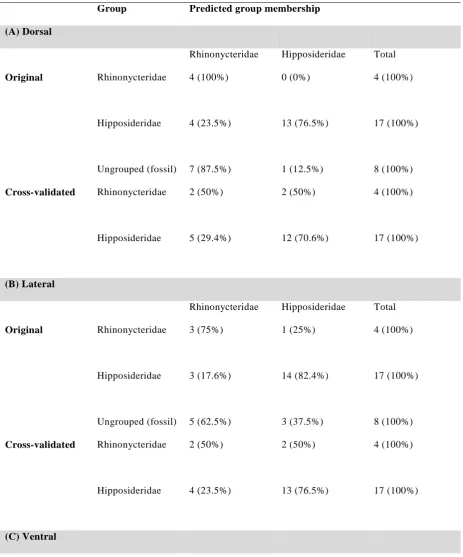
Discriminant analyses conducted separately on each data set resulted in cross-validated
13
landmarks. Classification of the original grouped cases resulted in success of 81% for each
data set (Table 2). Taxa that were misclassified varied between the data sets (Supplementary
File S1) with only Coelops frithi featuring as misclassified in more than one data set (both
lateral and ventral landmarks). All rhinonycterids were correctly classified using dorsal
measurements, whereas for the lateral landmark data set Rhinonicteris aurantia was
misclassified, and for the ventral landmarks Cloeotis percivali was misclassified. Posterior
probabilities for classification were slightly higher for dorsal measurements (p = 0.64–1.0)
than for the other two data sets (p = 0.60–0.99, lateral landmarks; p = 0.61–0.98, ventral
landmarks) (Supplementary File S1).
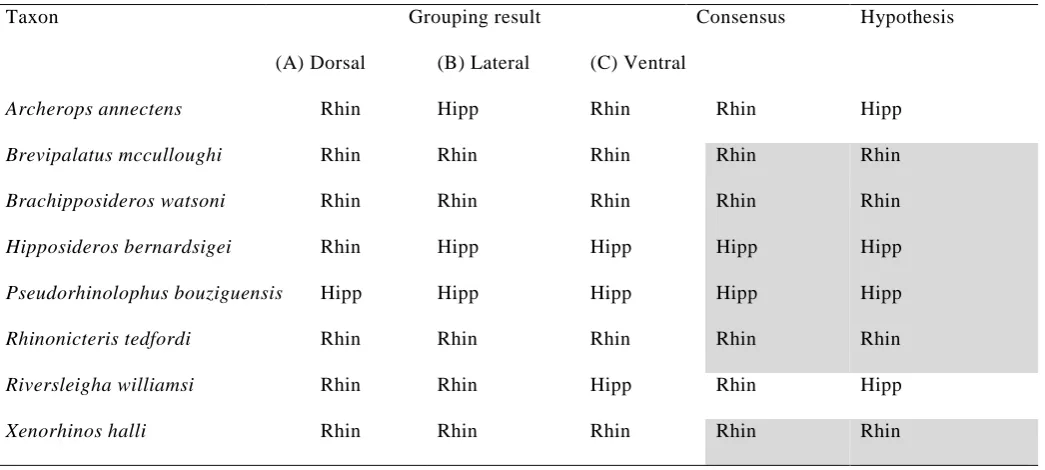
Overall, there was good agreement between the hypothesized grouping of the fossil taxa
and the group assignment recovered in this study, when taking the consensus result across the
three data sets (Table 3). Of the eight fossil taxa, six consensus group assignments were in
agreement with the hypothesized group for that taxon. Archerops annectens was classified as
a rhinonycterid by both dorsal measurements and ventral landmarks, whereas it has been
hypothesized previously to belong to the Hipposideridae (Hand & Kirsch 2003). Moreover,
Riversleigha williamsi was identified as a rhinonycterid based on discriminant analysis of
dorsal measurements and lateral landmarks, conflicting with its assignment to Hipposideridae
in our phylogenetic analysis based on discrete cranial, dental and postcranial characters (Fig.
2).
Five of the eight fossil taxa were classified as belonging to the same group by all data sets
(Table 3). The taxa with conflicting results among data sets were A. annectens, Hipposideros
bernardsigei and R. williamsi. In the case of A. annectens, which was classified as a
rhinonycterid based on discriminant analysis of dorsal measurements and ventral landmarks,
its classification as a hipposiderid using the lateral landmarks is likely reflected in that taxon
14 cervinus, H. jonesi and H. speoris. Like these taxa, and unlike most rhinonycterids, A.
annectens is characterized by a very narrow and low rostrum. In the case of H. bernardsigei,
contra the results from the other two data sets for this taxon, dorsal measurements classify it
as a rhinonycterid, sharing with definitive rhinonycterids a broad and tall rostrum; however,
this morphology is also found in some hipposiderids, such as H. semoni and Aselliscus.
Hand & Kirsch (1998) were unable to confidently place Riversleigha in their phylogenetic
analysis of leaf-nosed bats. In our GMM analysis, R. williamsi was identified as a
rhinonycterid based on dorsal measurements and lateral landmarks. This conflicts with its
placement in the Hipposideridae by our phylogenetic analysis, which places it as a close
relative of H. cervinus, H. jonesi and H. speoris that have a narrow, low rostrum (Fig. 2) and
the ventral landmark data set. In the latter, R. williamsi is located away from extant
rhinonycterids and in close proximity to several extant hipposiderids, including H. diadema,
H. armiger and H. commersoni in PC1–PC2 morphospace and H. commersoni, in PC1–PC3
morphospace. With these hipposiderid taxa, it shares a lengthened palate, lengthened
sphenorbital region, and widened glenoid fossa.
Of note, dorsal measurements classify nearly all fossil taxa (seven out of eight) as
rhinonycterid, although this assignment is not clearly reflected in the PC1–PC2 plot for the
dorsal measurements, which reveals a considerable amount of overlap in morphospace
between hipposiderids and rhinonycterids, and most fossil taxa (except Xenorhinos halli) are
located separate from the extant grouping.
Ancestral cranial shape reconstructions for major nodes in our phylogeny showed marked
shape changes occurring across the tree. For lateral landmarks, from H. bernardsigei to the
base of the hipposiderid radiation (Node a) differences in cranial shape include less
distinction between the rostrum and braincase, reflecting the absence of a frontal depression,
15 tedfordi to the base of the rhinonycterid radiation (Node b) differences in skull shape include
a longer rostrum and shorter braincase, with a lower peak or crest in the braincase anteriorly
(Fig. 6). Shape differences between the reconstructed ancestor shape of hipposiderids (Node
a) and the reconstructed ancestor shape of rhinonycterids (Node b) reflect a shorter rostrum
and less distinction between the rostrum and braincase (Fig. 6), as discussed below. For
ventral landmarks, shape changes occurring from H. bernardsigei to the base of hipposiderids
(Node a), mainly reflected a narrowing and shortening of the maxilla with a slight anterior
displacement of the pterygoid (Fig. 7). The ancestral reconstruction for ventral shape at Node
b reflected a slight extension of the maxilla, and an anterior shift of the posteromedial flange
of the basioccipital. The reconstructed ancestral shapes for hipposiderids and rhinonycterids
were highly similar, and differences were limited to a slight extension of the maxilla for the
ancestor shape of rhinonycterids (Node b) (Fig. 7).
Discussion
Geometric morphometric and phylogenetic analyses undertaken in this study have facilitated
assignment of several extinct species of Old World leaf-nosed bats, previously all referred to
family Hipposideridae sensu Miller, 1907, or to either Hipposideridae or Rhinonycteridae
sensu Foley et al. (2015). When the rhinonycterid family-group was formally elevated to
family level by Foley et al. (2015), only two fossil genera (Brachipposideros and
Brevipalatus) were included in Rhinonycteridae. Allocating all candidate fossil genera to
either of these families (and confirming the affiliations of Brachipposideros and
Brevipalatus) is made difficult owing to a lack of information about diagnostic genetic and
external morphological features in fossils, and limited diagnostic craniodental characters.
Shape analysis provides the most robust approach currently available to allocate candidate
16
results, we taxonomically assign the Riversleigh Miocene species Archerops annectens,
Brachipposideros watsoni, Brevipalatus mcculloughi, Rhinonicteris tedfordi and Xenorhinos
halli to Rhinonycteridae, and Riversleigha williamsi and Hipposideros bernardsigei to
Hipposideridae. The results support the allocation of Pseudorhinolophus bouziguensis, from
the early Miocene of Bouzigues in southern France, to Hipposideridae, and probably
Hipposideros, as originally described by Sigé (1968).
For all geometric morphometric data sets, extant hipposiderid and rhinonycterid cranial
shapes overlapped significantly in morphospace, as did fossil cranial forms. This result lends
support to the difficulty in identifying diagnostic craniodental features for Rhinonycteridae,
as encountered by Foley et al. 2015. Overlap was slightly greater for ventral landmarks,
where shape variation among rhinonycterids was completely encompassed within the
morphospace occupied by hipposiderids for the main axes of shape variance (Fig. 5A). The
more speciose hipposiderids showed greater variability in cranial shape than rhinonycterids,
as captured by lateral and ventral landmarks. Similarly, variation in dorsal measurements was
much greater among hipposiderids, but following allocation of fossil species to
Rhinonycteridae based on the classification results of the DA (Table 3), this difference was
less marked.
One of the most conspicuous features of the Hipposideridae, Rhinonycteridae and
Rhinolophidae is the inflated nasal chambers of the rostrum, and there are considerable
differences in size among the different species that mirror the remarkable diversity of form in
the noseleaf (Hill 1963, 1982, Csorba et al. 2003). There have been many studies that have
described how wing morphology and echolocation call design relate to flight space, prey
capture strategy, diet and community structure in bats (e.g., Norberg & Rayner 1987,
Kingston et al. 2000, Bullen & McKenzie 2001, Denzinger et al. 2004). However, we still
17
various parts of the vocal tract and noseleaf on echolocation signals generated by the glottis
and the ecological factors that might influence the shape and size of the echolocation
apparatus and characteristics of the signals themselves (Armstrong 2002, Jones & Barlow
2004, Armstrong & Coles 2007, Armstrong & Kerry 2011). One of the most fundamental
relationships between skull size and echolocation call frequency is known—Hartley &
Suthers (1988) discounted a role for Helmholtz resonance in the nasal chambers but also
established that the wavelength of the second harmonic of tonal components was one quarter
the length of the vocal tract (including soft tissue between the glottis and the nares; see also
Pedersen 2000). This opens the possibility for estimating echolocation call frequency in fossil
taxa from palatal lengths and, together with information on skull size and shape, could help
with reconstructions of flight space ecology, diet and community structure of extinct bat
assemblages (Hand 1998b, Hand & Kirsch 2003, Hand & Archer 2005).
Most hipposiderids and rhinolophids forage within forest habitats and their echolocation
calls are ‘clutter-resistant’ in two ways—the tonal component allows the fluttering wings of
insects to be detected in close proximity to vegetation ‘clutter’ and the longer calls
(Rhinolophidae) are resistant to the effects of emission-echo overlap (Fenton et al. 1995,
Denzinger et al. 2004). Some of the rhinonycterids, however, have been observed foraging in
more open habitats, such as hummock grasslands, and have the capability for swift and
acrobatic flight (e.g., Rhinonicteris; Churchill et al. 1988, Armstrong 2001, Bullen &
McKenzie 2002). Given the general ecology of bats in these three families, Hipposideros
bernardsigei has previously been inferred to be typical of small hipposiderids that are
specialized for foraging within and around clutter, given its small body size, markedly
enlarged petrosals (a feature of highly specialized clutter-foraging bats) and close
phylogenetic relationship to other ecologically similar species in the New Guinea-centred H.
18
grouped in all three data sets with Aselliscus, H. stenotis and H. semoni (Fig. 2). A previous
study suggested that Brevipalatus mcculloughi was an aerial insectivore specializing on
moths, on the basis of its gracile dentition, enlarged rostrum, moderately expanded petrosals
and close relationship to the extant Rhinonicteris aurantia (Hand & Archer 2005). In the
current study, by contrast, we find that Brevipalatus mcculloughi grouped with a very broad
suite of species, which differed among the three data sets, and did not reflect a clear grouping
according to similarity in feeding habit. In this case, the very short palate and relatively large
nasal inflations might simply indicate that it is one of the smaller species that emits relatively
high frequency echolocation calls, which does not always reflect phylogenetic relationships.
Riversleigha williamsi may have been a hard food specialist, perhaps including large,
armoured beetles in its diet, as suggested by its long palate, well-developed cranial crests and
large crushing teeth (Hand 1998a). Consistent with this suggestion, we find in dorsal, lateral
and ventral data sets that R. williamsi grouped closely with extant large, hard food specialists
that emit lower frequency echolocation calls and who hunt their prey from perches via a
sit-and-wait strategy (e.g., Hipposideros armiger, H. commersoni, H. diadema and Macroderma
gigas; Vaughan 1977, Thabah 2005, Churchill 2008).
The elevation of Rhinonycteridae to a distinct family by Foley et al. (2015) follows long
recognition of the morphological distinctiveness of this group (e.g., Gray 1866, Tate 1941,
Sigé 1968, Hill 1963, 1982, Koopman, 1994, McKenna & Bell 1997, Bohdanowicz & Owen
1998, Hand & Kirsch 1998, 2003, Simmons 2005, Benda & Vallo 2009). Their peculiar
noseleaf structure, tall postorbital zygomatic processes and genetic differences distinguish the
nine living rhinonycterid species from the other 56 Old World leaf-nosed bats (Hill 1982,
Hand & Kirsch 2003, Foley et al. 2015). However, these nine species have different skull
morphology and retain a dentition that appears to be essentially plesiomorphic, featuring an
19
c1 and relatively large p2 (Hand 1998 a). Rostrum and noseleaf morphology varies
considerably among rhinonycterids, and Hand (1998 b) noted that size and shape of the
rostrum did not appear to be directly correlated with noseleaf size and complexity, although
further quantitative work to systematically evaluate this relationship is needed. Our analyses
of lateral landmarks are able to detect some of the distinguishing features among
rhinonycterids, particularly rostral height, which is reflected in the main axes of shape
variance in the sample (Fig. 4). Along PC1, Africa’s Cloeotis percivali is separate from other
taxa, reflecting the very low rostrum in that species, in contrast to the Australian
Rhinonicteris aurantia, which has a tall, broad rostrum clearly distinct from a uniquely
anterior-crested braincase, and is located at the extreme positive end of PC1 occupation for
rhinonycterid, beyond Paratriaenops furculus and Triaenops persicus, both displaying
intermediate rostral height. Variation in rostrum height in the Hipposideridae ranges from
low in species of Coelops to tall in species of Aselliscus and the Hipposideros semoni group.
Investigations by the authors on the functional and evolutionary significance of the observed
morphological differences among Old World leaf-nosed bat taxa are underway.
By mapping lateral landmark data onto our phylogeny (Fig. 2) we reconstructed ancestral
shape at the base of families Hipposideridae (Node a) and Rhinonycteridae (Node b).
Attributes of the ancestral skull form for Rhinonycteridae (Fig. 6 C) include a relatively long
rostrum and tooth row (with anterior premolar P2 present), conspicuous posterior nasal
inflation, a clear distinction between rostrum and braincase with a frontal depression, steep
increase in braincase height and anteriorly tall sagittal crest, and, with respect to
hipposiderids, a more ventrally directed foramen magnum. To these features, we would add a
tall postorbital zygomatic process; this is present in most rhinonycterids we have examined,
including extinct taxa known from this region of the zygoma, but is typically broken in fossil
20
form for Hipposideridae (Fig. 6–7), with respect to rhinonycterids, include a shorter rostrum
and tooth row (P2 reduced or absent), equally inflated anterior and posterior nasal inflations,
and a gradual increase in cranial height from rostrum to braincase, with deeper interorbital
region.
The fossil species included in this study are well-dated members of their respective families.
Most were recovered from radiometrically (U–Pb) dated Riversleigh cave deposits (Woodhead
et al. 2016): Brachipposideros watsoni, Brevipalatus mcculloughi, Rhinonicteris tedfordi,
Riversleigha williamsi and Xenorhinos halli from Bitesantennary Site (17.11 +/- 0.24 Ma),
Hipposideros bernardsigei from Neville’s Garden Site (17.85 +/- 0.06 Ma, 18.24 +/- 0.27 Ma), and
Archerops annectens from AL90 Site (14.64 +/- 0.46 Ma, 14.82 +/- 0.27 Ma).
Pseudorhinolophus bouziguensis occurs in early Miocene (latest Aquitanian) sediments near
Bouzigues in Hérault, southern France (Sigé 1968), correlated in the European Neogene land
mammal chronostratigraphic scale as MN2 (ca 19 Ma; Aguilar et al. 1997). A minimum age for
the early radiation of Old World leaf-nosed bats is provided by the early middle Eocene age (ca
45 Ma) of relatively derived fossil taxa from southwestern Europe (e.g., species of
Pseudorhinolophus; Revilliod 1922, Maitre 2014). The oldest representatives of the
Rhinonycteridae are late Oligocene Brachipposideros species from France, Oman and
Riversleigh, at around 25 Ma (Sigé 1968, Sigé et al. 1994, Long et al. 2002). Analyses of
molecular data estimate the time of divergence of Old World leaf-nosed bats from rhinolophids
to be ca 39–42 Ma (Lavery et al. 2014, Foley et al. 2015), and that for the split of rhinonycterids
and hipposiderids at ca 34–39 Ma (Lavery et al. 2014, Foley et al. 2015). The base of the
modern rhinonycterid radiation has been estimated to be ca 19 Ma by Foley et al. (2015) but our
results indicate it is older, given the proposed phylogenetic position of Brachipposideros species
nested within the modern rhinonycterid clade (Fig. 2) and their appearance on three continents
21
Our phylogeny suggests that the Riversleigh leaf-nosed bats probably do not represent an
endemic Australian radiation, with fossil species spread throughout the tree and several with
sister-group relationships with non-Australian taxa (Xenorhinos–Triaenops, Archerops–
Cloeotis, Riversleigha–Aselliscus–Coelops, Hipposideros bernardsigei–muscinus–
wollastoni) (Fig. 2). The relationships of other Riversleigh taxa (e.g., species of
Brachipposideros and Rhinonicteris) to each other and to others are unresolved or appear to
be paraphyletic. Foley et al. (2015) suggested an African origin for Rhinonycteridae and
Hipposideridae, and the fossil record suggests that both families were widespread throughout
the Old World tropics and paratropics in the Paleogene and Neogene (40–15 Ma). The
disjunct distribution of modern rhinonycterids, including their absence from most of Asia and
from New Guinea, could be the result of differential extinctions, particularly given that they
are recorded from the Miocene of Thailand (Mein & Ginsberg 1997), but improved resolution
of the phylogenetic relationships of extinct and extant members is required to determine this.
Conclusions
Geometric morphometric and phylogenetic analyses carried out in this study have facilitated
assignment of several extinct species of Old World leaf-nosed bats, previously all referred to
family Hipposideridae sensu Miller, 1907, to either Hipposideridae or Rhinonycteridae sensu
Foley et al. (2015). Our results indicate that taxonomic and functional information can be
extracted from the quantification of cranial shape in Old World leaf-nosed bats. Furthermore,
insights into the magnitude and mode of variation in cranial shape in extinct species have
implications for trophic niche partitioning in palaeotropical bat communities. Particularly, we
note convergences in shape between hard-food specialists among extant species and
Riversleigh taxon Riversleigha williamsi and similarly Hipposideros bernardsigei was found
22
foraging within and around vegetation clutter. Future geometric morphometric analyses of
crania and partial crania of undescribed Riversleigh leaf-nosed species to retrieve both
taxonomic and ecomorphological data (e.g., diet, acoustics, habitat use) is underway. The
abundance and diversity of the bats that are available for quantitative analysis from the
Riversleigh deposits is expected to yield further insights into the macroevolutionary
dynamics underpinning the radiation of Old World leaf-nosed bats.
Acknowledgements
For access to specimens we thank R. Portela Miguez and P. Jenkins (NHM London); L.
Gordon (USNM), T. Ennis and S. Ingleby (AM); H. Felten and R. Rabenstein (SMF); B. Sigé
(UM), N.B. Simmons and E. Westwig (AMNH); H. Janetski (QM); and K.J. Travouillon
(WAM). We thank T. Myers and A. Gillespie (UNSW) for skilled preparation of bat skulls
collected at Riversleigh. L.A.B.W. is supported by the Australian Research Council (ARC)
Discovery Program (DE150100862). C.L.A. is supported by the COLFUTURO scholarship
program. Riversleigh fossil research is supported by ARC DP130100197, LP100200486 and
DE130100467 grants to S.J.H, M.A. and K.H.B, and R.M.D.B. by ARC DE120100957. We
thank P. Creaser and the CREATE Fund at UNSW; the Queensland Parks and Wildlife
Service; Riversleigh Society Inc.; Environment Australia; Outback at Isa; and private
supporters including K. & M. Pettit, E. Clark, M. Beavis, M. Dickson, S. Lavarack and the
Rackham family. Vital assistance in the field has come from many hundreds of volunteers as
well as staff and students of UNSW.
23
Supplementary File S1: Detailed classification results from the Discriminant Analyses
conducted on the following data sets: dorsal measurements, lateral landmarks, ventral
landmarks.
Supplementary File S2: Data matrix for PAUP analysis. Available to download from
Figshare as a nexus file. DOI: 10.6084/m9.figshare.3190114
Supplementary File S3: Characters and states used in the phylogenetic analysis of
rhinolophoid taxa. Available to download from Figshare as a nexus file. DOI:
10.6084/m9.figshare.3190117
References
ADAMS, D.C., ROHLF, F.J. & SLICE, D.E., 2013. A field comes of age: geometric morphometrics in the 21st century. Hystrix-Italian Journal of Mammalogy 24, 7–14.
AGUILAR, J.-P., ESCARGUEL, G., CROCHET, J.-Y., SIGÉ, B. & SUDRE, J., 1997. Nouveaux sites d'âges variés dans les remplissages karstiques du Miocène inférieur de Bouzigues
(Hérault, Sud de la France): Partie II: faunes 2 (rongeurs), biochronologie et corrélations.
Geobios 30 Supplement 1, 485–491.
ARCHER, M., GODTHELP, H., HAND, S.J. & MEGIRIAN, D., 1989. Preliminary overview of mammalian diversity, biostratigraphy, correlation and environmental change evidenced by
the fossil deposits of Riversleigh, northwestern Queensland, Australia. Australian
Zoologist 25, 29–64.
ARCHER, M., HAND, S.J. & GODTHELP, H., 1994. Riversleigh: The Story of Animals in the
Ancient Rainforests of Inland Australia, 2nd Edition. Reed Books, Sydney, 264 pp.
24
TRAVOUILLON K.J. & WROE, S., 2006. Current status of species-level representation in faunas from selected fossil localities in the Riversleigh World Heritage Area, northwestern
Queensland. Alcheringa Special Issue 1, 1–17.
ARMSTRONG, K.N., 2001. The roost habitat and distribution of the orange leaf-nosed bat,
Rhinonicteris aurantius, in the Pilbara region of Western Australia. Wildlife Research 28,
95–104.
ARMSTRONG, K.N., 2002. A morphometric examination of the Australian Rhinonicteris
aurantius: evidence for divergence. Australian Journal of Zoology 50, 649–669.
ARMSTRONG, K.N. & COLES, R.B., 2007. Echolocation call frequency differences between geographic isolates of Rhinonicteris aurantia (Chiroptera: Hipposideridae): implications
of nasal chamber size. Journal of Mammalogy 88, 94–104.
ARMSTRONG, K.N. & KERRY, L.J., 2011. Modelling the prey detection performance of
Rhinonicteris aurantia (Chiroptera: Hipposideridae) in different atmospheric conditions
discounts the notional role of relative humidity in adaptive evolution. Journal of
Theoretical Biology278, 44–54.
BENDA, P. & VALLO, P., 2009. Taxonomic revision of the genus Triaenops (Chiroptera: Hipposideridae) with description of a new species from southern Arabia and definitions of
a new genus and tribe. Folia Zoologica 58 (Monograph 1), 1–45.
BOGDANOWICZ, W. & OWEN, R.D., 1998. In the Minotaur's labyrinth: a phylogeny for the Hipposideridae. In Bats: Phylogeny, Morphology, Echolocation, and Conservation
Biology. KUNZ, T. H. & RACEY, P. A., eds, Smithsonian Institution Press, Washington, 27–42.
25
BULLEN, R. & MCKENZIE, N.L., 2001. Bat airframe design: flight performance, stability and control in relation to foraging ecology. Australian Journal of Zoology 49, 235–261.
BULLEN, R. & MCKENZIE, N.L., 2002. Scaling bat wingbeat frequency and amplitude.
Journal of Experimental Biology 205, 2615–2626.
CARDINI, A., NAGORSEN, D., O'HIGGINS, P., POLLY, P.D., THORINGTON, R.W. & TONGIORGI, P., 2009. Detecting biological distinctiveness using geometric morphometrics: an example
case from the Vancouver Island marmot. Ethology Ecology & Evolution 21, 209–223.
CHURCHILL, S.K., 2008. Australian bats. Second edition. Jacana Books, Allen and Unwin, Sydney, 255 pp.
CHURCHILL, S.K., HELMAN, P.M. & HALL, L.S., 1998. Distribution, population and status of the Orange Horseshoe Bat, Rhinonicteris aurantius (Chiroptera: Hipposideridae).
Australian Mammalogy 11, 27–33.
CSORBA, G., UJHELYI, P. & THOMAS, N., 2003. Horseshoe bats of the world (Chiroptera:
Rhinolophidae). Alana Books, Bishops Castle, UK, 160 pp.
DENZINGER, K., KALKO, E.K. & JONES, G., 2004. Ecological and evolutionary aspects of echolocation in bats. In Echolocation in bats and dolphins. THOMAS, J.A., MOSS, C.F. & VATER, M., eds, University of Chicago Press, Chicago, 311–326.
DOBSON, G.E., 1871. On a new genus and species of Rhinolophidae with description of a new species of Vesperus, and notes on some other species of insectivorous bats from
Persia. Journal of the Asiatic Society of Bengal 11, 455–461.
DRAKE, A. G., & KLINGENBERG, C. P., 2010. Large-scale diversification of skull shape in domestic dogs: disparity and modularity. American Naturalist175, 289–301.
26
EITING, T.P. & GUNNELL, G.F., 2009. Global completeness of the bat fossil record. Journal of Mammalian Evolution 16, 151–73.
EVIN, A., BAYLAC, M., RUEDI, M., MUCEDDA, M. & PONS, J.-M., 2008. Taxonomy, skull diversity and evolution in a species complex of Myotis (Chiroptera: Vespertilionidae): a
geometric morphometric appraisal. Biological Journal of the Linnean Society 95, 529–
538.
FENTON, M. B., AUDET, D. M., OBRIST, M. K. & RYDELL, J., 1995. Signal strength, timing, and self-deafening: the evolution of echolocation in bats. Paleobiology 21, 229–242.
FINDLEY, J.S., 1993. Bats: A Community Perspective. Cambridge University Press, London, 167 pp.
FLANNERY, T.F., 1995. Mammals of New Guinea. Revised edition. Reed Books, Chatswood. FOLEY, N.M., THONG, V.D., SOISOOK, P., GOODMAN, S.M., ARMSTRONG, K.N., JACOBS, D.
S., PEUCHMAILLE, S.J. & TEELING, E.C., 2015. How and why overcome the impediments to resolution: lessons from rhinolophid and hipposiderid bats. Molecular Biology &
Evolution32, 313–333.
GOSWAMI, A., 2006. Cranial modularity shifts during mammalian evolution. American Naturalist 168, 270–280.
GRAY, J.E., 1847. Characters of six new genera of bats not hitherto distinguished.
Proceedings of the Zoological Society, London 1847, 14–16.
GRAY, J.E., 1866. A revision of the genera of Rhinolophidae, or horseshoe bats. Proceedings of the
Zoological Society London 1866, 81–83.
HAND, S.J., 1997. Hipposideros bernardsigei, a new hipposiderid (Microchiroptera) from the Miocene of Australia and a reconsideration of the monophyly of related species groups.
27
HAND,S.J., 1998a. Riversleigha williamsi n. gen. et n. sp., a large Miocene hipposiderid from Riversleigh, Queensland. Alcheringa22, 259–276.
HAND,S.J., 1998b. Xenorhinos, a new genus of Old World leaf-nosed bats (Microchiroptera: Hipposideridae) from the Australian Miocene. Journal of Vertebrate Paleontology 18, 430–
439.
HAND,S.J., 2006. Bat beginnings and biogeography: the Australasian record. In Evolution and Biogeography of Australasian Vertebrates. MERRICK, J., ARCHER, M., HICKEY, G.M. & LEE, M.S.Y., eds, Auscipub, Oatlands, NSW, 673–705.
HAND, S.J., 2012. Australian bats: differential responses to Cenozoic climate change. In
Wildlife and Change: Towards Robust Conservation Strategies for Australian Fauna.
LUNNEY, D. & HUTCHINGS, P., eds, Royal Zoological Society NSW, 16–21.
HAND, S.J. & ARCHER, M., 2005. A new hipposiderid genus (Microchiroptera) from an early Miocene bat community in Australia. Palaeontology48, 1–13.
HAND, S.J. & KIRSCH, J.A.W., 1998. A southern origin for the Hipposideridae
(Microchiroptera)? Evidence from the Australian fossil record. In Bats: Phylogeny,
Morphology, Echolocation, and Conservation Biology. KUNZ, T.H. & RACEY, P.A., eds, Smithsonian Institution Press, Washington, 72–90.
HAND, S.J. & KIRSCH, J.A.W., 2003. Archerops, a new annectent hipposiderid genus
(Mammalia: Microchiroptera) from the Australian Miocene. Journal of Paleontology77,
943–955.
HARTLEY, D.J. & SUTHERS, R.A., 1988. The acoustics of the vocal tract in the Horseshoe bat
Rhinolophus hildebrandti. Journal of the Acoustical Society of America 84, 1201–1213.
28
HILL, J.E., 1963. A revision of the genus Hipposideros. Bulletin of the British Museum of Natural History (Zoology) 11, 3–129.
HILL, J.E., 1982. A review of the leaf-nosed bats Rhinonycteris, Cloeotis and Triaenops
(Chiroptera: Hipposideridae). Bonner Zoologische Beiträge 33, 165–186.
JACKSON, D.A., 1993. Stopping rules in principal components analysis – a comparison of heuristic and statistical approaches. Ecology 74, 2204–2214.
JONES, G. & BARLOW, K.E., 2004. Cryptic species of echolocating bats. In Echolocation in
Bats and Dolphins. THOMAS, J.A., MOSS, C.F. & VATER, M., eds, University of Chicago Press, Chicago, 345–349.
JONES, G. & TEELING, E.C., 2006. The evolution of echolocation in bats. Trends in Ecology and Evolution 21, 149–156.
KINGSTON, T., JONES, G., ZUBAID, A. & KUNZ, T.H., 2000. Resource partitioning in rhinolophid bats revisited. Oecologia 124, 332–342.
KITCHENER, D.J., KONISHI, Y. & SUYANTO, A., 1996. Morphological variation among eastern Indonesian island populations of Hipposideros bicolor (Chiroptera: Hipposideridae), with
descriptions of three new subspecies. Records of the Western Australian Museum 18, 179–
192.
KLINGENBERG, C.P., 2011. MorphoJ: an integrated software package for geometric morphometrics. Molecular Ecology Resources 11, 353–357.
KOOPMAN, K.F., 1994. Chiroptera: systematics. Handbuch der Zoologie VIII. Mammalia 60, 1–217.
LAVERY, T.H., LEUNG, L.K.-P. & SEDDON, J.M., 2014. Molecular phylogeny of hipposiderid bats (Chiroptera: Hipposideridae) from Solomon Islands and Cape York Peninsula,
29
LEGENDRE, S., 1982. Hipposideridae (Mammalia: Chiroptera) from the Mediterranean Middle and Late Neogene and evolution of the genera Hipposideros and Asellia. Journal
of Vertebrate Paleontology 2, 59–81.
LI, G., LIANG, B., YANG, Y., ZHAO, H., HELGEN, K.M., LIN, L., JONES, G. & ZHANG, S., 2007. Echolocation calls, diet, and phylogenetic relationship of Stoliczka’s trident bat,
Aselliscus stoliczkanus (Hipposideridae). Journal of Mammalogy 88, 76–744.
LONG, J.A., ARCHER, M., FLANNERY, T. & HAND, S.J., 2002. Prehistoric mammals of
Australia and New Guinea: one hundred million years of evolution. UNSW Press, Sydney,
244 pp.
LÓPEZ-AGUIRRE, C., PÉREZ-TORRES, J. & WILSON, L.A.B., 2015. Cranial and mandibular shape variation in the genus Carollia (Mammalia: Chiroptera) from Colombia:
biogeographic patterns and morphological modularity. Peer J 3, e1197.
MADDISON, W.P., 1991. Squared-change parsimony reconstructions of ancestral states for continuous-valued characters on a phylogenetic tree. Systematic Zoology 40, 304–314.
MAITRE, E., 2014. Western European middle Eocene to early Oligocene Chiroptera: systematics, phylogeny and palaeoecology based on new material from the Quercy
(France). Swiss Journal of Palaeontology 133, 141–242.
MCKENNA, M.C. & BELL, S.K., 1997. Classification of Mammals Above the Species Level. Columbia University Press, New York, 631 pp.
MEIN, P. & GINSBURG, L., 1997. Les mammifères du gisement miocène inférieur de Li Mae Long, Thailand: systématique, biostratigraphie et paléoenvironnement. Geodiversitas 19,
783–844.
30
MONTEIRO, L.R. & NOGUEIRA, M.R., 2010. Adaptive radiations, ecological specialization, and the evolutionary integration of complex morphological structures. Evolution 64, 724–
744.
MONTEIRO, L.R. & NOGUEIRA, M.R., 2011. Evolutionary patterns and processes in the radiation of phyllostomid bats. BMC Evolutionary Biology 11, 137.
MURRAY, S.W., CAMPBELL, P., KINGSTON, T., ZUBAID, A., FRANCIS, C.M. & KUNZ, T.H., 2012. Molecular phylogeny of hipposiderid bats from Southeast Asia and evidence of
cryptic diversity. Molecular Phylogenetics and Evolution 62, 597–611.
NOGUEIRA, M.R., PERACCHI, A.L. & MONTEIRO, L.R., 2009. Morphological correlates of bite force and diet in the skull and mandible of phyllostomid bats. Functional Ecology 23,
715–723.
NORBERG, U. & RAYNER, J.M.V., 1987. Ecological morphology and flight in bats (Mammalia: Chiroptera): wing adaptations, flight performance, foraging strategy and
echolocation. Philosophical Transactions of the Royal Society B 316, 335–427.
PAVEY, C.R. & BURWIL, C.J., 1998. Bat predation on eared moths: a test of the allotonic frequency hypothesis. Oikos 81, 143–151.
PAYNE, J., FRANCIS, C.M. & PHILLIPS, K., 1985. A Field Guide to the Mammals of Borneo. The Sabah Society with World Wildlife Fund Malaysia, Kuala Lumpur, 320 pp.
PEDERSEN, S.C., 2000. Skull growth and the acoustical axis of the head in bats. In Ontogeny,
Functional Ecology and Evolution of Bats. ADAMS, R.A. & PEDERSON, S.C., eds, Cambridge University Press, 174–213.
31
REMY, J.A., CROCHET, J.-Y., SIGÉ, B., SUDRE, J., DEBONIS, L., VIANEY-LIAUD, M., GODINOT, M., HARTENBERGER, J.-L., LANG-BADRE, B. & COMTE, B., 1987.
Biochronologie des phosphorite de Quercy: mise a` jour des listes fauniques et nouveaux
gisements de mammifères fossils. Müncher Geowissenschaftliche Abhandlungen A 10,
169–188.
REVILLIOD, P.A., 1922. Contribution à l’étude des chiroptères des terrains tertiaires, 3.
Mémoires de la Société Paléontologique Suisse 45, 133–195.
ROHLF, F.J., 2010. TPSDig2, version 2.16. Department of Ecology and Evolution, State University of New York, Stony Brook, NY. Available at http://life.bio.sunysb.edu/morph/
SANTANA, S.E. & LOFGREN, S.E., 2013. Does nasal echolocation influence the modularity of the mammal skull? Journal of Evolutionary Biology26, 2520–2526.
SIGÉ, B., 1968. Les chiroptères du Miocène inférieur de Bouzigues, I, Etude systématique.
Palaeovertebrata1, 65–133.
SIGÉ, B., HAND, S.J. & ARCHER, M., 1982. An Australian Miocene Brachipposideros (Mammalia, Chiroptera) related to Miocene representatives from France.
Palaeovertebrata12, 149-72.
SIGÉ, B., THOMAS H., SEN, S., GHEERBRANDT, E., ROGER, J. & AL-SULAIMANI,Z., 1994. Les chiroptères de Taqah (Oligocène inférieur, Sultanat d'Oman). Premier inventaire
systématique. Münchner Geowissenschaftliche Abhandlungen A26, 35–48.
SIMMONS, N.B., 2005. Order Chiroptera. In Mammal Species of the World: a taxonomic and geographic reference. WILSON, D.E. & REEDER, D.A.M., eds, The John Hopkins
University Press, Baltimore, 312–529.
32
SZTENCEL-JABLONKA, A., JONES, G. & BOGDANOWICZ, W., 2009. Skull morphology of two cryptic bat species: Pipistrellus pipistrellus and P. pygmaeus – a 3D geometric
morphometrics approach with landmark reconstruction. Acta Chiropterologica 11, 113–
126.
TATE, G.H.H., 1941. Results of the Archbold Expeditions, 36: Remarks on some Old World leaf-nosed bats. American Museum Novitates 1140, 1–11.
TAYLOR, P. J., 2000. Bats of Southern Africa: Guide to biology, identification, and
conservation. University of Natal Press, Pietermaritzburg, South Africa, 206 pp.
THABAH, A., 2005. The diversity of bats in Meghalaya, north east India, with emphasis on the species found at Phlang karuh Cave in Nongtrai and Tem dibai Cave in Sohbar. PhD
thesis, University of Bristol, UK (unpublished), 177 pp.
THOMAS, O., 1901. Some new African bats (including one from the Azores) and a new galago. Annals and Magazine of Natural History, London, 7th Series 8, 27–34.
TRAVOUILLON, K.J., LEGENDRE, S., ARCHER, M. & HAND, S.J., 2009. Palaeoecological analyses of Riversleigh’s Oligo-Miocene deposits: implications for Oligo-Miocene climate
change in Australia. Palaeogeography, Palaeoclimatology, Palaeoecology 276, 24–37.
VAUGHAN, T.A., 1977. Foraging behaviour of the giant leaf-nosed bat (Hipposideros
commersoni). East African Wildlife Journal 15, 27–249.
WHITE, A.W. & MASON, D.R. 2013. The modern mammal fauna of Riversleigh and Boodjamulla National Park. Australian Zoologist 35, 599–618.
WILSON, L.A.B., CARDOSO, H.F.V. & HUMPHREY, L.T., 2011. On the reliability of a
geometric morphometric approach to sex determination: A blind test of six criteria of the
33
WILSON, L.A.B., 2013. Geographic variation in the greater Japanese shrew-mole, Urotrichus talpoides: Combining morphological and chromosomal patterns. Mammalian Biology 78,
267–275.
WOODHEAD, J., HAND, S.J., ARCHER, M., GRAHAM, I., SNIDERMAN, K., ARENA, D.A., BLACK, K.H., GODTHELP, H., CREASER, P. & PRICE, L. 2016. Developing a
radiometrically-dated chronologic sequence for Neogene biotic change in Australia, from
the Riversleigh World Heritage Area of Queensland. Gondwana Research 29, 153–167.
ZIEGLER, R., 1993. Die Chiroptera (Mammalia) aus dem Untermiozän von Wintershof-West bei Eichstätt (Bayern). Mitteilungen der Bayerischen Staatssamlung für Paläontologie und
34
APPENDIX A. List of specimens used in this study.
Institutional abbreviations: AM, Australian Museum, Sydney; AMNH, American Museum of Natural History, New York; AR, Vertebrate Palaeontology Collection, University of New South
Wales, Sydney; BM(NH), Natural History Museum, London; QM, Queensland Museum,
Brisbane; SMF, Naturmuseum Senckenberg, Frankfurt; UM, Université Montpellier,
Montpellier; USNM, National Museum Natural History, Smithsonian Institution, Washington D.
C.; WAM, Western Australian Museum, Perth.
Hipposideridae: Anthops ornatus AM M5831, AM M6351; Asellia tridens AR21820; Aselliscus
tricuspidatus AR21823; Coelops frithi BM(NH) 20.11.1.23, USNM 308425, AMNH107508;
Hipposideros armiger AR21821, WAM M21164; H. ater AR17662, WAM M15920; H. bicolor
AM M9231; H. caffer AM M9950; H. cervinus QM J15117; H. commersoni AR21822, WAM
M32679; H. diadema AR5194, WAM M32581; H. galeritus WAM M25961; H. jonesi BM(NH)
66.6244, BM(NH) 63.1605; H. megalotis SMF47960, AMNH M219738; H. pomona BM(NH)
2003.298, BM(NH) 1997.387; H. semoni AM M10207, WAM M18055; H. speoris WAM M23642,
AMNH M208842; H. stenotis AM M9852, WAM M19319. Rhinonycteridae: Cloeotis percivali
SMF47483, AMNH168160; Paratriaenops furculus BM(NH) 95.1.6.8, BM(NH) 95.1.6.17;
Rhinonicteris aurantia AR2050; Triaenops persicus AR21824. Megadermatidae: Megaderma
spasma AR21825; Macroderma gigas AR20505, AR5193. Rhinolophidae: Rhinolophus
megaphyllus AR1655, AM M12549; R. euryale AR21828; R. hipposideros AMNH 245359. Fossil
taxa: Archerops annectens QM F31570; Brachipposideros watsoni QM F22915; Brevipalatus
mcculloughi QM F22821; H. bernardsigei QM F23859; Pseudorhinolophus bouziguensis
AR21819, UM CB172; Rhinonicteris tedfordi QM F22910; Riversleigha williamsi QM F24100;
Xenorhinos halli QM F22918.
35
Molecular scaffold topology used as a ‘backbone’ constraint in the phylogenetic analysis
(based on Foley et al. 2015) in parenthetical format:
((Megaderma_spasma,Macroderma_gigas),((Rhinolophus_hipposideros,Rhinolophus_euryal
e),((Asellia_tridens,(Hipposideros_commersoni,(Hipposideros_galeritus,Hipposideros_jonesi
,(Hipposideros_armiger,Hipposideros_larvatus),(Hipposideros_pomona,Hipposideros_caffer)
),(Aselliscus_tricuspidatus,Coelops_frithii))),(Paratriaenops_furculus,(Rhinonicteris_aurantia
36
Figure captions
Fig. 1. Illustration of geometric morphometric landmarks collected in this study, showing (A) dorsal view, (B) lateral view and (C) ventral view. Descriptions of dorsal measurements, lateral and ventral landmarks are provided in Table 1. Landmarks shown on a fossil Old
World leaf-nosed bat (Brachipposideros sp.) cranium from the middle Miocene AL90 Site,
Riversleigh World Heritage Area, northwestern Queensland.
Fig. 2. Phylogenetic relationships based on analysis of the morphological characters
described in Supplementary File S2 and S3. 50% majority rule consensus of nine most
parsimonious trees (length = 419 steps, CI 0.222, RI 0.561). Bootstrap values >50% are
indicated at nodes using dashed lines. Branches that are not present in a strict consensus are
coloured light grey. Nodes labelled (a) and (b) were selected for ancestral shape
reconstruction, shown in Fig. 6. The molecular scaffold used for the analysis is provided in
Appendix B. Fossil taxa are denoted with a dagger.
Fig. 3. Plot of Principal Components (PC) describing the main axes of shape variance in
dorsal measurements, showing PC1 vs PC2. Taxa are coloured according to phylogenetic
group, and fossils are (a) Archerops annectens, (b) Xenorhinos halli, (c) Brevipalatus
mcculloughi, (d) Pseudorhinolophus bouziguensis, (e) Brachipposideros watsoni, (f)
Rhinonicteris tedfordi, (g) Hipposideros bernardsigei and (h) Riversleigha williamsi.
Photographs of A. annectens and X. halli (dashed boxes), illustrate shape variation captured
by PC1.
Fig. 4. Plot of Principal Components (PC) describing the main axes of shape variance in
37
according to phylogenetic group, and fossils are (a) Archerops annectens, (b) Xenorhinos
halli, (c) Brevipalatus mcculloughi, (d) Pseudorhinolophus bouziguensis, (e)
Brachipposideros watsoni, (f) Rhinonicteris tedfordi, (g) Hipposideros bernardsigei and (h)
Riversleigha williamsi. Shape models illustrate the main aspects of shape variance associated
with each axis, moving from negative scores (black solid line) to positive scores (grey dashed
line).
Fig. 5. Plot of Principal Components (PC) describing the main axes of shape variance in
ventral landmarks, showing (A) PC1 vs PC2 and (B) PC1 vs PC3. Taxa are coloured according to phylogenetic group, and fossils are (a) Archerops annectens, (b) Xenorhinos
halli, (c) Brevipalatus mcculloughi, (d) Pseudorhinolophus bouziguensis, (e)
Brachipposideros watsoni, (f) Rhinonicteris tedfordi, (g) Hipposideros bernardsigei and (h)
Riversleigha williamsi. Shape models illustrate the main aspects of shape variance associated
with each axis, moving from negative scores (black solid line) to positive scores (grey dashed
line).
Fig. 6. Illustrations of shape reconstructions using squared-change parsimony methods to
map lateral landmark data onto a pruned version of the phylogeny presented in Fig. 2. The
positions of Node a and Node b are shown in Fig. 2, and shape differences are illustrated
from Hipposideros bernardsigei (solid line) to Node a (dashed line) and from Rhinonicteris
tedfordi (solid line) to Node b (dashed line). Hipposideridae–Rhinolophidae shows shape
differences between the reconstructed ancestor shape (solid line) of hipposiderids (Node a)