Integrating communities : how spatial
patterns matter?
Trillo, C, Pizzimenti, P, Bevilacqua, C and Maione, C
http://dx.doi.org/10.1016/j.sbspro.2016.05.358
Title
Integrating communities : how spatial patterns matter?
Authors
Trillo, C, Pizzimenti, P, Bevilacqua, C and Maione, C
Type
Article
URL
This version is available at: http://usir.salford.ac.uk/id/eprint/39082/
Published Date
2016
USIR is a digital collection of the research output of the University of Salford. Where copyright
permits, full text material held in the repository is made freely available online and can be read,
downloaded and copied for noncommercial private study or research purposes. Please check the
manuscript for any further copyright restrictions.
ScienceDirect
Procedia - Social and Behavioral Sciences 00 (2016) 000–000
www.elsevier.com/locate/procedia
1877-0428 © 2016 The Authors. Published by Elsevier Ltd.
Peer-review under responsibility of the organizing committee of ISTH2020.
2nd International Symposium "NEW METROPOLITAN PERSPECTIVES" - Strategic planning,
spatial planning, economic programs and decision support tools, through the implementation of
Horizon/Europe2020. ISTH2020, Reggio Calabria (Italy), 18-20 May 2016
Integrating communities: how
spatial patterns
matter?
Claudia Trillo
a*, Pasquale Pizzimenti
b, Carmelina Bevilacqua
b, Carla Maione
b aSalford University,The Crescnt, Salford M5 4WT, UKbCLUDsLAB - PAU Department Università degli Studi Mediterranea, Salita Melissari, Reggio Calabria 89124 Italy
Abstract
Social exclusion is a key issue in the European Cohesion Policy 2014-2020. Despite the magnitude of the problem and the importance recognized by the literature to the spatial component of the city in supporting effective inclusion, policy documents still lack of attention on spatial patterns and their influence on integration. This paper discusses how spatial patterns may influence the outcomes of urban policies addressed to social inclusion, with a particular focus on Roma minorities. Recommendations will be supported by the findings from two case studies located in a Southern European metropolitan area, Reggio Calabria, and include: 1) Avoiding concentration of minorities through appropriate displacement, planned on case-by-case approach and discussed with the interested community; 2) Supporting flexible displacement through appropriate rules and planning regulations; 3) Avoiding displacement of minorities in areas lacking physical and social connectivity.
© 2016 The Authors. Published by Elsevier Ltd.
Peer-review under responsibility of the organizing committee of ISTH2020.
Keywords: Integration, minorities, spatial pattern, inclusive urban policies
1.Inclusive urban policies and spatial patterns
Social Exclusion is a key issue of the European Cohesion Policy in the current programming period 2014-2020, which considers inclusivegrowth one of its three main pillars. A major target of the Europe 2020 strategy is to lift at least 20 millions of people out of poverty and social exclusion (EC 2016 a). The European platform against Poverty
* Claudia Trillo. orcid.org/0000-0002-5961-0706
2 Claudia Trillo, Pasquale Pizzimenti, Carmelina Bevilacqua, Carla Maione / Procedia - Social and Behavioral Sciences 00 (2016) 000–000
and Social Exclusion is an instrument foreseen to support the fight to social exclusion, which covers a wide range of policies aimed at reaching the targets set out by the Europe 2020 strategy (EC 2016 b). Despite the magnitude of the problem and the importance recognized by the literature to the spatial component of the city in supporting effective integration (Madanipour 2006 and 2011, Bollens 2002 and 2009), policy documents lack of attention on spatial patterns and their influence on social inclusion. This paper discusses how spatial patterns may influence the outcomes of urban policies addressed to social inclusion, with a particular focus on Roma minorities. The discussion is supported by findings from direct survey and field work, conducted in a Southern European city, Reggio Calabria.
Amongst the broad range of groups plagued by social exclusion, Roma population is gaining growing interest in the European 2014-2020 policies because of the difficult conditions that characterize the majority of this population. According to the European Union Agency for the Fundamental Rights, the living conditions of Roma across Europe are associated to poverty and marginalization (FRA 2009). In the literature, Roma integration as it is pursued by the European Commission is a controversial topic. Goodwin & Buijs (2014) highlight that although the Europe 2020 strategy seems to enact a shift from an economic and financial – centred Union towards a more inclusive and socially sensitive one, in reality, what the European Commission is seeking to achieve, is to turn Roma into good European
citizens. Some authors (McGarry 2012, Tremlett and McGarry 2013) provides us with an overall understanding of the rationale behind the European approach to the Roma situation. Regardless the genuine reasons for which European Commission seeks to address the Roma situation, several authors highlight the new centrality of this issue in the current European policy (Chorianopoulos et al. 2014, Uzunova 2010, Sobotka and Vermeer 2012). A few authors consider the spatial feature in Roma integration (Bessone et al. 2014) and in the integration of ethnic minorities more in general (Arbaci 2008). In the following section, the Roma integration will be discussed by drawing insights, as anticipated, from two case studies located in Reggio Calabria, more specifically, Arghillà and Rione Marconi - Sbarre. The paper includes recommendations on how space matters in inclusive urban policies, that are applicable to the larger European context.
2.Research methodology
The research question of this paper stems from the unexpected findings of a previous project, BESECURE (7th
3.Roma integration: spatial patterns matter
[image:4.544.101.443.199.344.2]Roma presence in Reggio Calabria dates back to the XV century (Cammarota & Tarsia 2009). However, issues in integrating Roma within the urban community of Reggio Calabria started during the 1950s, under the pressure of a growing urbanization process that displaced large groups to the city without adequate infrastructures and housing. At that time, Roma became increasingly detached from the existing urban community and gathered in slums located close to the city streams. Disastrous floods in 1971 and 1976 severely affected Roma population and elicited intervention from local government, thus paving the way for the relocation policies of Roma population to council housing.
Table 1. Relocation of Roma families in the neighborhoods of Reggio Calabria. Authors’ elaboration based on data available in Cammarota et al. 2009: 90.
Year No. of Families Neighborhood
1980-1997 47 Ex Caserma Cantaffio 208
6 Piazza Milano – Viale Calabria 20 Modena Ciccarello ex Polveriera 48 Modena Palazzine
9 Archi
8* Arghillà
1998 25* Arghillà
2003 13 Different City neighborhoods
2003-2006 65 Arghillà
* plus 20 already living there
Today the 65% of the 160 Roma Families settled in the city of Reggio Calabria live in blighted ghettos, only 35% of them live in social housing units in which they suffer social exclusion conditions. As shown in Table 1, starting from 1998 the majority of Roma families have been mainly directed to the neighbourhood of Arghillà, leading to their concentration in a specific area of the city. The two ways in which Roma families were assigned housings followed two basic spatial rationales. As shown in Table 2, 82 families have been displaced across the city following the
dispersal rationale of spreading them in small groups (with an average ration of 2 families for each apartment block hosting 10 families), interrupting the social linkages within the ethnic community. Out of these 82 families, 16 were located to Rione Marconi and Sbarre. Rione Marconi - Sbarre area is therefore an interesting example of a neighbourhood in which displacement of an ethnic minority reflects the dispersal rationale. While this happened in Rione Marconi- Sbarre, about 70 further families were displaced following the rationale of moving them in large group to the same place (concentration rationale). The preferred target destination was the neighbourhood of Arghillà. A local NGO -Opera Nomadi- supported Roma population in getting council housing. Although the strategy was led by the idea of preserving the existing social network within the Roma community by keeping them together as much as possible, after having discussed this issue with the Roma themselves, social workers realized that the willingness of the Roma community was to be equally distributed across the whole existing communities (interview with Opera Nomadi, 2016). After having framed the two case studies within the wider urban context, the following two sub-sections will examine them in details.
Table 2. Dispersal vs concentration rationale in Reggio Calabria. Authors’ elaboration based on data available in Cammarota et al. 2009: 90.
City of Reggio Calabria Rione Marconi Arghillà
Dispersal rationale 82 16 0
[image:4.544.95.453.591.635.2]4 Claudia Trillo, Pasquale Pizzimenti, Carmelina Bevilacqua, Carla Maione / Procedia - Social and Behavioral Sciences 00 (2016) 000–000
3.1 Rione Marconi - Sbarre
Rione Marconi and Sbarre are located East of the Reggio Calabria city centre on the other side of the Calopinace fiumara, along the arterial road Argini Calopinace, that connect the city centre to the airport. In the late 1980s the area was interested by the construction of intensive public housing estates, sufficiently equipped with public services (a school, a police station). Up to the 1990s, in the heart of the neighbourhood a military estate was in use. Outside it, over the time a nomadic camp inhabited by Roma grew and was taken under control with regular checks from the local military forces. At the end of the 1990s, a dramatic increase in sanitary issues related to the poor hygienic condition determined the death of some kids, thus eliciting the public authorities to tackle the situation. Thus, the local government of the City of Reggio Calabria decided to assign public housing to Roma families in different areas of the city. Some families were concentrated to Arghillà, others were distributed through Rione Marconi and Sbarre (Cammarota et al, 2009: 90, Marino 2008). The physical environment in Sbarre – Rione Marconi is featured by a dense urban structured, with medium- rise buildings. A public estate built according to the 167 Law –i.e., the national Law that gave impulse to the construction of massive public estate neighbourhoods throughout the whole Italian territory- occupies a significant part of the area. At the end of the 1990s, the social structure was mainly composed by low- income families living in the public estate stock of the 167 and by families of military forces employed in the police station nearby. The spatial pattern of the neighbourhood is compact; the social structure reflects an adequate sense of community. In this context, the assignment of public houses to Roma families followed the logic of spatially distribute them in different parts of the neighbourhood.
[image:5.544.187.364.485.614.2]The researchers decided to investigate the current level of integration of the Roma families by undertaking both secondary data analysis and field work in the area. The first step was a preliminary investigation through local newspapers and websites, in order to detect possible problems and social conflicts. Neither particular threats nor risks were reported on the area that on the contrary was considered a quite positive example of successful integration. The researchers then conducted an in-depth field work. A photographic survey documented the major physical issues affecting the area. Scarce maintenance of public spaces was considered the most relevant problem by all the residents informally interviewed. In several places, the streets were poorly maintained and showed sewing water coming out from obsolete pipes, producing bad smell. Some lack of maintenance also emerged in playgrounds and green open spaces. Some evidence from the photographic survey are showed in Figure 1. However, no relevant issues seemed to emerge in terms of social conflict. Informal talks with residents, both from the Roma and the Italian community, conducted during the field work sessions, confirmed that lack of maintenance, and not lack of integration, was the major issue in the area. Semi-structured interviews with key informants allowed researchers to assess the services delivered in the area. Particularly in the early childhood service, the local institutions seemed to be fully involved in the fight against social exclusion with excellent results (interviews with experts working in the early education services in the Rione Marconi, 2016; interview with public officers working at the Social Policies Department of the City of Reggio Calabria, 2016).
3.2 Arghillà
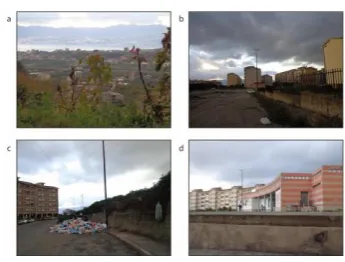
[image:6.544.182.355.304.435.2]Arghillà is located in a suburban area in the Northern part of the city of Reggio Calabria, detached from the city centre and currently characterized by urban and social decline. However, the location on the top of a steep hill allows a wonderful view on the Strait, giving outstanding landscape value to the area. It is not by chance that an old fortress is located in the Southern part of Arghillà, currently occupied by the Ecolandia park. In the 1970s General Plan of the City of Reggio Calabria, Arghillà was planned as middle upper-class residential area. After that some private real estate initiatives had started, the City promoted the implementation of 167 Law plans for council housing. This decision led to the perception of an ongoing process of ghettoization of the area, that prevented private estate initiatives from being put forward (interview with the technical staff of the municipality of Reggio Calabria, 2014). The area ended up in being not mixed enough to support a socially thriving environment, as the population were composed by mainly low income families. In this context, at the end of the 1990s the displacement of several Roma families happened, following the rationale that has been described in the previous sections (see Table 2), thus definitively undermining the social structure of the neighbourhood and exacerbating social exclusion. Informal talks with the local community conducted during the two sessions of field work showed how the presence of Roma population is associated with social issues in the area, while it tends to be underestimated the fact that Roma families were relocated in an already socially unstable context. The lack of public services and community- oriented spaces furtherly increased tensions in the area. As shown in Fig.2, the area is characterised by a socio-economic and urban-physical decay, the quality of the built environment is very low and the spatial pattern, complemented by extremely poor mixed-use, is not supportive of safety and security.
Fig. 2. Arghillà. a) View from the area; b) Lack of maintenance; c) Lack of services; d) Underutilized public spaces (Authors’ photographs)
6 Claudia Trillo, Pasquale Pizzimenti, Carmelina Bevilacqua, Carla Maione / Procedia - Social and Behavioral Sciences 00 (2016) 000–000
How can inclusive urban policies be improved
This paper aims at suggesting how spatial patterns may support integration and inclusive urban policies. These latter currently tend to focus on quantity and quality of services delivered rather than on their spatial component. Because of this limit, through recognizing that public services are key in achieving integration, the paper highlights that some backlashes and pitfalls can happen. Through the discussion of the two case studies, it is showed for example that by ignoring concentration vs dispersal patterns and by underestimating the importance of a supportive urban structure (dense and mixed use) as well as the relevance of a high degree of connectivity, the integration process can be undermined, as it happened in Arghillà, where the displacement of Roma population exacerbated the sense of disconnection and exclusion of the area. On the other side, the balanced displacement of Roma in a neighborhood with a different spatial pattern (dense and mixed use) coupled by an adequate quantity and quality of public services can produce a completely different outcome, as it happened in Rione Marconi- Sbarre. As a result of the case studies discussion, the main findings are:
1) Services are essential in order to support inclusion among different groups. All the social workers in both areas (Arghillà and Rione Marconi- Sbarre) agreed on the importance of delivering high standard of services. However, they also recognized the financial value of available public spaces, as precondition to make the community-led initiative viable;
2) Displacement of minorities across the existing communities -in a ratio lower than 2 families every 10 families per apartment block- was considered as desirable by the minorities’ families themselves. Because sometime rules and planning regulations prevent policy makers from enacting a mixed and balanced displacement, it is paramount that flexible rules are aligned with flexible displacement. In the Reggio Calabria case, once it had been ascertained that Roma families were keen on being equally displaced, the rigidity of the rules concerning allocation of public housing would have prevented local authorities from managing this process differently;
3) Connectivity and accessibility, rather than mere physical existence of public and shared spaces, are keys. Sometime, they are challenged by social stigma, thus preventing the integrated use of existing facilities because of prejudices and bias. In the Arghillà case, the Ecolandia Park is not used by outsiders, although the very high quality of the services offered, because it is associated with a deprived area.
In conclusion, moving forward from the studies of Wilson (1987) on the ghettoized underclass created by a specific concentrated development in America, this paper suggests that the way in which minorities are distributed in an existing area, also in relationship with the specific spatial pattern, may contribute to their successful inclusion, as well as, the existing spatial organization may play a role in honing successful integration policies. Although some authors suggest that successful inclusion of minorities almost entirely relies on integrated accessible services particularly in early education and health (Bodewig & Sethi 2005), this paper suggests that positive outcomes can be reinforced through the implementation of an inclusive spatial pattern based on the following recommendations, applicable to similar cases in which minorities require to be integrated:
1) Avoiding concentration of minorities through appropriate displacement, planned on case-by-case approach and discussed with the interested community;
2) Supporting flexible displacement through appropriate rules and planning regulations; 3) Avoiding displacement of minorities in areas lacking in physical and social connectivity.
Acknowledgements
This paper builds on and puts forward the research results achieved by the Laboratory CLUDs (PAU Department)
with the BESECURE Research Project funded by the 7th European Research Framework Program. Furthermore, it
Reference
Arbaci S. (2008). (Re)Viewing Ethnic Residential Segregation in Southern European Cities: Housing and Urban Regimes as Mechanisms of Marginalisation, Housing Studies 23 (4), 589–613.
Bessone M., Doytcheva M, Duez J. B., Girard C., Guerard De Latour S. (2014). Integrating or Segregating Roma Migrants in France in the Name of Respect: A Spatial Analysis of the Villages D’insertion, Journal of Urban Affairs 36,2, pp.182–196.
Bodewig C. & Sethi A. (2005). Poverty, Social Exclusion and Ethnicity in Serbia and Montenegro: The Case of the Roma. [online] Available at: http://web.worldbank.org [Accessed 28 Feb. 2016].
Bollens, S. (2009). Intervening in Politically Turbulent Cities: Spaces, Buildings, and Boundaries, Journal of Urban Technology, 16(2), pp. 79– 107.
Bollens, S. (2002). Urban Planning and Intergroup Conflict: Confronting a Fractured Public Interest, Journal of the American Planning Association, 68(1), pp. 22–42.
Cammarota A., Petronio A., Tarsia A., Marino A.G. (2009). I Rom e l’abitare interculturale. Dai torrenti ai condomini. Milano: Franco Angeli Cammarota A., Tarsia T. (2009). Reggio Calabria e Messina: tra mediazioni e conflitti. In T. Vitale (Eds.), Politiche Possibili. Abitare le città con
i Rom e con i Sinti (pp. 87-94). Roma: Carocci Editore.
Chorianopoulos I., Tsetsiou I., Petracou E. (2014). Revisiting the EU’s Social Exclusion Discourse: Residential Segregation, Greek Roma and the Participatory Governance Lock. Geoforum 55, pp. 100–109.
Ecolandia (2016). Il parco. [online] Available at: http://www.parcoecolandia.it/ecosite/il-parco/ [Accessed 28 Feb. 2016].
European Commission (1999). Urban Community Initiative 1994-1999. [online] Available at http://ec.europa.eu/regional_policy/archive/urban2/urban/initiative/src/frame1.htm [Accessed 28 Feb. 2016]
European Commission (2016 a). Europe 2020 Strategy. [online] Available at: http://ec.europa.eu/europe2020/index_en.htm [Accessed 25 Feb. 2016].
European Commission (2016 b). Employment, Social Affairs and Inclusion. European platform against poverty and social exclusion. [online] Available at: http://ec.europa.eu/social/main.jsp?catId=961 [Accessed 25 Feb. 2016].
FRA (European Union Agency for Fundamental Rights) (2009). Housing conditions of Roma and Travelers in the European Union. Comparative Report Available at: fra.europa.eu [Accessed 25 Feb. 2016].
Goodwin M., Buijs R. (2014). Making Good European Citizens of the Roma: A Closer Look at the EU Framework for National Roma Integration Strategies, German Law Journal 1 (10).
Madanipour, A. (2006). Roles and Challenges of Urban Design, Journal of Urban Design, 11(2), pp. 173–193.
Madanipour, A. (2011). Social exclusion and space. In: LeGates, R.T. & Stout, F., (ed.) The City Reader (London: Routledge), pp. 186–194. Marino A.G. (2008). Il Percorso abitativo dei ROM a Reggio Calabria, Politiche e Servizi 3, 26-34.
McGarry, A. (2012). The Dilemma of the European Union’s Roma Policy, Critical Social Policy 32, 126–36.
Sobotka E., Vermeersch P. (2012). Governing Human Rights and Roma Inclusion: Can the EU Be a Catalyst for Local Social Change?, Human Rights Quarterly, 34,800–822.
Tremlett A., McGarry A. (2013). Challenges Facing Researchers on Roma Minorities in Contemporary Europe: Notes towards a Research Program. ECMI Working Paper #62, January 2013.
Uzonova I. (2010). Roma Integration in Europe: Why Minority Rights Are Failing, Arizona Journal of International & Comparative Law, Vol. 27, 1, 283-323.