International Journal of Emerging Technology and Advanced Engineering
Website: www.ijetae.com (ISSN 2250-2459,ISO 9001:2008 Certified Journal, Volume 5, Issue 3, March 2015)
312
VANET Data Synchronization
Syed Muzamil Nazir
1, Dr. Ravi Rastogi
21,2Sharda Univeristy, Plot No. 32-34, Knowledge Park III, Greater Noida, Uttar Pradesh 201306, India
Abstract— VANET may be defined as the vehicular ad hoc network where cars act as a wireless data transmission to pass signals. The main role of the cars is to propagate data from one end to another end of the network that’s why there is a inbuilt router fitted inside the car. In VANET network every car tends to move in higher speed and their speed varies from node to node so it is necessary to hold every data in secure form in order to have accuracy of data. Since VANET is a wide area network thus it is necessary to keep network under strong security in order to avoid threat. Every time data is being sent from node to node for the vehicular communication so its required that data should reach to the destination without being affected or modified by external malicious attacker. Nevertheless, we need a strong security protocols for maintaining the accuracy of data and to impose security. Some protocols that we have been implemented for data transmission are APLM AND TESLA. Both protocols defines us the delay time, throughput, and delivery fraction between the nodes in a vehicular environment. TESLA (Timed Efficient Stream Loss-Tolerant Authentication Protocol) which is broadcast authentication protocol that helps to secure the broadcast communication by source authentication. On the other hand APLM (Asynchronous profit Loss Markov Model) is used to conclude the end to end delay, throughput and delivery ratio.
Keywords— VANET, APLM, TESLA, AODV, MANET
I. INTRODUCTION
VANET may be defined as the vehicular ad hoc network. In VANET cars acts as nodes which is equipped with wireless router for the propagation of the data streams. Cars are also called as nodes in network terminology. Each car should maintain a distance of 300 meters for the proper communication and synchronization. On Board Units (OBUs) are the essential unit in the car which allows us to collect all the information that have received by the various sensors in the car. Every OBUs are communicating to each other in order to share the information from one node to another node. Each OBUs is communicating with Road Side Units (RSUs). Road Side Units are the stationary units which are placed every 1 km to maintain the communication with every legitimate vehicle in the vehicular environment.
The main aim of road side units is to establish connection between various backbone networks in the vehicular environment. VANET is known as ad hoc network because there is no central unit which can make communication between various cars together. The only criteria are that RSUs are there to make connections between backbone area networks. Every VANET OBUs has got large storage units which helps to store all the information that have received by the various sensors of the car. Every vehicle in vehicular environment tends to move with some speed so its necessary to have strong protocol connectivity between each vehicle passing by.
Every vehicle communicates with RSUs in order to get updated information of all the vehicles that should be in the vehicular environment. The communication between vehicle to vehicle is in the form of route exchange by the implementation of the protocol. There are many numbers of road side units situated at every kilometre which needs strong protocol to maintain potent connection to all the vehicles in the vehicular environment. For the strong communication, it’s required to have precise location of the vehicles and accurate protocol exchanging information. Thus helps faster exchange of information and reliable data communication in a vehicular ad hoc network.
II. INTER VEHICULAR COMMUNICATION
International Journal of Emerging Technology and Advanced Engineering
Website: www.ijetae.com (ISSN 2250-2459,ISO 9001:2008 Certified Journal, Volume 5, Issue 3, March 2015)
313
Fig.1. Inter Vehicular Communication.
III. ROUTING BASED COMMUNICATION
Routing based communication deals with the
propagating of routes between vehicle to vehicle or vehicle to road side units. Routing based communication is a multi hop uni cast communication that means every routes is being propagated to the specific vehicles in the vehicular environment.
IV. VEHICLE TO ROAD SIDE COMMUNICATION
Vehicle to road side communication can be defined as the single hop communication because the communication takes place between the vehicle and stationary road side units. Roadside elements are configured in a way to deliver high bandwidth links for the vehicles to maintain connectionless based communication. The medium between road side units and vehicles are called dedicated short range communication (DSRC) which gives us proper communication to the moving vehicles. Road side units are the essential element in the vehicular environment which gives us proper positioning of the vehicle and helps drives to aware of his speed limit on road. If a driver is crossing speed limit then a message is being sent from RSUs to vehicle to control the speed limit. The message appears on the display screen inside the vehicle which is in form of visuals.
Fig.2. Vehicle to road side communication.
V. ROUTING PROTOCOL STUDY FOR VANET In VANET network every vehicles tends to move in a higher speed and their speed varies from distance to distance so it’s necessary to have protocol that can govern the efficient traffic propagation between vehicles. It is also necessary that we need to implement routing protocol for road side unit in order to maintain communication between vehicle and other backbone networks. Communication between road side units is called inter road communication. So routing may be defined as the process of selecting the best paths between various node in a vehicular network and helps in forwarding the traffic to the various backbone networks. Since VANET is wide area network so it is necessary that we need to take efficient routing protocol which can in even security part as well.
International Journal of Emerging Technology and Advanced Engineering
Website: www.ijetae.com (ISSN 2250-2459,ISO 9001:2008 Certified Journal, Volume 5, Issue 3, March 2015)
314 Every time it sends routing information to the other nodes in the network in order to maintain table consistency. So there would be less traffic delay in this type of protocol. Since VANET is wide area network and is dense network so it’s difficult to maintain up to date information in the table. This type of protocol is also called table driven protocol. Some examples of this protocol are DSDV, WRP. In reactive routing protocol, route discovery is being initiated to every node in order to send packets to the destination network. In this type of protocol route discovery is maintained by route maintenance. Every node has to keep route to find the path for destination by sending the flood of query packets to the destination. So this leads the path search in the network. Some protocols are AODV, DSR,.
So routing in very essential medium as far as wide area network is concerned. Every node in the vehicular network sends broadcast messages at every time in order to get updated information. So propagation of broadcast data synchronization in VANET leads to the safety applications, thus it’s required that we need to provide efficient data technique in order to have reliable safety application for human benefits. It’s actually mobile spectrum which is used for safety applications. Applications for VANET can be categorised into two types i.e. safety application and non
safety applications. Safety applications includes
cooperative driver assistance, intersection collision warning, cooperative collision warning etc. While as non – safety applications include application to data transfer, traffic information and traffic management applications. In VANET, it is required to have actual time data of traffic in order to get identification of the vehicles and this requires broadcasting. Conventional broadcasting leads to the broadcast storm problem which may be defined as when many broadcast messages are being rebroadcasted to the network in the vehicular environment thus causing continuous message collision problem between nodes. So in order to eradicate collision it is necessary to have RTS/CTS exchange between nodes in the vehicular network. So this may lead to the decrease in the throughput and increase in delay rate between node to node.
Techniques for broadcasting should meet these
requirements which are scalability, efficiency and effectiveness.
VI. APLMMODEL FOR DATA SYNCHRONISATION
APLM and TESLA are two different protocols that are used in the VANET topology. In order to implement these two models we need to create basic topology.
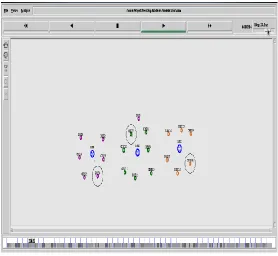
[image:3.612.323.601.392.648.2]The simulation that we have been using for VANET topology is ns-2 and VANET Mobisim for basic network topology. Ns-2 uses c++ language for the script and it is based on tool command line language. As we know that in VANET OBUs are in moving position and RSUs are in stationary position. Each moving node has got some parameters that have been used in the simulation. These parameters are used to configure the each node in the vehicular network. Every moving node are moving in the x, y. and z axis for which we need to set some values for every node in the simulation area. There are two propagation models that have been used in VANET topology which are nakagami and two ray ground propagation. Both two models are used to send signals and used for accurate position of the signals which are received by the vehicles at longer distances. Each node has set parameters, Link Layer (LL), MAC 801.11, Interface queue (IQ), and PHY layer which implies wireless channel for the propagation of the signals. Every car is fitted with an omni antenna which has got characteristic of sending the signals in all directions. The signals are travelling in form of radio waves.
Fig. 3. Node to node data transmission
International Journal of Emerging Technology and Advanced Engineering
Website: www.ijetae.com (ISSN 2250-2459,ISO 9001:2008 Certified Journal, Volume 5, Issue 3, March 2015)
315 AODV routing algorithm is self starting and multi hoping routing protocol which enable node to node data synchronisation. AODV routing protocol helps to get routes faster for the new destinations, and only active nodes have to maintain routes other than inactive nodes which are not in communication process. AODV is reactive routing protocol and does not need to send periodic updates it only sends when there is new update occurring in the network and thus updates routing table that is why its so called on demand routing protocol. Every table in ADOV data has got next hop count and sequence number of nodes in the network.
[image:4.612.325.598.131.378.2]APLM is used to get the details of data sent by data received of each node in the network. I have used APLM model in the VANET topology in order to check the integrity level of the data received by the receiver. Each time data synchronization occurs in the VANET network which is in form of packets. So this model concludes three types of equations that can determine the actual throughput, packet delivery ratio and end to end delay.
Fig.4 . Packet Delivery Ratio
Packet delivery ratio can be concluded by the following equation:-
No of packet received / No of packet sent = 0.74
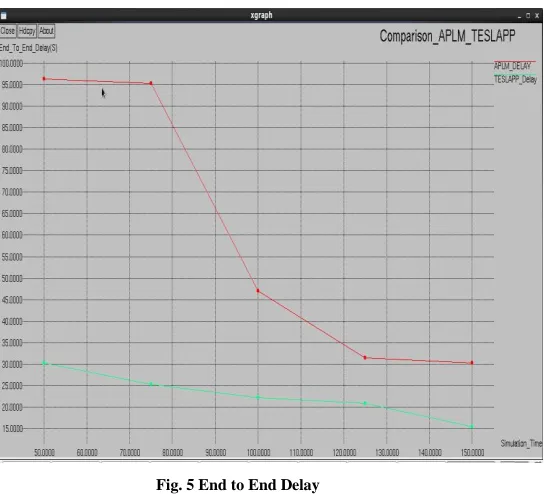
Fig. 5 End to End Delay
End to end delay can be concluded by the following equation:-
[image:4.612.48.300.368.660.2](arrive time – send time) / No of connections = 40.1ms
[image:4.612.324.587.427.663.2]International Journal of Emerging Technology and Advanced Engineering
Website: www.ijetae.com (ISSN 2250-2459,ISO 9001:2008 Certified Journal, Volume 5, Issue 3, March 2015)
316 Through put can be concluded by the following equation :-
(Received Size/(Stop Time-Start Time))*(8/1000))
=488.97
On the other hand TESLA is timed efficient stream loss tolerant broadcast authentication protocol which is used to authenticate the message. In TESLA protocol MAC address is being attached to every packet with key k which is private key. And sender only sends key to the receiver once the packet is being received by the receiver and only then it authenticates the message. TESLA uses digital signatures for the authentication purposes and decreases over heads of messages in ad hoc wireless networks and wireless sensor networks. The mechanism used to authenticate the message with digital signature is called Elliptic Curve Digital Signature Algorithm (ECDSA). This algorithm is used for encryption and decryption of messages. The advantage of using this algorithm is because it provides faster delivering. So this mechanism provides good authentic and reliability level. So the above graph depicts that TESLA is much better protocol than APLM
VII. CONCLUSION
In this paper we have proposed an APLM model for the data synchronisation in VANET. APLM helps us to conclude the total number of packets that have been received by the receiver and the number of packets lost in the network during data synchronisation.
REFERENCES
[1] M. Nasir, A.S.M. Hossain, S. Hossain, M. Hasan, B. Ali: Security Challenges And Implementation Mechanism For Vehicular Ad Hoc Network, International Journal of Scientific & Technology Research, Vol. 2, No 4, 2013, pp. 156-61.
[2] K. Azogu, T. Ferreira, H. Liu:. A Security Metric for VANET Content delivery, IEEE Globecom, 2012, pp. 991-96.
[3] Y. Gadkari and B. Sambre: VANET: Routing Protocols, Security Issues and Simulation Tools, Journal of Computer Engineering, 2012, pp. 28-38.
[4] S. Nain and S. Tayal: A comparative study of the Security Protocols in VANET, Proceedings of the International Conference on Emerging Trends in Engineering and Management, 2012, pp. 279-81.
[5] T. Kaur and A. K. Verma: Simulation and Analysis of AODV routing protocol in VANETs, International Journal of Soft Computing and Engineering, 2012, pp. 293-301.
[6] K. Bür and M. Kihl: Selective Broadcast Algorithms for Safety Applications in Vehicular Ad Hoc Networks, IEEE VTS Workshop on Wireless Vehicular Communications, 2010, pp. 1-15.
[7] J. Haas, Y. Hu and P. Laberteaux: Real-World VANET Security Protocol Performance, IEEE Globecom, 2009, pp. 1-7.
[8] Zhang and S. Wolff: Routing Protocols For VANET in Rural Area, IEEE Automotive Networking, 2008, pp. 126-131.
[9] M. Raya and J. Hubaux: Securing vehicular ad hoc networks, Journal of Computer Security, Vol. 15, 2007, pp. 39-68.