International Journal of Emerging Technology and Advanced Engineering
Website: www.ijetae.com (ISSN 2250-2459, ISO 9001:2008 Certified Journal, Volume 7, Issue 7, July 2017)211
Reducing Lead Time of Open-Tendering Process Using Value
Stream Mapping
Kamal Kant Sharma
1, Suman Kant
21Currently Pursing M.tech in Total Quality Management (TQM) in PEC University of Technology, Chandigarh, India 2Currently working as an Assistant Professor in Production and Industrial Engineering in PEC University of Technology,
Chandigarh, India
Abstract— This paper discusses how a lean tool like value
stream mapping can be used in service sector scenarios where we need to manage, information flow more than material flow and how VSM can effectively reduce the lead time of processes like open-tendering and make the organization improve continuously and turn into a lean enterprise. A few case studies were carried out at Tata Power Delhi Distribution Limited to explore the current state scenario and identify the areas of waste and non-value added activities to develop the current state maps. A future state map is proposed to show the action plan to improve and reduce the lead time of existing process using various kaizens.
Keywords- Kaizen, Lead time, Open-tendering process, Power distribution sector, Value stream mapping.
I. INTRODUCTION
In today’s scenario when competition in market is really high, every company wants to strive towards reduced lead time of the processes which results into improved satisfaction of internal and external customers ultimately. Power distribution sector has been devoid of any research in the field of lean methods and its tool, this work is a small effort to bridge the gap in the application of lean to power distribution sector, through the value stream mapping approach. The aim of value stream mapping is to make the downstream get everything smoothly coming from the upstream by removing the non-value adding activities and waste from the whole value stream and pass on the value to the end customer.
Usually value stream mapping is used to picturize the material as well information flow in a set manufacturing environment, but in the case of handling contracts of power distribution sector, the material flow is actually the information flow through various methods such as emails, telephones, mouth to mouth communication(meetings) and open-tendering is a system of inviting tenders by public advertisement in most public manner possible, therefore to map such a process we chose value stream mapping because VSM helps in:
Visualization of total process
Seeing the process from customer’s point of view
Finding wastes in the process
Developing the linkage between the sub-processes
Aligning the whole organization, process by process
Empowering with more focused approach
Helps in selection of Kaizens, Pokayoka’s for
improvement.
II. LITERATURE REVIEW
Beau Keyte and Drew A. Locher in the complete lean enterprise (2016), explained how value stream mapping can be used for information management purposes, service industry as per them views their different departments as individual silos and as independent contributors to the company’s success, since they do not see the interaction and integration of the work activities of all departments together.
Rahul R. Joshi et al (2012) used value stream mapping to reduce the waste in a die manufacturing industry by visualizing the production process in current state map and then after tracking the entire process they came up with future state map and suggested ways to improve.
Joseph C. Chen1 et al (2012) proposed, a systematic procedure for conducting Lean Office techniques. The systematic procedure proposed extends concept to transform an office environment into a Lean office that has
customer-triggered working processes, faster and
systematic task tracking, and reduced costs due to a reduction of non-value added activities.
Don Tapping and Tom Shuker elaborated employee’s benefits from lean in a very proficient way saying Lean seeks to eliminate waste, and employees function better in waste free environment, waste in the workplace causes fatigue, frustration and burnout in value stream mapping for office environment (2003)
III. METHODOLOGY
International Journal of Emerging Technology and Advanced Engineering
Website: www.ijetae.com (ISSN 2250-2459, ISO 9001:2008 Certified Journal, Volume 7, Issue 7, July 2017)212
Our research was influenced by three major contributors,1) literature review covering the existing research
[image:2.612.64.540.165.331.2]2) Case studies conducted at Tata Power DDL 3) Needs of power distribution sector for continuously improving.
Figure-I Research approach
Using these three contributor’s foundation of the study was constructed which was further moved by:
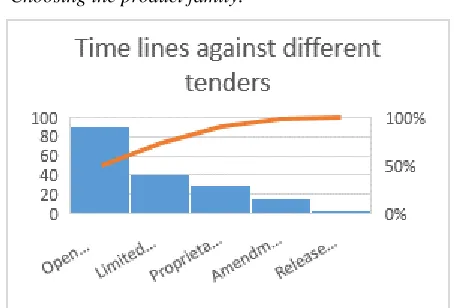
Choosing the product family:
Figure –II Choosing open tendering as product family
Obtaining information about the process from the company to have clear understanding of the process. Doing time study of each sub-process within the
overall process in each case study.
Using the information generated from the case
studies, mapping the current state and identifying the bottleneck and gaps in the process.
Using brainstorming, benchmarking and innovating
developing kaizens and pokayoka’s to develop a future state value stream map.
IV. RESULTS AND DISCUSSIONS
For this study a case study approach has been chosen, this approach is considered to be appropriate as it allows to investigate the non-value adding activities and wastes and their sources within the real world scenario. The approach was to conduct a single case study, but as interlinkage was found, it was chosen to collect data and conduct and study three case studies for this research.
Case Study:
During my tenure at TPDDL, contracts department was dealing with procurement of 3 IT products:
1) Reverse proxy
2) Antivirus
3) Firewall
[image:2.612.54.281.385.539.2]International Journal of Emerging Technology and Advanced Engineering
Website: www.ijetae.com (ISSN 2250-2459, ISO 9001:2008 Certified Journal, Volume 7, Issue 7, July 2017)213
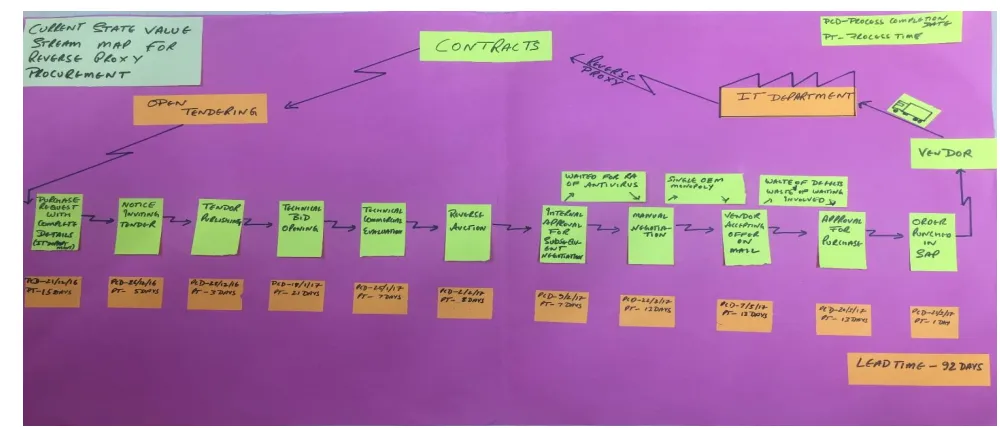
[image:3.612.51.551.146.360.2]A.Current State VSM for Procurement of Reverse Proxy
Figure III -Current state VSM for reverse proxy
Areas of Major Wastes Identified:
1. Manual negotiation (13 days)
2. Vendor accepting order (13 days)
3. Approval for purchase (13 days)
Reasons and Types of Wastes: 1. Manual negotiation:
a)Waste of waiting: Here we were just waiting for 13 days so that we are able to adjust the budget. But as per the PR submission date, antivirus’s PR was submitted on 22/11/16 whereas reverse proxy’s PR was submitted on 21/12/16, even then antivirus’s reverse auction was late, due to which reverse proxy suffered a delay of 13 days.
2. Vendor accepting order:
a)Waste of waiting: Here also we were simply waiting, because we were having one single OEM for this product and we were found helpless, as he was taking his time for accepting our offer of 80 lakhs.
3.Approval for purchase:
a)Waste of defects(correction): After 22 hours HOG contracts rejected the request of initiator without telling the reason, then pre-audit rejected it asking for clarification about consumption details.
International Journal of Emerging Technology and Advanced Engineering
Website: www.ijetae.com (ISSN 2250-2459, ISO 9001:2008 Certified Journal, Volume 7, Issue 7, July 2017)214
B.Current State VSM for Procurement of Antivirus
Figure-IV Current state VSM for antivirus
Areas of Major Wastes Identified:
1) Notice inviting tenders (1 month 19 days) 2) Re-Purchase request release (13 days) 3) Tax finalization (3 days)
4) Approval for purchase (11days)
Reasons and Types of Wastes Identified:
1. Notice inviting tenders:
a)Waste of defects(correction): In this process, Contracts departments disapproved the PR request of IT department due several reasons, like budget clarifications, specification related queries causing lot of delay.
b)Waste of waiting: This process initiated late, unnecessary waiting was involved causing delay.
2. Re-purchase request release:
a)Waste of defect(correction): In this case as it was a new product, it was found in such a later stage, that it does not have an asset code in the system, which has to generated again.
3.Tax finalization:
a)Waste of defect(correction): It was found even after the reverse auction that, there was service for 3 years also includes, for which service tax has to be made inclusive in capex, resulting which a non-value adding step got added to the process making 3 days of delay.
4.Approval for purchase:
a)Waste of defects(correction): After 27 hours’ Pre-audit rejected the request of initiator asking for DERC approval, RA screenshot and Price Bid missing.
International Journal of Emerging Technology and Advanced Engineering
Website: www.ijetae.com (ISSN 2250-2459, ISO 9001:2008 Certified Journal, Volume 7, Issue 7, July 2017) [image:5.612.53.552.147.335.2]215
C. Current State VSM for Procurement of FirewallFigure V-Current state VSM for firewall
Areas of Major Wastes Identified: 1)Notice inviting tenders (20 days)
2)Technical bid opening (1 month)
3)Approval for purchase (20 days)
Reasons and Types of Wastes Identified:
1. Notice inviting tenders:
a)Wastes of defect(correction): In this process, Contracts departments disapproved the PR request of IT department due several reasons, like budget clarifications, specification related queries causing lot of delay.
b)Waste of waiting: unnecessary waiting was involved causing delay.
2. Technical Bid opening:
a)Waste of waiting: We took 10 days extra then specified time for letting bidder to bid against our published tender, but in IMS document it is nowhere mentioned that during festive season we can extend such time limit.
3. Approval for purchase:
a)Waste of defects(correction): Approval got rejected
several times at several levels including HOG
contracts(once), then at pre-audit twice resulting into huge delay.
b)Waste of waiting: HOG contracts took 3 days 3 hours to approve the request initiated, then 2 days for rejecting, again HOG contracts took 4 days 12 hour to revert with clarification and then pre-audit again rejected after 2 days 6 hours, which further took 5 days 2 hours from pre-audit to get final approval.
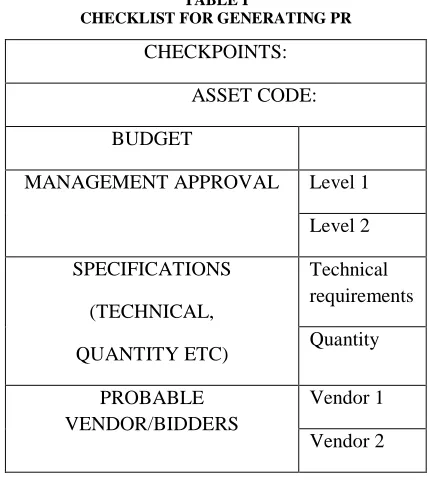
D. Kaizens to Remove Gaps from Current Process 1. Initiate NIT’s on FIFO basis
2. Create a checklist for internal customer, comprising of documents needed to be attached for generating a purchase request.
TABLE I
CHECKLIST FOR GENERATING PR
CHECKPOINTS:
ASSET CODE:
BUDGET
MANAGEMENT APPROVAL Level 1
Level 2
SPECIFICATIONS
(TECHNICAL,
QUANTITY ETC)
Technical requirements
Quantity
PROBABLE VENDOR/BIDDERS
Vendor 1
Vendor 2
3. Do vendor development for such products
[image:5.612.336.552.427.667.2]International Journal of Emerging Technology and Advanced Engineering
Website: www.ijetae.com (ISSN 2250-2459, ISO 9001:2008 Certified Journal, Volume 7, Issue 7, July 2017)216
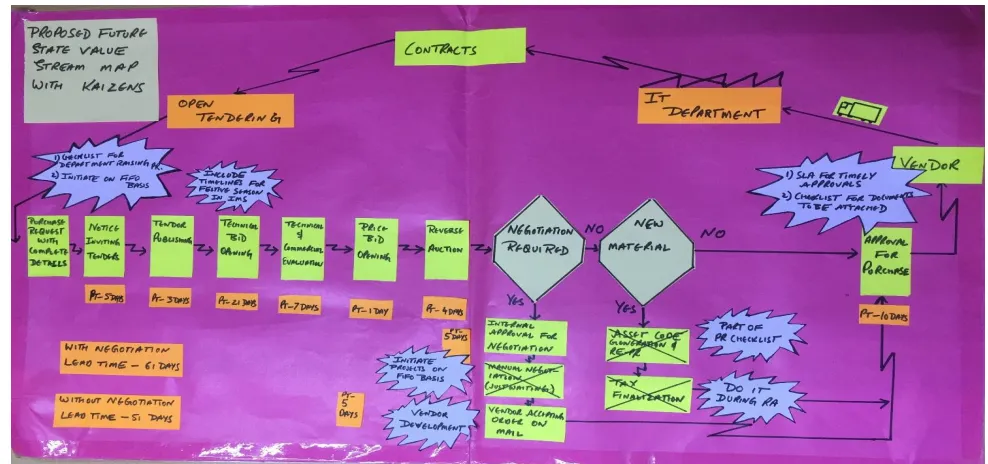
5.Create service level agreement for all level definingthe timeline in which they need to approve the purchase approval.
6.Asset code generation for new products should be a parallel activity.
7. Do tax-finalization at the time of reverse auction. SOP’s should include the defined the timelines for technical Bid opening which can be extended during festive seasons
[image:6.612.56.559.209.686.2]E.Proposed Future State VSM for Open-Tendering Process
Figure VI-Proposed future state VSM
V. CONCLUSION
TABLE II
LEAD TIME IMPROVEMENT
Variable Current state scenario Future state with negotiation
Future state without negotiation
Lead time 90 days 61 days 51 days
Hence by using value stream mapping in such service sector scenario we observed that lead time of the total process of open-tendering can be reduced to 32.2% if negotiation with vendors is involved and 43.4% if negotiation with vendors is not involved. This proves the efficacy of value stream mapping in power distribution sector.
REFERENCES
[1] Beau Keyte and Drew A. Locher in the complete lean enterprise (2016)
[2] Don Tapping and Tom Shuker value stream mapping for office environment (2003)
[3] N. Rich et al (2006) in Lean evolution.
[image:6.612.57.551.224.456.2]