DATA ANALYSIS
' .• Thesis by .
Norton Robert Gr~enfeld
In Partial Fulfillment of the Requirements For the Degree of
Doctor of Philosophy
California Institute of Technology 'Pasadena, California
1972
ACKNOWLEDGMENT
'
ABSTRACT
This thesis is an investigation into the nature of data analysis and computer software systems which support this activity.
The first chapter develops the notion of data analysis as an . experimental science which has two major components:
data-gathering and theory-building. The basic role of language in determining the meaningfulness of theory is stressed, and the informativeness of a language and data base pair is studied. The static and dynamic aspects of data analysis are then considered from this conceptual vantage point. The second chapter surveys the available types of computer systems which may be useful for data analysis. Particular attention is paid to the questions raised in the first chapter about the language restr~ctions imposed by the computer . system and its dynamic properties.
LIST OF ILLUSTRATIONS . . . • . . • . . . • . . . • • . . . . • . . . • . . vi INTRODUCTION . . . · ... · . . . 1
Chapter
I. THE ESSENCE OF DATA ANALYSIS . . . • . . . 3 The Role of Language
Information, Language, and Data Statics of Data Analysis
Dynamics of Data Analysis Conceptual Frictions
II. THE CURRENT STATE OF DATA ANALYSIS SYSTEMS. 33 Data Management Systems
Statistical Analysis Systems Question-Answering Systems Reference Retrieval Systems Simulation
The Bowidaries of the Practicable
..
III. THE REL DA TA ANALYSIS SYSTEM . • • . • . . . • . . . 62 The REL System
The REL Data Analysis System Data Structures and Processing Quantification
Use of the REL Data Analysis System
LIST OF ILLUSTRATIONS
Figure Page
1. The two dimensions of data analysis . . . · . . . 11
2. "Objective reality" information curve . . . • . . . 18
3. The information curve of the Fundamental Theorem . . . • . . 19
4. An example of data management systems . . . 36
5. An example of statistical analysis systems . . . • • . . 39
6.
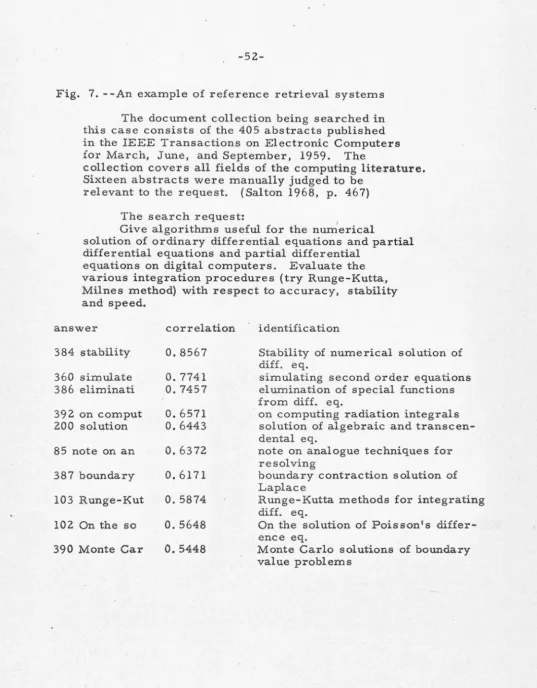
An example of deductive question-answering . . . • . . . 447 .. An example of reference retrieval systems . . . 52
8. An example of a discrete simulation . . . 55
9.
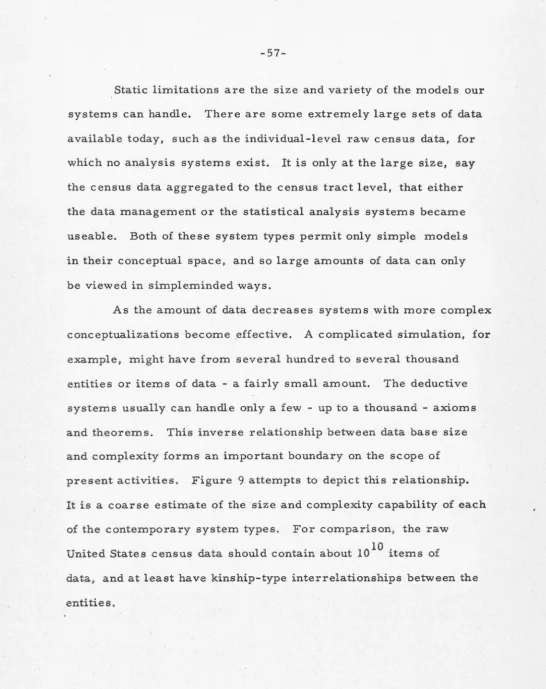
The contemporary relationship between data base si;z;e . and complexity .. . . 5810. Syntax-directed interpretive systems . . . • . . . 67
11. Parse of quantification example . . . • . ~ . . . • . . . . • . . . 9 7 12. P-marker for "variable" quantifier technique . . . .. . . 100
13. P-marke·r for second "variable" quantifier example . . . . • . . . 104
14. P-marker for "label class'' quantifier technique . . . 105
15.- Parse and label class processing for (each, each) example .. 110
Introduction
The development of data analysis has paralleled the rise of
empirical science itself. Modern science is founded upon the idea
that theory should be verified against the data obtainable from
reality. This inclusive view of the analysis of data has tended to
be submerged by the successful development of the theories of
probability and statistics, which have turned data analysis into a
. relatively confined sub-branch of mathematics. The advent of the
electronic computer, however, with its great flexibility and
liber-ating power has caused the rediscovery of data analysis as a field
in its own right that has much wider goals and fewer restrictions
than either mathematical statistics or probability theory.
To get a feel for the rapid changes in attitude that have
occurred recently, listen to the pioneer John W. Tukey ( 1962, p. 1):
For a long time I have thought I was a statistician, interested in inferences from the particular to the
general. But as I have watched mathematical statistics evolve, I have had cause to wonder and to doubt. And when I have pondered about why such techniques as the spectrum analysis of time series have proved so useful,
it has become clear that their "dealing with fluctuations"
aspects are, in many circumstances, of lessor impor-tance than the aspects that would already have been required to deal effectively with the simpler case of very extensive data, where fluctuations would no longer be a problem. All in all, I have come to feel that my central interest in is data analysis, which I
take to include, among other .things, procedures for
analyzing data, techniques for interpreting the results of such procedures, ways of planning the gathering of data to make its analysis easier, more
precise or more accurate, and all the machine.ry and
This statement, first presented in 1961, is still closely
bound to the traditional notions of statistics, as it is a description
of what statisticians did as opposed to what they said they did. A
short time later Tukey recognized ( 1966, p. 69 5) the generality
and independence of data analysis and had progressed far beyond
the narrow confines of conventional statistics:
THE ESSENCE OF DATA ANALYSIS
Data analysis is that coordination of continuing observation and developing theory which prod-uces information.
Data analysis is the activity of interrelationship between ongoing theory and ongoing data: it is neither the theory-changing nor data-gathering process. Modern trends in the philosophy of
science match this view that the existence of reality, and with it the notion of truth, is irrelevant. Data analysis does not result in true theories, only informing ones.
This use of "information" is non- standard. Both theory and data are required to produce information. Theory without data is so unsubstantiated as to be empty. Data without theory is mean-ingless. In tying data to theory, data analysis gives the confirmation of data to theory and the interpretation of theory to data, and
creates information.
Now a theory is linguistic in nature: a set of statements in some language. One might prefer "conceptualization" instead, but this is illdefined and unmanageable. Theory is the tangible, manipulabl~ form of conceptualization, insight, understanding, and explanation.
The distinction between extension, the data structure, and
intension, the theory, is the first fundamental duality. Data analysis
is the bridge between them. It resembles the double helix, that
foundation of life as we know it. If one strand is the activity of
observation and the other is the unfolding process of
conceptual-ization, then data analysis bonds the two, holding them together
and conveying their recriprocal influences.
The Role of Language
When one is faced with a body of data, one conceives his
task to be finding relationships which are substantiated by that
data. One searches for those models, or sets of structural
relationships, which best reflect the data. Some would like to
think that the data analyzer has at his disposal all possible
structures or models - this is not the case.
11All possible models" is far too large a class and in fact
is philosophically treacherous. In any particular case the
analyzer is limited, limits himself, to a much more detailed and
circumscribed set of models. These are the ones compared with
the data. Thus another aspect of the task is to determine the
modelspace, the set of models, to be considered.
Equivalently, since a theory is embedded in a language,
one must determine the language in which to express the theories
or modelspace and model, is the second fundamental distinction of data analysis.
An illustration can be formed from the relationships given by a family tree. When a researcher knows that his data is about family relationships he will use such terms as father, mother, and grandparent, and will state such particular data as "John is the father of Mary, " fully understanding the meaning of these ter,ms. These phrases, together with some knowledge of their meanings and interrelationships, form a language which he uses to describe certain worlds.
Tacit Knowledge. Which models are available in this
lang'uage? It is clear. that using such terms one cannot describe
The position of tacit knowledge is generally misunderstood. Consider "John is the father of Sue." Even if the level of implicit meaning that relates father to child is ignored, there remains a basic understanding of the structure of the sentence itself: it establishes that a relationship, namely father, exists between John and Sue. It is only in terms of these understandings of language and language structure that data is in any sense meaningful. Even when the data is given in the form of tabulations, without some prior understanding of how the forms of these tabulations are to be interpreted, of the significance of the symbols used, and so on, the data would be complete nonsense.
Let us examine in greater detail the implicit knowledge tacit in language itself. One's ontology - what types of things one believes can exist - determines to a large extent what things one looks for, pokes and examines, or considers errors in measurement
rather than data. To see that these metaphysical assumptions affect our perceived reality reconsider family relationships. We know that a father is male and a mother female, and every person has one of each. Yet in certain primitive cultures a person might have two female parents, one the mother and the other the father. Further, in our own society, artificial inovulation makes it
It can be argued that the above is merely a change in the meaning of the words. This is a change of language (in the broad
sense of language) and as such is a very definite change in the assumptions and knowledge we bring to a situation. The informa-tiveness of data is affected rather directly by this kind of change. The linguist Benjamin Whorf expresses (1956, p. 212) the role of language quite forcefully:
When linguists became able to examine critically and scientifically a large nwnber of languages of
widely different patterns, their base of reference was expanded; they experienced an interruption of phenom-ena hitherto held universal, and a whole new order of significances came into their ken. It was found
that the background linguistic system (in other words,
the grammar) of each language is not merely a reproducing instrwnent for voicing ideas but rather is itself the shaper of ideas, the program and guide for the individual's mental stock in trade. Formu-lation of ideas is not an independent process, strictly rational in the old sense, but is part of a particular grammar, and differs, from slightly to greatly, between different grammars. We dissect nature along lines laid down by our native languages. The categories and types that we isolate from the world of phenomena we do not find there because they stare every observer in the face; on the contrary, the world is presented in a kaleidoscopic flux of
impressions which has to be organized by our
minds-and this means largely by the linguistic systems in our minds. We cut nature up, organize it into concepts, and ascribe significanc,es as we do,
largely because we are parties to an agreement to
organize it in this way - an agreement that holds
throughout our speech.community and is codified
in the patterns of our language.
may go beyond or be inconsistent with the data, presumably we start with a language which does not do this. But the theories which extend the tacit meaning may well.
One can think of the sentences that make up a theory as specifications of certain aspects of the world. As such, each statement further restricts the class of possible models. In general, one would hope to have a theory which so restricts the possibilities that there would be one and only one left - this, then, would be the "true" theory of reality. Unfortunately, no data is complete enough to confirm such a theory, thus theory must be weaker.
Data as Theory. There is at core a language in terms of which the data is stated. But the languages we use to deal with data are far richer than that minimally necessary for the statement of the data itself. We can describe further, more complex relation-ships that may or may not exist in the data. We can account for processes that reduce the data into other forms. Moreover, the language could have potentially stated items of data incompatible with those that may have been given, or which may extend or modify the original data.
How is it possible that we can extend our laws
into regions we are not sure about? Why are we so confident that, because we have checked the energy conservation
here, when we get a new phenomenon we can say it has to satisfy the law of conservation of energy? Every once in a while you read in the paper that physicists have discovered that one of their favorite laws is wrong. Is it then a mistake to say that a law is true in a
region where you have not yet looked? If you will
never say that a law is· true in a region where you have
not already looked, you do not know anything. If the
only laws that you find are those which you have just finished observing then you can never make predictions. Yet the only utility of science is to go on and try to make guesses. So what we always do is to stick our necks out, and in the case of energy the most likely thing is that it is conserved in other places.
It is evident that data as theory is too weak. However, theory
that goes far beyond data is too unsubstantiated. The "proper"
theory is in an intermediate position between the two. We seek a
theory that provides the greatest insight adequately confirmed
by the data.
Data as Submodel. Another view, complementary to the
above notion, is that we seek that model' or set of structural
relationships which best reflects the data and its interconnections.
We begin with some assemblage of models, the modelspace, from
which we can choose a model on the basis of our data. The
modelspace cannot be the set of all models:. the limitations are
identical to those imposed by the tacit knowledge underlying a
language. For example, social scientists doing regression
analysis have confined themselves to linear models of their data.
Thus the modelspace limits our alternatives in exactly the same
Since the data specifies structural interrelationships one can view it as a submodel. As we have seen, the data- submodel does not form a complete model in itself, but only a partially specified configuration of the universe. The modelspace, then, consists of models which extend that partial specification- -models which contain the data as a submodel. These are the models which are compatible with the data.
The relationship between a language and a modelspace is quite close: one can derive the modelspace from the language, though not quite the reverse. Consider the models of set theory as "all possible models", at least from a meta-level vantage point. We can say that two of these models are equivalent, to us, if no sentence in a given language can distinguish between them. Thus, no sentence of our language is true in one model and false on the other, or vice versa. In this case the language simply cannot express those features that differentiate the two models. As an example, suppose our language talked about flipping coins. We can express whether a coin lands with either heads or tails
showing. What we cannot express or distinguish is the difference between landing heads up on the table or landing heads up on the . floor or landing heads up after spinning exactly 101 times. All of
clusters, and cannot be so used on models within the same cluster.
Formally, the language has partitioned the models into a set of
elementary equivalence classes. These clusters, or equivalence
classes, form the modelspace we see when using that language. This modelspace represents exactly the possible states of
the universe--as seen by a particular language or conceptualization.
It mirrors the implicit understandings, knowledge, and structural
relationships which are tacit in that language.
A language corresponds to a modelspace. A theory, or set
of statements, within that language will select one or more of the
equivalence classes as being the set of models compatible with that
theory. We can correspond theories and models in this way, with
a "complete" theory selecting only one equivalence class, or one
model in the modelspace.
We will label the language/theory approach as intensional
and the. modelspace/model approach as extensional. While the two
are complementary, their differences are meaningful and will be
discussed further in the section below on computer system techniques.
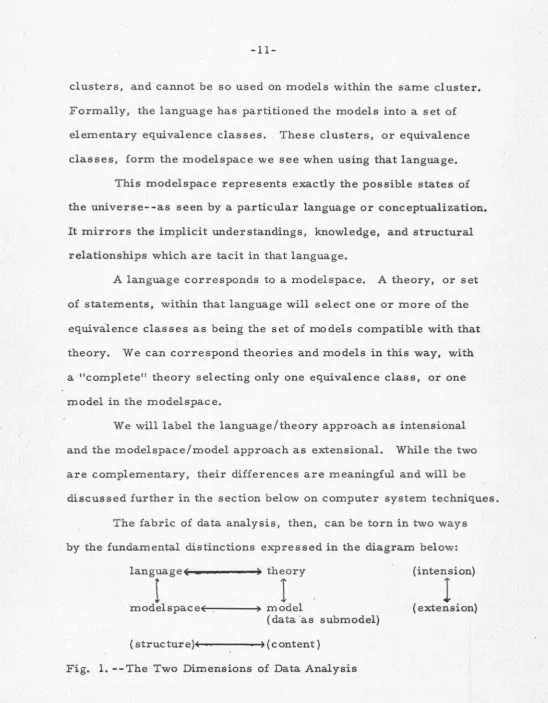
The fabric of data analysis, then, can be torn in two ways by the fundamental distinctions expressed in the diagram below:
language~,---~) theory (intension)
1
I
modelspace( > model (extension)
J
(data 'as submodel)
(structure)~---+( content)
Fig. 1. --The Two Dimensions of Data Analysis
[image:17.562.4.553.32.736.2]Just as the first distinction can be considered intension vs.
extension, the second can be thought of as structure vs. content.
The difficulty is that there is no adequate definition of structure.
As used here it means the commonalities found in a set of models,
or the organization abstracted from some particular set of data. It
is in this sense that we utilize a set of models, for the language/
modelspace gives us a means to manipulate structure. Marshall
McLuhan pursues a somewhat similar idea in distinguishing media
from message.
The importance of structure is now being realized. If the
milestones of computing history were to be enumerated, most
computer scientists would agree on ( 1) the notion of a
stored-program machine and ( 2) the notion of list-processing techniques.
Information scientists, however, would subsume list-processing
under the idea of structure processing in general, for we ~re
becoming aware that the limitations of our programs are set by
the structures we utilize much more than by any other factor.
Furthermore, by designing programs to handle some particular
structure rather than a very specific set of data, we acquire more
widelr applicable programs. One can in fact go to the extreme
(but logically correct) position that all our computers do is convert
from one structure to another and therefore should be called
We impose structure on our universe. But the structure of
our observations is too weak to be of any use; enormous structure
far beyond our data has too low a confirmation. We need theories
and models which are in between.
What we do is build theories which are informing: which
are compatible with our data and which go beyond the data in
delimiting alternatives. This notion that our theories are not
totally implied by our data disturbs people, for it insists that
"totally objective science" does not exist. It means that in all
human endeavors we impose our own subjective views on our
perceptions and that if we wish to be informed we must be artists.
But artists and scientists combined, for there are the two aspects
to information: the side which compares theory to data in order
to maintain compatibility, and the side which adds subjective
·structure in order to delimit the alternatives to be considered.
This imposition of cognitive structure on observation means
that one can no longer believe in the primitive scientific ideal: one
merely looks at nature (in this case some data) and all will be
revealed, for all scientific laws are inherent in the data waiting
for us to elicit them. This naive view has been supplanted by one
in which scientific iaws are the product of our perceptions and of
Information, Language, and Data
The notion of information has been woven throughout the
preceding discussion; with it has been the assumption that
informa-tion is a funcinforma-tion of both language and observainforma-tion. While the
formalization is beyond the scope of this work, it is possible to
outline some characteristics of this function.
The word information reminds us immediately of the
exis-tence of information theory, as communication theory has come to
be known. This branch of probability theory, founded in 1948 by
C. E. Shannon, is concerned with the likelihood of the transmission
of messages when they are subject to certain probabilities of
trans-mission failure, distortion, and accidental additions called noise.
The notion of information quickly appeared as workers in the field
tried to express what it is that is communicated, and was just as
quickly given a mathematical definition which fits the context of
communication theory.
The technical definition of information in communication
theory is an attempt to measure the worth or value of receiving
any particular message from some fixed set of messages (Pierce
1961, p. 23}:
messages. The entropy of communication theory is a measure of this uncertainty and the uncertainty, or entropy, is taken as the measure of the amount of information conveyed by a message from a source. The more we know about what message the source will produce, the less uncertainty, the less the entropy, and the less the information.
This tremendously successful conception of information has one important point: the amount of informatio~ depends heavily upon the characteristics of the set of alternatives from which the message is drawn. In fact, the amount of information conveyed by a message is defined as the difference before and after its receipt of our uncertainty about the message space. Thus the central concept of information is the space of alternatives and its probability distribution.
What is the alternative space in a given situation? Commu-nication theory was first applied to telegraphy, whose space was obviously the alphabet, numerals, and a few punctuation characters. These few characters were encoded into dots and dashes for
transmission, and one could determine the amount of information a particular sequence of dots and dashes represented.
space. Communication theory limits itself to a known and fixed alternative space and probability distribution.
What has all this to do with data analysis? First, one can certainly think of data as a message, perhaps received from Nature over a noisy channel. One would obviously like to know how much information that data contained. If we had an alternative space the whole of communication theory would be applicable, and presumably we could compute the information.
The problem, of course, is the space of alternatives. Here, as should be guessed by now, is the function of language. A language determines a modelspace, as shown previously, which is exactly the set of alternatives needed.
Therefore, a language and a set of data together determine the amount of information. Given a body of data, one can search for that language which maximizes the information associated with that data. Given a fixed language, one can search for that data
which is most informing within that conceptualization. We maximize our information by adjusting_ both language and data as necessary.
The case of a single, fixed language is exactly that covered by communication theory. More interesting is the extension of the notion of information into the realm of many ~anguages, conceptual-izations, alternative spaces. We will refer to a conjecture con-cerning this area, enunciated by F. B. Thompson, as the
Consider the case of a fixed set of data and a linear chain of
languages. The languages form a "proper" cha.i:ri, that is, any
language in the chain is a proper ramification of the languages to
its left. More formally, we can induce a partial ordering on the set
of all formal languages by this definition: if L
1 and L2 are formal
languages, then L
1 :!::: L2 if the modelspace associated with L2 is a
refinement of the model space associated with L
1• That is, some
model possible in L
1 has been ramified into several distinguishable
models in L 2.
Two properties of such chains of languages are worth noting:
every proper chain has a right-hand end, and none have a left-harrl
end. The right-hand end language is one which creates a model-space with only one model - it cannot distinguish between any ·
states of the universe. Such a language might consist, for example, of the one word "wow. " The fact that there is no most powerful language is essentially Tarski's theorem on truth: for any formal
language L
1, there is a more powerful language L 2 which can express
things not expressible in L 1.
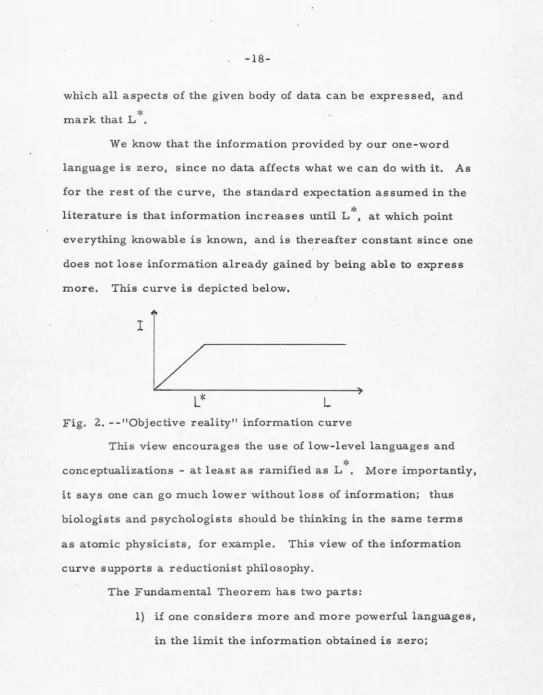
Thus, if we make our chain of languages the horizontal axis of a graph, and a measure of the amount of information given by a fixed set of data the vertical axis, we should at least be able to see the shape of the curve even if we cannot give explicit formulae
for its computation. There is one point worth noting on the language
which all aspects of the given body of data can be expressed, and
~'
mark that L .
We know that the information provided by our one-word
language is zero, since no data affects what we can do with it. As
for the rest of the curve, the standard expectation assumed in the
literature is that information increases until L
*,
at which pointeverything knowable is known, and is thereafter constant since one
does not lose information already gained by being able to express
more. This curve is depicted below.
I
L*
L
Fig. 2. - -"Objective reality" information curve
This view encourages the use of low-level languages and
>'<
conceptualizations - at least as ramified as L'. More importantly,
it says one can go much lower without loss of information; thus
biologists and psychologists should be thinking in the same terms
as atomic physicists, for example. This view of the information
curve supports a reductionist philosophy.
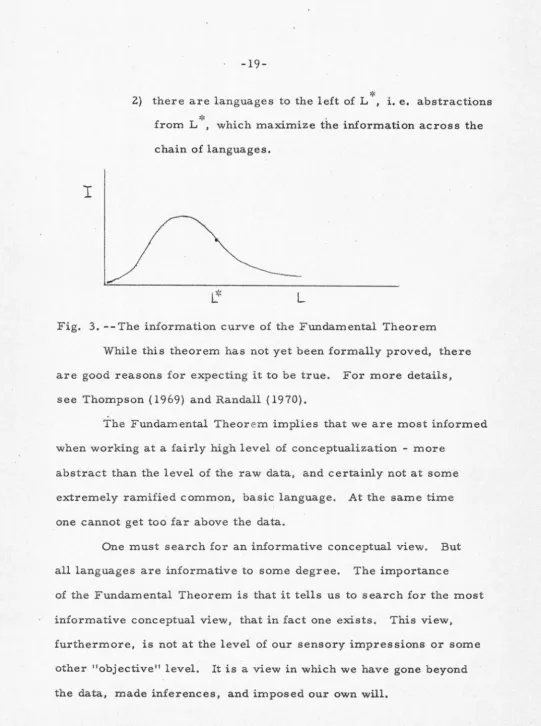
The Fundamental Theorem has two parts:
1) if one considers more and more powerful languages,
[image:24.561.7.551.22.718.2]*
2} there are languages to the left of L , i. e. abstractions
>'<
from L ', which maximize the information across the
chain of languages.
I
Fig. 3. --The information curve of the Fundamental Theorem
While this theorem has not yet been formally proved, there
are good reasons for expecting it to be true. For more details,
see Thompson (1969} and Randall (1970),
The Fundamental Theorem implies that we are most informed
when working at a fairly high level of conceptualization - more
abstract than the level of the raw data, and certainly not at some
extremely ramified common, basic language. At the same time
one cannot get too far above the data.
One must search for an informative conceptual view. But
all languages are informative to some degree. The importance
of the Fundamental Theorem is that it tells us to search for the most
informative conceptual view, that in fact one exists. This view,
furthermore, is not at the level of our sensory impressions or some
other "objective" level. It is a view in which we have gone beyond
[image:25.564.14.555.20.746.2]What is data analysis? On one side is the activity of finding
an informative language and theory within that language. On the
other is the continuing activity of perceiving and data gathering.
Both of these processes affect the other enormously, and data
\
analysis is the bridge that intervenes. Data analysis should tell
us when to move to a more informing theory, and when to gain
information by changing the data we work with to bring it closer to
current language and theory.
Data analysis is that connecti'on between advancing cognitive
structuring, on the one hand, and continuing perception~ on the
other, which produces information.
Statics of Data Analysis
If information is a function of language, one might well
ponder the use of theory. Theories are necessary for the process
of confirmation: one can compare data to a theory, not to a
language. Theory is our bridge between data and conceptual view.
Given a language and a body of data how does one choose
which theory within the language will be used as representative and
compared to the data? We would like to choose the best one, the
theory which fits the data most closely, out of the possibilities
provided by our language. In most languages, however, there is
Mathematical Statistics. Fortunately, for a very few simple languages we can define "fit" and elicit the best-fitting theory.
Mathematical statistics is that subject which describes these languages, a notion of fit, and procedures for finding the best theory in the language. The languages involved are all numeric, and in general are the ones which are mathematically tractable.
For example, one of the most frequently used languages talks about lines: linear functions of one real vari, ble. All sentences in the language are of the form "Y = < number
1 >
+
< number2 > •:C X"; any such sentence can be considered a theory. The associated modelspace is the set of all non-vertical lines in a coordinate plane-- every line corresponds to a sentence and every sentence specifies a line.
For this language and a set of data (pairs of numbers < x., y.>} l l
one can define the best-fitting theory. It is that theory whose values of <.number
1> and <number2> are such as to minimize the function E(a, b}
=
..Z..
(a+ bx. -y.}
2. l l
l
This definition is then used to find the bestfitting theory -the coefficients which minimize -the error function. Obviously. this procedure is curve-fitting with a least-squares criterion,
and in this case finds the regression line.
notion of fit is
---
, and ( 2) using this notion, the best-fitting theory can be found by - - - "Thus mathematical statistics is an important part of data analysis and is limited only by the languages and model spaces it considers.
The Uses of Fitting. Suppose we step back a little and consider what people think they do. We find two rather distinct groups. The first, consisting mainly of statisticians, advocates the use of models to analyze data. The second group, the simulation users, champion the use of data to analyze models. Are these
opposing philosophies?
The people who use models to analyze data talk in terms of "fit": how well does the model fit the data? The viewpoint here is that it is the data which is important; they desire techniques and tools that summarize the dat:a and display the interesting relation-ships in the data. Models, from this point of view, are simply structures that guide data analysis. They are assisting tools, and one should never completely believe in them. Tukey (and Wilk 19 66, p. 796) puts the matter this way: Data analysis "can only bring to our attention a combination of the content of the data with the knowledge and insight about its background which we must
The main tools of this· group are fit and exposure. They fit a model to the data, then consider the residuals - those places and instances of lack of fit. Again according to Tukey ( 1966):
\
The iterative and interactive interplay of summarizing by fit and exposing by residuals is vital to effective
data analysis. Summarizing and exposing are comple-mentary and pervasive . . . . The single most important process of data analysis is fitting. It is helpful in
summarizing, exposing, and communicating. Each fit ( 1) gives a summary description, ( 2) provides a
basis for exposure based on the residuals, and (3) may have the parsimony needed for effective comm uni ca ti on.
In this type of data analysis, while the focus is on the data, we use models and theories as tools to get at the relationships that hold between the various elements in the data. Thus our eyes are on the data and our hands can be manipulating theory.
The other school says that one uses data to analyze models. In this case, people generally have some theory and wish to verify the correctness of that theory against some "real world" data. This is the problem of verification of theory to increase the credibility of theoretical construction.
The view that science proves theories to be true by verifying them has passed its day. The question has instead .become "how much should one believe in a given theory? 11 This is one of the main concerns of the people who design and experiment with simu-lations:
A simulation or game is the partial represen-tation of some independent system. Usually we
Therefore, the representativeness of a simulation or game becomes extremely important in assessing its value. The process of determining how well one system replicates properties of some other system is called validation. In experimental research, validity is the goodness of fit or the correspondence between phenomena produced by two sets of properties. (Hermann 1967, p. 216)
To gain confidence in his simulations, the social scientist may check them against scholarly work in general. Further, he should compare his constructions with "realities'' - empirical descriptions of the world of nation-states and international
or-ganizations . . . . However, a simulated construction is but theory. It provides no shortcut or magical route to the "proof" of the validity of the verbal and
mathematical components it contains. Thus, there is a need for a systematic examination of the extent of the congruences between empirical analyses of world processes and simul.ations of international relations. (Guetzkow 1968, p. 202)
While these two viewpoints seem to be in opposition, it should be clear that both are sub-processes of what we call data analysis. They are both involved in the relationship of data to model, data to theory. The difference is that one side
emphasizes data as being more important, the other side emphasizes the model. This unbalanced attention determines and is determined by the researcher's relative reluctance to change one or the other.
\
Clearly data analysis encompasses both viewpoints and more: it is the dynamic balancing of the activities of perception
and cognition.
Dynamics of Data Analysis
One of the criticisms of statistical decision theory is that the se.t of alternatives open to a decision maker is assumed to be fixed. The importance of this static nature is only now being
recognized:
Much of the impetus for the computerization of managerial decision making came from operations researchers who saw the power of certain optimizing techniques and recognized that most managers could not hope to find the best answers to their problems without the assistance of certain sophisticated mathematics . .
However, an answer can be "optimal" only if the· range of choices considered by the manager is restricted. Let me illustrate: A manager who is being "eaten alive" by carrying costs on his
inventory might be told by a bright young operations researcher (or a computer printout) that he should order items into his inventory in optimal lot sizes. There is a nice little square root formula that tells him how to determine the optimum. Suppose a lot size of 162 is the optimal answer to the math-ematicians question, "What is the optimal lot size? 11 This may solve one facet of the problem, but it is not necessarily the best answer to the manager's questionll
"What should I do about my high inventory carrying
costs?"
The best answer for him might be: (a) hold a fire sale; (b) put a new roof on the warehouse to
stop parts from rusting; ( c) hire new design engineers who can standardize the parts; ( d) fire the accountant
who treats this account as a place to dump other costs; ( e} change the reorder points; or (f} instruct the inventory clerk on corporate goals! (Jones 1970, p. 76}
Enlarging the space of alternatives is one of the means we have for changing a situation in order to gain information. The possibilities for change form the dynamics of data analysis and have too long be en ignored.
There are three types of change which can be considered from our conceptual vantage point: ( 1) one can change his data; ( 2) one can change theories within the basic framework of some fixed language; or (3) one can change languages.
That one might change his data seems improper and is often referred to as unscientific. Historians of science, especially
Kuhn ( 1970, p. 135), have investigated scientists at work and have actually found enormous amounts of selected purging of old data, usually in times of revolutionary science. Further, the gathering of new data is always under the guidance of the current conceptual-ization, including when and how. In statistical analysis there are special techniques which justify the elimination of unwanted data by labeling it error or "outlier."
The dynamics of the situation are such that at times the current conceptualization is more valuable or more believed than data which raises questions about it, and so that data is ignored
or dropped. This may be used to increase the information associated with that conceptualization/ data pair.
language which is best confirmed by our data, which fits best, or which has the best expected payoff. There may be technical
difficul-ties in finding such theories, but for a wide variety of theories the techniques of curve fitting, the calculus of variations, or dynamic programming are effective. The problems· intensify, of course, as the theories involved become more complex.
The conceptual problem, and our lack of understanding, of
language change is greater. We can identify several instances of the general notion of language change.
If some part of a theory becomes very highly confirmed, it
is usually more informative to shift the explicit structure of this subtheory to implicit structure within a language. That way one asswnes something that was once questioned and considered. An example is the belief that physical laws can be stated mathemati-cally. This notion was once as controversial in physics as it is
today in the social sciences.
Other types of language change can have even greater effects. There is change which admits the existence of new
conceptual entities. The existence of forces-which-work-at-a-distance was a revolution in physics, as was the emergence of aristocrats in social philosophy.
alternatives where before there was only one. Abstraction has the
opposite effect; it consolidates many alternatives into one by
ignoring differences. The concept of "people" ignores many
individual d~fferences in favor of certain commonalities. The
concept of sex subdivides the class of people by emphasizing certain
differences while excluding others. The dynamics of
conceptuali-zation is often a pattern of alternation between abstraction and
ramification.
Note that change of language implies theory change as well.
A theory, as a set of sentences within some language, is interpreted
only with reference to rules contained within that language. Even
if the explicit statement of a theory does not change, its meaning
can.
Think of the theory of physics, part of which is contained in
the statement, "all of the properties of the world can be accounted
for as interactions between atoms. " When atoms were defined as
indivisible, basic particles, physicists conducted certain
experi-ments to determine their characteristics, for example the
impli-cation that chemical reactions occur with small-integer weight
relations.
Now, however, when an atom is a collection of further
particles and forces, the operational meaning of the above
state-ment is quite different. "Atom smashers11 were self-contradictory
Language change is more difficult than theory change since
it entails the latter. It therefore occurs less frequently and with
greater effort and attendant confusion. This more basic kind of
change affects the unspoken assumptions of a field so that
commun-ication may be disrupted. In data analysis this relative difficulty
also holds. A social scientist doing correlations and regressions
is working within the language of linear models. To switch to
general polynomial models requires major adjustments in
technique, interpretation, and theory.
The importance .of language chan"ge in the dynamic asp"ects
has already been recognized. Thomas Kuhn, in his work on the
nature of scientific progress ( 19 70}, distinguishes normal science
from revolutionary science. We can identify normal science as
theory change and revolutionary science as. language change.
Kuhn's thesis is. that normal science means working within
a "paradigm", while revolutionary science changes paradigms.
--Kuhn's paradigm is our notion of language. Paradigms are works
which (p. 10} "served for a time implicitly to define the legitimate
problems and methods of a research field for succeeding generations
of practitioners. T-hey were able to do so because they shared two
essential characteristics. Their achievement was sufficiently
unprecedented to attract an enduring group of adherents away from
competing modes of scientific .activity. Simultaneously, it was
redefined group of practitioners to resolve." Although Kuhn is
concerned with major upheavals, his notion is close to our
concep-tion of language, within which there are many theories.
On revolutionary science, or important language change,
Kuhn (p. 84) writes:
The transition from a paradigm in crisis to a new one from which a new tradition of normal science
·can emerge is far from a cwnulative process, one
achieved by an articulation or extension of the old paradigm. Rather it is a reconstruction of the field from new fundamentals, a reconstruction that
changes some of the field's most elementary theoretical generalizations as well as many of its paradigm methods and applications.
Conceptual Frictions. A discussion of dynamics would not
be complete without some thought given to the frictions which are
inhibiting conceptual change. The following is superficial, yet
does represent a beginning on this complex subject.
We can classify the inertias into three broad categories:
informational, psychological, and technical. Psychological
_,resistance to change is the best docwnented and studied. In this
domain, anxiety is a major cause for mental rigidity. An anxious
person seems to lose the ability to move in the
abstraction/ramifi-cation dimension, to a degree dependent on the level of anxiety.
Psychologists are irivestig;:i.ting this aspect of anxiety now.
Another psychological friction is reluctance to change solely
because of the previous level of investment. The investment could
be in terms of money, time, mental effort, or any such scarce
one tries to retain that view if at all possible. These views are
usually abandoned much later than they should have been, only
when their use is a total catastrophe. This effect is visible today
especially in societies, government structure, and computer systems.
Under technological frictions are classified all inertias
imposed on us by our use of current technology. There will always
be technological friction, since one's technology forms a part of
one's reality. Some forms of technology are less limiting than
others, though. The electronic computer has the potential _to
enormously facilitate our conceptual movement. The present_ usage
of computers, however, does not. Chapter II of this dissertation
provides the details on the current computer practice in data
_analysis systems.
Informational frictions are those related to the nature of
information and the conceptualization process. First, suppose that
we attempt to find the most informing conceptual view. That is,
given some starting view, we move in the direction of increasing
information: information hill-dim bing. But there is a trap
here: we may find a language which provides a local maximum,
in terms of information. All of its neighboring languages have
less information, even though some other languages provide more.
One would be reluctant to change conceptual views if it meant a
loss of information immediately and a possible gain later.
The second type of information friction is related to the
can only take place if they share some conceptualization. Remember
that we equate conceptualization to language: the individuals
communicating must be talking the same language. What happens
if one person changes his language? Either the amount of
commun-ication drops, to that part of the language still held in common, or
the other person must adjust his conceptualization to match. The
painfulness of this process is evident, and one can cite many
examples of its effects. A simple one is the frantic effort to
standardize programming languages such as FOR TRAN, COBOL,
or BASIC.
These inertial forces in the dynamics of conceptual change
constitute an interesting and important area of research for the
behavioral sciences. A much deeper understanding of them is
THE CURRENT STATE OF DATA ANALYSIS SYSTEMS
A data analysis computer system is certainly a repository
for data, but it is also something more: a medium for the
articu-lation of conceptualizations. Since data analysis is the interaction
between cognition and perception, the primary goal of these
compu-ter systems is to encourage and provide support for this incompu-teraction.
Data analysis systems must aid both sides: the ongoing
processes of data collection and theory building. Furthermore,
these two processes must be in harmony--neither can be neglected
or overshadowed.
There is an important point to be made about computer aids
for conceptual developments. Computer systems are always a
resistance to conceptual movement. They are, after all, only
recursive mechanisms. Beyond this, however, various types of
systems have their own rigidities. These,,restrictions exist
be-cause of the incorporation of meta-level conceptualizations (the
system designer's) and CUl;'rent technological limitations. Any particular system represents a balance between the conceptual and
technological efficiencies obtainable by imposing limitations and
tl~e inhibition of conceptual freedom that such limitations require.
The basic questions to be asked about current systems
include: ( 1) what range of user conceptualizations does the system
system aid the process of data adjustment; and (4) does the system
balance data and theory?
Today there are five identifiable system types being used
for data analysis:
1. data management
2. statistical analysis
3. question-answering
4. reference retrieval
5. simulation
Data Management Systems
These are the systems designated by some combination of
the terms data, information, file, retrieval, management, and
generalized. There are currently around 200 distinct systems in
existence; the system type is being studied intensively by a
CODASYL committee ( 1969).
Data management systems are an evolved form of the 3 x 5
card file. This extremely useful device is typified by the card
catalogue in a library. The catalogue consists basically of a file
of cards, one for each book in the library. Each card contains all
the data pertaining to one book, such as its title, call number, author,
etc. There are also auxiliary files, containing such things as
cross-references which facilitate certain types of searches.
In current data management systems a data base consists of
a similar, fixed format and all contain data about a single type of
entity. Each record contains essentially all of the data about an
entity, and ideally there is only one record per entity. Finally,
some of the newer systems have added auxiliary files of indexes,
using the notion of the "inverted file," in order to facilitate certain
kinds of searches.
Using these data management systems, one could,
theoreti-cally, display the record of a single, particular entity. Instead,
one usually produces' a "report," a display of a specified portion
of the record for all those records satisfying some selection
criteria. An example of such a report, and of these systems, is shown below in Figur<;i 4. An understanding of the nature of data
management systems requires a look at the restrictions placed
on the selection criterion. The decision of whether to include record
X must be made on the basis of data contained only in record X.
That is, the selection criterion is a recursive function of data in the given record exclusively.
This limitation enforces a worldview that each entity, i.e.
record, is basically independent of every other entity. What sorts of user conceptualizations are allowed in this environment? The
only theories permitted are those that state that some entities
. really are related and are interesting: all those which pass some stated selection process. Thus the space of theories is generated by the set of allowable selection functions, which are limited as
The data management systems facilitate the user's movement
through this conceptual space both by providing such a simplified
space and by making it relatively easy to describe the selection
function desired. The tremendous proliferation of such systems
provides proof of the effectiveness of their conceptualization and
implementation technique.
The.limits of their applicability are equally clear. These
systems assume a basically static language, that is in this case a
basic set of data attributes. Modification of data in existing records
is tolerated, as is the addition of new records within an existing
file. Barely tolerated, since, as a typical example of the common
use of such systems, a change-of-address on a magazine
subscrip-tion will take six to ten weeks.
As for more fundamental changes, the addition or deletion
of an attribute across an entire file for instance, these require
major upheavals in conceptualization as well as considerable time
and effort. Data management systems are counterproductive in
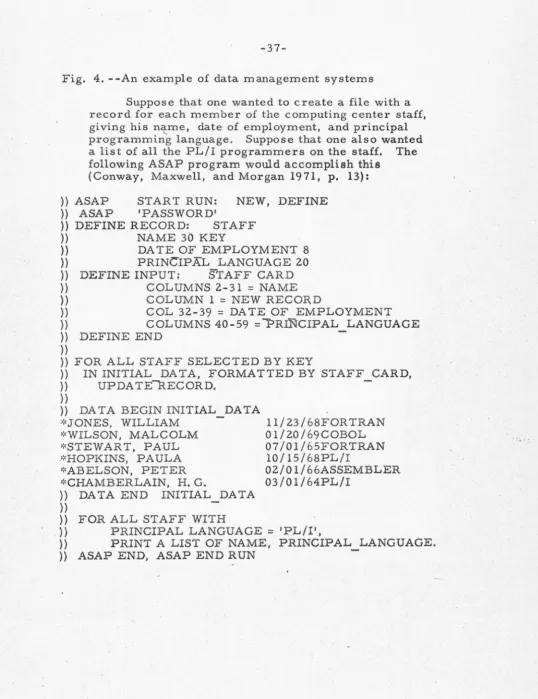
Fig. 4. --An example of data management systems
Suppose that one wanted to create a file with a record for each member of the computing center staff, giving his n~me, date of employment, and principal programming language. Suppose that one also wanted a list of all the PL/I programmers on the staff. The following ASAP program would accomplish this
(Conway, Maxwell, and Morgan 1971, p. 13): )) ASAP START RUN: NEW, DEFINE
)) ASAP 'PASSWORD'
) ) DEFINE RECORD: STAFF
)) NAME 30 KEY
)) DATE OF EMPLOYMENT 8
)) PRINCIPAL LANGUAGE 20
)) DEFINE INPUT; STAFF CARD
)) COLUMNS 2-31 =NAME
)) COLUMN l =NEW RECOR.D
)) COL 32-39 = DA TE OF EMPLOYMENT
)) COLUMNS 40-59 =PRINCIPAL LANGUAGE
) ) DEFINE. END
))
)) FOR ALL STAFF SELECTED BY KEY
)) IN INITIAL DATA, FORMATTED BY STAFF CARD,
)) UPDATE~ECORD.
-))
)) DATA BEGIN INITIAL DATA >!<JONES, WILLIAM
>:<WILSON, MALCOLM >!<STEWART, PAUL .':'HOPKINS, PA ULA >!<ABELSON, PETER >'.cCHAMBERLAIN, H. G.
)) DATA END INITIAL DATA FOR ALL STAFF WITH
ll/23/68FORTRAN Ol/20/69COBOL 07 /Ol/65FORTRAN
l0/15/68PL/I
02/0 l/ 66ASSEMBLER 03/0l/64PL/I
))
))
))
))
))
PRINCIPAL LANGUAGE = 'PL/I', PRINT A LIST OF NAME, PRINCIPAL ASAP END, ASAP END RUN
[image:43.564.11.549.27.726.2]Statistical Analysis Systems
These systems have been designed to support the
mathemati-cal statistics view of data analysis. These packages usually include
a primitive data management system with a simple, rigid data
structure, and place emphasis on the processes available for
analysis and summary. Some of the current systems are OSIRIS
(Inter-university Consortium for Political Research), SPSS
(University of Chicago), PSTAT (Princeton University), and BMD
(UCLA).
The statistical analysis systems make the asswnption that
their data is a random sample from some much larger (i. e. iz:i.f.inite)
population. In this conceptualization only the broad, statistical
view is relevant and analysis of individuals is meaningless. Thus
these systems have a data structure which can be described as
rectangular: a fixed set of entities, a fixed set of attributes (either
nwnerical or character-valued), and each entity is characterized
by all attributes. There is no cross-linking of entities.
In fact, in a random sample one does not expect the
indivi-duals to be interconnected, and most statistical processes assume
independence of individuals. Having related entities implies that ·
the sampling technique was faulty.
Thus the world view presented is one of having a small
amount of data taken from a large population. One wishes to
In order to do this, the statistical systems provide a set of
primary tools. Each tool is a process which imposes some
particular conceptualization on the data and summarizes the data
accordingly. These basic theoretical views are the usual ones
found in mathematical statistics, simple random variables with
known probability distributions, for example.
In these systems a user can also express his theoretical
view by transformations of the data or by some recursive selection
process. Thus a user's conceptual space consists of some fixed
set of basic views applicable to recursive transformations of the
data. The overriding limitation is that the data must be considered
a random sample collected from a large total population.
Fig. 5. - -An example of statistical analysis systems (Nie, et al. 1970, p. 54)
RUN NAME FILE NAME VARIABLE LIST
INPUT MEDIUM
#OF CASES
INPUT FORMAT MISSING VALUES
VAR LABELS
VALUE LABELS
SAMPLE RUN OF THE SPSS SYSTEM EXAMPLE2, THIS IS THE FILE LABEL AGE, SEX, RACE, INCOME, EDUCA TN CARD
10
FREEFIELD
AGE TO RACE (0,
8,
9) /INCOME(?)/EDUCATN(O)
AGE, AGE OF THE RESPONDENT/ SEX, SEX
OF THE RESPONDENT /INCOME, YEARLY
FAMILY INCOME IN DOLLARS/EDUCATN,
EDUCA TN OF HEAD OF HOUSEHOLD
SEX( l)MALE(2)FEMALE(3)NOT
ASCER-TAINED/RACE( l)WHITE(2)NEGR0(3)
ORIENTAL(4)0THER(9)NOT ASCERTAINED/ EDUCATN(l)NONE(2)PRIMARY OR LESS(3) SOME SECONDARY(4)SECONDARY GRADU-ATE(5)SOME COLLEGE(6)COLLEGE
[image:45.563.18.548.29.725.2]PRINT FORMATS AGE TO EDUCATN (o)
CROSSTABS RACE BY INCOME BY EDUCATN/INCOME
BY RACE BY SEX
OPTIONS 1, 3
STATISTICS 1, 4, 6
READ INPUT DATA
74 1 2 8999 7 64 2 1 7463 4 24 3 1 5000 6
41 3 1 4756 2 87 1 2 2746 3 55 2 4 8468 5
57 2 3 9999 7 25 3 4 5472 1 37 2 3 2757 4
28 1 1 7000 1
PEARSON CORR AGE TO EDUCA TN WITH SEX TO INCOME
OPTIONS 1, 3
FINISH
Question-Answering Systems
W. Cooper ( 1964) first described what is now the standard
view of question-answering or fact-retrieval:
There are two propositions which are plausible in themselves, and which, when viewed in conjunction, focus attention on what we believe to be the fundamental problem of Fact Retrieval.
Proposition I. A Fact Retrieval system must
normally accept most of its information to be stored, and also its queries, in the form of natural
language sentences (e.g. English) rather than in some artificial language selected for the purpose.
Proposition II. A Fact Retrieval system must possess the capability of performing logical
deduc-tions among the sentences of its input language .. .
Together these propositions suggest that the central theoretical problem of Fact Retrieval is to
·develop a system of logical inference among natural
We can categorize question-answering systems into two
types. Corresponding to an intensional view are the deductive
systems, to an extensional view are the relational systems. A
third type, the semantic net system (Quillian 1969), is an interesting
and novel attempt to combine an intensional view with an extensional
structure.
Deductive Question-Answering Systems
Deductive systems have evolved from artificial intelligence
research on finding deductive proofs of mathematical theorems.
The research has been generalized to deductions in a predicate
calculus environment, usually only the first-order calculus. The
question-answering systems, then, add to this work a translation of
the English input sentences into the predicate calculus, but
other-wise use the same techniques.
These deductive systems all assume the intensional view,
that is, they manipulate sentences and theories. The approach to
. deduction is essentially syntactic: new theorems are added to a
growing store by grammatical manipulations of the previously
existing set. The most efficient current techniques, the resolution
methods, do work extensionally by trying to construct models.
If an appropriate model cannot be constructed, it proves the falsity
. of some sentence: usually the negation of the theorem one is trying
and clauses; one uses the linguistic entities as elements of models
in order to construct manipulable models.
There are several interesting aspects to the intensional
approach. The first deals with the notion of atomistic completeness.
The concept of completeness, taken from logic, is the property of a
theory or model that all parts of that theory or model can be derived
from some basic set of primitive elements--the atoms of that
theory or model. Applied to a data base, this means that all of
the data can be derived by application of recursive functions to the
atomic elements of the data base.
A good example is the grandparent relation. Suppose that the
parent relation is a primitive in some data base. Then one can
define the grandparent relation as the composition of parent with
itself: "grandparent" means "parent of parent." In this case the
grandparent relation is totally dependent on the parent relation and
derives all of its characteristics from it; for example, the fact
that every person has four grandparents. At this point the
grand-parent relation has added nothing new, and all instances of the
term could be replaced by its definition.
Suppose, however, that one added the datum "the grandparent
of Mary is John" and that our data does not include Mary's parents.
Now grandparent is de-coupled from parent; it has more properties
and relationships to the rest of the world than is implied by the
parent relation. This data base no longer has the property of
A theory or model can be atomistically complete only if all
of its elements are of the primitive, atomic kind, with recursive
definitions added for higher-level structures. In an atomistically
complete model, with a primitive parent relation, the grandparent
relation can be either 1) defined solely as "parent of parent" and
thus completely coupled, or 2) defined primitively also, thus
completely uncoupled.
All of the current extensional systems are atomistically
complete, and it is only the intensional, deductive systems which
are not so ·restricted.
The ability to handle meta-level data gives these systems
their great power. The logic of the deductive systems is explicit,
and therefore can be manipulated instead of implicit in the
processing routines as is the case for other types of systems. An
example of this power is the fact that these systems can comprehend
data containing quantifiers as primitive items. "At least ten
people live in Boston, 11 as data, makes certain kinds of deductions
and answers possible, even if we· are uncertain exactly who is in
Boston.
The cost of this power is clear; deductive systems use a
recursively-enumerable search procedure, rather than the
recursive procedures found in the extensional systems. By this
we mean that the set of theorems in a formal language is recursively
truth or falsity of any given sentence directly, but instead one
must list all theorems and see if the given sentence is among
them. This enumeration technique, the only effective procedure
for a recursively enumerable non-recursive set, has been shown
time and again to be much slower than a direct approach where
that is possible. This relative inefficiency limits the complexity
of query and the size of data base allowable. For example, a
recently developed system (Biss, Chien, and Stahl 1971, p. 303)
works with a data base consisting of 2000 English sentences, claimed
to be "larger than any other data base currently being used for
natural language [ deductive ] question-answering systems. 11
This fundamental limitation on efficiency may be bypassed to some
extent by a judicious combination of both intensional and extensional
approaches, which is the long-range promise of the semantic net
systems.
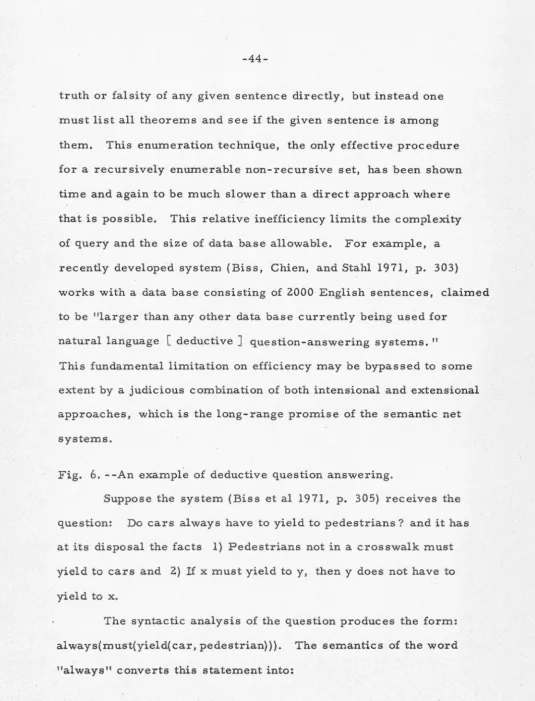
Fig. 6. --An exampl~ of deductive question answering.
Suppose the system (Biss et al 1971, p. 305) receives the
question: Do cars always have to yield to pedestrians? and it has
at its disposal the facts 1) Pedestrians not in a crosswalk must
yield to cars and 2) If x must yield to y, then y does not have to
yield to x.
The syntactic analysis of the question produces the form:
always(must(yield(car, pedestrian))). The semantics of the word
[image:50.564.16.551.24.725.2]