N A N O I D E A
Open Access
Highly Stretchable Micro/Nano Wrinkle
Structures for Infrared Stealth Application
Jia Wang
1,2, Yijun Li
1, Jianli Cui
2and Hao Guo
2*Abstract
We demonstrate a novel infrared stealth structure consisting of SiO2/TiO2film, which was manufactured as the highly stretchable triangular wrinkle structures. The triangular wrinkle structures have firstly been transferred to the flexible substrate from the surface of Si-substrate, which was manufactured by the MEMS technology. Then, the infrared reflective film have been manufactured to be the triangular wrinkle structures by depositing the materials (noble metal (Ag or Au) or multilayer oxide (SiO2/TiO2)) on the surface of flexible substrate. Due to the lower reflection effect of curved surface, the infrared reflectivity of these structures has been tuned down to 5%. And, compared to the flat surface, the reflection-to-diffuse ratios improved approximately one order of magnitude. These structures can adapt to the environment by changing the reflectivity of triangular wrinkle structures under stretching. Finally, an Au-modified infrared stealth structure has been fabricated as the array structures, which disappeared and then display by stretching the triangular wrinkle structures at room temperature. It features high reflection-to-diffuse ratios, stable repeatability, low-cost, and easy to manufacture. It may open opportunities for infrared camouflage for military security and surveillance field application.
Keywords:Infrared stealth, Triangular wrinkle structures, Highly stretchable, Mechanical actuation
Background
Infrared stealth technology has been widely used in field of spacecraft components [1], camouflage plat-forms [2], protective clothing [3], container packaging [4], and so on [5–7]. Especially to the military security and military surveillance field, which can protect the aircraft from detection.
In recent year, many materials, which statically re-flect radiation in the infrared region of the electromag-netic spectrum, have been studied [8–10]. Wei et al. [11] proposed a metamaterial-based infrared reflection method by modulating the photo-generated carrier doping. Kocabas et al. [12] demonstrate active surfaces structures that can be controlled to tune the reflection, transmission, and absorption of microwaves. However, this kind of novel material was confined by complex technology, ultra-low production, and high cost.
To optimize the adaptabilities of infrared stealth structures, many different adaptive infrared materials
and structures have been designed and studied [13–15]. Valentine et al. [16] demonstrated a metamaterial-based infrared reflection method by spatiotemporally control-ling the emissivity of metamaterial which is modulated with ultraviolet light. However, this structure has been actuated by the ultraviolet light, high temperatures, and large temperature gradients. Gorodetsky et al. [17] de-veloped an adaptive infrared-reflecting structures based on the wrinkles structure with the feature of low work-ing temperature, tuneable spectral range, fast response, and autonomous operation. However, this structure must be actuated by the high voltage about 3 kV, which is difficult to achieve in the common field, especially for aircraft.
In this study, a novel stretchable triangular wrinkle structure has been designed and manufactured to be the adaptive infrared stealth structure. The infrared re-flectivity of this structure has been tuned to 5%, and a straightforward manufactured using the infrared reflecting materials was disappearance, and then dis-play with the deformation of the triangular wrinkle structures under a simple mechanistically actuation at room temperature.
* Correspondence:[email protected]
2Science and Technology on Electronic Test & Measurement Laboratory,
North University of China, Taiyuan 030051, Shanxi, China Full list of author information is available at the end of the article
Methods
The polydimethylsiloxane (PDMS) (10:1) membranes (Sylgard 184, Dow Corning) were prepared by spin coating on silicon wafers with a thickness of 500 μm by controlling the spinning speed, and cured immedi-ately after spinning at less than 80 °C for 2 h [18].
The silver film and the alternating layers of titanium di-oxide (TiO2) and silicon didi-oxide (SiO2) were deposited on the PDMS substrates by the electron-beam evaporation according to the standard micro-fabrication techniques.
The total reflectance, diffuse reflectance, and total trans-mittance of our structures were characterized with a Fron-tier transform infrared spectrometer (Perkin Elmer). The measurements were performed at an illumination angle of 12° over a wavelength range of 2 to 14μm and referenced to a diffuse gold standard (Pike Technologies).
The topography of the triangular wrinkle structure were characterized by laser scanning microscope (Model: LEXT OLS4100; Co.: Olympus) and atomic force microscope (AFM) (Model: Multimode8; Co.: Bruker). The infrared pictures and videos were obtained with a thermal imager camera (FOTRIC 226S) for the temperature and an effect-ive spectral range from wavelengths of 8μm to 14μm.
Results and Discussion Infrared Stealth Mechanism
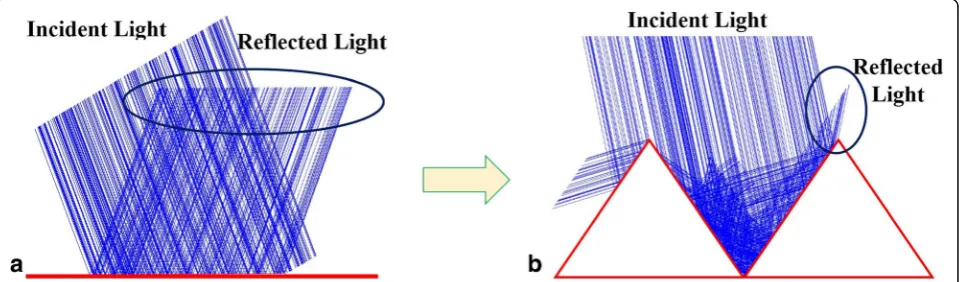
Schematics of the infrared reflecting structures were depicted in Fig.1. We investigated the properties of in-frared reflectance based on the triangular structure. The model of infrared stealth was simulated by the software of Zemax. As the light was incident on a flat structure, the most the incident light would reflected along a determined direction following the law of re-flection, as shown in Fig. 1a. When the light was inci-dent on the triangular structures, most of the light fall inside the triangular trap structures and only a litter light can reflect out of the triangular structures, as depicted in Fig. 1b. That is, as the infrared light was incident into the triangular structure, most of the
infrared light would not be detected using the reflec-tion mechanism of light. This triangular structure can be invisible for the infrared detection technique.
Fabrication of Triangular Wrinkle Structure
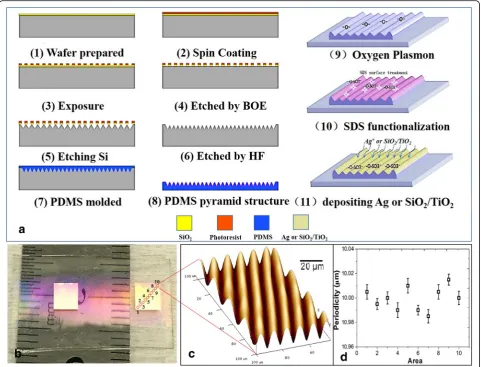
As shown in Fig. 2, the triangular wrinkle structures were fabricated using the MEMS technology, which have been reported in our previous work [19]. First, a positive photoresist was spin-coated on the silica wafer at 3000 rad/min and baked at 105 °C for 90 s. Second, the wafer was exposed to a dose of 135 mJ/cm2with a mask aligner and baked at 115 °C for 120 s to form strong crosslinks. After the wafer had gradually cooled down, the structure was immersed in a positive devel-oper (40 s). Third, etch SiO2 using a buffered oxide etch and etch Si using 15 wt% TMAH + 17 vol% iso-propyl alcohol (22 min). Fourth, a SiO2 layer was re-moved by the hydrofluoric acid. Then, a triangular-like structure was obtained, as shown in Fig.2a [6]. Fifth, a PDMS mold was prepared by mixing the liquid PDMS elastomer and curing agent at a 10:1 ratio in volume, which was poured onto the Si mold and was thermally cured at 80 °C for 1.5 h to obtain the triangular struc-ture on the surface of PDMS substrate to form the PDMS mold. Then, a SiOx layer and hydrophilic groups (e.g., -OH) have been formed on the surface of the PDMS substrate under oxygen plasma treatment at 150 W for 15 s. The sample was then immersed in an SDS solution for 15 s to introduce -SO3− groups at the surface of the triangular wrinkled PDMS structure. This process can introduce a condensation reaction of hydrophilic functionalities between the PDMS and noble metal (Ag, Au) and oxide materials (SiO2, TiO2), which have been reported in detail in our previous work [20–22]. Finally, metal or oxide triangular wrin-kle structure were obtained by coating the metal or oxide on the surface of the PDMS mold using the electron-beam evaporation technology, which have been reported in detail in our previous work [20–22].
[image:2.595.59.540.573.714.2]As shown in Fig. 2b–d, the periodicity of triangular wrinkle structures was uniform, and the periodicity was about (10 ± 0.1) μm on the whole surface of the sample tested by atomic force microscopy. And the size of sample was about 4 mm × 4 mm. Desired peri-odicity was achieved by tuning the size of mask struc-tures and etch parameters, which can be calculated as introduced in our previous studies [19].
Infrared Stealth Testing
In our work, the metal triangular wrinkle structures have been firstly fabricated to investigate the infrared reflec-tion effect. Due to the high ductility, excellent bendabil-ity, and relatively low hardness and cost, metal Ag materials have been selected to manufacture the infrared reflective film. The Ag triangular wrinkle structures have been fabricated following the process of Fig.2a.
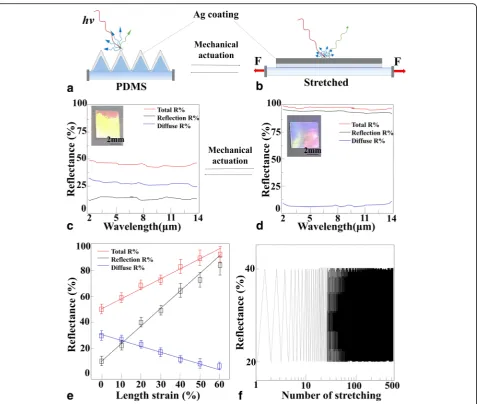
Before mechanical actuation, when a beam of light is incident on the tip of the triangular infrared reflective structure (Fig. 3a), most of the infrared ray (red line) has been diffused by the tip (blue line) and only a little light can be reflected (green line) into the detector. While after mechanical actuation, the surface of tri-angular structure can be gradually stretched to be plane as shown in Fig.3b. In the case, most of the inci-dent light would reflect into the detector.
The corresponding infrared spectra have proved the above results in our experiment as shown in Fig.3c. As unactuated triangular wrinkle structures, it featured a high average total reflectance of 46 ± 2%, a low average reflection of < 13%, and a moderate average diffuse light of 33 ± 2%. Hence, the total reflectance featured a weak average reflection of 13 ± 2% and a dominant average diffuse component of 33 ± 2%, in a ratio of ~ 0.4. After mechanically stretching the triangular wrinkle structures
Fig. 2Fabrication process and morphology characterization of the triangular wrinkle structures on the polydimethylsiloxane (PDMS) substrates.a
[image:3.595.58.540.88.455.2](as shown in Fig.3d), the corresponding infrared spectra featured an increased average total reflectance of 97 ± 1%, a high average reflection of 89 ± 1%, and a low aver-age total diffuse light of 8 ± 1%.
From the experiment results, the reflectivity increased from 13 to 89% with stretching the triangular Ag wrinkle structures. Also, the diffuse light has been reduced from 33 to 8%. The reason was that the triangular Ag wrinkle structures have been stretched to be Ag plane film. The incident light can reflect along a certain angle from the plane film following the law of reflection. Due to the high reflectivity of plane film, the total reflectance can be up to 100% in theory and the diffuse light was only a small amount. Considering the rough surface of Ag film, the
reflection would be reduced (89%) and the diffused light would be increased (8%).
Meanwhile, compared to the wrinkle structure, the dif-fused light reduced from 33 to 8% from the plane film. The reason was that the roughness of the triangular Ag wrinkle structures was about ~ 1 μm depended by the height of wrinkle structures. But for the Ag plane film, the roughness was about ~ 20 nm or smaller, which was the roughness of Ag film. Hence, the diffuse light can be fur-ther reduced by optimizing the technological parameter of electron-beam evaporation.
In this case, the total reflectance featured a much larger average reflection of 89 ± 1% and a smaller average diffuse light component of 8 ± 1%, in a ratio of ~ 11. Hence, the
[image:4.595.61.539.85.489.2]reflection-to-diffuse ratios have been approximately in-creased an order of magnitude based on triangular wrinkle structures.
In general, the total reflectance of triangular wrinkle structures at broadband wavelength increased as a func-tion of the strain (Fig.3e). The reflectivity increased with the strain, but the diffuse reduced, as stretching the tri-angular wrinkle Ag film to be flat. The infrared reflection properties were fully reversible on repeated mechanical actuation contributing to the highly stretchable property of wrinkle structures. And only minor performance deg-radation has been observed after 500 cycles (Fig. 3f ). Thus, mechanical actuation of our triangular wrinkle structures induced a change, which can be reversible and dynamically modulated of the broadband reflectance within the short- to long-wavelength infrared region.
In general, compare to the broadband infrared technol-ogy, the narrow infrared band has the higher signal-to-noise ratio and easier traceability for infrared target detection, discernment, and tracking application.
Hence, to improve the precision of infrared target detec-tion, discernment, and tracking technology, the narrowband
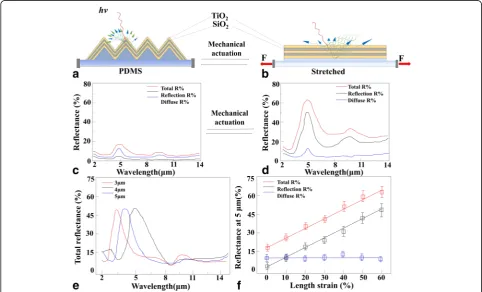
infrared reflection effect of triangular wrinkle structures has been investigated as shown in Fig.4.
To obtain narrowband infrared reflectance peak, al-ternating TiO2/SiO2/TiO2/SiO2/TiO2 layers with thicknesses of λpeak/(4 ×nTiO2) and λpeak/(4 ×nSiO2)
have been designed. The structures were manufactured according to standard lithographic protocols as shown in Fig.2a. The TiO2/SiO2Bragg stacks with a peak re-flectance intensity at 5μm was produced with the SiO2 thickness was 0.933 μm and the TiO2 thickness was 0.543μm by an Angstrom Engineering EvoVac system. The narrowband infrared reflection structures consist of two-layer SiO2and three-layer TiO2. And the size of narrowband infrared reflection structures based on the triangular wrinkle structures was about 4 mm × 4 mm.
In our works, before mechanical actuation, the nar-rowband infrared reflection structures based on the triangular wrinkle structures, the infrared spectra fea-tured the total reflectance intensities of 18 ± 2% at a wavelength of 5μm, with a weak average reflection of 5 ± 2% and an average diffuse component of 13 ± 2%, in a ratio of ~ 0.38, as shown in Fig.4c.
[image:5.595.56.539.362.654.2]After mechanical actuation, the total reflectance in-tensities increased up to 63 ± 4% at a wavelength of 5 μm, with a much larger reflection component of 50 ± 3% and a nearly unchanged diffuse component of 13 ± 2% in a ratio of ~ 3.8 (as shown in Fig. 4d). This re-sult was consistent with the Ag-modified reflective film based on the triangular wrinkle structures. The reflect-ivity increased from 5 to 63% caused by the reasons that the triangular TiO2/SiO2 multi-layers wrinkle structures have been stretched to be plane film. The incident infrared light can reflect along a certain angle from the plane film to improve the reflectivity.
Similarly, for narrowband infrared reflectivity structure based on the triangular wrinkle structures, the reflection-to-diffuse ratios reduced about one order of magnitude at a wavelength of 5μm. Also, the same results can be proved at the wavelengths of 3, 4, and 5μm (owing to the change of thickness of the TiO2and SiO2), as shown in Fig.4e.
In general, the total reflectance of triangular wrinkle structures at broadband wavelength increased as a function of the strain (Fig.4f ). The reflection increased with the strain, but the diffuse components remained relatively unaffected. The reason was that the rough-ness of the triangular wrinkle structures and the plane film was about the same size. The height of wrinkle structures was reduced from ~ 1μm to ~ 200 nm with covering the TiO2or SiO2film. Because the corner be-tween two triangular structures would cover more film than other area, which would reduce the height of TiO2/SiO2 multi-layers film wrinkle structures. The
more the thickness of film increased, the more the height reduced. While for the TiO2/SiO2plane film, the rough-ness was about ~ 50 nm caused by the worse quality for the oxide than the metal using the MEMS technology.
Demonstration of Application Examples
As a proof-of-concept for infrared stealth of triangular wrinkle structures, we evaluated our infrared stealth struc-tures to conceal themselves under infrared visualization.
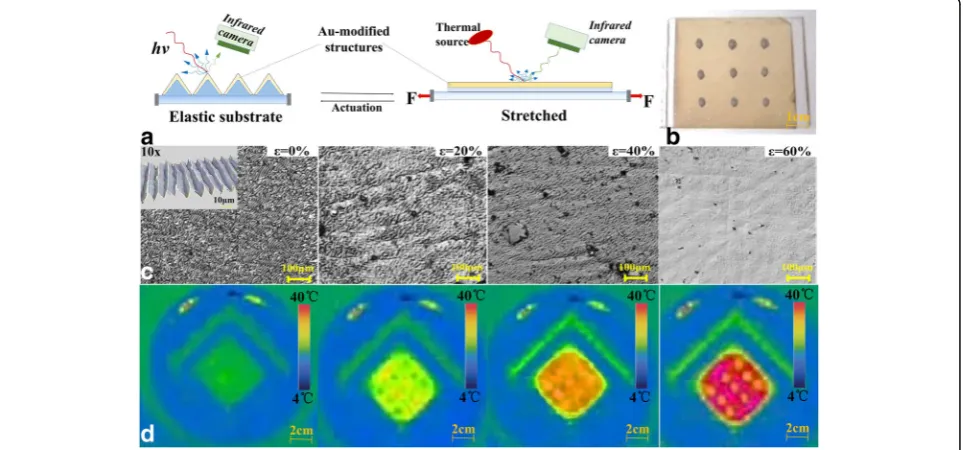
We designed and manufactured an Au-modified infra-red reflective film with three-by-three arrays structures. The size of the sample was 5 cm × 5 cm and imaged by a thermal infrared camera, as shown in Fig. 5a. The three-by-three arrays structures served as the label com-posed of PDMS-nanodiamond composite materials, which have high infrared transmission materials, as shown in Fig.5b.
Before mechanical actuation, the triangular Au-modified wrinkle structures were clearly observed by the laser scan-ning confocal microscopy as shown in the inset in Fig.5c (left). From the sectional view of inset, triangular structure can be seen clearly. And the corresponding infrared image can be shown in Fig. 5d (left). Without actuation, there was only an overall outline of Au-modified film structures. As the strain increased from 0 to 60%, the triangular wrin-kle structure had been stretched to become flat and the height decreased to zero, which was observed by the laser scanning confocal microscopy. And the corresponding in-frared image have shown that the Au-modified film struc-tures gradually become red caused by the increased
[image:6.595.58.540.459.684.2]infrared reflectivity. And the three-by-three arrays structure was emerging to be a hole. Hence, the re-sults prove the infrared stealth effect of the triangular wrinkle structures with the advantage of repeatability, stability, and fully reversibility.
Conclusions
We have examined the infrared stealth properties of noble metal (Au and Ag) and metal oxide (TiO2/SiO2)-modified stretchable triangular wrinkle structures.
First, the infrared reflectivity of these structures has been tuned from 50 to 5% and the reflection-to-diffuse ra-tios dynamically modulated by approximately order of magnitude. Second, our presented structures feature cap-abilities for adaptive infrared camouflage technologies at the broadband and narrowband wavelength. Third, the structures have been straightforward integrated and fea-tured stability to repeated cycling. Last, the structures en-able new autonomous porten-able technologies under a simple mechanistically actuation at room temperature. Ul-timately, the described structures may afford new possibil-ities for infrared camouflage applied in the field of military security and surveillance.
Abbreviations
AFM:Atomic force microscope; PDMS: Polydimethylsiloxane
Funding
This work was financially supported by the China Postdoctoral Innovative Talents Support Program (BX20180276), the National Natural Science Foundation of China (51635011 and 51727808), and the Shanxi“1331 Project”Key Subjects Construction.
Availability of Data and Materials
They are all in the main text and figures.
Authors’Contributions
JW performed the measurements and wrote the main manuscript text. HG conceived the idea. JC prepared the samples. JL modified the manuscript. All authors contribute the analysis and discussion of the experimental data and approved the final manuscript.
Competing Interests
The authors declare that they have no competing interests.
Publisher’s Note
Springer Nature remains neutral with regard to jurisdictional claims in published maps and institutional affiliations.
Author details
1Department of Physics, School of science, North University of China, Taiyuan
030051, Shanxi, China.2Science and Technology on Electronic Test &
Measurement Laboratory, North University of China, Taiyuan 030051, Shanxi, China.
Received: 24 July 2018 Accepted: 31 October 2018
References
1. Dai GL, Shang J, Huang JP (2018) Phys Rev E 97(2):022129
2. Li Y, Shen XY, Wu ZH, Huang JY, Chen YX, Ni YS, Huang JP (2015) Phys Rev Lett 115(19):195503
3. Xu HY, Shi XH, Gao F, Sun HD, Zhang BL (2014) Phys Rev Lett 112(5):054301
4. Yang TZ, Wu QH, Xu WK, Liu D, Huang LJ, Chen F (2016) Phys Rev A 380(7– 8):965–969
5. El-Ganainy R, Makris K, Khajavikhan M, Musslimani Z, Rotter S, Christodoulides D (2018) Nat Phys 14:11–19
6. Zigoneanu L, Popa B, Cummer S (2014) Nat Mater 13(4):352–355 7. Han TC, Bai X, Gao DL, Thong JTL, Li BW, Qiu CW (2014) Phys Rev Lett
112(5):054302
8. Niu S, Joe G, Zhao H, Zhou Y, Orvis T, Huyan H, Salman J, Mahalingam K, Urwin B, Wu J, Liu Y, Tiwald T, Cronin S, Howe B, Mecklenburg M, Haiges R, Singh D, Wang H, Kats M, Ravichandran J (2018) Nat Photonics 12:392–396 9. Arbabi A, Arbabi E, Horie Y, Kamali SM, Faraon A (2017) Nat Photonics 11(7):415 10. Giddens H, Yang L, Tian J, Hao Y (2018) IEEE Photon Technol Lett 30(8):748–751 11. Xiao L, Ma H, Liu J, Zhao W, Jia Y, Zhao Q, Liu K, Wu Y, Wei Y, Fan S, Jiang K
(2015) Nano Lett 15:8365–8370
12. Balci O, Polat E, Kakenov N, Kocabas C (2015) Nat Commun 6:6628 13. Maldovan M (2013) Nature 503:209–217
14. Li Y, Bai X, Yang T, Luo H, Qiu C (2018) Nat Commun 9:273
15. Liu D, Cheng H, Xing X, Zhang C, Zheng W (2016) Infrared Physics and Technology 77:339–343
16. Coppens Z, Valentine J (2017) Adv Mater 29:1701275 17. Xu C, Stiubianu G, Gorodetsky A (2018) Science 359:1495–1500 18. Duan J, Zhu Q, Qian K, Guo H, Zhang B (2017) Nanoscale Res Lett 12:515 19. Cui J, Zhang B, Duan J, Guo H, Tang J (2017) Materials 10(12):1439 20. Tang J, Guo H, Zhao M, Yang J, Tsoukalas D, Zhang B, Liu J, Xue C, Zhang
W (2015) Sci Rep 5:16527
21. Guo H, Tang J, Zhao M, Zhang W, Yang J, Zhang B, Chou X, Liu J, Xue C, Zhang W (2016) Nanoscale Res Lett 11:112