BIROn - Birkbeck Institutional Research Online
Gutin, G.Z. and Reidl, Felix and Wahlström, M. (2018) k-distinct in- and
out-branchings in digraphs. Journal of Computer and System Sciences 95 , pp.
86-97. ISSN 0022-0000.
Downloaded from:
Usage Guidelines:
Please refer to usage guidelines at
or alternatively
k
-Distinct In- and Out-Branchings in Digraphs
∗
Gregory Gutin
1, Felix Reidl
2, and Magnus Wahlstr¨
om
11
Royal Holloway, University of London, UK
2
North Carolina State University, USA
October 8, 2018
Abstract
An out-branching and an in-branching of a digraphD are called k -distinct if each of them has k arcs absent in the other. Bang-Jensen, Saurabh and Simonsen (2016) proved that the problem of deciding whether a strongly connected digraph D has k-distinct out-branching and in-branching is fixed-parameter tractable (FPT) when parameterized byk. They asked whether the problem remains FPT when extended to arbitrary digraphs. Bang-Jensen and Yeo (2008) asked whether the same problem is FPT when the out-branching and in-branching have the same root.
By linking the two problems with the problem of whether a digraph has an out-branching with at leastkleaves (a leaf is a vertex of out-degree zero), we first solve the problem of Bang-Jensen and Yeo (2008). We then develop a new digraph decomposition called the rooted cut decomposition and using it we prove that the problem of Bang-Jensen et al. (2016) is FPT for all digraphs. We believe that therooted cut decomposition will be useful for obtaining other results on digraphs.
1
Introduction
While both undirected and directed graphs are important in many applications, there are significantly more algorithmic and structural results for undirected graphs than for directed ones. The main reason is likely to be the fact that most problems on digraphs are harder than those on undirected graphs. The situation has begun to change: recently there appeared a number of important structural results on digraphs, see e.g. [16, 17, 18]. However, the progress was less pronounced with algorithmic results on digraphs, in particular, in the area of parameterized algorithms.
∗A short version of this paper was published in the proceedings of ICALP 2017. Research
of Gutin was partially supported by Royal Society Wolfson Research Merit Award.
In this paper, we introduce a new decomposition for digraphs and show its usefulness by solving an open problem by Bang-Jensen, Saurabh and Simon-sen [6]. We believe that our decomposition will prove to be helpful for obtaining further algorithmic and structural results on digraphs.
A digraphT is anout-tree(anin-tree) ifT is an oriented tree with just one vertex s of in-degree zero (out-degree zero). The vertex s is the root of T. A vertex v of an out-tree (in-tree) is called aleaf if it has out-degree (in-degree) zero. If an out-tree (in-tree)T is a spanning subgraph of a digraph D,thenT
is anout-branching(anin-branching) of D. It is well-known that a digraphD
contains an out-branching (in-branching) if and only ifD has only one strongly connected component with no incoming (no outgoing) arc [3].
A well-known result in digraph algorithms, due to Edmonds, states that given a digraph D and a positive integer `, we can decide whether D has `
arc-disjoint out-branchings in polynomial time [15]. The same result holds for
` arc-disjoint in-branchings. Inspired by this fact, it is natural to ask for a “mixture” of out- and in-branchings: given a digraph D and a pair u, v of (not necessarily distinct) vertices, decide whether D has an arc-disjoint out-branching Tu+ rooted at uand in-branchingTv− rooted atv. We will call this
problemArc-Disjoint Branchings.
Thomassen proved (see [2]) that the problem is NP-complete and remains NP-complete even if we add the condition that u = v. The same result still holds for digraphs in which the out-degree and in-degree of every vertex equals two [7]. The problem is polynomial-time solvable for tournaments [2] and for acyclic digraphs [8, 10]. The single-root special case (i.e., whenu=v) of the problem is polynomial time solvable for quasi-transitive digraphs1 [4] and for
locally semicomplete digraphs2 [5].
An out-branchingT+and an in-branchingT−are calledk-distinctif|A(T+)\ A(T−)|>k. Bang-Jensen, Saurabh and Simonsen [6] considered the following parameterization ofArc-Disjoint Branchings.
Input: A digraphD, an integer k.
Question: Are therek-distinct out-branchingT+and in-branchingT−?
k-Distinct Branchingsparametrised byk
They proved thatk-Distinct Branchingsis fixed-parameter tractable (FPT)3 whenD is strongly connected and conjectured that the same holds when D is an arbitrary digraph. Earlier, Bang-Jensen and Yeo [9] considered the version of
1A digraphD= (V, A) is quasi-transitive if for everyxy, yz∈Athere is at least one arc
betweenxandz, i.e. eitherxz∈Aorzx∈Aor both.
2A digraphD = (V, A) is locally semicomplete if for everyxy, xz ∈ Athere is at least
one arc betweenyandzand for everyyx, zx∈Athere is at least one arc betweenyandz. Tournaments and directed cycles are locally semicomplete digraphs.
3Fixed-parameter tractability ofk
k-Distinct BranchingswhereT+andT−must have the same root and asked whether this version ofk-Distinct Branchings, which we callSingle-Root
k-Distinct Branchings, is FPT.
The first key idea of this paper is to relatek-Distinct Branchingsto the problem of deciding whether a digraph has an out-branching with at least k
leaves via a simple lemma (see Lemma 1). The lemma and the following two results on out-branchings with at leastkleaves allow us to solve the problem of Bang-Jensen and Yeo [9] and to provide a shorter proof for the above-mentioned result of Bang-Jensen, Saurabh and Simonsen [6] (see Theorem 3).
Theorem 1 ([1]). Let D be a strongly connected digraph. If D has no out-branching with at leastkleaves, then the (undirected) pathwidth ofDis bounded byO(klogk).
Theorem 2([12, 19]). We can decide whether a digraphDhas an out-branching with at leastk leaves in time4 O∗(3.72k).
The general case of k-Distinct Branchings seems to be much more com-plicated. We first introduce a version of k-Distinct Branchings called k
-Rooted Distinct Branchings, where the rootss and t of T+ and T− are fixed, and add arc ts toD (provided the arc is not inD) to make D strongly connected. This introduces a complication: we may end up in a situation where
D has an out-branching with many leaves, and thereby potentially unbounded pathwidth, but the root of the out-branching is nots. To deal with this situ-ation, our goal will be toreconfigure the out-branching into an out-branching rooted ats. In order to reason about this process, we develop a new digraph decomposition we call therooted cut decomposition. The cut decomposition of a digraphDrooted at a given vertexrconsists of a tree ˆTrooted atrwhose nodes are some vertices of D and subsets of vertices of D called diblocks associated with the nodes of ˆT.
Our strategy is now as follows. If ˆT isshallow (i.e., it has bounded height), then any out-branching with sufficiently many leaves can be turned into an out-branching rooted atswithout losing too many of the leaves. On the other hand, if ˆT contains a path from the root of ˆT with sufficiently many non-degenerate diblocks (diblocks with at least three vertices), then we are able to show immediately that the instance is positive. The remaining and most difficult issue is to deal with digraphs with decomposition trees that contain long paths of diblocks with only two vertices, called degenerate diblocks. In this case, we employ two reduction rules which lead to decomposition trees of bounded height.
The paper is organized as follows. In the next section, we provide some terminology and notation on digraphs used in this paper. In Section 3, we prove Theorem 3. Section 4 is devoted to proving that Rooted k-Distinct
Branchingsis FPT for all digraphs using cut decomposition and Theorems 1 and 2. We conclude the paper in Section 5, where some open parameterized problems on digraphs are mentioned.
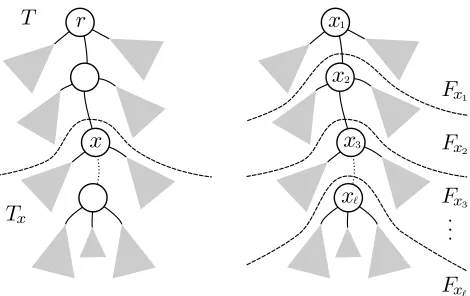
Figure 1: Subtree notationTx for x∈ T (left) and the fins Fx1, . . . , Fx` for a pathx1. . . x`in T (right).
2
Terminology and Notation
Let us recall some basic terminology of digraph theory, see [3]. A digraphD is
strongly connected(connected) if there is a directed (oriented) path fromxtoy
for every ordered pairx, y of vertices ofD. Equivalently,D is connected if the underlying graph ofDis connected. A vertexvis asource(sink) if its in-degree (out-degree) is equal to zero. It is well-known that every acyclic digraph has a source and a sink [3].
In this paper, we exclusively work with digraphs, therefore we assume all our graphs, paths, and trees to be directed unless otherwise noted. For a path P = x1x2. . . xk of length k−1 we will employ the following notation
for subpaths of P: P[xi, xj] := xi. . . xj for 1 6 i 6 j 6 k is the infix of P
from xi to xj. For paths P1 := x1. . . xkv and P2 := vy1. . . y` we denote
byP1P2:=x1. . . xkvy1. . . y` theirconcatenation. For rooted treesT and some
vertexx∈T,Tx stands for the subtree ofT rooted at x(see Figure 1).
We will frequently partition the nodes of a tree around a path in the following sense (cf. Figure 1): Let T be a tree rooted at r and P = x1. . . x` a path
fromr=x1 to some nodex`∈T. Thefins ofP are the sets{Fxi}xi∈P defined asFxi :=V(Txi)\V(Txi+1) fori < `andFx` :=V(Tx`).
Definition 1(Bi-reachable Vertex). A vertexv of a digraphD isbi-reachable
from a vertexrif there exist two internally vertex-disjoint paths fromrto v. Given a digraphDand a vertexr, we can compute the set of vertices that are bi-reachable fromr in polynomial time using network flows.
3
Strongly Connected Digraphs
et al. [1] and an algorithmic result for the Maximum Leaf Out-branching problem [12, 19] gives a short proof that both versions ofk-Distinct Branch-ingsare FPT for strongly connected digraphs.
Lemma 1. LetDbe a digraph containing an out-branching and an in-branching. IfD contains an out-branching (in-branching)T with at leastk+ 1leaves, then every in-branching (out-branching)T0 of D isk-distinct from T.
Proof. We will consider only the case when T is an out-branching since the other case can be treated similarly. LetT0 be an in-branching ofD and let L
be the set of all leaves ofT apart from the one which is the root ofT0. Observe that all vertices ofLhave outgoing arcs inT0 and since inT the incoming arcs ofLare the only arcs incident toLinT, the sets of the outgoing arcs inT0and incoming arcs inT do not intersect.
From the next section, the following problem will be of our main interest. The problemk-Distinct Branchingsin whichT+andT−must be rooted at given
verticessandt, respectively, will be called theRooted k-Distinct
Branch-ingsproblem. We will use the following standard dynamic programming result (see, e.g., [6]).
Lemma 2. Let H be a digraph of (undirected) treewidth τ. Thenk-Distinct
Branchings,Single-Root k-Distinct Branchingsas well as Rootedk -Distinct BranchingsonH can be solved in time O∗(2O(τlogτ)).
Note that if a digraph D is a positive instance of Single-Root k-Distinct
BranchingsthenDmust be strongly connected as an out-branching and an in-branching rooted at the same vertex form a strongly connected subgraph ofD. Thus, the following theorem, in particular, solves the problem of Bang-Jensen and Yeo mentioned above.
Theorem 3. Bothk-Distinct Branchings and Single-Root k-Distinct
Branchingson strongly connected digraphs can be solved in timeO∗(2O(klog2k)).
Proof. The proof is essentially the same for both problems and we will give it for Single-Root k-Distinct Branchings. Let D be an input strongly connected digraph. By Theorem 2 using an O∗(3.72k)-time algorithm we can find an out-branching T+ with at least k+ 1 leaves, or decide that D has no such out-branching. IfT+ is found, the instance ofSingle-Root k-Distinct Branchingsis positive by Lemma 1 as any in-branchingT− ofDisk-distinct from T+. In particular, we may assume that T− has the same root as T+
(a strongly connected digraph has an in-branching rooted at any vertex). Now suppose thatT+does not exist. Then, by Theorem 1 the (undirected) pathwidth
ofD is bounded byO(klogk). Thus, by Lemma 2 the instance can be solved in timeO∗(2O(klog2k)
).
{v0v1, v1v2, . . . , vnvn+1} ∪ {vivj : 1 6j < i 6n}. Observe that D is of
un-bounded (undirected) treewidth, but has unique in- and out-branchings (which are identical). The same statement holds if we add an arcvn+1v0 (to make the
graph strongly connected) but insist that the out-branching is rooted inv0and the in-branching invn+1.
4
The
k
-Distinct Branchings Problem
In this section, we fix a digraphD with terminals s, t and simply talk about
rooted out-branchings (in-branchings)whose root we implicitly assume to bes
(t). Similarly, unless otherwise noted, a rooted out-tree (in-tree) is understood to be rooted ats(t).
Clearly, to show that both versions ofk-Distinct Branchingsare FPT it is sufficient to prove the following:
Theorem 4.Rootedk-Distinct Branchingsis FPT for arbitrary digraphs.
In the rest of this section, (D, s, t) will stand for an instance of Rooted k
-Distinct Branchings (in particular,D is an input digraph of the problem) andH for an arbitrary digraph. Let us start by observing what further restric-tions onD can be imposed by polynomial-time preprocessing.
4.1
Preprocessing
Let (D, s, t) be an instance of Rooted k-Distinct Branchings. Recall thatD contains an out-branching (in-branching) if and only ifD has only one strongly connected component with no incoming (no outgoing) arc. As a first preprocessing step, we can decide in polynomial time whether D has a rooted out-branching and a rooted in-branching. If not, we reject the instance. Note that this in particular means that in a non-rejected instance, every vertex inD
is reachable fromsandtis reachable from every vertex.
Next, we test for every arca∈ D whether there exists at least one rooted in- or out-branching that usesaas follows: since a maximal-weight out- or in-branching for an arc-weighted digraph can be computed in polynomial time [14], we can force the arcato be contained in a solution by assigning it a weight of 2 and every other arc weight 1. If we verify thata indeed does not appears in any rooted out-branching and in-branching, we removeafromDand obtain an equivalent instance of Rooted k-Distinct Branchings.
After this polynomial-time preprocessing, our instance has the following three properties: there exists a rooted out-branching, there exists a rooted in-branching, and every arc ofDappears in some rooted in- or out-branching. We call such a digraph with a pairs, treduced.
Lemma 3. LetH = (V, A) be a digraph containing an out-branching rooted at
s∈ V. Then every out-tree rooted at s with q leaves can be extended into an out-branching rooted atswith at least qleaves in timeO(|V|+|A|).
4.2
Decomposition and Reconfiguration
We work towards the following win-win scenario: either we find an out-tree with Θ(k) leaves that can be turned into a rooted out-tree with at least k+ 1 leaves, or we conclude that every out-tree inD has less than Θ(k) leaves. We refer to the process of turning an out-tree into a rooted out-tree as a reconfigu-ration. In the process we will develop a new digraph decomposition, therooted cut-decomposition, which will aid us in reasoning about reconfiguration steps and ultimately lead us to a solution for the problem. In principle we recursively decompose the digraph into vertex sets that are bi-reachable from a designated ‘bottleneck’ vertex, but for technical reasons the following notion of a diblock
results in a much cleaner version of the decomposition.
Definition 2. LetH be a digraph with at least two vertices, and letr∈V(H) such that every vertex ofH is reachable fromr. LetB⊆V(H) be the set of all vertices that are bi-reachable fromr. Thedirected block (diblock)BrofrinHis
the setB∪N+[r], i.e., the bi-reachable vertices together with all out-neighbors
ofrandritself.
Note that according to the above definition a diblock must have at least two vertices.
The following statement provides us with an easy case in which a reconfig-uration is successful, that is, we can turn an arbitrary out-tree into a rooted out-tree without losing too many leaves. Later, the obstructions to this case will be turned into building blocks of the decomposition.
Lemma 4. Let Bs ⊆V(D) be the diblock ofs and let T be an out-tree of D
whose rootrlies inBswith`leaves. Then there exists a rooted out-tree with at
least(`−1)/2 leaves.
Proof. We may assume that r6=s. In caseT containssas a leaf, we removes
from T for the remaining argument and hence will argue about the `−1 re-maining leaves.
Ifris bi-reachable froms, consider two internally vertex-disjoint paths P, Q
fromstor. One of the two paths necessarily avoids half of the`−1 leaves ofT; let without loss of generality this path beP. Let furtherL be the set of those leaves ofT that donot lie onP. Ifr∈N+(s), letP =sr.
We construct the required out-tree T0 as follows: first, add all arcs and vertices ofP toT0. Now for every leafv∈L, letPv be the unique path fromr
tovinT and letPv0 be the segment ofPvfrom the last vertexxofPv contained
inT. Add all arcs and vertices ofPv0 toT0. Observe thatx6=v asv cannot be in T0. SincePv and thusPv0 contains no leaf of Lother than v, in the end of
The definition of diblocks can also be understood in terms of network flows: Let
v 6=r. Consider the vertex-capacitated version ofH where r andv both have capacity 2, and every other vertex has capacity 1, for somev ∈ V(H)\ {r}. Thenvis contained in the diblock ofrinH if and only if the max-flow fromr
tovequals 2. Dually, by Menger’s theorem,v isnot contained in the diblock if and only if there is a vertexu /∈ {r, v}such that allr-vpathsP intersectu. This has the following simple consequence regarding connectivity inside a diblock:
Lemma 5. Fix r∈V(H)and let Br ⊆V(H)be the diblock of r inH. Then
for every pair of distinct verticesx, y∈Br, there exist an r-x-path Px and an
r-y-path Py that intersect only inr.
Proof. If r ∈ {x, y}, then clearly the claim holds since every vertex in Br is
reachable fromr. Otherwise, add a new vertexz with arcsxzandyz, and note that the lemma holds if and only ifz is bi-reachable fromr. If this is not true, then by Menger’s theorem there is a vertex v∈Br, v6=r, such that all paths
from r to z, and hence to x and y, go through v. But as noted above, there is no cut-vertex v /∈ {x, r} for r-xpaths, and no cut-vertex v /∈ {y, r} forr-y
paths. We conclude thatzis bi-reachable fromr, hence the lemma holds. Next, we will use Lemma 5 to show that given a vertexr, the set of vertices not in the diblockBr ofrinH partitions cleanly aroundBr.
Lemma 6. Letr∈V(H)be given, such that every vertex ofHis reachable from
r. LetBr⊂V(H)be the diblock ofrinH. ThenV(H)\Brpartitions according
to cut vertices inBr, in the following sense: For everyv∈V(H)\Br, there is
a unique vertexx∈Br\ {r} such that every path fromr tov intersectsBr for
the last time inx. Furthermore, this partition can be computed in polynomial time.
Proof. Assume towards a contradiction that for v∈V(H)\Br there exist two
r-v-pathsP1, P2 that intersectBr for the last time in distinct vertices x1, x2,
respectively. We first observe that r /∈ {x1, x2}, since the second vertices of
P1 and P2 are contained in Br by definition. By Lemma 5, we may assume
thatP1[r, x1]∩P2[r, x2] ={r}. But thenP1 andP2intersect for the first time outside ofBrin some vertexv0 (potentially inv0 =v). This vertex is, however,
bi-reachable from r, contradicting our construction of Br. Hence there is a
vertexx∈Br such that every path fromr tov intersects Br for the last time
in x, with x 6= r, and clearly this vertex is unique. Finally, the set Br can
be computed in polynomial time, and given Br it is easy to compute for each
x∈Brthe set of all verticesv∈V(H) (if any) for whichxis a cut vertex.
We refer to the vertices x∈Br that are cut vertices in the above partition as
thebottlenecks of Br. Note that r itself is not considered a bottleneck inBr.
Using these notions, we can now define acut decompositionof a digraph H.
Definition 3(Rooted cut decomposition and its tree). LetHbe a digraph andr
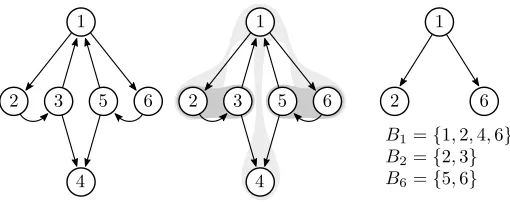
Figure 2: An example of a rooted cut decomposition.
decompositionofH is a pair ( ˆT ,B) where ˆT is a rooted tree withV( ˆT)⊆V(H) and B = {Bx}x∈Tˆ, Bx ⊆ V(H) for each x ∈ Tˆ, is a collection of diblocks
associated with the nodes of ˆT, defined and computed recursively as follows. 1. Let Br be the diblock of r in H, and let L⊆Br\ {r} be the set of
bottlenecks in Br. Let {Xx}x∈L be the corresponding partition of the
remainderV(H)\Br.
2. For every bottleneckx∈L, let ( ˆTx,Bx) be thex-rooted cut decomposition
of the subgraphD[Xx∪ {x}].
3. ˆT is the tree with root noder, whereLis the set of children ofr, and for every x∈L the subtree of ˆT rooted atxis ˆTx.
4. Finally,B={Br} ∪Sx∈LBx.
Furthermore, for every nodex∈Tˆ, we defineB∗x=S
y∈TˆxBy as the set of all
vertices contained in diblocks associated with nodes of the subtree ˆTx.
Figure 2 provides an illustration to Definition 3.
Lemma 7. Let a digraphH and a rootr∈V(H)be given, such that every ver-tex ofH is reachable fromr. Then ther-rooted cut decomposition( ˆT ,{Bx}x∈Tˆ)
ofH is well-defined and can be computed in polynomial time. Furthermore, the diblocks cover V(H), i.e., S
x∈TˆBx =V(H), and for every node x∈Tˆ, every
vertex ofB∗x is reachable fromxin D[Bx∗].
Proof. By Lemma 6, the root diblockBras well as the setL⊆Brof bottlenecks
and the partition{Xx}x∈L are well-defined and can be computed in polynomial
time. Also note that for each x ∈ L, r /∈ Xx∪ {x}, and every vertex of
Hx:=H[Xx∪ {x}] is reachable fromxinHx by the definition of the partition.
Hence the collection of recursive calls made in the construction is well-defined, and every digraph Hx used in a recursive call is smaller than H, hence the
process terminates. Finally, for any two distinct bottlenecksx, y∈L we have
V(Hx)∩V(Hy) =∅. Thereby, distinct nodes of ˆT are associated with distinct
We collect some basic facts about cut decompositions.
Lemma 8. LetH be a digraph,r∈V(H)a vertex and let( ˆT ,{Bx}x∈Tˆ)be the r-rooted cut decomposition ofH. Then the following hold.
1. The sets {Bx\ {x}}x∈Tˆ are all non-empty and partitionV(H)\ {r}.
2. For distinct nodesx, y∈Tˆ, ifxis the parent ofyinTˆthenBx∩By={y};
in every other situation,Bx∩By=∅.
3. For every nodex∈Tˆ, the following hold:
(a) If y is a child of xin Tˆ, then any arc leading into the set By∗ from
V(H)\By∗ will have the form uy whereu∈Bx.
(b) Ify,y0 are distinct children ofxin Tˆ, then there is no arc between
By∗ andBy∗0.
In particular, every arc ofH is either contained in a subgraph ofH induced by a diblockBx, or it is aback arc going from a diblockBy to a diblockBx, where
xis an ancestor ofy inTˆ.
Proof. For the first claim, the sets Bx\ {x} are non-empty by definition; we
show the partitioning claim. By Lemma 6, for every v ∈ V(H)\ {r} either
v∈Br\ {r}or there is exactly one bottleneckx∈Brsuch that v∈Xx in the
construction of the decomposition. Also note that in the latter case,v6=xsince
x∈ Br. Applying the argument recursively and using that the diblocks cover
V(H), by Lemma 7, we complete the proof of the partitioning claim.
For the second claim, the partitioning claim implies that ifv∈Bx∩By for
distinct nodesx, y∈Tˆ, then eitherv=xorv=y, i.e.,v must be a bottleneck. This is only possible in the situation described.
For Claim 3(b), first consider the diblockBrand the partition{Xz}z∈Lgiven
by Lemma 6. To prove Claim 3(b) it suffices to show that for any two distinct setsXy,Xy0 of the partition, there is no arc betweenXy andXy0. Suppose for
a contradiction that there is such an arcuv, u∈Xy, v ∈ Xy0. By Lemma 5,
there are pathsPyandPy0 inBr fromrtoy andy0, respectively that intersect
only inr, and by Lemma 7, there are pathsPufromytouinXy andPvfromy0
tovinXy0. But then the pathsPyPuuvandPy0Pv form twor-vpaths that are
internally vertex-disjoint, showing that v ∈ Br, contrary to our assumptions.
Since the decomposition is computed recursively, this also holds in every internal node of ˆT.
For Claim 3(a), letuv be an arc such that u /∈B∗y andv ∈By∗. Moreover, letu∈Bx0 andv∈By0. By construction of cut decomposition, there is a path
ˆ
P from x0 to y0 in ˆT containing nodesxand y. Let x00 be the second node in ˆ
P (just after x0). Thus, there is a path P from x00 to v in H containing the vertices of ˆP apart from x0.
Assume that u 6= x00. Then by Lemma 5, there is an x0-u-path P0 and anx0-x00-pathP00 of H which intersect only at x0. Then x0P0uv and P00P are internally vertex-disjoint paths fromx0tov. This means thatvmust be inB
a contradiction unlessx0=x,u∈Bx andv=y. Ifu=x00, thenP anduvare
internally vertex-disjoint paths fromutov. This means thatv must be inBx00,
a contradiction unlessx0=xandv=y.
As we saw, for every diblockBy, y ∈Tˆ, any path “into” the diblock must go
via the bottleneck vertexy. By induction, for anyv∈By, every node of ˆT from
rtoy represents a bottleneck vertex that is unavoidable for paths fromrtov. More formally, the following holds in cut decompositions:
Lemma 9. Let ( ˆT ,{Bx}x∈Tˆ) be the cut decomposition ofH rooted atr. Fix a
diblockBxforx∈Tˆ. Consider a pathP inH fromrtov∈Bxand letx1. . . x`
be the sequence of bottleneck vertices thatP encounters. ThenPˆ =x0x1. . . x`
withx0=r is the path fromr toxinTˆ.
Proof. We prove the claim by induction over the depthdof the vertex xin ˆT. Ifr =xthen any path from r to v ∈Br containsr itself and hence the base
case ford= 0 holds trivially.
Consider a diblockBx, x∈Tˆ wherexhas distancedtorin ˆT and lety be
the parent ofxin ˆT. We assume the induction hypothesis holds for diblocks at depth d−1, hence it holds for By in particular. Because x∈By, this implies
that every path from r to x will contain all ancestors of x in ˆT. Since by construction every path fromrto a vertexv∈Bxneeds to pass throughx, the
inductive step holds. This proves the claim.
As an immediate consequence, we can identify arcs in cut decompositions that cannot participate in any rooted out-branching.
Corollary 1. Let ( ˆT ,{Bx}x∈Tˆ) be the cut decomposition ofH rooted atr and
let R := {uv ∈ A(H) | u∈ Bx and x∈ Tˆv} be all the arcs that originate in
a diblock Bx and end in an ancestor v of xon Tˆ. Then for every out-treeT
rooted atrwe have A(T)∩R=∅.
Proof. Fix a bottleneck vertex v ∈Tˆ of the decomposition and let the arc uv
be in an out-treeT rooted at r. There must exist a path Psu froms touthat
is part ofT. By Lemma 9, this path will contain the vertex v. But then v is an ancestor ofuin T and therefore the arcuv cannot be part ofT, which is a contradiction.
The decomposition actually restricts paths even further: a path that starts at the root and visits two bottleneck verticesx, y (in this order) cannot intersect any vertex ofBy∗before visitingyand cannot return to any setBz∗,z∈Tˆ, after having left it.
Lemma 10. Let( ˆT ,{Bx}x∈Tˆ)be the cut decomposition ofH rooted atr. Fix a
diblockBx forx∈Tˆ. Consider a pathP fromrtov∈Bx and letPˆ=x0. . . x`
be the path fromr=x0 to x=x` in Tˆ. Let furtherF0, . . . , F` be the fins of Pˆ
inTˆ. Then the subpathP[xi, xi+1]\ {xi+1}is contained in the union of diblocks
Proof. By Lemma 9 we know that the nodes of ˆP appear in P in the correct order, hence the subpathP[xi, xi+1] is well-defined. Let us first show that the
subpathP[xi, xi+1]\ {xi+1}cannot intersect any diblock associated with ˆTxi+1.
By Lemma 8, the only arcs fromBxi into diblocks belowxi+1 connect to the bottleneck xi+1 itself. Since xi+1 is already the endpoint of P[xi, xi+1], this
subpath cannot intersect the diblocks of ˆTxi+1. This already proves the claim
forx0; it remains to show that it does not intersect diblocks ofV( ˆT)\V( ˆTxi) for
i>1. The reason is similar: since the bottleneckxiis already part ofP[xi, xi+1],
this subpath could not revisit Bxi if it enters any diblock By for a proper ancestoryofxiin ˆT. We conclude that therefore it must be, with the exception
of the vertexxi+1, inside the diblocks of the fin Fi.
Corollary 2. For every vertex u∈V(H) and every set X ⊆V(H)\(V( ˆT)∪ {u}) of non-bottleneck vertices there exists a path P from r to u in H such that|P∩X|6|X|/2.
Proof. Assume that u ∈ Bx and let ˆP = x0. . . x` be a path from x0 = r
tox`=xin ˆT. Let furtherF0, . . . , F` be the fins of ˆP in ˆT andUi the union of
diblocks associated withFi, 06i6`. We partition the setX into X1, . . . , X`
whereXi=X∩Ui for 06i6`. Lemma 10 allows us to construct the pathP
iteratively: any path that leads tou will pass through bottlenecksxi, xi+1 in
succession and visit only vertices in Ui in the process. Since there are two
internally vertex-disjoint paths between xi, xi+1 for 1 6 i6 `, we can always
choose the path that has the smaller intersection withXi. Stringing these paths
together, we obtain the claimed pathP.
We want to argue that one of the following cases must hold: either the cut decomposition has bounded height and we can ‘re-root’ any out-tree with many leaves into a rooted out-tree with a comparable number of leaves, or we can directly construct a rooted out-tree with many leaves. In both cases we apply Lemmas 1 and 3 to conclude that the instance has a solution. This approach has one obstacle: internal diblocks of the decomposition that contain only two vertices.
Definition 4 (Degenerate diblocks). Let {Bx}x∈Tˆ be the cut decomposition
rooted at s. We call a diblock Bx degenerate if x is an internal node of ˆT
and|Bx|= 2.
Let us first convince ourselves that a long enough sequence of non-degenerate diblocks provides us with a rooted out-branching with many leaves.
Lemma 11. Let ( ˆT ,{Bx}x∈Tˆ) be the cut decomposition rooted at s of H and
lety be a node in Tˆ such that the pathPˆsy from stoy in Tˆ contains at least`
nodes whose diblocks are non-degenerate. Then H contains an out-tree rooted atswith at least` leaves.
and for each 1 6 i < ` let x+i be the node after xi in ˆPsy. We construct a
sequence ofs-rooted out-treesT1,. . .,T` such that for 16i6`, the vertexxi
is a leaf ofTi, andTi containsileaves. First construct T1 as a path from sto
x1, then for every 1 6i < ` we construct an out-treeTi+1 from Ti as follows.
Letvi∈Bxi\ {xi, x
+
i}, which exists sinceBxi is non-degenerate, and letPxix+i,
Pxivi be a pair of paths inD[B ∗
xi] fromxi to x
+
i and tovi respectively, which
intersect only inxi. Such paths exist by Lemma 5, and since xi is a leaf ofTi,
Lemma 9 implies that Ti is disjoint from Bx∗i\ {xi}. Hence the paths can be appended toTi to form a newr-rooted out-treeTi+1inH which contains a leaf
in every diblock Bxj, 1 6 i. Finally, note that the final tree T` contains two leaves inBx`−1, henceT`is anr-rooted out-tree with `leaves.
The next lemma is important to prove thatRootedk-Distinct Branchings is FPT for a special case of the problem considered in Lemma 13.
Lemma 12. Let ( ˆT ,{Bx}x∈Tˆ)be the cut decomposition of D rooted at s such
thatTˆis of heightdand letT be an out-tree rooted at some vertexrwith`leaves. Then we can construct an out-treeTs rooted atswith at least(`−d)/2 leaves.
Proof. Assume that ris contained in the diblockBxof the decomposition and
let xp. . . x1 = ˆPsx be a path from s = xp to x = x1 in ˆT. Let L be the
leaves of T and let L0 :=L\Pˆsx. Clearly, |L0|>`−d. Applying Corollary 2
with X = L0 and u =r, we obtain a path Psr in D from s to r that avoids
half ofL0. We construct Ts in a similar fashion to the proof of Lemma 4. We
begin withTs=Psr, then for every leafv∈L0\Psr, proceed as follows: letPv
be the unique path fromr tov in T and letPv0 be the segment ofPv from the
last vertexxofPv contained inTs. Add all arcs and vertices ofPv0 toTs. Since
Pv and thusPv0 contains no leaf of L0 other thanv, in the end of the process,
all vertices of L0\Psr are leaves of Ts. Since |L0\Psr|>|L0|/2, we conclude
thatTscontains at least (`−d)/2 leaves, as claimed.
Using these results, we are now able to prove that if the height d of the cut decomposition of D is upper-bounded by a function in k, then Rooted k
-Distinct BranchingsonD is FPT. Combined with Lemma 11, this implies that the remaining obstacle is cut decompositions with long chains of degenerate diblocks, which we will deal with in Section 4.3.
Lemma 13. Let ( ˆT ,{Bx}x∈Tˆ)the cut decomposition rooted atsof heightd. If d6d(k)for some function d(k) = Ω(k) ofk only, then we can solve Rooted
k-Distinct Branchingson D in timeO∗(2O(d(k) log2d(k))).
Proof. By Theorem 2, in timeO∗(2O(d(k))) we can decide whetherDhas an
IfDhas no out-branching with at least 2k+2+d(k) leaves, by Theorem 1 the pathwidth ofDisO(d(k) logd(k)) and thus by Lemma 2 we can solveRooted
k-Distinct Branchings on D in time O∗(2O(d(k) log2d(k))). (Note that for the dynamic programming algorithm of Lemma 2 we may fix roots of all out-branchings and all in-out-branchings ofDby adding arcss0sandtt0toD, wheres0
andt0 are new vertices.)
4.3
Handling degenerate diblocks
The following is the key notion for our study of degenerate diblocks.
Definition 5(Degenerate paths). Let ( ˆT ,{Bx}x∈Tˆ) be a cut decomposition of D. We call a path ˆP in ˆT monotone if it is a subpath of a path from the root of ˆT to some leaf of ˆT. We call a path ˆP in ˆT degenerate if it is monotone and every diblockBx,x∈Pˆ is degenerate.
Let (D, s, t) be a reduced instance of Rooted k-Distinct Branchings. As observed in Section 4.1, we can verify in polynomial time whether an arc partic-ipates insome rooted in- or out-branching. LetRs⊆A(D) be those arcs that
do not participate in any rooted out-branching andRt ⊆A(D) those that do
not participate in any rooted in-branching. Since (D, s, t) is a reduced instance, we necessarily have that Rs∩Rt =∅, a fact we will use frequently in the
fol-lowing. Corollary 1 provides us with an important subset ofRs: every arc that
originates in a diblock Bx of the cut decomposition and ends in a bottleneck
vertex that is an ancestor ofxon ˆT is contained inRs.
Let us first prove some basic properties of degenerate paths.
Lemma 14. Let ( ˆT ,{Bx}x∈Tˆ) be the cut-decomposition ofD rooted at s, and
letPˆ=x1. . . x` be a degenerate path ofTˆ. Then the following properties hold:
1. Every rooted out-branching containsA( ˆP), 2. every arc xjxi with j > iis contained inRs, and
3. there is no arc fromxi (i < `)toBy inD, wherey is a descendant ofxi
onTˆ, except for the arc xixi+1.
Proof. First observe that, by definition of a degenerate path, ˆP is a path inD. Every rooted out-branching contains in particular the last vertexx`of the path.
By Lemma 9, it follows that ˆP is contained in the out-branching as a monotone path, hence it containsA( ˆP). Consequently, no ‘back-arc’xjxi withj > i can
be part of a rooted out-branching and thus it is contained inRs. For the third
property, note that all arcs fromxiexcept back arcs are contained inBxi. Since
Bxi is degenerate there can be only one such arc.
For the remainder of this section, let us fix a single degenerate path ˆP=x1. . . x`.
We categorize the arcs incident to ˆP as follows:
1. Let A+ contain all ‘upward arcs’ that originate in ˆP and end in some
2. letA0 contain all ‘on-path arcs’xjxi,j > i, and
3. letA− contain all ‘arcs from below’ that originate from some diblockBy
wherey is a (not necessarily proper) descendant ofx`.
By Lemma 14, this categorization is complete: no other arcs can be inci-dent to ˆP in a reduced instance. By the same lemma, we immediately obtain that A0, A− ⊆R
s. We will now apply certain reduction rules to (D, s, t) and
prove in the following that they are safe, with the goal of bounding the size of ˆP
by a function of the parameterk.
Reduction rule 1:If there are two arcsxiu, xju∈A+∩Rtwithi < j, remove
the arcxju.
Lemma 15. Rule 1 is safe.
Proof. Since (D, s, t) is reduced, the arcs xiuand xju cannot be inRs. Pick
any rooted out-branchingT that contains the arcxju. By Lemma 14, we have
that ˆP ⊆T, therefore we can construct an out-branchingT0 by exchanging the arcxjufor the arcxiu. Since a) no rooted in-branching contains either of these
two arcs, and b) no out-branching can contain both, we conclude that (D \ {xju}, s, t) is equivalent to (D, s, t) and thus Rule 1 is safe.
Corollary 3. Let (D, s, t) be reduced with respect to Rule 1. Then we either find a solution for(D, s, t)or |A+∩R
t|62k+ 1.
Proof. Let H be the heads of the arcs A+ ∩R
t. Since Rule 1 was applied
exhaustively, no vertex inH is the head of two arcsA+∩R
t; therefore we have
that|H|=|A+∩R
t|.
Note that any arc inA+∩R
tcannot be contained inRs, thereforeHdoes not
contain any bottleneck vertices. Applying Corollary 2, we can find a path P`
from s to x` that avoids half of the vertices in H. Thus we can add half
of H as leaves to P` using the arcs from A+∩Rt. Thus if |H| > 2k+ 2, we
obtain a rooted out-tree with at leastk+ 1 leaves, which by Lemmas 1 and 3 imply that the original instance has a solution. We conclude that otherwise
|H|=|A+∩Rt|62k+ 1.
Lemma 16. Let Pˆ =x1. . . x` be a degenerate path. Assume t 6∈Pˆ and that
(D, s, t)is reduced with respect to Rule 1. Let furtherX⊆V( ˆP)be those vertices ofPˆ that are tails of the arcs inA+. We either find that(D, s, t)has a solution
or that|X|63k+ 1.
Proof. For every vertex xi ∈ X with an arc xiv ∈ A+ \Rt, we construct a
path ˜Pxitfromxi totthat containsxiv as follows: sincexiv6∈Rt, there exists a rooted in-branching ˜T that containsxiv. We let ˜Pxit⊆T˜be the path fromxi totin ˜T.
Since ˜Pxitleaves ˆP via the first arcxiv, it cannot use the arcxixi+1. Since this is the only arc that leads to vertices in diblocks of ˆTxi, the claim follows. Let us relabel the just constructed paths to ˜P1, . . . ,P˜`such that they are sorted
with respect to their start vertices on ˆP. That is, for i < j the first vertex of ˜Piappears before the first vertex of ˜Pjon ˆP. We iteratively construct rooted
in-trees ˜T1, . . .T˜` with the invariant that a) ˜Ti has exactlyileaves and b) does
not contain any vertex of ˆP below the starting vertex of ˜Pi. Choosing ˜T1:= ˜P1
clearly fulfills this invariant. To construct ˜Ti from ˜Ti−1for 26i6`, we simply
follow the path ˜Piup to the first intersection with ˜Ti−1. Sincet∈P˜i∩T˜i−1, such
a vertex must eventually exist. By the above claim, ˜Pidoes not contain any
ver-tex below its starting verver-tex on ˆP, thus both parts of the invariant remain true. We conclude that ˜T` is a rooted in-tree with ` leaves, where` is the
num-ber of vertices in X that have at least one upwards arc not contained in Rt.
For`>k+ 1, Lemmas 1 and 3 imply that the original instance has a solution. Otherwise, ` 6 k. By Corollary 3, we may assume that |A+∩R
t| 62k+ 1.
Taken both facts together, we conclude that either |X| 6 3k+ 1, or we can construct a solution.
We will need the following.
Lemma 17. LetPˆ=x1. . . x` be a degenerate path and assume thatt6∈Pˆ. Let
furtherY ⊆V( ˆP) be those vertices of Pˆ that are tails of the arcs in A0. We
either find that(D, s, t)has a solution or we have|Y|< k.
Proof. We will construct a rooted in-tree that contains|Y|arcs fromA0. Since
no rooted out-branching contains any such arc, this will prove that the instance is positive provided|Y|>k. Note in particular that we are not concerned with the number of leaves of the resulting tree.
First associate every vertexv∈Y with an arcvxv∈A0, where we choosexv
to be the vertex closest tov. LetX+be the heads of all arcs inA+and letX ⊆Pˆ be the tails of all arcs inA+.
Let u∈ Y be the vertex that appears first on ˆP among all vertices in Y. Since uxu ∈ Rs, uxu cannot be contained in Rt. Accordingly there exists a
pathPu fromuto t that uses the arcuxu. Note thatPu leaves ˆP through an
A+-arc whose tail lies betweenxu anduon ˆP.
Note that the segment Pu[xu, t], by our choice of u, does not contain any
vertex ofY. We now construct theseed in-treeT0as follows. We begin withPu
and add the arcu0xu0 for every vertex u0 ∈ Y where xu0 ∈Pu. Next, we add
every vertexv ∈X+ to T0 by finding a path from v to t and attach this path up to its first intersection withT0. Since vlies above xu in the decomposition,
this path cannot intersect any vertex inY. We form an in-forest5F
0from the arcs ofT0and all arcsvxv,v∈Y that are
not inT0. Every in-treeT ∈ F0 has the following easily verifiable properties:
1. Its root is the highest vertex in the decomposition among all verticesV(T) (recall Lemma 8),
2. its root is eithert or a vertexxv with v∈Y, and
3. every segment ˆP[x, y] of ˆP contained inT has no vertex ofX orY with the possible exception ofy∈Y.
We will maintain all three of these properties while constructing a sequence of in-forestsF0⊆ F1⊆. . .where each in-forest in the sequence will have less roots
than its predecessor (here⊆stands forFi−1 being a subgraph ofFi). We stop
the process when the number of roots drop to one.
The construction ofFi from Fi−1 fori>1 works as follows. LetT ∈ Fi−1
be the in-tree with thelowest root in the in-forest. By assumption, Fi−1 has
at least two roots, thus it cannot betand therefore, by part 2 of our invariant, is a vertexxv withv ∈Y. Now from xv onwards, we walk along the path ˆP
until we encounter a vertex z that is either 1) the tail of an arc A+ or 2) a
vertex of the in-forest Fi−1. In the former case, we use the segment ˆP[xu, z]
to connect T to a vertex in X+ via the A+-arc emanating from z. Since all
vertices in X+ are part of the seed in-tree T
0 this preserves all three parts of
the invariant andFi−1⊆ Fi.
Consider the second case: we encounter a vertex z that is part of some treeT0 ∈ Fi−1. Let us first eliminate a degenerate case:
Claim. The treesT0 andT are distinct.
Assume towards a contradiction that T0 =T. In that case, there is no single vertex between xv and z that is either the tail of an A+ or A0-arc. If z is
such thatxz=xv (for example z=v), we already obtain a contradiction: the
arczxz cannot possibly be part of any in-branching rooted att, contradicting
the fact that it is not inRt.
Otherwise, z = xw for some w ∈ Y. By assumption, wz ∈ T, thus there
exists a pathPwxv which contains both the arcwzas well as the arcvxv. There-fore, the vertexwmust lie below v onP. Furthermore, the pathPwxv cannot contain any vertex abovexv by property 1 of the invariant. It follows that the
subpathP[z, v] is entirely contained inT—by property 3 of the invariant, none of the vertices (except v) in this subpath can be in X or Y. Since the same was true for the subpathP[xv, z], we conclude that the whole subpathP[xv, v]
contains no vertex ofX or Y. This contradicts our assumption thatxvv 6∈Rt
and we conclude thatT andT0 must be distinct.
By our choice ofT, the vertexz cannot be the root ofT0. Accordingly, we can mergeT and T0 by adding the path ˆP[xv, z]. This concludes our construction
ofFi. Since the root ofT0 lies above all vertices ofT, part 1) of the invariant
remains true. We did not change a non-root to a root in this construction, thus part 2) remains true. The one segment of ˆP[xv, z] we added to mergeT andT0
did not, by construction, contain any vertex ofY orX, with the exception of the last vertexz, hence part 3) remains true. Finally, we clearly have thatFi−1⊆ Fi
and the latter contains one less root than the former.
The process clearly terminates with some in-forestFpwhich contains a single
all|Y|arcsuxu,u∈Y; therefore ˜T contains those arcs, too. Since all of these
arcs are inRs, we arrive at the following: either|Y|< k, as claimed, or we found
a rooted in-tree that avoids at leastkarcs with every rooted out-branching, in other words, as solution to (D, s, t).
Taking Lemma 16 and Lemma 17 together, we see that onlyO(k) vertices of a degenerate path are tails of arcs inA+ orA0. The following lemma now finally
lets us deal with degenerate paths: we argue that those parts of the path that contain none of these few ‘interesting’ vertices can be contracted.
Reduction rule 2: If ˆP[x, y]⊆Pˆ is such that no vertex in ˆP[x, y] is a tail of arcs inA+∪A0, contract ˆP[x, y] into a single vertex.
Lemma 18. Rule 2 is safe.
Proof. Simply note that every vertex in ˆP[x, y] has exactly one outgoing arc. We already know that every arc of ˆP must be contained in every rooted out-branching, now we additionally have that all arcs in ˆP[x, y] are necessarily contained in every rooted in-branching. We conclude that Rule 2 is safe.
We summarize the result of applying Rules 1 and 2.
Lemma 19. Let Pˆ be a degenerate path in an instance reduced with respect to Rules 1 and 2. Ift6∈Pˆ then|Pˆ|68k+ 1. Otherwise, |Pˆ|616k+ 3.
Proof. We may assume thatt6∈Pˆ as otherwise we can partition ˆP into its part beforet and its part aftert and obtain |Pˆ|616k+ 3 from the bound on |Pˆ|
whent6∈Pˆ. By Lemmas 16 and 17, the number of vertices on ˆP that are tails of either A+ or A0 is bounded by 4k. Between each consecutive pair of such
vertices, we can have at most one vertex that is not a tail of such an arc. We conclude that|Pˆ|68k+ 1, as claimed.
Now we can prove the main result of this paper.
Proof of Theorem 4. Consider the longest monotone path ˆP of ˆT. By Lemma 11, if ˆP has at leastk+ 1 non-degenerate diblocks, thenDhas a rooted out-tree with at leastk+ 1 leaves. This out-tree can be extended to a rooted out-branching with at least k+ 1 leaves by Lemma 3. Thus, by Lemma 1, (D, s, t) is a positive instance if and only ifD has a rooted in-branching, which can be decided in polynomial time.
Now assume that ˆP has at most knon-degenerate diblocks. By Lemma 19 we may assume that before, between and after the non-degenerate diblocks there are O(k) degenerate diblocks. Thus, the height of ˆT is O(k2). Therefore, by
5
Conclusion
We showed that the Rooted k-Distinct Branchings problem is FPT for general digraphs parameterized by k, thereby settling open question of Bang-Jensenet al. [6]. The solution in particular uses a new digraph decomposition, therooted cut decomposition, that we believe might be useful for settling other problems as well.
We did not attempt to optimize the running time of the algorithm of The-orem 4. Perhaps, a more careful handling of degenerate diblocks may lead to an algorithm of running time O∗(2O(klog2k)). Another question of interest is
whether theRooted k-Distinct Branchingsproblem admits a polynomial kernel.
References
[1] N. Alon, F. V. Fomin, G. Gutin, M. Krivelevich, and S. Saurabh. Spanning directed trees with many leaves. SIAM Journal on Discrete Mathematics, 23(1):466–476, 2009.
[2] J. Bang-Jensen. Edge-disjoint in- and out-branchings in tournaments and related path problems.Journal of Combinatorial Theory, Series B, 51(1):1– 23, 1991.
[3] J. Bang-Jensen and G. Gutin. Digraphs: Theory, Algorithms and Applica-tions. Springer, 2002.
[4] J. Bang-Jensen and J. Huang. Quasi-transitive digraphs. Journal of Graph Theory, 20:141–161, 1995.
[5] J. Bang-Jensen and J. Huang. Arc-disjoint in- and out-branchings with the same root in locally semicomplete digraphs. Journal of Graph Theory, 77:278–298, 2014.
[6] J. Bang-Jensen, S. Saurabh, and S. Simonsen. Parameterized algorithms for non-separating trees and branchings in digraphs. Algorithmica, 76(1):279– 296, 2016.
[7] J. Bang-Jensen and S. Simonsen. Arc-disjoint paths and trees in 2-regular digraphs. Discrete Applied Mathematics, 161:2724–2730, 2013.
[8] J. Bang-Jensen, S. Thomass´e, and A. Yeo. Small degree out-branchings.
Journal of Graph Theory, 42(4):297–307, 2003.
[10] K. B´erczi, S. Fujishige, and N. Kamiyama. A linear-time algorithm to find a pair of arc-disjoint spanning in-arborescence and out-arborescence in a directed acyclic graph. Information Processing Letters, 109(23-24):1227– 1231, 2009.
[11] M. Cygan, F. Fomin, L. Kowalik, D. Lokshtanov, D. Marx, M. Pilipczuk, M. Pilipczuk, and S. Saurabh. Parameterized Algorithms. Springer, 2015. [12] J. Daligault, G. Gutin, E. J. Kim, and A. Yeo. FPT algorithms and kernels
for the directed k-leaf problem. Journal of Computer and System Sciences, 76(2):144–152, 2010.
[13] R. Downey and M. Fellows. Fundamentals of Parameterized Complexity. Springer, 2013.
[14] J. Edmonds. Optimum branchings. Journal of Research of the National Bureau of Standards, Section B, 71B:233–240, 1967.
[15] J. Edmonds. Edge-disjoint branchings. In B. Rustin, editor,Combinatorial Algorithms, pages 91–96. Academic Press, 1973.
[16] A. Fradkin and P. Seymour. Tournament pathwidth and topological con-tainment. Journal of Combinatorial Theory, Series B, 103(3):374–384, 2013.
[17] K. Kawarabayashi and S. Kreutzer. The directed grid theorem. In Pro-ceedings of the Forty-Seventh Annual ACM on Symposium on Theory of Computing, STOC 2015, pages 655–664, 2015.
[18] I. Kim and P. D. Seymour. Tournament minors. Journal of Combinatorial Theory, Series B, 112:138–153, 2015.