Griffiths, A and Deighton, K and Shannon, O and Matu, J and King, R and O’Hara, JP (2019) Substrate oxidation and the influence of breakfast in normobaric hypoxia and normoxia. European Journal of Applied Physiology, 119 (9). pp. 1909-1920. ISSN 1439-6319 DOI: https://doi.org/10.1007/s00421-019-04179-6
Link to Leeds Beckett Repository record:
http://eprints.leedsbeckett.ac.uk/6003/
Document Version: Article
Creative Commons: Attribution 4.0
The aim of the Leeds Beckett Repository is to provide open access to our research, as required by funder policies and permitted by publishers and copyright law.
The Leeds Beckett repository holds a wide range of publications, each of which has been checked for copyright and the relevant embargo period has been applied by the Research Services team.
We operate on a standard take-down policy. If you are the author or publisher of an output and you would like it removed from the repository, please contact us and we will investigate on a case-by-case basis.
https://doi.org/10.1007/s00421-019-04179-6
ORIGINAL ARTICLE
Substrate oxidation and the influence of breakfast in normobaric
hypoxia and normoxia
Alex Griffiths1 · Kevin Deighton1 · Oliver M. Shannon1,2 · Jamie Matu1 · Roderick King1 · John P. O’Hara1
Received: 2 April 2019 / Accepted: 17 June 2019 / Published online: 3 July 2019 © The Author(s) 2019
Abstract
Purpose Previous research has reported inconsistent effects of hypoxia on substrate oxidation, which may be due to differ-ences in methodological design, such as pre-exercise nutritional status and exercise intensity. This study investigated the effect of breakfast consumption on substrate oxidation at varying exercise intensities in normobaric hypoxia compared with normoxia.
Methods Twelve participants rested and exercised once after breakfast consumption and once after omission in normobaric hypoxia (4300 m: FiO2 ~ 11.7%) and normoxia. Exercise consisted of walking for 20 min at 40%, 50% and 60% of altitude-specific V̇O2max at 10–15% gradient with a 10 kg backpack. Indirect calorimetry was used to calculate carbohydrate and fat
oxidation.
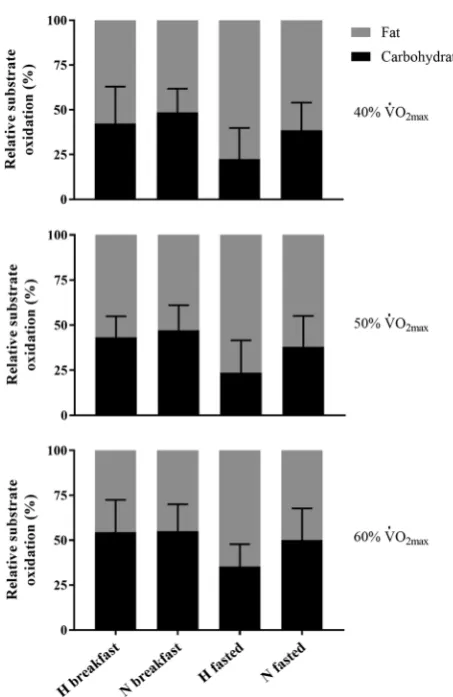
Results The relative contribution of carbohydrate oxidation to energy expenditure was significantly reduced in hypoxia compared with normoxia during exercise after breakfast omission at 40% (22.4 ± 17.5% vs. 38.5 ± 15.5%, p = 0.03) and 60% V̇O2max (35.4 ± 12.4 vs. 50.1 ± 17.6%, p = 0.03), with a trend observed at 50% V̇O2max (23.6 ± 17.9% vs. 38.1 ± 17.0%, p = 0.07). The relative contribution of carbohydrate oxidation to energy expenditure was not significantly different in hypoxia compared with normoxia during exercise after breakfast consumption at 40% (42.4 ± 15.7% vs. 48.5 ± 13.3%, p = 0.99), 50% (43.1 ± 11.7% vs. 47.1 ± 14.0%, p = 0.99) and 60% V̇O2max (54.6 ± 17.8% vs. 55.1 ± 15.0%, p = 0.99).
Conclusions Relative carbohydrate oxidation was significantly reduced in hypoxia compared with normoxia during exercise after breakfast omission but not during exercise after breakfast consumption. This response remained consistent with increas-ing exercise intensities. These findincreas-ings may explain some of the disparity in the literature.
Keywords Carbohydrate · Fat · Utilisation · Fasted · Fed · Altitude
Abbreviations
AUC Area under the curve FFA Free fatty acids
FiO2 Fraction of inspired oxygen
HIF-1α Hypoxia inducible factor 1 alpha
PiO2 Partial pressure of inspired oxygen
PPARα Peroxisome proliferator-activated receptor alpha RPE Rating of perceived exertion
SD Standard deviation SE Standard error
̇
VCO2 Carbon dioxide production
Communicated by Susan Hopkins.
* Alex Griffiths
[email protected] Kevin Deighton
[email protected] Oliver M. Shannon
[email protected] Jamie Matu
[email protected] Roderick King
John P. O’Hara
1 Research Institute for Sport, Physical Activity and Leisure,
Leeds Beckett University, Leeds LS6 3QS, UK
2 Human Nutrition Research Centre, Institute of Cellular
̇
VO2 Oxygen uptake
̇
VO2max Maximal oxygen update
Introduction
Disparate metabolic responses have been observed during exercise matched for relative intensities in hypoxia com-pared with normoxia (Young et al. 1982; Braun et al. 2000; Beidleman et al. 2002; Lundby and Van Hall 2002; Fried-mann et al. 2004; Péronnet et al. 2006; Katayama et al. 2010; Morishima et al. 2014; O’Hara et al. 2017; Matu et al. 2017). These contrasting findings within the literature appear to be due to differences in experimental design, specifically pre-exercise nutritional status and exercise intensity (Grif-fiths et al. 2019). Whilst the effect of pre-exercise breakfast consumption (Edinburgh et al. 2018) and exercise intensity (Van Loon et al. 2001) on metabolism are well documented in normoxic conditions, the metabolic response to these fac-tors is yet to be quantified in hypoxia. In addition, due to the inconsistent use of pre-exercise breakfast consumption in the literature, a direct comparison of the two distinct states dur-ing exercise of varydur-ing intensities in normoxia and hypoxia may provide clarity on such equivocal findings. Further, whilst the use of studies utilising fasted participants to con-trol for baseline metabolic status is warranted, knowledge of how this differs to fed participants is necessary to generate practical recommendations for relevant populations.
It has been proposed that during exercise matched for relative intensities, the relative contribution of carbohy-drate oxidation to energy expenditure is higher in hypoxia compared with normoxia when performed after breakfast consumption, but lower in hypoxia than normoxia when exercise was performed after breakfast omission (Griffiths et al. 2019). A potential explanation of findings observed after breakfast consumption is that greater oxidation and mobilisation of endogenous carbohydrate stores may be stimulated via the combined effect of hypoxia (Katayama et al. 2010) and feeding (Tentolouris et al. 2003) on the sym-pathetic nervous system. Additionally, a similar effect of hypoxia (Matu et al. 2018) and feeding (Blom et al. 2005) may increase circulating insulin concentration and subse-quently inhibit lipolysis and free fatty acid (FFA) mobilisa-tion (Coyle et al. 1997). It also seems plausible that greater fat oxidation may be observed in hypoxia, compared with normoxia after breakfast omission. Increased expression of the transcription factor hypoxia inducible factor 1 alpha (HIF-1α) may upregulate the fatty acid-activated tran-scription factor peroxisome proliferator-activated receptor alpha (PPARα) as per the metabolic response to hypoxia (Aragones et al. 2008). This response may be further stimu-lated by the fasted state (König et al. 1999), subsequently
inhibiting pyruvate dehydrogenase activity (Huang et al. 2002) and enabling greater mobilisation and oxidation of fat stores (Spriet and Watt 2003).
Exercise intensity was also identified as a significant moderator of substrate oxidation during exercise matched to relative intensities in hypoxia (Griffiths et al. 2019). Spe-cifically, the relative contribution of carbohydrate oxidation to energy expenditure was higher in hypoxia compared with normoxia during exercise performed at higher intensities. This was attributed to the hypoxic effect of both altitude and high intensity exercise, augmenting skeletal muscle hypoxia. The subsequent change in substrate oxidation could, there-fore, be explained as per the normoxic response to increased exercise intensity (i.e., reduction in adipose tissue blood flow and lipolysis and/or downregulation of carnitine pal-mitoyltransferase-1) (Sahlin 1990; Romijn et al. 1993; Van Loon et al. 2001). Alternatively, sympathetic nervous system activity may be potentiated by hypoxia and greater exercise intensities, augmenting glycogenolysis and, therefore, car-bohydrate oxidation (Watt et al. 2001).
An investigation into the effects of pre-exercise nutri-tional status and exercise intensity in hypoxia compared with normoxia may provide clarity on the current literature and facilitate the development of nutritional strategies for high altitude mountaineers and military personnel alike. As such, the purpose of this study was to investigate the effect of breakfast consumption or omission on substrate oxidation during exercise matched for relative intensities in normobaric hypoxia and normoxia. These exercise inten-sities ranged from 40–60% of altitude specific maximal oxygen uptake ( V̇O2max). We hypothesised that the relative
contribution of carbohydrate oxidation to energy expendi-ture would be increased during exercise matched to rela-tive intensities in hypoxia compared with normoxia after breakfast consumption, but that this response would not occur after breakfast omission. We also hypothesised that the relative contribution of carbohydrate oxidation would be potentiated with increasing exercise intensities in hypoxia compared with normoxia after both breakfast consumption and omission. Due to the differing metabolic response to hypoxia in females compared with males (Braun et al. 2000), all participants in the present study were male. Inclusion of a female sub-group was beyond the scope of the present study but warrants investigation in future studies.
Methods
Participants
participate in this study. The study received institutional ethical approval (Leeds Beckett research ethics committee, application reference: 46180) and was conducted in accord-ance with the Declaration of Helsinki. All participants were non-smokers, normotensive, free from food allergies and were not taking any medication. None of the participants had travelled to an altitude of > 1500 m within the previous three months and were all currently residing at an altitude < 500 m.
Experimental design
Participants were required to make a total of seven vis-its to the laboratory. The first visit involved pre-exercise screening, anthropometry, verbal familiarisation with test-ing procedures and a sickle cell trait test. Sickle cell trait was an exclusion criterion due to complications that may occur at altitude, for example, splenic infarction (Goodman et al. 2014). Further exclusion criteria included diabetes and thyroid disorders. The second and third visit required participants to be acutely exposed to normobaric hypoxia (fraction of inspired oxygen (FiO2): ~ 11.7% when
consider-ing water vapour partial pressure (Conkin 2011; Fenn et al. 1946) and daily fluctuations in barometric pressure) equiva-lent to 4300 m (partial pressure of inspired oxygen (PiO2): 83 mmHg) in an environmental chamber (TISS, Alton, UK and Sporting Edge, Sheffield on London, UK) or normoxia (absolute altitude ~ 113 m). Ambient temperature was main-tained at 20 °C and relative humidity at 50% for all trials. Participants completed sub-maximal and maximal exer-cise tests to calculate walking speeds matched for relative exercise intensity in each environmental condition for the experimental trials. These two preliminary trials were sepa-rated by ≥ 48 h and conducted in a single-blind randomised
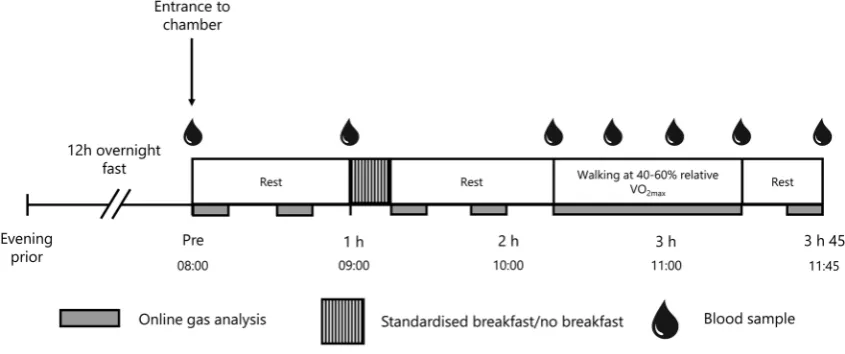
fashion. On visits 4–7 the participants completed a 3-h 45 min experimental trial, which included a 2-h 15 min rest period, followed by a 1-h incremental walking protocol and a 30-min post-exercise rest period (Fig. 1). Two of the trials were performed in normobaric hypoxia equivalent to 4300 m [one trial with breakfast consumption (HB), and one with breakfast omission (HF)] and two were performed in nor-moxia [one trial with breakfast consumption (NB), and one with breakfast omission (NF)]. These visits were separated by ≥ 7 days and were randomised independent of the prelimi-nary trials, using a Latin Square design.
Preliminary testing
Participants completed an exercise test on a motorised tread-mill (Woodway PPS S5; Waukesha, WI), which comprised of a sub-maximal and maximal phase. In the normoxic condition, the incremental sub-maximal phase involved four, 3-min stages walking at 3 km/h, 4 km/h, 4.5 km/h and 5.5 km/h. Participants carried a 10 kg backpack to mimic the physiological demands of the experimental trials. The initial two walking speeds in the normoxic condition were performed at a 10% gradient and the second two at a 15% gradient. In normobaric hypoxia, participants walked at 1.5 km/h, 2.5 km/h, 3.5 km/h and 4.5 km/h, at a 10% gradi-ent throughout. Lower speeds and gradigradi-ents were used in normobaric hypoxia based on the reduced V̇O2max elicited
at altitude (Dill et al. 1931), and the need for all participants to achieve 60% V̇O2max within the 12-min trial. The higher
gradient utilised in normoxia was employed to ensure par-ticipants achieved 60% V̇O2max with a walking gait.
Follow-ing completion of the sub-maximal phase, participants then rested for approximately 5 min, after which the maximal phase of the test commenced. Within this 5 min, participants
Fig. 1 Schematic of full experimental trial. Trials were completed twice in hypoxia (once with breakfast consumption, once with break-fast omission) and twice in normoxia (once with breakbreak-fast
[image:4.595.86.509.499.676.2]were permitted to rest seated, or complete some light stretch-ing. Participants ran without a backpack, at a 1% gradient (Jones and Doust 1996), at a constant speed dependant on fitness and environmental condition, aiming for a perceived exertion of 12. The gradient was increased by 1% every minute until volitional exhaustion. Oxygen uptake ( V̇O2)
and carbon dioxide production ( V̇CO2) measurements were
made throughout both phases of the test using an online gas analysis system (Metalyser, Cortex, Germany), which was calibrated following the manufacturer’s instructions. In this regard, the online gas analyser was calibrated with daily barometric pressure, a 3 L syringe (volume), as well as ambient gases and two known concentrations of gas (15% O2 and 5% CO2). These gases were subsequently checked
before use with an acceptance limit set at ± 0.02% for both O2 and CO2. All participants were deemed to reach a ‘true’
̇
VO2max by fulfilment of > 2 of the following criteria: a
pla-teau in V̇O2 in the final exercise stage, respiratory exchange
ratio ≥ 1.15, heart rate within 10 b·min−1 of age predicted
maximum (220-age), rating of perceived exertion (RPE) ≥ 19 and/or blood lactate ≥ 8 mM (Howley et al. 1995). The sub-maximal and maximal data was used to establish walk-ing speeds that would elicit 40%, 50% and 60% V̇O2max
rela-tive to both normoxia and hypoxia whilst carrying a 10 kg backpack at a 10% gradient.
Diet and physical activity before testing
Participants recorded their food intake for the 24 h before the first experimental trial and were instructed to repeat the quantity and timing of this intake for each subsequent visit. During these 24 h, participants were asked not to perform strenuous activity or consume caffeine or alcohol. Partici-pant adherence to these requirements was verbally confirmed before each trial. In addition, on the day before each experi-mental trial, participants were provided with, and consumed a standardised evening meal at home between 7 and 8 pm that included fusilli pasta, pasta sauce, cheddar cheese, milk and jelly beans (1037 kcal, 57% carbohydrate, 28% fat, 15% protein). This meal was consumed to minimise the possibil-ity of a second meal effect confounding glycaemic control or any other measured variables (Wolever et al. 1988; Ste-venson et al. 2005).
Experimental trials
Participants arrived at the research facilities following a 12 h fast and entered the environmental chamber at 8 am. Verbal confirmation that participants had fasted for the pre-vious 12 h was obtained prior to commencing each trial. Participants then rested for an hour. During rest periods, participants were seated upright and permitted to under-take personal activities such as reading. At 1 h, in both the
normobaric hypoxia and normoxia breakfast consump-tion trials, participants were allowed 15 min to consume a standardised breakfast (535 kcal, 58% carbohydrate, 24% fat, 18% protein). This meal included rolled oats, semi-skimmed milk and orange juice, and was designed to replicate typi-cal breakfast consumption in the UK (Reeves et al. 2013). At 1 h in the normobaric hypoxia and normoxia breakfast omission trials, participants continued resting for 15 min, without the consumption of breakfast. At 1 h 15 min, par-ticipants in all trials rested for a further hour. At 2 h 15 min, participants completed a 1-h walking test (20 min at 40%, 50% and 60% V̇O2max) at a 10% gradient, carrying a 10 kg
backpack, to mimic the demands of high altitude trekking (Mellor et al. 2017). Participants then rested for 30 min after exercise. Water was allowed ad libitum throughout all trials. See Fig. 1 for a schematic representation of the experimental trials.
Measurements
Heart rate, capillary oxygen saturation and RPE
Heart rate and capillary oxygen saturation were measured using a fingertip pulse oximeter (Nellcor PM10N, United States) every 15 min during rest. Heart rate, capillary oxygen saturation and RPE were measured every 10-min throughout exercise.
Expired breath analysis
̇
VO2 = 4.4%, V̇CO2 = 5.2%). Substrate oxidation was
calcu-lated using relevant equations for both resting (Frayn 1983) and exercise periods (Jeukendrup and Wallis 2005).
Blood sampling
Researchers entered the chamber to draw venous blood sam-ples from a 20-gauge cannula (Introcan Safety; B Braun, Sheffield, UK) which was inserted into an antecubital vein upon arrival. Samples were drawn at baseline (before entry to the chamber) for the analysis of plasma glucose, plasma lactate, serum FFA and serum insulin. Subsequent blood samples variables were drawn at 1 h (pre-prandial), 2 h 15 min (post-prandial), 2 h 35 min (40% V̇O2max), 2
h 55 min (50% V̇O2max), 3 h 15 min (60% V̇O2max) and 3
h 45 min (post exercise) (no insulin at this time point due to plate layout). For samples in close proximity (i.e., dur-ing exercise), researchers stayed in the chamber to avoid unnecessary opening and closing of chamber doors. Fluoride oxalate tubes used for plasma glucose and lactate were spun at 1500 × g for 10 min in a centrifuge (CompactStar CS4, VWR) immediately after being filled with venous blood. The serum separator tubes used for FFA and insulin were spun at the same speed, 30 min after collection to allow for clotting. The supernatant was then transferred into separate Eppendorf tubes to be frozen immediately at − 20 °C before being transferred to − 80 °C until analysis.
Blood analysis
Commercially available enzyme-linked immunosorbent assay kits were used to determine serum concentrations of insulin (IBL, Hamburg, Germany). To eliminate interassay variation, all samples from each participant were analysed on the same plate. Plasma glucose and lactate, and serum FFA were measured photometrically with reagents from Instrumentation Laboratories (Lexington, MA) and Randox Laboratories (Crumlin, UK). The within batch coefficients of variation were as follows: insulin 5.9%, glucose 1.8%, lactate 2.8% and FFA 3.7%.
Statistical analysis
Data are expressed as mean ± standard deviation (SD) in text and mean ± standard error (SE) in figures. All data were ana-lysed using IBM SPSS statistics (v24 for Windows; SPSS; Chicago, IL). The trapezoid method was used to calculate area under the curve (AUC) for substrate oxidation and hor-mone concentrations. The periods of AUC were defined as pre-prandial (0–1 h), post-prandial (1 h 15 min–2 h 15 min), 40% relative V̇O2max (2 h 15 min–2 h 35 min), 50% relative
̇
VO2max (2 h 35 min–2 h 55 min), 60% relative V̇O2max (2
h 55 min–3 h 15 min) and post exercise (3 h 15 min–3 h 45 min). Normality of distribution was evaluated using his-tograms and Shapiro–Wilk test and approximated normal distribution. A paired sample t test was used to determine differences between V̇O2max in normoxic and hypoxic
con-ditions. One-way repeated measures ANOVA was used to determine differences between trials for energy expenditure, heart rate, capillary oxygen saturation and RPE. Two-way repeated measures ANOVA (time × trial) was used to deter-mine differences between absolute and relative carbohydrate and fat oxidation and hormone concentrations between AUC periods. Where significant main effects of trial were found, further post hoc analysis was performed using Bonferroni correction for multiple comparisons. Effect sizes are pre-sented as Cohen’s d and interpreted as ≤ 0.2 trivial, > 0.2 small, > 0.6 moderate, > 1.2 large, > very large and > 4 extremely large (Hopkins 2004).
Results
Maximal oxygen uptake and walking speeds
̇
VO2max was significantly reduced in hypoxia
com-pared with normoxia (38.3 ± 6.0 mL·kg−1·min−1 vs.
53.0 ± 8.6 mL·kg−1·min−1; p < 0.001, d = 2.00). In hypoxia,
this elicited walking speeds of 1.8 ± 0.4 km·h−1 (HB:
40.3 ± 4.1%; HF: 38.9 ± 3.1% V̇O2max), 2.7 ± 0.5 km·h−1
(HB: 47.8 ± 3.3% V̇O2max; HF: 48.0 ± 4.4% V̇O2max;) and
3.5 km·h−1 (HB: 59.6 ± 5.9% V̇O2max; HF: 59.1 ± 5.0%
̇
VO2max). In normoxia, this elicited walking speeds of
3.4 ± 0.3 km·h−1 (NB: 38.4 ± 3.4% V̇O2max; NF: 38.1 ± 3.9%
̇
VO2max), 4.1 ± 0.4 km·h−1 (NB: 45.8 ± 3.3% V̇O2max; NF:
45.1 ± 2.9% V̇O2max) and 4.6 ± 0.5 km·h−1 (NB: 61.4 ± 2.5% ̇
VO2max; NF: 61.3 ± 3.3% V̇O2max) for each 20-min exercise
period. Relative exercise intensity was not significantly dif-ferent between any trial at 40% (p = 0.39), or 60% V̇O2max
(p = 0.18), however, a trend for an increased relative exercise intensity in hypoxia compared with normoxia after breakfast omission was observed at 50% V̇O2max (p = 0.06).
Experimental trials
Energy expenditure
Energy expenditure at rest was significantly greater in hypoxia compared with normoxia in both the breakfast consumption (1252 ± 158 kJ vs. 1108 ± 145 kJ; p = 0.02,
Energy expenditure during exercise was significantly reduced in hypoxia compared with normoxia after both breakfast consumption (1809 ± 218 kJ vs. 2477 ± 205 kJ
p < 0.001, d = 3.16) and omission (1734 ± 223 kJ vs. 2425 ± 262 kJ, p < 0.001, d = 2.83). Energy expenditure dur-ing exercise was not significantly different between breakfast consumption and omission in hypoxia (p = 0.34, d = 0.22) and normoxia (p = 0.99, d = 0.33).
Pre‑prandial carbohydrate and fat oxidation
In the pre-prandial period, absolute (Table 1) carbohydrate oxidation (p ≥ 0.11, d ≤0.86) and its relative contribu-tion to energy expenditure were not significantly different between trials (HB: 43.8 ± 16.8%, HF: 40.8 ± 24.0%, NB: 34.8 ± 16.2%, NF: 38.4 ± 15.5%, p ≥0.63, d ≤ 0.54). In the same period, absolute (p = 0.99, d ≤ 0.42, Table 1) and rela-tive contributions of fat oxidation were not significantly dif-ferent between trials (HB: 56.2 ± 16.8%, HF: 59.2 ± 24.0%, NB: 65.2 ± 16.2%, NF: 61.6 ± 15.5%, p ≥ 0.63, d ≤ 0.54).
Post‑prandial carbohydrate and fat oxidation
In the post-prandial period, absolute carbohydrate oxidation (Table 1) was significantly higher after breakfast consump-tion, compared with breakfast omission in hypoxia (abso-lute: p < 0.001, d = 1.92) and normoxia (p = 0.04, d = 1.25). In addition, the relative contribution of carbohydrate oxida-tion was significantly higher after breakfast consumpoxida-tion, compared with breakfast omission in hypoxia (46.2 ± 14.1% vs. 19.6 ± 14.9%, p < 0.001; d = 1.84), but not normoxia (45.5 ± 15.4% vs. 29.6 ± 16.9%, p = 0.14, d = 0.99). Abso-lute carbohydrate oxidation was not significantly different between hypoxia and normoxia after breakfast consump-tion (p = 0.50, d = 0.56) or omission (p = 0.99, d = 0.20). The relative contribution of carbohydrate oxidation was not significantly different between hypoxia and normoxia after breakfast consumption (p = 0.99, d = 0.05) or omission (p = 0.56, d = 0.63).
In the same period, absolute fat oxidation was signifi-cantly higher after breakfast omission, compared with con-sumption in hypoxia (p < 0.01, d = 1.72) but not normoxia (p = 0.99, d = 0.49). In addition, the relative contribution of fat oxidation was significantly higher after breakfast omis-sion, compared with consumption in hypoxia (80.4 ± 14.9 vs. 53.8 ± 14.1, p < 0.001, d = 1.84) but not normoxia (70.4 ± 16.9 vs. 54.5 ± 15.4, p = 0.14, d = 0.99). Absolute fat oxidation was significantly higher in hypoxia compared with normoxia after breakfast omission (p < 0.01, d = 1.72) but not consumption (p = 0.48, d = 0.68). The relative contribu-tion of fat oxidacontribu-tion was not significantly different between hypoxia and normoxia after breakfast omission (p = 0.56,
d = 0.63), or consumption (p = 0.99, d = 0.05). Table
1
Ar
ea under t
he cur
ve (A
UC) v
alues f
or absolute carboh
ydr
ate and f
at o
xidation in all tr
ials H h ypo xia, N nor mo xia Ex er cise Pr e-pr andial Pos t-pr andial 40%
̇VO
2max
50%
̇VO
2max
60%
̇VO
Exercise carbohydrate and fat oxidation
During exercise at all intensities, absolute (Table 1) car-bohydrate oxidation was significantly lower in hypoxia compared with normoxia after breakfast omission (40%
p < 0.01, d = 1.49; 50% p = 0.01, d = 1.27; 60% p = 0.001,
d = 1.96). Absolute carbohydrate oxidation was also sig-nificantly lower in hypoxia compared with normoxia after breakfast consumption at 60% V̇O2max (p = 0.02, d = 1.42),
and approached significance at 50% V̇O2max (p = 0.06,
d = 1.00), but not at 40% V̇O2max (p = 0.71, d = 0.71). The
relative contribution of carbohydrate (with the exclusion of 50% V̇O2max) was significantly lower in hypoxia,
com-pared with normoxia after breakfast omission (40% p = 0.03;
d = 0.98; 50% p = 0.07, d = 0.83; 60% p = 0.03, d = 0.98) but not breakfast consumption at any intensity (all p = 0.99,
d ≤ 0.42). Absolute carbohydrate oxidation was significantly higher after breakfast consumption compared with omis-sion at all intensities in hypoxia (40%: p = 0.02, d = 1.14; 50%: p = 0.001, d = 1.30; 60%: p < 0.01, d = 1.24) but not normoxia (p ≥ 0.09, d = 0.68). The relative contribution of carbohydrate oxidation was significantly higher after break-fast consumption, compared with omission at all intensities in hypoxia (40%: p < 0.01, d = 1.20; 50%: p < 0.01, d = 1.32; 60% p = 0.01, d = 1.28), but not in normoxia (all p ≥ 0.28,
d ≤ 0.69).
During exercise, absolute fat oxidation (Table 1) was not significantly different between hypoxia and normoxia at any exercise intensity after breakfast consumption (p ≥ 0.14,
d ≤ 1.12) or omission (all p = 0.99, d ≤ 0.43). The relative contribution of fat oxidation (with the exclusion of 50% V̇
O2max) (Fig. 2) was significantly higher in hypoxia compared
with normoxia after breakfast omission (40%: p = 0.03,
d = 0.98; 50%: p = 0.07; d = 0.83; 60%: p = 0.03, d = 0.98) but not at any intensity after breakfast consumption (all
p = 0.99, d ≤ 0.42). In addition, absolute fat oxidation was significantly higher at all exercise intensities after break-fast omission compared with consumption in hypoxia (40%:
p = 0.04, d = 0.93; 50%: p = 0.02, d = 1.12; 60%: p = 0.02,
d = 1.24) but not normoxia (p ≥ 0.58, d ≤ 0.68). The rela-tive contribution of fat oxidation was significantly higher at all exercise intensities after breakfast omission compared with consumption in hypoxia (40%: p < 0.01, d = 1.20; 50%:
p < 0.01, d = 1.32; 60%: p = 0.01, d = 1.28), but not normoxia (p ≥ 0.28, d ≤ 0.69).
Post‑exercise carbohydrate and fat oxidation
In the post-exercise period, absolute carbohydrate oxida-tion was not significantly different between trials (p ≥ 0.12,
d ≤ 0.92). The relative contribution of carbohydrate oxidation was also not significant between trials (HB: 19.9 ± 19.8%, HF: 6.6 ± 10.0%, NB: 30.01 ± 21.2%, NF: 19.7 ± 15.5%,
p ≥ 0.10, d ≤ 1.02). In the same period, absolute fat oxidation was significantly higher after breakfast omission compared with consumption in normoxia (p = 0.001, d = 1.97), but not hypoxia (p = 0.85, d = 0.71). Absolute fat oxidation was not significantly different between hypoxia and normoxia after breakfast consumption (p = 0.10, d = 1.10) or omission (p = 0.99, d = 0.28). The relative contribution of fat oxida-tion was not significantly different between any trial (HB: 80.1 ± 19.8%, HF: 93.4 ± 10.0%, NB: 69.9 ± 21.2%, NF: 80.3 ± 15.5%, p ≥ 0.10, d ≤ 1.02).
Blood biochemistry
A significant effect of time (all p < 0.01) and trial (all
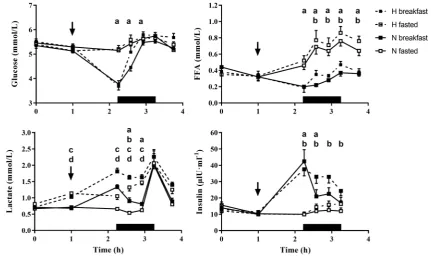
p < 0.01) was observed for all analytes. Further, a signifi-cant interaction effect of time x trial was also observed for all analytes (all p ≤ 0.03). All significant pairwise statistical comparisons are presented in Fig. 3.
Fig. 2 The relative (% energy yield) contribution of carbohydrate and fat oxidation during uphill walking at 40%, 50% and 60% V̇O2max in
[image:8.595.308.535.51.400.2]Heart rate, capillary oxygen saturation and RPE
Capillary oxygen saturation, heart rate, and RPE scores for the duration of the experimental trial are presented in Table 2. There were no significant differences between tri-als for heart rate (p ≥ 0.14, d ≤ 0.96) and RPE (p ≥ 0.86,
d ≤ 0.21). Capillary oxygen saturation was significantly lower in hypoxia compared with normoxia in both the break-fast consumption and omission trials (p < 0.01, d = 7.83) (p < 0.01, d = 9.63).
Discussion
This study investigated the effect of breakfast consumption and exercise intensity on substrate oxidation in hypoxia compared with normoxia during both rest and exercise. In this regard, the relative carbohydrate contributions to energy expenditure decrease, while relative fat contributions increase, during exercise matched for relative intensities in hypoxia compared with normoxia after breakfast omission, but not consumption. This effect of breakfast consumption in hypoxia compared with normoxia appears to be exclusive to exercise, with no differences in relative substrate oxidation between hypoxia and normoxia after breakfast consumption
or omission at rest. Higher exercise intensities did not poten-tiate carbohydrate oxidation in hypoxia, compared with nor-moxia after either breakfast consumption or omission.
Absolute carbohydrate oxidation was significantly lower in hypoxia compared with normoxia during exercise at all intensities after breakfast omission. It has long been estab-lished that hypoxia induces a lower V̇O2max than normoxia
(Dill et al. 1931), which subsequently elicits lower absolute workloads during exercise matched to relative intensities in hypoxia, compared with normoxia (Lundby and Van Hall 2002). As such, the reduction in absolute carbohydrate oxi-dation in hypoxia, compared with normoxia after breakfast
Fig. 3 Plasma glucose, plasma lactate, serum FFA and serum insulin concentrations over the full experimental trial. Values are mean ± SE. The thin arrow represents the timing of breakfast in the hypoxic and normoxic breakfast consumption trials. Breakfast was not consumed in the hypoxic and normoxic fasted trials. The black rectangle repre-sents the exercise period. a A significant difference between breakfast
consumption and omission in normoxia. b A significant difference between breakfast consumption and omission in hypoxia. c A signifi-cant difference between hypoxia and normoxia after breakfast con-sumption. d A significant difference between hypoxia and normoxia after breakfast omission. Significance p < 0.05
Table 2 Mean capillary oxygen saturation (SpO2), heart rate and RPE
in all trials
H hypoxia, N normoxia
* Denotes significance in comparison with corresponding nutritional
status in hypoxia
[image:9.595.306.543.81.155.2] [image:9.595.80.512.386.644.2]omission is likely due in part to the reduced energy expendi-ture during exercise in hypoxia. Interestingly, this effect was less pronounced during exercise after breakfast consumption in hypoxia compared with normoxia (significance at 60%
̇
VO2max only and approaching significance at 50% V̇O2max).
However, due to the confounding factor associated with utilising absolute substrate oxidation, the use of substrate oxidation data relative to total energy expenditure is war-ranted to determine an effect of hypoxia beyond a reduced absolute workload.
A novel finding of this study is the lower relative contri-bution of carbohydrate and higher relative contricontri-bution of fat oxidation observed during exercise matched for relative intensities in hypoxia, compared with normoxia after break-fast omission. This finding is in agreement with some exist-ing literature utilisexist-ing overnight fasted male participants in acute hypoxia (O’Hara et al. 2017) but not others (Katayama et al. 2010; Morishima et al. 2014). O’Hara et al. (2017) observed an increased relative contribution of fat to energy expenditure during exercise matched to relative intensities (74% V̇O2max) in hypoxia compared with normoxia. It was
proposed that this may in part, be associated with augmented lipolysis and, therefore, FFA oxidation. The increased rates of lipolysis were supported by elevated concentrations of metanephrine and normetanephrine, as well as a subsequent increase in circulating FFA. This effect was observed despite consumption of a carbohydrate drink in both conditions (1.2 g·min−1 glucose, 0.6 g·min−1 fructose), demonstrating
the potency of being fasted during exercise in hypoxia. In the present study, no significant differences in FFA con-centrations were observed between hypoxia and normoxia after breakfast consumption or omission. This suggests that the higher relative contribution of fat oxidation observed in hypoxia, compared with normoxia after breakfast omission in the present study may not be associated with increased lipolysis of triglycerides stored in adipose tissue. As such, it seems plausible that an increased oxidation of intramus-cular trigylcerides which would not influence circulating FFA concentrations, may contribute to the increased relative contribution of fat oxidation during exercise after breakfast omission in hypoxia, compared with normoxia.
At the mitochondrial level, it has been proposed that the increased relative contribution of fat oxidation to energy expenditure in hypoxia may be a result of increased expres-sion of the transcription factor HIF-1α and the upregulation of PPARα (Aragones et al. 2008). Specifically, PPARα has been demonstrated to deactivate pyruvate dehydrogenase (Huang et al. 2002), inhibiting the conversion of pyruvate to acetyl-coA and, therefore, enabling greater mobilisation and oxidation of fat stores (Spriet and Watt 2003). Subsequently, pyruvate may then be shunted towards lactate production and away from oxidative metabolism. Logically, the reduced relative carbohydrate oxidation observed after breakfast
omission in hypoxia, compared with normoxia may be asso-ciated with a potentiated PPARα response induced by fasting (König et al. 1999). Therefore, as expected, increased lac-tate concentrations were observed after breakfast omission in hypoxia, compared with normoxia however, this effect was also evident after breakfast consumption. Albeit, lactate concentrations in the fed state may also be inflated by the metabolism of fructose, derived from the consumption of orange juice during breakfast. Specifically, fructose metabo-lism can occur without the rate limiting step of glycolysis (catalysed by phosphofructokinase) and is, therefore, rapidly phosphorylated leading to increased rates of glycolysis and elevated plasma lactate concentrations (Jentjens et al. 2004; Tappy 2018).
In contrast to findings from our recent meta-analysis (Griffiths et al. 2019), we observed no significant change in the relative contribution of carbohydrate or fat to energy expenditure during exercise matched for relative intensities in hypoxia, compared with normoxia after breakfast con-sumption. This finding is in accordance with a number of studies investigating substrate oxidation during exercise matched to relative intensities in hypoxia, compared with normoxia (Lundby and Van Hall 2002; Young et al. 1982). However, it is in contrast to those who observed an increased relative contribution of carbohydrate (Péronnet et al. 2006; Friedmann et al. 2004) and fat (Matu et al. 2017; Braun et al. 2000) to energy expenditure in the same conditions. The variance in the literature regarding the use of fed partici-pants is difficult to explain, but may be due to the numerous differing experimental characteristics such as carbohydrate supplementation and the sex of participants. The isolation of each of these characteristics in randomised control trials is required to further understand their influence on substrate oxidation in hypoxia.
Absolute carbohydrate oxidation was significantly higher in the post-prandial period after breakfast consumption compared with omission in both hypoxia and normoxia. Interestingly, the increased absolute carbohydrate oxidation observed after breakfast consumption in hypoxia and nor-moxia was associated with lower plasma glucose concentra-tions than breakfast omission. This effect remained signifi-cant at 40% and 50% V̇O2max in normoxia and approached
significance at 40% V̇O2max in hypoxia. This is likely due to
et al. (1993) also observed a reduction in muscle glycogen concentrations 1 h post-meal, before increasing again in the subsequent hours (1–7 h). Whilst we cannot confirm this in the present study, this may have implications for the timing of breakfast before exercise, and also provide a considera-tion for an addiconsidera-tional exogenous carbohydrate source during exercise if the primary goal is to spare muscle glycogen and improve performance.
Alterations in substrate oxidation between hypoxia and normoxia after both breakfast consumption and omission were consistent across varying exercise intensities, suggest-ing that increassuggest-ing exercise intensities may not potentiate carbohydrate oxidation in hypoxia, as previously proposed (Griffiths et al. 2019). However, the range of exercise sities used in the present study were low to moderate inten-sity (40–60% V̇O2max) and, therefore, may not have been
suf-ficient to potentiate sympathetic nervous system activity and glycogenolysis, as plasma epinephrine concentrations have been demonstrated to increase exponentially with exercise intensities increasing up to 85% V̇O2max (Romijn et al. 1993).
The finding that energy expenditure at rest was signifi-cantly higher in normobaric hypoxia compared with nor-moxia is consistent with numerous other studies (Butterfield et al. 1992; Matu et al. 2017). An increase in resting energy expenditure and/or a reduction in energy intake has been associated with a negative energy balance and, therefore, weight loss during chronic hypoxic exposure (Armellini et al. 1997; Sergi et al. 2010). The increase in resting energy expenditure has been attributed to the elevated cardiovascu-lar and ventilatory responses experienced during hypoxic exposure (Butterfield 1999). The reduction in energy intake observed in hypoxia is likely explained by impaired appetite regulation, a result of the hypoxic-induced suppression of the orexigenic hormone, acylated ghrelin (Debevec 2017; Matu et al. 2017). Whilst a reduction in body mass may induce debilitating effects on performance for high altitude mountaineers and military personnel alike, this finding may have implications for weight loss strategies in obese popu-lations (Kayser and Verges 2013). The finding that energy expenditure during exercise was reduced in normobaric hypoxia compared with normoxia substantiates previous research (Matu et al. 2017), and is likely due to the reduced absolute workload in hypoxia. However, this reduced work-load in hypoxia has been suggested to induce a similar meta-bolic load to normoxia, therefore, facilitating physical activ-ity adherence while reducing the risk of musculoskeletal injury in obese individuals (Girard et al. 2017).
Despite the novel findings of this study, some notable limitations must be acknowledged. The use of muscle biop-sies to investigate a key theory involving PPARα was beyond the scope of this study and as such, a physiological explana-tion for the changes in substrate oxidaexplana-tion in the fasted state could not be confirmed. Further, whilst we could calculate
whole body substrate oxidation, muscle/liver glycogen oxi-dation could not be analysed without muscle biopsies or tracer derived methods. In addition, the present study only investigated changes in young men; therefore, caution should be applied when applying the results to other populations. For example, women have been shown to elicit differing metabolic responses to hypoxia, when compared with men (Braun et al. 2000). Finally, the use of a normobaric hypoxic chamber in the present study should be acknowledged when considering the practical applicability of these findings to terrestrial altitude. Future research should investigate the effect of nutritional strategies (i.e., carbohydrate supple-mentation) in hypoxia after both breakfast consumption and omission to determine their effect on substrate oxidation and performance. In addition, it would be necessary to investi-gate substrate oxidation during exercise across a broader range of exercise intensities to determine if high intensity exercise induces different substrate oxidation responses than low intensity exercise when performed in hypoxia compared with normoxia.
Conclusions
In conclusion, we observed a reduced relative contribution of carbohydrate oxidation to energy expenditure during exer-cise matched for relative intensities in hypoxia, compared with normoxia after breakfast omission but no difference was observed during exercise after breakfast consumption. The effect of hypoxia on substrate oxidation was not altered with increasing exercise intensities when compared with normoxia. These data provide clarity on the current litera-ture and may be useful in the design of nutritional strategies for high altitude mountaineers and military personnel.
Acknowledgements Funding for the study was provided internally by Leeds Beckett University. The authors would like to thank all partici-pants for their time and commitment in undertaking this study.
Author Contribution AG, JOH, KD and RK conceived and designed the study. AG, OS and JM collected the data. AG analysed the data and wrote the manuscript. All authors read and provided critical feedback on the manuscript before approving.
Compliance with ethical standards
Conflict of interest The authors declare that they have no conflict of interest.
Informed consent Informed consent was obtained from all individual participants included in the study.
Open Access This article is distributed under the terms of the Crea-tive Commons Attribution 4.0 International License (http://creat iveco mmons .org/licen ses/by/4.0/), which permits unrestricted use, distribu-tion, and reproduction in any medium, provided you give appropriate credit to the original author(s) and the source, provide a link to the Creative Commons license, and indicate if changes were made.
References
Aragones J, Schneider M, Van Geyte K, Fraisl P, Dresselaers T, Maz-zone M, Dirkx R, Zacchigna S, Lemieux H, Jeoung NH, Lambre-chts D, Bishop T, Lafuste P, Diez-Juan A, Harten SK, Van Noten P, De Bock K, Willam C, Tjwa M, Grosfeld A, Navet R, Moons L, Vandendriessche T, Deroose C, Wijeyekoon B, Nuyts J, Jordan B, Silasi-Mansat R, Lupu F, Dewerchin M, Pugh C, Salmon P, Mortelmans L, Gallez B, Gorus F, Buyse J, Sluse F, Harris RA, Gnaiger E, Hespel P, Van Hecke P, Schuit F, Van Veldhoven P, Ratcliffe P, Baes M, Maxwell P, Carmeliet P (2008) Deficiency or inhibition of oxygen sensor Phd1 induces hypoxia tolerance by reprogramming basal metabolism. Nat Genet 40(2):170–180. https ://doi.org/10.1038/ng.2007.62
Armellini F, Zamboni M, Robbi R, Todesco T, Bissoli L, Mino A, Angelini G, Micciolo R, Bosello O (1997) The effects of high altitude trekking on body composition and resting metabolic rate. Horm Metab Res 29(9):458–461
Beidleman BA, Rock PB, Muza SR, Fulco CS, Gibson LL, Kami-mori GH, Cymerman A (2002) Substrate oxidation is altered in women during exercise upon acute altitude exposure. Med Sci Sports Exerc 34(3):430–437
Blom W, Stafleu A, de Graaf C, Kok F, Schaafsma G, Hendriks H (2005) Ghrelin response to carbohydrate-enriched breakfast is related to insulin. Am J Clin Nutr 81:367–375
Braun B, Mawson J, Muza SR, Dominick S, Brookes G, Horning M, Rock PB, Moore L, Mazzeo R, Ezeji-Okoye S, Butterfield G (2000) Women at altitude Carbohydrate utilisation during exercise at 4300m. J Appl Physiol 88(1):246–256
Butterfield GE (1999) Nutrient requirements at high altitude. Clin Sports Med 18(3):607
Butterfield GE, Gates J, Fleming S, Brooks GA, Sutton JR, Reeves JT (1992) Increased energy intake minimises weight loss in men at high altitude. J Appl Physiol 72:1741–1748
Conkin J (2011) PH2O and simulated hypobaric hypoxia. Aviat Space Environ Med 82:1157–1158
Coyle E, Jeukendrup A, Wagenmakers A, Saris W (1997) Fatty acid oxidation is directly regulated by carbohydrate metabolism during exercise. Am J Physiol 273:E268–E275
Debevec T (2017) Hypoxia-related hormonal appetite modulation in humans during rest and exercise: mini review. Front Physiol 30(8):366
Dill DB, Edwards HT, Folling A, Oberg AM, Pappenheimer AM, Tal-bott JH (1931) Adaptations of the organism to changes in oxygen pressure. J Physiol 71
Edinburgh RM, Hengist A, Smith HA, Travers RL, Koumanov F, Betts JA, Thompson D, Wahlin JP, Hamilton DL, Stevenson EJ, Tipton KD, Gonzalez JT (2018) Pre-exercise breakfast ingestion versus extended overnight fasting increases postprandial glucose flux after exercise in healthy men. Am J Physiol. https ://doi. org/10.1152/ajpen do.00163 .2018
Fenn W, Rahn H, Otis A (1946) A theoretical study of the composition of the alveolar air at altitude. Am J Physiol 146:637–653 Frayn K (1983) Calculation of substrate oxidation rates in vivo from
gaseous exchange. J Appl Physiol 55:628–634
Friedmann B, Bauer T, Menold E, Bartsch P (2004) Exercise with the intensity of the individual anaerobic threshold in acute hypoxia. Med Sci Sports Exerc 36(10):1737–1742. https ://doi. org/10.1249/01.mss.00001 42307 .62181 .37
Geiger P, Han D, Wright D, Holloszy J (2006) How muscle insulin sensitivity is regulated: testing of a hypothesis. Am J Physiol 291(6):E1258–E1263
Girard O, Malatesta D, Millet G (2017) Walking in hypoxia: an effi-cient treatment to lessen mechanical constraints and improve health in obese individuals? Front Physiol 8:73
Goodman J, Hassell K, Irwin D, Witkowski EH, Nuss R (2014) The splenic syndrome in individuals with sickle cell trait. High Alt Med Biol 15:468–471
Griffiths A, Shannon O, Matu J, King R, Deighton K, O’Hara J (2019) The effects of environmental hypoxia on substrate uti-lisation during exercise: a meta-analysis. J Int Soc Sports Nutr 16:1
Hopkins W (2004) How to interpret changes in an athletic performance test. Sportscience 8:1–7
Howley E, Bassett D, Welch H (1995) Criteria for maximal oxy-gen uptake: review and commentary. Med Sci Sports Exerc 27:1292–1301
Huang B, Wu P, Bowker-Kinley M, Harris R (2002) Regulation of pyruvate dehydrogenase kinase expression by peroxisome pro-liferator-activated receptor-alpha ligands, glucocorticoids, and insulin. Diabetes 51:276–283
Jentjens R, Moseley L, Waring R, Harding L, Jeukendrup A (2004) Oxidation of combined ingestion of glucose and fructose during exercise. J Appl Physiol 96:1277–1284
Jeukendrup A, Wallis G (2005) Measurement of substrate oxidation during exercise by means of gas exchange measurements. Int J Sports Med 26(1):28–37
Jones A, Doust J (1996) A 1% treadmill grade most accurately reflects the energetic cost of outdoor running. J Sports Sci 14:321–327 Katayama K, Goto K, Ishida K, Ogita F (2010) Substrate utilization
during exercise and recovery at moderate altitude. Metabolism 59(7):959–966. https ://doi.org/10.1016/j.metab ol.2009.10.017
Kayser B, Verges S (2013) Hypoxia, energy balance and obesity: from pathophysiological mechanisms to new treatment strategies. Obes Rev 14(7):579–592
König B, Rauer C, Rosenbaum S, Brandsch C, Eder K, Stangl G (1999) Fasting upregulates PPAR target genes in brain and influences pituitary hormone expression in a PPAR dependent manner. PPAR Res. https ://doi.org/10.1155/2009/80160 9
Lundby C, Van Hall G (2002) Substrate utilization in sea level residents during exercise in acute hypoxia and after 4 weeks of acclimatiza-tion to 4100 m. Acta Physiol Scand 176(3):195–201
Matu J, Deighton K, Ispoglou T, Duckworth L (2017) The effect of moderate versus severe simulated altitude on appetite, gut hor-mones, energy intake and substrate oxidation in men. Appetite 113:284–292. https ://doi.org/10.1016/j.appet .2017.02.041
Matu J, Gonzalez JT, Ispoglou T, Duckworth L, Deighton K (2018) The effects of hypoxia on hunger perceptions, appetite-related hor-mone concentrations and energy intake: a systematic review and meta-analysis. Appetite 125:98–108. https ://doi.org/10.1016/j. appet .2018.01.015
Morishima T, Mori A, Sasaki H, Goto K (2014) Impact of exercise and moderate hypoxia on glycemic regulation and substrate oxidation pattern. PLoS ONE 9(10):e108629. https ://doi.org/10.1371/journ al.pone.01086 29
O’Hara JP, Woods DR, Mellor A, Boos C, Gallagher L, Tsakirides C, Arjomandkhah NC, Holdsworth DA, Cooke CB, Morrison DJ, Preston T, King RF (2017) A comparison of substrate oxidation during prolonged exercise in men at terrestrial altitude and nor-mobaric normoxia following the coingestion of 13C glucose and 13C fructose. Physiol Rep. https ://doi.org/10.14814 /phy2.13101
Péronnet F, Massicotte D, Folch N, Melin B, Koulmann N, Jimenez C, Bourdon L, Launay JC, Savourey G (2006) Substrate utilization during prolonged exercise with ingestion of 13C-glucose in acute hypobaric hypoxia (4,300 m). Eur J Appl Physiol 97(5):527–534 Reeves S, Halsey L, McMeel Y, Huber J (2013) Breakfast habits,
beliefs and measures of health and wellbeing in a nationally rep-resentative UK sample. Appetite 60:51–57
Romijn JA, Coyle E, Sidossis LS, Gastaldelli A, Horowitz JF, Endert E, Wolfe RR (1993) Regulation of endogenous fat and carbohydrate metabolism in relation to exercise intensity and duration. Am J Physiol 265(28):E380–E391
Sahlin K (1990) Muscle carnitine metabolism during incremental dynamic exercise in humans. Acta Physiol 138(3):259–262 Sergi G, Imoscopi A, Sarti S, Perissinotto E, Coin A, Inelman EM,
Zambon S, Busetto L, Seresin C, Manzato E (2010) Changes in total body and limb composition and muscle strength after a 6–8 weeks sojourn at extreme altitude (5000–8000 m). J Sports Med Phys Fitness 50(4):450–455
Skinner JS et al (1999) Reproducibility of maximal exercise test data in the HERITAGE family study. Med Sci Sports Exerc 31:1623–1628
Spaeth AM, Dinges DF, Goel N (2015) Resting metabolic rate varies by race and by sleep duration. Obesity 23(12):2349–2356 Spriet L, Watt M (2003) Regulatory mechanisms in the interaction
between CHO and lipid oxidation during exercise. Acta Physiol Scand 178:443–452
Stevenson E, Williams C, Nute M, Swaile P, Tsui M (2005) The effect of the glycemic index of an evening meal on the metabolic responses to a standard high glycemic index breakfast and subse-quent exercise in men. Int J Sport Nutr Exerc Metab 15:308–322 Tappy L (2018) Fructose-containing caloric sweeteners as a cause of
obesity and metabolic disorders. J Exp Biol 221:164202 Taylor R, Price T, Katz L, Shulman R, Shulman G (1993) Direct
meas-urement of change in muscle glycogen concentration after a mixed meal in normal subjects. Am J Physiol 265(2):E224–E229 Tentolouris N, Tsigos C, Perea D, Koukou E, Kyriaki D, Kitsou E,
Daskas S, Daifotis Z, Makrilakis K, Raptis SA, Katsilambros N (2003) Differential effects of high-fat and high-carbohydrate iso-energetic meals on cardiac autonomic nervous system activity in lean and obese women. Metabolism 52(11):1426–1432
Van Loon L, Greenhaff P, Constantin-Teodosiu D, Saris W, Wagenmak-ers A (2001) The effect of increasing exercise intensity on muscle fuel utilisation in humans. J Physiol 536:295–304
Watt M, Howlett K, Febbraio M, Spriet L, Hargreaves M (2001) Adren-aline increases skeletal muscle glycogenolysis, PDH activation and carbohydrate oxidation during moderate exercise in humans. J Physiol 534:269–278
Wolever T, Jenkins D, Ocana A, Rao V, Collier G (1988) Second-meal effect: low glycemic-index foods eaten at dinner improve subse-quent breakfast glycemic response. Am J Clin Nutr 48:1041–1047 Young A, Evans W, Cymerman A, Pandolf K, Knapik J, Maher J
(1982) Sparing effect of chronic high-altitude exposure on muscle glycogen utilization. J Appl Physiol 52(4):857–862
Publisher’s Note Springer Nature remains neutral with regard to