STUDY OF PROFESSIONAL COMMITMENT AMONG P.S.E.B AND
C.B.S.E SECONDARY SCHOOL TEACHERS IN RELATION TO THEIR
TEACHING EXPERIENCE
Dr. (Mrs.) Vijay Laxmi
Principal, D.D. Jain College of Education, Ludhiana, India. &
Mrs. Puneet Kaur
Assistant Professor, D.D. Jain College of Education, Ludhiana, India.
ABSTRACT
In the present study an attempt has been made to study professional commitment among PSEB
and CBSE secondary school teachers. Data was collected randomly from six different schools (3
PSEB and 3 CBSE secondary schools) by using Professional commitment scale by Dr. Ravinder
Kaur, Dr. Sarabjit Kaur Ranu and Dr Sarvjit Kaur Brar (2011). Results of the study revealed
significant difference between various dimensions of Professional commitment i.e., commitment
to learner, commitment to society, commitment to profession but no significant difference in the
mean scores of various dimensions such as Commitment to Attain Excellence and Commitment
to Basic Human Values among PSEB and CBSE secondary school teachers. Also, no significant
difference was found in the means of various dimensions of professional commitment and
varying lengths of teaching experience of PSEB secondary school teachers. On the same lines no
significant difference was found between various dimensions of professional commitment and
varying lengths of teaching experience of C.B.S.E secondary school teachers. But Significant International Research Journal of Human Resources and Social Sciences
Vol. 3, Issue 12, December 2016 Impact Factor- 5.414
ISSN(O): (2349-4085) ISSN(P): (2394-4218)
relationship was found between professional commitment and teaching experience of PSEB and
CBSE secondary school teachers.
INTRODUCTION
Teachers are the main agents in the field of education. Quality of education depends on quality of teachers. It is he who can act as a builder of students life and hence builder of nation. Teaching is an art. The teacher who is well versed with the pros and cons of quality teaching can provide effective education. Teaching is very skillful and difficult job. Some of the characteristics and professional qualities such as variety of skills, efficiency, confidence, dedication, hard work and commitment are very important for effective teachers.
Teachers work involves rigorous efforts in the classroom and outside as well as frequent interaction with parents and community members. For this purpose teachers need to be well trained and competent to perform their jobs. If teachers acquire Professional competencies and commitment and if they are enabled and empowered to perform their multiple tasks in the classroom as well as in the school and community in a genuinely professional manner, then it will result in a high quality learning among students in their cognitive, affective and psychomotor areas . Teacher‟s dedication to his work depends on multiple factors such as school environment, salary, age, teaching experience, relation with head of the institution and colleagues etc.
PROFESSIONAL COMMITMENT
Professional commitment means ―The feeling of dedication among the individuals of a group towards their profession. There are two components of commitment namely-pride in one„s being in the teaching profession and a strong desire for professional development. In fact after joining the profession they should fully understand as long as they are there they have to develop pride knowing that this is a Nobel profession charged with great responsibilities as the society hands over its children to this system for their wholesome education.
Vandenberg and Scarpello (1994) defined professional commitment as “a person‟s belief in and acceptance of the values of his or her chosen occupation or line of work, and a willingness to maintain membership in that occupation” (p. 535).
Mayer and Allen (1997) stated teacher commitment as a psychological position that display a teacher‟s relationship with his or her profession and has a strong influence for the decision to remain as a part of that profession.
Brooks and Swailes (2002) stated professional commitment as the strong point of identification of an individual and participation in that particular profession.
Thus, Teacher commitment helps us to differentiate between those teachers, who are devoted and take profession very seriously than who prefer their own interest (Nais, 1981; 1989).
COMPONENTS OF PROFESSIONAL COMMITMENT
Meyer et al. (1993) defined three different components of professional commitment.
1. Affective Professional Commitment (APC): Affective professional commitment (APC) refers to identification with, involvement in, and emotional attachment to the profession. Thus, employees with strong affective professional commitment remain members of their profession because they want to do so.
2. Continuance Professional Commitment (CPC): Continuance professional commitment (CPC) refers to commitment based on the employee‟s recognition of the costs associated with leaving their profession. Employees with strong continuance commitment remain with their profession because they realise that they have much to lose by not doing so.
because they feel they ought to do so. Normative professional commitment may develop because of effective professional socialisation or the sacrifices involved in becoming a member of a particular profession (Meyer et al., 1993).
AREAS OF COMMITMENT
1. Commitment to the learner- Children need teacher who understand them and their needs with sensitivity. They need to be looked after by teachers who understand their instincts, learning needs and tendencies along with their capacities and abilities. By taking up the profession of teaching, the teacher is pledged to progress and development of learners.
2. Commitments to the society- The school and community have symbolic relation between them. Teachers need is to orient community towards the importance of education as a lifelong process and also motivate them to take it in that perspective. Teachers need to have deep concern and commitment towards the community.
3. Commitment to the profession- Teachers are entrusted by the community to shoulder the responsibility of shaping the present generation for the future through the process of teaching and learning. Committed professionals should adopt various innovative method of teaching taking into consideration how best to learn and bring about the effective learning. This can happen only when teachers themselves show commitment to the profession to improve both guided as well as self-directed learning.
4. Commitment to the attaining excellence for professional actions- Teachers who continue their search for becoming better human beings and better teachers are followed in their footsteps by the learners. They get all the respect from them and at the same time acquire higher levels of excellence and proficiency.
5. Commitment to Basic Human values- Every community expects the teachers to follow a value based approach in their personal life so as to become role models for the future generation.
TEACHING EXPERIENCE
on life as a whole and the course of their professional development. Many factors such as how serious teachers are in performing their duties, what steps they take for their professional growth during their carrier, how far they sustain their love for teaching and how much job satisfaction they feel, length of teaching experience also matters with respect to the development of professional commitment.
More the teachers are Proficient and experienced greater is the growth of their students. Shulman & Shulman (2004), observe that teaching proficiencies develop over time, through multiple, coherent opportunities to experience, understand, act, and reflect, many times with colleagues, sometimes alone, sometimes spontaneously and at other times through structured professional development sessions. When teachers become more experienced in their teaching, then a kind of decision scheme or criteria develops. Proficient and expert teachers are the need of present times. Expert teachers devote their time and energy to maximizing learning for all students, and they enable them to improve their achievements. Teaching proficiency is naturally associated with years of experience. If teaching task are taken seriously and sincerely over years that leaves to the highest degree of teaching capability and proficiency. Day (2004) says that experienced teachers who do maintain their levels of commitment became capable because they modify their commitment in response to their levels of commitment became capable because they modify their commitment in response to their current personal and professional situations. Hoy and Woolfolk (1993) found that experiences that provide teachers with success in daily tasks increases teacher‟s sense of efficacy. In particular, pre-service teachers‟ sense of efficacy grows as a result of field experiences with students in schools.
Eleonora (2003), points out that teacher professional development has to be perceived as a long term process as it acknowledges the fact that teachers learn over time help teachers in mastery of new skills widen their knowledge, develop an innovative insight into their pedagogy, their practice and their understanding of their own needs since teacher's professional experience is an aspect of his or her personal development as a whole.
REVIEW OF LITERATURE
Hoy and Woolfolk (1993) found that experiences that provide teachers with success in daily tasks increases teacher‟s sense of efficacy In particular pre-service teachers‟ sense of efficacy grows as a result of field experience with students in schools. When teachers have a sense of efficacy, they remain motivated and committed despite setbacks and obstacles.
National Center For Education Statistics (1997) found that teachers with more teaching experience reported slightly less commitment than did teachers with less experience. It should be noted, however, that in each case, the relationship is statistically significant, but is weak.
Boylan and Me Swan (1998) found that teachers who had served in rural schools for more than six years reported a high level of commitment to teaching, which appeared to increase as teaching experience increased.
Hung and Liu (1999) depicted that stay-back is the factor which is most highly and significantly related to commitment. Apart from this, the other factors like marital status, age and tenure were also found to be significantly related to commitment.
Smart (2003) investigated the relationship between working conditions, selected personal factors and professional commitment of primary school teachers. A significant positive relationship was found between professional commitment and working conditions. A linear relationship was found between professional commitment and all the four predictors‟ variable, working conditions, gender, salary and qualifications. The four regression models shows working conditions to be the strongest predictor of professional commitment followed by gender, salary and qualification. Marital status, teaching experience, type of school do not contribute significantly in the prediction of professional commitment in this study.
teaching experience increases initially but when time and tenure of their being in service decreases and teaching experience increases the level of their professional commitment also increases.
Chan (2006) administered questionnaire to 106 in service teachers of a university in Hong Kong to study their motives and commitment in teaching. Pearson correlation analysis showed that intrinsic/altruistic motives were significantly related to teachers‟ commitment in teaching. Multivariate analysis (MANOVA) of the commitment factors showed no significant differences at .05 level with respect to the participants gender, age, elective and teaching experiences.
Sood and Anand (2011) studied the level of professional commitment of teacher educators serving in secondary teacher training institutions of Himachal Pradesh. The data were gathered through Scale for Professional Commitment of Teacher Educators from 135 teacher educators of 25 B. Ed. colleges of Himachal Pradesh. Results showed that the level of professional commitment of B. Ed. teacher educators in Himachal Pradesh is moderate. Significant differences were found in professional commitment of B. Ed. teacher educators with regard to gender, marital status and teaching experience. However, NET qualified and Non-NET qualified teacher educators were found to have similar level of commitment towards their profession.
Arjunan and Balamurugan (2013) studied the Professional Commitment among in-service teachers and as a result they concluded that the gender of teachers has no impact on the level of professional commitment. Moreover, more experienced teacher possessed more professional commitment.
Dhamane (2013) in his study focused on Professional commitment of secondary school teachers and compares it with gender wise, type of management and nature of appointment. The sample for this study was 100 secondary school teachers as per the objectives of the study. Results revealed that Professional Commitment of aided secondary school teachers and unaided secondary school teachers was found significantly different. The Professional commitment of permanently appointed secondary teachers and temporarily appointed secondary teachers was also found significantly different.
study also revealed that females had better commitment than males. The commitment of experienced teachers was more than inexperienced.
Brar (2016) in her study revealed no significant difference in the professional commitment of teachers with varying lengths of teaching experience.
NEED OF THE STUDY
A committed teacher is an advantage of any organization and occupies the most important place in an educational institution because they are in charge of the future of the nation. Need of the nation is not only to attract but also to retain committed teachers. Provision of facilitating working conditions for teachers will help in the enhancement of their commitment to the profession. To strengthen educational system we require teachers who are trained and aware of their duties and thus perform their jobs with the best they can afford. The need for the improvement and enhancement of professional commitment of teacher educators is now universally emphasized and highlighted in educational circles and forums. Hence, the present study was undertaken to examine the level of professional commitment of teacher educators and identify the factors like teaching experience responsible for commitment and dedication among teacher educators.
OBJECTIVES OF THE STUDY
1. To find out the difference in professional commitment of PSEB and CBSE secondary school teachers.
2. To find out the difference between professional commitment and teaching experience of PSEB secondary school teachers.
3. To find out the difference between professional commitment and teaching experience of CBSE secondary school teachers.
HYPOTHESES
1. There will be no significant difference in professional commitment of PSEB and CBSE secondary school teachers.
2. There will be no significant difference between professional commitment and teaching experience of PSEB secondary school teachers.
3. There will be no significant difference between professional commitment and teaching experience of CBSE secondary school teachers.
4. There will be no significant relationship professional commitment and teaching experience of PSEB and CBSE secondary school teachers.
METHODOLOGY
STATISTICAL TECHNIQUES
1. t-test was used to find out the difference in the means of professional commitment of PSEB and CBSE secondary school teachers.
2. t-test was calculated to find out the difference in the means of professional commitment and Teaching Experience of PSEB secondary school teachers.
3. t-test was calculated to find out the difference in the means of professional commitment and Teaching Experience of CBSE secondary school teachers.
4. Product moment correlation was calculated to find out the relationship between professional commitment and Teaching Experience of secondary school teachers.
SAMPLE
Table 1: List of Schools
TOOLS USED
1. Professional Commitment Scale by Kaur, Ranu and Kaur (2011)
This scale is divided into five dimensions consisting 45 items. The dimensions are:
i) Commitment to learner (9 items)
ii) Commitment to society (9 items)
iii) Commitment to profession (9 items)
iv)Commitment to attain excellence (9 items)
v) Commitment to basic Human value (9 items).
Each dimension possessing nine items. The reliability of the scale is 0.76. These items were selected after carefully scrutinizing the definition of professional commitment and its dimensions; hence scale has fair degree of content validity.
S.No. Name of the school Type of school No of the teachers
1. Atam Devki Niketan School CBSE 14
2. M.G.N Public School CBSE 12
3. N.M Jain Senior Secondary School PSEB 15
4. Teja Singh Memorial Senior Secondary School, Shimlapuri.
PSEB 12
5. Atam Public School CBSE 12
6. Guru Nanak Khalsa Sen. Sec. School PSEB 15
2. Teaching experience was considered as less than ten years and above ten years.
[image:11.612.62.551.144.583.2]RESULTS AND DISCUSSION
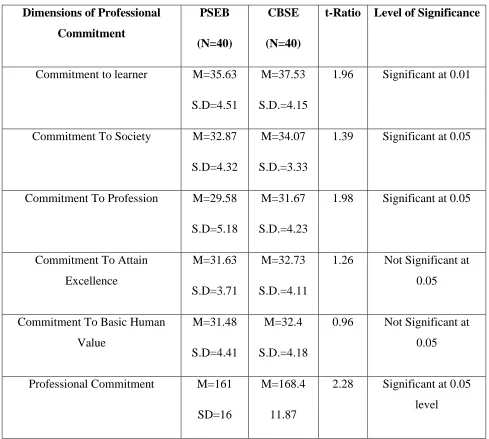
Table 2: Showing difference in the means of Professional Commitment of PSEB and CBSE
secondary school teachers
Dimensions of Professional
Commitment
PSEB
(N=40)
CBSE
(N=40)
t-Ratio Level of Significance
Commitment to learner M=35.63
S.D=4.51
M=37.53
S.D.=4.15
1.96 Significant at 0.01
Commitment To Society M=32.87
S.D=4.32
M=34.07
S.D.=3.33
1.39 Significant at 0.05
Commitment To Profession M=29.58
S.D=5.18
M=31.67
S.D.=4.23
1.98 Significant at 0.05
Commitment To Attain Excellence
M=31.63
S.D=3.71
M=32.73
S.D.=4.11
1.26 Not Significant at 0.05
Commitment To Basic Human Value
M=31.48
S.D=4.41
M=32.4
S.D.=4.18
0.96 Not Significant at 0.05
Professional Commitment M=161
SD=16
M=168.4
11.87
2.28 Significant at 0.05 level
commitment i.e., commitment to learner, commitment to society, commitment to profession but no significant difference was found in the mean scores of various dimensions such as Commitment to Attain Excellence and Commitment to Basic Human Value among PSEB and CBSE secondary school teachers.
Therefore the hypothesis H1 stating that there will be no significant difference in Professional Commitment of PSEB and CBSE secondary school teachers is rejected. The above results are in line with Dhamane (2013).
[image:12.612.68.547.306.660.2]This may be due to the difference between the grants, faculty development programmes, orientations of teachers at different levels received by CBSE teachers.
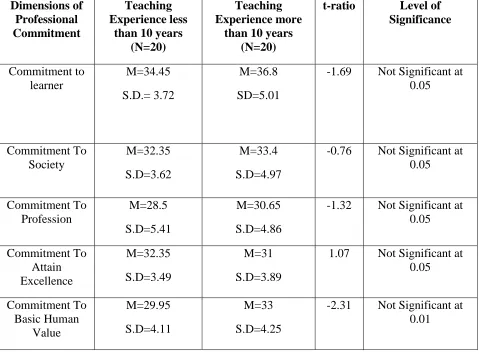
Table 3: Showing difference in the means of professional commitment and teaching
experience of PSEB secondary school teachers
Dimensions of Professional Commitment
Teaching Experience less
than 10 years (N=20)
Teaching Experience more
than 10 years (N=20)
t-ratio Level of Significance Commitment to learner M=34.45 S.D.= 3.72 M=36.8 SD=5.01
-1.69 Not Significant at 0.05 Commitment To Society M=32.35 S.D=3.62 M=33.4 S.D=4.97
-0.76 Not Significant at 0.05 Commitment To Profession M=28.5 S.D=5.41 M=30.65 S.D=4.86
-1.32 Not Significant at 0.05 Commitment To Attain Excellence M=32.35 S.D=3.49 M=31 S.D=3.89
1.07 Not Significant at 0.05 Commitment To Basic Human Value M=29.95 S.D=4.11 M=33 S.D=4.25
Table 3 revealed that the mean scores of Professional Commitment and teaching experience of P.S.E.B secondary school teachers. The above results revealed that there exists no significant difference in the means of various dimensions of professional commitment and varying lengths of teaching experience of PSEB secondary school teachers. Thus, the hypothesis 2 stating, “There will be no significant difference between professional commitment and teaching experience of PSEB secondary school teachers” stands accepted. The results are in conformity with Chan (2006).
Table 4: Showing difference in the means of professional commitment and teaching
experience of CBSE secondary school teachers.
Dimensions of Professional Commitment
Teaching Experience less
than 10 years (N= 20)
Teaching Experience more than 10 years (N= 20)
t- ratio Level of Significance
Commitment to learner M=37.25 S.D.= 4.75 M=37.8 SD=3.56
-0.41 Not Significant at 0.05 Commitment To Society M=33.2 S.D=3.34 M=34.95 S.D=3.15
-1.70 Not Significant at 0.05 Commitment To Profession M=32 S.D=3.77 M=31.35 S.D=4.72
0.48 Not Significant at 0.05 Commitment To Attain Excellence M=32.55 S.D=4.38 M=33.11 S.D=3.92
-0.27 Not Significant at 0.05 Commitment To Basic Human Value M=31.85 S.D=4.01 M=32.95 S.D=4.38 -0.83
Not Significant at 0.01
experience of C.B.S.E secondary school teachers” stands accepted. The above results are in conformity with Kohli(2005) and Chan (2006).
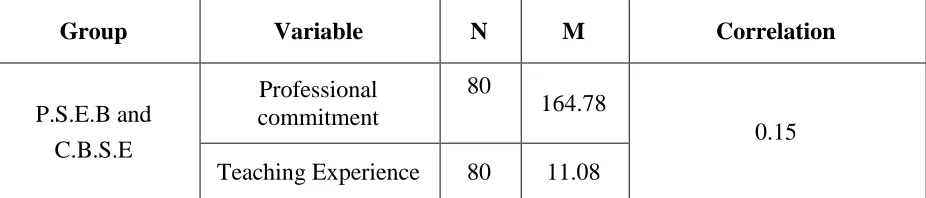
Table 5: Showing relationship between Professional Commitment and Teaching
Experience of PSEB and CBSE secondary school teachers.
Group Variable N M Correlation
P.S.E.B and C.B.S.E
Professional commitment
80
164.78
0.15 Teaching Experience 80 11.08
The above results revealed positive but weak relationship between Commitment and Teaching Experience of PSEB and CBSE secondary school teachers. Thus the hypothesis stating, “There will be no significant relationship between professional commitment and teaching experience of PSEB and CBSE secondary school teachers” stands rejected.
The results are in line with Kohli (2005), Arjunan and Balamurugan (2013) and Swarnalatha (2016).
This may be due to the reason that with experience, teachers acquire proficiencies and learn various teaching skills which further increase their commitment towards their profession.
RESULTS
1. Significant difference was found between various dimensions of Professional commitment i.e., commitment to learner, commitment to society, commitment to profession but no significant difference was found in the mean scores of various dimensions such as Commitment to Attain Excellence and Commitment to Basic Human Value among PSEB and CBSE secondary school teachers.
3. No significant difference was found between various dimensions of professional commitment and varying lengths of teaching experience of C.B.S.E secondary school teachers.
4. Significant relationship was found between professional commitment and teaching experience of PSEB and CBSE secondary school teachers
EDUCATIONAL IMPLICATIONS
1. The present study can be conducted on primary and elementary teachers.
2. The professional committed can be studied with factors such as grade level taught, age etc.
3. The study can be conducted with many other variables like work motivation, self efficacy, leadership style, organizational commitment etc.
REFERENCES
Bagraim, Jeffrey J. (2003). The Dimensionality of Professional Commitment. SA Journal of Industrial Psychology, 29 (2), 6-9.
Boylan, C., & Me Swan, D. (1998). Long-Staying Rural Teachers; Who Are They? Australian Journal ofEducation 42 (1), 49-65.
Brar, Sarvjeet(2011) in her study Professional Commitment of Teachers in relation to their life satisfaction, teaching experience and organisational climate .an unpublished Thesis Submitted to the Faculty of Education Panjab University, Chandigarh.
Chan, K. W. (2006). In Service Teachers‟ Motives and Commitment in Teaching. Education Today, 48(1), 2-8.
Day, C. (2004). A Passion for Teaching. London: Routledge-Falmer.
Eleonora, V. R. (2003). Teacher Professional Development: An International Review of the Literature. Paris: UNESCO - International Institute for Educational Planning.
Hoy, W. K., & Woolfolk, H. A. (1993). Teachers‟ Sense of Efficacy and the Organisational Health of Schools. Elementary School Journal, 93, 335-372
Hung, A. & Liu, J. (1999) Effects of stay-back on teachers‟ professional commitment.
International Journal of Educational Management 13, 5, 226-241.
Kadyschuk, Ronald(1997) Teacher Commitment: A Study Of The Organizational Commitment, Professional Commitment, And Union Commitment Of Teachers In Public Schools In Saskatchewan. An unpublished Thesis submitted to the University Of Saskatchewan.
Kohli, K. (2005b) Assessment of professional commitment of teacher educators. Edutracks 5, 1, 23-27.
National Center For Education Statistics(1997)Teacher Professionalization and Teacher Commitment: A Multilevel Analysis. Retrieved from http://nces.ed.gov/pubs/97069.pdf
Swarnalatha, S. Sunitha (2016). Work Commitment of Secondary School Teachers.The
International Journal of Indian Psychology , 3(4),84-89.
Shukla, Shashi(2014) Teaching Competency, Professional Commitment and Job Satisfaction-A Study of Primary School Teachers. IOSR Journal of Research & Method in Education, 4(II),44-64.
Smart, R. (2003). A study of Professional Commitment of Primary School Teachers in relation to Working Conditions and Selected Personal factors. Indian Educational Abstracts. 1 and 2.
Sood, Vishal and Anand, Arti (2010). Professional commitment among B.Ed teacher educators of Himachal Pradesh.Journal of All Indian Association for Educational Research,22(1),51-60.
Shulman, L. S., & Shulman, J. (2004). How and what teachers learn: a shifting perspective.