International Research Journal of Human Resources and Social Sciences Impact Factor- 2.561
Vol. 3, Issue 2, Feb 2016 ISSN(O): (2349-4085) ISSN(P): (2394-4218)
© Associated Asia Research Foundation (AARF)
Website: www.aarf.asia Email : [email protected] , [email protected]
“A CONTEMPORARY APPROACH FOR CONSTRUCTING
COMPUTER NETWORK IN LIBRARY SYSTEM”
Prof. Shilpa Shantaram Pawar
ABSTRACT
This article describes how to build a network. Which covers all the requirements for
the crating of the network i.e. hardware, software, network hardware, network software,
human resources, network securities etc. This is helpful for library professionals in creating
a network of the libraries in this information society. Now a days for getting the advantages
of the digital information resources and the websites, portals, consortium were used in vast
proportion hence it becomes essential for studying this aspect cautiously. The prerequisites
and appraisal (expenses) for the small and medium size networks are discussed which
provides tentative cost for creating the network.
Keywords: Development of networks, Library networks, hardware, software, network hardware, network software, manpower, network securities, resource sharing, consortium, Internet, Intranet etc.
Introduction:
Since world war two and especially after innovation of paper and printing machine, the scenario of communication changed in massive ways. Multiple copies of documents were generated and the spread of knowledge was fast. The scope of library also changed from archival to usage. The Libraries played an important role of dissemination of knowledge. The functions slowly shifted to Acquire, Process, and Store and disseminate the information form the preservation.
This was quite comfortable position of libraries as the requirement was limited and generation of information was controlled by acquiring information.
Objectives:
Following objectives were considered to accomplish the aim of the study.
1) To study the Development of Libraries & prerequisites of library networks
2) To appraise the cost of building networks with respect to advantages of Networks 3) To study the problems and challenges in establishing Networks
4) To determine the benefits of Library network and services.
Need for the Research:
Keeping all these developments in mind the research student felt that it is a welcome need for the libraries and librarians to understand the basics of networks and prerequisites for creating networks in Library. Whatever may be the size of collection of physical library it is essential to convert the library to digital world and get the information available on internet.
Scope:
Scope of the study is limited to building a small network at the initial stage and expands whenever required. The study will restrict to only creating a LAN at libraries and indicate what is required in construction of LAN type of network.
Importance of Study:
Along with the development of faster, reliable communication systems, there was a phenomenal growth of computers and related products. VLSI technology allowed the production of smaller, less expensive and widely acceptable computers. Currently the influence of computers is very significant in every walk of human life. The development in the computer technology and the communication technology established the networks and helped in moving the data form one place to another without any geographical limitations. The development and the advancement of the Internet (From ARPANET) gave the best facilities to the users. Thus the networks become the part of the life of the Information society similarly the developments in the intranet and extranet made advantages to the links within the organization or its branches to keep up-to-date with the development of organization at the most economical ways.
Prerequisite for the establishing network at institute
1) Hardware 2) Central Processing Unit
3) Input / Output Devices 4) Cable
5) Unshielded Twisted Pair UTP) cable 6) Shielded Twisted Pair (STP) Cable
7) Coaxial Cable 8) Switch
9) Router 10) Modems
13) Software 14) Systems Software and Application Software
15) INTRANET 16) Protocols
17) HTTP (Hyper Text Transfer Protocol) 18) FTP (File Transfer Protocol 19) TCP/IP (Transmission Control Protocol/Internet Protocol) 20) Web Browser
Methodology: The Methodology adopted to conduct this study is: 1) Literature survey for achieving information of ILL service 2) Case study method
3) Discussion with network professionals
4) Discussion and interview of library professionals.
Case Study:
Case study of the library network at Indira College of Commerce and Science (ICCS),
Pune:
Shree Chanakya Education society is one of the most popular education society in the area of Pune region it having different campus in different regions. There are five Institutes under the axis of Shree Chanakya Education society namely Indira institute of Management, Indira School of Business Studies, Indira college of Commerce and Science, Indira College of Pharmacy and Indira IT campus. All management and IT courses are run under Indira Institute of Management.
IIMP and IT campus is connected with 6 core fiber cabal for internet connection as well as transferring data and voice between the two campus. From the 6 core fiber cable four pairs are used for transferring data and voice (Tr Rr) and two separate pairs are spared for any problem with these pairs.
Amongst the other fore campuses, IT campus is connected to Pharmacy campus with 100 pair’s cable through which information is transferred. At the same time, Pharmacy campus is also connected to commerce and ISBS campuses through fiber optical cables. All the five campuses are having different modems and IT campus is having EPBAX system in which easy communication through telecom is possible.
Backbone of Indira Network: 1. Modems
2. EPBAX system 3. 100 pairs fiber cable 4. 8 mbps VSNL line
5. Fully digitalized connection
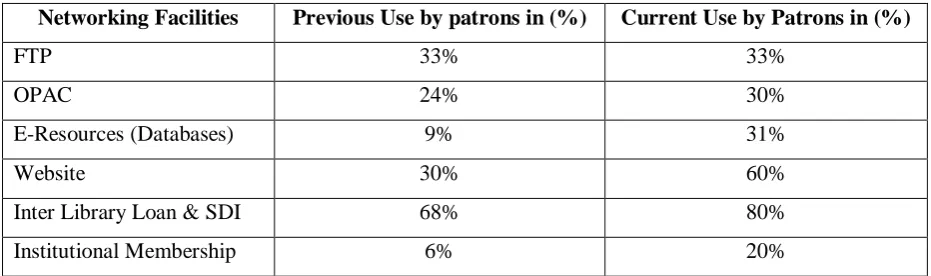
Following are the significant changes made after the use of networking facilities in the ICCS library. User get aware about the facilities provided and take benefits accordingly for satisfying their needs with the aid and guidance of librarian. They can store bulky data (soft copy of e-books, e-journals which is retrieved or downloaded from the databases) on the FTP Server. He or she has given the username and password for that specific need.
Networking Facilities Previous Use by patrons in (%) Current Use by Patrons in (%)
FTP 33% 33%
OPAC 24% 30%
E-Resources (Databases) 9% 31%
Website 30% 60%
Inter Library Loan & SDI 68% 80%
[image:4.595.65.531.283.421.2]Institutional Membership 6% 20%
0%
10%
20%
30%
40%
50%
60%
70%
80%
FTP OPAC E-Resources
(Databases)
Website Inter Library Loan & SDI
Institutional Membership 33%
24%
9%
30%
68%
6% 33%
30% 31%
60%
80%
20%
Previous Use
Current Use
Graph 1: Comparison of use of Networking facilities.
Building networks in the Library
Pre-requisites for Networking
For entering into a networking Programme, all participating libraries should have common understanding and agreement on the following:
(i) Subject areas.
(ii) For implementing cooperation.
(iii) Acquisition policies to ensure balanced collection in development programme. (iv) Sharing of the current materials, with clearly defined protocols, limitations and
priorities.
(v) Schemes to be used for organization of information and documents. (vi) Compatibility among systems to be used by the libraries.
Overview of the Costing
Cabling is very important to connect two computers in networking. Cabling can be done in two different types i.e. traditional cabling and Structural cabling. Structural cabling is the heart of networking. The following accessories are required in Structural cabling:-
1) Computer 2) Patch cord 3) Input Output Device 4) Cable 5) Rack & Switches 6) Cable Manager
How to do Structural cabling: At the outset, configuration has to be done with latest operating system and standard version. In Structural cabling, patch cord and input output devices are essential to pass on the data and voice. The next role is of cable which passes the data and voice from input output device to the Rack. There are different types of cables namely UTP cable, STP cable, coaxial cable and Fiber cable.
In network Rack, three things are important i.e. Patch Panel switches & cable Manager. In Rack, there are more than 2 switches and cables. In order to avoid interference between the switches and cables and to enable smooth wiring, cable manager play an important role. In switches, there are active and passive components which play a major role. In active component, electricity is not required as well as in passive component, electricity is required.
Cost of Structural Cabling
Sr. No.
Particular Configuration
Quantity Rate (Rs.) Configuration
1. Computer 01 17000/- Core 2 DUO, 80 GB Hard Disk, 1 GB RAM, 17 inch Monitor, 2.4 processor
2. Patch Cord 01 150/- 2 Meters
3. Patch Panel 01 3395/-
4. Cat 5 Cable 108/- 2 Meters
5. Switches 4000/- 24 ports
The costing is based on the following standards: The costing of the network is based on the approximation values and will act as guiding information. The costing is for the base work and for the initial stage, where as one could calculate based on the unit cost of the activities.
Problems and challenges in establishing Networks:
Network Interface Card (NIC) damaged/ not placed well: It is through the NIC (Network Interface Card) or network adaptor that a computer is connected to a computer network. There can be two possible reasons for its failure, either there is an installation failure or it has become damaged.
No Network Access Issue: In some situations the “No Network Access” icon or a HTTP 504 web server error code may come up. One of the reasons for this can be failure in the physical connections.
Check Firewall Restrictions or Settings: Firewall restrictions are necessary to protect your computer from malware. However, sometimes these can be the reason for lack of
connectivity with the network.
Low Internet or Network Speed: Sometimes, everything is fine, but there is a sudden drop in speed. Most people put it down to having exceeded the data limit. Though this can be one reason, it is better to run a check. It can also be due to inadequate planning of the network.
Benefit of Networks and Services for Libraries
Benefits: Following are the various benefits of networking.
1) Helps to enhance connectivity: Networks connect and link unlimited number of computers. This in turn connects the people using those computers. Individuals within a work group are connected through local area networks.
2) Networking helps in sharing of hardware: Networks help in sharing of different kinds of hardware devices. For example, sharing of a single printer in an office of twenty people is done through networking of wires. This saves lot of cost that could otherwise have incurred if twenty different printers were provided for each computer in use.
3) Eases out management of data: Networking provides the advantage of centralization of data from all the user systems to one system where it can be managed in an easy and better way. Administrators can thus manage all this data efficiently and in the best interest of the company. Even the access of this data becomes easy for the users. 4) Internet: The most beautiful gift of networking is internet that is massively used by
5) Data Sharing: Sharing of data through the use of networks helps save a lot of time and energy. It also facilitates the use of applications like databases that are based on ability of many individuals to access and to share exactly the same data.
Services:
Following are the Library Services provided through network: 1) Online Database
2) Union Catalogue
3) Current Awareness Service (CAS)
4) Selective Dissemination of Information (SDI) 5) Online Public Access Catalogue (OPAC) 6) Library website
Findings:
Establishing library network through Internet and Intranet connectivity, without these we cannot move towards Digital Library because the base of Digital Library is Internet and Digital Documents. Resource sharing will be increased in its scope and size due to budget decreases at different level. The networking plays vital role in using the e-resources and databases as well as deliver easy access of information to the users on their own desk.
Suggestion: to initiate the activity at base level and then expand it phase by phase.
Further study:
Concerning to the Virtual Library it is more effective in respect of networking services provided by libraries.
Conclusion:
No doubt traditional library is more effective in resource sharing and initiated manually Inter Library Loan or Library Cooperation etc. but due to growth of information technology it is possible to add computer and which developed network based libraries these libraries made powerful resource sharing library system at local level, but at national, international level.
The progress of Electronic Library, Digital Library, Virtual Library, Paperless Library Hence it is time to establish a perfect networking using Information Technology.
References:
1) Gulati, R. and Gargiulo, M. (1999), where do inter organizational networks come from? American Journal of Sociology, 104: pp. 1439-1493
3) Mishra, L. (2008), Automation and networking of libraries: a manual of library management software and applications of computer technology in libraries, ebrary 4) Agre Philip, Rotenberg Marce and Misra Sudip (2011), Cooperative Networking,
ebook
5) Brewer, Dennis C., (2009), Picture yourself networking your home or small office: step-by-step instruction for designing, installing and managing a wired or wireless computer network, ebrary.