
Citation:
Abraham, AG and Rutter, B and Bantin, T and Hermann, C (2018) Creative conceptual expansion: A combined fMRI replication and extension study to examine individual differ-ences in creativity. Neuropsychologia, 118 (Part A). pp. 29-39. ISSN 1873-3514 DOI: https://doi.org/10.1016/j.neuropsychologia.2018.05.004
Link to Leeds Beckett Repository record:
http://eprints.leedsbeckett.ac.uk/4953/
Document Version: Article
Creative Commons: Attribution-Noncommercial-No Derivative Works 4.0
The aim of the Leeds Beckett Repository is to provide open access to our research, as required by funder policies and permitted by publishers and copyright law.
The Leeds Beckett repository holds a wide range of publications, each of which has been checked for copyright and the relevant embargo period has been applied by the Research Services team.
We operate on a standard take-down policy. If you are the author or publisher of an output and you would like it removed from the repository, please contact us and we will investigate on a case-by-case basis.
TITLE: Creative conceptual expansion: A combined fMRI replication and extension study to examine individual differences in creativity
AUTHORS: Anna Abraham* (1), Barbara Rutter (2), Trisha Bantin (2) Christiane Hermann (2)
AFFILIATIONS: (1) School of Social Sciences, Leeds Beckett University, UK (2) Department of Clinical Psychology, Justus Liebig University
Giessen, Germany
* Corresponding author contact details
Address: Leeds Beckett University, School of Social Sciences, City Campus CL 821, Leeds LS1 3HE, United Kingdom
Tel: +44 (0) 113 812734
Email: [email protected] (or) [email protected]
Type of Contribution: Research Report
Abstract
The aims of this fMRI study were two-fold. The first objective of the study was to verify whether the findings associated with a previous fMRI study could be replicated in which a novel event-related experimental design was developed which rendered it possible to investigate the brain basis of creative conceptual expansion. The ability to widen the boundaries of conceptual structures is integral to creative idea generation, which makes conceptual expansion a core component of creative cognition. Creative conceptual expansion led to the engagement of brain regions that are known to be involved in the access, storage and relational integration of conceptual knowledge in the original study. These included the anterior inferior frontal gyrus, the temporal poles and the lateral frontal pole. These findings in relation to the brain basis of creative conceptual expansion were replicated in the current study. The second objective of this study was to evaluate the brain basis of individual differences in creative conceptual expansion. The high creative group relative to the low creative group was shown to exhibit greater activity in regions of the semantic cognition network as well as the salience network during creative conceptual expansion. The findings are discussed from the point of view of classical hypotheses about information processing biases that explain individual differences in creativity including flat associative hierarchies, defocused attention and cognitive disinhibition.
INTRODUCTION
The neuroscience of creativity is a rapidly advancing field with wide-ranging approaches that can be adopted to understand the neural underpinnings of the creative mind. The approaches can generally be classified as global or local in their focus (Abraham, 2018). ‘Global’ approaches seek to explain creativity in terms of large-scale brain networks and mechanisms (Abraham, 2014; Beaty, Benedek, Silvia, & Schacter, 2016). The most dominant contemporary idea within global approaches is that creativity is subserved by the dual workings of two brain networks, namely the default mode network (DMN) and the central executive brain network (CEN). The DMN is engaged during contexts of internal mentation and spontaneous cognition (Andrews-Hanna, Smallwood, & Spreng, 2014; Buckner, Andrews-Hanna, & Schacter, 2008; Raichle, 2015) whereas the CEN is engaged during goal-directed cognition (Cole & Schneider, 2007; Niendam et al., 2012; Robbins, 2007). In the context of creativity, the DMN is held to be involved in the generation of idea variants via divergent aspects of creative thinking whereas the CEN is held to be involved in selection of idea variations by means of convergent aspects of creativity (Beaty, Benedek, Kaufman, & Silvia, 2015; Jung, Mead, Carrasco, & Flores, 2013).
prefrontal cortex, rostral prefrontal cortex or frontopolar cortex) in analogical reasoning (Green, 2016; Hobeika, Diard-Detoeuf, Garcin, Levy, & Volle, 2016) has been made based on extensive evidence showing the engagement of this region in relational reasoning and relational integration. This has been evidenced in the conceptual domain when deriving an association between semantically distant concepts (Wendelken, Nakhabenko, Donohue, Carter, & Bunge, 2008) as well during abstract reasoning (Christoff et al., 2001). Neuropsychological evidence also points to the utility and validity of the local approach. For instance, while patients with lesions of the basal ganglia displayed poorer performance on select aspects of creative cognition, such as practicality in creative imagery, they performed better than healthy matched control participants on the ability to overcome the constraining influence of salient examples during creative idea generation. Patients with parieto-temporal lesions, on the other hand, performed worse on both these aspects of creative cognition (Abraham, Beudt, Ott, & von Cramon, 2012).
patterns when contrasting divergent thinking tasks was mainly attributable to the differences in cognitive demand, a severe problem that was associated with neuroimaging studies of creativity at the time (Abraham, 2013). The pattern of findings revealed that creative conceptual expansion was associated with heightened brain activity in anterior aspects of the lateral inferior frontal gyrus (BA 45 and 47), temporal pole (BA 38) and lateral anterior prefrontal cortex (BA 10).
The aims of the current study are two-fold. The first objective is to verify whether the original brain imaging findings in relation to creative conceptual expansion can be replicated. This is of paramount importance given the current replication crisis in research within psychology and neuroscience (Gilmore, Diaz, Wyble, & Yarkoni, 2017; Maxwell, Lau, & Howard, 2015). The second objective is to test for the neural correlates of individual differences in conceptual expansion. While much of the empirical literature in relation to the neuroscience of creativity is directed at uncovering the brain correlates of creative cognition (e.g., Abraham, Beudt, et al., 2012) and the brain correlates of individual differences in creative cognition (e.g., Zabelina, Saporta, & Beeman, 2016), there are few contemporary theoretical models that have been proposed to explain the brain basis of individual differences in creative cognition. Three classical formulations of information processing biases that were held to typify highly creative individuals were flat associative hierarchies (Mednick, 1962), defocused attention (Mendelsohn, 1974) and cognitive disinhibition (Martindale, 2007). Each of these will be explored briefly and proposals will be put forward in relation to their putative brain basis.
people with regard to the strengths of the connections between concepts in long-term memory. Less creative individuals are regarded as having steep associative hierarchies in that the activation of one concept (e.g., milk) prompts the activation of mainly closely associated concepts (e.g., white, tea), which in turn points to a steep search space within a narrow set of semantic categories (e.g., color, beverage). Highly creative people, on the other hand, have flat associative hierarchies as the activation of one concept also activates weakly associated concepts (e.g., exploit). Evidence for this seminal theoretical idea in creativity stems from studies of behavioral performance on word association paradigms and the remote associates test (RAT) (Mednick, 1962).
associative and open-ended cogitation, are associated with enhanced creativity compared to extreme primordial cognition (dreaming) or conceptual cognition (externally guided action).
its roots in a previous review which featured in a Special Issue on Methods in Creativity Research (Abraham & Windmann, 2007).
METHODS
Sample
A large sample of female university students at the Justus Liebig University of Giessen in Germany (n = 110) completed five trials (2 minutes per trial) of the alternate uses task (AUT) – brick, newspaper, bottle, tyre, and umbrella – as well as the vocabulary scale of the Hamburg Wechsler Intelligence Test for Adults (HAWIE: Tewes, 1994). The HAWIE vocabulary scale involves the experimenter reading aloud 32 words with increasing difficulty to the participant. Upon hearing each word, the participant’s task is to provide a brief definition of each word. The number of correctly defined words is transformed into a standardized value, which takes the participant’s age into consideration, thereby giving a measure of intellectual ability (WST IQ).
high and low creative groups from the fMRI sample (n = 34) revealed that they did not differ in terms of age (t32 = 0.77, p = .445) or WST IQ (t32 = 0.77, p = .104). None of the
participants were taking medication at the time of measurement. All gave informed consent before participation and received either payment (€ 20) or course credits for their participation. The experimental standards of the study were approved by the Ethics Commission of the German Psychological Society (DGPs).
Experimental Design
As this study was conducted to replicate the findings in relation to creative conceptual expansion found in a previous fMRI study, the same experimental design was employed in the present fMRI study (Abraham, Pieritz, et al., 2012). The original study featured 2 x 2 repeated measures factorial design with Task Type (divergent, control) and Cognitive Demand (high, low) as the factors (see Figure 1 for trial overview and examples of each condition – DivH, DivL, ConH, ConL). The experiment was conducted in one functional run1 with 20 trials per condition and 8 resting baseline trials. The resting baseline trials (null events) were pseudo-randomly interspersed following every 8-12 condition trials. A ‘Start Cue’ and ‘End Cue’ always indicated the beginning and end of a condition trial, whereas a blank screen was presented during the resting baseline trials. All stimuli were presented visually in a pseudo-randomised order such that the frequency of all trial transition types was counterbalanced and all conditions occurred equally often in the first and second halves of the experiment. The experimental session lasted around 38 minutes (trial length = 25 secs).
1 A single lengthy functional run has been used to examine research questions across a wide array of
complex domains including mental time travel (Abraham, Schubotz, & von Cramon, 2008), mental
state reasoning (Abraham, Rakoczy, Werning, von Cramon, & Schubotz, 2010) and self-referential
The participants were given task instructions and performed a 10-minute practice session on a laptop prior to the imaging session where they were encountered a few trials of each task and understood how to perform each task. They were also informed that they would be asked to report the uses they generated in the scanner for each object (DivH: alternate uses task - AUT) as well as the objects they generated for each location (DivL: object location task - OLT) during the feedback session, which took place after the experimental session. They were made aware that the experimenter had a record on hand of how many objects and uses were generated per trial during the experiment and that these would be checked with the feedback report to examine performance accuracy.
Experimental Tasks
(fluency and originality) for the AUT was undertaken in the pre-fMRI screening study and the fMRI study.
(b) Divergent-low (DL): The Object-Location task was used in this condition. Each trial began with the “Start Objects” Trial Cue, which was followed by a Task Cue that showed the word “Objects” coupled with a Location (e.g., Objects -> Office). The Task Cue remained on the screen for the duration of the trial and indicated for which particular location different objects would have to be generated. The location was different in each trial. Participants indicated with a button press as soon as they thought of a new Object. The end of each trial was indicated with the “End Objects” Cue. The objects generated were collected in the post-fMRI feedback session. The variable analysed further in relation to the DL task was the total score (number of appropriate objects).
(d) Abbreviated Torrance Test for Adults (ATTA): This measures creative ability (Goff & Torrance, 2002). Following the manual guidelines, two raters independently scored each participant’s response. Intra-class correlations (ICC) (model: 2-way random effects; value: average measures; type: consistency) were carried out to determine interrater reliability. The creativity level and creativity index were derived from the norm-referenced measures of fluency (ICC: 0.966 p < .001), originality (ICC: 0.915 p < .001), elaboration (ICC: 0.907 p < .001) and flexibility (ICC: 0.954 p < .001). Criterion-referenced indicators were not scored. The ATTA was administered in a separate follow-up behavioral study (see Footnote 3).
MRI scanning procedure
at the end of the scanner (visual field = 18°) using an LCD projector (EPSON EMP-7250) and were viewed by the participants through a mirror mounted on the head coil. NBS Presentation® software was used to present the stimuli (resolution: 800 x 600).
fMRI data analysis
The protocol followed for the data preprocessing was also kept identical to that of the original study (Abraham, Pieritz, et al., 2012). The fMRI data were processed using the LIPSIA software package (Lohmann et al., 2001). This freeware contains tools for preprocessing, registration, statistical evaluation and presentation of fMRI data. Functional data were first motion-corrected using a matching metric based on linear correlation. To correct for the temporal offset between the slices acquired in one scan, a sinc-interpolation based on the Nyquist-Shannon-Theorem was applied. Low-frequency signal changes and baseline drifts were removed using a temporal highpass filter with a cut-off frequency of 1/150 Hz. Spatial smoothing was performed with a Gaussian filter of 8 mm FWHM. The functional data were registered to the anatomical data via a rigid linear registration with 6 degrees of freedom (3 rotational, 3 translational) and were then normalized to the Talairach standard space. The normalized parameters were then used to transform the functional slices using trilinear interpolation, thus generating output data with a spatial resolution of 3x3x3 mm (voxel size:
27 mm3).
period (see Table 1) (3-5 responses for DH as indicated by DH fluency [in scanner], and 7-9 responses for DL as indicated by DL total [in scanner]). The onsets for the experimental conditions were recorded as beginning 1 second before each response (e.g., DH: each generated use in each trial). This is because the responses in the experiment indicated either a hit in the case of the 2-back (CH) or 1-back (CL) tasks, or the generation of a new use (DH) or object (DL) in the divergent thinking tasks. The mental operations of interest were therefore taking place just prior to the generation of the response. The design matrix was generated with a boxcar function, convolved with the hemodynamic response function. Brain activations were analyzed in an event-related design, time-locked to the responses. The model equation, including the observation data, the design matrix, and the error term, was convolved with a Gaussian kernel dispersion of 4 sec FWHM to account for the temporal autocorrelation (Worsley & Friston, 1995). Contrast images or beta value estimates of the raw-score differences between specified conditions were generated for each participant. The Talairach Atlas was used to map the location of brain activity to brain regions (Talairach & Tournoux, 1988).
(a) Replication of findings pertaining to creative conceptual expansion2: The steps followed for this part of the data analysis was the same as that of the original study (Abraham, Pieritz, et al., 2012). As all individual functional data sets were aligned to the same stereotactic reference space, the single-subject contrast images were entered into a second-level random-effects analysis for each of the contrasts. One-sample t tests were employed for the group
2 While the primary focus in the original Abraham, Pieritz et al. (2012) paper was on the creative
conceptual expansion contrast, two other contrasts of interest were also carried out to assess
divergent thinking (DH, DL > controls CH, CL) and cognitive control (CH > CL). This was the
analyses across the contrast images of all subjects, which indicated whether observed differences between conditions were significantly distinct from zero. t values were subsequently transformed into z scores. The results were corrected for multiple comparisons using double thresholding, a combination of single voxel probability thresholding on one hand (here z > 3.09, p < .001), and cluster-size and cluster-z-value thresholding on the other (here p < .01), which is computed using Monte-Carlo simulations (Lohmann, Neumann, Muller, Lepsien, & Turner, 2008). To uncover the brain correlates of conceptual expansion, an inclusive mask analysis was carried out where the statistic parametric map of the random-effects analysis of the divergent-high versus control-high contrast (DH > CH) was used as an inclusive mask in the random-effects analysis of the divergent-high versus divergent-low contrast (DH > DL) contrast. The findings that resulted from this inclusive masked analysis indicate which brain areas were significantly activated during DH relative to DL, but only if the same regions were also more highly activated during DH relative to CH.
Klein et al., 2007). It provides estimates for, not only the size of an effect of interest, but also the probability for that effect to occur in the population. It also overcomes some of the common problems of null hypothesis significance tests such as the need to correct for multiple comparisons (Neumann & Lohmann, 2003).
The output of the Bayesian second-level analysis is a probability map, which shows the probability that the contrast is greater than zero. Group differences (high creative versus low creative) were carried out using Bayesian analyses. The Bayesian second-level probability maps for the two groups were used as the input. The output of this between-groups analysis is a probability map which shows the probability for that particular contrast to be larger in one group relative to the other group. Group differences were analysed for the following contrasts: (a) Divergent-High (DH) > Divergent-Low (DL), (b) Divergent (DH) > Control (CH). For the contrasts related to each group, inclusive masks were employed to limit the regions of activation to those specific to that creativity group. So, for instance, in the high creative > low creative between-subjects contrast of DH > DL, the high creative within-group contrast (high creative only: DH > DL) was used as an inclusive mask, and in the high creative > low creative between-subjects contrast of DH > CH, the high creative within-group contrast (high creative only: DH > CH) was used as an inclusive mask. To determine which regions of the brain show group differences that are specific to conceptual expansion, a conjunction analysis [(DH > DL) & (DH > CH)] of the preceding contrasts were carried out for each group. There are no standard ‘thresholds’ that indicate the significance of a result within the framework of Bayesian statistics3. As values of over 99% are held to indicate a high probability of activation, a significance threshold of 99.5% was applied for all Bayesian
analyses in the current study with a minimum cluster size of 10 or more voxels (270 cubic mm).
General information on differences between frequentist approaches (null hypothesis significance testing) and Bayesian approaches with regard to the theoretical assumptions, the multiple comparisons problems and the associated advantages/disadvantages of each approach can be found in the published literature (Gelman, Hill, & Yajima, 2012; Han & Park, 2018; Wagenmakers et al., 2017) and on online forums4.
RESULTS & DISCUSSION
Behavioral Findings
The statistical analyses were run using the JASP open source project (JASP Team, 2017). As participants completed the ATTA in a follow-up behavioral study (n=27)5, it was possible to evaluate the consistency in their creative performance across three different testing sessions as well as the reliability of performance on the AUT on two separate occasions with different
4 A selection of three useful blogs: (i)
http://andrewgelman.com/2016/08/22/bayesian-inference-completely-solves-the-multiple-comparisons-problem/, (ii)
http://thestatsgeek.com/2016/11/18/frequentists-should-more-often-consider-using-bayesian-methods/, and (iii)
http://bayesfactor.blogspot.co.uk/2015/01/multiple-comparisons-with-bayesfactor-1.html
5 As noted in the Methods Section, following the screening study, participants were invited to
participate in three follow-up studies: an fMRI study (the focus of this paper), an EEG study and a
behavioral study. The ATTA was one of the measures used in the behavioral study. As not all the
participants from the fMRI study also participated in the behavioral study, the sample size in
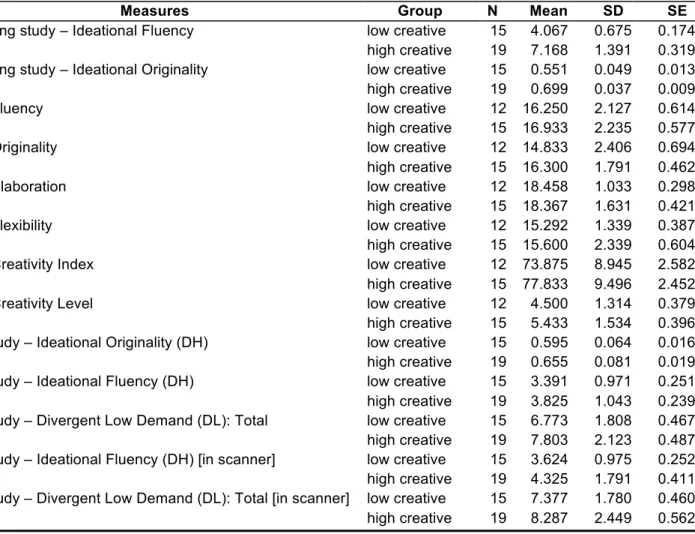
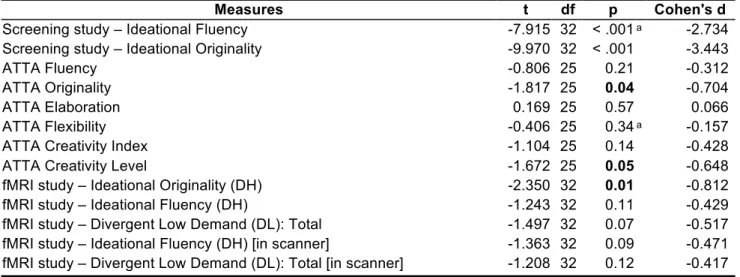
objects (5 in the screening study and 20 in the fMRI study). As indicated in Tables 1 and 2, while the groups were not significantly differentiable in the number of responses generated in the divergent low demand object location task, as the high creative group demonstrated higher ideational originality (p = .01, d = 0.81) than the low creative group in the divergent high demand alternate uses task, but not significantly higher ideational fluency.
In the pre-fMRI screening study though, the high creative group demonstrated both higher originality (p < .001, d = 3.44) and higher fluency (p < .001, d = 2.73) than the low creative group. So how can these discrepant findings in relation to ideational fluency across the two AUT testing sessions be best explained? One key factor that may have contributed to the difference in the findings is the differing trial lengths of the AUT in each study. The pre-fMRI screening was a behavioral study where the participants had 2 minutes per item to generate as many uses as possible. In the fMRI study, in contrast, the participants had only 20 seconds per item, posing a temporal limit on the extent of fluency that is possible to generate in that context.
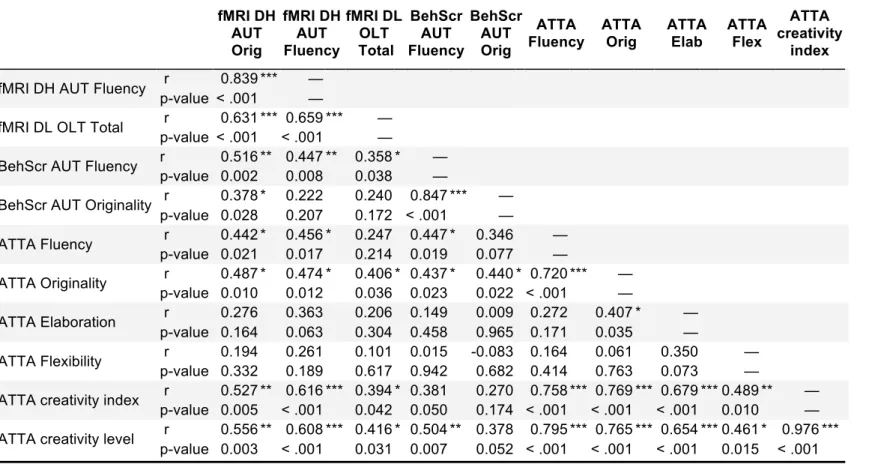
In addition, the two groups were also significantly different in terms of their ATTA performance with the high creative group performing better than the low creative group on the ATTA originality measure (p = .04, d = 0.7) as well as the ATTA creativity level (p = .05, d = 0.65). Moreover, correlational analyses between these creativity-relevant variables have
This also speaks for the consistent differences between the high and low creative groups in their creative ability as measured by two different divergent thinking tasks.
Although there were no group differences in relation to IQ scores, linear regression analyses were carried out as a check to verify whether performance on the AUT task was significantly predicted by IQ. The findings revealed no evidence for the same given non-significant
regression equations for DH fluency (F1, 32=1.91, p = .18 with an R2 of 0.056) and DH
originality (F1, 32=0.53, p = .47 with an R2 of 0.016).
As a check the number of responses generated during the fMRI testing session (in the scanner) and after the testing session (in the post-fMRI feedback session) were compared for the divergent thinking tasks. In line with the previous findings (Abraham, Pieritz, et al., 2012), the number of responses generated in the scanner (DH: Mean = 4.02, SD = 1.51; DL: Mean = 7.89, SD = 2.2) was higher than the number of responses generated after the scanning session (DH: Mean = 3.63, SD = 1.02; DL: Mean = 7.35, SD = 2.03) for both the alternate uses task (DH: t33 = 2.08, p = .045) and the object location task (DL: t33 = 6.91, p
< .001). This reduction in responses was attributed to forgetting in the previous study and the same interpretation is put forward as a possible explanation in the current study. No significant differences were found between the high and low creative groups in relation to the same (Table 2).
fMRI Findings: Replication
carry out the alternate uses task (DH) and compare the brain activity generated during that task with another task of divergent thinking, the object location task (DL). The latter did not necessitate the expansion of conceptual boundaries or creative idea generation but it did involve access to conceptual or semantic knowledge and it was open-ended with regard to the number of responses that could be given when undertaking the task. In order to rule out the possibility that the differences between the patterns brain activity seen when performing the alternate uses task and object location task were not merely attributable to higher cognitive demands posed in the former case, cognitive control tasks that did not involve accessing semantic knowledge were also employed. The contrast between the brain activity patterns generated during the alternate uses task compared to that of the highly demanding 2-back working memory task was used as inclusive mask. In this way, the only brain regions that were more strongly engaged during the alternate uses task compared to the 2-back working memory task would meet the threshold to allow warrant consideration in the contrast between the alternate uses task (DH) and the object location task (DL).
As shown in Table 4 and Figure 2, the involvement of these regions during conceptual expansion was confirmed in the present fMRI study. Indeed, the extent of brain activity was strikingly similar to that of the original study (Abraham, Pieritz, et al., 2012). Moreover, several other brain regions (for which no a priori hypotheses were put forward) that were significantly activated during creative conceptual expansion in the original study were also found in the current study. These include posterior regions in the inferior frontal gyrus (BA 44), the middle frontal gyrus (BA 8), the anterior cingulate cortex (BA 24), dorsomedial prefrontal cortex (BA 8, 9, 6), and the inferior parietal lobule (BA 40) as well as regions of the basal ganglia (putamen, globus pallidus). Just as in the original study, the entire activation pattern across the brain was more strongly lateralized to the left hemisphere (Table 4).
fMRI Findings: Individual Differences
The lack of contemporary neuroscientific theories to explain the brain basis of individual differences in creativity means that investigations of the same are largely explorative. However, as expounded in the Introduction of this paper, classic theoretical accounts that were steeped in tradition of experimental psychology and sought to uncover information processing biases that explain individual differences in creativity (Martindale, 1999; Mednick, 1962; Mendelsohn, 1974) are very useful in generating postulations concerning individual differences in creative neurocognition. This is because those early insights can be combined with our current knowledge of neurocognitive basis of creativity and newer frameworks that have been proposed to explain the information processing mechanisms that underlie the same (Abraham, 2014; Beaty et al., 2016; Dietrich & Haider, 2016; Jung et al., 2013). Indeed, allusions to the adoption of such an approach were even made more than a decade ago (Abraham & Windmann, 2007: pp 39, 46). The immense advantage of the present day is that far more is known about cognitive and brain function from which to make informed postulations.
& Wagner, 2007) would be implicated as they are involved in the retrieval conceptual knowledge and so would working memory relevant regions, such as the dorsolateral prefrontal cortex (du Boisgueheneuc et al., 2006) as the manipulation of information in one’s stream of consciousness is inherent in such conceptualizations. The third alternative points to the role of inhibitory control in creative ideation (Martindale, 1999), which points of regions of the CEN such as the basal ganglia and the right inferior frontal gyrus being selectively responsive during creative conceptual expansion (Aron et al., 2014; Hampshire & Sharp, 2015; Schall et al., 2017).
It must be emphasized here that the current study is certainly not designed to be a test of any of these theories. These influential ideas merely constitute well-informed sources from which to derive useful interpretations when exploring the patterns of findings associated with individual differences in creative conceptual expansion.
& Desai, 2011) and are involved in the access and storage of conceptual knowledge (Lau et al., 2008). This would imply that highly creative people expend greater neural resources towards such semantic operations when undertaking the alternate uses task and engaging in conceptual expansion. This pattern of findings cannot be attributed to differences in the number of generated responses as the high and low creative groups were not significantly different on that count. If permitted to postulate further, this pattern of findings would be in line with the theoretical frameworks of individual differences in creative thinking as espoused by both Mednick (flat associative hierarchies) and Mendelssohn (defocused attention). Please note though that the findings cannot be taken as evidence against the theoretical framework of Martindale (cognitive disinhibition) as the experimental paradigm was not designed as a test of proof between the theories.
versus evaluate: Ellamil et al., 2012) and connectivity based analyses (resting state: Beaty et al., 2014). Indeed, given the mounting evidence that suggests that the salience network modulates the dynamic switching between the endogenously-mediated or internally-directed DMN and the exogenously-driven or externally-directed CEN (Menon, 2015; Uddin, 2015), creativity researchers also emphasize the role of the salience network, the core regions of which include the anterior insula and the dorsal ACC, in orchestrating the interplay between the processing of DMN and CEN during creative ideation (Beaty et al., 2015; Heinonen et al., 2016).
While the pattern of findings in the present study cannot be used to support or reject the brain network interplay idea, the clear involvement of the salience network in creative conceptual expansion raises interesting questions about its specific role in this context. Abundant research has indicated that, “brain signals involved in conflict monitoring, interoceptive– autonomic, and reward processing areas” are integrated “into a common ‘salience network’” (Menon, 2011: 457). The point concerning interoceptive awareness may be the focal one as the anterior superior temporal gyrus (aSTG), a region that is commonly discussed in the experience of insight during creative problem solving (Jung-Beeman et al., 2004), was also engaged in the present study as a function of individual differences in conceptual expansion. The fact that the phenomenology of insight involves a sudden awareness of a reaching a solution following an impasse fits well with the interpretation of the role of the salience network in interoceptive awareness. This is one of several potential directions of exploration of the individual differences in conceptual expansion and other facets of creative cognition.
How can the current findings on the neural basis of individual differences in conceptual expansion be aligned to the extant literature on individual differences in creativity? This is more challenging than one might expect given than the focus in the present study follows a local approach whereas neuroimaging research on creativity is increasingly shifting to the norm of global approaches to understanding creative neurocognition where the focus is on uncovering the dynamics of the interactions between large-scale networks (Abraham, in press). Several studies have examined the brain basis of individual differences in creativity (e.g., Aberg, Doell, & Schwartz, 2016; Jung et al., 2010; Takeuchi et al., 2010a, 2010b). For instance, a well designed recent comparison of brain activity of high and low creative individuals using task-based fMRI and task-free resting state connectivity analyses revealed heightened functional connections between hub regions of the default mode network (posterior cingulate), the central executive network (dorsolateral prefrontal cortex) and the salience network (anterior insula) (Beaty et al., 2018). Global approaches are also being applied at the level of behavioral responses. A good example of this is the fascinating finding of differences in the structure of semantic memory networks as a function of individual differences in creative ability such that high creative individuals are characterised by more flexible networks which are more robust to network percolation or the removal of below threshold low strength links (Kenett et al., 2018).
creative operations such as analogical reasoning (Green, Kraemer, Fugelsang, Gray, & Dunbar, 2012), creative imagery (Aziz-Zadeh, Liew, & Dandekar, 2012), overcoming knowledge constraints (Abraham, Beudt, et al., 2012), metaphor processing (Mashal, Faust, Hendler, & Jung-Beeman, 2007), improvisation (Limb & Braun, 2008) and insight (Kounios & Beeman, 2014), explorations of individual differences in relation to the same are rare (e.g., Bendetowicz, Urbanski, Aichelburg, Levy, & Volle, 2017). So there is much that remains to be done in creativity research that follows a local approach. Moreover, if investigations following global approaches saw the inclusion of multiple measures of creative cognition (a valuable recommendation to improve validity, see Cropley, 2000; Kim, 2006), the differences in the functional connectivity analyses, for instance, in relation to the various measures would be highly informative for the local approach and, as a consequence, would aid us in further understanding the mechanisms underlying creative thinking in all its complexity.
Limitations of the Study
differences based analysis (high creative group versus low creative group), the introduction of yet another variable that would need to be controlled for, especially given that there some gender-based differences in brain structure and function have been reported in relation to creativity (Abraham et al., 2014; Ryman et al., 2014). These are, however, very early days in the neuroscientific study of gender differences in creativity. So it is not possible to infer how the findings reported herein may or may not be impacted by having assessed creative conceptual expansion only in women. However, any cause for concern should be alleviated by the strong parallels in the findings of the original study and the present study with reference to the brain correlates of creative conceptual expansion.
Post-fMRI difficulty ratings for the conditions, which were part of the behavioural measures in the Abraham et al. (2012) study, were not included in the present study. We did not have any expectations with reference to group based differences in relation to how cognitive demanding the different conditions were experienced to be. While differences between the high and low creative groups in the number of responses generated in the divergent high demand (DH fluency) and divergent low demand (DL total score) were not significant, it cannot be assumed that both these conditions were experienced as equivalently demanding by both groups. This therefore constitutes a shortcoming of the current study.
Conclusions
inferior frontal gyrus, the temporal poles and the lateral frontopolar cortex, areas that play a significant role in the retention, retrieval and relational integration of semantic information. The assessment of the second question revealed that regions involved in the access and storage of semantic knowledge such as the anterior inferior frontal gyrus, the temporal poles and the posterior middle temporal gyrus were more strongly engaged in the high creative group compared to the low creative group. The responsiveness of the salience network during creative conceptual expansion also differentiates the high creative group from the low creative group.
ACKNOWLEDGEMENTS
FIGURE LEGENDS
Figure 1. A schematic diagram of the trial events and examples of the different conditions
Figure 2. The brain correlates of creative conceptual expansion across all participants. A: Inferior frontal gyrus, temporal pole | B: Orbitofrontal cortex | C: Hippocampus | D: Dorsomedial prefrontal cortex.
REFERENCES
Aberg, K. C., Doell, K. C., & Schwartz, S. (2016). The “Creative Right Brain” Revisited: Individual Creativity and Associative Priming in the Right Hemisphere Relate to Hemispheric Asymmetries in Reward Brain Function. Cerebral Cortex (New York, N.Y.: 1991). https://doi.org/10.1093/cercor/bhw288
Abraham, A. (in press). Neuroscience of Creativity. Cambridge University Press.
Abraham, A. (2013). The promises and perils of the neuroscience of creativity. Frontiers in Human Neuroscience, 7:, 246. https://doi.org/10.3389/fnhum.2013.00246
Abraham, A. (2014). Creative thinking as orchestrated by semantic processing vs. cognitive control brain networks. Frontiers in Human Neuroscience, 8, 95.
https://doi.org/10.3389/fnhum.2014.00095
Abraham, A. (2018). The forest versus the trees: Creativity, cognition and imagination. In R. E. Jung & O. Vartanian (Eds.), Cambridge Handbook of the Neuroscience of
Creativity (pp. 195–210). New York: Cambridge University Press.
Abraham, A., Beudt, S., Ott, D. V. M., & von Cramon, D. Y. (2012). Creative cognition and the brain: dissociations between frontal, parietal-temporal and basal ganglia groups. Brain Research, 1482, 55–70. https://doi.org/10.1016/j.brainres.2012.09.007
Abraham, A., Kaufmann, C., Redlich, R., Hermann, A., Stark, R., Stevens, S., & Hermann, C. (2012). Self-referential and anxiety-relevant information processing in subclinical social anxiety: an fMRI study. Brain Imaging and Behavior.
https://doi.org/10.1007/s11682-012-9188-x
Abraham, A., Pieritz, K., Thybusch, K., Rutter, B., Kröger, S., Schweckendiek, J., … Hermann, C. (2012). Creativity and the brain: Uncovering the neural signature of conceptual expansion. Neuropsychologia, 50(8), 1906–1917.
Abraham, A., Rakoczy, H., Werning, M., von Cramon, D. Y., & Schubotz, R. I. (2010). Matching mind to world and vice versa: Functional dissociations between belief and desire mental state processing. Social Neuroscience, 5(1), 1–18.
https://doi.org/10.1080/17470910903166853
Abraham, A., Schubotz, R. I., & von Cramon, D. Y. (2008). Thinking about the future versus the past in personal and non-personal contexts. Brain Research, 1233, 106–119. https://doi.org/10.1016/j.brainres.2008.07.084
Abraham, A., Thybusch, K., Pieritz, K., & Hermann, C. (2014). Gender differences in creative thinking: behavioral and fMRI findings. Brain Imaging and Behavior, 8(1), 39–51. https://doi.org/10.1007/s11682-013-9241-4
Abraham, A., & Windmann, S. (2007). Creative cognition: the diverse operations and the prospect of applying a cognitive neuroscience perspective. Methods (San Diego, Calif.), 42(1), 38–48. https://doi.org/10.1016/j.ymeth.2006.12.007
Albrecht, K., Volz, K. G., Sutter, M., Laibson, D. I., & Cramon, D. Y. von. (2011). What is for me is not for you: brain correlates of intertemporal choice for self and other. Social Cognitive and Affective Neuroscience, 6(2), 218–225.
https://doi.org/10.1093/scan/nsq046
Andrews-Hanna, J. R., Smallwood, J., & Spreng, R. N. (2014). The default network and self-generated thought: component processes, dynamic control, and clinical relevance. Annals of the New York Academy of Sciences, 1316, 29–52.
https://doi.org/10.1111/nyas.12360
Aziz-Zadeh, L., Liew, S.-L., & Dandekar, F. (2012). Exploring the neural correlates of visual creativity. Social Cognitive and Affective Neuroscience.
https://doi.org/10.1093/scan/nss021
Badre, D., & Wagner, A. D. (2007). Left ventrolateral prefrontal cortex and the cognitive control of memory. Neuropsychologia, 45(13), 2883–2901.
https://doi.org/10.1016/j.neuropsychologia.2007.06.015
Bar, M. (2007). The proactive brain: using analogies and associations to generate predictions. Trends in Cognitive Sciences, 11(7), 280–289.
https://doi.org/10.1016/j.tics.2007.05.005
Beaty, R. E. (2015). The neuroscience of musical improvisation. Neuroscience and
Biobehavioral Reviews, 51, 108–117. https://doi.org/10.1016/j.neubiorev.2015.01.004
Beaty, R. E., Benedek, M., Kaufman, S. B., & Silvia, P. J. (2015). Default and Executive Network Coupling Supports Creative Idea Production. Scientific Reports, 5, 10964. https://doi.org/10.1038/srep10964
Beaty, R. E., Benedek, M., Silvia, P. J., & Schacter, D. L. (2016). Creative Cognition and Brain Network Dynamics. Trends in Cognitive Sciences, 20(2), 87–95.
https://doi.org/10.1016/j.tics.2015.10.004
Beaty, R. E., Benedek, M., Wilkins, R. W., Jauk, E., Fink, A., Silvia, P. J., … Neubauer, A. C. (2014). Creativity and the default network: A functional connectivity analysis of the creative brain at rest. Neuropsychologia, 64, 92.
https://doi.org/10.1016/j.neuropsychologia.2014.09.019
Beaty, R. E., Kenett, Y. N., Christensen, A. P., Rosenberg, M. D., Benedek, M., Chen, Q., … Silvia, P. J. (2018). Robust prediction of individual creative ability from brain
Bendetowicz, D., Urbanski, M., Aichelburg, C., Levy, R., & Volle, E. (2017). Brain
morphometry predicts individual creative potential and the ability to combine remote ideas. Cortex; a Journal Devoted to the Study of the Nervous System and Behavior, 86, 216–229. https://doi.org/10.1016/j.cortex.2016.10.021
Benedek, M., Beaty, R., Jauk, E., Koschutnig, K., Fink, A., Silvia, P. J., … Neubauer, A. C. (2014). Creating metaphors: The neural basis of figurative language production. NeuroImage, 90, 99–106. https://doi.org/10.1016/j.neuroimage.2013.12.046
Binder, J. R., & Desai, R. H. (2011). The neurobiology of semantic memory. Trends in Cognitive Sciences, 15(11), 527–536. https://doi.org/10.1016/j.tics.2011.10.001
Bookheimer, S. (2002). Functional MRI of language: new approaches to understanding the cortical organization of semantic processing. Annual Review of Neuroscience, 25, 151–188. https://doi.org/10.1146/annurev.neuro.25.112701.142946
Buckner, R. L., Andrews-Hanna, J. R., & Schacter, D. L. (2008). The brain’s default network: anatomy, function, and relevance to disease. Annals of the New York Academy of Sciences, 1124, 1–38. https://doi.org/10.1196/annals.1440.011
Christoff, K., Prabhakaran, V., Dorfman, J., Zhao, Z., Kroger, J. K., Holyoak, K. J., & Gabrieli, J. D. (2001). Rostrolateral prefrontal cortex involvement in relational integration during reasoning. NeuroImage, 14(5), 1136–1149.
https://doi.org/10.1006/nimg.2001.0922
Cole, M. W., & Schneider, W. (2007). The cognitive control network: Integrated cortical regions with dissociable functions. NeuroImage, 37(1), 343–360.
https://doi.org/10.1016/j.neuroimage.2007.03.071
Dietrich, A., & Haider, H. (2016). A Neurocognitive Framework for Human Creative
Thought. Frontiers in Psychology, 7, 2078. https://doi.org/10.3389/fpsyg.2016.02078 du Boisgueheneuc, F., Levy, R., Volle, E., Seassau, M., Duffau, H., Kinkingnehun, S., …
Dubois, B. (2006). Functions of the left superior frontal gyrus in humans: a lesion study. Brain: A Journal of Neurology, 129(Pt 12), 3315–3328.
https://doi.org/10.1093/brain/awl244
Duff, M. C., Kurczek, J., Rubin, R., Cohen, N. J., & Tranel, D. (2013). Hippocampal amnesia disrupts creative thinking. Hippocampus, 23(12), 1143–1149.
https://doi.org/10.1002/hipo.22208
Ellamil, M., Dobson, C., Beeman, M., & Christoff, K. (2012). Evaluative and generative modes of thought during the creative process. NeuroImage, 59(2), 1783–1794. https://doi.org/10.1016/j.neuroimage.2011.08.008
Finke, R. A., Ward, T. B., & Smith, S. M. (1996). Creative cognition : theory, research, and applications (1st pbk. ed.). Cambridge Mass.: MIT Press.
Friston, K. J., Holmes, A. P., Worsley, K. J., Poline, J.-P., Frith, C. D., & Frackowiak, R. S. J. (1994). Statistical parametric maps in functional imaging: A general linear
approach. Human Brain Mapping, 2(4), 189–210. https://doi.org/10.1002/hbm.460020402
Gelman, A., Hill, J., & Yajima, M. (2012). Why We (Usually) Don’t Have to Worry About Multiple Comparisons. Journal of Research on Educational Effectiveness, 5(2), 189– 211. https://doi.org/10.1080/19345747.2011.618213
Goff, K., & Torrance, E. P. (2002). Abbreviated Torrance Test for Adults manual. Bensenville, IL: Scholastic Testing Service, Inc.
Green, A. E. (2016). Creativity, Within Reason Semantic Distance and Dynamic State
Creativity in Relational Thinking and Reasoning. Current Directions in Psychological Science, 25(1), 28–35. https://doi.org/10.1177/0963721415618485
Green, A. E., Kraemer, D. J. M., Fugelsang, J. A., Gray, J. R., & Dunbar, K. N. (2012). Neural correlates of creativity in analogical reasoning. Journal of Experimental Psychology. Learning, Memory, and Cognition, 38(2), 264–272.
https://doi.org/10.1037/a0025764
Hampshire, A., & Sharp, D. J. (2015). Contrasting network and modular perspectives on inhibitory control. Trends in Cognitive Sciences, 19(8), 445–452.
https://doi.org/10.1016/j.tics.2015.06.006
Han, H., & Park, J. (2018). Using SPM 12’s Second-Level Bayesian Inference Procedure for fMRI Analysis: Practical Guidelines for End Users. Frontiers in Neuroinformatics, 12. https://doi.org/10.3389/fninf.2018.00001
Heinonen, J., Numminen, J., Hlushchuk, Y., Antell, H., Taatila, V., & Suomala, J. (2016). Default Mode and Executive Networks Areas: Association with the Serial Order in Divergent Thinking. PLOS ONE, 11(9), e0162234.
https://doi.org/10.1371/journal.pone.0162234
Hobeika, L., Diard-Detoeuf, C., Garcin, B., Levy, R., & Volle, E. (2016). General and specialized brain correlates for analogical reasoning: A meta-analysis of functional imaging studies. Human Brain Mapping, 37(5), 1953–1969.
https://doi.org/10.1002/hbm.23149
Jung, R. E., Mead, B. S., Carrasco, J., & Flores, R. A. (2013). The structure of creative cognition in the human brain. Frontiers in Human Neuroscience, 7.
https://doi.org/10.3389/fnhum.2013.00330
Jung, R. E., Segall, J. M., Jeremy Bockholt, H., Flores, R. A., Smith, S. M., Chavez, R. S., & Haier, R. J. (2010). Neuroanatomy of creativity. Human Brain Mapping, 31(3), 398– 409. https://doi.org/10.1002/hbm.20874
Jung-Beeman, M. (2005). Bilateral brain processes for comprehending natural language. Trends in Cognitive Sciences, 9(11), 512–518.
https://doi.org/10.1016/j.tics.2005.09.009
Jung-Beeman, M., Bowden, E. M., Haberman, J., Frymiare, J. L., Arambel-Liu, S., Greenblatt, R., … Kounios, J. (2004). Neural Activity When People Solve Verbal Problems with Insight. PLOS Biology, 2(4), e97.
https://doi.org/10.1371/journal.pbio.0020097
Kenett, Y. N., Levy, O., Kenett, D. Y., Stanley, H. E., Faust, M., & Havlin, S. (2018).
Flexibility of thought in high creative individuals represented by percolation analysis. Proceedings of the National Academy of Sciences, 201717362.
https://doi.org/10.1073/pnas.1717362115
Kim, K. H. (2006). Can We Trust Creativity Tests? A Review of the Torrance Tests of Creative Thinking (TTCT). Creativity Research Journal, 18(1), 3–14.
https://doi.org/10.1207/s15326934crj1801_2
Kounios, J., & Beeman, M. (2009). The Aha! Moment The Cognitive Neuroscience of Insight. Current Directions in Psychological Science, 18(4), 210–216.
https://doi.org/10.1111/j.1467-8721.2009.01638.x
Kounios, J., & Beeman, M. (2014). The cognitive neuroscience of insight. Annual Review of Psychology, 65, 71–93. https://doi.org/10.1146/annurev-psych-010213-115154
Lau, E. F., Phillips, C., & Poeppel, D. (2008). A cortical network for semantics: (de)constructing the N400. Nature Reviews. Neuroscience, 9(12), 920–933. https://doi.org/10.1038/nrn2532
Limb, C. J., & Braun, A. R. (2008). Neural substrates of spontaneous musical performance: an FMRI study of jazz improvisation. PloS One, 3(2), e1679.
https://doi.org/10.1371/journal.pone.0001679
Lohmann, G., Müller, K., Bosch, V., Mentzel, H., Hessler, S., Chen, L., … von Cramon, D. Y. (2001). LIPSIA--a new software system for the evaluation of functional magnetic resonance images of the human brain. Computerized Medical Imaging and Graphics: The Official Journal of the Computerized Medical Imaging Society, 25(6), 449–457.
Lohmann, G., Neumann, J., Muller, K., Lepsien, J., & Turner, R. (2008). The multiple
comparison problem in fMRI: A new method based on anatomical priors. Presented at the MICCAI, New York.
Martindale, C. (1999). Biological bases of creativity. In R. J. Sternberg (Ed.), Handbook of Creativity (pp. 137–152). Cambridge, UK: Cambridge University Press.
Martindale, C. (2007). Creativity, primordial cognition, and personality. Personality and Individual Differences, 43(7), 1777–1785. https://doi.org/10.1016/j.paid.2007.05.014
Maxwell, S. E., Lau, M. Y., & Howard, G. S. (2015). Is psychology suffering from a replication crisis? What does “failure to replicate” really mean? The American Psychologist, 70(6), 487–498. https://doi.org/10.1037/a0039400
Mednick, S. A. (1962). The associative basis of the creative process. Psychological Review, 69, 220–232.
Mendelsohn, G. A. (1974). Associative and attentional processes in creative performance. Journal of Personality, 44, 341–369.
Menon, V. (2011). Large-scale brain networks and psychopathology: a unifying triple network model. Trends in Cognitive Sciences, 15(10), 483–506.
https://doi.org/10.1016/j.tics.2011.08.003
Menon, V. (2015). Salience Network. In Brain Mapping (pp. 597–611). Elsevier. https://doi.org/10.1016/B978-0-12-397025-1.00052-X
Neumann, J., & Lohmann, G. (2003). Bayesian second-level analysis of functional magnetic resonance images. NeuroImage, 20(2), 1346–1355. https://doi.org/10.1016/S1053-8119(03)00443-9
Niendam, T. A., Laird, A. R., Ray, K. L., Dean, Y. M., Glahn, D. C., & Carter, C. S. (2012). Meta-analytic evidence for a superordinate cognitive control network subserving diverse executive functions. Cognitive, Affective & Behavioral Neuroscience, 12(2), 241–268. https://doi.org/10.3758/s13415-011-0083-5
Patterson, K., Nestor, P. J., & Rogers, T. T. (2007). Where do you know what you know? The representation of semantic knowledge in the human brain. Nature Reviews. Neuroscience, 8(12), 976–987. https://doi.org/10.1038/nrn2277
Ramnani, N., & Owen, A. M. (2004). Anterior prefrontal cortex: insights into function from anatomy and neuroimaging. Nature Reviews. Neuroscience, 5(3), 184–194.
https://doi.org/10.1038/nrn1343
Robbins, T. W. (2007). Shifting and stopping: fronto-striatal substrates, neurochemical modulation and clinical implications. Philosophical Transactions of the Royal Society of London. Series B, Biological Sciences, 362(1481), 917–932.
https://doi.org/10.1098/rstb.2007.2097
Runco, M. A., Okuda, S. M., & Thurston, B. J. (1987). The Psychometric Properties of Four Systems for Scoring Divergent Thinking Tests. Journal of Psychoeducational
Assessment, 5(2), 149–156. https://doi.org/10.1177/073428298700500206
Ryman, S. G., van den Heuvel, M. P., Yeo, R. A., Caprihan, A., Carrasco, J., Vakhtin, A. A., … Jung, R. E. (2014). Sex differences in the relationship between white matter connectivity and creativity. NeuroImage, 101, 380–389.
https://doi.org/10.1016/j.neuroimage.2014.07.027
Schall, J. D., Palmeri, T. J., & Logan, G. D. (2017). Models of inhibitory control. Philosophical Transactions of the Royal Society of London. Series B, Biological
Sciences, 372(1718). https://doi.org/10.1098/rstb.2016.0193
Takeuchi, H., Taki, Y., Sassa, Y., Hashizume, H., Sekiguchi, A., Fukushima, A., & Kawashima, R. (2010a). Regional gray matter volume of dopaminergic system associate with creativity: evidence from voxel-based morphometry. NeuroImage, 51(2), 578–585. https://doi.org/10.1016/j.neuroimage.2010.02.078
Takeuchi, H., Taki, Y., Sassa, Y., Hashizume, H., Sekiguchi, A., Fukushima, A., &
Kawashima, R. (2010b). White matter structures associated with creativity: evidence from diffusion tensor imaging. NeuroImage, 51(1), 11–18.
Talairach, J., & Tournoux, P. (1988). Co-planar stereotaxic atlas of the human brain: 3-dimensional proportional system: an approach to cerebral imaging. Stuttgart ; New York: Georg Thieme.
Tewes, U. (1994). HAWIE-R. Hamburg-Wechsler-Intelligenztest für Erwachsense, Revision 1991; Handbuch und Testanweisung. Göttingen: Verlag Hans Huber.
Thirion, B., Pinel, P., Mériaux, S., Roche, A., Dehaene, S., & Poline, J.-B. (2007). Analysis of a large fMRI cohort: Statistical and methodological issues for group analyses. NeuroImage, 35(1), 105–120. https://doi.org/10.1016/j.neuroimage.2006.11.054
Thompson-Schill, S. L. (2003). Neuroimaging studies of semantic memory: inferring “how” from “where.” Neuropsychologia, 41(3), 280–292.
Uddin, L. Q. (2015). Salience processing and insular cortical function and dysfunction. Nature Reviews. Neuroscience, 16(1), 55–61. https://doi.org/10.1038/nrn3857
Wagenmakers, E.-J., Marsman, M., Jamil, T., Ly, A., Verhagen, J., Love, J., … Morey, R. D. (2017). Bayesian inference for psychology. Part I: Theoretical advantages and
practical ramifications. Psychonomic Bulletin & Review. https://doi.org/10.3758/s13423-017-1343-3
Ward, T. B. (1994). Structured imagination: The role of category structure in exemplar generation. Cognitive Psychology, 27, 1–40.
Wendelken, C., Nakhabenko, D., Donohue, S. E., Carter, C. S., & Bunge, S. A. (2008). “Brain is to thought as stomach is to ??”: investigating the role of rostrolateral prefrontal cortex in relational reasoning. Journal of Cognitive Neuroscience, 20(4), 682–693. https://doi.org/10.1162/jocn.2008.20055
Zabelina, D., Saporta, A., & Beeman, M. (2016). Flexible or leaky attention in creative people? Distinct patterns of attention for different types of creative thinking. Memory & Cognition, 44(3), 488–498. https://doi.org/10.3758/s13421-015-0569-4
Table 1. Descriptive data (mean, standard deviation, standard error) across experimental measures for the low and high creative groups.
Measures Group N Mean SD SE
Screening study – Ideational Fluency low creative 15 4.067 0.675 0.174
high creative 19 7.168 1.391 0.319
Screening study – Ideational Originality low creative 15 0.551 0.049 0.013
high creative 19 0.699 0.037 0.009
ATTA Fluency low creative 12 16.250 2.127 0.614
high creative 15 16.933 2.235 0.577
ATTA Originality low creative 12 14.833 2.406 0.694
high creative 15 16.300 1.791 0.462
ATTA Elaboration low creative 12 18.458 1.033 0.298
high creative 15 18.367 1.631 0.421
ATTA Flexibility low creative 12 15.292 1.339 0.387
high creative 15 15.600 2.339 0.604
ATTA Creativity Index low creative 12 73.875 8.945 2.582
high creative 15 77.833 9.496 2.452
ATTA Creativity Level low creative 12 4.500 1.314 0.379
high creative 15 5.433 1.534 0.396
fMRI study – Ideational Originality (DH) low creative 15 0.595 0.064 0.016
high creative 19 0.655 0.081 0.019
fMRI study – Ideational Fluency (DH) low creative 15 3.391 0.971 0.251
high creative 19 3.825 1.043 0.239
fMRI study – Divergent Low Demand (DL): Total low creative 15 6.773 1.808 0.467
high creative 19 7.803 2.123 0.487
fMRI study – Ideational Fluency (DH) [in scanner] low creative 15 3.624 0.975 0.252
high creative 19 4.325 1.791 0.411
fMRI study – Divergent Low Demand (DL): Total [in scanner] low creative 15 7.377 1.780 0.460
high creative 19 8.287 2.449 0.562
Table 2. Findings from independent samples t-tests (low creative group versus high creative group) that evaluated the relations between all creativity measures across testing sessions
Measures t df p Cohen's d
Screening study – Ideational Fluency -7.915 32 < .001 ᵃ -2.734
Screening study – Ideational Originality -9.970 32 < .001 -3.443
ATTA Fluency -0.806 25 0.21 -0.312
ATTA Originality -1.817 25 0.04 -0.704
ATTA Elaboration 0.169 25 0.57 0.066
ATTA Flexibility -0.406 25 0.34 ᵃ -0.157
ATTA Creativity Index -1.104 25 0.14 -0.428
ATTA Creativity Level -1.672 25 0.05 -0.648
fMRI study – Ideational Originality (DH) -2.350 32 0.01 -0.812
fMRI study – Ideational Fluency (DH) -1.243 32 0.11 -0.429
fMRI study – Divergent Low Demand (DL): Total -1.497 32 0.07 -0.517
fMRI study – Ideational Fluency (DH) [in scanner] -1.363 32 0.09 -0.471
fMRI study – Divergent Low Demand (DL): Total [in scanner] -1.208 32 0.12 -0.417 Note. Student's T-Test.
Note. For all tests, the alternative hypothesis specifies that group low creative is less than group high creative.
ᵃ Levene's test is significant (p < .05), suggesting a violation of the equal variance assumption
Table 3. Correlation Matrix (Pearson correlation) with all creativity-relevant variables fMRI DH AUT Orig fMRI DH AUT Fluency fMRI DL OLT Total BehScr AUT Fluency BehScr AUT Orig ATTA Fluency ATTA Orig ATTA Elab ATTA Flex ATTA creativity index
fMRI DH AUT Fluency r 0.839 *** —
p-value < .001 —
fMRI DL OLT Total r 0.631 *** 0.659 *** —
p-value < .001 < .001 —
BehScr AUT Fluency r 0.516 ** 0.447 ** 0.358 * —
p-value 0.002 0.008 0.038 —
BehScr AUT Originality r 0.378 * 0.222 0.240 0.847 *** —
p-value 0.028 0.207 0.172 < .001 —
ATTA Fluency r 0.442 * 0.456 * 0.247 0.447 * 0.346 —
p-value 0.021 0.017 0.214 0.019 0.077 —
ATTA Originality r 0.487 * 0.474 * 0.406 * 0.437 * 0.440 * 0.720 *** —
p-value 0.010 0.012 0.036 0.023 0.022 < .001 —
ATTA Elaboration r 0.276 0.363 0.206 0.149 0.009 0.272 0.407 * —
p-value 0.164 0.063 0.304 0.458 0.965 0.171 0.035 —
ATTA Flexibility r 0.194 0.261 0.101 0.015 -0.083 0.164 0.061 0.350 —
p-value 0.332 0.189 0.617 0.942 0.682 0.414 0.763 0.073 —
ATTA creativity index r 0.527 ** 0.616 *** 0.394 * 0.381 0.270 0.758 *** 0.769 *** 0.679 *** 0.489 ** — p-value 0.005 < .001 0.042 0.050 0.174 < .001 < .001 < .001 0.010 —
ATTA creativity level r 0.556 ** 0.608 *** 0.416 * 0.504 ** 0.378 0.795 *** 0.765 *** 0.654 *** 0.461 * 0.976 *** p-value 0.003 < .001 0.031 0.007 0.052 < .001 < .001 < .001 0.015 < .001 * p < .05, ** p < .01, *** p < .001
Table 4. Brain Correlates ofCreative Conceptual Expansion [DH alternate uses task > DL object location task contrast (with inclusive mask: DH alternate uses task > CH 2-back task contrast)]. Information provided below includes approximate anatomical
specification, Talairach coordinates, maximum Z value and volume (cubic mm) of the significantly activated areas (l.m.: local
maxima within each volume). The results were corrected for whole brain multiple comparisons at the cluster level (p < .01).
Area x y z BA mm3 z-max
Lateral IFG, MFG, TP, OFC, Hipp -49 6 9 44-47,10,38 60183 6.44
Lateral IFG -43 18 15 45, 44 l.m. 6.91
Posterior insula -34 -9 3 l.m. 4.73
Putamen -13 3 9 l.m. 5.00
Globus pallidus -13 -9 -3 l.m. 5.04
Globus pallidus 14 -9 -3 l.m. 4.39
Thalamus -4 -18 9 l.m. 4.64
Thalamus -19 -30 0 l.m. 4.60
Lateral IFG 50 27 6 45 621 4.77
Dorsomedial PFC, ACC -7 21 45 8, 9, 24 17280 5.61
Dorsomedial PFC -4 12 54 8, 6 l.m. 5.38
Dorsomedial PFC -13 42 30 9 l.m. 4.42
ACC -1 -6 36 24 l.m. 4.65
SFG, MFG -31 12 42 8, 46 l.m. 4.39
Caudate nucleus 14 3 12 l.m. 5.27
Inferior Parietal Lobe -55 -33 39 40 5805 6.66
ITG, MTG, Cerebellum -46 -69 -6 13149 6.62
Occipital Lobe -25 -99 -6 l.m. 5.53
Thalamus 14 -9 -3 999 4.39
Cerebellum, Occipital Lobe 23 -72 -24 51165 6.44
Cerebellum 38 -60 -36 l.m. 5.36
Occipital Lobe 11 -87 9 l.m. 5.24
Table 5. Brain Correlates ofIndividual Differences in Creative Conceptual Expansion [Conjunction of (a) DH alternate uses task > DL object location task contrast AND (b) DH alternate uses task > CH 2-back task contrast]. Information provided below includes
approximate anatomical specification, Talairach coordinates, max probability (Prob) and volume (cubic mm) of the significantly
activated areas. The minimum threshold was set at 99.5% probability (Bayesian) with a minimum cluster size more than 10 voxels
(270 cubic mm).
Area x y z BA mm3 Prob
High Creative Group > Low Creative Group: Creative Conceptual Expansion
Lateral IFG -46 30 18 45, 47 1350 100
Lateral IFG -28 18 -9 47 l.m. 99.62
Lateral IFG 44 27 3 45 351 100
Insula -34 -12 12 1080 99.99
Dorsal ACC -1 -9 33 24 513 99.99
Temporal Pole -37 9 -12 38 1134 99.96
Anterior STG -49 3 0 22 l.m. 99.91
Posterior MTG -49 -66 3 37 1782 100
Orbital gyrus -40 -60 0 19 l.m. 99.99
Postcentral gyrus -52 -27 33 2 1431 100
Supramarginal gyrus -58 -42 33 40 l.m. 99.99
Occipital lobe - cuneus -1 -87 3 17 1080 99.98
Occipital Gyrus 23 -87 0 18, 19 918 99.98
Low Creative Group > High Creative Group: Creative Conceptual Expansion
![Table 4. Brain Correlates of Creative Conceptual Expansion [DH alternate uses task > DL object location task contrast (with inclusive mask: DH alternate uses task > CH 2-back task contrast)]](https://thumb-us.123doks.com/thumbv2/123dok_us/6230.1000361/48.1262.107.746.278.769/correlates-creative-conceptual-expansion-alternate-location-inclusive-alternate.webp)