Lara-Bercial, S and North, J and Petrovic, L and Livingstone, K and Oltmanns, K and Hamalainen, K and Minkhorst, J (2016) Project CoachLearn - Report #1 - Appendix #1 General and Coaching Specific Education Frameworks in the EU – Knowledge, Impact and Future Needs Survey. Project Report. CoachLearn.
Link to Leeds Beckett Repository record: http://eprints.leedsbeckett.ac.uk/3030/
Document Version: Monograph
c
CoachLearn 2016
The aim of the Leeds Beckett Repository is to provide open access to our research, as required by funder policies and permitted by publishers and copyright law.
The Leeds Beckett repository holds a wide range of publications, each of which has been checked for copyright and the relevant embargo period has been applied by the Research Services team.
We operate on a standard take-down policy. If you are the author or publisher of an output and you would like it removed from the repository, please contact us and we will investigate on a case-by-case basis.
1 | P a g e
Enhancing Coaches’ Learning, Mobility and Employability
in the European Union
Report #1 - Appendix #1
General and Coaching Specific Education Frameworks
in the EU – Knowledge, Impact and Future Needs Survey
March 2016
Authors: Sergio Lara-Bercial, Julian North, Ladislav Petrovic, Klaus Oltmanns, Jan Minkhorst, Kirsi Hämäläinen and Karen Livingstone
Project Partners
www.coachlearn.eu CoachLearn @CoachLearnEU
2 | P a g e
Disclaimer
3 | P a g e
Contents
1. Executive Summary ... 4
Key Challenges ... 4
The Solutions So Far ... 4
Existing Frameworks and Mobility Tools ... 4
Required Support ... 5
The Need for and Benefits of a European Sport Coaching Framework ... 5
Implementation of the ESCF ... 5
Conclusion ... 6
2. Project CoachLearn – Background & Introduction ... 7
CoachLearn Rationale ... 7
CoachLearn Objectives ... 7
CoachLearn Impact ... 8
3. Aims of the Survey ... 9
4. Survey Scope, Participants & Methodology ... 9
Scope ... 9
Participants ... 10
Methodology ... 10
5. Survey Findings ... 12
Key issues faced by those working in coach education ... 12
Guidance tools used by those working in coach education ... 13
Impact of the generic qualification frameworks and mobility tools ... 14
Additional Guidance & Tools needed for those working in Coach Education ... 15
Knowledge and Impact of Sport Coaching-Specific Frameworks ... 15
The Need for, Benefits and Priorities of a European Sport Coaching Framework ... 16
Adoption and Implementation of the future European Sport Coaching Framework ... 18
4 | P a g e
1.
Executive Summary
The General and Coaching Specific Education Frameworks in the EU – Knowledge, Impact and Future Needs Survey is part of project CoachLearn. CoachLearn is co-funded by Erasmus+ under the Strategic Partnerships Action within Key Action 2 – Cooperation and Innovation for Good Practices. CoachLearn seeks to enhance sport coaches' learning, mobility and employment through the development of a European Sport Coaching Framework. The survey aimed to gather the views of a cross-section of coach education stakeholders across the European Union which included national lead coaching organisations, national Olympic committees, national and international governing bodies of sport and vocational and higher education institutions. The first half of the consultation revolved around the identification of common challenges faced by stakeholders, the various tools they have used to overcome them and the role played by existing generic and coaching specific qualification frameworks and mobility tools. The second half investigated the views of the participants in relation to the development of the future European Sport Coaching Framework.
Key Challenges
Coaching stakeholders identified four key challenges they have to overcome on a daily basis:
A lack of a framework or systems culture in coach education which renders the landscape disjointed and convoluted, and overall hard to understand and navigate.
The absence of appropriate curricula which take into account the wide range of functions coaches fulfil and the ways coaches learn
A distinct difficulty to instil a lifelong learning mindset into coaches and their employers The recognition of coaching as a legitimate professional area that requires adequate training
The Solutions So Far
In building their coaching qualifications and systems, those working in coach education have relied heavily in the support and guidance from generic National Qualifications Frameworks. Where these do not exist, the European Qualifications Framework for Lifelong Learning has played a leading role. Very few countries have developed national frameworks specific to sport coaching qualifications. Against this unsettled background, some national organisations have taken it upon themselves to produce guidance materials and bespoke training to support coach educators and system builders in their nations.
Cooperation with all other stakeholders and marketing strategies to raise the profile of coaching are deemed vital.
Existing Frameworks and Mobility Tools
5 | P a g e
nationally in terms of newly developed coaching qualification systems, and self-assessment and fine-tuning of existing ones.
Required Support
National Governing Bodies (NGBs) of sport within the sample, expressed a concern about their lack of operational capacity to be able to understand, digest and implement the directives and guidance arising from the various education frameworks and mobility tools. A call for the creation of national coaching lead organisations to support the systemisation of coach education in each country was made. At a cross-national level, stakeholders requested qualification-mapping tools to support translation and comparability, and a database of case-studies and best-practice examples. Finally, additional support regarding the creation of a suitable Coach Developer workforce and guidance about the development of multi-modal education was identified as a priority.
The Need for and Benefits of a European Sport Coaching Framework
In this context, the vast majority of stakeholders saw the development of the European Sport Coaching Framework (ESCF) as highly beneficial. Comparability of qualifications, quality assurance, enhanced learning and increased mobility are key outcomes sought by European coaching stakeholders. In order to achieve these outcomes, the respondents felt that the ESCF must deal with three themes:
The figure of the coach: participants have clearly expressed the need for the ESCF to present a clear, yet adaptable, definition of the role and functions of the coach. This includes the relevant competencies to fulfil the needs of the coaching job.
Translation: respondents have unequivocally signalled the role the ESCF needs to play in the translation process between and within countries and federations. Quality assurance, trust, comparability, recognition of prior learning and mobility are central outcomes sought in this process.
Coach learning: less emphasised than the previous two themes, enhancing coach learning is however, still viewed as fundamental. Specifically, the development of a suitable coach developer workforce, appropriate curricula and the fostering of a lifelong learning mindset amongst coaches are identified as central to success.
Implementation of the ESCF
6 | P a g e
Conclusion
The landscape of coach education across Europe is very varied and disjointed. The EQF has somewhat contributed to an increased alignment between and within countries and federations, yet much more needs to be done. The lack of a NQF aligned to EQF in some countries, and the overall dearth of sport coaching specific qualification frameworks in most nations is hindering the progress of those NGBs, IFs, and Vocational Training Institutions and HEIs working in coach education. The development of a
7 | P a g e
2.
Project CoachLearn – Background & Introduction
CoachLearn is led by Leeds Beckett University (UK) in conjunction with the International Council for Coaching Excellence (UK), Trainerakademie Köln (Germany), the Hungarian Coaching Association (Hungary), Haaga-Helia University (Finland) and NOC*NSF (Netherlands). The project is co-funded through an Erasmus+ bid (2014 call) under the Strategic Partnerships Action within Key Action 2 – Cooperation and Innovation for Good Practices. It started in October 2014 and will be completed in August 2017.
CoachLearn Rationale
Sport coaches are at the front-line of sport development and delivery. Based on previous studies, it is estimated that there could be as many as 5 to 9 million coaches operating across Europe, with a likely reach of somewhere between 50 and 100 million sport participants (Duffy et al., 2011; European Commission, in preparation). In June 2014 the European Commission (Directorate-General for Education and Culture: Youth and Sport) produced an Implementation Report for the period 2007-2014. A key element of this implementation report was the further work required on the European Qualification Framework for Lifelong Learning (EQF) and European Credit System for Vocational Education and Training (ECVET) within the sport sector. This had already been acknowledged in the Council’s Work Plan for sport 2011-2014 (European Council, 2011), and re-emphasised in the 2014-2017 edition (European Council, 2014).
Notwithstanding considerable work in recent years, a number of key issues remain to be addressed:
a) Despite significant progress on the development of the European Framework for the Recognition of Sport Coaching Competence and Qualifications (EFRCCQ; ECC, 2007), there remains a need to further evolve this work so that it aligns with EQF and with the recently developed International Sport Coaching Framework (ISCF; ICCE, ASOIF and LBU, 2013). Achieving clarity around the necessary competencies per role and domain will support this.
b) Sport coaching is, by its nature, lifelong and employment/deployment orientated. Yet, there is a need to develop consistent and appropriate approaches to the recognition of prior learning that are more closely related to the work and life experiences of volunteer; part-time and full-time coaches.
c) Within this context, there is also need to develop a more effective system for the recognition of experience, education and qualifications that occur in a work based context.
d) The nature and contribution of the sport coaching workforce has not been quantified, with consequent implications for planning; education and training; work-integrated learning; employment and mobility.
CoachLearn Objectives
8 | P a g e
a) Develop a European Sport Coaching Framework (ESCF) that is responsive to the needs of coaches and the idiosyncrasies of international, national and sport specific contexts. This Framework will be aligned to EQF and the International Sport Coaching Framework, and referenced against other relevant European qualification systems and tools.
b) Provide, through a careful process of data collection and analysis, a clear picture of the needs of sport coaches, coach developers (trainers of coaches) and a variety of organisations with a stake in their education, employment and mobility.
c) Identify examples of good practice at a global and European level in relation to systems and frameworks of education, employment and mobility of sports coaches.
d) Offer an accurate representation of the nature of the sport coaching workforce in the five participant countries in relation to its status (volunteer; part-time paid; full-time paid), domain (children; participation; emerging athletes; high performance athletes) and its role (coaching assistant; coach; senior coach; master coach).
e) Develop suitable guidance and practical tools to facilitate the adoption and implementation of recognised protocols and systems for Recognised Prior Learning within European Union coach education stakeholders
f) Produce tools to support member states and coaching stakeholders evaluate their current coach education systems against clear reference points (European Sport Coaching Framework) and plan for the development of future, enhanced systems. This tool will also serve as a quality assurance instrument for relevant bodies and agencies
Overall thus, CoachLearn seeks to enhance sport coaches' learning, mobility and employment through the development of a European Sport Coaching Framework and associated research data and implementation and dissemination tools. This framework will act as recognised reference point across the Union for the development and benchmarking of coach education programmes and coaching systems. The ESCF will also enhance national systems of vocational education and training in sport coaching by being referenced against relevant EU education and employment frameworks. The outcomes of CoachLearn will create a step change in the learning, mobility and employment of sport coaches in the European Union.
CoachLearn Impact
As a result of the above developments, CoachLearn will:
a) Enhance the lives of sport coaches and their participants and athletes across the European Union. b) Increase the synergies and effectiveness of the existing European network of organisations involved in the betterment of sport coaching. This will provide the basis for future research, development, innovation, dissemination, implementation and evaluation of new solutions in the education, employment and mobility of coaches that will be applied to the wider industry. c) Support the creation of a common language and methodology used by member states.
9 | P a g e
for the development of suitable coach and coach developer learning and employment pathways across the Union.
e) Clearly define primary functions of the coach and work related competencies and associated modes of work-based integrated learning per coaching domain (children, participation, emerging athlete and high performance athlete), role (coaching assistant, coach, senior coach and master coach) and status (volunteer, part-time and full-time). These will provide the basis for the development of effective and efficient learning opportunities for sport coaches throughout the member states.
f) Enhance the contribution of sport coaching to the social and economic life of the EU.
g) Retain and further enhance the position of Europe as a leader in sport coaching and in the development of solutions that are relevant to the labour market and the social economy of the Union.
3.
Aims of the Survey
CoachLearn Report #1 (Qualification Frameworks and Employment and Mobility Tools in the European Union: Implications for Sport Coaching and the European Sport Coaching Framework) aims to identify the existing general and sport coaching specific education frameworks and employment and mobility tools operating within the EU, their most significant features, and their impact. The report is also concerned with tracking the history of coach education through the evolving and emerging context of the EU in the last 20 years. More specifically, it reviews the different initiatives and frameworks
developed by the European Coaching Council that have provided, and continue to provide, guidance to nations and federations across Member States.
The principal objective of the report, however, is to, in light of all the above, establish the key issues that the proposed European Sport Coaching Framework needs to address, and the parameters within which it must function in order to best serve the coaching community in the EU. A fundamental step in gathering the required intelligence to fulfil such objective is the conducting of a small-scale survey amongst key stakeholders.
4.
Survey Scope, Participants & Methodology
Scope
The survey was designed to facilitate the establishment of the key areas of interest for the development of the ESCF. Given the fact that the ESCF will undergo a one-year consultation period from the
publication of the first draft, sampling a relatively small, yet broad and diverse number of organisations was deemed sufficient in the first instance to elicit relevant information to guide the early development of the framework. The survey, was therefore envisaged as providing a road map to be read in
10 | P a g e
Participants
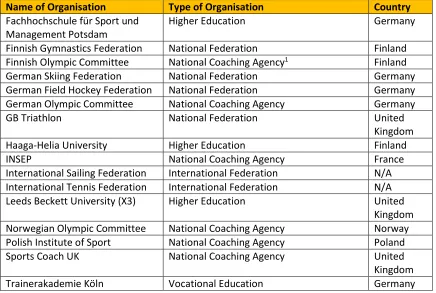
[image:11.612.72.508.212.505.2]CoachLearn partners were asked to nominate organisations representing a wide number of stakeholders and nationalities in order to get as broad a view of the topic as possible. Nominees had to fulfil the following criteria: a) operate within a Member State; b) being involved in coach education and development. All in all, 18 respondents, from 15 different organisations representing 6 different countries and 5 different types of stakeholder completed the survey.
Table 2 shows the list of participants and the type of stakeholder they belong too.
Name of Organisation Type of Organisation Country
Fachhochschule für Sport und Management Potsdam
Higher Education Germany
Finnish Gymnastics Federation National Federation Finland Finnish Olympic Committee National Coaching Agency1 Finland
German Skiing Federation National Federation Germany
German Field Hockey Federation National Federation Germany German Olympic Committee National Coaching Agency Germany
GB Triathlon National Federation United
Kingdom
Haaga-Helia University Higher Education Finland
INSEP National Coaching Agency France
International Sailing Federation International Federation N/A International Tennis Federation International Federation N/A Leeds Beckett University (X3) Higher Education United
Kingdom Norwegian Olympic Committee National Coaching Agency Norway Polish Institute of Sport National Coaching Agency Poland
Sports Coach UK National Coaching Agency United
Kingdom
Trainerakademie Köln Vocational Education Germany
Table 1 – Participant organisations by type and nationality
Methodology
The survey was conducted using Google Forms. Some questions required a text answer where the participants were asked to elaborate on a certain topic while some others asked participants to choose between a number of options. On the latter type, a text box was supplied and participants were asked to rationalized their choices. Table 2 offers an overview of the survey structure and the questions.
1 A National Coaching Agency is defined as the country organisation with direct responsibility to oversee coach
11 | P a g e
Section Title Questions Answer Type
You and your organization
General questions about the person completing the survey and their organisation
Text
Your Current Situation
What is your current involvement as an organization in the education, development, and/or employment of coaches?
In your work supporting the development of coaching and coaches in your country, what are the main
problems you have to deal with at the moment or have dealt with in the past?
What guidance document or tools have you used or are using to help solve those problems?
What kind of additional guidance documents and tools would be helpful for you and your organization?
Text
Text
Text
Text
Existing Tools and Frameworks2
Which of these tools and frameworks do you know of and are familiar with?
Which of these tools and frameworks do you take into account in your daily work to support coaches’ learning, mobility and employment?
Overall, how do you feel the tools and frameworks above support you and your organization in your work with coaches? Selection from list Selection from list Text Existing Sport Coaching Frameworks3
Which of these existing frameworks specific to sport are you familiar with?
Please briefly describe how the development of your coach education system was influenced by the two abovementioned frameworks Selection from list Text The European Sport Coaching Framework – What and Why?
Do you think a European Sport Coaching Framework would benefit your organization and your coaches?
What do you think are the key benefits of developing a European Sport Coaching Framework?
Yes/No
Selection from list + Text
2 Europass; Professional Qualifications Directive; European Credit Transfer & Accumulations System; Framework
for Qualifications of the European Higher Education Area (Bologna Agreement); European Qualifications
Framework for Lifelong Learning; European Credit System for Vocational Education & Training (ECVET); European Quality Assurance in Vocational Education & Training (EQAVET)
3 European Framework for the Recognition of Coaching Competence and Qualificatoins; International Sport
12 | P a g e
What are the key themes the European Sport Coaching Framework needs to address?
Selection from list + Text
The European Sport Coaching Framework - How
What from the list below would you see as priorities to support adoption and implementation of the ESCF?
[image:13.612.67.519.78.162.2]Selection from list + Text
Table 2 – Survey structure and questions
Text answers were thematically analysed4 giving rise to a number of main themes and subthemes.
Multiple choice questions were tallied up and proportions calculated.
5.
Survey Findings
Key issues faced by those working in coach education
The survey participants identified the following issues in no particular order of importance:
Lack of ‘framework culture’: a number of organisations stressed the extreme difficulty of operating in an environment ‘without boundaries’. This could be due to the non-existence of a National Qualifications Framework (NQF) in that particular country, because of coaching qualifications not sitting within the NQF or not being mapped against it, or owing to intra-national fragmentation based on federalism or regional autonomy. In line with this, some participants stressed how many of their stakeholders still had not understood the benefits of a joint-up framework approach whereby all stakeholders work to the same principles and objectives. One of these benefits, according to the respondents yet to be realized, would be enhanced quality assurance within and across countries
Lack of suitable curricula: a concerned was expressed that some coach education programmes suffered from poor curriculum design, inappropriate pedagogical choices and delivery formats that do not support the principles of lifelong learning. A specific are of improvement identified by the survey was the inclusion of learning outcomes related to the development of the interpersonal and intrapersonal knowledge and skills of the coach. There was a perception that in the main, coaching education focused too heavily on the technical elements of the various sports. In addition, it was felt that despite a philosophical move towards coach education that takes into account the domain and context in which the coach will operate, this had not
translated into the development of suitable domain and context specific curricula. Particularly in relation to International Federations, the difficulty of adapting curricula and delivery to the constraints of different countries was highlighted as an area of interest.
4 Braun, V., & Clarke, V. (2006). Using thematic analysis in psychology. Qualitative Research in Psychology, 3(2),
13 | P a g e
Development of a lifelong learning mindset: someparticipants emphasised a resistance from both coaches and their employers to embrace a lifelong learning mentality where formal, non-formal and innon-formal learning are equally valued and promoted. Related to this, the need to develop coach learning opportunities that are cheap and accessible once coaches are already in employment was highlighted. The need to identify, design and facilitate suitable practicum periods as an integral part of coaching qualifications was stressed particularly by the higher education institutions. Likewise, a lack of suitable coach developers (tutors, teachers, lecturers, mentors, etc.) was thought to be an area that needs urgent attention.
Developing coaching as a profession: a number of participants stated that developing and promoting coaching as a profession, including the social recognition of the figure of the coach was a priority. Linked to the above, the possibility of setting up coach certification and licensing schemes was seen by some organisations as a pivotal step in this process. In addition, the lack of recognition of coaching qualifications by academic institutions and national education
frameworks was seen as a key stumbling block for the progression of the coaching profession. Furthermore, a lack of opportunities for female coaches and the underdevelopment of the legal status of the coach in most countries provide cause for concern.
Guidance tools used by those working in coach education
Participants were asked to describe the tools and strategies they had used to develop their coaching systems and qualifications, and to overcome the day-to-day challenges of their job. Not surprisingly, NQFs were identified as a fundamental reference point for those organisations working in countries that had developed their own. In those cases, guidance documents produced by the relevant national organization had been the main source of information and guidance. Likewise, the EQF was highlighted as a central point of focus to ensure there was alignment between national and European structures. Very significant is the experience of the UK where, in addition to a NQF aligned to EQF, a framework specific to coaching has been developed (UK Coaching Framework) which has been adopted by the majority of NGBs as the reference point. Because of this common approach, the UK has been able to develop multiple guidance tools and strategies led by its national coaching agency sportscoachUK. Countries which do not have a coaching specific framework, have approached the task as a collaborative exercise where all coaching stakeholders have had to be in constant contact to ensure progress. In addition, these countries with no coaching specific framework have tended to rely heavily on materials produced by the International Council for Coaching Excellence such as the International Sport Coaching Framework and the International Coach Developer Framework.
With regards to the strategies used to support implementation of their qualifications and overcome some of the barriers. The following initiatives were put forward by the various contributors:
Production of own guidance documents and rubrics for all stakeholders Continuous cooperation with key stakeholders
14 | P a g e
Marketing strategies to increase recognition of the figure of the coach
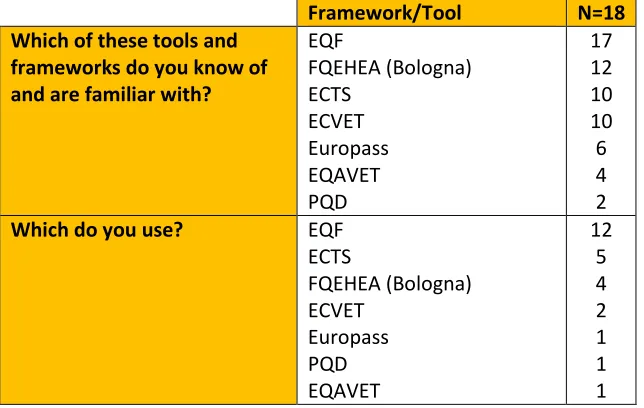
The participants were subsequently asked to identify those tools and frameworks they were familiar with and were using to inform their work from a sample of the seven most relevant existing ones. Table 3 offers the collated figures.
Framework/Tool N=18 Which of these tools and
frameworks do you know of and are familiar with?
EQF FQEHEA (Bologna) ECTS ECVET Europass EQAVET PQD 17 12 10 10 6 4 2
[image:15.612.147.469.158.362.2]Which do you use? EQF ECTS FQEHEA (Bologna) ECVET Europass PQD EQAVET 12 5 4 2 1 1 1
Table 3 – Knowledge and use of general education and mobility frameworks and tools
Impact of the generic qualification frameworks and mobility tools
The impact of the generic qualifications and mobility tools was felt differently by the respondents. Some admitted to not having much formal knowledge of them and to not have used them in their work at all. Confusion as to what each of the tools was for and how to use them was a major reason for lack of adoption. There was an overall sense of lack of support from the organisations promoting these tools. Respondents highlighted that they did not know where to go for advice and that specially, the
information on various websites was confusing and overwhelming.
For some participants, the various frameworks and tools had provided loose guidance and somehow influenced the development of their coaching qualifications. This tended to be more from a distance, based more on political pressure to comply but with no direct formal connection to the frameworks, especially the EQF. A view was expressed that the frameworks are very general, theoretical in nature and not fully understood by the end-user. As expected, however, higher education institutions (HEIs), had a good working knowledge of the main frameworks. Particularly, understanding of the EQF was fundamental for HEIs as this allowed them to grasp where their graduates sit in the overall picture, and facilitated the mobility of students between countries from which they had benefited in the past.
15 | P a g e
these other frameworks. They, however, stressed that perhaps the most difficult barriers to surmount to implement a new system laid within the organization itself, not outside. In line with this, it was
highlighted that most NGBs do not have the operational capacity and financial resource to deal with these transformational issues and that a national agency should guide and support them. The view is that each NBG on their own is unlikely to feel the need for change or to align with external frameworks.
Additional Guidance & Tools needed for those working in Coach Education
Survey respondents were asked to think about what additional guidance or implementation tools they would like to see developed to support their work. The following were proposed:
A European inter-federation mapping tool which allows any national federation to: o Understand coach education pathways in different countries
o Approach the recognition of prior learning process with transparency and fairness A catalogue of sport coaching qualifications in European countries aligned with EQF containing
details of their curricula and academic requirements
A directory of European countries with sport coaching specific qualification frameworks aligned with EQF and a case study/best practice examples repository
Coach developer resources
Guidelines to support on-line coach education Coach job description templates
In addition, some participants advocate for the relevant bodies to lobby for the development of coaching as a profession at the highest level of European policy-making.
Knowledge and Impact of Sport Coaching-Specific Frameworks
Survey participants were asked if they were aware of sport coaching specific frameworks such as the European Framework for the Recognition of Coaching Competence and Qualifications (EFRCCQ) and the International Sport Coaching Framework (ISCF). Table 4 shows the results:
Framework N=18
Which of this existing sport coaching frameworks are you familiar with?
EFRCCQ ISCF None
2 13
[image:16.612.130.489.535.592.2]2
Table 4 – Knowledge of sport coaching specific frameworks
16 | P a g e
felt the impact of the ISCF had been high and that it really had made a contribution to the global understanding of sport coaching as well as to the specifics of developing coaching qualifications. At a national level, the ISCF is being used by a number of countries to inform the development of their national coaching frameworks and systems. In the case of NGBs, the ISCF had, in the main, not had a major impact on the development of their qualifications, yet was now being used as a tool for self-reflection and fine-tuning of the existing systems.
The Need for, Benefits and Priorities of a European Sport Coaching Framework
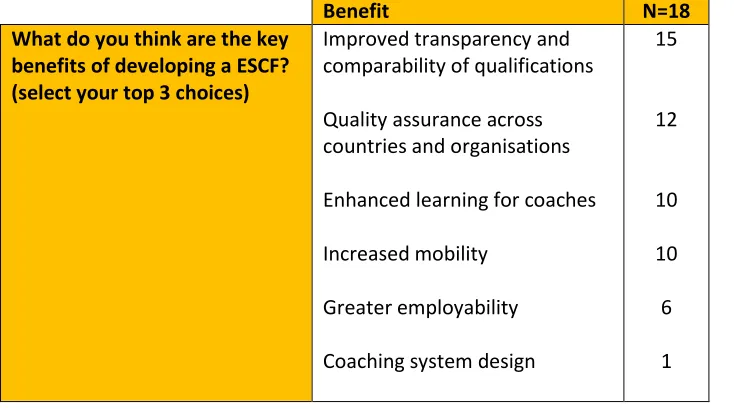
The next block of questions in the survey was aimed at determining the value of developing a European Sport Coaching Framework (ESCF). Participants were first asked if they felt the creation of the ESCF would be beneficial to their organisations. The overwhelming majority of organisations (17 out of 18) felt the ESCF would make a positive contribution. They were then requested to choose what they felt the key benefits of the ESCF would be. Table 5 shows the participants choices.
Benefit N=18
What do you think are the key benefits of developing a ESCF? (select your top 3 choices)
Improved transparency and comparability of qualifications
Quality assurance across countries and organisations
Enhanced learning for coaches
Increased mobility
Greater employability
Coaching system design
15
12
10
10
6
[image:17.612.72.439.286.491.2]1
Table 5 – Key forecasted benefits of the development of the European Sport Coaching Framework
The figures in table 5 show that comparability of qualifications, quality assurance, enhanced learning and increased mobility are key outcomes sought by European coaching stakeholders. The ESCF is not seen by stakeholders as a regulatory or compulsory document, but much more as a facilitator at a number of levels: e.g. as a translator between countries or federations to support comparability of qualifications and coach mobility; as a guidance tool to improve the quality of the education and development opportunities afforded to coaches; and as a ‘check & challenge’ tool to reflect on the strengths and weaknesses of a coaching system. For this to happen however, participants felt that ESCF should fully align with EQF and be compatible with NQFs.
17 | P a g e
Priority Themes N=18
What are the priority themes that must be addressed by the ESCF
Competences needed to fulfil the functions in a specific given role
Coaches Core Functions (what coaches do)
Coaching Roles (i.e. coaching assistant, coach, senior coach, master coach [from ISCF, 2013])
Links between Coaching Qualifications and National and International Qualification Frameworks
Comparability and Validation of Qualifications
Recognition of Prior Learning
Assessment of Competence
Coaching as a profession
Coaching Qualifications Curricula
Quality assurance of qualifications
Coaches lifelong learning
Athlete and Participant Pathways (i.e. participation versus performance sport)
Coach Developers/Educators
How coaches learn
Coaching Philosophy and Objectives
Coaching Research and Exchange
Coach Licensing
12
12
11
11
9
8
7
7
6
5
5
5
4
2
2
1
[image:18.612.82.479.100.636.2]1
18 | P a g e
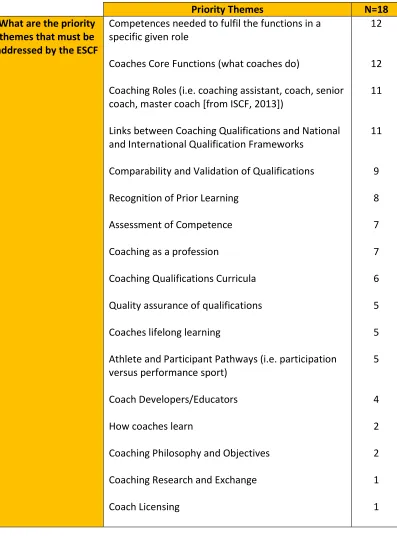
A number of overarching priority themes emerge from the above exercise:
The figure of the coach: participants have clearly expressed the need for the ESCF to present a clear, yet adaptable, definition of the role and functions of the coach. This includes the relevant competencies to fulfil the needs of the job.
Translation: respondents have unequivocally signalled the role the ESCF needs to play in the translation process between and within countries and federations. Quality assurance, trust, comparability, recognition of prior learning and mobility are central outcomes sought in this process.
Coach learning: less emphasised than the previous two themes, enhancing coach learning is however, still viewed as fundamental. Specifically, the development of a suitable coach developer workforce, appropriate curricula and the fostering of a lifelong learning mindset amongst coaches are identified as central to success.
Respondents appeared to be less interested in areas such as coach learning and licensing.
Adoption and Implementation of the future European Sport Coaching Framework
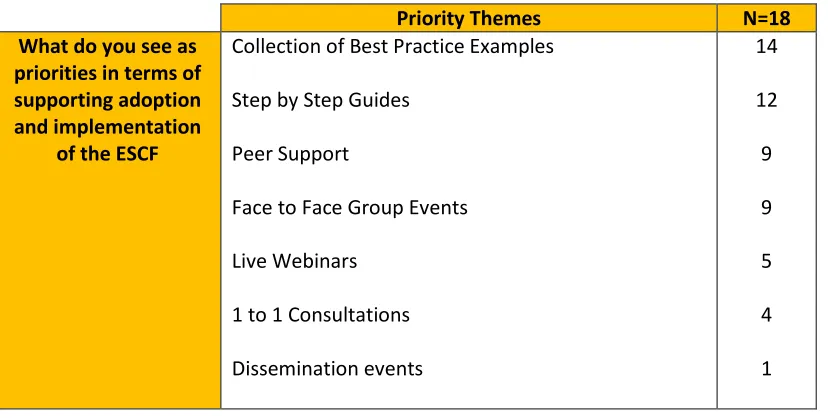
Stakeholders were asked to rank their top three choices of support mechanism necessary for the progressive adoption and implementation of the ESCF. Table 7 provides the outcomes of this exercise.
Priority Themes N=18
What do you see as priorities in terms of supporting adoption and implementation
of the ESCF
Collection of Best Practice Examples
Step by Step Guides
Peer Support
Face to Face Group Events
Live Webinars
1 to 1 Consultations
Dissemination events
14
12
9
9
5
4
[image:19.612.75.489.393.602.2]1
Table 7 – ESCF adoption and implementation preferred support needs
The results above offer clear guidance as to the required tools and support mechanism to increase the likelihood of countries and sports adopting the principles contained in the future ESCF. Practical support in the shape of best practice examples and carefully designed step-by-step guides are favoured by the majority of stakeholders. In addition, the development of opportunities for peer support and
19 | P a g e
Conclusions
The landscape of coach education across Europe is very varied and disjointed. The EQF has somewhat contributed to an increased alignment between and within countries and federations, yet much more needs to be done. The lack of a NQF aligned to EQF in some countries, and the overall dearth of sport coaching specific qualification frameworks in most nations is hindering the progress of those NGBs, IFs, and Vocational Training Institutions and HEIs working in coach education. The development of a
European Sport Coaching Framework fully aligned with EQF and other relevant European education and mobility tools is seen as having the potential to alleviate many of the issues faced by all coach education stakeholders.
© CoachLearn
Report compiled by Sergio Lara-Bercial, Julian North, Ladislav Petrovic, Klaus Oltmanns, Jan Minkhorst, Kirsi Hämäläinen and Karen Livingstone