Citation:
Curcuruto,
MM
(2016)
Safety
participation
in
the
workplace:
A
multidimensional
as-sessment tool (PROSAFE). Chemical Engineering Transactions.
ISSN 2283-9216 DOI:
https://doi.org/10.3303/CET1653031
Link to Leeds Beckett Repository record:
http://eprints.leedsbeckett.ac.uk/3144/
Document Version:
Article
Creative Commons: Attribution 4.0
The aim of the Leeds Beckett Repository is to provide open access to our research, as required by
funder policies and permitted by publishers and copyright law.
The Leeds Beckett repository holds a wide range of publications, each of which has been
checked for copyright and the relevant embargo period has been applied by the Research Services
team.
We operate on a standard take-down policy.
If you are the author or publisher of an output
and you would like it removed from the repository, please
contact us
and we will investigate on a
case-by-case basis.
CHEMICAL ENGINEERING
TRANSACTIONS
VOL. 52, 2016
A publication of
The Italian Association of Chemical Engineering Online at www.aidic.it/cet Guest Editors: Valerio Cozzani, Eddy De Rademaeker, Davide Manca
Copyright © 2016, AIDIC Servizi S.r.l., ISBN 978-88-95608-43-3; ISSN 2283-9216
Safety participation in the workplace: An assessment tool of
proactive safety orientations by individuals (PRO-SAFE)
Matteo Curcuruto
aaSchool of Social Sciences, Leeds Beckett University, Calverley Building, Portland Way, Leeds, LS1 3HE, United Kingdom
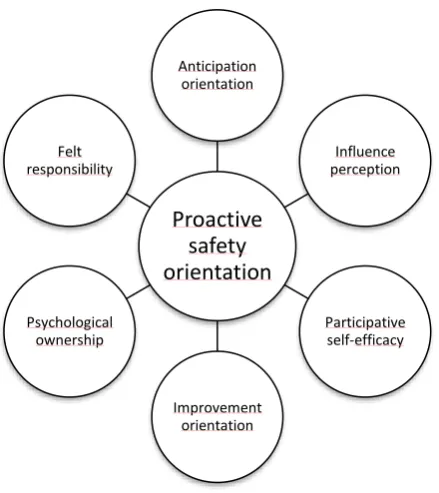
The importance of the concept of the workforce participation in safety management has been underlined by different studies in the Human Factors literature of the last twenty years. All these contributions have stressed the importance of considering the positive contribution of individuals and teams in achieving the desired level of safety. Within this framework, the construct of proactive safety orientation toward safety emerged as a general and broad set of psychological orientations by individuals in managing safety issues, preventing injuries, improving workplace safety conditions and sustainability of organizational contexts, beyond the mere avoidance of negative events for individuals, teams and organizations. In the light of these conceptual bases, the aim of the present research is to define an original assessment tool of “proactive safety orientation” to assess the psychological factors leading individuals toward a more proactive and participative approach to safety management and risk prevention in the workplace. The model tool was developed as a multidimensional questionnaire on existing conceptual dimensions of organizational proactivity adapted to safety issues in the workplace. In order to achieve this aim, three main research phases were planned: 1) Exploratory semi-structured interviews on conceptual issues, involving safety experts 2) Generation of a new set of assessment measures with content items interview with experts 3) Quantitative pilot study on the psychometric properties of reliability of the new evaluation instruments involving a new set of safety experts. In summary, our research allowed us to generate an assessment tool inclusive of six psychological dimensions supportive of a general proactive orientation by individuals toward the management of safety and the prevention of accidents in the workplace: i) participative self-efficacy; ii) influence perception; iii) psychological ownership; iv) felt responsibility; v) anticipation orientation; vi) improvement orientation..
1. Introduction
risks); c) taking-charge of critical issues with the aim of improving safety in the workplace (e.g. through suggestions for improvements in safety practices, procedures and work routines).
2. Conceptual foundations: proactive motivation and future orientation
In a theoretical conceptualization recently proposed by Parker, Bindl and Strauss (2010), proactivity is represented as a set of states and psychological conditions. These have an impact on both individual dimensions (traits and stable provisions; skills and psychosocial resources) and organizational dimensions (organizational climate; trust relationships with superiors and colleagues, job design). The authors distinguish between three clusters of psychological dimensions that support a proactive role in the workplace. On this basis, Curcuruto and Griffin (2016) have recently reviewed three general domains of motivational states leading and supporting individuals toward a proactive management of safety related instances: a) the first conceptual domain refers to the employee’s perception of their individual ability to contribute to safety programs and initiatives in their organizations ("can do" motivation); b) the second domain refers to the employee’s internalization of safety related principles and the value of these principles for the individual in carrying on their activities ("reason to" motivation); c) the third domain refers to the future-orientations in safety management. These direct the motivational focus by individuals toward the anticipation of problems and the prevention of their negative consequences. These macro-categories are briefly presented below.
2.1 Employees’ capabilities as motivational driver of proactivity (“can do”)
The first psychological domain (“can do” motivation) refers to employees’ self-perception of their own capabilities. It looks at how these can facilitate the generation of proactive behaviours by workers in those domains of organizational life in which the individual experiences a high sense of personal mastery. This first macro-motivational category includes conceptual constructs of professional capability such as occupational self-efficacy. This leads individuals to strive to achieve objectives that do not fall clearly within their job description, such as the construct of role-breadth self-efficacy (Parker et al., 2010). This macro-category would also include the psychological dimensions of perceived control (such as the degree of influence perceived by workers on a specific target of work behaviour) and psychological empowerment (Spreitzer, 1996). This would help people to achieve and experience a higher level of mastery in their work reality.
2.2 Internalization of managerial values as motivational driver of proactivity (“reason to”)
The second psychological domain (“reason to” motivation) relates to psychological dimensions of subjective internalization of values. While the psychological dimensions of "can do" previously described inform the individuals about expectations of success of a proactive behaviour, this second motivational "reason to" cluster acts as stimulators of individual initiative because of its personal meaning for the subject (Mariani et al., 2015). Expressions of this second macro-category are motivation constructs like psychological ownership (the deep internalization of organizational values and principles which are eventually perceived by workers as truly their own) (Pierce et al., 2001), the construct of felt responsibility to constructive change (the perception of being personally responsible for generating spontaneous initiatives with the aim of resolving organizational problems and the improvement of the organizational reality) (Morrison, 1994), the construct of flexible role-orientation (the individual tendency to enact a broader involvement in the organizational life engaging in tasks which are not formally or technically included in the formal job-description) (Parker et al., 2010).
2.3 Future orientation and proactive management of safety in the workplace
The third psychological domain considers psychological orientations which direct and support individual proactivity and initiative over time (Frese et al., 2007). Examples of such future-oriented constructs are psychological dimensions. They include an active coping with adversities orientation, an active orientation toward error management, and learning and change orientations. The latter helps individuals to proactively predict and manage problems in advance. It also entails persisting when faced with potential obstacles that may be hidden in a near future or which might arise when undertaking innovative courses of actions not explicitly covered by the current organizational standards, prescriptions and procedures. From a safety capability perspective (Griffin et al., 2015) such future-orientations would facilitate two functions of safety management: the anticipatory prevention of risks and hazards and the promotion of continuous incremental adjustments of safety systems.
3. Research aims and phases: development of PRO-SAFE assessment tool
contribution in two directions: a) the identification of relevant conceptual dimensions of a proactive safety orientation through a qualitative interview phase with safety experts (research phase 1); b) the preliminary development of an assessment questionnaire tool. Its aim is to evaluate individual’s proactivity tendency toward safety management using a mix of qualitative and quantitative methodologies (research phases 2 and
3).
3.1 Phase 1: Explorative interview study on the representations of safety experts
A first phase of semi-structured interviews involving eighteen experts in occupational safety from different organizational contexts in the Veneto and Emilia-Romagna regions of Italy: two university administrations, a manufacturing company, a chemical company; a packaging company; a healthcare products company.
Research methods and participants. This sample of experts included two university researchers with expertise in the field of occupational safety, two safety consultants collaborating with multinational companies, two safety principal managers (RSPP head), two safety executives (ASPP managers), nine safety officers (“lavoratori preposti per la sicurezza”) and a worker representative (RLS). This qualitative information was analysed using a content analysis procedure. The interviews with the experts were focused on the following aspects: a) general features of their organizations; b) review of the main risks and hazards; c) analysis of the specific organizational position of the person interviewed, and the proximal organizational network; d) types of participatory contributions (or "extra-role”) expected for safety promotion; e) personal representation of the notion of a proactive approach to safety management; f) personal assessment of the motivation factors behind such a proactive approach; g) personal assessment of the factors that can hinder the active participation of workers in promoting safety. Table 1 shows a summary of the principal results.
Table 1: Principal contents from the explorative interviews to the safety experts
Principal representations of the concept of proactivity in the management of occupational safety:
i) Active prediction of risks and hazards, and future-thinking about safety system capability ii) Deep knowledge and mastery in one’s own job which allows effective safety participation iii) High personal involvement and ownership for the organizational safety programs and practices iv) Feeling of personal and shared responsibility toward safety goals and achievements
v) Personal desire to develop and improve one’s own competence and company effectiveness vi) Spontaneous problem solving activities to contribute and impact on the resolution of problems
Principal reasons to play a proactive role in the management of safety in the workplace:
i) Perception of affective and emotional membership to the company ii) Perception of interdependence between the members of the organizations
iii) Perception of reciprocal obligations associated with cohabitation in a shared social context iv) Perception of prosocial responsibility for other people’s health and well-being
v) Perceived need of competence and self-promotion
Principal obstacles to a proactive approach toward safety management:
i) Indifference to others and to the organizational community ii) Lack of support from senior management
iii) Lack of training and knowledge
iv) Lack of openness to change and experimentation with new ways of organizing work
v) Ambiguity about formal role responsibilities resulting in a general lack of operative accountability
Figure 1: Psychological dimensions supporting a “proactive safety orientation” in the workforce
3.2 Phase 2: Qualitative development and content analysis of an original set of measures
In the light of the interview findings, the research team generated an initial pool of 110 statement items related to the constructs of proactivity described in section 2 of the current paper.
Research methods and participants. The constructs were adapted by the research team with the safety issues identified in the interview phase with the safety experts. By way of example, the following constructs were adapted to safety contents: flexible role-orientation (Parker et al., 2010); felt responsibility to change (Morrison, 1994); role breadth self-efficacy (Parker et al., 2010); proactive coping (Greenglass and Fiksenbaum, 2009); change orientation (Parker et al., 2010); psychological empowerment (Spreitzer, 1996). The item pool was subjected to a new group of experts (N = 17) from the companies mentioned in phase 1. This included four new safety executives (ASPP managers), eleven safety officers (“lavoratori preposti per la sicurezza”) in charge of safety in their groups, and two safety consultants. The aim was to examine the content and face validity of the developed pool of items, their ease of understanding and the potential presence of redundancies and ambiguities. Results. Based on the opinions expressed by the experts, a preliminary questionnaire consisting of 48 statement items were selected to assess the six model dimensions identified from the expert’s representations of the PRO-SAFE model. Each proposed scale consists of eight items. Table 3 reports an example of items for the assessment of each of the six dimensions of the model.
3.3 Phase 3: Quantitative pilot study on the reliabilities properties of the new assessment tool
A third research stage was undertaken to test the quantitative psychometric properties of the 48-item questionnaire (reliability; item-total correlation). A new sample of workers characterized by different job positions and risk levels in their work activities was used for this.
Research methods and participants. The questionnaire was administered to a sample of 90 workers of some
departments from one of the two universities mentioned in phase 1. This new sample of workers consisted of 43 safety officers and 47 workers without added safety responsibilities. These workers were selected from seven university departments in order to represent a broad range of work situations with different typologies of implications for safety: biology, chemistry, agronomy, engineering, humanities, pedagogy, and psychology. All items were presented with a Likert response five-point scale (1=strongly disagree; 5=strongly agree). The data collected on the six scales were analysed with indexes of item-total correlation and Cronbach's alpha. These are two statistical indices broadly used to assess the reliability properties of new psychometric questionnaire tools. It starts from a value of zero (no reliability) to the value of 1.00 (high reliability) (Kline, 2000). Specifically, the item-total correlation index assesses the internal correlation between the single items statements aimed to assess an overall dimension. On the other hand, the Cronbach’s alpha index indicates the overall degree to which the whole set of items measures that overall dimension as a single unidimensional construct.
Proactive
safety
orientation
Anticipation orientation
Influence perception
Participative self-efficacy
Improvement orientation Psychological
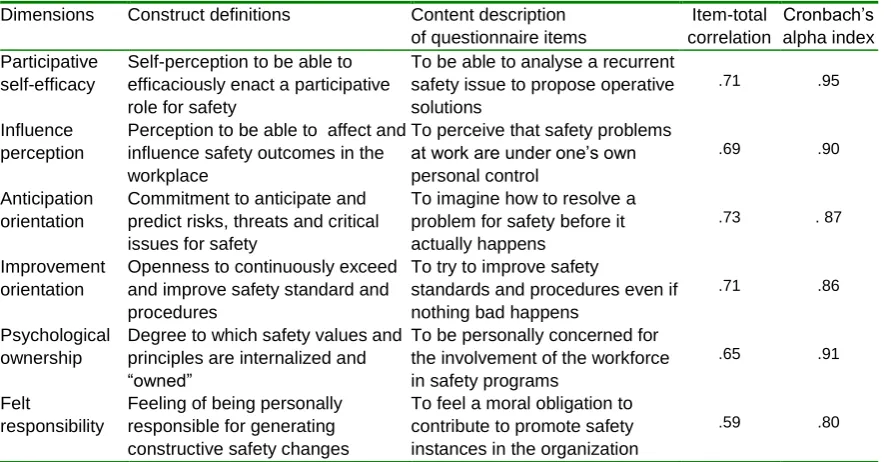
Table 2: Conceptual definition, content description, reliability indices of the six PRO-SAFE dimensions
Dimensions Construct definitions Content description
of questionnaire items
Item-total correlation Cronbach’s alpha index Participative self-efficacy
Self-perception to be able to efficaciously enact a participative role for safety
To be able to analyse a recurrent safety issue to propose operative solutions
.71 .95
Influence perception
Perception to be able to affect and influence safety outcomes in the workplace
To perceive that safety problems at work are under one’s own personal control
.69 .90
Anticipation orientation
Commitment to anticipate and predict risks, threats and critical issues for safety
To imagine how to resolve a problem for safety before it actually happens
.73 . 87
Improvement orientation
Openness to continuously exceed and improve safety standard and procedures
To try to improve safety
standards and procedures even if nothing bad happens
.71 .86
Psychological
ownership
Degree to which safety values and principles are internalized and “owned”
To be personally concerned for the involvement of the workforce in safety programs
.65 .91
Felt
responsibility
Feeling of being personally responsible for generating constructive safety changes
To feel a moral obligation to contribute to promote safety instances in the organization
.59 .80
Results. Table 2 presents the mean of the item-total correlation values and the Cronbach’s alpha index for
each questionnaire dimension. The average item-correlation value was found around .60 (considered as fairly good). The average Cronbach alpha index settled around .87 (considered as very good). In general, these two indices provided evidence of reliability of the PRO-SAFE questionnaire as a set of assessment tools to evaluate psychological and behavioural orientations by individuals toward a proactive management of safety and accident prevention in the workplace. Finally, we used the item-total correlation index to identify a more parsimonious version of the overall 48-item questionnaire. Using the value of .50 as the cut-off criteria, it was possible to identify a shorter version for each dimension composed of the five items with the highest correlation with the whole single measure. This latter procedure allowed us to arrive at a shorter version of PROSAFE with 30 items.
4. Conclusions
limitations of this study are inherent in the objectives themselves. The content validity, although a basic element of the broader construct validity, only takes into account some aspects of the quality of an instrument. Further studies will need to investigate other psychometric properties of the measures developed here, including deeper internal factor validity and other facets of construct validity (Mariani et al., 2015). Looking ahead for further evidence of validity, the cognitive-motivational PRO-SAFE could be used as a diagnostic tool to monitor the levels of safety participation by workers in safety management issues in the organization. It could also be a diagnosis tool to investigate the maturity stage of safety culture in a given company. This would provide accurate information on specific weaknesses (e.g. poor internalization of safety values; low levels of risk anticipation) (Saracino et al., 2015). Overall, this kind of information might be useful to design managerial interventions to change and improve safety policies, programs, practices and, eventually, the general safety culture in the organization.
Acknowledgments
This study is based on the doctoral dissertation developed by the author at the University of Verona (Italy). A special thanks to Marco Mariani, Adalgisa Battistelli and Guido Sarchielli for their inspiration and support.
References
Curcuruto M., Conchie S., Mariani M.G., Violante F.S., 2015, The role of prosocial and proactive safety behaviors in predicting safety performance, Saf. Sci. 80, 317-323.
Curcuruto M., Griffin, M.A., 2016, Safety Proactivity in Organizations: The Initiative to Improve Individual, Team and Organizational Safety, Proactivity at Work, Eds. Parker S.K., Bindl U., Routledge, New York, US.
Curcuruto M., Guglielmi D., Mariani M.G., 2014, A diagnostic tool to evaluate the proactivity levels of risk-reporting activities by the workforce, Chemical Engineering Transactions, 36, 397-402, DOI: 10.3303/CET1436067
Frese M., Garst H., Fay D., 2007, Making things happen: Reciprocal relationships between work characteristics and personal initiative in a four-wave longitudinal structural equation model, J. Appl. Psychol. 92, 1084-1102.
Greenglass E.R., Fiksenbaum L., 2009, Proactive coping, positive affect, and well-being: Testing for mediation using path analysis, Eur. Psychol. 14, 29-39.
Griffin M.A., Cordery, Soo C., 2015, Dynamic safety capability: How organizations proactively change core safety systems, Organ. Psychol. Rev., 1-25, DOI: 10.1177/2041386615590679
Griffin M.A., Curcuruto M., 2016, Safety climate in organizations, Annu. Rev. Organ. Psychol. Organ. Behav. 3, 191-212.
Hollnagel E., 2014, Safety-I and Safety-II: The Past and Future of Safety Management. Ashgate, Aldershot, UK.
Kline P., 2000, The Handbook of Psychological Testing. Routledge, London, UK.
Mariani M.G., Soldà B., Curcuruto M., 2015, Employee safety motivation: perspectives and measures on the basis of the self-determination theory, Med. Lav. 5, 333-341.
Morrison E.W., 1994, Role definitions and organizational citizenship behavior: The importance of employees perspectives, Acad. Manag. J. 37, 1543-1562.
Parker S.K., Bindl U., Strauss K., 2010, Making things happen: A model of proactive motivation, J. Manag. 36, 827-856.
Pierce J.L., Kostova T., Dirks K., 2001, Toward a theory of psychological ownership in organizations, Acad. Manag. Rev. 26, 298-310.
Saracino A., Curcuruto M., Antonioni G., Mariani M.G., Guglielmi D., Spadoni G., 2015, Proactivity-and-consequence-based safety incentive (PCBSI) developed with a fuzzy approach to reduce occupational accidents, Saf. Sci. 79, 175-183.
Saracino A., Curcuruto M., Spadoni G., Guglielmi D., Pacini V., Saccani C., Bocci M., Cimarelli M., 2012, IPESHE: an index for quantifying the performance for safety and health in a workplace, Chemical Engineering Transactions, 26, 489-494, DOI: 10.3303/CET1226087