Citation:
Hartford, T (2007) Computer based feedback: friend or foe? Assessment, Teaching & Learning Journal, 1 (1). ISSN 1756-8781
Link to Leeds Beckett Repository record: http://eprints.leedsbeckett.ac.uk/1038/
Document Version: Article
The aim of the Leeds Beckett Repository is to provide open access to our research, as required by funder policies and permitted by publishers and copyright law.
The Leeds Beckett repository holds a wide range of publications, each of which has been checked for copyright and the relevant embargo period has been applied by the Research Services team.
We operate on a standard take-down policy. If you are the author or publisher of an output and you would like it removed from the repository, please contact us and we will investigate on a case-by-case basis.
2
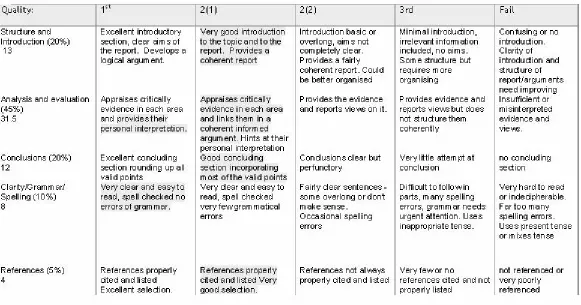
This approach has allowed quicker turnaround of scripts, however if the tutor is not comfortable marking from a screen then this may not be the case. Once scripts have been marked electronically they were saved on the WebCT module for the students to retrieve. Feedback was given two thirds of the way through the module and then again at the end of the module, students were made aware how this feedback could be used to their advantage with specific subsequent modules in the course. Each year there have been a number of students who didn’t bother to collect their feedback/work. Using electronic feedback, all students visited the WebCT module after the end of the final assessment and between 80526 times each during the course of the module. Although it is not possible to say if they opened their assignment and used the feedback, I cannot think of another reason why they would visit the site! Of the 14% of students who did not submit electronically only one collected their marked script plus feedback. With this approach there is a greater potential to reach the entire cohort although there may be access issues for some students. On the other hand it may increase access for some, for example those who use a sightreader. For dyslexic students it is possible to adapt the view so they can read the script against the background colour of their choice. A final year module, Integrative Studies, involves a report written as a critical evaluation of a student conference. Electronic submission via WebCT is used but this time electronic feedback was simplified using a grid based on assessment criteria. This grid was not new to the students, but was the basis of a report writing workshop part way through the module. Key failings of feedback can be lack of specificity and unfamiliarity with academic language (Hartley andChesworth, 2000; Higgins et al., 2002; Weaver, 2006). A workshop such as this aids understanding of assessment criteria or marking schemes aiding delivery of meaningful feedback (Orsmond et al., 2002b;) and can be used to develop a grid facilitating more rapid feedback. The grid was pasted at the end of each
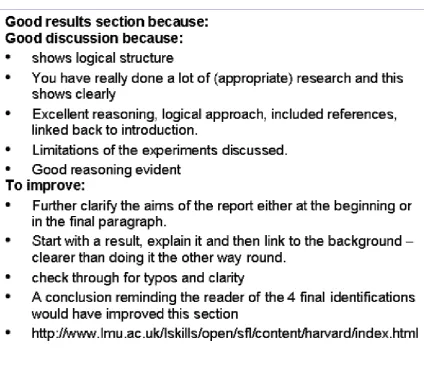
assignment and comments relevant to the student highlighted in yellow. Any additional or more personal comments were added below the table (Figure 2).
3
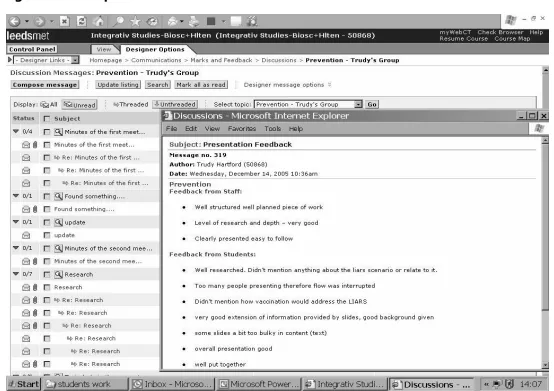
[image:4.595.89.514.225.595.2]work. The key advantages include potential for improving the timing of feedback and incorporating direct links to websites offering support (e.g. WebCT pages or Skills for Learning). Additional bonuses are the removal of complaints about unreadable feedback and ease of collation of material for external examiners. On the down side you need to be comfortable reading electronically (or request hard copy submission as well) and need to mark at a computer. For group work or feedback using a discussion facility the benefits of the increased opportunity for feedback and the development of a dialogue between tutor and student is well worth considering.
5
6
References
Gibbs G and Simpson C. (20045). Conditions under which assessment supports students’ learning. Learning and Teaching in Higher Education 1 331. Available from:<www.open.ac.uk/science/fdtl/pub.htm> [Accessed <19 July 2006].
Hartford T. (2005). Facilitation and Assessment of Group work using webbased tools, Biosciences Education Electronic Journal Volume 5 Available from:
<http://www.bioscience.heacademy.ac.uk/journal/vol5/beej5.5.pdf>
Hartley J. & Chesworth K. (2000). Qualitative and quantitative methods in research on essay writing: No one way. Journal of Further and Higher Education, 24, 1, 1524. Higgins R., Hartley P. and Skelton A. (2002). The Conscientious Consumer: reconsidering the role of assessment feedback in student learning. Studies in Higher Education 27, 1 5364. Juwah C. MacfarlaneDick D., Matthew B., Nicol D., Ross D. and Smith B. (2004). Enhancing student learning through effective formative feedback. Higher Education Academy Generic Centre. Mutch A. (2003). Exploring the practice of feedback to students. Active Learning in Higher Education 4 (1) 2438. Nicol D. and MacfarlandDick, D. (2006) Formative Assessment and Self regulated learning: a model and 7 principles for good feedback practice. Studies in Higher Education 31 (2) 199218. Orsmond P., Merry S., Reiling K., 2002a. The student use of tutor feedback in their learning. Paper presented at the Learning Communities and Assessment Cultures Conference, University of Northumbria. Available from: < www.leeds.ac.uk/educol> [Accessed <12 July 2006]. Orsmond, P., Merry, S., Reiling, K., 2002b. The use of exemplars and formative feedback when using student derived marking criteria in peer and self
assessment. Assessment and Evaluation in Higher Education 27 (4) 309323.
Peat M. and Franklin, F. 2002 Supporting Student Learning: the use of computer based formative assessment modules. British Journal of Educational Technology 33 (5) 515523.
Rust C. 2001. An opinion piece: A possible studentcentred assessment
solution to some of the current problems of modular degree programmes Active Learning in Higher Education 1 (2) 126–131.
Rust C. 2002. The Impact of assessment on Student Learning. Active Learning in Higher Education 3(2) 145158.
Taras M. (2006). Do unto others or not: equity in feedback for undergraduates. Assessment and Evaluation in Higher Education 31 (3) 365 – 377.