A STUDY ON CONSUMER SATISFICATION OF ADVERDISEMENT
AND PURCHASE DECISION WITH SPECIAL REFERENCE TO HERO
MOTORS IN SALEM CITY.
Dr. M. Manivannan, M.Com., M.Phil., B.Ed., Ph.D.,
Assistant Professor and HOD of Commerce (CA), AVS College of Arts and Science,
Salem, Tamil Nadu.
ABSTRACT
Advertising is virtually everywhere in daily life and its forms and roles are both contested
and admired. Some see advertising as both the mirror the maker of culture. Its words and images
reflect the present and the past even as they contribute new sounds and symbol that shape the
future. Others say advertising is purely an economic activating with one purpose to sell,
whatever your view many advertisers and agencies believe that advertising create “Magic in the
market place.”
Advertising is not developed or delivered in a vacuum. It’s one element – a key element –
in the process of marketing. Business, individuals, governments and non-profit organizations
that purchase a product and advertising helps persuade customer to select one product rather
than another.
Advertising play an important but relatively limited role in marketing. It can be used to
promote a product many advertising appears in effect the marketing process provides the frame
work in which advertising is created. The emergence of the marketing concept with its emphasis
take on an expanded, role as a marketing communications assumed greater importance in
business.
Advertising provides an efficient, inexpensive and fast method of reaching the much
sought after consumer. Its extensive use now rivals that of personal selling. Advertising has
become a key ingredient in the effective implementation of the marketing concept.
INTRODUCTION
Advertising is virtually everywhere in daily life and its forms and roles are both contested
and admired. Some see advertising as both the mirror the maker of culture. Its words and images
reflect the present and the past even as they contribute new sounds and symbol that shape the
future. Others say advertising is purely an economic activating with one purpose to sell,
whatever your view many advertisers and agencies believe that advertising create “Magic in the market place.”
Advertising is not developed or delivered in a vacuum. It’s one element – a key element –
in the process of marketing. Business, individuals, governments and non-profit organizations that
purchase a product and advertising helps persuade customer to select one product rather than
another.
Advertising play an important but relatively limited role in marketing. It can be used to
promote a product many advertising appears in effect the marketing process provides the frame
work in which advertising is created.
The emergence of the marketing concept with its emphasis take on an expanded, role as a
marketing communications assumed greater importance in business.
Advertising provides an efficient, inexpensive and fast method of reaching the much
sought after consumer. Its extensive use now rivals that of personal selling. Advertising has
become a key ingredient in the effective implementation of the marketing concept.
COMPANY PROFILE
The success of the Hero Group lies in the determination and foresight of the Munjal
brothers, who shared their vision with their workers and led the Group to a position where its
name has become synonymous with top-quality two wheelers.
The flame kindled by the Mmunjal brothers 1956 with the flagship company Hero
Cycles; Mr.Satyanand Munjal, Mr.Brijmohan Lall Munjal and Mr. O. P. Munjal continue to
The saga is being continued with the same zeal by the second and third generations of
the family and the large working force of the Hero Group. The spirit of enterprise which
dominates the progress of the of the Group is characteristic of the land where it all began – the
City of Ludhiana, in Punjab – home to some of India’s finest workers and entrepreneurs.
The Hero Group is a thriving examples of three generations of a family working and
striving together to ensure quality, satisfaction and extensive growth.
STATEMENT OF THE PROBLEM
Today is the day of speedy and mechanized life style. To cope up with the system that
prevails in the present day, speedy transport is has become one of the major factors.
The usage of transport medium has been drastically improved in the current era. One
such major medium is two wheeler motorbikes. The utility of the two wheeler are cast effective,
easy in handling and easy operated in heavy traffic.
All the consumers have different taster, likes and dislikes and adopt different behaviour
patterns, while making purchase decisions. Similarly, if the customer gets satisfied with his
purchase then it persuades him to buy the same frequently. Hence the detailed study on
advertisement and purchase decision provides us the reason why consumer influenced by
advertisement while making purchase decision.
SCOPE OF THE STUDY
This study focuses on how and why consumers make decisions to goods and services,
consumer behaviour research goes for behind these factors of consumer behaviour and considers
the users consumers make of the goods they buy and their subsequent evaluations.
The dissatisfaction with a choice of an automobile perhaps leads to many reasons. This
can be continuing poor service problem. Poor influencing of the existing consumer towards
potential consumer and vintage model for prolong period, each of this possible consequence of
convenience post purchase.
OBJECTIVES OF THE STUDY
To know the impact of advertisement in the purchase decision.
To know the advertising strategies to promote a product.
RESEARCH METHODOLOGY
A Research Method is purely and simply basic framework or plan for the study that
guides the collection of data analysis of the data. In Consumer Surveys, we adopted this
descriptive research for collecting and analysis of the data. It is the systematic way to solve
problems. It may be understood as a Science of studying how research is done scientifically.
RESEARCH DESIGN
Research Design is the plan conceived so as to obtain answer to research questions and to control
variance. The research has use descriptive research design in the project.
SAMPLING
An integral component of a research design is the Sampling Plan. Specifically, it
addresses three questions: When to Survey, how many to Survey and how to select them. In this
study the researcher has used simple random sampling method.
SAMPLE SIZE
The total sample consists of 200 respondents who are living in and around Salem district.
DATA COLLECTION METHOD:
PRIMARY DATA & SECONDARY DATA
The Primary data is collected well-structured questionnaire, which comprises of Socio
economic information and the information pertaining to study. Secondary Data is collected through various books, journals, articles and web sites.
HYPOTHESIS
There is a significant relationage and opinion towards drawback in the advertisement.
LIMITATION OF THE STUDY
Due to paucity of time and certain reasons the study has been limited to 200 respondents
only.
Being the sample size in small it cannot actually represent the whole population. The study is limited only selected area alone.
Respondent’s view which could be bias in nature.
OBJECTIVES OF THE STUDY
To know the impact of advertisement in the purchase decision.
To know the weather advertisement made awareness about the product. To know the advertising strategies to promote a product.
REVIEW OF LITERATURE:
Kalavani (2006) in her study on consumer preference exposed that, “purchase decision taken by the consumer is purely psychological, owing to this feature predicting the mind of the
consumers is very difficult.”
Kannan (2002) in his study on “A study on Advertisement Effectiveness” ,The two wheeler industry is all about impulse for buying, and it is at utmost importance that the consumer
get the product and hence the maintenance of the advertisement take a lead role in determining
the customer satisfaction status.
Mehmet I. Yagci, Abhijit Biswasand Sujay Dutta (2009) in their study on “Effects of comparative advertising format on consumer responses”, distinguish between ads that compare two different brands (Across-Brand Comparison or ABC ads) and those that compare
different versions of the same brand (Within-Brand Comparison or WBC ads). Results from an
experiment indicate that when comparative ads use attributes that are relevant to product
performance, ad type and brand image interact such that an ABC ad leads to less favorable
consumer perceptions than a WBC ad when image of the sponsor brand is low but not when it is
DATA ANALYSIS AND INTERPRETATION Table - 1
The Respondents On The Basis Of Their Age
Age No. of Respondents Percentage (%)
Below 20 25 12.5
21-25 52 26
26-30 52 26
30&above 71 35.5
Total 200 100
Source: Primary data
Inference
From the above table it is clear that 12.5% of the respondents are below 20, 26% of the
respondents are 21-25, 26% of the respondents are 26-30 and 35.5% of the respondents are 30 &
above.
Maximum 35.5% of the respondents are 30 & above and minimum 12.5% of the
respondents are below 20.
Table - 2
The Respondents On The Basis Of Their Gender
Source: Primary data Inference
The above table reveals that 80.5% of the respondents are male and 19.5% of the
respondents are female.
Gender No. of Respondents Percentage (%)
Male 161 80.5
Female 39 19.5
Maximum 80.5% of the respondents are male and minimum 19.5% of the respondents are
female.
Table - 3
The Respondents On The Basis Of Their Occupation Occupation No. of Respondents Percentage (%)
Business 50 25
Government 28 14
Private 47 23.5
Professional 21 10.5
Student 54 27
Total 200 100
Source: Primary data Inference
The above table reveals that 25% of the respondents are business man, 14% of the
respondents are government employees, 23.5% of the respondents are private employees, 10.5%
of the respondents are professionals and 27% of the respondents are students.
Maximum 27% of the respondents are students and minimum 10.5% of the respondents
are professionals.
Table -4
The Respondents On The Basis Of Their Monthly Income Level Monthly Income No. of Respondents Percentage (%)
Below 5000 58 29
5001-10000 71 35.5
10001-20000 57 28.5
20001-50000 14 7
Above 50001 nil nil
Total 200 100
From the above table it is interred that 29% of the respondents belongs to monthly
income of below 5000, 35.5% of the respondents belongs to monthly income 5001-10000, 28.5%
of the respondents are belongs to monthly income 10001-20000, 7% of the respondents belongs
to monthly income of 20001-50000 and nil percent of the respondents belongs to income level of
above 50001.
Maximum 35.5% of the respondents are belongs to monthly income 10001 – 20000 and
[image:8.612.66.556.476.688.2]minimum 7% of the respondents belongs to income level of 20001 -50000.
Table -5
Classification of the Respondents On The Basis Of the Awareness of the Product Aware of the Product No. of Respondents Percentage (%)
Yes 200 100
No nil 0
Total 200 100
Source: Primary data
Inference
From the above table it is inferred that 100% of the respondents are aware of the Hero
Motors products and nil of them are unaware.
Maximum 100% of the respondents are aware of the product.
Table -6
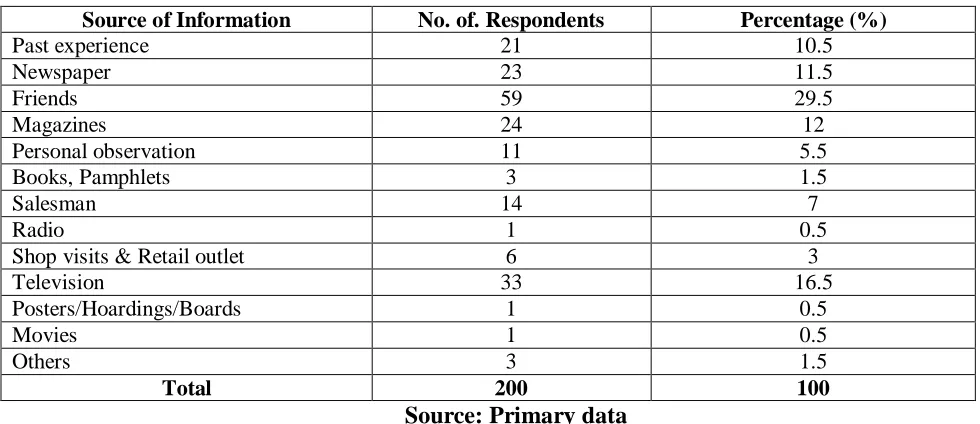
Classification of the Respondents towards the Source of Information
Source of Information No. of. Respondents Percentage (%)
Past experience 21 10.5
Newspaper 23 11.5
Friends 59 29.5
Magazines 24 12
Personal observation 11 5.5
Books, Pamphlets 3 1.5
Salesman 14 7
Radio 1 0.5
Shop visits & Retail outlet 6 3
Television 33 16.5
Posters/Hoardings/Boards 1 0.5
Movies 1 0.5
Others 3 1.5
Total 200 100
Inference
The above table reveals that 10.5% of the respondents receive information from the past
experience, 11.5% of the respondents are from newspaper, 29.5% of the respondents receive
information from friends, 12% of the respondents are from the magazines, 5.5% of the
respondents are from personal observation, 1.5% of the respondents are from books, pamphlets,
7% of the respondents are from the salesman, 3% of the respondents are from shop visit & retail
outlet, 16.5% of the respondents are from television, 0.5% of the respondents are from
poster/hoardings/boards, 0.5% of the respondents are from the movies and 1.5% of the
respondents receive information from the other sources.
Maximum 29.5% of the respondents receive information through the source of friends
and minimum 0.5% of the respondents receive information through posters, movies and radio.
Table - 7
The Respondents towards the Media of Advertisement
Source: Primary data
Inference
The above table inferred that 60.5% of the respondent’s media of advertisement is television, 13.5% of the respondent’s media of advertisement is newspaper, 15% of the
respondent’s media of advertisement is magazine, 10% of the respondent’s media of
advertisement is outdoor and 1% of the respondent’s media of advertisement is others.
Maximum 60.5% of the respondent’s media of advertisement is television and minimum 1% of the respondent’s media is other media.
Table - 8
The Respondents towards the Advertisement of Hero Motors
Feel of Advertisement No. of Respondents Percentage (%)
Interesting 48 24
Media of advertisement No. of Respondents Percentage (%)
Television 121 60.5
Newspaper 27 13.5
Magazine 30 15
Outdoor 20 10
Others 2 1
Informative 55 27.5
Induce to buy 19 9.5
Eye catching 25 12.5
Very attractive 30 15
All of the above 23 11.5
Total 200 100
Source: Primary data
Inference
The above table reveals that 24% of the respondents feels that the advertisement is
interesting, 27.5% of the respondents feels that the advertisement is informative, 9.5% of the
respondents feels that the advertisement is induce to buy, 12.5% of the respondents feels that the
advertisement is eye catching, 15% of the respondents feels that the advertisement is very
attractive and 11.5% of the respondents feels that the advertisement is all of the above.
Maximum 27.5% of the respondents feels that advertisement is informative and minimum
[image:10.612.64.554.69.156.2]9.5% of the respondents feels that it id induced to buy.
Table -9
Opinion of the Respondents towards the Appealing Media Media Appealing No. of Respondents Percentage (%)
Television 95 47.5
Newspaper 51 25.5
Magazines 42 21
Outdoor 12 6
TOTAL 200 100
Source: Primary data
Inference
The above table reveals that 47.5% of the respondent’s appealing media is television, 25.5% of the respondent’s appealing media is Newspaper, 21% of the respondent’s appealing media is magazines and 6% of the respondent’s appealing media is outdoor.
Maximum 47.5% of the respondents appealing media is television and minimum 6% of
the respondents appealing media is outdoor.
Table - 10
The Respondents Opinion on Channel of Advertisement Channel of Advertisement No. of Respondents Percentage (%)
[image:10.612.71.511.396.486.2]Sun 93 46.5
Jaya 13 6.5
Star Vijay 5 2.5
NDTV 19 9.5
Raj 1 0.5
Pothigai 1 0.5
More than one 46 23
Others 18 9
Total 200 100
Source: Primary data
Inference
The above table reveals that 2% of the respondents came across the advertisement at
Kalaignar TV, 46.5% of the respondents came across the advertisement at Sun TV, 6.5% of the
respondents came across the advertisement at Jaya TV, 2.5% of the respondents came across the
advertisement at Star Vijay TV, 9.5% of the respondents channel of advertisement is NDTV,
0.5% of the respondents channel of advertisement is Raj TV, 0.5% of the respondents channel of
advertisement is Pothigai TV, 23% of the respondents came across the advertisement at more
than one channel and 9% of the respondents have came across the advertisement in other
channels.
Maximum 46.5% of the respondents have seen the Hero Motors advertisement in Sun TV
[image:11.612.64.513.500.556.2]and minimum 0.5% respondents have seen the advertisement in raj and Pothigai channel.
Table - 11
The Respondents Opinion on Message of Advertisement Conveying Message No. of Respondents Percentage (%)
Yes 168 84
No 32 16
Total 200 100
Source: Primary data
Inference
From the above table it is inferred that 84% of the respondents reveals that the
advertisement is conveying message and 16% of the respondents reveals that the advertisement
is not conveying message.
Maximum 84% of the respondents say that the advertisement is conveying message and
FINDINGS:
The study consists of 200 Respondents, out of that 80.5% of the respondents belong to Male
and remaining 19.5% of the respondents are belonging to Female category.
Out of 200 respondents, 100% of the respondents come under the category of Advertisement
awareness.
Out of 200 respondents, 27% of the respondent’s occupation falls under student category.
Out of 100%, 35.5% of the respondents belong to the age group of 30 and above.
Out of 100%, 35.5% of the respondents earn a monthly income of 5000- 10000.
Out of 200 respondents, 100% are aware of the brand.
It is conclude that 100% of the respondents have seen the advertisement.
It is conducted that the felling of advertisement is like Informative.
Most of the respondents have come across the advertisement towards the media of television.
Out of 200 respondents, 47.5 % of the respondent’s opinion’s focus towards television
channel advertisement.
SUGGESTIONS :
The awareness of advertisement is at high level. So it must be still developed to sustain the position.
Some important decision wants to be made in models of advertisement and presentation because it makes some drawback in the advertisement.
Large improvement faculty wants to be made in advertisement campaign.
The advertisement through the newspaper, magazine and outdoor must be improved.
The advertisement must be improved and it must be attractive, so that it should be easily recalled at the time of making decision to purchase.
Some of the respondents feel that advertisement is not conveying the message, so the advertiser should concentrate on the message conveyance of the advertisement.
5.3 CONCLUSION
The two wheeler industry is all about impulse for buying and it is at almost importance
that the consumer gets the product and hence the maintenance of the advertisement takes a lead
role in determining the customer satisfaction status.
This research project which was primarily aimed at determining the effect at the various
attributes of the advertisement in determining the volume of sales in the outlet eventually arrived
at the fact that a clear demarcation cannot be made in identifying the factory influencing sales of
both the performance and the underperformance advertisement.
More emphasis should be given on the direct determinants of sales like the pamphlets, the
point of purchase items like the banners, stickers, name boards etc, the customer executives
should take due care to check whether articles reach the retail outlets and are displayed as per the
standards set by the company.
Bibliography Books
1. A Glossary Of Marketing Terms, 1960, P.19
2. Stanton.W.J (1971), “Fundamentals Of Marketing”, P.535
3. Russel. T., “Commercial Advertising”, pp-2-3
4. Tipper. H. “Advertising: Its Principles And Practice”, P-15
5. Colley.R.H.,(1961),“Defining Advertising Goods For Measured Advertising Results”,
6. A Glossary Of Marketing Terms, 1960, P-19
7. Presbery. F., “The History And Development Of Advertising”, P-2
8. Edward.C.D., “Advertising And Competition,” Business Horizon., Vol. IX No.1-P-59
9. Kleppner Otto, “Advertising Procedure”, P.39