VOLUME 3
April 1950
Number 2
In this Issue
Current and Future progress of the Range Society
F.G. Renner
91
Field Methods Used to Demonstrate Range
Conservation ... Horace L. Leithead
95
Effects of Different Intensities of Grazing on Depth
and Quantity of Roots of Grasses
J.E. Weaver
100
Range Condition and Soil Site Classification
by Helicopter
John Chohlis and Fred Schlots
114
Chemical Control of Undesirable Southern Hardwoods
R.S. Campbell and Fred A. Peevy
118
Management of Reseeded Ranges
Waldo R. Frandsen
125
Feeding Deer on Browse Species During Winter
Arthur D. Smith
130
Current Literature... Grant A. Harris
133
News and Notes ... ... ... 139
With the Sections... ... ... 143
Third Annual Meeting... ... ... 148
Published Quarterly by
CURRENT AND FUTURE PROGRESS OF
THE RANGE SOCIETY
Presidential
Address-Third
Annual Meeting
American Society of Range Management
San Antonio, Texas, January 10-12,
1950
F.G.RENNER
U. S. Soil Conservation Service, Washington 25, D. C.
F
ELLOW members of the American Society of Range Management-and friends. It is with a great deal of pleasure that I welcome you to the third annual meeting of our organization.The constitution of our Society pro- vides that the President shall deliver an address at the annual meeting. This pro- vision was made to insure that you would be fully appraised of all matters affecting your organization during the year. Only with this knowledge will you be in a position to further extend the influence of your Society, and aid and guide your officers in the management of its affairs. The primary purpose of my remarks here this morning is thus twofold,-to report to you on important developments during the year just past-and to call to your attention some of the problems now con- fronting the Society and on which it needs to formulate policy or take action.
A year ago your Council set out to expand and strengthen the Society and to build even stronger the foundations laid by its founders and first officers. This was clearly a necessity if we were to carry on the affairs of the Society and continue to publish a creditable Journal. I am very happy to report to you that material progress has been made toward this end.
Along with the other progress we have made during the past year, the Society has attained increased recognition in na-
tional affairs. The Society has joined the Natural Resources Council of America. At the invitation of the American Society of Animal Production, we held a joint meeting with them at Pullman, Washing- ton in June. The Secretary-General of the United Nations extended an invita- tion to us to send a representative to the world-wide meeting of conservationists at Lake Success, August 17 to September 6. The Pan American Union asked us to recommend a member to an important conservation award Board that agency has established. These are but some of the examples of the enlarging horizons of your Society.
The Society has added nearly seven hundred members to its rolls, barely fall- ing short of attaining twice the 753 mem- bers we had a year earlier. I think we can take considerable satisfaction in this. I feel that we can be gratified also over the two groups of our members who are among those showing the largest per-cent- age of increase. These are STUDENTS, who are just starting their careers in range work; and RANCHERS, whose experi- ence furnishes the final test of the sound- ness of the facts developed by the science of our profession.
92 F. G. RENNER
zation. Do we want to hold our Society to its present size, or do we want 2,000, 4,000 or 10,000 members? The decision is up to us.
We should recognize that there are dis- advantages that all large organizations must face. Chief among them is the fact that as they grow in size, the interests of their members tend to diverge. Beyond a certain size, our Society might find itself unable to take a position on many b questions because of the divergent in- terests and viewpoints of its members.
On the other hand, divergent view- points are likely to provoke thought and discussion, and thereby lead to progress. They might stimulate the Society to at- tempt to meet a greater variety of prob- lems, and consequently enable it to grow in responsibility and influence. Moreover, an increased membership would permit more frequent issues of the Journal, pro- vide the financial resources to allow us to sponsor certain worthwhile projects, and enlarge the influence of the Society in public affairs.
We need to decide how large an organi- zation we want. Of even greater import- ance, we need to plan how best we can maintain the interest of the members, increase their participation in Society af- fairs, and meet their needs. This is the real challenge.
The financial position of your Society has been materially improved. Our “cash on hand” has grown from $2,841 on Janu- ary 1, 1949 to $6,578 on January 1, 1950. This is largely, of course, a result of the material increase in membership. It is due partly, however, to the’ fact that all officers, but especially the Editor and Treasurer have served with out pay and have given so freely of their time in the discharge of the increasingly burdensome duties of their offices. The Editor has available the services of the Editorial Board to relieve him of many of the
chores of his position. Moreover, con- siderable honor and recognition comes to the Editor from having his name on the masthead of the Journal. With the present size of our membership, it is, however, too much to expect that the many hours of work required to maintain the neces- sary records, to send out the repeated dues notices, and to receive and properly account for all funds, can continue to be furnished gratis. The Society should be prepared to make a reasonable pay- ment for the services received from its National Treasurer and at its meeting yesterday, the Council approved a pro- vision for such a payment in the 1950 budget.
A year ago the finance committee rec- ommended, and the Society approved, the granting of “Life Memberships” to members upon an advance payment of One Hundred Dollars. Thirteen members of the Society have taken advantage of this provision, thus providing a special reserve fund of $1300. It is the intent of the Council that this fund shall not be used for current operations of the So- ciety, or of the Journal. The Council, however, has approved the recommenda- tion that the annual income from this reserve may be used for special purposes. This might take the form of an award to the author of the best article in the Journal, during a given year. It might be awarded as a prize to a graduate student for outstanding research, or used for other projects that in the opinion of the Council will advance the objectives of the Society. Recommendations for the use of the in- come from this reserve might well ema- nate from the Local Sections after con- sideration by their members.
CURRENT AND FUTURE PROGRESS OF THE RANGE SOCIETY 93
developed programs which will help bind us more closely together and further ex- tend our influence. Two others are in the process of organization, and when ap- proved, will increase to nine the number of Ilocal Sections.
The Local Sections are important seg- ments of our organization. They are fre- quently closer to actual problems con- fronting our members than are your national officers. The Local Sections, moreover, offer an effective means of mar- shalling the judgement of a large number of members on matters affecting the So- ciety. Means should be sought for making use of that judgement in the formation of Society policy and the direction of its affairs.
The Council held two meetings during the course of the year-the first immedi- ately following the last annual meeting of the Societ,y, and the second just pre- ceding this meeting. In addition, we “met” through the United States mails on nine different occasions to consider problems concerned with the management of the Society. Some of the matters con- sidered required immediate action which t)he Council took, pending the time when they could receive more general considera- tion by the membership of the Society. I shall mention some of these here that you may be prepared to discuss them ‘later in our business meeting, should this ap- pear desirable.
Our const,itution provides that “the Council may annually assign, from the funds of the Society, to each Local Sec- tion, a sum varying in proportion to its needs not to exceed one dollar for each member belonging to that) section”. This provision, which is permissive and not mandatory, has been interpreted in a number of ways by the Local Sections. One requested that it be reimbursed for certain expenses incurred in connection with its organization. Another encouraged
the formation of a Local Section by in- forming members that the full amount of one dollar might be expected from the Society’s national treasury for use in carrying on the affairs of the Section. Other Local Sections made no such re- quests but met their own expenses.
The Council adopted the policy of dis- couraging such requests. There were sev- eral reasons for this action. First, it was considered important to avoid any ex- penditures that might lead to an increase in our present annual dues. Moreover, it was necessary to avoid adding to the duties of the already overworked Treas- urer. Some Sections appeared willing and able to finance their own operations and the Council felt that all should be treated alike. In addition, the Council was anx- ious to build up a financial reserve which would permit an early increase over the present number of four issues of the Journal per year. The Council now has proposed that the constitution be amended to eliminate the provision quoted above, in the meantime adhering to its policy of discouraging requests for such financial aid. This matter needs to be considered by the membership.
94 F. G. RENNER
amendments to all members, and afi- proval of two-thirds of those voting. Our old by-laws, on the other hand, could be amended by a two-thirds vote of those in attendance at an annual meeting of the Society-or could be referred to the entire membership with a majority vote only required for approval. The Council recom- mends the adoption of the Articles of Incorporation with the more strict amend- ment provisions of the old constitution. This will require approval of the mem- bership.
During the past year, the Society, through the Council, has taken no action on important issues of the day, although it is recognized that many of these con- cern the welfare of the Nation’s grazing lands and therefore are of direct interest to us as an organization. It is felt that such issues should first be thoroughly con- sidered in the meetings of our Local Sec- tions and the position of the Society de- termined by the combined weight of their judgement. When this action has been taken, the Society should not hesitate to make its influence on such issues felt.
In summary, we need (1) constantly to seek means by which we can measure up to the responsibilities we have been granted and continually look for ways in which we can extend our influence and attain the objectives laid down by our founders; (2) we need to determine how large an organization we want and plan how best we can meet the desires and need of all our members; (3) we should take the necessary action to formally ap-
prove our Articles of Incorporation; (4) we need to develop recommendations for the use of the income from our Life Mem- bership “reserve”; (5) we need to give further consideration to the matter of financial relationships between the Na- tional Society and the Local Sections, and adopt a plan that will be equitable to all members; (6) we need to increase the number of Local Sections and devise ways in which they may participate in the formation of Society policy and in the direction of Society affairs; and (7) crystallize our opinion on important public issues affecting the welfare of the Nation’s grazing resources and become prepared to bring the influence of the Society to bear on such problems.
Field Methods Used to Demonstrate
Range Conservation
HORACE L. LEITHEAD
District Conservationist
,
Soil Conservation Service, Marja, TexasT
HE energy with which a farmer orrancher applies his range conservation program is likely to be in direct relation to his understanding of it. And his under- standing, likewise, is apt to depend more on what he has seen than on what he has been told. Methods used to give a man this understanding through “seeing” are usually called visual aids.
The rancher naturally wants to know immediately what he can do to get his range in higher condition.
“But what can I do without rain?” he asks. “It hasn’t rained enough to make my grass head out.”
The grass, it is usually safe to say, did not head out because the range was too depleted to make use of the rain that fell. The landowner wants to know why the amount of grass his land produces is not in proportion to the rain he gets. It is easy to point out that the grass produced may be due to the condition of the range, and to the ease with which the soil can absorb moisture and make it available to plants. Soil texture and soil moisture have a bearing on the amount of moisture the soil can take up and hold. The depth of the soil is important, too. But it is easier to show this than to tell it. Take a “sharp- shooter” spade and dig around in several spots to see what the soils are like.
In a valley the soil is deep. Feel the texture-see how fine it is. Soil moisture is held as a film around these tiny par- ticles. It takes two to three inches of water to wet soil like this as much as a foot in depth. On the other hand, a coarse soil requires less than an inch of moisture to wet it a foot down. The finer the soil
the greater the holding surface for the film of moisture.
Select a plot where the range is excellent. Usually the soil here is darker in color than it is on poor condition ranges. That means there is more litter and organic matter-the living and dead plant matter, animal life and humus. The decay of grass roots, leaves, and the for- mation of humus improves the fertility, the physical condition and the water- holding capacity of the soil. The rate of water intake and storage capacity of any soil type can vary with the amount of organic material in the soil.
For any range site, it is recognized that certain combinations of plants largely de- termine range condition. It is only when a range is managed in such a way as to build up plant vigor and to return organic matter to the soil that we can expect the combination of plants known as climax vegetation or range in excellent condition to become established.
Just after a rain is a splendid time to show how range condition makes a big difference in moisture infiltration. Where a fence divides different range condition classes is a good place to show this. Use the sharpshooter spade again. Dig holes to show the depth of moisture penetra- tion.
In May of 1948, after a two-inch rain at Marfa, Texas, Soil Conservation Service range men and a group of ranchmen checked a site where a fence divided range in good and fair condition. They found that on the range in good condition the soil was wet to a depth of 30 inches. Across the fence that same amount of
96 HORACE L. LEITHEAD
rain had penetrated the soil only two inches. Three weeks later the grasses were starting to head out on the range in good condition, while on the other side of the fence, the grass had grown up about two inches and had burned up for the lack of moisture.
If a range technician is working with a rancher or a group and there is no rain to permit this demonstration of soil-moisture
I/S * “00s s- LONS AN0 AoUstAsLC.
‘d
FOR o.LI,R.IIO* 7 ss4 CU. MC”LI 0” It,., co L0Ul.S .I INO” I” lo 1°C” “MS.
VIEW W PARTS ARRANGED FOR USE
FIG. 1. Concentric rings for making soil in-
filtration rate determinations.
relationship, there is another demonstra- tion that can be used. Infiltration rings,
as shown in Figure 1, will demonstrate
how fast different soils can absorb mois- ture.
These iron rings of 10 or 12 gauge black
iron can be driven into the ground two or three inches so that water cannot seep
out from under them. A board with two
nails in it may be laid across the rings so that one nail is in the middle of the center ring and the other halfway between the
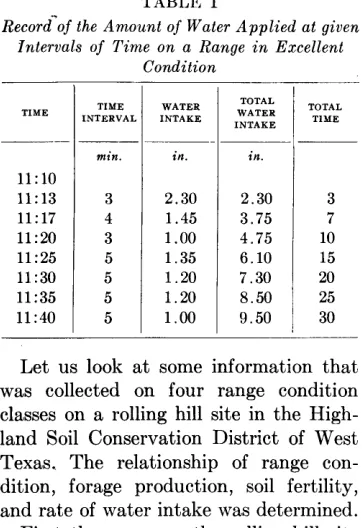
inner and outer rings. The nails should be adjusted so that the points are two inches above the ground. From a one-gallon glass jar or similar vessel calibrated in tenths of inches with the size of the inner ring, water is applied to the inner ring. The vessel should hold two inches of water, the initial application. At given intervals water is added to both rings to bring the water level up to the points of the nails. Time and amount of water applied to the inner ring are recorded, with the time interval between applications. Water is applied to the outer ring to compensate for the lateral movement of moisture in the soil, but no measurement of this is necessary.
Single rings may be used on field tours to show trends in infiltration rate. Double rings are more accurate because lateral penetration of moisture is avoided.
Those who see this test can readily understand the meaning of Table 1.
TABLE I
Record-of the Amount of Water Applied at given Intervals of Time on a Range in Excellent
Condition
TIME
11:lO 11:13 11:17 11:20 11:25 11:30 11:35 11:40
TIME WATER INTERVAL INTAKE
min.
3 4 3 5 5 5 5
in.
2.30 2.30 3
1.45 3.75 7
1.00 4.75 10
1.35 6.10 15
1.20 7.30 20
1.20 8.50 25
1.00 9.50 30
TOTAL WATER INTAKE
in.
TOTAL TIME
Let us look at some information that
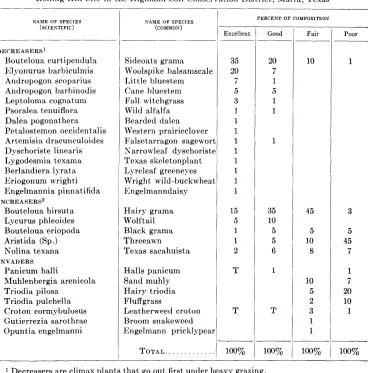
was collected on four range condition classes on a rolling hill site in the High- land Soil Conservation District of West Texas. The relationship of range con- dition, forage production, soil fertility, and rate of water intake was determined.
FIELD METHODS USED TO DEMONSTRATE RANGE CONSERVATION
TABLE 2
Range Condition
97
Rolling Hill Site in the Highland Soil Conservation District, Marfa, Texas
NAME OF SPECIES NAME OF SPECIES
(SCIEKTIFIC) (COMMON)
DECREASERS’
Bouteloua curtipendula Elyonurus barbiculmis
Andropogon scoparius
Andropogon barbinodis
Leptoloma cognatum Psoralea tenuiflora Dalea pogonathera
Petalostemon occidentalis
Artemisia dracunculoides
Dyschoriste linearis
Lygodesmia texama
Berlandiera lyrata Eriogonum wrighti Engelmannia pinnatifida INCREASERS~
Bouteloua hirsuta Lycurus phleoides Bouteloua eriopoda Aristida (Sp.) Nolina texana INVADERS
Panicum halli
Muhlenbergia arenicola
Triodia pilosa Triodia pulchella Croton cormybulosus Gutierrezia sarothrae Opuntia engelmanni
Sideoats grama Woolspike balsamscale Little bluestem Cane bluestem Fall witchgrass Wild alfalfa Bearded dalea Western prairieclover
Falsetarragon sagewori
Karrowleaf dyschoristc
Texas skeletonplant Lyreleaf greeneyes Wright wild-buckwheat Engelmanndaisy
Hairy grama Wolftail Black grama Threeawn Texas sacahuista
Halls panicum Sand muhly Hairy triodia Fluff grass
Leatherweed croton Broom snakeweed Engelmann prickIypear
TOTAL. . .
Excellent Good Fair Poor
35 20 7 5 3 1 1 1 1 1 1 1 1 1 15 5 1 1 2 T T 100% 20 7 1 5 1 1
10 1
1 35 10 5 5 6 1 45 5 10 8 T __--- 100% 10 5 2 3 1 1 3 5 45 7 1 7 20 10 1
100% 100%
PERCENT OF COMPOSITION
1 Decreasers are climax plants that go out first under heavy grazing.
2 Increasers are climax plants that increase temporarily and later decrease under heavy gran- ing.
was divided into four range condition classes (Table 2) based largely on the kinds of plants making up the forage cover. The most valuable plants occurred on range in excellent condition, whereas the least valuable plants occurred in abundance on the range in poor condition.
Analyses of these soils give the percent of organic matter for each range condition class as :
Excellent Condition ...
Good Condition ...
Fair Condition ...
Poor Condition. ...
4.6 3.8 3.6 2.1
98 HORACE L. LEITHEAD
on these four range condition classes in August, 1947, with an
perature of 90” were:
atmosphere tem-
Excellent Condition. ... 104”
Good Condition ... 110”
Fair Condition ... 114”
Poor Condition ... 120”
A soil thermometer helps to show how range condition affects soil temperatures. Moisture lost through evaporation in- creases as soil temperatures increase, thus reducing the amount of moisture available for plant growth.
The relation of the amount of surface litter and other vegetation to the rate at which moisture soaks into the ground is extremely important. This cover breaks the force of falling rain. It increases pene- tration, thereby reducing runoff. The in- creased penetration pays off in higher plant and animal production.
Water was applied by using infiltration
5 IO 15 20 25 30 Minutes
FIG. 2. Rate of range condition.
water intake as influenced bY
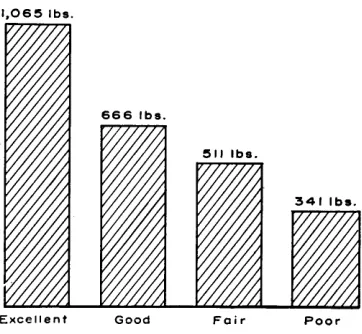
*To check forage production on each range condition class a two-foot quadrat can be laid out. The vegetation inside the quadrat is clipped and weighed. Results of one such comparison are shown in
Figure 3. Litter in this same quadrat was collected and weighed to find out how much was being returned to the soil to decay and be incorporated as humus. These weights (Fig. 4) reflect an accumu- lated amount of litter and not the exact amount being returned in any one year.
1,065 Ibs.
341 Ibr.
Excellent Good Fair Poor
FIG. 3. Pounds of air dried vegetation pro- duced per acre on rolling hill site according to range condition class.
726 Ibs.
Excellent Good
FIG. 4. Pounds of litter per acre on hill site according to range condition.
Fair Poor
rolling
Grass production can be increased sev- eral times by properly managing a range to bring it back to excellent condition.
FIELD METHODS USED TO DEMONSTRATE RANGE CONSERVATION 99
condition. Simple methods can be used to for detail planning on a large number of help everyone understand conservation individual ranches. This results in more problems and treatment. These methods, conservation plans developed and applied, of course, can be used more effectively with the same manpower. Ranch planning with groups than with individuals. Work- requires time and hard work, and the ing with groups means spreading informa- planner, as well as the ranchman and the tion more quickly, thereby allowing time public, wants results.
PRESIDENT TRUMAN SPEAKS ON SOIL CONSERVATION
In his address to the Congress on the State of the Union, on January 4,1950, President
Truman said, in part:
“If we are to achieve a better life for all, the natural resources of the country must be regarded as a public trust. We must use our precious assets of soil, water, forest, and
grassland in such a way that they become constantly more productive and more valu-
able.”
Effects of Different Intensities of Grazing on
Depth and Quantity of Roots of Grasses1
J. E. WEAVER
Professor of Plant Ecology University of Nebraska, Lincoln, Nebraska
T
HE writer has been interested inprairies, pastures, and root depth and distribution over a period of many years. He had the privilege of examining these relationships in the Palouse prairie of Washington long ago while numerous rep- resentative areas still remained in a virgin condition (5, 6). Extensive studies have been made in the hardlands of Colorado, Kansas, and Nebraska many years be- fore, during, and following the great drought of 1933-40 (7, 8, 1, 11). Vegeta- tion and root habits have been studied in sand hills (7,8,4), in bluffs of wind-blown loess (1‘2), and wet soils of lowland. The trench and hand pick method was em- ployed throughout and roots in prairie and pasture were measured, compared, and sketched in the field. Their depth, spread, and chief characteristics were re- corded. Only general consideration was given to soil type. At that time there was no method of quantitatively comparing one root system with another or the roots from one soil with those of the same species from a different soil. The need for such a method has been felt for a long time and lack of one that could be put into general use has probably greatly re- tarded root studies.
This paper is concerned with a new quantitative method of studying root-soil relations and particularly its application to the effects on the underground plant parts brought about by grazing. The
l I Contribution No. 155 from the Department of Botany, University of Nebraska. This study was aided by a grant from the University Research Council, University of Nebraska.
The monolith is marked out on the vertical trench wall directly beneath a representative bunch or sod of grass to be studied. With appropriate knives and spades the soil at the sides and beneath the monolith is removed to such a distance into the wall that the column of soil protrudes at least 3 inches into the trench. The monolith is tightly incased in a special open box or frame before it is cut from the trench wall and taken to the laboratory. This prevents cracking of the soil column and breaking of the roots. The soil is removed from the box by a process of repeated soaking, often for sev- eral days, and gentle washing, mostly under water. This is accomplished even when the soil is extremely compact or contains a claypan. During this process one may study the intimate relations of soil and roots. Roots remain unharmed and in their natural position in the water after the soil has been washed away. They are mounted on black felt cloth and pho- tographed. They may then be sectioned in such a manner that the dry weight of 100
EFFECTS OF INTENSITIES OF GRAZING ON ROOTS OF GRASSES 101
the root-mass at O-6 inches, 1 to 2 feet, or at any other soil depth may be ascer- tained. A brief description of the met hod is given in Science (16) and a more de- tailed one in Ecological Monographs (17). By this method many range grasses in numerous soil types have been st,udied (20).
DEGENERATION OF PRAIRIE A survey of prairie vegetation in eastern Nebraska, western Iowa, and contiguous portions of the four adjacent states was made in 1928-33 (18). The manner in which prairie degenerated under grazing into various types of pastures was also observed. The native pastures in this 60,000 square-mile area were classified into four distinct types according to the degree of degeneration . of the native vegetation (19).
Briefly, the excellent or high-grade pas- tures consist almost entirely of climax grasses well liked by livestock. These are chiefly little and big bluestem, _4ndro-
pogon scoparius and A. jur&ztus. But
needle grass (Stipa spartea), prairie drop- seed (Sporobolus heterolepis) , numerous other grasses, and a host of legumes and other herbaceous plants (forbs) occur.
In the good or medium-grade pastures Kentucky bluegrass (Poa pratensis) or short grasses-blue grama (Bouteloua gra-
c&s) and buffalo grass (Buchloe dactg-
Zoides)-or alternating areas of these equal or exceed the usual prairie species. They form the background or matrix of the vegetation. The original prairie species are clearly on the decline, although still abundant. The cover of grass is yet well intact.
The fair-grade pasture differs from the preceding in having a practically pure stand of bluegrass or short grass. Little bluestem has usually disappeared. In the best pastures the cover may be well intact
but frequently it is broken. Both perennial and annual weeds are ,abundant .
In poor or low-grade pastures, areas of grass alternate frequently with bare ground or soil clothed only with weeds. Prairie forbs, with few exceptions, have disappeared. Both bluegrass and the short grasses are so severely grazed that t’he stand is thin. Many places are trampled bare. The cover is open almost every- where.
These pasture types are easily recog- nized. They have the same general appearance throughout this very large tract of true prairie. Over most of the area the pastures are small (40 to 80 acres), uniformly grazed, and usually con- tain only a single pasture type. But in larger ones, where distance to water is greater, two or even three types may occur. Unlike the preceding they do not stop at the fence line, but one grades gradually into the other. It was in such a range that the studies on amount and distribution of roots were made.
TIIE: PASTURE
102 J. E. WEAVER
ravines which must be crossed by the livestock.
Grazing began in this prairie in 1903, although hay was cut, in fall where grazing had been light (usually in the north end) and the topography permitted. Originally the vegetation was similar in all part,8 of the pasture, the cover being Ias dense, of course, on the ridges. But after several years of grazing it became clear that pro- duction in the south part was declining.
for each 2.54 acres. This is far greater than that recommended by experienced cattle- men, which is 5 to 7 acres per animal unit (2). Grazing began between April 15 and May 10, and ended late in October. The horses, however, hnd access to the pasture all winter. Since thiv heavy stock- ing was more or less concentrated in the south end of the pasture, it could result only in overgrazing and deterioration of this part.
This occurred bwause grazing wu nh~\-ays more intense in that area, adjacent to the farmyard vhere vater and salt could be obtained. The pasture has nerw been partitioned by fences. The rate of st,ock- ing in the past 47 years has been xwy constant according to the owxr, Mr. It. .J. Hack, irrespective of seasonal growth of vegetation, markets, etc. About 100 ani- mal units of cnttlc and 14 of h&es were carried each year. The rate is one animal
EFFECTS OF INTENSITIES OF GRAZING ON ROOTS OF GRASSES 103
2 percent of the cover.2 The soil mulch was heavy.
In medium-grade pasture little blue- stem had decreased to 19 percent and big bluestem to 10. But bluegrass had cor- respondingly increased to form nearly half (45 percent) of the cover. Side-oats grama
(Routeloua curtipendula) composed 7 per-
cent and purple lovegrass (Erugrostis spec-
tabilis) about 9 percent of the cover.
About 3 percent was forbs. A moderate soil mulch occurred.
Composition of the lower grades of pas- ture (fair to poor) was much more vari- able. Little bluestem and many other climax grasses had disappeared and nu- merous weedy grasses had invaded. The forb population (mostly of weeds) com- posed 11 percent of the vegetation. The soil mulch was light, sometimes there was none. Where the roots were excavated nearly all of the vegetation was bluegrass and blue grama.
ROOT SYSTEMS FROM THE SAME SOIL IN THREE GRADES OF PASTURE
The first monolith was taken on a typi- cal north slope in the high-grade part of the pasture. The sample was selected according to the average composition of the vegetation in this part. The sample was mostly little bluestem but also in- cluded about 15 percent big bluestem. Smaller amounts of bluegrass, side-oats grama, and other species were present (Fig. 2). The thorough occupation of the soil by the roots, especially the upper soil, and their uniform decrease with depth is representative of this type of vegeta- tion which has been examined in many places. Above ground the bluestems were 10 to 14 inches high when the monolith was taken, about June 5, 1949.
In the mid-grade pasture a typical area
2 Data from unpublished Master’s Thesis by L. G. Butler, University of Nebraska, 1948.
was selected on a mid-slope with a north- ern exposure. About half of the area was occupied by bluegrass. Much of the re- maining little bluestem had been more or less weakened by prolonged grazing. Hence this monolith was taken so as to include about half bluegrass and portions of both a vigorous and a weakened bunch of little bluestem as well (Fig. 3).
The soil in the two trenches dug to secure the root samples varied but little, as did also that from a third excavation in low-grade pasture. The description of this Carrington silt loam is from the mid- grade type. It is given here since it has recently been ascertained that the nature of the soil profile often has a profound effect upon the distribution of roots in the soil. For example, percentage of the weight of the root system of big bluestem occurring in the surface 6 inches has been found to vary from 63 to 80 in Crete silt loam and Crete silty clay loam, respec- tively. In some soil types with a claypan, roots of western wheatgrass (Agropyron
smithii) below the compacted layer (B
horizon) may branch so greatly that their weight is a third greater than that of roots in a similar volume of soil in the B hori- zon (17).
The upper part of the soil to a depth of 28 inches appears to have developed from a thin layer of loess. Below 28 inches the parent material apparently is part of an old soil that was developed largely from Kansan glacial till. Below 38 inches all of the soil material appears to be weathered from glacial till. It contains small pebbles and grit mixed with clay and silt in varying proportions. Nowhere in the first five feet was any calcium car- bonate in evidence.3
106 J. E. WEAVER
Hor-
izon Depth, in.
AI 0 -4
4 -10.5
in the A horizon (0 to 10.5 inches depth) and 15 percent in the B horizon (10.5 to 60 + inches).
BI 10.5-15.5
Bz 15.5-28
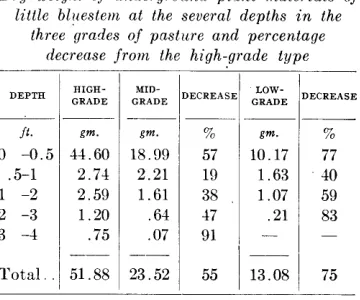
Dry weight in grams of underground plant material at the several soil depths in three
grades of pasture and percentage decrease from the high-grade type
28 -38
Description (Color of soil when dry)
Dark grayish brown fine gran- ular heavy silt loam; pH (with Soiltex) 6.5
Slightly lighter grayish brown
heavy silt loam; granular ;
pH 6.5
Dark grayish brown silty clay loam; granular; pH 6.5
Pale brown coarse granular
silty clay; with a tendency to
cleave vertically; pH 6.5
Brown and mottled light gray to yellowish brown heavy silty clay loam; strongly prismatic
breaking down into half-inch
sharply angular blocks; pH
6.5
DEPTH HIGH- hfID-
GRADE GRADE
0 -0.5
38 -48 Brownish yellow, mottled with
brown and light gray heavy
sandy clay or clay with
pebbles ; pH 7.0
Mottled light gray heavy clay
loam with pebbles; not so
heavy as horizon above; mas- sive; pH 7.5
.5-l 1 -2 2 -3 3 -4
Total
C 48 -60
In the low-grade pasture bluegrass and blue grama, except for weeds, clothed large portions of the soil. A trench was dug and a monolith secured on a hillside in such a manner as to include about half bluegrass and half blue grama. No little bluestem was present here (Fig. 4).
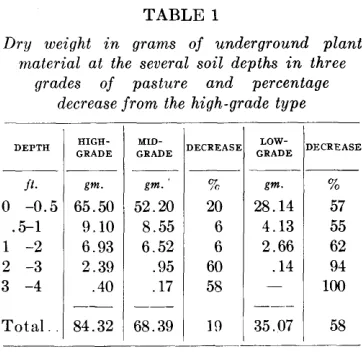
Comparison of figures 2,3, and 4 shows remarkable changes in root depths in the three grades of pasture. As the native mid and tall grasses weakened and died and were replaced by low-growing blue- grass and blue grama, both depth of soil occupied by roots and the amount of root material decreased greatly. Oven-dry weights of roots and percentage decrease at each soil level are shown in Table 1. Distribution of the roots followed the usual pattern for little bluestem. Weight of roots decreased rapidly but regularly with depth and no visible irregularities were caused by changes in the soil pro- file, which were also gradual. About 85 percent of the total root weight occurred
TABLE 1
m. gm. ’ 5%
65.50 52.20 20
9.10 8.55 6
6.93 6.52 6
2.39 .95 60
.40 .17 58
-_I
84.32 68.39 19
I )ECREASI GRADE LOW-
gm. 28.14 4.13 2.66 .14 --- 35.07
D bECREASE
7% 57 55 62 94 100 58
The chief cause of the greater weight of materials in the surface O-O.5 foot com- pared with that of the second layer is the great abundance of stem-bases and rootstocks near the soil surface. These often equal the weight of the roots. They, of course, are lighter in worn-down blue- stems, and especially in bluegrass and blue grama. But the roots at all depths decreased greatly and especially those in the third and fourth foot. Here losses of 60 to 100 percent were found. Decrease in total dry weight of root systems, was also very marked, at first it was 19 and then 58 percent. Loss of yield of 50 percent in the annual forage crop has been as- certained when bluestems are replaced by bluegrass (13). Loss of roots in the deeper soil or death of all the roots in this part results in a much restricted volume of soil from which water and nutrients may be absorbed.
low”. The total wight of roots \n,s only 28.15 grams. IIere again nil but n \wy few roots were found in the surfncc 2 feet of soil. Conversely, the root-weight has been found to be greater elserhew, cs- pecinlly in deep lowland soil. Monoliths were taken in the high-grade pasture on low, lcvcl land ncnr Lincoln. ThP rich, deep, alluvial soil VW \Vabash silt loam and the grass namined was big blucstem. Here the roots made a \wmlrrful dcvrlop- ment in the first t,hrer feet of soil, and many penetrated to (i frrt in depth. The total root-weight was 91.15 grams. This exceeds the weight in the upland sample
EFFECTS OF INTENSITIES OF GRAZING ON ROOTS OF GRASSES 109
The bluestem was in a very vigorous sample the roots were not only fewer than condition. A second bunch was selected in the first but also finer. Their diameter in the mid-grade area. Apparently it had was only a half to a third as great. Some been grazed closely for at least two years. dead roots were found. In the third sample There was only a little debris left from differences were even more marked. preceding years. The individual tufts com- Branches were fewer, many roots were posing the bunch were abundant but more dead, and debris from decaying root’s was or less separated by bare spaces; hence abundant. There were no roots in the the crown was somewhat open. The third fourth foot. They were 83 percent less clump was from a portion of a low-grade in the third, compared with the high-grade area where little bluestem still persisted sample, 59 in t’he second foot, and 40 per- but in a much weakened condition. The cent in the second six-inches. This same bunch was very open, much bare soil was sequence of decreasing weight occurred exposed because of this and the lack of in the second sample. Thus, it seems clear a good mulch. The individual tufts of that root deterioration is from the tips grass were short and much stunted. Many
fragments of dead tufts were present. A TABLE 2
monolith of soil 12 inches wide and 4 Dry weight of underground plant materials of feet in depth was taken directly below little blylestem at the several depths in the each bunch. After the roots were freed three grades of pasture and percentage of soil each root system was photographed 7 decrease from the high-grade type
(Fig. 5). DEPTH
Decrease in the density of the root- ~
HIGH-
GRADE MID-
GRADE DECREASE LOW-
GRADE DECREASE
mass at all levels from the high-grade fit. to the low-grade pasture is clearly evi-
dent. The roots were almost 5 feet deep
‘. ,y. 5 1 _2 in the first sample, about 4 feet in the 2 -3 second, but they extended to only about 3 -4 3 feet in the third. The dense crown of the
first sample was separated only with much Totn1 difficulty in washing away the soil. The
sm. gm. % m.
44.60 18.99 57 10.17
2.74 2.21 19 1.63
2.59 1.61 38 1.07
1.20 .64 47 .21
.75 .07 91 -
51.88
- 23.52 _ 55 13.08
%
77 10 59 83
more open crown of the second bunch was easily torn apart, while the third was so nearly decayed that it fell apart as the soil of the soaked sod was washed away (Table 2).
The high weight of the first sample in the shallow soil is characteristic of this species and is due in a large measure to the weight of underground stem-bases and short rootstocks. Decrease in weight at all depths in the second sample is very great. The weight, compared with that of t)he first sample, decreases regularly with depth from 19 to 91 percent (Table 2). Total weight of the second sample was 55 percent, less than the first. In the second
upward toward the crown. This sequence has been noted several times and the actual process was observed in Sudan
’ grass as a result of frequent clipping (3).
110 J. E. WEhvEn
EFFECTS OF IKTEKSITIFS OF GRAZING OK IKlcmS OF GR.usES 111
112 J. E. WEAVER
sequently open as in figure 5, but a mod- erately thick new growth was about 2.5 inches high. The third bunch was from a much abused, low-grade pasture on similar soil. The central part of the bunch was dead; only a few weak shoots 0.5 to 1.5 inches tall grew on the periphery. The thin stand and weak plants were also similar to those in figure 5.
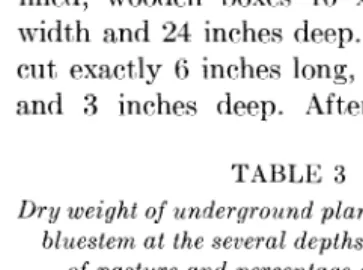
The sods were transplanted into fertile well-watered soil in good tilth in metal lined, wooden boxes 10 x 10 inches in width and 24 inches deep. Each sod was cut exactly 6 inches long, 4 inches wide, and 3 inches deep. After 6 weeks’ of
TABLE 3
Dry weight of underground plant materials of big bluestem at the several depths in three grades
of pasture and percentage decrease from that in the high-grade area
DEPTH HIGH- MID-
GRADE GRADE DECREASE
_ft. km. iv* %
0 -0.5 28.70 13.55 53
.5-l 3.72 2.53 32
1 -2 2.60 1.89 27
2 -3 1.19 .59 50
3 -4 .46 .20 57
Total. .
-- --
36.67 18.76 49 LOW- GRADE gm. 7.05 1.15 .95 .29 .14 -- 9.58 DECREASE % 75 69 63 76 70 76
growth one side of each box was removed and the soil was carefully washed from the roots. Then both tops and roots were photographed (Fig. 7). The dry weight of the new tops was 30.22, 12.89, and 1.87 grams, respectively. Dry weight of new roots below the old sod was 4.70, 1.72, and 0.33 grams in the same order, a ratio of 14 to 5 to 1. Roots were progressively thinner with decreasing vigor.
Experiments wit’h big bluestem and several other species of pasture grasses gave similar results, all showing the evil effects of overgrazing. Dry weight of tlops produced by weakened plants was 32 tlo 84 aercent less than that of slants
10. ---- 1947. Rate of decomposition of roots and rhizomes of certain range grasses in undisturbed prairie soil. Ecol-
A A ogy 28 : 22 l-240.
which had good to fair vigor. New roots were always shorter and less branched, and dry weight was 28 to 94 percent iess than that of vigorous plants of the same species. Just as the forage yield may be increased by good pasture management, so too the root systems of the grasses will be improved somewhat in proportion. A good top that produces much nutri- tious forage and a good root system that can withstand drought and store much food for early growth in spring go hand in hand. A depleted range of non-vig- orous grasses is usually also one in which the root systems are absorbing water and nutrients only in the upper portion of the soil.
LITERATURE CITED
1. ALBERTSON, F. W. 1937. Ecology of mixed
prairie in western Kansas. Ecol. Monog. 7 :481-547.
2. ALDOUS, A. E. 1938. Management of Kansas
bluestem pastures. Jour. Amer. Sot. Agron. 30 :244-253.
3. PERALTA, F. 1935. Some principles of com-
petition as illustrated by Sudan grass, Holcus sorghum sudanensis (Piper) Hitch. Ecol. Monog. 5:355-404.
4. TOLSTEAD, W. L. 1942. Vegetation of the
northern part of Cherry county, Xe- braska. Ecol. Monog. 12:255-292. 5. WEAVER, J. E. 1915. A study of the root
systems of prairie plants of southeastern Washington. Plant World 18 :227-248,273- 292.
6. ---- 1917. A study of the vegetation of sout8heastern Washingt’on and adjacent Idaho. Univ. Studies, Univ. Neb., Lin- coln, 17 (1): 1-114.
7. ---- 1919. Ecological relations of roots. Carn. Inst. Wash. Pub. 286.
8. _-__ 1920. Root development in the grassland formation. Cam. Inst. Wash. Pub. 292.
EFFECTS OF INTENSITIES OF GRAZING ON ROOTS OF GRASSES 113
11. ----, AND F. W. ALBERTSON. 1943. Re- survey of grasses, forbs, and underground plant parts at the end of the great drought. Ecol. Monog. 13:63-117.
12. ----, AND W. E. BRUNER. 1948. Prairies
and pastures of the Dissected Loess
Plains of central Nebraska. Ecol. Monog. 18 : 507-549.
13. ----, AND R. W. DARLAND. 1945. Yields
and consumption of forage in three pas-
ture types; an ecological analysis. Neb.
Conserv. and Surv. Div. Bul. 27.
14. ---. AND --- 1947. A method of
measuring vigor in range grasses. Ecology __~_. _____
28 :146-162.
15. ----, AND ---- 1948. Changes in
vegetation and production of forage ri%
sulting from grazing lowland prairie.
Ecology 29 :l-29.
16. ----, AND ---- 1949. Quantitative
study of root systems in different soil types. Science 110 (No. 2850) :164-165.
17. ----, AND ---- 1949. Soil-root rela-
tionships of certain native grasses in
various soil types. Ecol. Monog. 19:303- 338.
18. ----, AND T. J. FITZPATRICK. 1934. The
prairie. Ecol. Monog. 4 :109-295.
19. ----, AND W. W. HANSEN. 1941. Native
midwestern pastures-their origin, com-
position, and degeneration. Univ. Neb.
Cons. and Surv. Div. Bul. 22.
20. ----, AND J. VOIGT. 1950. Monolith
method of root-sampling in studies on
Range Condition and Soil Site
Classification
by Helicopter
JOHN CHOHLIS Range Conservationist
AND FRED SCHLOTS
Soil Survey Supervisor, Soil Conservation Service, Yakima, Washington
I
N May 1949 the authors were given anopportunity to use a helicopter on a large-scale mapping job. The Land Man- agement Division, Department of the Army, requested the Soil Conservation Service to prepare a land management plan for their llO,OOO-acre Firing Center near Yakima, Washington. Before the War the area was made up of several going livestock ranches. Grazing has been considerably restricted since then because the Firing Center is being used for field exercises by Fort Lewis artillery units. The plan was requested with the view of leasing grazing privileges on “safe” areas to individuals who formerly used the area.
AERIAL MAPPING
Although the range condition classifica- tion and the soil conservation survey were made separately and independently, the authors followed the same procedure in the field and office.
Preflight Preparation of Aerials
A set of 4-inch-to-the-mile aerial photos (1945 flight by U. S. Army) was furnished the authors. A flight index map was pre- pared and mapping portions (center) of the aerials were blocked with match lines.
Mapping in Flight
Aerial photos were arranged in the se- quence. The line of flight used in mapping corresponded to the one in which the aerials were originally taken.
Range condition, roads, fences, and
stockwater were mapped and located on the range photos. Likewise, soil units, slope, and erosion were mapped on the soil photos. Ground speed averaged around 45 m.p.h. Altitude varied between 25 feet to 500 feet, depending on air currents, topography, and the necessity of getting a closer view of physical and ’ cultural features. The best altitude for mapping is between 100 to 200 feet. The medium, because of its strangeness, made mapping difficult at the outset. Flight position on the aerial photos was fre- quently lost. When this happened the pilot would obligingly land atop the near- est vantage point until bearings and flight position were regained. A total of 125,000 acres were mapped, 110,000 acres inside the Firing Center plus an additional 15,000 on its periphery. The range in- formation was mapped in 6 hours elapsed flying time, the soils information in 5s hours. Figure 1 shows the type of heli- copter used in the mapping.
Advantages
(a) The time element-while the differ-
ence between comparative costs is neg- ligible, the savings in technicians time is important. The soil scientists saved 176 man hours and the range specialists 171 man hours. The savings were equiva- lent to one man month in each specialty field.
(b) When vegetation is seen from 100 to 200 feet altitude, range condition lines are easier to see and map. This presup-
COMPARATIVE COSTS
A. Range
(1) With helicopter
60 hours of P-3 tim? @S2.15 per hour. $148.35
IO hours of P-l time @$I .43 per hour. 14.30
6 hours rental of commercial helicopter and pilot (no cost to Service bemuse
Army donated use of the same) @ $60.00 par hour ... ... 360.00
(2) By convent,ional method
TOTAL $522.65
250 hours of P-l, P-2 h P-3 time @J average of Sl.70 per hour. $457.50
Pickup, 1500 miles @ S.10 per mile. 150.00
TOTAL S607.5”
B. Comparative Cost-Soil Conservation Survey (using mme basic wage senle as ahave) (1) With helicopter
88 hours of P-3 time @ 52.15 per hour $189.20
6 hours rental of comm~reial helicopter (no espens~ to Service ~8 Army do-
nated same) @, $60.00 per hour. 360.00
TOTAL. $549.20
(2) By convent,ional method
266 hours of P-l, P-2 & P-3 time @ average of Sl.70 per hour. $472.56
Car tmvpl 1500 miles @ S.10 per mile. 150.00
ir
116 JOHN CHOHLIS AND FRED SCHLOTS
poses, of course, a thorough knowledge of the area and the vegetation. This knowledge can come only after long ex- perience in mapping range condition or soil unit areas.
(c) A better job of mapping can be done on the inaccessible areas where con- ventional methods require walking or a saddle horse.
(d) Stockwatering places were easier to spot and locate on the aerial photos. None were missed.
(e) Meandering fences that take off across country are easier to locate and map.
(f) Extent of physical circumstances may be more efficiently evaluated and non-essential detail is quickly eliminated.
(g) The ease of mapping was possible because our position of observation was identical to that of the camera that re- corded, photographically, the details on the aerials we had in front of us.
Disadvantages
(a) Because of its speed. the method can be used only by men who have had considerable experience in mapping range and land characteristics. Even an experi- enced mapper will require one or two hours in the air before he gets accustomed to the strange environment.
(b) If the land area is cut up by too many fences and small fields, speed of the helicopter becomes a disadvantage because it makes mapping difficult. It becomes necessary for the pilot to “hover” the helicopter or land on top of some nearby point. Hovering is expensive and hard on the pilot.
(c) Soil texture and depth cannot be mapped without frequent landings or by one experienced in mapping associations. (d) Even under ideal flying conditions, the machine is difficult to handle. The onset of pilot fatigue is more rapid than in conventional aircraft.
(e) Temporary refueling bases have to be set up as near as possible to the area that is going to be surveyed. Maximum time in the air of the two-seated heli- copter used was 2+ hours.
(f) An acceptable mapping job can be made only if good aerial photos of recent “vintage” are available.
COMMENTS AND RECOMMENDATIONS 1. Seemingly the physical exertion which is a part of conventional survey methods can be eliminated. Actually the pressure of keeping located and getting all the necessary information on the aerials is so great that the resultant ner- vous exhaustion is more fatiguing than if conventional survey methods are used. It goes without saying that a man should be in the best of physical condition before going on an aerial mapping mission. The mapper should not be in the air more than 24 hours during each half day.
2. Helicopter mapping would be of very little practical value in the timbered range country.
3. To be used to the best advantage a man should have a general knowledge of the area to be mapped. The mapper should spend some time on the ground prior to the aerial mapping.
4. The authors recommend the use of 2-inch-to-the-mile aerials covering a greater area than the 4-inch which we used. This might be rather difficult to resolve because each aerial photo is pre- sumably an enlargement of the original negative so that irrespective of scale, the area covered by each individual print would remain the same.
5. The method would be most advan- tageous only on large scale surveys, in which case more favorable rates than those quoted under comparative costs might be obtained.
RANGE CONDITION AND SOIL SITE CLASSIFICATION BY HELICOPTER 117
ence. The factor of time, however, is an important consideration, particularly where there is an immediate need for such information. Since the job has been completed, it has come to our attention that the U. S. Geological Survey used helicopters for topographic mapping in Alaska last summer. We talked with one of the pilots on this assignment and he said that the information gathered last summer would have taken thirty-five years to gather by conventional methods.
CONCLUSIONS
The authors were well satisfied with the quality of the mapping job made with
the use of an Army helicopter on the Yakima Firing Center. It provided all the information needed to complete a land management plan for the area. With the limitations and qualifications stated, we believe the use of a helicopter will speed up the job of gathering the basic resource information needed to plan and establish conservation programs on large areas of range. It would be particularly valuable in Soil Conservation Districts where group planning procedures make it necessary to have all the basic resource information before attempting to develop a land use and conservation program a specific group or community.
WHAT’S BECOME OF THE NATION’S WATER?
The water table has been dropping in many places throughout the continent during
the past few years but this didn’t excite anybody except conservationists and scientists.
But when New Yorkers were called upon to forego their Friday bath and Sunday shave the whole country heard about it and the Federal government promptly decided to do something. President Truman appointed a temporary Water Resources Policy Commis- sion which will study the water resources and supply of the entire country and report
later with recommendations of what to do about it. Morris L. Cooke, an engineer
living in Philadelphia and Washington, is the chairman. Other members are Leland
Olds, former member of the Federal Power Commission; President R. R. Renne, of
Montana State College; Lewis W. Jones, President of the University of Arkansas;
Gilbert White, President of Haverford College; Samuel B. Morris, of the Los Angeles Department of Water and Power and Paul S. Burgess, Dean of the College of Agriculture at the University of Arizona.
It is fairly certain that the Commission will recommend (1) the cleaning up of polluted
waters; (2) better flood control practices; and (3) replanting denuded areas to retard
run-off from rainfall and melting snows.
Conservation News
Chemical Control of Undesirable
Southern
Hardwoods
R. S. CAMPBELL
Chief, Division of Range Research AND FRED A. PEEVY
Range Conservationist, Southern Forest Experiment Station, New Orleans 12, Louisiana
C
ONTROL of low-value or undesirablehardwoods is a problem throughout the forested South, just as brush control is a major need on much of the western range. From eastern Texas and Oklahoma to Virginia, scrub oaks and other weed trees reduce the forage and complicate the management of ranges and pastures. They are equally troublesome in manage- ment of forests and maintenance of rights- of-way. After several years of research, the Southern Forest Experiment Station has recently released recommendations for poisoning these low-value hardwoods
(Peevy, 1949). Ammonium sulfamate, commercially known as Ammate, is the principal chemical recommended.
Four methods of applying Ammate have proven useful in actual tree-poison- ing operations:
1. Ammate crystals in cups or notches chopped in base of tree trunk (Figure 1A). This method is recommended for use in standing timber less than 12 inches d.b.h., where complete crown kill with least basal sprouting is desired. It is useful in conversion of low-value hardwood stands to range or pasture, and for timber stand improvement with slow starting longleaf pine seedlings.
2. Solution of Ammate in frills chopped around the tree trunk at convenient height-24 to 30 inches above ground (Figure 1B). This method is suggested where moderate sprouting is permissible, as in range or pasture development, par-
titularly when subsequent spraying of basal sprouts is feasible. It is also useful in timber stand improvement to release desirable trees at least one or two feet high. It works better than the cup method for trees over 12 inches in diameter.
3. Poisoning freshly cut stumps. The tree is cut and Ammate crystals are ap- plied to the outer sapwood of the stump top. This is useful in clearing land with a minimum of resprouting.
4. Spraying Ammate solution on small trees, brush, and sprouts. Follow-up treat- ment usually is necessary if complete con- trol is desired.
There are conditions under which other chemicals than Ammate should be used; and concentration should be adapted to the method of application as well as species and size of trees to be poisoned. It is the purpose of this article to sum- marize the experimental results on which these recommendations are based, includ- ing choice of chemical, methods and sea- sons of application, species susceptibility, and costs. The main studies were started in 1944 in central Louisiana on blackjack oak, but the methods have since been tested both experimentally and in scrub hardwood control operations on many tree species in east Texas, Arkansas, Missis- sippi, Alabama, and elsewhere.
CHOICE OF CHEMICALS Ammonium sulfamate is the most effec- tive chemical found so far for poisoning
southern upland hardwoods. It is also safe to use, h&g classed as “relatively non-toxic to animals” by Raynor and Britton (1943).
Sodium arsenite applied ns EL 61.3 prr- cent solution is nearly as eRert,ive as Ammat?, ~xwpt that it permits mow basal sprouting. It does not, work as well in x?nter and is hazardous and difficult to use. In bottomland hardwoods, how ww, it, is reported t,o bc the better poison
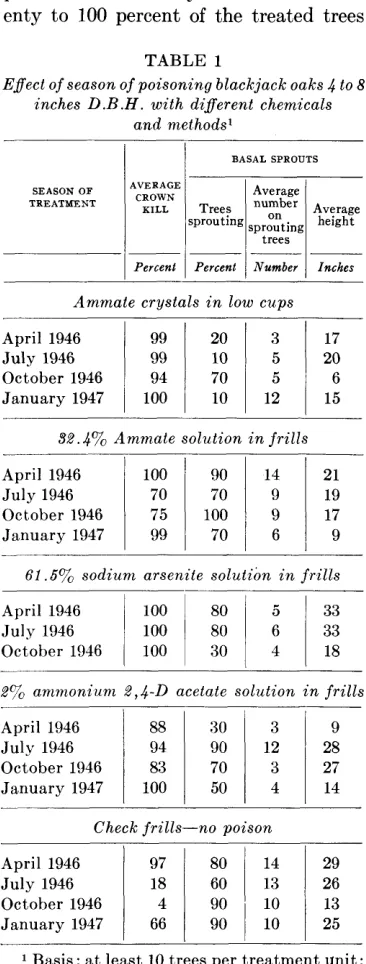
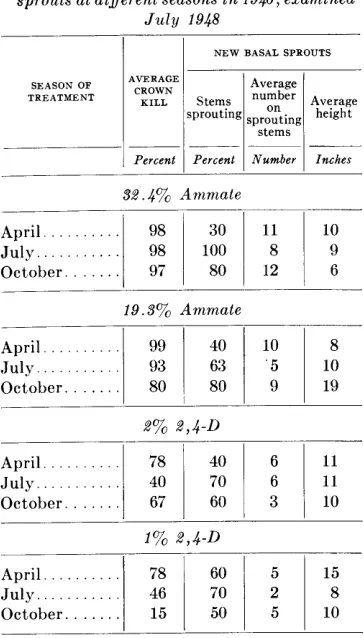
Several chrmicnls and methods of ap- plication nvw tested on hardwoods in ccntml Louisiana at four seasons: spring, summer, Ml, and winter. Some of the hcst methods arr shown in Table 1, which gives results 18 to 27 months after treat- ment. Many additional combinations ww tried, of which the more promising ones arc included in the following dis- cussion. The effects are best expressed
E tr”r
into
of on
(Maisenhelder, 1948). Some formulations of 2,4-D and 2,4,5-T are promising, but all of them tested thus far have failed to kill trees as well as Ammate and sodium arsmitt- do, and basal sprouting usually has been prolific and vigorous.
Creosote, Diesel fuel, copper sulphate, zinc chloride, sodium chloride, sodium ni- trate, potassium nitrate, and ammonium nitrate have heen found to give only a poor kill on trees and sprouts of southern upland hardwoods (Perry and Campbell, 1949).
in average percentage of live crown killed, and in number and vigor of new sprouts at the base.
As the table shows, Ammatc cryst,als in low rups gave exwllent results at all seasons. Ammate cry&Is in frills also gave a complete cr0x-n kill at all seasons, but Ml to 90 percent of the tree responded with vigorous sprouts at the base, and considerable chemical was wasted in ap- plication.