(will be inserted by the editor)
Privacy-Preserving Face Recognition with Outsourced
Computation
Can Xiang · Chunming Tang
Received: date / Accepted: date
Abstract Face recognition is one of the most impor-tant biometrics pattern recognitions, which has been widely applied in a variety of enterprise, civilian and law enforcement. The privacy of biometrics data raises important concerns, in particular if computations over biometric data is performed at untrusted servers. In previous work of privacy-preserving face recognition, in order to protect individuals’ privacy, face recognition is performed over encrypted face images. However, these results increase the computation cost of the client and the face database owners, which may enable face recog-nition cannot be efficiently executed. Consequently, it would be desirable to reduce computation over sensi-tive biometric data in such environments. Currently, no secure techniques for outsourcing face biometric recog-nition is readily available. In this paper, we propose a privacy-preserving face recognition protocol with out-sourced computation for the first time, which efficiently protects individuals’ privacy. Our protocol substantially improves the previous works in terms of the online com-putation cost by outsourcing large comcom-putation task to a cloud server who has large computing power. In par-ticular, the overall online computation cost of the client and the database owner in our protocol is at most 1/2
C. Xiang
College of Mathematics and Information Science, Guangzhou University, Guangzhou 510006, China E-mail: [email protected]
C. Tang
College of Mathematics and Information Science, Guangzhou University, Guangzhou 510006, China
Key Laboratory of Mathematics and Interdisciplinary Sci-ences of Guangdong Higher Education Institutes,
Guangzhou University, Guangzhou 510006, China State Key Laboratory of Information Security, Beijing 100093, China
E-mail: [email protected]
of the corresponding protocol in the state of the art al-gorithms. In addition, the client requires the decryption operations with onlyO(1) independent ofM, whereM is the size of the face database. Furthermore, the client can verify the correction of the recognition result.
Keywords Face recognition· Outsourced computa-tion·Privacy-preserving
1 Introduction
Biometric techniques have advanced over the past years to a reliable means of authentication, which have been deployed in various application domains. Many govern-ments have already rolled out electronic passports [1] and IDs [2] that contain biometric information (e.g.,face image, fingerprints, and iris scan) of their legitimate holders. Unlike other types of data used for authentica-tion purposes (passwords, key material, secure tokens, etc.), biometric data cannot be revoked and replaced with a new value, hence it calls for strict protection of such biometric data. In particular, face recognition systems have become more popular due to its unobtru-siveness and ease of use. Thus, face recognition systems have been widely applied in a variety of enterprise, civil-ian and law enforcement, such as surveillance of public places, access and border control at airports, facebook in social networking platforms, etc.
[3-5], secure sketches and fuzzy extractors [6-11], shield-ing functions [12-14], cancelable or revocable biometrics [15], and so on. These methods stored a function of each biometric rather than the biometrics data themselves, but it did not lead to compromise of the biometric data in the case of server compromise. For face recognition systems, in order to protect individuals’ privacy, face recognition was performed over encrypted face images in previous works [16-17]. However, these results in-creased the computation cost of clients and database owners of the face images, which enable face recogni-tion cannot be efficiently executed. Currently, no ex-isting tools or techniques are readily available to carry out the huge computation task of the database owner. Thus, the problem of secure biometric face identifica-tion (or matching) with the aid of untrusted servers is the focus of this work.
In this paper, we concentrate on efficient privacy-preserving face recognition systems. The typical sce-nario here is a application which consists of three par-ties, i.e., a client, a database owner of face images and a cloud server. Both the client and database owner have limited (or weak) computing power, but the cloud server has the ability to process magnanimity data and perform parallel computation. The client provides a specific face image and needs to know the image whether is contained in the database of face images with the fol-lowing requirements: 1)the client believes the database owner correctly performs the matching algorithm for the face recognition but without revealing any useful information to the database owner about the requested image as well as about the outcome of the matching algorithm; 2) the database owner requires privacy of its database beyond the matching results to the client; 3) the database owner needs help from the cloud server which cannot reveal any useful information about real face images and can greatly reduce the database owner’s computation cost by using the ability of processing in-telligent data and performing parallel computation.
1.1 Related Work
Some authors have proposed different complementary techniques for making surveillance cameras more pri-vacy friendly, e.g. [18-20]. However, they do not consider face recognition. For privacy-preserving face recogni-tion, Erkin et al.[16] proposed for the first time a strongly privacy-enhanced face recognition system. They used the standard and popular Eigenface [21-22] recogni-tion algorithm. The system performs operarecogni-tions on en-crypted images by means of homomorphic encryption schemes, more concretely, Pailler [23-24] as well as a
cryptographic protocol for comparing two Pailler en-crypted values based on DGK (Damgard, Geisler and Kroigard) cryptosystem [25-27]. They demonstrate that privacy-preserving face recognition is possible in prin-ciple and give required choices of parameter sizes to achieve a good classification rate. However, the pro-posed protocol requiresO(logM) rounds of online com-munication as well as computationally expensive opera-tions on homomorphically encrypted data to recognize a face in the database of M faces. Due to these re-strictions, the proposed protocol cannot be deployed in practical large-scale applications. After that, Sadeghi et al. [17] given two privacy-preserving face recogni-tion protocols which substantially improved over pre-vious work [16]. One is based on homomorphic encryp-tion (see, e.g., [23-24]) and Yao et al.’s Garbled Circuit (GC)[28-29], the other is based on GC only. Althouth the protocols allowed to shift most of the computation and communication into a pre-computation phase, the computation cost of the client and database owner was not reduced. This means that efficiently implementing privacy-preserving face recognition is difficult for the client and the database owner with weak computing power. We improves Sadeghi et al. ’s protocol based on homomorphic encryption and Garbled Circuit in this paper. In the rest of the paper, the protocol in [17] is based on homomorphic encryption and Garbled Circuit unless stated otherwise.
The related problem of privacy-preserving face de-tection [30] allows a client to detect faces on his image using a private classifier held by servers without re-vealing the face or the classifier to the other party. In order to preserve privacy, faces can be de-identified so that face recognition software cannot reliably recognize de-identified faces, even though many facial details are preserved as described in [31].
computation task to a third party (e.g., cloud servers) who has a huge computing power.
1.2 Contribution
We propose an efficient and secure privacy-preserving face recognition protocol with outsourced computation. Our protocol is based on the Eigenfaces recognition al-gorithm [21-22] and a hybrid Encryption based on FHE [36]. We do not use Garbled Circuits. Our protocol sub-stantially improves over previous work [16-17] as it has only one round between the client and the database owner. Furthermore, the protocol can efficiently out-source most of the computation to an untrusted cloud server. The remaining computation cost of the client and the database owner is small. Beyond the encryption operations, the online computation cost of the client and the database owner in our protocol is at most 1/2 of the corresponding protocol in the state of the art al-gorithms, this is especially important for the client and the database onwer with weak computing power.
1.3 Organization
The rest of the paper is organized as follows. We sum-marize our model and security requirements, parame-ters setting and cryptographic tools used in our con-structions in Section 2. A summary of the face recogni-tion algorithm using Eigenfaces is reviewed in Secrecogni-tion 3. Section 4 details our secure privacy-preserving face recognition protocol with outsourced computation. Se-curity and efficiency analysis of our protocol are given in section 5. And section 6 concludes the paper.
2 Preliminaries
2.1 Model and security requirements
In this paper, three parties are involved in our schemes, that is, a client, a database owner of face images and an untrusted cloud server. Both the client and database owner have limited (or weak) computing power, but the cloud server has the ability to process magnanim-ity data and perform parallel computation. The client provides a specific face image and needs to know the image whether is contained in the database of face im-ages with the following requirements: 1)the client trusts the database owner to correctly perform the matching algorithm for the face recognition but without reveal-ing any useful information to the database owner about the requested image as well as about the outcome of the
Table 1 Summarize of notations and parameters
Parameter Description
M number of faces in database
N size of a face in pixels
K number of Eigenfaces
Γ face
Ψ average face
u1, u2,· · ·, uK Eigenfaces ¯
Ω projected face forΓ Ω1,· · ·, ΩM projected faces in database
D1,· · ·, DM squared distances between projected images
l′ the bit length of valuesD1,· · ·, DM
τ threshold value
matching algorithm; 2) the database owner requires pri-vacy of its database beyond the outcome of the match-ing algorithm to the client; 3) the database owner needs help from the cloud server which cannot learn any use-ful information about real face images and can greatly reduce the database owner’s computation cost by using the ability of processing intelligent data and performing parallel computation.
We work in the semi-honest model where the client and the database owner are assumed to be honest-but-curious but the cloud server is untrusted.
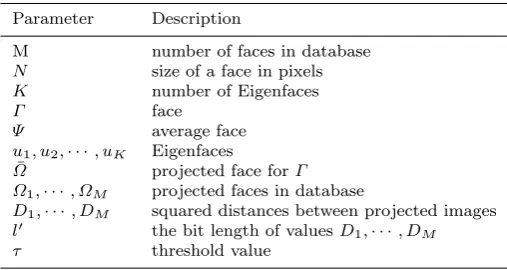
Similar to [16,17], we summarize the notations and the parameters used in this paper in Table 1.
2.2 Cryptographic tools
Hybrid encryption based on FHE. We use a se-mantically secure hybrid encryption (HS) based on FHE scheme in [36], which is a combination of an ordinary (non-FHE) encryption scheme and a FHE scheme. In [36], the authors given a detailed hybrid encryption scheme using a symmetric encryption scheme and a FHE scheme. A public-key encryption schemes (e.g., RSA, Paillier) can as well be used as an ordinary en-cryption scheme. In this paper, we use a semantically secure hybrid encryption (HS) which is a combination of a public key encryption scheme and a FHE scheme. Let M be a plaintext space, (FHE.KeyGen,FHE.Enc, FHE.Dec,FHE.Eval) be a FHE scheme, and (PE.KeyGen, PE.Enc, PE.Dec) be a public-key encryption scheme (PE). A hybrid encryption scheme HS=(HS.KeyGen, HS.Enc1,HS.Enc2, HS.Dec, HS.Eval) consists of fiveP P T
algorithms (P P T is shorthand for probabilistic polyno-mial time), which are described as follows.
encryption keypk′ and a secret decryption key sk. Then, encryptsskunder the public keypkto obtain κ←FHE.Enc(pk, sk), outputs (pk, dk, pk′, sk, κ). – HS.Enc1(pk′, x)→cx. Runs PE.Enc to encrypt
mes-sage x ∈ M under the public key pk′, outputs ci-phertextc.
– HS.Enc2(pk, κ, c)→cx. On input (pk, κ, c), outputs
a new ciphertextcxwhich is equal to FHE.Enc(pk, x). – HS.Dec(dk, cx) → x. Same as FHE.Dec. Takes as
inputdkand cx, and decrypts the ciphertextcx to a plaintextx∈M under the secret keydk.
– HS.Eval(pk, C, c1, c2,· · · , cn)→cy. Same as FHE.Eval. Given the public keypk, a circuitC and a set ofn ciphertextsc1, c2,· · · , cn deterministically compute
and outputs a new ciphertextcy.
Similar to FHE, A HS scheme should also satisfy four properties, which is encryption correctness, evalu-ation correctness, succinctness and semantic security.
As instantiation we use the Paillier public-key en-cryption scheme [23-24] which has plaintext space ZN and ciphertext space ZN2, where N is a T-bit RSA
modulus, while we use the FHE scheme over the in-tegers [37]. In [16], the privacy-preserving face recog-nition protocol uses the homomorphic cryptosystem of Damgard, Geisler and Kroigard (DGK) other than the Paillier public-key encryption scheme. The DGK homo-morphic encryption scheme can reduce the ciphertext space toZN∗. In [17], the privacy-preserving face recog-nition protocol additionally uses Yao’s Garbled Circuit other than the Paillier public-key encryption scheme. Both protocols in [16,17] do not use FHE.
In this paper, in an additively homomorphic Pail-lier encryption scheme, given encryptions [a]P E and [b]P E, an encryption [a+b]P E can be computed by [a +b]P E = [a]P E ·[b]P E, where all operations are performed in the algebra of the message or ciphertext space. Furthermore, in a FHE scheme, given encryp-tions [a]F HE and [b]F HE, an encryption [a+b]F HEcan be computed by [a+b]F HE = [a]F HE + [b]F HE and [ab]F HEcan be computed by [ab]F HE= [a]F HE[b]F HE.
3 Face recognition algorithm using Eigenfaces In the following we briefly summarize the recognition process of the Eigenfaces algorithmm[16-17,21-22]. The algorithm obtains as input the query face imageΓ rep-resented as a pixel image with N pixels. Additionally, the algorithm obtains the parameters determined in the enrollment phase as inputs: the average faceΨ which is the mean of all training images, the Eigenfacesu1,· · ·, uK which span theK-dimensional face space, the projected facesΩ1,· · · , ΩM being the projections of theM faces
in the database into the face space, and the threshold value τ. The output r of the recognition algorithm is the index of that face in the database which is closest to the query face Γ or the special symbol⊥ if no match was found, i.e., all faces have a larger distance than the thresholdτ. Specifically, the recognition algorithm consists of three phases, which are described as follows.
1. Projection:The average faceΨ is subtracted from the face Γ and the result is projected into theK -dimensional face space using the Eigenfacesu1,· · · , uK.
The result is the projectedK-dimensional face ¯Ω. 2. Distance:The square of the Euclidean distanceDi
between the projected K-dimensional face ¯Ω and all projected K-dimensional faces in the database Ωi(i= 1,2,· · ·, M), is computed.
3. Minimum:The minimum distanceDminis selected. If Dmin is smaller than the threshold τ, the index of the minimum value, i.e., the identifier imin of the match found, is returned to the client as result r=imin. Otherwise, the image was not found and the special symbolr=⊥is returned.
4 Privacy-preserving face recognition with outsourced computation
In this section, we present a privacy - preserving face recognition protocol with outsourced computation. The protocol operates on encrypted images. three parties are involved in our schemes, that is, a clientC, a database ownerDBof face images and an untrusted cloud server CS. We work in the semi-honest attacker model. Infor-mally, this assumes that the clientC and the database owner DB follow the protocol but try to learn addi-tional information from them. In addition, any out-sourcer can verify the correctness of the untrusted cloud server output. It is also assumed that the parties com-municate over an authenticated channel (this can be achieved by standard mechanisms and is thus outside the scope of this paper). We assume that a database owner has already set up the face recognition system by running the enrollment process (in the clear) on all available training images{θ1,· · ·, θM}to obtain the
basisu1,· · · , uK of the face space and feature vectors
Ωi(i= 1,2,· · · , M) of faces to be recognized.
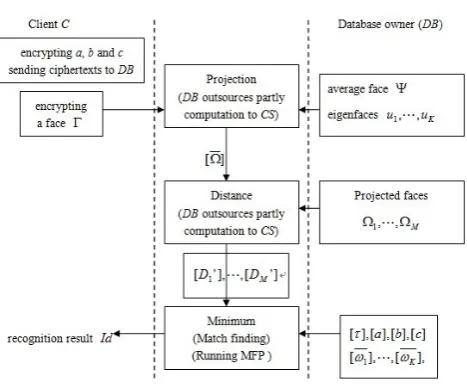
Fig. 1 Outline of our protocol
Fig. 1 shows an outline of our protocol, which is de-scribed as follows.
Projection. The input image Γ has to be projected onto the low dimensional face space spanned by the eigenfacesu1,· · · , uK. the clientC runs HS.Gen to
ob-tain (pk, dk, pk′, sk, κ), where (pk, dk) is the public/secret key pair of the FHE and (pk′, sk) is the public/secret key pair of the Paillier homomorphic encryption scheme. In addition, κis the encryption ofsk under FHE. Let κ be [sk]F HE. The client C encrypts the face Γ as [Γ]P E = ([Γ1]P E,· · · ,[ΓN]P E). Meanwhile, the client randomly chooses three elements a,b and c, and en-crypts them as [a]P E, [b]P E and [c]P E.
The client sends{[Γ]P E,[a]E,[b]P E,[c]P E,[sk]F HE} along with (pk, pk′) to the database owner DB. Us-ing the homomorphic properties and outsourced com-putation,DBprojects the encrypted face into the low-dimensional face space and obtains the encryption of the projected face [ ¯Ω]P E = ([ ¯ω1]P E,· · · ,[ ¯ωK]P E) as follows.
1. Fori= 1,· · ·, K, the database ownerDBcomputes pi =−
∑N
j=1ui,jΨj, where Ψj is the component of the vectorΨ = M1 ∑Mi=1θi. This step can be com-pleted in the pre-computation phase (offline phase). 2. The database ownerDBencryptspiunder the
pub-lic key pk′ to obtain [pi]P E = [− ∑N
j=1ui,jΨj]P E,
This step is completed in the online phase. 3. DB computesqi=
∏N j=1[Γj]
ui,j
P E by using outsourc-ing exponentiation algorithm (such as [38]) which can reduce the database ownerDB ’s computation cost.
4. For i = 1,· · ·, K, the database owner computes [ ¯ωi]P E = [pi]P E·qi.
Distance.AfterProjection, the database ownerDB need to compute the Paillier encryption of the Euclidean distances between the projected face ¯Ω and all pro-jected faces Ω1,· · ·, ΩM in the database held by the
database owner in [16,17]. In addition,DB also needs interaction with the client. In our protocol, DB does not need interaction with the client. Because the com-putation cost is very large for DB, who may no ca-pacity to complete the computation task by himself. Thus, the database ownerDB requires assistance from a third party (e.g., cloud server). In this paper, we use outsourced computation which can enable the database owner to outsource all or partly computation to the cloud server who has lager computing powering. For i= 1,2,· · · , M, the encryption of the square Euclidean distances [Di]P E = [∥Ωi −Ω¯∥2]P E = [S1,i+S2,i+ S3]P E = [S1,i]P E·[S2,i]P E ·[S3]P E, where [S1,i]P E = [∑Kj=1ω2
i,j]P E, [S2,i]P E= [ ∑K
j=1(−2ωi,jω¯j)]P E = ∏K
j=1[ ¯ωj]−
2ωi,j
P E and [S3]P E = [
∑K j=1ωj¯
2]
P E. We notice that S3 is a
fixed value once the input mageΓ and the face database are fixed. Hence,DB only need to compute [D′i]P E = [S1,i+S2,i]P E= [S1,i]P E·[S2,i]P E. These cannot effect the next step (See. Match finding). Specifically, [Di′]P E can be computed as follows.
1. To obtain [S1,i]P E, the database owner DB needs to complete two steps below.
– DBcomputes∑Kj=1ω2
i,jwhich can be pre - com-puted in the offline stage.
– DBencrypts∑Kj=1ω2
i,junder the public keypk′ to obtain [S1,i]P E = [
∑K j=1ω
2
i,j]P E. This step is completed by the database owner DB in the online phase.
2. For computing [S2,i]P E, the database owner DB firstly outsources exponentiation [ ¯ωj]−2ωi,j
P E to the cloud server CS by outsourcing exponentiation al-gorithm, and then multiply those exponentiation to-gether to obtain [S2,i]P E.
3. Fori= 1,2,· · ·, M,DBcomputes [D′i]P E= [S1,i]P E· [S2,i]P E
Then, DB can finish this phase without interacting with the client.
Minimum (Match finding). In the last step of the recognition algorithm, the goal is to find the minimum valueD from{Di}Mi=1 and its indexIdmin. If the min-imum value D is smaller than the threshold value τ known by the database owner, then a match is reported and an encryption of the identity Idmin which corre-sponds to the best matching feature vector is returned to the client. BecauseS3 is a fixed value, we only need
to find the minimum value D′ from {Di′}M
i=1 and its
an encryption of the identityIdmin which corresponds to the best matching feature vector is returned to the client.
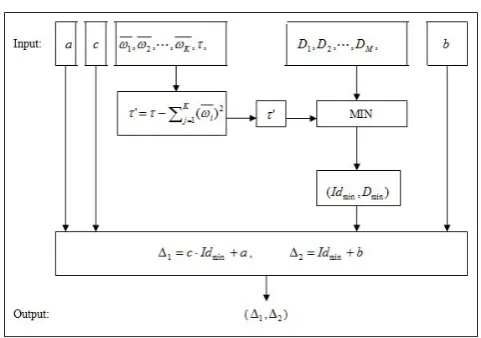
As we need to return the identity of the best match-ing feature vector, we also have to keep track of the IDs during the minimum computation. This is done by working with pairs ([D′i]P E,[Idi]P E) of distances and their corresponding identities. To check if the minimum distance is smaller thanτ′, we can treat the valueτ′ as one additional distance that has the special identity 0. Together with the distancesD1′.· · ·, DM′ , the client, the database owner, and the cloud server jointly carry out the protocol with verifiable outsourced computation to find minimum distance and the corresponding identity ([D′]F HE,[Id]F HE), whereD′∈ {τ′, D′1,· · · , D′M}and Id ∈ {0, Id1,· · · , IdM}. Thus, if a face image could be recognized the value Id contains the corresponding identity. If no match could be found Id is equal to 0. Some encrypted values are finally sent to the client as the result of the private face recognition protocol. Then, the client can obtain the recognition resultIdby some computations and can verify the correctness of the re-sult. To achieve this, the client C, the database owner DB, and the cloud server CS jointly run the follow-ing match findfollow-ing protocol (MFP) with verifiable out-sourced computation(VOC).
1. The database ownerDBconstructs a circuitCcircuit with multi-input, which is shown in Fig.2. This can be completed by the database owner in the offline stage.
2. DB sends the circuit Ccircuit, [sk]F HE and σ = {[τ]P E,[ ¯ω1]P E,· · ·,[ ¯ωK]P E,[D1′]P E,· · ·, [D′M]P E, [a]P E, [b]P E, [c]P E}to the cloud serverCS.
3. For each element in the setσ,CSruns the algorithm HS.Enc2to getσ′={[τ]F HE, [ ¯ω1]F HE,· · ·,[ ¯ωK]F HE, [D1′]F HE,· · ·,[D′M]F HE, [a]F HE,[b]F HE,[c]F HE}. 4. CS computesF HE.Eval(pk, Ccircuit, σ′) to obtain
[∆1]F HEand [∆2]F HE, then sends them to the client. 5. The client decrypts [∆1]F HE and [∆2]F HE under
the secret keydkto obtain∆1 and∆2. If∆1−a=
c(∆2−b), then the client accepts the match result
Id=∆2−b, otherwise rejects. IfId= 0, it shows
that no match could be found in the database held by the database owner.
In our minimum (Match) finding protocol, the on-line computation and round complexity have been sub-stantially improved for the client C and the database ownerDO, we have given the comparison of three min-imum protocols from two aspects, i.e., the online round complexity and the asymptotic computation complex-ity (ACC1), which is shown as in Table 2 with param-eter m ≈ Tl′−Mκ′, where T is the asymmettric security
Fig. 2 CircuitCcircuitfor match finding with VOC
parameter andκ′ is the statistical correctness parame-ter in [17].
5 Security and efficiency analysis
The security of our protocol is based on the security of there schemes, i.e. the privacy-preserving face recogni-tion scheme in [17], HS scheme in [36] and the verifiable outsourced computation scheme for simultaneous expo-nentiations in [38]. This three schemes are secure which has been proved in [17,36,38]. Thus, our protocol is se-cure.
In order to illustrative the efficiency of our protocol, we will give detailed analysis from three respects, i.e., the round, the communication and computation com-plexity.
5.1 Round complexity
Table 2 Comparison of three minimum protocols.
Protocol [16] [17] Ours
Round Complexity [moves] 6⌈logM⌉+ 1 3 2
ACC1 (Conline) 2MDecP E+l′MDecDGK mDecP E+3l′M Hash 2 DecF HE ACC1 (DOonline) 2MExpP E+l′MExpDGK mExpP E 1EncP E
to the cloud server, in which it can reduce the compu-tation cost of the database owner.
5.2 Online communication complexity
For communication complexity, the communication com-plexity highly depends on the size of Paillier encryp-tion, FHE, and outsourcing exponentiation algorithm. In the offline phase, the circuit Ccircuit with VOC can be transmitted to the cloud server. In the following, we only analyze the online communication complexity.
– C →DB. For the client sends some encrypted data to the database owner, the client requires transmis-sion of 1 FHE encrypted value [sk]F HE, (N+3)
Pail-lier encrypted values{[Γ1]P E,· · ·,[ΓN]P E,[a]P E,[b]P E,[c]P E}. – DB ⇀↽ CS. In the distance calculation phase, for
i = 1,· · ·, K, to obtain [ ¯ωi]P E = [pi]P E ·qi, the database owner outsources the computation qi = ∏N
j=1[Γj]
ui,j
P E to CS by using outsourced computa-tion algorithm for simultaneous exponentiacomputa-tion (Sexp) in [38] in the projection stage. Therefore, it needs K· ⌈N/2⌉ operations of Sexp, which means that the communication overhead isK· ⌈N/2⌉ ·(6logp+ 12Len[Γj]P E), where p is the bit length of ui,j and
Len[Γj]P E is the bit length of [Γj]P E. In the
dis-tance computation stage, it needsK· ⌈N/2⌉ opera-tions of Sexp for computing [S2,i]P E, which means that the communication overhead is K · ⌈N/2⌉ · (6logp′+12Len[ ¯ωj]P E) bits, wherep′is the bit length
of−2ωi,j andLen[ ¯ωj]P E is the bit length of [ ¯ωj]P E.
– DB →CS. In the minimum (match) finding stage, the circuitCcircuitcan be transmitted in the offline stage. It requires transmission of 1 FHE encrypted value and (K + 2M + 4) PE encrypted values in the online stage. Similar to [16,17], we only requires transmission of (K+M+ 4) PE encrypted values if we omit the statistic for the transmission of [id]P E. – CS →C. In the minimum (Match) finding stage, it requires transmission of 2 FHE encrypted value [∆1]F HE and [∆2]F HE.
Suppose that the size of FHE-ciphertexts isγ bits. Similar to [16,17], we omit the statistic for the trans-mission of [idi]P E. Let kbe the number of the packed ciphertexts in [17]. We now compare our protocol with
the previous works [16,17] as shown in Table 3. Unfor-tunately, the online communication cost of our protocol is larger than the precious works because we use out-sourced computation algorithms which means that the outsourcer requires some interactions with the cloud server.
5.3 Online computation complexity
The overall online computation complexity of our pro-tocol is substantially lower. We denote by EncP E an invocation of the Paillier homomorphic encryption al-gorithm, by DecP E an invocation of the Paillier homo-morphic decryption algorithm, by EncF HE an invoca-tion of the FHE algorithm, by DecF HEan invocation of the fully homomorphic decryption algorithm, by MM a modular multiplication, by MInv a modular inverse, by Exp a modular exponentiation, by SexpV OCan invoca-tion of the verifiable outsourced computainvoca-tion algorithm for simultaneous exponentiation. We omit other oper-ations such as modular additions. More precisely, the online computation cost of the client and the database owner is given as follows.
– In the projection phase, the client needs (N+3)EncP E and 1 EncF HE, and the database owner requiresK EncP E,K· ⌈N/2⌉SexpV OC and (K⌈N/2⌉) MM. – In the distance computation phase, the database
owner needs M EncP E, (M · ⌈K/2⌉)SexpV OC and (M· ⌈K/2⌉)MM.
– In the minimum distance (or match)finding phase, the client needs 2DecF HE. Because the database owner needs to encrypt{τ, id0, id1,· · · , idM}under
PE, the database owner needs (M+ 2)EncP Ein the online phase.
Compared with the previous algorithms in [16-17], our protocol is superior in efficiency due to the re-duction of the computation cost of the client and the database owner. Similar to [16,17], we omit the statistic for the computation cost of the encryption{idi}Mi=0
Table 3 Comparison of round and asymptotic communication complexity(ACC).
Protocol [16] [17] Ours
Round Complexity O(logM) O(1) O(1)
Moves 6⌈log(M+ 1)⌉+ 4 6 3 (or 7)
ACC (online, [bits]) 2T(l′M+K+N+ 1 + 8M) 2T(l′M+k+m+N+ 1) 6K· ⌈N/2⌉ ·(logp′+ 8T+logp) +2T(K+N+M+ 7) + 4γ
Table 4 Comparison of asymptotic computation complexity (online)
Protocol [16] [17] Ours
C (N+ 1)EncPE+ (K+ 2M)DecPE
+(l′M)DecDGK+KMM
(N+ 1)EncPE+ (k+m)DecPE +(3l′M)Hash +KMM
(N+ 3)EncPE+ 1EncFHE +2DecFHE
DO
(K+M)EncPE
+((l′+K+ 2)M+ (N+ 1)K)Exp +((N+M+ 2)K+ 1−M)MM
(K+M)EncPE +(KN+KM+k+ 1 +m)Exp +(KN+M(K−1) + 1 +⌈K/k⌉)MM
(M+K+ 1)EncPE +(K⌈N/2⌉+M⌈K/2⌉)SexpVOC
+(K⌈N/2⌉+M⌈K/2⌉)MM
Sum
(K+M+N+ 1)EncPE +(K+ 2M)DecPE+ (l′M)DecDGK
+((l′+K+ 2)M+ (N+ 1)K)Exp +((N+M+ 3)K+ 1−M)MM
(K+M+N+ 1)EncPE +(k+m)DecPE+ (3l′M)Hash +(KN+KM+k+ 1 +m)Exp +(K(N+ 1 +M)−M+ 1 +⌈K/k⌉)MM
(K+M+N+ 4)EncPE+ 1EncFHE +2DecFHE
+(K⌈N/2⌉+M⌈K/2⌉)SexpVOC +(K⌈N/2⌉+M⌈K/2⌉)MM
protocol is at most 1/2 of the corresponding protocol in the state of the art algorithms [16,17].
6 Conclusion
In this paper, we present a privacy-preserving face recog-nition scheme with outsourced computation, which al-lows to match an encrypted image showing a face against a database of facial templates in such a way that the biometric itself and the detection result is hidden from the server that performs the matching. In particular, our protocol allows the database owner to securely out-source some computation task to an untrusted cloud server and detect the dishonest behavior of untrusted cloud server. Furthermore, the client can verify the cor-rectness of the recognition result. Compared with the state-of-the-art algorithms [16-17], beyond the same op-erations for encryption, the overall online computation cost of the database owner and the client is greatly reduced. However, the online communication cost can-not reduce due to using outsourced computation. Thus, the key problem of our protocol is that how to further reduce the online communication cost and the client’s computation cost on the future work.
Acknowledgements This work is supported in part by the National Natural Science Foundation of China under Grant No. 11271003, the National Research Foundation for the Doc-toral Program of Higher Education of China under Grant No. 20134410110003, High Level Talents Project of Guang-dong, Guangdong Provincial Natural Science Foundation un-der Grant No. S2012010009950, the Project of Department of Education of Guangdong Province under Grant No 2013KJ-CX0146, and the Natural Science Foundation of Bureau of Education of Guangzhou under Grant No. 2012A004.
References
1. Internfgational Civil Aviation Organization (ICAO). Ma-chine Readable Travel Documents (MRTD), Doc 9303, Part 1, Fifth Edition, 2003.
2. Naumann I, and Hogben G. Privacy features of European aid card specifications. Network Security, European Net-work and Information Security Agency (ENISA), vol. 8, pp. 9-13, 2008.
3. Juels A, and Sudan M. A fuzzy vault scheme. In: Interna-tional Symposium on Information Theory, 2002.
4. Chang E-C, and Li Q. Small secure sketch for point-set dif-ference. Cryptology ePrint ArchiveReport 2005/145, 2005. 5. Chang E-C, and Li Q. Hiding secret points amidst chaff. In: Advances in Cryptology-EUROCRYPT, vol. LNCS 4004, pp. 59-72, 2006.
6. Juels A, and Wattenberg M. A fuzzy commitment scheme. In ACM Conference on Computer and Communications Se-curity (CCS), pp: 28-36, 1999.
7. Dodis Y, Reyzin L, and Smith A. Fuzzy extractors: How to generate strong keys from biometrics and other noisy data. In Advances in Cryptology- EUROCRYPT, vol. LNCS 3027, pp. 523-540, 2004.
8. Boyen X. Reusable cryptographic fuzzy extractors. In ACM Conference on Computer and Communications Se-curity (CCS), pp. 82-91, 2004.
9. Dodis Y, and Smith A. Correcting errors without leak-ing partial information. In ACM Symposium on Theory of Computing (STOC), pp. 654-663, 2005.
10. Boyen X, Dodis Y, Katz J, Ostrovsky R, and Smith A. Secure remote authentication using biometric data. In Ad-vances in Cryptology-EUROCRYPT, vol. LNCS 3493, pp. 147-163, 2005.
11. Dodis Y, Ostrovsky R, Reyzin L, and Smith A. Fuzzy extractors: How to generate strong keys from biometrics and other noisy data. SIAM Journal of Computing, vol. 38, no. 1, pp. 97-139, 2008.
12. Linnartz J, and Tuyls P. New shielding functions to en-hance privacy and prevent misuse of biometric templates. In International Conference on Audio and Video Based Bio-metric Person Authentication, June, 2003.
Benelux W.I.C. Symposium on Information Theory, pp. 125-131, 2003.
14. Tuyls P, Akkermans A, Kevenaar T, Schrijen G.-J, Bazen A, and Veldhuis G. Practical biometric authentication with template protection. In Audio- and Video-Based Biometric Person Authentication (AVBPA), vol. LNCS 3546, pp. 436-446, 2005.
15. Ratha NK, Connell JH, and Bolle RM. Enhancing se-curity and privacy in biometrics-based authentication sys-tems. IBM Systems Journal, vol. 40, no. 3, pp. 614-634, 2001.
16. Erkin Z, Franz M, Guajardo J, Katzenbeisser S, La-gendijk I, and Toft T. Privacy-preserving face recognition. In Privacy Enhancing Technologies (PET’09), vol. LNCS 5672, pp. 235-253, 2009.
17. Sadeghi AR, Schneider T, and Wehrenberg I. Efficient Privacy-Preserving Face Recognition. Information, Security and Cryptology-ICISC 2009, vol. LNCS 5984, pp. 229-244, 2010.
18. Senior A, Oankanti A, Hampapur A, et al. Enabling video privacy through computer vision. IEEE Security and Pri-vacy Magazine, vol. 3, no. 3, pp. 50-57, 2005.
19. Dufaux F, and Ebrahimi T. Scrambling for video surveil-lance with privacy. In: Proceedings of IEEE Workshop on Privacy Research In Vision, New York, p. 160, June 2006. 20. Yu X, Chinomi K, Koshimizu T, Nitta N, Ito Y, and
Babaguchi N. Privacy protecting visual processing for se-cure video surveillance. In: Proceedings of the International Conference on Image Processing (ICIP’08), October 2008, San Diego, Calif, USA, pp. 1672-1675, 2008.
21. Turk M, and Pentland A. Eigenfaces for recognition. Journal of Cognitive Neuroscience, vol. 3, no. 1, pp. 71-86, 1991.
22. Turk MA, and Pentland AP. Face recognition using eigen-faces. In Proceedings of the IEEE Computer Vision and Pattern Recognition (CVPR’91), pp. 586-591, 1991. 23. Paillier P. Public-key cryptosystems based on
compos-ite degree residuosity classes. In Advances in Cryptology-EUROCRYPT’99, vol. LNCS 1592, pp. 223-238, 1999. 24. Damgard IB, and Jurik MJ. A generalisation, a
sim-plification and some applications of paillier’s probabilistic public-key system. In Public-Key Cryptography (PKC’01), vol. LNCS 1992, pp. 119-136, 2001.
25. Damgard I, Geisler M, and Kroigard M. Efficient and se-cure comparison for online auctions. In Australasian Con-ference on Information Security and Privacy (ACISP’07), vol. LNCS 4586, pp. 416-430, 2007.
26. Damgard I, Geisler M, and Kroigard M. A correc-tion to ”efficient and secure comparison for on-line auctions”. Cryptology ePrint Archive, Report 2008/321, http://eprint.iacr.org/2008/321, 2008.
27. Damgard I, Geisler M, and Kroigard M. Homomor-phic encryption and secure comparison. Journal of Applied Cryptology, vol. 1, no. 1, pp. 22-31, 2008.
28. Yao AC. How to generate and exchange secrets. In The Computer Society of IEEE, 27th Annual Symp. on Foun-dations of Computer Science (FOCS), pp. 162-167, 1986. 29. Lindell Y, and Pinkas B. A proof of Yao’s protocol for
secure two-party computation. Cryptology ePrint Archive, Report 2004/175, 2004.
30. Avidan S, and Butman M. Efficient methods for privacy preserving face detection. In Advances in Neural Informa-tion Processing Systems (NIPS’06), pp. 57-64, 2006. 31. Newton EM, Sweeney L, and Malin B. Preserving
pri-vacy by de-identifying face images. IEEE Transactions on Knowledge and Data Engineering, vo. 17, no. 2, pp. 232-243, 2005.
32. Tuyls P, Akkermans AHM, Kevenaar TAM, Schrijen G.-J, Bazen AM, and Veldhuis RNJ. Practical biometric au-thentication with template protection. In: Inter. Conf. on Audio- and Video-Based Biometric Person Authentication (AVBPA 2005). vol. LNCS 3546, pp. 436-446, 2005. 33. Ratha N, Connell J, Bolle R, and Chikkerur S. Cancelable
biometrics: A case study in fingerprints. In: Proceedings of the 18th International Conference on Pattern Recognition (ICPR), vol. IV, pp. 370-373, 2006.
34. Kevenaar T. Protection of Biometric Information. In: Se-curity with Noisy Data, pp. 169-193, 2007.
35. Blanton M, and Aliasgari M. Secure Outsourced Compu-tation of Iris Matching.
36. Li ZZ, and Lai TH. Deterministic Fully Homomor-phic Encryptions for Privacy Preserving Cloud Computing, http://web.cse.ohio-state.edu/-lizh/.
37. Dijk MV, Gentry C, Halevi S, and Vaikuntanathan V. Fully homomorphic encryption over the integers, Advances in Cryptology, ASIACRYPT 2010, Vol. LNCS 6110, pp. 24-43, 2010.