Robust Fault Detection for Switched Linear Systems with
State Delays
Dong Wang, Wei Wang and Peng Shi,Senior Member, IEEE
Abstract— This paper deals with the problem of robust fault detection for discrete-time switched systems with state delays under arbitrary switching signal. The fault detection filter is used as the residual generator, in which the filter parameters are dependent on the system mode. Attention is focused on designing the robust fault detection filter such that, for unknown inputs, control inputs and model uncertainties, the estimation error between the residuals and the faults is minimized. The problem of robust fault detection is converted into an H∞ filter-ing problem. By switched Lyapunov functional approach, a sufficient condition for the solvability of this problem is established in terms of linear matrix inequalities (LMIs). A numerical example is provided to demonstrate the effectiveness of the proposed method.
Index Terms— Fault Detection and Isolation, Switched Systems, LMIs, State Delays.
I. INTRODUCTION
Fault Detection and Isolation (FDI) in dynamic systems has attracted great attention of many researchers over the past decades, and some model-based fault detection approaches have been proposed (see, e.g. [1]–[6] and the references therein). Among these model-based approaches, the most common one is to use state observers or filters to construct a residual signal and compare it with a predefined threshold. When the residual evaluation function has a value larger than the threshold, an alarm is generated. It is well known that unknown inputs, control inputs, model uncertainties and the faults are coupled in many industrial systems, which is a source of false alarms. This means that FDI systems have to be sensitive to faults and simultaneously robust to unknown inputs, control inputs and model uncertainties. Therefore, it is of great significance to design a robust FDI system [7]–[10]. Recently, an H∞-filtering formulation
of FDI problem has been presented to solve the robust FDI problem [11]–[13]. In [11], the problem of Robust Fault Detection Filter Design (RFDFD) for discrete-time Markovain jump linear systems is formulated as an H∞-filtering problem. In [13], the problem
of RFDFD for discrete-time networked systems with multiple state delays and unknown input is transformed into an H∞-filtering
problem for Markovain jumping system. In this paper, the problem of RFDFD for discrete-time switched systems with state delays is cast into anH∞filtering problem.
On another research front line, there has been increasing interest in the control problems of switched systems due to their significance both in theory and applications (see, for instance, [14]–[25] and the references therein). Many methods have been developed in the study of switched systems such as multiple Lyapunov functions ap-proach [23], average dwell time technology [24], switched Lyapunov function approach [25] and so on. In [25], a switched Lyapunov function approach is proposed for stability analysis for discrete-time switched systems, but time delays are not considered. In this paper,
Manuscript received April 10, 2008; revised July 11, 2008.
Dong Wang and Wei Wang are with Research Center of Information and Control, Dalian University of Technology, Dalian, 116023, P. R. China. (email:[email protected]; [email protected])
Peng Shi is with Faculty of Advanced Technology, University of Glamor-gan, Pontypridd, CF37 1DL, UK. He is also with ILSCM, School of Science and Engineering, Victoria University, Australia; and School of Mathematics and Statistics, University of South Australia. (Email: [email protected])
state delays are involved. However, the existence of time delays in a system may cause instability or bad system performance [26]– [30]. Hence, switched systems with time delay have gained a great deal of attention (see, for example, [19]–[22], [31]–[34] and the references therein). However, to the best of the authors’ knowledge, the problem of RFDFD for discrete-time switched systems with state delays has not been investigated yet. This motivates us to study this interesting and challenging problem, which has great potential in practical applications.
This paper deals with the problem of RFDFD by using switched Lyapunov functional approach for discrete-time switched systems with state delays. Firstly, the residual generator is constructed based on the filter. Secondly, by augmenting the states of the original system and the fault detection filter, the problem of RFDFD is formulated as anH∞ filtering problem. The objective is to make the difference
between the faults and the residuals as small as possible, and increase robustness of the residuals to the unknown input. Then, by using switched Lyapunov functional approach, a sufficient condition on the existence of such filters is established in terms of LMIs. The desired filter are constructed by solving the corresponding LMIs. Finally, a simulation example is presented to demonstrate the effectiveness of the proposed method.
The rest of this paper is organized as follows. In Section 2, system descriptions and definitions are presented. A sufficient condition on the existence of a robust fault detection filter for discrete-time switched systems with state delays is presented in terms of LMIs, and the desired filter are constructed in Section 3. To demonstrate the validity of the proposed approach, an example is given in Section 4 which is followed by a conclusion in Section 5.
II. PROBLEM FORMULATION
Consider the following discrete-time switched systems with state delays:
xk+1= N
X
i=1
ξi(k) (Aixk+Adixk−d+Eiuk+Bidk+Gifk)
yk= N
X
i=1
ξi(k) (Cixk+Cdixk−d+Qiuk+Didk+Jifk) (1)
wherexk∈Rnis the state, yk∈Rr is the measured output,dk∈
Rp,u
k∈Rs andfk∈Rqare, respectively, the unknown input, the
control input and the faults which belong tol2[0,∞). The matrices
Ai, Adi, Bi, Ci, Cdi, Di, Ei, Gi, Ji, Qi are of the appropriate
dimensions, whereAi= ¯Ai+∆Ai(k), Adi= ¯Adi+∆Adi(k), Ei=
¯
Ei+∆Ei(k). The modeling errors∆Ai(k),∆Adi(k),∆Ei(k)are
norm-bounded uncertainties satisfying £
∆Ai(k) ∆Adi(k) ∆Ei(k)
¤
= ¯HiF¯(k)
£
¯
C1i C¯2i C¯3i
¤
whereH¯i,C¯1i,C¯2i,C¯3iare known constant matrices, whileF¯(k)is
unknown time-varying matrices satisfying F¯T(k) ¯F(k) ≤ I. The
positive integersN andddenote the number of subsystems and the state delay, respectively. ξi(k) : Z+ → {0,1} and
N
P
i=1
1, k ∈Z+, i∈ N ={1,2,· · ·, N} is the switching signal which
specifies which subsystem is activated at the switching instant. An FDI system consists of a residual generator and a residual evaluation stage including an evaluation function and a threshold. For the purpose of residual generation, the following fault detection filter is constructed as a residual generator:
ˆ
xk+1 = N
X
i=1
ξi(k) (Af ixˆk+Bf iyk)
rk = N
X
i=1
ξi(k) (Cf ixˆk+Df iyk) (2)
wherexˆk is the filter’s state,rk is the residual signal. The matrices
Af i,Bf i,Cf iand Df i are the filter parameters to be determined.
For the purpose of fault detection, it is not necessary to estimate the faultfk. Sometimes one is more interested in the fault signal of a
certain frequency interval, which can be formulated as the weighted faultfˆ(z) =Wf(z)f(z)withWf(z)being a given stable weighting
matrix. A minimal realization offˆ(z) =Wf(z)f(z)is supposed to
be
¯
xk+1 = Awx¯k+Bwfk
ˆ
fk = Cwx¯k+Dwfk (3)
where x¯k ∈ Rn¯ is the state of the weighted fault, fk ∈Rq is the
original fault andfˆk ∈Rq is the weighted fault.Aw, Bw, Cw and
Dw are known constant matrices.
Remark 1: The parameters of filter (2) depend on the system modes. This means that the switching signals in system (1) and filter (2) are the same. In practice, each subsystem of filter (2) is designed for the corresponding subsystem of system (1). Then, each pair of subsystems can be actived by one signal. As in [32], [25], it is assumed that the switching signal is not known a priori, but its instantaneous value is available in real-time implementation. When the swithing signal changes, the jumps between the modes occur simultaneously and in pairs.
Remark 2: Similar to [11], [13], the introduction ofWf(z)could
limit the frequency ranges of interest, but the system performance could be improved and the frequency characteristics required to reflect the emphases of different frequency ranges could be captured. Denoting ek = rk−fˆk and augmenting the model of system (1)
to include the states of (2), we can obtain the augmented system as follows:
˜
xk+1= N
X
i=1
ξi(k)
³
˜
Ai˜xk+ ˜Adix˜k−d+ ˜Biwk
´
ek= N
X
i=1
ξi(k)
³
˜
Cix˜k+ ˜Cdix˜k−d+ ˜Diwk
´
(4) where
˜
Ai=
BAf iiCi A0f i 00
0 0 Aw
,x˜k=
xxˆkk
¯
xk
,
˜
Adi=
BAf idiCdi 00 00
0 0 0
, wk=
udkk
fk
,
˜
Bi=
BEf iQi i Bf iBiDi BGf iiJi
0 0 Bw
,
˜
Ci=
£
Df iCi Cf i −Cw
¤ ,
˜
Cdi=
£
Df iCdi 0 0
¤ ,
˜
Di=
£
Df iQi Df iDi Df iJi−Dw
¤ .
Remark 3: It should be noted fromek=rk−fˆkthat the residualrk
generated by filter (2) provides an estimate of the faultfˆk. The stable
weighting matrixWf(z)is given. Thus, detection and isolation of the
faultfkcan be achieved by examining the values of the residualrk.
That is, the designed filter not only detects the occurred fault, but also can isolate it.
Now, the problem of RFDFD can be transformed into an H∞
filtering problem for system (4): to develop filter (2) for system (1) such that the augmented system (4) under arbitrary switching signal is asymptotically stable whenwk= 0and, under zero-initial condition,
the infimum ofγ is made small in the feasibility of
sup
wk6=0,wk∈l2[0,∞)
kekk2 kwkk2
< γ, γ >0 (5) After designing the residual generator, the remaining important task is to evaluate the generated residual. One of the widely adopted approaches is to select a threshold and a residual evaluation function. In this paper, the residual evaluation function is chosen as
JL(r) =krkk2,L=
l0X+L
k=l0
rTkrk
1/2
(6)
wherel0is the initial evaluation time instant,Lis the evaluation time
window.
Remark 4: In fact, the length of the evaluation windowLis limit since it is desired that the faults will be detected as early as possible, while an evaluation of residual signal over the whole time range is not practical. This point has been mentioned in [?], [10]–[12]. Once the evaluation function has been selected, we are able to determine the threshold. Since the faults can be detected by using the following logical relationship:
JL(r)> Jth⇒F aults⇒Alarm
JL(r)≤Jth⇒N o F ault
it is reasonable to choose the threshold as Jth= sup
d∈l2, u∈l2, f=0
krkk2,L. (7)
It is clear that the computation ofJthinvolves the determination of
the unknown inputsdkand the control inputsukon the residualsrk.
III. H∞FAULTDETECTIONFILTERDESIGN
In this section, a sufficient condition on the existence of the robust fault detection filters would be given and a desired filer could be constructed.
Lemma 1 [35]: Let Y, H and C be matrices with appropriate dimensions. Supppose that Y is symmetric and ∆(k)T∆(k) ≤ I,
then,
Y +H∆(k)C+CT∆(k)H <0
if and only if
Y +ε−1HHT+εCTC <0
whereεis a given positive scalar.
Lemma 2: For a given scalar γ > 0, system (4) under arbitrary switching signals is asymptotically stable whenwk = 0and, under
matricesPiandQi,i∈ N such that the following inequality holds,
−P−1
j A˜i A˜di B˜i 0 0
∗ −Pi 0 0 C˜iT I
∗ ∗ −Ql 0 C˜diT 0
∗ ∗ ∗ −γ2I D˜T
i 0
∗ ∗ ∗ ∗ −I 0
∗ ∗ ∗ ∗ ∗ −Q−1
i
<0 (8)
Proof. First, the asymptotical stability of system (4) withwk= 0
is established. The following Lyapunov functional is constructed by:
Vk = x˜Tk
ÃN X
i=1
ξi(k)Pi
! ˜ xk + k−1 X
s=k−d
˜
xTs
ÃN X
i=1
ξi(k)Qi
!
˜
xs (9)
wherePi andQi are the positive define symmetric matrices. Then,
we get
∆Vk = Vk+1−Vk
= x˜Tk+1
ÃN X
i=1
ξi(k+ 1)Pi
!
˜
xk+1
− x˜Tk
ÃN X
i=1
ξi(k)Pi
!
˜
xk+ ˜xTk
ÃN X
i=1
ξi(k)Qi
!
˜
xk
− x˜T k−d
ÃN X
i=1
ξi(k−d)Qi
!
˜
xk−d (10)
As this has to be satisfied under arbitrary switching signals, it follows that this has to hold for the configuration ξi(k) = 1,
ξr6=i(k) = 0, ξj(k+ 1) = 1, ξr6=j(k+ 1) = 0, ξl(k−d) = 1
andξr6=l(k−d) = 0, along the solution of system (4) withwk= 0,
we have
∆Vk|wk=0= ˜η T
kΛiη˜k (11)
where
˜
ηTk =
£
˜
xT k x˜Tk−d
¤ ,
Λi=
· ˜ AT i ˜ AT di ¸ Pj £ ˜
Ai A˜di
¤
+
·
Qi−Pi 0
∗ −Ql
¸ .
By using Schur complement, it follows from (8) thatΛi<0. Thus,
from (11) we have ∆Vk|wk=0 <−ρkxkk2 for a sufficiently small
ρ > 0 andxk 6= 0, which establishes the asymptotical stability of
system (4).
Secondly, we consider the following performance index:
J=
KX−1
k=0
h
eTkek−γ2wkTwk
i
(12) where K is an arbitrary positive integer. For any nonzero wk ∈
l2[0,∞)and under zero-initial condition˜x0 = 0, one has
J =
KX−1
k=0
h eT
kek−γ2wTkwk+ ∆Vk|(4)
i
−VK
≤ KX−1
k=0
h eT
kek−γ2wTkwk+ ∆Vk|(4)
i
(13)
where ∆Vk|(4) defines∆Vk along the solution of system (4). It is
noted that
eTkek−γ2wkTwk+ ∆Vk|(4)=ηkTΠηk (14)
where Π = ˜ AT i ˜ AT di ˜ BT i
Pj
£
˜
Ai A˜di B˜i
¤
+
−Pi∗+Qi −0Ql 00
∗ ∗ −γ2I
+ ˜ CT i ˜ CT di ˜ DT i
£ C˜i C˜di D˜i ¤, ηk=
xx˜˜kk−d wk
It follows from (8) and Schur complement thatΠ<0, which implies J <0. Then, one has that for any nonzerowk∈l2[0,∞),kekk2<
γkwkk2, which completes the proof.
Lemma 3: For a given scalar γ >0 and the augmented system (4), LMI (8) is feasible, if there exist the positive definite symmetric matricesRi, Φi, and matrices Ωi, i ∈ N such that the following
inequality holds,
−Rj A˜iΩi A˜diΩi B˜i 0 0 ∗ R¯i 0 0 ΩTiC˜iT ΩTi
∗ ∗ Φ¯l 0 ΩTiC˜diT 0
∗ ∗ ∗ −γ2I D˜T
i 0
∗ ∗ ∗ ∗ −I 0
∗ ∗ ∗ ∗ ∗ −Φi
<0. (15)
whereR¯i=Ri−
¡
ΩT i + Ωi
¢
andΦ¯l= Φl−
¡
ΩT i + Ωi
¢ .
Proof. Assume that (15) is feasible, then it is easy to see that Ri−
¡
ΩT i + Ωi
¢
< 0 which means that Ωi is nonsingular. Since
Ri > 0, we have (Ri−Ωi)TR−1i (Ri−Ωi) ≥ 0 which implies −ΩT
iR−1i Ωi≤Ri−
¡
Ωi+ ΩTi
¢
. Similarly, one has−ΩT
iΦ−1l Ωi≤
Φl−
¡
Ωi+ ΩTi
¢
. Then, (15) is transformed into
−Rj A˜iΩi A˜diΩi B˜i 0 0 ∗ Rˆ−1
i 0 0 ΩTiC˜iT ΩTi
∗ ∗ Φˆ−1
l 0 ΩTiC˜diT 0
∗ ∗ ∗ −γ2I D˜T
i 0
∗ ∗ ∗ ∗ −I 0
∗ ∗ ∗ ∗ ∗ −Φi
<0 (16)
where Rˆ−1i = −ΩTiR−1i Ωi and Φˆ−1l = −ΩTiΦ−1l Ωi.
Premultiplying diag©I,Ω−T
i ,Ω−iT, I, I, I
ª
and postmultiplying diag©I,Ω−1i ,Ω
−1 i , I, I, I
ª
to (16) yields
−Rj A˜i A˜di B˜i 0 0
∗ −R−1
i 0 0 C˜iT I
∗ ∗ −Φ−1
l 0 C˜
T di 0
∗ ∗ ∗ −γ2I D˜T
i 0
∗ ∗ ∗ ∗ −I 0
∗ ∗ ∗ ∗ ∗ −Φi
<0 (17)
LettingRi=Pi−1andΦi=Q−1i , by means of Schur Complement,
we can see that (17) is equivalent to (8). The proof is completed. Remark 5: We can see from (8) in Lemma 2 that it is difficult to deal with the problem of RFDFD due to the existence ofP−1
j , which
leads to some product terms between Pj and A˜i, A˜di and B˜i. To
overcome the difficulties, an auxiliary slack matrixΩiis introduced
in Lemma 3 such that these product terms are decoupled. That is, Ri andRjare not involved in any product withA˜i,A˜diandB˜iin
(15). This implies it is more tractable to cope with the problem of RFDFD.
matricesR1i, R4i,R6i,X1i,X4i,X6i, and metricsR2i,R3i,R5i,
X2i,X3i,X5i,Zi,Yi,Wi,Hi,Mi,Li,Ni,Siand a scalarε >0,
i∈ N such that the following LMI holds,
−Ψ11 Ψ12 Ψ13 Ψ14 0 0 Ψ17
∗ Ψˆ22 Ψ23 Ψ24 ΨT25 ΨT26 0
∗ ∗ Ψˆ33 Ψ34 ΨT35 0 0
∗ ∗ ∗ Ψˆ44 ΨT45 0 0
∗ ∗ ∗ ∗ −I 0 0
∗ ∗ ∗ ∗ ∗ −Ψ66 0
∗ ∗ ∗ ∗ ∗ ∗ −εI
<0 (18)
where
ˆ
Ψ22= Ψ22−Ψ26−ΨT26,Ψˆ33= Ψ33−Ψ26−ΨT26,
ˆ
Ψ44=−γ2I+εC3TiC3i,Yˆi=YiA¯i+HiCi,
ˆ
Ydi=YiA¯di+HiCdi, Yei=YiE¯i+HiQi,
Ybi=YiBi+HiDi, Ygi=YiGi+HiJi,
¯
C12i=εC¯1TiC¯2i,C¯13i=εC¯1TiC¯3i,C¯23i=εC¯T2iC¯3i,
Ψ11=
R∗1j RR24jj RR53jj
∗ ∗ R6j
,Ψ66=
X∗1i XX24ii XX53ii
∗ ∗ X6i
,
Ψ12=
Zi
¯
Ai ZiA¯i 0
ˆ
Yi+Li Yˆi 0
0 0 WiAw
,Ψ17=
Zi
¯
Hi
YiH¯i
0
,
Ψ13=
Zi
¯
Adi ZiA¯di 0
ˆ
Ydi Yˆdi 0
0 0 0
,Ψ23=
¯
C12i C¯12i 0
¯
C12i C¯12i 0
0 0 0
,
Ψ14=
Zi
¯
Ei ZiBi ZiGi
Yei Ybi Ygi
0 0 WiBw
,Ψ24=
¯
C13i 0 0
¯
C13i 0 0
0 0 0
,
Ψ22=
R1i+ε
¯
CT
1iC¯1i R2i+εC¯1TiC¯1i R3i ∗ R4i+εC¯1TiC¯1i R5i
∗ ∗ R6i
,
Ψ26=
Yi+ZiMi ZYii 00
0 0 Wi
,Ψ34=
¯
C23i 0 0
¯
C23i 0 0
0 0 0
,
Ψ33=
X1l+ε
¯
CT
2iC¯2i X2l+εC¯2TiC¯2i X3l ∗ X4l+εC¯2TiC¯2i X5l
∗ ∗ X6l
,
Ψ25=
£
NiCi+Si NiCi −Cw
¤ ,
Ψ35=
£
NiCdi NiCdi 0
¤ ,
Ψ45=
£
NiQi NiDi NiJi−Dw
¤ .
then, a robust fault detection filter (2) can be constructed by ·
Af i Bf i
Cf i Df i
¸
=
· V−1
i LiMi−1Vi Vi−1Hi
SiMi−1Vi Ni
¸
(19) whereVi∈ Rn×nis any invertible matrix (for example,Vicould be
set as I).
Proof. By Lemmas 2 and 3, the augmented system (4) under arbitrary switching signals is asymptotically stable when wk = 0
and, under zero-initial conditions, guarantees (5) for all nonzero wk∈l2[0,∞), if LMI (15) holds.
Note that from (18), we have
Zi+Z
T
i Zi+YiT+MiT 0
∗ Yi+YiT 0
∗ ∗ Wi+WiT
>0 (20)
which means thatZi,Yi andWiare nonsingular.
Premultiplying £ I −I 0 ¤ and postmultiplying £
I −I 0 ¤T to (20), one has −Mi − MiT > 0, which
implies that Mi is nonsingular. And thus, if (18) holds, there exist
nonsingular matricesViand UisatisfyingMi=ViUi.
Now, introduce
FT i =
ZYii V0i 00
0 0 Wi
, Ωi=
UIi I0 00
0 0 I
F−1 i ,
and define
Hi=∆ViBf i, Li=∆ViAf iUi, Si=∆Cf iUi, Ni=∆Df i,
Mi ∆
=ViUi, Rj ∆
=F−T
i Ψ11Fi−1, Ri ∆
=F−T
i Ψ22Fi−1,
Φl∆=Fi−TΨ33Fi−1, Φi=∆Fi−TΨ66Fi−1. (21)
By using (4), (18) and (21), we can get
FiTA˜iΩiFi= Ψ12, FiTA˜diΩiFi= Ψ13, FiTB˜i= Ψ14,
FiTΩiFi= Ψ26, C˜iΩiF1= Ψ25, C˜diΩiFi= Ψ35. (22)
Then, by using (22), Lemma 1 and Schur complement, performing a congruence transformation to (15) via diag{Fi, Fi, Fi, I, I, Fi}
yields (18), which implies that (15) holds. Meanwhile, we know from (21) that the parameters of a admissible filter are given by (19). The proof is completed.
Remark 6. Note that in the derivation of [11] and [13], not only a block-diagonal Lyapunov matrix is used, but also it is required that a diagonal block is the same for different Markov modes. This can bring conservatism in the filter design. The main reasons for introducing such block-diagonal Lyapunov matrix rather than the symmetric Lyapunov matrix are:
1) Coupling the parameter matrices of the original systems and the filter with those of estimator of the fault can result from the existence of the non-diagonal block of the latter.
2) The former can make the filter design feasible by introducing less dimension of some auxiliary matrices than one of the latter. However, the conservatism could be reduced by our proposed ap-proach. That is, the symmetric Lyapunov matrix is introduced and those problems mentioned above are solved by usingFT
i andΩiFi.
Thus, our approach could improve the results in [11] and [13]. Remark 7: Stability criteria for delayed systems can be classified into two categories: delay-independent and delay-dependent. As time delay is not considered during stability analysis, our results in this paper are delay-independent. That is, our results can be applicable to unknown value of time delay, or even time-varying delay. On the contrary, as time delay is taken into consideration in delay-dependent approach, stability result is less conservative comparatively, especially when the value of time delay is small. To obtain delay-dependent results would be one of our future topics.
Remark 8: For discrete-time systems with state delay, one can transform a delayed system into a delay-free system by using state augmentation methods. Stability of delay-free systems can be tested by employing classical results. But delay-free systems will become much complex and thus difficult to analyze with the increase of the size of delays. Moreover, such method is not applicable to time-varying case due to the limitation of available tools. On the contrary, Lyapunov approaches can be particularly good to deal with discrete-time systems with discrete-time-varying delay.
Remark 9: Based on [36], it is possible to extend the main results to uncertain stochastic systems with missing measurements.
IV. ILLUSTRATIVE EXAMPLE
Consider discrete-time switched system (1) consisting of two subsystems with parameters:
A1 =
·
0.2 −0.1 0 0.4
¸
, Ad1 =
·
0.1 0 0.1 0.3
¸ ,
B1 =
£
0.2 0.1 ¤T, E1 =
£
0.1 0.3 ¤T, G1 =
£
1.3 1.6 ¤T, C1 =
£
0.1 0 ¤, Cd1 =
£
0 0.1 ¤, H¯1 =
£
0.01 0.1 ¤T,
¯
C11=
£
0.1 0.01 ¤, C¯21 =
£
0.01 0.01 ¤,
¯
C31= 0.01, D1= 1.1, J1 = 1.4, Q1= 1.0.
A2=
·
0.4 0.1 0.1 0.3
¸
, Ad2=
·
0.1 0 0.2 0.1
¸ ,
B2=
£
0.2 0.6 ¤T, E2=
£
0.3 0.2 ¤T, G2=
£
1.5 1.2 ¤T, C2=
£
0 0.1 ¤, Cd2=
£
0.1 0 ¤, H¯1=
£
0.1 0.1 ¤T,
¯
C12= ¯C22=
£
0.1 0.1 ¤, C¯32= 0.1, D2= 1.2,
J2= 1.5, Q2= 1.1, F¯(k) = 1, τ= 1.
The weighted matrix of the fault is supposed to be Wf(z) =
0.5z/(z −0.5) with the minimal realization: Aw = 0.5, Bw =
0.25, Cw= 1.0, Dw= 0.5. For a givenγ= 1.2, by solving (18), we
can have a feasible solution. Furthermore, by (19), it follows from Theorem 1 that:
·
Af1 Bf1
Cf1 Df1
¸
=
−00..10652451 −00..40506430 −00..03862548
−0.2042 0.0671 0.4552
·
Af2 Bf2
Cf2 Df2
¸
=
−00..06572392 00..04031803 −−00..01262144
−0.1760 −0.0792 0.4089
Furthermore, an unknown input is assumed to dk =
0.01exp(−0.04k)cos(0.03πk). The control input uk is the
unit step function. The fault signal fk is simulated as a square
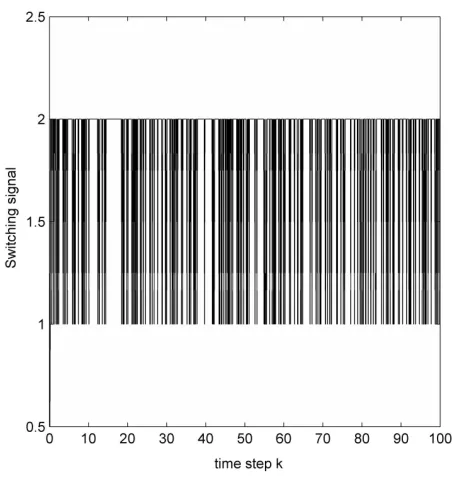
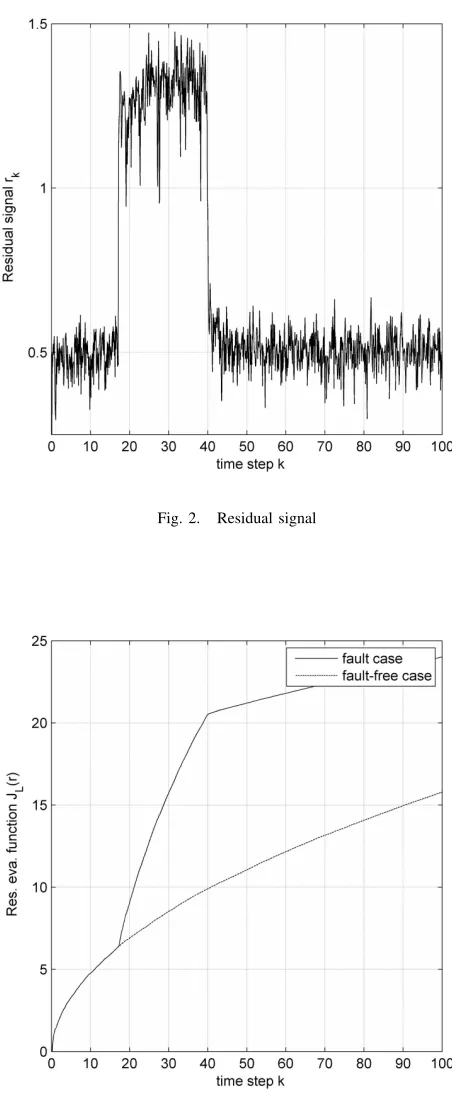
wave of unit amplitude occurred from 20 to 40 steps. The switching signal is generated randomly and shown in Fig.1. The generated residual rk is shown in Fig.2. The threshold can be determined
as Jth = 15.8092 for l0 = 0 and L = 100. Fig.3 shows the
evolution of residual evaluation function JL(r), where the dashed
line is fault-free case, the solid line is the case with the fault fk.
The simulation results show that JL(r) = 15.9613> 15.8092for
L= 32, which means that the faultfk can be detected twelve time
steps after its occurrence.
V. CONCLUSION
The problem of RFDFD for discrete-time switched systems with state delays has been investigated. A mode-dependent filter is con-structed as a residual generator. By augmenting the states of the original system and the filter, the problem of RFDFD has been cast into an H∞ filtering problem. By using switched Lyapunov
functional approach, a sufficient condition for the solvability of this problem is established in terms of LMIs and the desired filter has been constructed. An example has been given to show the effectiveness of the proposed methods.
ACKNOWLEDGMENT
The authors would like to thank the editor and the reviewers for their helpful suggestions to improve the quality of this paper.
Fig. 1. Switching signal
REFERENCES
[1] R. J. Patton, P. M. Frank, R. N. Clark, Issue of Fault Diagnosis for Dynamic Systems. Springer: Berlin, 2000.
[2] A. Casavola, D. Famularo, and G. Franze, “A robust deconvolution scheme for fault detection and isolation of uncertain linear systems: an LMI approach,”Automatica, vol. 41, no. 8, pp. 1463–1472, Aug. 2005. [3] J. Chen, and P. R. Patton,Robust model-based fault diagnosis for dynamic
systems. Boston: Kluwer Academic, 1999.
[4] Z. Mao, and B. Jiang, “Fault identification and fault-tolerant control for a class of networked control systems,”Int. J. Innov. Comput., Inf. Control, vol. 3, no. 5, pp. 1121–1130, May 2007.
[5] A. Fekih, H. Xu and F. Chowdhury, “Neural networks based system identification techniques for model based fault detection of nonlinear systems,”Int. J. Innov. Comput., Inf. Control, vol.3, no.5, pp.1073-1085, May 2007.
[6] P. M. Frank, and S. Ding, “Survey of robust residual generation and evaluation methods in observer-based fault detection systems,” J. Process Control, vol. 7, no. 6, pp. 403–424, Dec. 1997.
[7] S. K. Nguang, P. Shi, and S. Ding, “Fault detection for uncertain fuzzy systems: an LMI approach,”IEEE Trans. Fuzzy Systems, vol. 15, no. 6, pp. 1251–1262, Dec. 2007.
[8] A. M. Stoica, A. Constantinescu, “Fault detection algorithm based on a discrete-time observer residual generator–a GPS application,” inEuropean Control Conference, 2007, pp. 345–3152.
[9] A. M. Stoica, M. J. Grimble, “H∞low-order design for fault detection
and identification problems,” inSAFEPROCESS Conference, 2003, pp. 537–542.
[10] S. Ding, T. Jeinsh, P. M. Frank, and E, L. Ding, “A unified approach to the optimization of fault detection systems,”Int. J. Adapt. Control Signal Process., vol. 14, no. 5, pp. 725–745, Oct. 2000.
[11] M. Y. Zhong, H. Ye, P. Shi, G. Wang, “Fault detection for Markovian jump systems,”IEE Proc. Control Theory Appl., vol. 152, no. 4, pp. 397– 402, Apr. 2005.
[12] M. Y. Zhong, S. Ding, J. Lam, and H. Wang, “An LMI approach to design robust fault detection filter for uncertain LTI systems,”Automatica, vol. 39, no. 3, pp. 543–550, Mar. 2003.
[13] X. He, Z. Wang, Y. D. Ji and D. H. Zhou, “Network-based fault detection for discrete-time state-delay systems: a new measurement model,”Int. J. Adapt. Control Signal Process., vol. 22, no. 5, pp. 510–528, Jun. 2008. [14] D. Liberzon, Switching in Systems and Control. Birkh¨auser, Boston,
2003.
Fig. 2. Residual signal
Fig. 3. Evolution of residual evaluation function
[16] R. DeCarlo, M. S. Branicky, S. Pettersson, and B. Lennartson, “Perspec-tives and results on the stability and stabilizability of hybrid systems,” Proc. of the IEEE, vol. 88, no. 7, pp. 1069–1082, Jul. 2000.
[17] Z. Sun, S. S. Ge, Switched Linear Systems: Control and Design, Springer-verlag, New York, 2005.
[18] R. Wang and J. Zhao, “Exponential stability analysis for discrete-time switched linear systems with time-delay,” Int. J. Innov. Comput., Inf. Control, vol.3, no.6(B), pp.1557-1564, Jun. 2007.
[19] D. Wang, W. Wang, and P. Shi, “Delay-dependent exponential stability for switched delay systems,” Optim. Control Appl. Meth., in press, DOI:10.1002/oca.856, 2008.
[20] D. Wang, W. Wang, and P. Shi, “ExponentialH∞Filtering for Switched
Linear Systems with Interval Time-Varying Delay,”Int. J. Robust Non-linear Control, in press, DOI:10.1002/rnc.1334, 2008.
[21] X. Sun, J. Zhao, D. J. Hill, “Stability andL2-gain analysis for switched
delay systems: A delay-dependent method,”Automatica, vol. 42, no. 10, pp. 1769–1774, Oct. 2006.
[22] X. Sun, W. Wang, G. P. Liu, J. Zhao, “Stability analysis for linear switched systems with time-varying delay,” IEEE Trans. Syst., Man Cybern. B: Cybern., vol. 38, no. 2, pp. 528–533, Apr. 2008.
[23] M. S. Branicky, “Multiple Lyapunov functions and other analysis tools for switched and hybrid systems,”IEEE Trans. Automat. Control, vol. 43, no. 4, pp. 475–482, Apr. 1998.
[24] J. P. Hespanha, A. S. Morse, “Stability of switched systems with average dwell-time,” inProc. 38th Conf. Decision Control, 1999, pp. 2655–2660. [25] J. Daafouz, P. Riedinger, and C. Iung, “Stability analysis and control synthesis for switched systems: A switched Lyapunov function approach,” IEEE Trans. Autom. Control, vol. 47, no. 11, pp. 1883–1887, nov, 2002. [26] H. Gao, J. Lam, Z. Wang, “Discrete bilinear stochastic systems with time-varying delay: Stability analysis and control synthesis,” Chaos Solitons Fractals, vol. 34, no. 2, pp. 394–404, Oct. 2007.
[27] H. Gao, and T. Chen, “New results on stability of discrete-time systems with time-varying state delay,”IEEE Trans. Autom. Control, vol. 52, no. 2, pp. 328–334, Feb. 2007.
[28] M. Basin, E. Sanchez and R. Martinez-Zuniga, “Optimal linear filtering for systems with multiple state and observation delays,” Int. J. Innov. Comput., Inf. Control, vol. 3, no. 5, pp. 1309–1320, May 2007. [29] A. E. Rodkina, and M. V. Basin, “On delay-dependent stability for vector
nonlinear stochastic delay-difference equations with Volterra diffusion term,”Syst. Control Lett., vol. 56, no. 6, pp. 423-430, Jun. 2006. [30] M. V. Basin, and A. E. Rodkina, “On delay-dependent stability for a class
of nonlinear stochastic systems with multiple state delays,” Nonlinear Anal. Theory, Meth. Appl., vol. 68, no. 8, pp. 2147-2157, Apr. 2007. [31] L. Hetel, J. Daafouz, and C. Iung, “Stabilization of arbitrary switched
linear systems with unknown time-varying delays,”IEEE Trans. Autom. Control, vol. 51, no. 10, pp. 1668–1674, Oct. 2006.
[32] D. Du, B. Jiang, P. Shi, S. Zhou, “H∞filtering of discrete-time switched
systems with state delays via switched Lyapunov function Approach,” IEEE Trans. Automat. Control, vol. 52, no. 8. pp. 1520–1525, 2007. [33] S. Kim, S. A. Campbell, X. Liu, “Stability of a class of linear switching
systems with time delay,”IEEE Trans. Circ. Syst. I Fun Theory Appl., vol. 53, no. 2, pp. 384–393, Feb. 2006.
[34] L. Zhang, P. Shi, E. K. Boukas, C. Wang, “Robustl2−l∞filtering for
switched linear discrete time-delay systems with polytopic uncertainties,” IET Proc. Control Theory Appl., vol. 1, no. 3, pp. 722–730, Mar. 2007. [35] P. Shi, E. K. Boukas, R. Agarwal, “Control of Markovian jump
discrete-time systems with norm bounded uncertainty and unknown delay,”IEEE Trans. Automat. Contr., vol. 44, no. 11, pp. 2139–2144, Nov. 1999. [36] Z. Wang, F. Yang, D. W. C. Ho, X. Liu, “Robust H∞ control for