Functions up to Fairness
Nikolaos Makriyannis
Departament de Tecnologies de la Informaci´o i les Comunicacions Universitat Pompeu Fabra, Spain
Abstract. Two parties,P1 andP2, wish to jointly compute some func-tionf(x, y) whereP1 only knowsx, whereasP2 only knowsy. Further-more, and most importantly, the parties wish to reveal only what the output suggests. Functionfis said to be computable withcomplete fair-ness if there exists a protocol computing f such that whenever one of the parties obtains the correct output, then both of them do. The only protocol known to compute functions with complete fairness is the one of Gordon et al (STOC 2008). The functions in question are finite, Boolean, and the output is shared by both parties. The classification of such func-tions up to fairness may be a first step towards the classification of all functionalities up to fairness. Recently, Asharov (TCC 2014) identifies two families of functions that are computable with fairness using the protocol of Gordon et al and another family for which the protocol (po-tentially) falls short. Surprisingly, these families account for almost all finite Boolean functions. In this paper, we expand our understanding of what can be computed fairly with the protocol of Gordon et al. In partic-ular, we fully describe which functions the protocol computes fairly and which it (potentially) does not. Furthermore, we present a new class of functions for which fair computation is outright impossible. Finally, we confirm and expand Asharov’s observation regarding the fairness of fi-nite Boolean functions: almost all functionsf:X×Y → {0,1}for which |X| 6=|Y|are fair, whereas almost all functions for which|X|=|Y|are not.
Keywords: Complete Fairness, Secure Two-Party Computation
1
Introduction
(personal) inputs/outputs suggest,correctness - parties’ outputs are distributed according to the prescribed functionality,independence of inputs - no party can choose his input as a function of another party’s input,complete fairness - if a certain party learns the correct output then all of them do. On the other hand, if the adversary corrupts more than half of the parties, then protocols are known to exist that satisfy the first three requirements but not the last. Whether or not there exist protocols that guarantee complete fairness (fairness for short) is an open problem. In fact, the problem remains open even for the case where only two parties are involved and the functionality in question is finite, Boolean and deterministic. The aim of the present paper is to shed some light on this particular case: fairness of finite Boolean functions in 2PC.
It was long thought that non-trivial functions arenot computable with fair-ness. Cleve’s seminal paper [8], while not explicitly about fairness, has some clear implications regarding the topic in question. Loosely speaking, any func-tion that can be used for coin-tossing is not computable with fairness. This includes, among others, the exclusive-or operation XOR : (x, y)7→ x⊕y. Ar-guably, the implications of Cleve’s paper may have deterred others from pursuing the question.
In a surprising turn of events, Gordon et al [10] showed that the folklore is false. In particular, all finite Boolean functionsf thatdo not contain embedded XORs (i.e.∃x1, y1, x2, y2such thatf(x1, y1) =f(x2, y2)6=f(x1, y2) =f(x2, y1)) are computable with fairness. These functions roughly correspond to the Mil-lionaire’s Problem (i.e.f(x, y) = 0⇔x≥y). The authors also show that even certain XOR-embedded functions are fair. Using the real/ideal world paradigm, they design a protocol (that we henceforth refer to as the GHKL-protocol) and show that for certain functions, any real world adversary can be simulated in the ideal model. Thus proving that in an execution of the GHKL-protocol, the adversary cannot gain any advantage in learning the output over the honest party. On the other hand, in [5], Asharov et al give a complete characterization of finite Boolean functions that are not fair due to the coin-tossing criterion. In other words, there exists a class of functions (strictly balanced functions) that cannot be computed fairly, since the realisation of any such function yields a completely fair coin-toss. What’s more, they show that functions that are not in that classcannot be reduced to the coin-tossing problem, meaning that any new negative results with respect to fairness must rely on different criteria.
fairness using the GHKL-protocol, leaving the problem of determining whether they are fair or not wide open. Finally, the author also considers asymmetric and non-binary functions.
Preventing one party from gaining an advantage over the other seems like a desirable security requirement for 2PC. Fairness guarantees exactly that. In addition, apart from its obvious appeal as a security requirement, fairness is important to the theoretical foundation of Multi-Party Computation. The char-acterization of finite Boolean functions that are computable with fairness may be a first step towards the classification of all functionalities up to fairness.
Our Results. In the present paper, we take another step towards characterizing finite Boolean functions up to fairness. Ideally, we would like to find a universal criterion to determine whether adeterministic single-output Boolean function is computable with fairness. We remind the reader that certain functions are known to be fair (using the GHKL-protocol) and certain functions are not (due to the coin-tossing criterion). We contribute to both of these fronts. First, we give a definite answer to the following question: Given a finite Boolean function f : X×Y → {0,1}, isf computable with fairness using the GHKL-protocol? In [3], Asharov answers the question for three particular families of functions. We settle the question using linear algebra. Next, we expand our knowledge of functions which are provably unfair. We show that certain functions are reducible to the sampling problem:P1 andP2 generate separate random bits according to some joint probability distribution. The sampling problem is a natural generalisation of coin-tossing and was shownnotto be computable with fairness by Agrawal and Prabhakaran [2]. Finally, by using the same argument, we confirm and expand Asharov’s observation regarding the fairness of finite Boolean functions:almost all functions f :X×Y → {0,1} for which |X| 6=|Y| are fair, whereas almost all functions for which|X|=|Y| are not.
Outline of the Paper. The next section contains notation and definitions. In particular, we introduce secure computation and the ideal model paradigm. In Section 3 we give an informal description of the GHKL-protocol (in its gener-alised version proposed by Asharov [3]) and a brief overview of the simulation strategy. We conclude with a sufficient criterion for fairness, as it appears in [10]. Our contributions begin in Section 4 where we find an equivalent criterion in-volving the linear dependence of the columns of a certain associated matrix. Section 5 contains the classification of all functions with respect to these crite-ria. Finally, the last section contains our negative result. We present a class of functions for which fair computation is impossible.
2
Preliminaries
sets, that is X = {x1, . . . , xℓ} and Y = {y1, . . . , yk}. To every such function
we associate a matrix M ∈Rℓ×k, whereM
i,j =f(xi, yj). Theith row andjth
column ofM will be denotedrowi andcolj, respectively. Thus,
M =
row1 .. .
rowℓ
=
col1
. . .colk
.
More generally, we use capital letters for matrices (M, P, . . .). We denote the ker-nel and image ofM by ker(M) and im(M) respectively, and its transpose byMT.
Vectors will be denoted by lower case letters (u, v, . . .) or bold letters (p,q,x, . . .). In particular, 1ℓ and 0ℓ represent the all-1 and all-0 vector respectively, these
elements will also be called monochromatic. We say that pT = (p1, . . . , pk) is a
probability vector ifPipi= 1 andpj≥0, for everyj.
Let Rk denote the real vector space of dimension k and let hu|vi = uTv
denote the standard inner product. As usual, two vectors are orthogonal if their inner product is equal to 0. Similarly, two subsets ofRk are orthogonal if every
element of the first is orthogonal to every element of the second. Recall the fundamental theorem of linear algebra: for a given matrix M ∈ Rℓ×k, ker(M)
and im(MT) are orthogonal and their sum spans the entire space. Furthermore,
letIker(M)denote theorthogonalprojection ofRk onto ker(M) i.e.Iker(M)is the unique linear map fromRk onto itself that annihilates the elements of im(MT)
and corresponds to the identity when restricted to ker(M). Finally, given a vector spaceV ⊆Rk and ak×kmatrixP, we say thatP defines an endomorphism of
V ifP v∈ V, for everyv∈ V.
2.1 Two-Party Computation
Let n ∈ N denote the security parameter. A function µ(·) is negligible if it vanishes faster than any (positive) inverse-polynomial. A distribution ensemble X ={X(a, n)}a∈∆n,n∈N is an infinite sequence of random variables indexed by
∆n andN. Two distribution ensembles,X andY, arecomputationally
indistin-guishable if for every non-uniform polynomial-time algorithm D, there exists a negligible functionµsuch that for everyaandn
|Pr[D(X(a, n)) = 1]−Pr[D(Y(a, n)) = 1]| ≤µ(n).
Furthermore, we say thatX andY arestatistically close if for allaand n, the following sum is upper-bounded by a negligible function inn:
1 2·
X
s
|Pr[X(a, n) =s]−Pr[Y(a, n) =s]|,
Let P1, P2 denote the parties. A two-party functionality F = {fn}n∈N, is
a sequence of random processes such that each fn maps pairs of inputs (one
for each party) to pairs of random variables (one for each party). The domain of fn is denoted Xn×Yn and the output (fn1, fn2). A two-party protocol π for
computing a functionalityF, is a polynomial-time protocol such that on inputs x∈Xn andy∈Yn, the joint distribution of the outputs of any honest execution
ofπis statistically close to fn(x, y) = (fn1(x, y), fn2(x, y)).
The Adversary. Following the usual convention, we introduce an adversaryA
given auxiliary inputz corrupting one of the parties. The adversary is assumed to be malicious and computationally bounded. For a protocolπ computing F, let (OutReal
A(z),π,View
Real
A(z),π)(x, y, n) denote the joint distribution of the honest
party’s output and the adversary’s view during an execution of π, wherexand y are the prescribed inputs andnis the security parameter.
2.2 The Ideal Model Paradigm
Let F = {fn}n∈N be a two-party functionality and let π be a protocol for
computingF. Further assume that an adversary is corrupting one of the parties. Security in two-party computation is defined via an ideal model. Namely, we assume that parties have access to a trusted party that performs the computation for them, and we attempt to show that protocolπemulates this ideal scenario. We will now describe three ideal models and give definitions of security for each of them. The first corresponds to complete fairness which is the topic of the present paper. Our goal is to show there exist (or not) protocols which are secure with respect to this model. The other two are stepping stones which will help us achieve that goal. We now describe the ideal model with complete fairness (Figure 1).
Inputs: P1 holds 1nandx∈Xn,P2 holds 1nandy∈Yn. The adversary is given an auxiliary inputz∈ {0,1}∗.
Parties send inputs: The honest party sends his input to T, the corrupted party sends a value of the adversary’s choice. Write (x′, y′) for the pair of inputs received
byT.
Trusted party performs computation: If eitherx′ory′are not in the appropriate
domain, thenT reassigns the aberrant input to some default value. Write (x′, y′)
for the pair of inputs after (possible) reassignment. The trusted party then chooses a random stringrand computes (fn1, fn) =2 fn(x′, y′;r).
Trusted party sends outputs: PartyP1 receivesfn,1 P2 receivesfn.2
Outputs: The honest party outputs whateverT sent him, the corrupted party outputs nothing and the adversary outputs a probabilistic polynomial-time function of its view.
Let S be an adversary given auxiliary input z corrupting one of the par-ties. Write (OutIM fairS(z),f,View
IM fair
S(z),f)(x, y, n) for the joint distribution of the honest
party’s output and the adversary’s view, wherexandyare the prescribed inputs andnis the security parameter. We now define security with respect to the ideal model with complete fairness.
Definition 2.1. Let π be a protocol for computing F. We say that π securely computes F with complete fairness (or F is fair for short) if for every non-uniform polynomial time adversary A in the real model, there exists a non-uniform polynomial time adversaryS in the ideal model such that
(
OutRealA(z),π,View
Real
A(z),π
x, y, n )
(x,y)∈Xn×Yn, z∈{0,1}∗,n∈N c
≡
(
OutIM fair
S(z),F,View
IM fair
S(z),F
x, y, n )
(x,y)∈Xn×Yn, z∈{0,1}∗,n∈N
.
In effect, showing that the above distribution ensembles are computationally indistinguishable implies that, in the plain model, the information acquired by the adversary together with his influence over the honest party’s output is no worse than what can be achieved in an idealized situation. Moving on, we also define the ideal model with abort (Figure 2) and define security with respect to this model. We note that all functionalities are securely computable with abort (Definition 2.2). Once again, letS be an adversary given auxiliary inputz corrupting one of the parties, and write (OutIM abort
S(z),f ,View
IM abort
S(z),f )(x, y, n) for the
joint distribution of the honest party’s output and the adversary’s view, where xandy are the prescribed inputs andnis the security parameter.
Definition 2.2. Let π be a protocol for computing F. We say that π securely computes F with abort if for every non-uniform polynomial time adversary A
in the real model, there exists a non-uniform polynomial time adversaryS in the ideal model such that
(
OutRealA(z),π,View
Real
A(z),π
x, y, n )
(x,y)∈Xn×Yn, z∈{0,1}∗,n∈N c
≡
(
OutIM abortS(z),F,View
IM abort
S(z),F
x, y, n )
(x,y)∈Xn×Yn, z∈{0,1}∗,n∈N
.
Inputs: P1 holds 1nandx∈Xn,P2 holds 1nandy∈Yn. The adversary is given an auxiliary inputz∈ {0,1}∗.
Parties send inputs: The honest party sends his input to T, the corrupted party sends a value of the adversary’s choice. Write (x′, y′) for the pair of inputs received
byT.
Trusted party performs computation: If eitherx′ory′are not in the appropriate
domain, thenT reassigns the aberrant input to some default value. Write (x′, y′)
for the pair of inputs after (possible) reassignment. The trusted party then chooses a random stringrand computes (f1
n, fn2) =fn(x′, y′;r).
Trusted party sends outputs: Corrupted party Pi receives fni from the trusted party. The adversary then decides either to abort or continue. In the first case, T sends⊥to the honest party. In the second case,P3−i receivesfn3−i.
Outputs: The honest party outputs whateverT sent him, the corrupted party outputs nothing and the adversary outputs a probabilistic polynomial-time function of its view.
Fig. 2:Ideal model with abort
LetF1, . . . ,FmandF be two-party functionalities. A protocolπfor computing
F in the (F1, . . . ,Fm)-hybrid model consists in an protocol computing F that
proceed in rounds such that at any given round:
• Parties exchange information as in the real modelor
• Parties invoke a trusted party computingFi according to a specified ideal
model.
We say that π computes F securely in the (F1, . . . ,Fm)-hybrid model if for
any adversary corrupting one of the parties in the hybrid model, there exists a simulator S in the ideal model such that the joint distribution of the adver-sary’s view and honest party’s output is indistinguishable in both worlds. Hence, applying the composition theorem of [7], and assuming there exists secure pro-tocolsρ1, . . . , ρmcomputingF1, . . . ,Fm, protocolπρ1...ρm securely computesF,
where πρ1...ρm is obtained by replacing ideal calls to the trusted party with the
appropriate protocols.
Reactive Functionalities. A reactive functionalityG is a cryptographic task that proceeds in several phases, where the input of one phase may depend on the output of previous phases. With respect to the ideal model with abort, every reactive functionality can be computed securely. Let π be a protocol for com-putingF that does not involve any direct exchange of information between the parties. Rather, at any given round, parties make a single call to a trusted party computingGwith abort. The composition theorem still holds, that is if the joint distribution of the adversary’s view and honest party’s output is indistinguish-able in the G-hybrid and ideal model with complete fairness, then protocol πρ
3
Computing Fair Functions
In this section, we focus on the GHKL-protocol [10], the only protocol that provably computes (certain) functions with complete fairness. We follow the de-scription and generalisation proposed by Asharov in [3]. The protocol is defined in the hybrid model where parties have access to a trusted party computing a certain reactive functionality with abort. We give an informal description of the protocol and a brief overview of the simulation strategy. The complete descrip-tion and simuladescrip-tion strategy can be found in [11] and [4], in their respective appendices.
3.1 Informal Description of the Generalised GHKL-Protocol
Letf :X×Y → {0,1}be a finite Boolean function, suppose that the prescribed inputs ofP1, P2 arexandy respectively. The GHKL-protocol for computingf is parametrized by three values: a real number α∈ (0,1), a probability vector
p∈Rℓand the security parametern. Prior to the execution of the protocol, the
number of rounds is fixed atr=α−1·ω(ln(n)).
• Compute Backup Outputs:P1 choosesye∈Y according to the uniform distribution and computes a0 = f(xi,y),e P2 choosesxe ∈ X according to distributionpand computesb0=f(ex, yj).
• Preliminary Phase: Parties are instructed to send their inputs to the trusted party. If either input is not in the correct domain, the trusted party responds with an abort symbol to both parties and halts. Otherwise, write (x′, y′) for the pair of inputs received by the trusted party. The trusted party
is instructed to choose an integeri∗according to the geometric distribution
with parameterα, and constructs the following bits:
− Fori= 1. . . i∗−1, seta
i=f(x′,ey(i)) andbi=f(ex(i), y′) whereye(i)and
e
x(i)are chosen according to the uniform distribution and distributionp, respectively.
− Fori=i∗. . . r, seta
i=bi=f(x′, y′).
• Online Phase:Fori= 1. . . r
1. P2 sends proceed to the trusted party,P1then receivesai.
2. P1 sends proceed to the trusted party,P2then receivesbi.
If either party sends abort, then both receive⊥and the trusted party halts.
• Outputs:Parties are instructed to output the last ai/bi they successfully
constructed/received.
3.2 Security
the other hand, precisely becauseP1receives the correct input first, an adversary
A controllingP1 can potentially affect the protocol’s fairness. We focus on the latter case and give an incomplete description of the simulator S in the ideal model.
Suppose thatAhands x∈X toS for the computation off. The simulator chooses a value i∗ according to the geometric distribution with parameter α.
Now, for i = 1. . . i∗ −1, simulator S hands ai = f(x,ye(i)) to A, where ey(i)
is chosen according to the uniform distribution. If at any point the adversary decides to abort,S choosesx′ according to probability distribution x(ai)
x (that
we define below), sends x′ to the trusted party, outputs whatever A outputs,
and halts. Otherwise, ati=i∗, the simulator sendsxto the trusted party and
receivesaout=f(x, y) which it hands toA. IfAaborts, thenSoutputs whatever
Aoutputs, and halts. Finally, fori=i∗+ 1. . . r, the simulator handsa
out toA. Once again, ifAaborts, thenS outputs whateverAoutputs, and halts.
Recall that the protocol is secure if the joint distributions of the adversary’s view and the honest party output in the ideal and hybrid model are computa-tionally indistinguishable. The simulation strategy boils down to the existence of x(xa) that will do the trick. Using the fact that i∗ is chosen according to a
geometric distribution, it can be shown that the above simulation works if for alla∈ {0,1}, for allx∈ {x1, . . . , xℓ},
MT·x(a)
x =c(xa),
whereMi,j=f(xi, yj),
c(0)x (j)def= (
pyj iff(x, yj) = 1 α·pyj
(1−α)·(1−px)+pyj otherwise ,
c(1)x (j)def=
(α·(pyj−1)
(1−α)·px +pyj iff(x, yj) = 1
pyj otherwise
,
and
(py1, . . . , pyk)
def
= pT·M, (px1, . . . , pxℓ)
T def= M·(1/k, . . . ,1/k)T.
Theorem 3.1. Using the notation above, if for some probability vector p and α∈(0,1), and for alli∈ {1, . . . , ℓ}, there exist probability vectorsx(0)xi,x(1)xi ∈Rℓ
such that
MT·x(xia)=c(xia),
thenf is computable with complete fairness using the GHKL-protocol.
4
Equivalent Conditions for GHKL-Fairness
The conditions of Theorem 3.1 depend heavily on parameters of the protocol, namelyα,{pxi}iand{pyj}y. A universal criterion for fairness would only depend
on the function itself. Failing that, we aim to find equivalent conditions that are “easier” to verify. In this section, starting with the equations of Theorem 3.1, we present a new set of conditions that do not depend on α, nor {pxi}i,
but only{pyj}j and the function itself. Let f be a finite boolean function, and
assume that f is GHKL-fair i.e. for some α ∈ (0,1) and probability vectorp, and all i ∈ {1, . . . , ℓ}, there exist probability vectors xxi(0),x(1)xi ∈ Rℓ such that
MT ·x(a)
xi =c(xia).Define
e
x(0)xi def= (1−α)(1−pxi) α
x(0)xi −p ,
e
x(1)xi def= (1−α)pxi α
x(1)xi −p
,
and note that
MT·ex(xia)=ec(xia) , (1) where
ec(0)xi(j) = (
0 iff(xi, yj) = 1
pyj otherwise
, ec(1)xi(j) = (
pyj −1 iff(xi, yj) = 1
0 otherwise .
Furthermore, X
j
e
x(xia)(j) = 0 , (2)
∀j, ex(0)xi (j)∈ (1−α)(1−pxi)
α ·[−p(j),1−p(j)] , (3)
∀j, ex(1)xi (j)∈ (1−α)pxi
α ·[−p(j),1−p(j)] . (4)
Conversely, if for some probability vector pand α∈(0,1), and for all i, there existex(0)xi andxe(1)xi satisfying relations (1) to (4), then we can constructx(0)xi and
x(1)xi satisfying Theorem 3.1. Specifically,
x(0)xi =
α·ex(0)xi
(1−α)(1−pxi)+p ifpxi 6= 1
p otherwise,
x(1)xi =
α·xe(1)xi
(1−α)pxi +p ifpxi 6= 0
p otherwise .
assumption does not incur any loss of generality: If there exists a “suitable”p
with zero-entries, then we can construct another “suitable” probability vector that is strictly positive. For further details, see Appendix A. To sum up, we conclude with the following theorem.
Theorem 4.1. Using the notation above, function f is GHKL-fair if and only if for some strictly positive p, and all i ∈ {1, . . . , ℓ}, there exist xe(0)xi and ex(1)xi
such that
MT ·xe(xia)=ec(xia) and X
j
e
x(xia)(j) = 0 .
Recall that pTM = (p
y1, . . . , pyk). Define P(M,p) = diag(py1, . . . , pyk) i.e.
the diagonal matrix whose components are thepyi. If no confusion arises,P(M,p)
will be denotedP. In Figure 3, we express the conditions of Theorem 4.1 with respect to matrix P. In effect, function f is GHKL-fair if (1T
k −rowi)P and
For alli∈ {1, . . . , ℓ}, for alla∈ {0,1}, there exists (µ(a)i,1, . . . , µ(a)i,ℓ) that satisfies 1. Pjµ(a)i,j = 0,
2. (µ(0)i,1, . . . , µ(0)i,ℓ)M = (1T
k −rowi)P, 3. (µ(1)i,1, . . . , µ(1)i,ℓ)M =rowi(P−Idk).
Fig. 3:GHKL-fairness conditions
rowi(P −Idk) belong to the image of MT and admit a suitable pre-image. Let
V ={v ∈ Rℓ|P
ivi = 0}. By considering an appropriate basis of V, we note
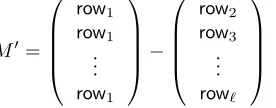
that the image ofV byMT corresponds exactly to the image ofM′T, where
M′=
row1
row1 .. .
row1 −
row2
row3 .. .
rowℓ
.
Furthermore, a quick analysis shows that ker(M′) =v∈RkM v= (δ, . . . , δ)T .
Going back to the conditions of Figure 3, functionf is GHKL-fair if (1Tk−rowi)P
androwi(P−Idk) belong to the image ofM′T. By orthogonality,
∀v∈ker(M′), (
(1Tk −rowi)P v = 0 rowi(P−Idk)v = 0
,
both of which boil down torowiP v=δ. By lettingivary, we deduce the following
Proposition.
Already, we see that for a givenp, verifying that a functionf is GHKL-fair is very easy. Take a basis of ker(M′) and check thatM(Id
k−P)v=0ℓ, for every
element of the basis. Of course findingpis a non-trivial task, and we look into that later on. For the remainder of the section, we show that certain functions are not viable candidates for GHKL-fairness, regardless of the value ofp.
Lemma 4.3. AssumingM v =M P v, for every v ∈ker(M′), matrixP defines
an endomorphism ofker(M)as well as im(MT).
Proof. First of all, ifv∈ker(M), thenM P v=M v= 0 and thusP v∈ker(M). On the other hand, let u ∈ im(MT) and v ∈ ker(M). Since P is diagonal,
we deduce that hP u|vi=hu|P vi, and thus hP u|vi= 0. Since v is arbitrary,
P u∈im(MT). ⊓⊔
Lemma 4.4. Suppose that M v =M P v, for every v ∈ ker(M′). Furthermore,
assuming it exists, let b ∈ Rk denote the unique pre-image of 1
ℓ by M that is
orthogonal toker(M). Then,b(j)6= 0impliescolj =1ℓ.
Proof. We know that (Idk−P)b ∈ker(M). Now, sinceP is an endomorphism
of im(MT), and thus (Id
k−P)b ∈ im(MT), we deduce that (Idk−P)b = 0.
Consequentlyb(j)6= 0 impliesPj,j= 1, and since Pj,j =pTcolj andp>0ℓ, we
conclude thatcolj=1ℓ. ⊓⊔
Theorem 4.5. Using the notation above, f is GHKL-fair if and only if 1. no linear combination of the non-monochromatic columns ofM yields1ℓ,
2. there exists a strictly positivepsuch that matrixP defines an endomorphism ofker(M).
Proof. The second item is necessary because of Lemma 4.3. For the first item, suppose without loss of generality that the first k′ columns contain1
ℓ in their
linear span, and none of them is monochromatic. We show thatb(j)6= 0, for some j∈ {1, . . . , k′}, in contradiction with Lemma 4.4. Let v= (v
1, . . . , vk′,0, . . . ,0),
such thatM v=1ℓ. We know thatv=b+v′, wherev′∈ker(M). Consequently,
hv|bi=hb|bi>0, and we conclude that at least one of the firstk′ entries ofb
is non-zero.
Conversely, we show that the two conditions imply Proposition 4.2. First, sinceP is an endomorphism of ker(M), then 0 =M v=M P v, for allv∈ker(M). It remains to show thatM b=M P b. Since the non-monochromatic columns of M do not span the all-1 vector, we deduce thatb(j)6= 0 if and only ifcoli=1ℓ,
and thus Pi,i= 1. Consequently,P b=b, and thus f is GHKL-fair. It can also
be shown that neither condition is sufficient on its own. ⊓⊔
5
Classification of GHKL-Fair Functions
Proposition 5.1. If f is GHKL-fair, then the same is true of1−f.
Proof. We prove the claim by applying Proposition 4.2. Assuming that M is the associated matrix of f, write M for the associated matrix of 1−f. Using the same p, assuming that M v = M P v, for every v ∈ ker(M′), and noting
that ker(M′) = ker(M′), we conclude that M v = M ·P(M ,p)·v, for every
v∈ker(M′). ⊓⊔
Corollary 5.2. Suppose that f is GHKL-fair. Further assume that the first k′
columns ofM are non-monochromatic. Then,Pki=1′ vicoli=0ℓimpliesPk ′
i=1vi=
0.
Proof. If not, we obtain a contradiction with the above proposition and the first
item of Theorem 4.5. ⊓⊔
DefineM0/1∈ {0,1}ℓ×k
′
obtained fromMby deleting all monochromatic columns. We distinguish 4 types of functions depending on the following properties of their associated matrix:
(Type 1) 1ℓ∈im(M0/1) .
(Type 2) 1ℓ∈/im(M0/1)and ker(M0/1) ={0k′}.
(Type 3) 1ℓ∈/im(M0/1)and ker(M0/1)6={0k′}and ker(M0/1)⊆ {v|Pivi= 0}. (Type 4) 1ℓ∈/im(M0/1)and ker(M0/1)=6 {0k′}and ker(M0/1)*{v|
P
ivi= 0}.
Theorem 5.3. Let f be a finite Boolean function.
• Iff is of type 1 or 4, then it is not GHKL-fair.
• Iff is of type 2, then it is GHKL-fair.
Proof. Functions of type 1 do not satisfy the first item of Theorem 4.5. Similarly, functions of type 4 are not in accordance with Corollary 5.2. On the other hand, and by applying Theorem 4.5, we note that functions of type 2 and 3 do not contain 1ℓ in the linear span of the non-monochromatic columns. It remains
to show that there exists a strictly positive p such that matrix P defines an endomorphism of the kernel. If f is of type 2, then columns of M that are linearly dependent are all monochromatic. Knowing that (py1, . . . , pyk) =p
TM,
a quick analysis shows that matrix P defines an endomorphism of ker(M), for anyp. Finally, for functions of type 3, the existence ofpdepends on the linearly dependent columns ofM0/1, and so a general rule cannot be extrapolated at this
point. ⊓⊔
5.1 Finding the Probability Vector
Theorem 5.3 does not account for functions of type 3. Indeed, the existence of
pdepends on the linearly dependent columns ofM0/1. In the remainder of this
section, we show that the existence of pis subject to the resolution of a linear program. We note that the program is defined in the broadest possible terms, meaning that it’s a “one size fits all” way to find p. To illustrate, consider a matrix M ∈ {0,1}ℓ×k of type 2. Construct a new matrix by concatenating a
column of M to itself. Now, M is of type 2 and thus GHKL-fair, whereas the other is of type 3. It is easy to see however that it is also GHKL-fair, for anyp. Moving on, recall thatIker(M)denotes the orthogonal projection onto the kernel ofM. Furthermore, for alli, letIrowi
denote the diagonal matrixIrowi
j,j =rowi(j).
Theorem 5.4. Let f be a finite Boolean function of type 3. Function f is GHKL-fair if and only if
Iker(M)·Irow1 .. . Iker(M)·Irowℓ
MT
r1 .. . rℓ = 0 .. . 0 (5)
admits a strictly positive solution.
Proof. Letp= (r1, . . . , rℓ)T. First, note thatP =PiriIrowi, and thatP defines
an endomorphism of ker(M) if and only if
∀j ∈ {1, . . . , ℓ}, X
i
riI
rowi !
rowTj ∈im(MT) . (6)
Since the matrices are all diagonal, and thus commute, we deduce that X
i
riI
rowi !
rowTj = X
i
riI
rowi !
Irowj
·1ℓ=I
rowj X
i
rirowTi
!
=Irowj X
i
rirowTi
! =Irowj
·MT(r
1, . . . , rℓ)T .
Consequently, (6) holds if and only if (5) admits a strictly positive solution, in which case the probability vector is obtained by normalisation. ⊓⊔
5.2 Complete Fairness and GHKL-Fairness
We take a moment to discuss the relationship between complete and GHKL-fairness. Recall that the latter depends on a specific protocol (and simulation strategy), and constitutes a sufficient criterion for complete fairness. Let f be a finite Boolean function and definefT : (y, x)7→f(x, y). It might be the case
computable with complete fairness, the protocol in question being the GHKL-protocol with the players’ roles interchanged. We conclude that for any f, if eitherf or fT are GHKL-fair, thenf is computable with complete fairness.
Another possibility is to consider computationally equivalent functions [10] i.e. functions obtained by adding/deleting redundant inputs. By applying The-orem 4.5 however, one can show that GHKL-fairness is preserved. In particular, adding/deleting redundant inputs for P2 has no effect, and with a straightfor-ward modification of the probability vector, the same can be shown for P1. In summary, assuming a given function f is fair, if neither f nor fT is
GHKL-fair then to the best of our knowledge, there is no immediate way to design a completely fair protocol computingf from the one of Gordon, Hazay, Katz and Lindell.
On the other hand, assume that fair computation is impossible for a given functionf. Further assume that the function is not reducible to coin-tossing (not strictly balanced [5]). Then we need a new argument to prove that it is indeed unfair. In the next section, we do exactly that.
6
A Class of Unfair Functions
In this section, we present a new class of functions for which fair computation is impossible. We begin with an example. Letf :{x1, . . . , x4} × {y1, . . . , y4} →
{0,1} be the function with associated matrix
M =
0 1 0 1 1 1 1 0 0 0 1 0 1 0 0 0
.
First, note that neitherf norfT are GHKL-fair, since both of them are of type
1. Assuming there exists a completely fair realization of functionf, consider the following: P1 chooses among {x1, x3, x4} with equal probability, P2 choosesy4 with probability 2/5, or one of his other inputs with probability 1/5. Players computef on the chosen inputs and obtainb. Define
Out1=b, Out2= (
1−b ifP2 chosey2
b otherwise .
A quick analysis shows that Pr[Out1= 1] = 1/3, Pr[Out2= 1] = 2/5, and that the two are equal with probability 4/5. If Out1 and Out2 were independent, they would be equal with probability 8/15, which is not the case. Finally, it is not hard to see that any malicious behaviour by either party does not affect the probability distribution of the other party’s output.
are not independent. In [2], Agrawal and Prabhakaran show that this problem cannot be realised with complete fairness. In what follows, we demonstrate that there exists a large class of functions that are reducible to the sampling problem, and are thus unfair. Formally, letFSS denote the following functionality:
• Parametersp,q∈[0,1] andχ∈[2 max(p+q−1,0)−2pq ,2 min(p, q)−2pq].
• InputsEmpty for both parties.
• OutputsP1 andP2 receive bitsb1andb2∈ {0,1}, respectively, such that 1. Pr[b1= 1] =p,
2. Pr[b2= 1] =q,
3. Pr[b1=b2] =pq+ (1−p)(1−q) +χ.
Theorem 6.1. Unlessχ= 0, functionalityFSSis not computable with complete
fairness.
Proof. The proof is a natural generalisation of Cleve’s [8] original argument (wherep=q= 1/2) and can be found in [2]. Note that ifχ= 0, thenb1 andb2
are independent andFSS is trivially fair. ⊓⊔
In fact, FSS is not computable with complete fairness even if we allow the
adversary to learn the honest party’s output. Formally, we augment the ideal model with complete fairness such that after sending the outputs, the trusted party divulges the honest party’s output to the adversary. We claim that FSS
is not securely computable in this new augmented model. The claim is true because Cleve’s argument makes no assumption regarding the privacy of the parties’ outputs. As a corollary, we deduce that any finite Boolean function that can be reduced to an instance of the sampling problem is inherently unfair, even if the adversary learns the honest party’s output.
6.1 Semi-Balanced Functions
In [3], the author identifies a class of functions that are not GHKL-fair. Here, we go one step further and show that they are inherently unfair. In particular, they are all reducible to a (non-trivial) instance of the sampling problem.
Definition 6.2. Let f be a finite boolean function with matrix representation M and write M for the matrix representation of 1−f. We say that f is right semi-balanced if
∃q∈Rk such that
(
Mq=1ℓ
Mq6=0ℓ
.
Similarly, f is left semi-balanced if
∃p∈Rℓ such that
(
MTp=1 k
MTp6=0k
.
We dedicate the rest of the section to the proof of Theorem 6.3. We show that any secure protocol computingf with respect to the ideal model with complete fairness, implies the existence of a secure protocol computingFSS with respect
to the augmented model where the adversary learns the honest party’s output. Assumingf is left and right semi-balanced, fixq∈Rk,p∈Rℓ such that
P
i|pi|= 1
pTM = (δ1, . . . , δ1), δ1>0
pTM 6= (0, . . . ,0)
,
P
i|qi|= 1
Mq= (δ2, . . . , δ2)T, δ2>0 Mq6= (0, . . . ,0)T
.
Suppose that parties have access to a trusted party T computingf. Consider protocolπin thef-hybrid model:
• Inputs: On empty inputs, P1 choosesxi with probability|pi|, P2 chooses columnyj with probability|qj|.
• Invoke Trusted Party:P1, P2 invoke the trusted party on inputs xi and
yj respectively. As per the ideal model with complete fairness (Figure 1),T
hands both parties a bitb.
• Outputs:If pi < 0, then P1 outputs 1−b. Similarly, if qj < 0, then P2 outputs 1−b. Otherwise, parties are instructed to outputb.
Define p+, q+, p−, q− such thatp− = 1−p+=P
pi<0|pi|, and q− = 1−q+ =
P
qj<0|qj|.
Lemma 6.4. (p+−p−)δ
2= (q+−q−)δ1. Proof.
(p+−p−)δ2=pT(δ2, . . . , δ2)T =pTMq = (δ1, . . . , δ1)q= (q+−q−)δ1 .
⊓ ⊔
Lemma 6.5. An honest execution of πyields the following outputs:
• Pr[Out1= 1] =δ1+p−,
• Pr[Out2= 1] =δ2+q−,
• Out1 andOut2 are not independent random variables. Proof. Write Out(1)2 (xi) for Pr[Out2= 1|x=xi], then
Out(1)2 (x1), . . . ,Out(1)2 (xℓ)
T
=X
qi<0
|qi|(1ℓ−coli) +
X
qi≥0
|qi|coli
=X
qi<0
|qi|1ℓ+ k
X
i=1 qicoli
The output ofP1 is obtained in a similar fashion. Moving on, if Out1 and Out2 are independent, then they are equal with probability
(δ1+p−)(δ2+q−) + (−δ1+p+)(−δ2+q+) .
On the other hand, when the players executeπ, they will agree on the output if and only if both players flip their bits, or both players do not. Thus, Pr[Out1= Out2] =p−q−+p+q+.Consequently, if Out1and Out2are independent random variables, we deduce that
(δ1+p−)(δ2+q−) + (−δ1+p+)(−δ2+q+) =p−q−+p+q+ ,
which boils down to 2δ1δ2 = δ1(q+−q−) +δ2(p+−p−). Now, by Lemma 6.4 and knowing thatδ1, δ26= 0, we deduce that thatδ2=Pjqj andδ1=Pℓi=1pi.
These in turn are equivalent toMq=0ℓ andpTM =0Tk, which we have ruled
out by assumption. Hence, we conclude that Pr[Out1= Out2] =
Pr[Out1= 0]Pr[Out2= 0] + Pr[Out1= 1]Pr[Out2= 1] +χ ,
for someχ6= 0. ⊓⊔
It remains to show that every adversary in thef-hybrid model can be sim-ulated in the ideal model. We briefly describe the simulation strategy for a corrupted P1, the other case being identical. First, construct ℓ×k matrix Mf such that thej-th column ofMfis equal tocolj ifqj>0, and 1−colj otherwise.
Now, simulator S invokes A on the security parameter and auxiliary input z. The adversary handsxi toSfor the computation off, and the simulator invokes
the trusted party for computing FSS. As per the augmented model with
com-plete fairness, the trusted party leaks the honest party’s output, say Out2, toS. The simulator choosesyjaccording to the prescribed distribution conditioned on
f
Mi,j= Out2. Ifqj<0, the simulator hands 1−Out2 toA. Otherwise,S hands Out2toA. In any case, the simulator outputs whateverAoutputs, and halts. It is easy to see that the simulation strategy yields identical output distributions in the hybrid and ideal world.
Conclusion
To conclude, we make an observation regarding the number of functions that are either GHKL-fair or semi-balanced. A weaker version appears in [3] and the argument is based on [14]. Take a random functionf :X×Y → {0,1}such that
|X|>|Y|. Then, with probability greater than 1−ν(|Y|), where ν(∗) is some negligible function, f is GHKL-fair. Intuitively, this occurs because k random 0/1-vectors of sizeℓ(withℓ > k) will almost surely form a linearly independent set and yet their linear span will not contain the all-1 vector.
Similarly, take a random function f : X ×Y → {0,1} such that |X| =
negligible function,f is (leftand right) semi-balanced. The intuition now relies on the fact that for a random square matrixM, bothM andM are non-singular with overwhelming probability. Putting everything together, we come to the following conclusion: Almost all functions for which |X| 6=|Y| are computable with fairness, whereas almost all functions for which|X|=|Y|are not.
References
[1] Agrawal, S., Prabhakaran, M.: On fair exchange, fair coins and fair sampling. In: Canetti, R., Garay, J. (eds.) CRYPTO ’13, LNCS, vol. 8042, pp. 259–276. Springer, Heidelberg (2013)
[2] Asharov, G.: Towards characterizing complete fairness in secure two-party com-putation. In: Lindell, Y. (ed.) TCC ’13, LNCS, vol. 8349, pp. 291–316. Springer, Heidelberg (2014)
[3] Asharov, G.: Towards characterizing complete fairness in secure two-party com-putation (extended version). Cryptology ePrint Archive, Report 2014/098 (2014), http://eprint.iacr.org/2014/098
[4] Asharov, G., Lindell, Y., Rabin, T.: A full characterization of functions that imply fair coin tossing and ramifications to fairness. In: Sahai, A. (ed.) TCC ’13, LNCS, vol. 7785, pp. 243–262. Springer, Heidelberg (2013)
[5] Blum, M.: Coin flipping by telephone a protocol for solving impossible problems. SIGACT News 15(1), 23–27 (1983)
[6] Canetti, R.: Security and composition of multiparty cryptographic protocols. J. Cryptology 13(1), 143–202 (2000)
[7] Cleve, R.: Limits on the security of coin flips when half the processors are faulty. pp. 364–369. STOC ’86, ACM (1986)
[8] Goldreich, O.: Foundations of Cryptography: Volume 2, Basic Applications. Cam-bridge University Press (2004)
[9] Gordon, D.S., Hazay, C., Katz, J., Lindell, Y.: Complete fairness in secure two-party computation. pp. 413–422. STOC ’08, ACM (2008)
[10] Gordon, S.D., Hazay, C., Katz, J., Lindell, Y.: Complete fairness in secure two-party computation (extended version). Cryptology ePrint Archive, Report 2008/303 (2008), http://eprint.iacr.org/2008/303
[11] Moran, T., Naor, M., Segev, G.: An optimally fair coin toss. In: TCC ’09. pp. 1–18. LNCS, Springer, Heidelberg (2009)
[12] Yao, A.C.: Protocols for secure computations pp. 160–164 (1982)
[13] Ziegler, G.M.: Lectures on 0/1-polytopes. In: Kalai, G., Ziegler, G.M. (eds.) Polytopes Combinatorics and Computation, DMV Seminar, vol. 29, pp. 1–41. Birkhauser Basel (2000)
A
Considering Probability Vectors with
Zero-Components
Letf ={x1, . . . , xℓ} × {y1, . . . , yk} → {0,1}and consider its associated matrix
M. Furthermore, fix a probability vector p∈ Rℓ and definek×k matrixP = diag(py1, . . . , pyk) where
(py1, . . . , pyk) =p
Recall the alternate GHKL-fairness conditions: for all i ∈ {1, . . . , ℓ}, for all a∈ {0,1}, there exists (µ(i,a1), . . . , µ
(a)
i,ℓ) satisfying
1. Pjµ(i,ja)= 0,
2. (µ(0)i,1, . . . , µ(0)i,ℓ)M = (1Tk −rowi)P withµ(0)i,j ≥0 ifp(j) = 0,
3. (µ(1)i,1, . . . , µ (1)
i,ℓ)M =rowi(P−Idk) withµ
(1)
i,j ≥0 ifp(j) = 0.
Without loss of generality, suppose thatp(1) = 0 and that the GHKL-fairness conditions are satisfied. Then
(µ(0)1,1, . . . , µ(0)1,ℓ)M = (1Tk −row1)P (µ(1)1,1+ 1, . . . , µ(1)1,ℓ)M =row1P . Add the two expressions together:
(µ(0)1,1+µ (1)
1,1+ 1, . . . , µ (0) 1,ℓ+µ
(1)
1,ℓ)M =1TkP =pTM .
Thus,
µ(0)1,1+µ(1)1,1+ 1−p(1), . . . , µ(0)1,ℓ+µ(1)1,ℓ−p(ℓ)
M = 0 ,
and note thatµ(0)1,1+µ(1)1,1+ 1−p(1)>0.Now, defineD={j|p(j) = 0} and let d=|D|. Using the same trick as above for every row indexed byD, deduce that (ν1, . . . , νℓ)M = 0,where
• νi= 1 +Pj∈D(µ
(0)
j,i +µ
(1)
j,i)>0 ifi∈ D,
• νi=−d·p(i) +Pj∈D(µ
(0)
j,i +µ
(1)
j,i) ifi /∈ D,
• Piνi= 0.
Next, chooseγ >0 such that
−p(i)< γ·νi<1−p(i) ,
for every i∈ {1, . . . , ℓ}, and define probability vectorep=p+γ·ν. By noting that peTM =pTM = (p
y1, . . . , pyk), we conclude that function f is GHKL-fair