A Study on the Use of Concept Maps in Web
Based Learning
Anal Acharya#1, Devadatta Sinha*2 1#
Computer Science Department, St. Xavier’s College Kolkata, India
2*
Computer Science and Engineering Department, University of Calcutta Kolkata, India
Abstract—This paper presents a study on the use of Concept Maps in Web based learning. At the onset a detailed literature survey is presented discussing the web learning systems developed by various researchers using Concept Maps from Personalized and Collaborative application point of view. A framework is then proposed defining the environment, applications and goals of these web based learning systems. Two practical examples from Computer Science and Engineering education are next used to illustrate generation of concept maps within this framework. This framework is found to be supported by the educational taxonomy proposed in cognitive learning domain. Although concepts maps have been used in a variety of applications, there are still some areas in which their application has not been explored. Some of these are next discussed. The paper concludes with a discussion on some of the limitations of concept map.
Keywords—Web based Learning, Concept Map, Bloom’s Taxonomy, Cognitive Learning, Personalized learning, Collaborative learning.
I. INTRODUCTION
In recent times there has been a lot of advancement in the domain of computer networks and communication technology. This has lead to the use of internet in various applications. One particular field that has reacted very positively to this development is education. Internet has turned out to be particularly useful in imparting education to the students who are physically separated from their instructors or peers. It has also enabled students to learn at their convenience, i.e. the location and time of study can be determined by them. All these requirements and technology has lead to the development of Web based Learning Systems (WLS) for various learning applications. There are several ways in which web based learning may be implemented. The most primitive form of this is Electronic Learning (E-Learning) in which learning is done from any device that are electronic in nature such as radio, television, computer etc [1]. A major disadvantage of this form of learning is its lack of ubiquity and idle time utilization. The advancement in the field of mobile communications in late 90’s gave birth to Mobile Learning (M-Learning). Mobility added to E-Learning is M-Learning. M-learning enables learning independently of place and time using devices such as personal digital assistants (PDA), and smart-phones.
All these discussions suggest that web based learning is indeed a blessing for students who are widely separated
from their instructors. Plenty of information is available to him over the internet. This explosion of information often leads to a challenge of higher dimension. Certain tools are required to organize this information so that the learner can use these to his benefit. This problem is often been solved by the use of various mind tools [2] in organizing and structuring knowledge. A Mind tool is a computer based knowledge construction tool that enables the learner to organize the subject they are studying. A typical example of such a mind tool is Concept Map (CM). A concept map [3] is a directed graph that shows the relationship between the concepts. The directed arcs indicate the sequence a learner should follow to learn a subject.
Fig 1 shows an example of a concept map of learning corresponding to a subject that has three concepts C1, C2, C3 shown the form of the vertices of a graph. The directed edges of the graph indicate the sequence in which lessons are to be delivered to the learner. Thus in Fig 1 a student should first learn the concept C1 first followed by the concept C2. In other words, if a student fails to learn C2 it is perhaps due to his lack of mastery over the concept C1. Associated with the edge C1C2 there is a confidence level of w which states that if the student fails to understand C1, then the probability for him failing to understand C2 is w[4].
The development of concept maps can be traced to the theory of Meaningful Learning proposed by David Ausubel [5,6] in 1963. In meaningful learning the learner is able to relate the new knowledge to the relevant concepts already known to him. Two methods were proposed by Ausubel for this purpose: (i) signaling which indicates important information and (ii) advanced organizers which indicate the sequence between these. These psychological foundation led to the development of Concept Maps by Joseph D Novak in Cornell University in 1972. Since then concept Map has been used by a lot of researchers to structure and organize knowledge in web based learning systems for various applications.
Based upon the nature of applications, web based learning systems can be classified into two categories: Personalized Learning (P-Learning) and Collaborative Learning (C-Learning). In P-learning, each student can plan his curriculum to meet his needs [7]. Thus a major design goal of this type of learning system is that it should enable students to work on their learning goals independently [8]. On the other hand, the effectiveness of web based learning is enhanced when several learners attempt to learn something together. In this form of learning, learners can capitalize on one another’s resources and skills. Thus Collaborative learning (C-Learning) [9,10] techniques may also be used in Web based learning environments to increase their efficacy.
Concept Maps have been widely used in web learning systems to develop personalized and collaborative learning applications. These applications have been developed using both E-Learning as well as M-Learning systems. In light of this, the organization of this paper is as follows: The next section gives a detailed account of the web learning systems developed using concept maps. The papers surveyed have been analyzed in two axes: firstly on the basis of applications and secondly on the basis of learning environment. A framework defining the environment, applications and goals of these systems are next proposed. Two practical examples from Computer Science and Engineering education illustrating generation of concept maps within this framework is then presented and their results compared. Bloom et al [11] in 1952 had proposed a framework stating the steps a learner should follow in any form of learning. It was called Bloom’s Taxonomy. It is farther found that the framework proposed in this study supports all the steps of learning stated in Bloom’s taxonomy. The next section enumerates certain interesting applications where concept maps may be used for future research. The study concludes with a brief description on the drawbacks of using concept maps in web based learning.
II. RELATED WORKS
This section presents a detailed discussion of the learning systems developed using concept maps in Web based learning. As indicated earlier, discussion has been done on two axes. Papers are first classified based on the nature of applications (Personalized and Collaborative). Within themselves they are farther classified based on environment (Electronic Learning and M Learning). Jong et al [12] al suggests two main applications of Concept Maps. In the first type of applications, students learn a subject and construct concept maps based on it. The instructor then constructs his own concept map and compares it with the student’s to find his learning deficiencies. He named this method concept mapping. In second application, named diagnostic concept graph, a concept map is constructed and the student is asked to evaluate his learning status from it. It has been found that both these techniques have been used in constructing concept maps for personalized as well as collaborative environment.
1. A. Concept Maps in Personalized Applications
It has been found that personalized applications are mostly developed using diagnostic concept maps. Current research [13] suggests that there are three methods of generating diagnostic concept maps: manual, semi automated and automated. To make the learning process effective and appealing to the students, automated construction of concept maps is necessary. In E-Learning environment, diagnostic concept maps were mostly constructed from students historical test records. Data mining heuristics were applied to these test records for generating concept maps. This process however cannot be followed in M-Learning systems due to the lack of sufficient computing power of mobile devices. This section first discusses the use of concept maps in E-Learning environment and then in M-Learning environment.
Concept maps were first used by Hwang [14,15] to generate learning guidance for students in science courses. In his work he created a Concept Effect Relationship (CER) builder which was used for automated construction of concept maps. He tested the system with Physics, Mathematics and Natural Science courses and proved statistically that CER indeed provides better learning diagnosis than traditional Intelligent Tutoring Systems (ITS). Lee et al[16] in their work has used the Apriori algorithm to generate concept maps which has been used to generate learning guidance. The system built by them is called Intelligent Concept Diagnostic System (ICDS). ICDS generates the Remedial Instruction Path (RIP) for providing proper learning guidance. Tseng et al [17] has proposed a Two-Phase Concept Map Construction (TP-CMC) algorithm. Phase 1 is used to mine association rules from input data whereas phase 2 uses these association rules for creating concept maps. They also developed a prototype system of TP-CMC and used real testing records of students in a junior school to evaluate the results. The experimental results showed that TP-CMC approach works satisfactorily. An agent based system was developed by Chen et al[18] to generate
[21] Algorithm to generate a set of association rules and relative weights between the concepts. The inputs to the association rules are Answer Sheet Summary Table (ASST) and Test Item Relationship Table (TIRT) [14]. Once the concept map is constructed the Remedial Learning Path (RLP) can be computed from it. A major drawback of this method is that relative weights of the concepts are not taken into account while computing the Remedial Learning Path (RLP). Thus [22] proposed an extension of Concept Map which they called Weighted Concept Map (WCM). In this study relative weights were assigned to the concepts based on their degree of importance. Corresponding to a concept which is not properly learnt by a student, several RLPs were generated. The path for which the sum of products of weights and corresponding probability is maximum gives the best RLP. This RLP is to be used for remedial learning. Compared to E-Learning environment the number of applications of concept maps in M-Learning environment has been few and far between. As hinted earlier, due to limited computing power automated generation of concept
maps here is distant reality. Thus most of the learning systems developed in mobile environment have stored concept maps in the form of database tables. Concept Maps mostly has been used here for organizing and structuring knowledge. A ubiquitous learning website has been developed by Chen et al [23] to provide learning guidance to students. The learning system can be accessed by PCs’ as well as mobile devices. They have assumed a concept map for an Object Oriented programming course. An architecture of a M-Learning system was proposed in [24] using concept maps. In this work an Intelligent Diagnostic and Remedial Learning System (IDRLS) was proposed which helps the learner identify the concepts he is deficient in and what are the related concepts he should revise. The architecture uses an inference engine to generate association rules. The architecture also uses a learning portfolio to generate learning guidance which is sent as a form of SMS to the learner. A prototype of the system was implemented using Android Emulator [25].
TABLE 1: USE OF DIAGNOSTIC CMs IN PERSONALIZED ENVIRONMENT
Reference Data Mining
heuristic CM objective Input used for CM construction
Entities involved in learning
Lee [16] Apriori Diagnose learning barrier and misconceptions
Test item-weight relation, learners
test portfolio Learner, teacher
Jong [12]
Sequential Probability Ratio Test
Identify missing concepts and faults in a CM
Test item database, teaching
material, CM drawn by a specialist Learner, CM specialist
Tseng [17] Fuzzy set theory Adaptive learning guidance for learners
Learner’s historical test records, test item-concept mapping database
Learners, educational experts
Chen [23] None Student’s learning sequence
for learning status None Learners, teachers
Acharya and Sinha [20]
Direct Hashing
and Pruning Identify deficient concept
Test item-weight relationship, test
records Learners, teachers
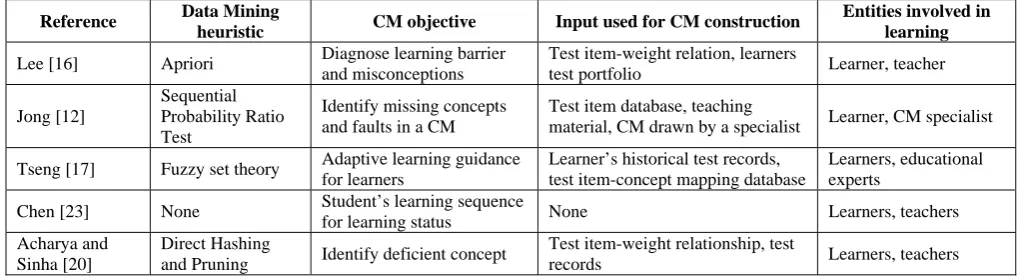
A comparative study of some of these learning systems are presented in Table 1 on the basis of the data mining heuristic used for concept map generation, the objective of constructing the concept map, the inputs used for construction and the entities involved in the learning process.
B. Concept Maps in Collaborative Applications
Following Jong’s [12] classification on the basis of applications, it has been found that concept mapping technique has mostly been used for collaborative applications. In typical applications, learners have been found to develop their own concept maps based on domain knowledge. This concept map is then finalized after discussion with peers. Support may also be taken from the instructors or materials from the web. Some of these applications in E-learning and M-Learning environment are next discussed.
Over the years several researchers have used collaborative learning strategy in E-Learning environment. Chang et al [26] has proposed a four stage web based collaborative inquiry learning system that uses the web as source of knowledge. Concept map has been used for organizing this knowledge. These stages of learning were used to generate the concept map by a set of 17 students in a University in Taiwan. A 17 item 4 point Likert scale was used to find the
opinion of students in web based learning. Simone et el [27] has used three tools namely student collaboration, concept mapping and electronic technologies to foster knowledge growth among university students. 26 students were divided into groups of 3 to 5 students each and were asked to generate concept maps on a given topic in learning theory. They found that students preferred sharing concept maps between themselves and is a good tool for generating and structuring ideas. Stayanova and Kommers [28] has conducted a experimental study to investigate the learning effectiveness of concept map in Computer Supported Collaborative Problem Solving Design (CSCPSD). Three scenarios of interaction were investigated: distributed, moderated and shared. It was found that shared scenario was most appropriate for establishing a supportive environment for CSCPSD.
developed their concept maps based on the knowledge learnt from the text books in the computer class room. These concept maps were then compared. The concept map was finalized when students performed relevant field work in the subject. Lai et al[29] reports their implementation of a handheld concept mapping tool to support cooperative learning in a nursing class. They used PicoMap software to enable students construct concept maps. They found that handheld tools enhanced interaction among students when aided by proper class management and technology support.
Silander et al [30] has used a Mobile Collaborative Concept Mapping (MoCoCoMa) learning system using the SMS property of mobile phones. The application software consists of PHP and Java Applet module and the database shared with these. The system was tested for a set of students for studying natural science courses.
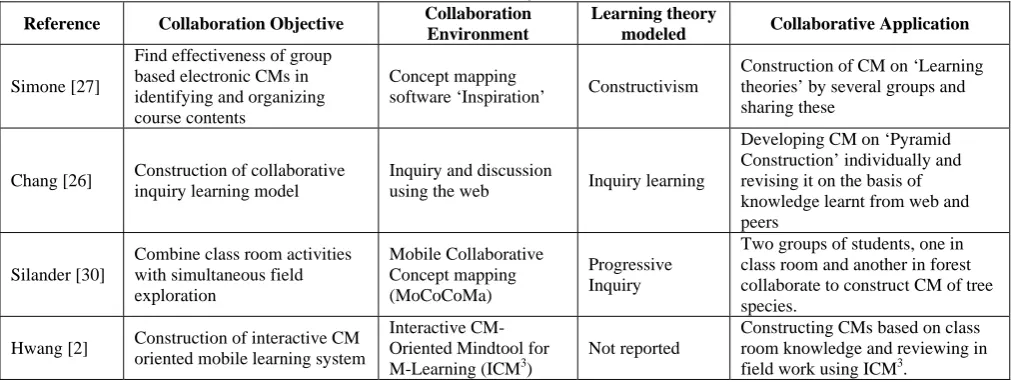
A comparative study of some of these learning systems are presented in Table 2 on the basis of the Collaboration objective, environment, application and the learning theory modeled in collaborative applications.
TABLE 2: USE OF CONCEPT MAPPING TECHNIQUE IN COLLABORATIVE ENVIRONMENT
Reference Collaboration Objective Collaboration Environment
Learning theory
modeled Collaborative Application
Simone [27]
Find effectiveness of group based electronic CMs in identifying and organizing course contents
Concept mapping
software ‘Inspiration’ Constructivism
Construction of CM on ‘Learning theories’ by several groups and sharing these
Chang [26] Construction of collaborative inquiry learning model
Inquiry and discussion
using the web Inquiry learning
Developing CM on ‘Pyramid Construction’ individually and revising it on the basis of knowledge learnt from web and peers
Silander [30]
Combine class room activities with simultaneous field exploration
Mobile Collaborative Concept mapping (MoCoCoMa)
Progressive Inquiry
Two groups of students, one in class room and another in forest collaborate to construct CM of tree species.
Hwang [2] Construction of interactive CM oriented mobile learning system
Interactive CM-Oriented Mindtool for M-Learning (ICM3)
Not reported
Constructing CMs based on class room knowledge and reviewing in field work using ICM3.
III.WEB BASED LEARNING CLASSIFICATION NOMENCLATURE
This section first proposes a framework for classifying the web learning systems developed using concept maps. Two live examples illustrating the generation of concept map within the proposed framework are then discussed. The examples are based on a set of students studying a undergraduate course on Computer Science and Engineering in a college in Kolkata, India. Finally, the methods used to generate the concept maps in these two examples are compared parametrically.
A. Proposed Frame Work
This section gives a detailed description of the proposed framework defining the environment, applications and objectives of Web learning systems developed using concept maps. Two dimensions are used in the proposed framework. The first dimension classifies these systems on the basis of evolution. Thus first E-Learning and then M-Learning Environments are shown in this axis (Fig. 2). The second dimension uses the type of application as a classification parameter. Thus Personalized and Collaborative Applications are shown in this axis. On this basis it may be concluded that Web Learning applications developed using Concept Maps can be classified into four categories: Personalized Applications in E-Learning Environment (PAELE), Personalized Applications in M-Learning Environment (PAMLE), Collaborative Applications in E-Learning Environment (CAELE), Collaborative Applications in M-Learning Environment (CAMLE).
A variety of learning systems have been proposed by various researchers in PAELE. These systems typically work by applying certain data mining heuristics on historical student test records. Typical examples of these heuristics are Apriori [16], Direct Hashing and Pruning [20], Sequential Probability Ratio Test [12]. The versatility of these algorithms makes the concept map generation process highly rigorous and automated in nature. Personalized applications have been proposed in M-Learning environment as well (PAMLE). However, as stated earlier, mobile devices are not able to generate CMs due to their limited computing power. These systems thus store CMs in the form of database tables. These tables along with learning portfolio [23] of a learner can be used to diagnose student learning behaviors and deliver suitable learning advice to the learners.
E-Learning Environment M-Learning Environment
Personalized Applications Generation of CM using data mining heuristic
Using CM stored in database tables
Relate now concepts to the concepts already known
Collaborative Applications
CM construction using electronic tools and sharing
these
CM construction by message
exchange between groups Promote learner discussion
Provide testing and diagnostic mechanism in computer assisted learning
environment
Immediate learning guidance to weak learners
Learning Objective
Fig 2: Proposed Classification framework
Personalized applications are developed with the aim of relating new concepts to the concepts already known by the learner [6]. This is very much in tune of the theory of meaningful learning discussed in Section 1. As an example, in Fig 1, if the learner has already learnt the concept C1, he should be able to relate it to the concept C2. Suitable remedial action should be taken on failure to relate between concepts. On the contrary, the purpose of collaborative learning is to create an environment where several learners can learn a subject together [9]. In this context the web is used to enable distant learners to be engaged in some form of conversation like identifying key concepts in a concept map and sharing these. Thus it may be concluded that whereas a majority of personalized applications use concept maps for remedial learning, collaborative applications mostly use these for information sharing. The main reason for the shift of focus from traditional learning to E-Learning is to provide an automated environment for testing and diagnosis [14]. However this diagnostic advice is not effective, if it cannot be provided in time [2]. Mobile connectivity added to the functionalities of E-Learning environment provides Learning [31]. M-Learning applications are ubiquitous in nature and thus WLS developed using Concept Maps provides immediate learning guidance to the learners [2]. These ideas are integrated to form the framework shown in Fig 2.
B. Examples
This section gives a detailed description of two live examples of concept map generation in web learning environment within the framework proposed in the previous section. Example 1 discusses generation of diagnostic concept map for personalized application in electronic environment whereas Example 2 uses concept mapping technique for collaborative application in mobile environment.
Example 1: This example is based on a elementary course of ‘Programming in C’ (Course Code BCSE03) taught to first year students of Computer Science and Engineering in a college in Kolkata, India. The class consists of 38 students. A test sheet [32] consisting of 7 test items (Q1,
Q2,….,Q7) was used for evaluating group of 6 students
(S1,S2,….,S6) of this class chosen at random. Each test item
contains questions on multiple concepts. The answers of the students corresponding to these concepts are stored in Answer Sheet Summary Table (ASST) [14] (Table 3).
TABLE 3: ASST FOR A SET OF STUDENTS FOR BCSE03 COURSE
Question Students
S1 S2 S3 S4 S5 S6 Total
Q1 1 0 1 0 1 0 3
Q2 0 1 1 1 0 1 4
Q3 1 1 1 0 1 0 3
Q4 1 0 0 0 1 1 3
Q5 0 1 1 1 0 0 3
Q6 1 0 1 0 0 1 3
Q7 0 0 1 1 0 0 2
It is to be noted that 1 denotes a wrong answer whereas 0 denotes a correct answer [16]. The underlying concepts of the course BCSE03 are enumerated below:
C1=Introduction C2=Data Types in ‘C’ C3=Variables in ‘C’ C4=Loops
C5= Library Functions C6=Branching C7= Functions C8= Arrays
Direct Hashing and Pruning (DHP) [21] algorithm was applied on this ASST to generate 2-large item sets. The modulo division hash function h(x,y)=((order of x)*7+(order of y))mod 7 was used. This method of hashing was used as it was found to generate the most compact hash table. Association rules [4] between the test items were then computed from 2-large item sets along with their confidences.
TABLE 4: TIRT USED FOR THE COURSE BCSE03
C1 C2 C3 C4 C5 C6 C7 C8
Q1 0.75 0 0 0 0.25 0 0 0
Q2 0 0.45 0 0 0.35 0 0.20 0
Q3 0 0 0 0.4 0 0.2 0 0.4
Q4 0.3 0.2 0.5 0 0 0 0 0
Q5 0 0 0.20 0.15 0 0.20 0.15 0.30
Q6 0 0.50 0.20 0 0 0 0.30
Q5 0.15 0 0 0.20 0 0.30 0.20 0.15
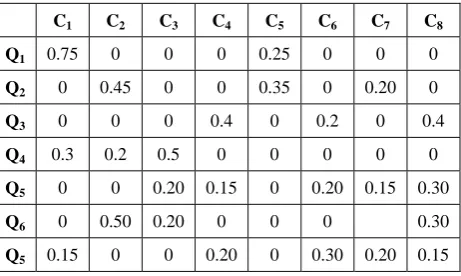
The relationship between the test-item and the concepts are given by Test Item Relationship Table (TIRT) (Table 4) [14].TIRT along with the association rules between test items are used to compute association rules and confidences between concepts. The resulting concept map is shown in Fig 1. It is to be noted that this concept map is generated from the test results of 6 students and thus can be used for their learning purpose only. This is thus an example of Personalized Application in E-Learning Environment (PAELE). The procedure is detailed out in [20].
Example 2: 16 undergraduate Computer Science and Engineering students were given to learn the course ‘Introduction to Java programming’ (Course Code BCSE21) in their third year classes in a college in Kolkata collaboratively between themselves. They
divided themselves into two groups (G1 and G2) each
containing 8 students. Each group was farther divided into three subgroups SGi1, SGi2, SGi3, =1,2. SGi1 and SGi2
contain 2 students each whereas SGi3 contains 4 students.
Students of SGi1 collaborate between themselves to learn
the subject in theory class whereas students of SGi2
collaborate to learn the subject in practical class. SGi1 and
SGi2 collaborate between themselves using SMS to create
the concept map of learning. Two types of messages are identified for collaboration purpose: Association
Fig 3: Concept Map for BCSE21 course for G1
messages and Coordination messages. Association messages are used for exchanging association rules whereas Coordination messages are used for
discussion only. SGi1 and SGi2 identified 8 concepts
enumerated below.
T1=Introduction to Object Oriented Programming T2=Variables in Java
T3=Operators in Java T4=Loops
T5=Branches T6=Arrays T7=Functions
T8=Overview of Advanced Concepts
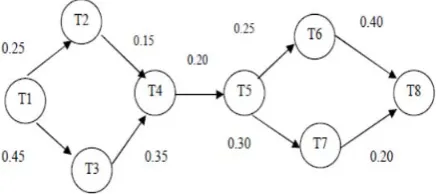
The concept map corresponding to the group G1 is shown
in Fig 3. The relative weights of the concepts were assigned intuitively by the group members based on their perceived degree of importance.
This concept map is mailed to Gi3 for development of
learning system. Students of Gi3 use this as a learning
sequence for construction of learning system and develop corresponding learning objects. The same procedure was followed by G2. Prototype learning systems by both groups
were constructed using Android emulator [25]. Learners of G1 are evaluated by a test sheet developed by G2 and vice
versa. It is to be noted that the concept map, learning and evaluation system is generated as a result of collaboration between 8 students. This is thus an example of Collaborative Application in M-Learning Environment (CAMLE).
C. Computational aspects
The above section provides examples of two types of concept maps identified by Jong[12]; Example 1 illustrates generation of diagnostic concept map whereas Example 2 illustrates the process of concept mapping. At this juncture, it is imperative that the computational aspects of these two methods be compared. A set of parameters are now proposed for comparing them:
1. Computational complexity for constructing Concept Maps: In general the most important factor in complexity computation is the number of learners (n) involved in concept map generation.
2. Inputs used in construction of Concept Map: Concept Maps are generally constructed on the basis of certain prior information. This could be student’s historical test records, learners perception of the subject or learning inputs received from the peers or the web.
3. Confidence between concepts: These are generally computed using the algorithms used for determining association rules between the concepts. However if these algorithms are not used, confidences may be assigned by the learner intuitively. Weights may also be assigned to the concepts to indicate their degree of importance [24].
4. Cycle removal in Concept Maps: A concept map
containing several concepts is almost found to contain cycles. These cycles introduce a certain degree of redundancy. As an example in Fig 1, if a cycle exists between the concepts C1 and C2, it is impossible to determine which concept should be learnt first. Cycles should be removed to get rid of this redundancy.
TABLE 5: COMPARISON OF THE CMs DEVELOPED IN BCSE03 AND BCSE21 COURSES
Computational Aspects of CM BCSE03 course BCSE21 course
Computational Complexity For m test-items, O(mn)
O(n) for group creation; O(nt) for message exchange ( t is the number of messages exchanged per learner)
Inputs for constructing CM TIRT and ASST Learner’s subject knowledge
Confidence estimation between concepts
Computed automatically using Bayes
theorem Intuitively assigned by the learners
Cycle removal in CM One cycle detected; eliminated by removing
the edge with least weight Cycles avoided by observation
Focus Area Remedial Learning Learning a subject using collaboration
Efficiency measurement
t-test to estimate the degree of significance between pretest and post test marks; surveys used to estimate learner satisfaction
Similar procedure used
6. Efficiency measurements of the learning system: Generally the efficiency of WLS is determined by conducting tests before and after the learning process and applying certain statistical tests on these test results. A survey may be conducted to evaluate learner satisfaction. Table 5 presents a comparative study of the list of computational aspects of the concept maps generated for the courses BCSE03 course and BCSE21 course.
IV.COGNITIVE SUPPORT
Section 1 indicates the major advantages of web based learning over class room learning: web based learning is independent of time and location parameters. Learners can thus learn a subject at any time of his choice independent of geographic location. Another addition in this respect is use of mind tool to organize and structure knowledge. As a result of this, learning becomes more self driven and automated. Section 2 indicates that a large number of researchers used concept map as a mind tool in organizing knowledge while constructing web based learning systems in personalized and collaborative environments. Learning outcomes of these systems indicate that they have been successful. Cicognani [33] has suggested that there are two reasons behind the success of these systems: place design and educational taxonomies. The utility of place design has already been discussed earlier. This aim of this section is to justify that educational taxonomies are indeed used in learning using web based systems. This justification is further validated with the examples discussed in the previous section.
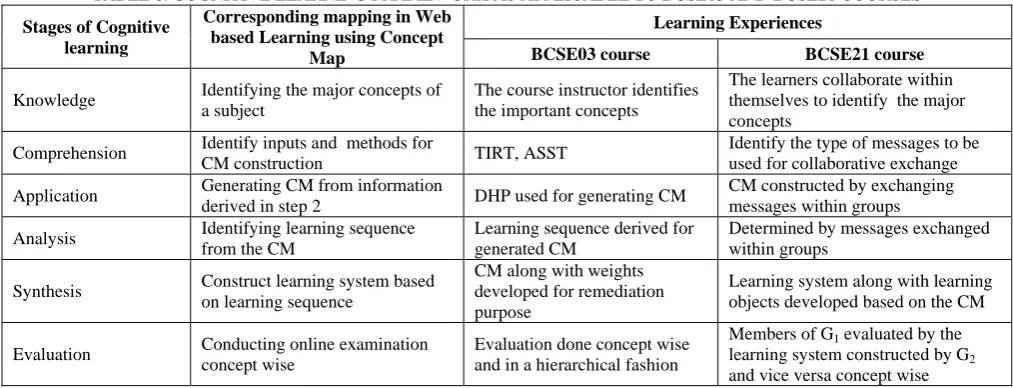
A framework for classifying statements of what a student is expected to learn in any mode of learning was defined in the form of taxonomy of educational objectives by Bloom et al (1956) [11]. This taxonomy defines six stages of learning in cognitive domain. Bloom professed that they are achieved in a hierarchy: mastering the previous stage is a prerequisite to mastering next stage. The six stages of cognitive learning as proposed by Bloom which is relevant to this study are summarized below:
1. Knowledge: recalling and recognizing information learnt earlier.
2. Comprehension: selection and organizing ideas.
3. Application: using ideas learnt in the previous stage to produce some result.
4. Analysis: identifying relationship structure between the ideas.
5. Synthesis: integrate derived ideas into a product.
6. Evaluation: learners assessed on the basis of certain criteria.
The original purpose of developing this taxonomy was creation of a question bank of test items by the faculty members of different universities for learner evaluation. In addition to this, it served as a communication media between learner, instructor and subject matter. In this context it may be argued that the goal of web learning systems developed using concept maps is much the same. As an example, concept wise test items were developed in BCSE03 course for generation of concept maps. The learners in BCSE21 course collaborated among themselves using SMS for development of concept maps. It is farther proposed that all the steps of cognitive learning domain enumerated earlier are followed by a learner when he performs learning using web learning systems developed using Concept Maps. In other words, there is a one-one mapping between stages of cognitive learning and the steps a learner follows while learning using web learning systems developed using concept maps. Moreover like Bloom’s taxonomy of traditional learning, they are followed in progression: starting with the simplest activity and proceeding towards most difficult. This mapping along with the corresponding implementations for the courses BCSE03 and BCSE21 are shown in Table 6.
TABLE 6: COGNITIVE LEARNING FRAMEWORK AS APPLICABLE TO BCSE03 AND BCSE21 COURSES
Stages of Cognitive learning
Corresponding mapping in Web based Learning using Concept
Map
Learning Experiences
BCSE03 course BCSE21 course
Knowledge Identifying the major concepts of a subject
The course instructor identifies the important concepts
The learners collaborate within themselves to identify the major concepts
Comprehension Identify inputs and methods for
CM construction TIRT, ASST
Identify the type of messages to be used for collaborative exchange
Application Generating CM from information
derived in step 2 DHP used for generating CM
CM constructed by exchanging messages within groups
Analysis Identifying learning sequence from the CM
Learning sequence derived for generated CM
Determined by messages exchanged within groups
Synthesis Construct learning system based on learning sequence
CM along with weights developed for remediation purpose
Learning system along with learning objects developed based on the CM
Evaluation Conducting online examination concept wise
Evaluation done concept wise and in a hierarchical fashion
Members of G1 evaluated by the learning system constructed by G2 and vice versa concept wise
V. FUTURE RESEARCH DIRECTIONS
Section 2 presents a detailed description of the use of Concept Maps in Web based Learning systems in Personalized as well as Collaborative Learning environments. However it is felt that there are several promising directions to extend their use in web based learning. Some of these are enumerated below:
A. Recommender Systems
These are a subclass of information filtering systems that seek to predict the preference that a user would give to an item [38]. In this direction techniques may be proposed that will help students identify student learning patterns before appearing for a test. As an example, before appearing for a test on concept X, a student may like to know the concepts learned by his predecessors who had appeared for a test on that concept. Similar methods may be employed to find the learning objects accessed by students who have performed well in the exams. A recommender system using concept maps and collaborative tagging has been proposed by Kardan et al [34]. The proposed method performs a mapping between tags and the concepts learnt by the student for identifying his learning deficiencies. However collaborative filtering methods suffer from disadvantages like requiring huge data sets and high computational power to make correct recommendations [35]. In this direction the use of content based, knowledge based and hybrid recommender systems may be investigated [36].
B. Concept Classification
This involves developing a mechanism to find the effect of each concept on student achievement. Each student learns a concept and appears in an exam. These test results can be used for mining interesting rules and patterns about the concepts. An example of such a mined rule could be, for securing more than 60% percent marks in C7, a learner has to get more than 60% marks in the concepts C4 and C6. These types of patterns are identified by applying machine learning algorithms [37] on concept wise test records. Another application may involve classifying concepts with high, moderate and low student pass percentage. These classification results may be used in evaluating the
performance of instructors who teach and develop course materials for those concepts.
C. Graph based applications
Concept maps may be useful in identifying the remedial path of a learner. A remedial path is defined as the concepts in the path from the concept that needs remediation to the concept learner stared learning from [22]. As an example, corresponding to the concept C4 the remedial path is C1-C2-C3-C4 (Fig. 1). This implies that if a student fails to learn the concept C4 he may revise the concepts C3, C2 and C1 sequentially. Thus corresponding to C4 there is a unique remediation path. However corresponding to C7 there are two remediation paths, C7-C4-C3-C1 and C7-C6-C5-C2-C1. Algorithms may be designed to compute the remediation path with maximum effectiveness from learner point of view. Similar algorithms may also be devised to find the cluster of students with similar learning patterns, i.e. the set of students who use the same Remedial Learning Path (RLP). Certain data mining algorithms may then be applied on this student cluster data set to find interesting patterns within themselves. Another application could be to detect cycles in the concept map while they are generated
in an automated fashion. Example 1 removes cycles in the concept map by removing edges with minimal weight which creates cycles. In this case cycles are detected by observation. However this strategy may not be efficient if the number of concepts is large.
D. Generic Concept map development
The association rules and the weights between the concepts for personalized applications were generated in various studies by applying varied data mining algorithms on historical test records of the students. This concept map is thus dependent on the particular data mining algorithm applied on the test records. A generic method could be developed that would generate a unique concept map for a particular test record.
E. Integration with other web learning application
applications for learning purpose only. However web learning systems in totality should contain other functionalities such as preprocessing student data, learning objects development and storage, designing test modules etc. All these applications should be integrated within a single web learning system.
VI.CONCLUSION
This paper presents a detailed study on the use of Concept Maps in Web based learning systems. The paper initially gives a simple introduction of concept maps and then goes on to a detailed discussion on the learning system proposed by various researchers using concept maps in personalized and collaborative environment. A classification framework is then proposed based on environment, application and goals of these web learning systems. Two live examples of concept map generation in engineering environment within the proposed framework is then discussed and their computational aspects compared. This framework is found to have support of cognitive learning domain where a set of learning objectives are defined for any mode of learning. The final section presents some discussion indicating the areas where concept maps may be used for further research. Concept Maps have been proven to be useful by a lot of researchers in Web based learning. However, on performing deeper analysis of their usage some critical facts emerge. Firstly, most of the students lack the motivation to use concept maps in learning. This is due to their failure to get a deeper picture of the relationship between learning theories like Cognitive learning, Theory of Meaningful learning, Constructivism etc and their learning implementation. Secondly, concept maps have mostly been generated from historical test records of students. Thus student test items have to be meticulously designed. The fact that most test items are of objective nature may not justify the construction of concept maps from them. Thirdly, literature survey indicates that concept map based web learning systems have mostly been constructed for science courses. Their use in the domain of humanities is yet to be investigated. Fourthly, the domain of use of C-Learning has not yet been clearly established. Although [9] suggests that C-Learning should be used in the learning domain which contains theory and field work, the truth of this statement is yet to be established. Finally construction of concept maps is not easy task. Correct identification of key concepts is necessary. This process may be cumbersome and time consuming for most learners. They may thus be taught to use automated concept map construction tool like PicoMap, [29], Cmap[2] etc. However this again requires proper training of learners in this area. Once these issues are sorted out, it is hoped that concept maps would be the ‘the tool’ to use in construction of web learning systems.
REFERENCES
[1] E. J. Cherian, P Williams, Mobile Learning: The Beginning of the End of Classroom Learning , WCECS ,2008.
[2] G J Hwang, P Wu, H Ku: An interacting Concept Map approach to supporting mobile learning activities for natural science courses, Computers and Education 57, pp 2272-2280, 2011
[3] D. Novak Joseph and J. Canas Alberto : Theoretical Origins of Concept Map, How to construct them and their used in Education, Reflecting Education, Vol 3, No 1,pp 29-42,2007.
[4] J Haan, M Kamber, Data Mining: Concepts and Techniques, Third Edition, Elsevier, 2011.
[5] F Pendidican : Learning Theories, Mathematika dan IInam Alam, Universitas Pendidikan Indonesia.
[6] T. Thompson: The learning theories of David P Ausubel: The importance of meaningful and reception learning.
[7] D Miliband : Choice and Voice in Personalised Learning. Personalising Education.,OECD, p. 24,2006.
[8] M. Fullan : Michael Fullan's Answer to "What is Personalized Learning?", Microsoft Partner Network. 2009.
[9] K Bruffee: Collaborative Learning. Baltimore: The Johns Hopkins University Press. pp. 28–51, 1993.
[10] P. Dillenbourg, P. Collaborative Learning: Cognitive and Computational Approaches. Advances in Learning and Instruction Series. New York, NY: Elsevier Science, Inc, 1999.
[11] B. S Bloom(Ed.), M. D. Engelhart, E. J. Furst, W.H Hill, D. R. Krathwohl. :Taxonomy of educational objectives: The classification of educational goals. Handbook 1: Cognitive domain.New York: David McKay,1956.
[12] B. Jong, T. Lin, Y. Wu, T Chan: Diagnostic and Remedial learning strategy based on conceptual Graph, Journal of Computer Assisted Learning 20, pp377–386, 2004.
[13] C. L. Hsiao, G.J Huang.: An interactive concept relationship construction assisted system for learning diagnosis,2001.
[14] G. J. Hwang : A conceptual map model for developing Intelligent Tutoring Systems, Computers and Education Vol 40, pp 217-235,2003.
[15] G. J. Hwang : A computer assisted approach to diagnosing student learning problems in science courses, Journal of Information Science and Engineering, Vol 5, pp 229-248,2003.
[16] C. Lee, G. Lee, Y. Leu: Application of automatically constructed concept maps of learning to conceptual diagnosis of e-learning, Expert Systems with applications, Vol 36, pp 1675-1684,2009. [17] S. Tseng, P. Sue, J Su, J Weng, W Tsai: A new approach for
constructing the concept map, Computers and Education, Vol 38, pp123-141,2005.
[18] C. C. Chen :Mining learner profile utilizing association rule for web-based learning diagnosis, Expert Systems with Applications 3,3 6– 22,2007.
[19] M. Hagiwara : Self-organizing Concept Maps.
[20] A. Acharya, D. Sinha: Construction of automated Concept Map of learning using Hashing Technique, In: Frontiers in Intelligent Computing Theory and Applications, vol 1, pp 567- 578, Springer International Publishing,2014.
[21] J. S. Park, M.S. Chen, S.Y. Philip: An effective Hash based Algorithm for mining Association Rules,
[22] A. Acharya, D. Sinha : A Weighted Concept Map Approach to Generate Learning Guidance in Science Courses: Information Systems Design and Intelligent Applications, vol 1, pp 143- 152, Springer International Publishing, 2015.
[23] G. Chen, C. Chan, C. Wang: Ubiquitous learning website: Scaffold learners by mobile devices with information-aware techniques, Computers and Education, Volume 50, pp 77-90(2008).
[24] A. Acharya, D. Sinha.: A Concept Map Approach to Supporting Diagnostic and Remedial Learning Activities, Advanced Computing, Networking and Informatics, Volume 1,pp. 565-57,Springer International Publishing,2014.
[25]. P. Pocatilu: Developing mobile learning applications for Android using web services, Informatica Economica, vol 14, No 3,2010. [26] K. E. Chang., Y.T Sung. , C. L Lee.: Web-based collaborative
inquiry learning, Journal of Computer Assisted Learning 19, pp 56-69,2003.
[27] C. D. Simone, R. F. Schmid,. L.A. McEwen: Supporting the Learning Process with Collaborative Concept Mapping Using Computer-Based Communication Tools and Processes, Educational Research and Evaluation, Vol. 7, No. 2-3, pp. 263-283,2001.
[28] N Stoyanova, P. Kommers : Learning Effectiveness of Concept Mapping in a Computer Supported Collaborative Problem Solving Design.
[30] P. Silander, E. Sutinen, J Tarhi: Mobile Collaborative Concept Mapping – Combining Classroom Activity withSimultaneous Field Exploration, Proceedings of the 2nd IEEE International Workshop on Wireless and Mobile Technologies in Education (WMTE’04). [31] Luvai F. Motiwalla, Mobile learning: A framework and evaluation,
Computers & Education 49 , pp 581–596,2007.
[32] G. J Hwang : A Test-Sheet-Generating Algorithm for Multiple Assessment Requirements, IEEE Transactions on Education, Vol. 46, No. 3,2003.
[33] Anna Cicognani : Concept Mapping as a Collaborative Tool for Enhanced Online Learning, Educational Technology & Society 3(3), 2000.
[34] A. Kardan, S Abbaspour, F Hendijanifard : A Hybrid Recommender System for E-learning Environments Based on Concept Maps and Collaborative Tagging, The 4th International Conference on Virtual Learning ICVL, 2009.
[35] S Lee, J Yang, S Park : Discovery of Hidden Similarity on Collaborative Filtering to Overcome Sparsity Problem, Discovery Science, 2007.
[36] P Brusilovsky: The Adaptive Web. p. 325,2007.
[37] S. B. Kotsiantis: Supervised Machine Learning: A Review of Classification Techniques, Informatica 31, pp. 249-268,2007.
AUTHOR PROFILES
Anal Acharya is Assistant Professor in the Department of Computer Science in St Xavier’s College, Kolkata. He was the Head of the Department of Computer Science from the period of 01.01.2009 to 30.06.2013. His present research interests include Data Mining and Intelligent Learning Systems. He has above 15 years of experience in undergraduate and post graduate teaching & supervised several post graduate dissertations. He has several accepted papers in International Conferences and Journals.