Analysis of the Kupyna-256 Hash Function
Christoph Dobraunig, Maria Eichlseder, and Florian Mendel
Graz University of Technology, Austria
Abstract. The hash function Kupyna was recently published as the Ukrainian standard DSTU 7564:2014. It is structurally very similar to the SHA-3 finalist Grøstl, but differs in details of the round transfor-mations. Most notably, some of the round constants are added with a modular addition, rather than bitwise xor. This change prevents a straightforward application of some recent attacks, in particular of the rebound attacks on the compression function of similar AES-like hash constructions. However, we show that it is actually possible to mount re-bound attacks, despite the presence of modular constant additions. More specifically, we describe collision attacks on the compression function for 6 (out of 10) rounds of Kupyna-256 with an attack complexity of 270, and for 7 rounds with complexity 2125.8. In addition, we can use the rebound
attack for creating collisions for the round-reduced hash function itself. This is possible for 4 rounds of Kupyna-256 with complexity 267and for
5 rounds with complexity 2120.
Keywords: hash functions·cryptanalysis ·collisions·free-start colli-sions·Kupyna·rebound attack
1
Introduction
Recently, Oliynykov et al. [11] published an English specification of the new Ukrainian hash standard DSTU 7564:2014, also known as Kupyna. In contrast to the previous standard GOST 34.311-95, the new hash standard facilitates more effective software implementations. Of course, it is also intended to offer improved security compared to the old GOST standard, which has shown weak-nesses against collision attacks [7]. As Kupyna is a national standard, it is likely to find wide-spread adoption in the Ukraine. Thus, comprehensive third-party analysis is necessary to evaluate the resistance of Kupyna against cryptanalytic attacks.
The Kupyna design aims to achieve a high level of security by relying on well-known and well-analyzed building blocks. It shares a notable similarity with the SHA-3 finalist Grøstl [2]. Kupyna’s mode of operation, in particular its com-pression function, is nearly identical to the one used in Grøstl, and its permu-tations – though different – follow very similar design ideas. One of Kupyna’s two permutations employs the wide-trail design strategy [1] of AES. Therefore, this permutation shares a common basis with Grøstl’s permutations, although Kupyna uses other constants, S-boxes, rotation values, and a different MDS
c
matrix. The second Kupyna permutation differs from the first in the constant addition, which applies addition modulo 264rather than bitwise xor. This mod-ular addition serves to differentiate the two permutations, but can also be seen as a measure to complicate algebraic cryptanalysis. Furthermore, it implies ad-ditional relations over byte boundaries. As a consequence, the modular addition leads to a weaker alignment for differential trails, making statements about the minimum number of active S-boxes in a differential trail more complicated, since the linear layer no longer achieves an optimal branch number.
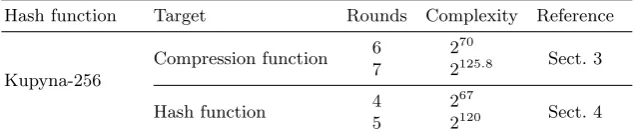
Our contribution. In this paper, we provide the first third-party analysis of the new Ukrainian hash standard Kupyna. We present collision attacks on round-reduced variants of Kupyna-256 for up to 5 out of 10 rounds, and collisions for the compression function of Kupyna-256 for up to 7 rounds. A summary of our results can be found in Table 1.
Table 1.Overview of collision attacks on Kupyna-256.
Hash function Target Rounds Complexity Reference
Kupyna-256
Compression function 6 2
70
Sect. 3 7 2125.8
Hash function 4 2
67
Sect. 4
5 2120
Our attacks make use of the capability of rebound attacks [8] to efficiently generate pairs of values which follow a given truncated differential trail. The core idea of such a rebound attack is to create many solutions with a low com-plexity per solution during the inbound phase, and propagate those solutions in a probabilistic manner during the so-called outbound phase.
To create solutions with a low average complexity during the inbound phase, the rebound attack takes advantage of the strong alignment of truncated differen-tial trails and the underlying independence of parts of the cipher. As mentioned before, one of the two permutations of Kupyna does not provide such a strong alignment. Hence, it is not trivial to perform the rebound attack for this per-mutation. However, in this work, we show how to deal with modular constant additions during the inbound and the outbound phase to be able to perform rebound attacks on such constructions.
compres-sion function of Grøstl were shown in [9]. An efficient collicompres-sion attack covering 5 rounds of the hash function Grøstl itself was published in [10].
In the meantime, Zou and Dong [13] independently analyzed the Kupyna hash function, and observed the applicability of some of the attacks on Grøstl to Kupyna. They present pseudo-preimage attacks on 6 rounds of Kupyna-256 and 8 rounds of Kupyna-512 with time complexities 2250.33and 2498.33, respectively, which are essentially identical to the original Grøstl attacks [12]. Additionally, they also noted the hash function attack on 5 rounds very similar to Section 4 of this paper.
Outline. The remainder of the paper is organized as follows. First, we start with a short description of Kupyna in Section 2. Next, we show how to apply the rebound attack on round-reduced versions of the compression function of Kupyna-256, to create semi-free-start collisions for 6 and 7 rounds, in Section 3. Then, we apply a collision attack for 4 and 5 rounds of Kupyna-256 in Section 4. Finally, we conclude in Section 5.
2
Description of Kupyna
Kupyna [11] is a family of iterated hash functions defined in the Ukrainian standard DSTU 7564:2014. The design principles of Kupyna are very similar to the SHA-3 finalist Grøstl [2]. As in Grøstl, the compression function of Kupyna is built from two distinct permutationsT⊕ andT+, which are both based (to a certain degree) on the AES design principles. In the following, we describe the components of the hash function in more detail.
2.1 The Hash Function
The Ukrainian standard DSTU 7564:2014 defines two main variants, Kupyna-256 and Kupyna-512, which produce a hash output size of n = 256 and n = 512 bits, respectively (the third recommendation, Kupyna-384, is simply a truncated version of Kupyna-512). The hash function first pads the input messageM and splits the message into blocks m1, m2, . . . , mt of ` bits each, with ` = 512 for Kupyna-256 and`= 1024 for Kupyna-512. The message blocks are processed via the compression functionf(hi−1, mi), which updates the internal`-bit chaining valuehi, and an output transformationΩ(ht) to produce the final hash valueh:
h0= IV
hi=f(hi−1, mi) for 1≤i≤t h=Ω(ht).
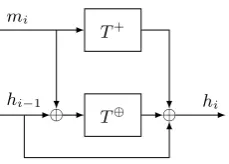
The compression functionf is based on two`-bit permutationsT⊕ andT+ and is defined as follows (see also Fig. 1):
T+
T⊕ mi
hi−1 hi
⊕ ⊕
Fig. 1.The compression functionhi=f(hi−1, mi) of the Kupyna hash function, using
`-bit permutationsT⊕andT+.
The output transformationΩis applied toht to give the final hash valueh of sizen, where truncn(x) discards all but the most significantnbits ofx:
Ω(ht) = truncn(T⊕(ht)⊕ht).
2.2 The Permutations T⊕ and T+
In the remaining document, we focus our analysis on Kupyna-256. The structure of the two permutations T⊕ and T+ of Kupyna is very similar to the ones of Grøstl. As in Grøstl-256, each Kupyna-256 permutation updates an 8×8 state of 64 bytes in 10 rounds. In each round, the round transformation updates the state by means of the sequence of transformations
MixBytes◦RotateBytes◦SubBytes◦AddConstant.
In the following, we briefly describe the round transformations ofT⊕ andT+in more detail. Note that the Kupyna specification [11] refers to the transforma-tions asψ,τ(`),π0, andκ(`)
i /η (`)
i , respectively, but we use the more commonly understood AES-like transformation names in the remaining document.
AddConstant (AC). In this transformation, the state is modified by combining it with a round constant. This is the only transformation where the two permu-tations differ. While T⊕ combines the round constant with each column with bitwise xor (⊕), T+ applies column-wise modular addition mod 264 (+). The round constants for T⊕ are defined as follows for round r, 1 ≤ r ≤ 10, and columnj, 0≤j <8:
ω(jr)= ((j4)⊕r,00,00,00,00,00,00,00)>.
The (round-independent) round constants forT+ for column j are given by: ζj(r)= (F3,F0,F0,F0,F0,F0,F0,(7−j)4)>,
difference of Kupyna compared to Grøstl from a cryptanalytic point of view. Note that this modular addition destroys the columnwise optimal branch number of the linear layer. We give an example with only 6 (rather than 9) active S-boxes over 2 rounds in Appendix A.
SubBytes (SB). TheSubBytes transformation is the same forT⊕ and T+. It is a permutation consisting of S-boxes applied to each byte of the state (with 4 different S-boxes, depending on the row index). The 8-bit S-boxes are designed to provide good cryptographic properties against differential and linear attacks. For a detailed description of the S-boxes, we refer to the specification [11]. Note that the SubBytes transformation is the only non-linear transformation of the permutationT⊕.
RotateBytes(RB). TheRotateBytestransformation is a byte transposition that cyclically shifts the bytes of each state row by different offsets: rowj is shifted rightwards by j byte positions, 0 ≤ j < 8. This transformation is the same for both permutations T⊕ and T+. This is also in contrast to Grøstl, where two different sets of rotation constants are defined for the two permutations, in order to diversify between the two. In Kupyna, this role is solely played by
AddConstant.
MixBytes (MB). TheMixBytes transformation is a permutation operating on the state column by column. To be more precise, it is a left-multiplication by an 8×8 circulant MDS matrix overF28. The coefficients of the matrix are
deter-mined in such a way that the branch number of MixBytes(the smallest nonzero sum of active input and output bytes of each column) is 9, which is the maxi-mum possible for a transformation with these dimensions. This transformation is the same for both permutationsT⊕ andT+.
3
Semi-free-start Collisions for 6 and 7 Rounds
In this section, we mount a collision attack on 6 rounds of the compression func-tion of the Kupyna-256 hash funcfunc-tion. The attack described here is based on the rebound attacks on Grøstl [9] using SuperBox matches [3, 5, 6]. Hence, the high-level attack strategy to create pairs following differential truncated trails stays the same. Due to the round-constant addition modulo 264 in the permutation T+, a straightforward application of the Grøstl attack is not possible, and some additional considerations are required.
Finally, in Section 3.5, we also show how to extend the collision attack to 7 rounds of the compression function, also based on rebound attacks on Grøstl [9].
3.1 Attack Strategy
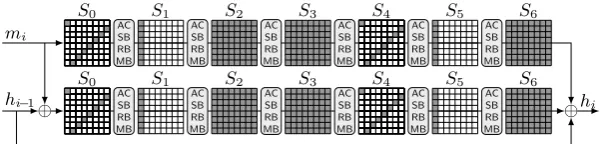
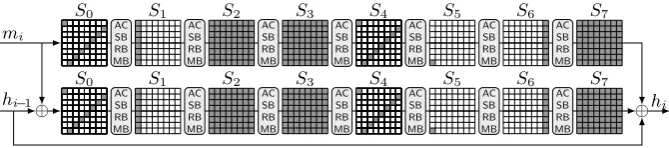
If the differences at the input and the output match, we get a semi-free-start collision. Note that the differences are introduced by the message block mi, whereas the chaining value hi−1 is free of differences, but can also be chosen arbitrarily. A high-level view of this attack is illustrated in Fig. 2.
S0 AC SB RB MB S1 AC SB RB MB S2 AC SB RB MB S3 AC SB RB MB S4 AC SB RB MB S5 AC SB RB MB S6 S0 AC SB RB MB S1 AC SB RB MB S2 AC SB RB MB S3 AC SB RB MB S4 AC SB RB MB S5 AC SB RB MB S6 mi
hi−1 hi
⊕ ⊕
Fig. 2.Collision attack on 6 rounds of the Kupyna-256 compression function.
To find matching trails, we use the rebound attack strategy introduced in [9]. This strategy consists of an inbound and an outbound phase. During the inbound phase, solutions for the core of the trail are deterministically created with a com-plexity close to 1 per solution, whereas the propagation through the outbound phase is done in a probabilistic manner. This, combined with the fact that we have to match the input and output differences of the independently created trails forT⊕ andT+, suggests a truncated differential target trail which is dense in the middle and gets sparse towards the ends, with the following numbers of active bytes (S-boxes):
8 r1 −→8 r2
−→64 r3 −→64 r4
−→8 r5 −→8 r6
−→64. (1)
3.2 Finding Pairs for T⊕
The permutationT⊕follows the wide-trail design strategy. Even thoughT⊕uses differentSubBytes,RotateBytesandMixByteslayers than Grøstl, the differential behaviour on byte level is almost identical, so those changes have a very lim-ited influence on the way a rebound attack is applied (e.g., due to the different rotation constants, slightly different truncated trails are used). Hence, the re-bound attack onT⊕ can be done very similarly to the Grøstl permutation [9]. Below, we repeat the essential parts of this attack. We use the same notation to denote intermediate states:S0 is the initial state, Si denotes the state after round i (1 ≤i ≤r), and the intermediate states after AddConstant, SubBytes,
RotateBytes, andMixBytesof roundiare labelledSAC
i ,SSBi ,SiRB, andSiMB=Si, respectively.
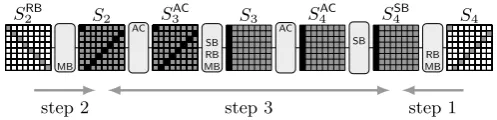
differential trail for the inbound phase is shown in Fig. 3. The attack works as follows:
1. First, we start backwards from stateS4, which has 8 active bytes. We enu-merate all 28·8possible bitwise difference patterns atS
4, and deterministi-cally propagate them backwards through the linearMixBytes◦RotateBytes
toSSB
4 . The resulting 264 difference patterns forS4SBare stored in a table D1.
2. Next, we choose a random difference pattern for stateSRB
2 and determin-istically propagate forward throughMixBytesto stateS2.
3. Finally, we have to connect the inputs of 8 S-boxes of stateS2 belonging to one SuperBox to its corresponding output in stateSSB
4 . We can do this for each of the 8 SuperBoxes independently in the following way:
(a) Enumerate all possible 264 value pairs for the SuperBox at stateS 2 and propagate forward to stateSSB
4 .
(b) Store the resulting 264 value pairs at stateSSB
4 in a tableD2. (c) To find solutions for this SuperBox, filter D2 with the possible
dif-ferences in tableD1.
SRB 2
MB S2
AC SAC
3
SB RB MB
S3 AC
SAC 4
SB SSB
4
RB MB
S4
step 1
step 2 step 3
Fig. 3.Inbound phase forT⊕, SuperBox in black
Now we have to determine how many solutions we get for the inbound phase. From a high-level point of view, we have generated 264·8pairs of values at state S2. All those pairs are filtered with the truncated differential of stateS4. Here, 56 bytes need to be zero. Thus, we expect 264·8−56·8= 264valid solutions (pairs) for the inbound phase. The computational complexity for the inbound phase is 264 round function calls for creating these 264 solutions with a complexity of 264in memory for storing the tables. The inbound phase can be repeated up to 264times with other difference patterns at state SRB
2 , leading to a maximum of 2128solutions with 2128complexity in time. Hence, the amortized complexity of finding one solution in the inbound phase is 1.
The Outbound Phase. During the outbound phase, the created solutions from the inbound phase have to be probabilistically propagated, first from state SRB
2 back toS0and then fromS4toS6. Both times, they have to follow the pattern of the truncated trail: 8 r1
←−8 r20
←−−8 (r20 =RB◦SB◦AC) in the backward direction,
and 8 r5 −→8 r6
3.3 Finding Pairs for T+
As for T⊕, we also need to find pairs of values for T+ which follow the given truncated differential trail. However, the modular constant addition of T+ on each column of the state can cause difference propagations between bytes, which are impossible in T⊕. Therefore, we cannot rely on the byte alignment of the truncated differential trails anymore. In the following, we show how to handle such uncertainties and how to apply the rebound attack on T+, although its trails are not strongly aligned. Note that we still target the same truncated trail for T⊕ and T+ (Fig. 2), and the input/outbound phases cover the same steps (Fig. 3).
The Inbound Phase. The round transformations covered by the inbound phase (states S2RBto S4) include two constant additionsAC: one between state S2 andS3AC, and one betweenS3 andS4AC, both corresponding to step 3 of this phase (see Fig. 3). The other steps 1 and 2 are not influenced by the constant additions and thus, our considerations do not change for them.
The constant addition betweenS3 and S4AC is aligned with each SuperBox. Hence, it only influences each of the 8 SuperBoxes individually. Therefore, the constant addition taking place between stateS3andS4AC can be integrated into the SuperBoxes and does not influence our considerations negatively. Unfortu-nately, this is not the case for the second constant addition.
During step 3, we want to propagate values and differences per SuperBox from its inputs to its outputs. At state SAC
3 , the inputs of the SuperBox are represented by bytes in the diagonals of the state. Hence, we cannot integrate the column-wise constant addition that happens beforeSAC
3 into our SuperBoxes anymore. Unfortunately, this constant addition creates a dependence between the 8 SuperBoxes via the carry. To be able to treat the SuperBoxes independently again, we only start with values at stateS2 so that the addition of one of these values with the constant definitely results in a carry for the next byte. By doing so, we can always expect a carry at the input of the bytes for the constant addition (except for the LSB, of course). In this way, we can treat every SuperBox separately and the rest of the attack works as described forT⊕.
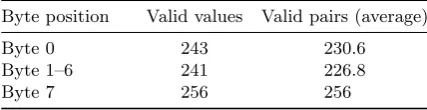
Since we have restricted the number of possible values in step 3 to values that generate a carry, we have to determine how many solutions we get. First consider the least significant byte (byte 0), corresponding to constantF3and an element xfrom the first state row. To generate the carry, we require thatx+F3>FF, so 243 (out of 256) values forxare valid. For the following bytes 1–6, we assume an input carry, so we require thatx+ 1 +F0>FF, which has 241 solutions. Finally, for byte 7, we have no requirements. If we assume that the required bitwise difference for a value pair is uniformly random, then the expected number of valid value pairs for byte 0 is 256·(1−2· 13
256 + ( 13 256)
2) ≈ 230.6. Similarly, for bytes 1–6, the expected number of valid pairs is ≈ 226.8. The results are summarized in Table 2.
Table 2.Number of byte values and average number of value pairs (for fixed bitwise difference) that produce a carry on modular addition with Kupyna’s round constants.
Byte position Valid values Valid pairs (average)
Byte 0 243 230.6
Byte 1–6 241 226.8
Byte 7 256 256
have the same filter criterion as forT⊕, we can create 262.8·8−56·8= 254.4 valid solutions for the inbound phase. These solutions are obtained with a complexity of 243·2416·256 = 263.4, since only this is the number of values per SuperBox that result in carries per byte. We can repeat the inbound phase 264 times to create up to 2118.4 pairs with a complexity of 2127.4. In other words, finding one solution in the inbound phase has an amortized complexity of 29.
The Outbound Phase. In the outbound phase, the pairs created during the inbound phase are propagated in a probabilistic manner. Since we have to con-sider the effects of the modular constant addition, the success probability of this phase is reduced compared toT⊕.
First, we want to consider the propagation from stateSRB
2 back toS0. Here, we have to follow the truncated trail 8 r1
←−8 r20
←−−8, where r20 =RB◦SB◦AC.
For the first constant addition between stateS1 and S2AC, the 8 active bytes lie within one column. Thus, the constant addition will not change the activeness of the bytes with overwhelming probability. The second constant addition occurs between state S0 and S1AC, where the active bytes are on the diagonal of the state. Therefore, the constant addition may lead to difference propagation from an active byte to a formerly inactive byte (if one value of the pair produces a carry and the other value does not). Assuming that none of the active bytes receives an input carry (worst case), the probability that none of the 8 active bytes propagates a difference to its neighbouring byte is (1−2· 13
256· 243
256)·(1−2· 16
256· 240 256)
6·1≈2−1.225. Summarizing, the probability that a value pair follows the differential trail fromSRB
2 toS0 is about 2−1.225.
For the propagation from state S4 to S6, we have another two constant additions, one of which is aligned with the SuperBox. Again, the probability that a pair follows this truncated differential is 2−1.225. So the probability that a pair created during the inbound phase follows the truncated differentials implied by the outbound phase is 2−2.45. Combining the inbound and the outbound phase, we can create 254.4−2.45= 251.95pairs that follow the 6-round truncated differential trail with a complexity of 263.4. Hence, one solution that follows the truncated trail forT+can be constructed with an amortized complexity of 211.45.
3.4 Results for 6 Rounds
collision for the compression function, we have to find pairs of values for T+ andT⊕ such that the input differences and the output differences match. At the input, we have 8 active bytes and therefore 64 bitwise conditions to match. At the output, we can match the state before the linearMixBytesoperation, resulting in another 64 bitwise conditions. Due to the birthday paradox, we expect a match on these 128 conditions after creating 264 pairs forT+ and forT⊕.
The complexity for creating 264pairs that follow the truncated trail inT⊕ is
264. Creating 264.95 pairs which follow the trail inT+ has a complexity of 276.4, settling the total complexity of the attack. A better attack complexity can be achieved by applying an unbalanced birthday attack. Creating 270pairs forT⊕
with complexity 270and 258.55pairs forT+with complexity 270allows us to find a semi-free-start collision for 6 rounds with a total attack complexity of about 270(time and memory).
Overall, the introduction of the modular addition only increased the attack complexity from 264 to 270 (compared to a variant whereT+andT⊕ are
essen-tially identical. Thus, this approach is significantly less effective at preventing this type of rebound attacks than that of Grøstl, namely, using different rotation values in T+ andT⊕ to prevent this type of truncated trails from matching at the ends. Note that the low increase of complexity is also due to the special choice of round constants in Kupyna. In particular, our experiments show that if the round constant bytes ofζj(r)were randomly selected, the probability that this kind of attack could succeed with complexity 270 or less is less than 1 in 10 000 (if the constants are still the same for all rounds and columns, as is the case for Kupyna – otherwise, even less).
3.5 Extending the Attack to 7 Rounds
We now extend the previous collision attack from 6 to 7 rounds of the compres-sion function. The attack is based on a closely related truncated differential trail with the following sequence of active S-boxes:
8 r1 −→8 r2
−→64 r3 −→64 r4
−→8 r5 −→1 r6
−→8 r7
−→64. (2)
Up to round 5 (state S4 in Fig. 4), this trail is identical to the 6-round attack. Consequently, the whole inbound phase works identically as before, and we only need to adapt the outbound phase in the attack on 7 rounds.
First, we want to determine the probability that a solution created during the inbound phase follows the truncated differential trail for permutation T⊕. The outbound phase from stateSRB
2 back toS0 is the same as for 6 rounds and thus works with a probability of 1. The target trail from state S4 to S7 has 8 r5
−→ 1 r6 −→ 8 r7
−→ 64 active S-boxes. The transitions of 1 r6
−→ 8 and 8 r7 −→ 64 active S-boxes have a probability close to 1. The transition of 8 r5
−→ 1 active S-boxes has a probability of 2−56, which also determines the total probability of the outbound phase forT⊕.
S0 AC SB RB MB S1 AC SB RB MB S2 AC SB RB MB S3 AC SB RB MB S4 AC SB RB MB S5 AC SB RB MB S6 AC SB RB MB S7 S0 AC SB RB MB S1 AC SB RB MB S2 AC SB RB MB S3 AC SB RB MB S4 AC SB RB MB S5 AC SB RB MB S6 AC SB RB MB S7 mi
hi−1 hi
⊕ ⊕
Fig. 4.Collision attack on 7 rounds of the Kupyna-256 compression function.
trail. The probability that the patterns stay the same is 2−1.225for the constant addition after S0 and S4, and 1 for the constant addition after S1, S5 (active byte at the MSB of the constant addition), andS6. Thus, the probability that the trail during the outbound phase is followed is 2−58.45forT+.
By repeating the attack onT⊕ 2s times,s≤64, we are able to generate up to 2s+64−56= 2s+8pairs following the truncated differential trails forT⊕with a complexity of 2s+64, and with 2trepetitions forT+, up to 2t+54.4−58.45= 2t−4.05 pairs with a complexity of 2t+63.4. Additionally, we still have to match an 8-byte condition at the input of the permutations and an 8-byte condition at the output of the permutation. In total, an unbalanced birthday attack with s≈61.8 and t ≈ 62.4 gives the best complexity. For T⊕, we generate 269.8 solutions with a complexity of 2125.8, and for T+ 258.35 solutions with a complexity of 2125.8. Since 269.8·258.35>2128, we expect a match with high probability. This results in a semi-free-start collision over 7 rounds with a total complexity of about 2125.8 and 270memory.
4
Collision Attacks on the reduced Hash Function
In this section, we describe collision attacks on Kupyna-256 reduced to 4 and 5 rounds. The attacks are a straight-forward application of the rebound attack on the reduced Grøstl-256 hash function [10] to Kupyna-256. To simplify the description of the attack, we use the alternative description of the hash function, similar to the attacks on round-reduced Grøstl in [10].
4.1 Alternative Description of Kupyna
Let ˆT⊕and ˆT+denote the permutationsT⊕andT+without the final application of MixBytes. Consider the following alternative description of Kupyna:
ˆ
h0=MB−1(IV) ˆ
hi= ˆT⊕(MB(ˆhi−1)⊕mi)⊕Tˆ+(mi)⊕ˆhi−1 for 1≤i≤t h=Ω(MB(ˆht))
place with the xor operation of the feed-forward. With this modified description, the limited set of differences at the output of the compression function becomes more clearly visible in the attack.
4.2 Attack Strategy
The essential idea of the hash function attack on reduced Kupyna-256 is to have a multi-block attack, but such that all message blocks except the first have no differences. This way, we can concentrate on the trails through ˆT⊕, and use the
freedom of the message blocks to successively cancel all differences in the internal chaining values.
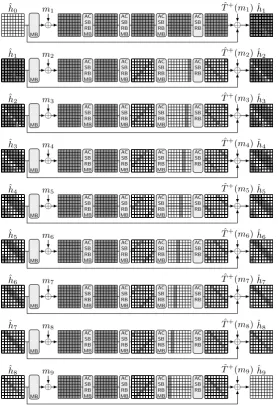
The first message block can be selected arbitrarily, we only require a differ-ence in the message. This way, we start from some arbitrary differdiffer-ence in the chaining variable for the second block, and want to convert it into an output dif-ference equal to zero after 8 more compression function calls. The corresponding 8 message blocks are fully controlled by the attacker and must not contain any differences. Then, each of the 8 message blocks is used to cancel one eighth of the differences at the output of the compression function to result in a collision at the end (see Fig. 5).
The trails used in our collision attack on 4 and 5 rounds start from a fully active input state and map it to 8 active bytes at the output of ˆT⊕:
4-round collision: 64 r1 −→64 r2
−→8 r3 −→8 r4
−→8, (3)
5-round collision: 64 r1 −→64 r2
−→8 r3 −→1 r4
−→8 r5
−→8. (4)
The trails for ˆT⊕ are similar to the trails used in Section 3 and Section 3.5, though this time, just covering the inbound phase and the outbound phase com-puted in forward direction. Hence, valid pairs can be created using the same methods. For a given input difference, we can construct 264or 28pairs following trail (3) or trail (4), respectively, with a complexity of 264 using the rebound attack.
4-Round Collision Attack. As shown in Fig. 5, the idea of this attack is to cancel the differences in 8 bytes in each iteration. The probability that 8 bytes match is 2−64, and so 264 pairs following the truncated differential trail for a given input difference have to be generated. The 4-round attack then works as follows:
1. Choose arbitrary message blocksm1, m∗1such that ˆh1 is fully active. 2. Use a right pair of message blocksm2, m∗2 for the trail of (3) to cancel 8
bytes of the difference in the state ˆh2(see Fig. 5).
m1 Tˆ+(m1)
m2 Tˆ+(m2)
m3 Tˆ+(m3)
m4 Tˆ+(m4)
m5 Tˆ+(m5)
m6 Tˆ+(m6)
m7 Tˆ+(m7)
m8 Tˆ+(m8)
m9 Tˆ+(m9)
MB AC SB RB MB AC SB RB MB AC SB RB MB AC SB RB ˆ
h0 ˆh1
⊕ ⊕ MB AC SB RB MB AC SB RB MB AC SB RB MB AC SB RB ˆ
h1 ˆh2
⊕ ⊕ MB AC SB RB MB AC SB RB MB AC SB RB MB AC SB RB ˆ
h2 ˆh3
⊕ ⊕ MB AC SB RB MB AC SB RB MB AC SB RB MB AC SB RB ˆ
h3 ˆh4
⊕ ⊕ MB AC SB RB MB AC SB RB MB AC SB RB MB AC SB RB ˆ
h4 ˆh5
⊕ ⊕ MB AC SB RB MB AC SB RB MB AC SB RB MB AC SB RB ˆ
h5 ˆh6
⊕ ⊕ MB AC SB RB MB AC SB RB MB AC SB RB MB AC SB RB ˆ
h6 ˆh7
⊕ ⊕ MB AC SB RB MB AC SB RB MB AC SB RB MB AC SB RB ˆ
h7 ˆh8
⊕ ⊕ MB AC SB RB MB AC SB RB MB AC SB RB MB AC SB RB ˆ
h8 ˆh9
⊕ ⊕
With the help of the rebound attack, the construction of a right pair for one ˆT⊕ has a complexity of 264. The differences have to be canceled iteratively 8 times starting from ˆh2 to ˆh9. Thus, the overall attack complexity for the collision for 4-round Kupyna-256 is 8 times constructing one right pair, which is 8·264= 267.
5-Round Collision Attack. To extend the attack to 5 rounds, we use the truncated differential trail in (4). However, for this trail, we can construct only 28pairs following the trail, and thus each step of the attack on 5 rounds succeeds only with a probability of 2−56. Luckily, this can be compensated by using more message blocks in each step of the attack, as already pointed out in [10]. To cancel 8 bytes of differences in one step, 256additional blocks (new starting points) are needed. This leads to an attack complexity of 8·264+56 = 2123 and a length of 8·256 = 259 blocks for the colliding message. However, as discussed in [10], the length of the colliding message pair can be significantly reduced again to 65 message blocks, by using a tree-based approach. Furthermore, the complexity of the attack can be slightly reduced to 2120.
5
Conclusion
Acknowledgments
The research leading to these results has received funding from the European Union’s Horizon 2020 research and innovation programme under grant agreement No 644052 (HECTOR).
Furthermore, this work has been supported in part by the Austrian Science Fund (project P26494-N15).
A
Observation on the Branch Number
Kupyna was clearly designed with the wide-trail strategy in mind. It features the classic AES-like construction with the linear MixBytes function that multiplies each column of the state with an MDS matrix. This function has a differential branch number of 9, meaning that any input column with a > 0 active bytes is mapped to an output with at least 9−a active bytes. Though the Kupyna specification features no proofs, this property is usually used to derive bounds on the minimum number of active S-boxes for the primitive.
The other linear functions of each round – in particular the constant and/or subkey xor-addition – do not change this property in AES-like designs. With the modular addition of Kupyna, however, this is no longer true. In particular, this modular addition can lead to carry propagation across byte borders, which also allows propagation of differences across byte borders. This means that the number of active S-boxes over 2 rounds is no longer lower-bounded by 9.
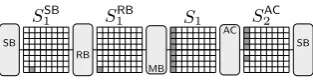
Consider the following example, illustrated in Fig. 6. We investigate the num-ber of active S-boxes over 2 rounds ofT+. For simplicity, we only state the value pair (x1, x2) for the first column of stateS1RBthroughS
AC
2 ; all other columns have zero difference (andRotateBytesdoes not change the number of active S-boxes). Using theMixBytesmatrixM ∈F8256×8 andAddConstantconstantζ
(0)
0 ∈Z264,
M =
01 01 05 01 08 06 07 04 04 01 01 05 01 08 06 07 07 04 01 01 05 01 08 06 06 07 04 01 01 05 01 08 08 06 07 04 01 01 05 01 01 08 06 07 04 01 01 05 05 01 08 06 07 04 01 01 01 05 01 08 06 07 04 01
, ζ0(1)=
F3 F0 F0 F0 F0 F0 F0 70 , we get
x1: (00 00 00 00 00 00 00 00)>
MB
7−−→(00 00 00 00 00 00 00 00)>7−AC−→(F3 F0 F0 F0 F0 F0 F0 70)>, x2: (00 00 00 00 00 00 00 FF)>
MB
SB SSB
1
RB SRB
1
MB S1
AC SAC
2 SB
Fig. 6.Example with 6 instead of 9 active S-boxes over 2 rounds ofT+.
References
1. Daemen, J., Rijmen, V.: The wide trail design strategy. In: Honary, B. (ed.) Cryp-tography and Coding – IMA 2001. LNCS, vol. 2260, pp. 222–238. Springer (2001) 2. Gauravaram, P., Knudsen, L.R., Matusiewicz, K., Mendel, F., Rechberger, C., Schl¨affer, M., Thomsen, S.S.: Grøstl – a SHA-3 candidate. Submission to NIST (January 2009), available online:http://www.groestl.info
3. Gilbert, H., Peyrin, T.: Super-Sbox cryptanalysis: Improved attacks for AES-like permutations. In: Hong, S., Iwata, T. (eds.) Fast Software Encryption – FSE 2010. LNCS, vol. 6147, pp. 365–383. Springer (2010)
4. Jean, J., Naya-Plasencia, M., Peyrin, T.: Improved rebound attack on the finalist Grøstl. In: Canteaut, A. (ed.) Fast Software Encryption – FSE 2012. LNCS, vol. 7549, pp. 110–126. Springer (2012)
5. Lamberger, M., Mendel, F., Rechberger, C., Rijmen, V., Schl¨affer, M.: Rebound distinguishers: Results on the full Whirlpool compression function. In: Matsui, M. (ed.) Advances in Cryptology – ASIACRYPT 2009. LNCS, vol. 5912, pp. 126–143. Springer (2009)
6. Lamberger, M., Mendel, F., Schl¨affer, M., Rechberger, C., Rijmen, V.: The rebound attack and subspace distinguishers: Application to Whirlpool. J. Cryptology 28(2), 257–296 (2015)
7. Mendel, F., Pramstaller, N., Rechberger, C., Kontak, M., Szmidt, J.: Cryptanal-ysis of the GOST hash function. In: Wagner, D. (ed.) Advances in Cryptology – CRYPTO 2008. LNCS, vol. 5157, pp. 162–178. Springer (2008)
8. Mendel, F., Rechberger, C., Schl¨affer, M., Thomsen, S.S.: The rebound attack: Cryptanalysis of reduced Whirlpool and Grøstl. In: Dunkelman, O. (ed.) Fast Soft-ware Encryption – FSE 2009. LNCS, vol. 5665, pp. 260–276. Springer (2009) 9. Mendel, F., Rechberger, C., Schl¨affer, M., Thomsen, S.S.: Rebound attacks on
the reduced Grøstl hash function. In: Pieprzyk, J. (ed.) Topics in Cryptology – CT-RSA 2010. LNCS, vol. 5985, pp. 350–365. Springer (2010)
10. Mendel, F., Rijmen, V., Schl¨affer, M.: Collision attack on 5 rounds of Grøstl. In: Cid, C., Rechberger, C. (eds.) Fast Software Encryption – FSE 2014. LNCS, vol. 8540, pp. 509–521. Springer (2014)
11. Oliynykov, R., Gorbenko, I., Kazymyrov, O., Ruzhentsev, V., Kuznetsov, O., Gor-benko, Y., Boiko, A., Dyrda, O., Dolgov, V., Pushkaryov, A.: A new standard of Ukraine: The Kupyna hash function. Cryptology ePrint Archive, Report 2015/885 (2015),http://eprint.iacr.org/2015/885
12. Wu, S., Feng, D., Wu, W., Guo, J., Dong, L., Zou, J.: (pseudo) preimage attack on round-reduced Grøstl hash function and others. In: Canteaut, A. (ed.) Fast Software Encryption – FSE 2012. LNCS, vol. 7549, pp. 127–145. Springer (2012) 13. Zou, J., Dong, L.: Cryptanalysis of the round-reduced Kupyna hash function.