Revisiting Secure Two-Party Computation with
Rational Players
Arpita Maitra, Goutam Paul, and Asim K. Pal
Abstract—A seminal result of Cleve (STOC 1986) showed that fairness, in general, is impossible to achieve in case of two-party computation if one of them is malicious. Later, Gordon et al. (STOC 2008, JACM 2011) observed that there exist two distinct classes of functions for which fairness can be achieved. One is any function without an embedded XOR, and the other one is a particular function containing an embedded XOR. In this paper, we revisit both classes of functions in two-party computation under rational players for the first time. We identify that the protocols proposed by Gordon et al. achieve fairness in non-rational setting only. In this direction, we design two protocols, one for the millionares’ problem or the greater-than function (any function without embedded XOR can be converted to this function) and the other for the particular embedded XOR function of Gordon et al., and show that with rational players, our protocols achieve fairness, correctness and strict Nash equilibrium under suitable choice of parameters in complete information game setting. The dealer is offline in both of our protocols and this is in contrast with the work of Groce et al. (Eurocrypt 2012) which shows fairness and Bayesian Nash equilibrium in two party computation with rational players for arbitrary function in an incomplete information game setting.
Index Terms—Cryptography, embedded XOR, fairness, millionaires’ problem, secure computation.
F
1
INTRODUCTION
In a secure two-party computation, two parties or players want to compute a particular function of their inputs while preserving specific security notions under certain adversar-ial model. In [7], Cleve showed an impossibility result that certain functions cannot be computed with complete fair-ness without an honest majority. From this, the community conjectured that no function can be computed without an honest majority. However, in [4], [6] the authors showed that absolute correctness can be achieved for certain other types of functions in case of multi-party computation with one-third faulty players. The positive results of [4], [6] do not conflict with the negative result of [7] as the impossibility result is shown for a different type of functions. The solution proposed in [4], [6] consider broadcast channel model. After more than two decades, Gordon et al. [9] came out with two sets of functions for which complete fairness is possible for two-party computation in non-simultaneous channel model, even if one of the players is malicious.
One particular function of interest in [9] was the Yao’s millionaires’ problem [22], or more precisely, the ‘greater than’ function. The problem deals with two millionaires, Alice and Bob, who are interested in finding who amongst them is richer, without revealing their actual wealth to each other. Since the subsequent work [10] by Gordon et al. showed that any function over polynomial-size do-mains which does not contain an “embedded XOR” can be
• A. Maitra and A. K. Pal are with Management Information Systems Group, Indian Institute of Management Calcutta, India. Email:{arpitam, asim}@iimcal.ac.in
• G. Paul is with Cryptology & Security Research Unit, R. C. Bose Centre for Cryptology & Security, Indian Statistical Institute, Kolkata. Email: [email protected]
converted into the greater than function, the millionaires’ problem covers all functions without embedded XOR.
In this paper, for the first time we study the fairness and correctness in millionaires’ problem with rational players. Rational players are neither ‘good’ nor ‘malicious’, they are utility maximizing. Each rational party wishes to learn the output while allowing as few others as possible to learn the output. Thus, each rational party chooses abort to maximize its utility. We show that the solution of Gordon et al. for millionaires’ problem in non-rational setting no longer remains fair in rational setting. We also propose a modification in the protocol with the help of a third player (explained later) so that fairness, correctness and strict Nash equilibrium can be established.
The work by Gordon et al. [9], [10] also studied the function that belongs to the class of embedded XOR. The XOR function simply checks whether the inputs chosen by two players (from a specified domain) are equal or not. They showed that under certain parameter value of a hybrid model, fairness is achieved. In this paper, we also revisit this problem with rational players and show that fairness is no longer guaranteed. We propose a modified version of the protocol by Gordon et al. in non-rational setting and prove its fairness and strict Nash equilibrium under suitable choice of the parameters.
In [3], Asharov et al. gave the full characterization of the functions which never be computed with complete fairness in two party setting when one of the parties is malicious. They actually extended the negative result of Cleve [7]. Interestingly, neither the greater than function nor the embedded XOR function belongs to these groups.
1.1 Related Works
are rational. However, in [12] the authors identified that the impossibility results of [2] are valid for some specific functions, specific input distribution and for specific set of utilities. They [12] came out with an algorithm for arbitrary function which can be computed with complete fairness in two party setting considering rational players. However, their protocol is an incomplete information game and thus achievesBayesian Nash equilibrium. Contrary to this, our pro-posed protocols are acomplete information gameand achieves strict Nash equilibrium. Moreover, in [12], the following is mentioned.
“Before continuing, it is helpful to introduce two modifications to the protocol that can only increase
P0’s utility. First, in each iteration i we tell P0 whetheri∗< i. (One can easily see thatP
0cannot increase its utility by aborting wheni∗ < i, and so the interesting case to analyze is whether P0 can improve its utility by aborting wheni∗≥i.) Second, ifP0ever aborts the protocol in some iterationiwith
i∗ ≥ i, then we tellP0 whetheri∗ = i beforeP0 generates its output. (P0is not, however, allowed to change its decision to abort.)”
It is not clear how “we” can let the player know whether
i∗ < i or i∗ ≥ i. Note that in [12], the symbol i stands for any iteration in which player P0 (in our case it is P1) aborts the protocol and symboli∗ stands for the revelation round (in our case it isr). One may interpret this “we” as a dealer who has to remain online throughout the game. This is not very practical, as in each iteration the dealer has to interact with the players and has to ask them whether they will choose to abort. Another restriction in their scheme is that the deviating player can not escape from its decision, knowing that the round it has chosen to abort is less than or equal to the revelation round. Exploiting the idea of an intermediate player who is a different entity from the dealer, we are able to make the dealer off-line in the millionares’ problem. Note that our protocol for the embedded XOR requires neither an online dealer, nor an intermediate player. One may think that the use of a third player is no different than the use of a dealer. But the fact is that our third player is less restrictive in comparison with the dealer. In the literature, the dealer is always assumed to be honest and this is a strong assumption. On the other hand, the third player in our model is assumed to be rational in nature and this is a more pragmatic assumption. Moreover, the dealer is a special distinct entity from the players, whereas the role of our intermediate third player can be adopted by any rational player who is not interested in the outcome of the game, rather his only objective is to earn some revenue at the end of the game. The analogy can be of a referee conducting a match. A referee remains true to the game and only deviates for a huge (monitory) gain at the risk of losing his reputation or job. A third player can also be referred as a ‘service provider’ entity, e.g. a cloud or an outsourcing agent. For simplicity, we assume that this third player is fail-stop in nature.
Making the dealer offline in the rational secret sharing was once a challenging task and it was overcome by intro-ducing an indicator bit [14] or a signal [8] to make the player aware of the fact that they have passed the revelation round.
To the best of our knowledge, there is no protocol in two party secure computation with rational players where the dealer is made offline. We believe that introduction of a third player is not a weakness of our protocol for the millionares’ problem, rather it may be considered as the first effort to make the dealer offline in secure two party protocol with rational players.
In case of embedded XOR problem, one may easily notice that when a player choosesx3as his input, he knows with certainty that his output will be1. So he should have no incentive to play the game anymore. According to [12], if a party aborts the game, the other party outputs0 or 1
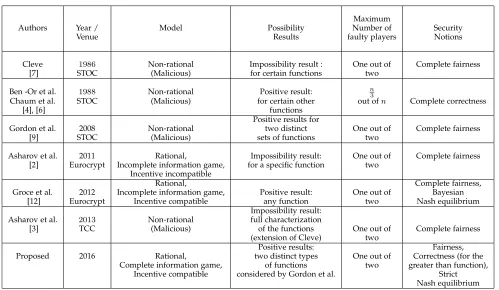
depending on his input. Thus, there is a non-negligible prob-ability that the protocol of [12] does not achieve fairness. On the other hand, our proposed protocol for the embedded XOR problem is free from this problem. We summarize all the positive and negative results in the context of multiparty computation in Table 1.
1.2 Contributions
We list our key contributions one by one.
1) We revisit fairness in two prominent Secure Two-Party Computation problems, namely, Yao’s mil-lionaires’ problem [22] and the Embedded XOR problems [9], [10], for the first time with rational players.
2) We show that the protocol of Gordon et al. [9], [10] for solving the millionaires’ problem which was meant for the non-rational setting does not auto-matically extend to the rational setting, in the sense that the fairness breaks down when the players are rational (Theorem 1).
3) We propose a variant of this protocol and show that fairness can be regained when players are rational (Theorem 4). We also establish correctness (Theo-rem 3) and strict Nash equilibrium (Theo(Theo-rem 5) for the new protocol.
4) We get away with the online dealer by introducing a rational third party for solving the millionaires’ problem. This helps us to establish the fairness of our protocol.
5) We show that the problem in the embedded XOR category [9], [10] also no longer remains fair with rational players (Theorem 6).
6) We propose a variant of the protocol in [9], [10] for embedded XOR and show that fairness can be guaranteed under certain assumptions (Theorem 7). We also establish strict Nash equilibrium for our protocol (Theorem 8).
7) For both the problems, we discuss the issues with unequal vs. equal domain sizes.
2
PRELIMINARIES
TABLE 1
Possibility and Impossibility Results in the Context of Multiparty Computation
Maximum
Authors Year / Model Possibility Number of Security
Venue Results faulty players Notions
Cleve 1986 Non-rational Impossibility result : One out of Complete fairness [7] STOC (Malicious) for certain functions two
Ben -Or et al. 1988 Non-rational Positive result: n3
Chaum et al. STOC (Malicious) for certain other out ofn Complete correctness
[4], [6] functions
Positive results for
Gordon et al. 2008 Non-rational two distinct One out of Complete fairness [9] STOC (Malicious) sets of functions two
Asharov et al. 2011 Rational, Impossibility result: One out of Complete fairness [2] Eurocrypt Incomplete information game, for a specific function two
Incentive incompatible
Rational, Complete fairness,
Groce et al. 2012 Incomplete information game, Positive result: One out of Bayesian [12] Eurocrypt Incentive compatible any function two Nash equilibrium
Impossibility result: Asharov et al. 2013 Non-rational full characterization
[3] TCC (Malicious) of the functions One out of Complete fairness (extension of Cleve) two
Positive results: Fairness, Proposed 2016 Rational, two distinct types One out of Correctness (for the
Complete information game, of functions two greater than function), Incentive compatible considered by Gordon et al. Strict
Nash equilibrium
2.1 Functionality
In classical domain and in two party setting, a functionality F={fλ}λ∈Nis a sequence of randomized processes, where λis the security parameter andfλmaps pairs of inputs to pairs of outputs (one for each party). Explicitly, we can write
fλ = (fλ1, f 2
λ), wheref 1
λ(resp.,f 2
λ) represents the output of the first party, say P1 (resp., output of the second party, say P2). The domain of fλ is Xλ ×Yλ, where Xλ (resp.
Yλ) denotes the possible inputs of the first (resp. second) party. If|Xλ|and|Yλ|are polynomial inλ, then we say that F is defined over polynomial size domains. If each fλ is deterministic we say that eachfλas well as the collectionF is a function [10].
2.2 Two Party Computation
In classical domain the two party computation of a func-tionalityF ={f1
λ, f 2
λ}is defined as follows: If partyP1 is holding1λ and a inputx∈Xλand partyP2is holding1λ and a inputy∈Yλ, then the joint distribution of the outputs of the parties is statistically close to(f1
λ(x, y), f 2
λ(x, y))[10].
2.3 Ideal vs. Real world model
Inideal world modelwe assume that there is an incorruptible trusted third party who computes the function on behalf of
P1 and P2. P1 and P2 send their inputs to the TTP who computes the functionality and returns the value to each party. On the other hand, in real world model there is no trusted party to compute the functionality. In real model a protocol is executed to compute the functionality.
In the same line of [9], [10], we here assume ahybrid world model, where there is a trusted party who just computes the
function and distributes the shares of the function’s output as in the ideal world. This is the counterpart of the case in secret sharing [16] in the non-rational setting.The players construct the output by exchanging their shares. In our model, we call this TTP asdealer.
2.4 Rational secret sharing
Secure Multiparty Computation (SMC) is the generalization of the classical rational secret sharing [12]. In this subsection, we briefly describe what is meant by classical rational secret sharing.
Share generation and distribution: If the dealer is online, then at the beginning of each round, he distributes to each playerPw the share of the actual secret with probabilityγ or that of a fake secret with probability(1−γ). The value of γ is kept secret from the parties and is dependent on the utility values of the parties [13], [11]. An offline dealer distributes to each partyPw a list of shares, one of which is that of the actual secret s and the remaining of fake secrets [14], [8], [17]. The positionrof this actual share in the lists is not revealed to the players and is chosen according to a geometric distributionG(γ), where the parameterγ in turn depends on the utility values of players. The dealer generates shares using Shamir’s secret sharing scheme [16]. Secret Reconstruction: In the lth round of communi-cation, each player Pw (either simultaneously or non-simultaneously) broadcasts or sends individually to each of the other players (in presence of synchronous, point-to-point channels) the shareswlcorresponding to that round. The shares are signed by the dealer. Hence, no player can give out false shares undetected and the only possible action of a player in a round is to either 1) send the message or 2) remain silent. The round in which the shares of the actual secret are revealed and hence the secret is reconstructed is called revelation or definitive round. When the dealer is offline, players are made aware that they have crossed the revelation round by the reconstruction or exchange of an indicator (a bit in [14], a signal in [8]). For simultaneous channel model, parties can identify a revelation round as soon as it occurs. However, for non-simultaneous channels, the indication is delayed till the subsequent round to avoid rushing strategy. In this case, the indicator cannot be recon-structed or interpreted by all the players. The player who communicates last during the reconstruction of the indicator is the first and only one to know that the last round was the revelation round. Once he comes to know this, he has no incentive to send his share of the indicator to the other players for reconstruction. Instead, he simply quits. The fact that this player quits signals to the other players that the secret has been reconstructed.
2.5 Computation of a functionality in Rational setting We define a mechanism for computing a functionality with rational adversary to be a pair (Γ,−→σ), where Γ is the game (i.e., specification of allowable actions) and −
→σ=(σ
1, . . . , σn)denotes the suggested strategies followed by n number of players. We use the notations −→σ−w and
(σw0 ,−→σ−w) respectively for (σ1, . . . , σw−1, σw+1, . . . , σn) and (σ1, . . . , σw−1, σw0 , σw+1, . . . , σn). Here, σw0 stands for deviated strategy. The outcome of the game is denoted by −
→o(Γ,−→σ)
=(o1, . . . , on). The set of possible outcomes with respect to a partyPwis as follows. 1)Pwcorrectly computes
f, while others do not; 2) everybody correctly computesf; 3) nobody computesf; 4) others computesf correctly, while
Pw does not and 5) others believe in a wrong functional value, whilePwdoes not.
The output that no function is computed is denoted by ⊥(i.e., nullas in [9]) and output of wrong computation is denoted by+.
In classical domain, the adversary that controls a player may be computationally bounded. Here, we assume the adversary has probabilistic polynomial time complexity.
2.6 Utilities and Preferences
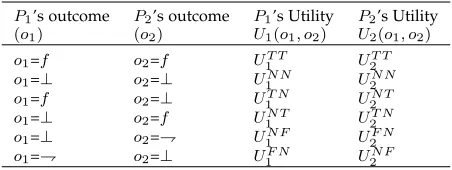
The utility function uw of each party Pw is defined over the set of possible outcomes of the game. The outcomes and corresponding utilities for two parties are described in Table 2. We here assume Bernoulli utility function.
TABLE 2
Outcomes and Utilities for(2,2)rational function reconstruction
P1’s outcome P2’s outcome P1’s Utility P2’s Utility
(o1) (o2) U1(o1, o2) U2(o1, o2)
o1=f o2=f UT T
1 U2T T
o1=⊥ o2=⊥ UN N
1 U2N N
o1=f o2=⊥ UT N
1 U2N T
o1=⊥ o2=f U1N T U2T N
o1=⊥ o2=+ UN F
1 U2F N
o1=+ o2=⊥ UF N
1 U2N F
Players have their preferences based on the different possible outcomes. In this work, a rational player w is assumed to have the following preference:
R1:UwT N > U T T w > U
N N w > U
N T w .
Some players may have the additional preference UwN F ≥
UwT T, whereas the rest haveUwN F < UwT T.
2.7 Fairness
In non-rational setting, the security of a protocol is ana-lyzed [9], [10], [15] by comparing what an adversary can do in arealprotocol execution to what it can do in anideal scenario that is secure by definition. This is formalized by considering an ideal computation involving an incorruptible trusted party to whom the parties send their inputs. The trusted party computes the functionality on the inputs and returns to each party its respective output. Loosely speak-ing, a protocol is secure if any adversary interacting in the real protocol (where no trusted party exists) can do no more harm than if it were involved in the above-described ideal computation.
A rational player, being selfish, desires an unfair out-come, i.e., computing the function alone. Therefore, the basic aim of rational computation has been to achieve fairness. According to Von Neumann and Morgensternexpected util-ity theorem[20], under natural assumptions, the individual would prefer one prospectO1 over another prospectO2 if and only ifE[U(O1)]≥E[U(O2)]. The work [1] implicitly uses the expected utility theorem to derive its results. We also use the same approach and accordingly redefine fair-ness as follows.
Definition 1. (Fairness) A function reconstruction mechanism
(Γ,−→σ)with rational players is said to be completely fair if for a party Pw,(w ∈ {1,2}), who is corrupted by a probabilistic polynomial time adversary, the following holds:
UwT T ≥E[Uw(Ol)],
whereOl = {o1w, . . . , on 0
2.8 Correctness of the Output
Secure two party computation inhybrid modelwith rational players is the generalization of rational secret sharing [11], [13], [14]. In rational secret sharing, the dealer is not a part of the reconstruction mechanism and therefore the output is well-defined. Whereas, in secure two party computation, the parties may not be committed to their inputs, and therefore the output is not uniquely defined. We here assume that the players have negligible probability to send arbitrary inputs. This is quite justified in the sense that the players are ratio-nal in nature, i.e., each wants to compute the function itself and does not want anyone else to compute the function. If a player sends wrong inputs, then it itself cannot learn the correct output. Thus, the players have no motivation to send wrong inputs. Rather they try to maximize their utility [12].
2.9 Complete Information Game and Nash Equilibrium
In a complete information game each player knows the other player’s payoff function and the rule of the game. It is defined asΓ = (Aw, uw), whereAw is the set of allowable actions of each playerwanduwis the utility function of the playerw[1].
A suggested strategy−→σ of a mechanism(Γ,−→σ)is said to be in Nash equilibrium when there is no incentive for a playerPwto deviate from the suggested strategy, given that everyone else is following this strategy. There are several variants of Nash equilibrium in the literature. In our context, we focus on strict Nash equilibrium.
Definition 2. (Strict Nash equilibrium) The suggested strategy −
→σ
in the mechanism(Γ,−→σ)is a strict Nash equilibrium if for every Pw and for any strategyσw0 , we have uw(σw0 ,−→σ−w) <
uw(−→σ).
In computational Nash equilibrium [1], the players will not change their strategy if their gain is negligible [5]. Since we show strict Nash for our protocols and strict Nash im-plies computational Nash, henceforth we do not talk about computational Nash anymore.
2.10 Fail-stop and Byzantine Adversarial model
In the fail-stop setting, each party follows the protocol as directed except that it may choose to abort at any time [12] and a party is assumed not to change its input when running the protocol. On the other hand, in Byzantine setting, a deviating party may behave arbitrarily. It may change the inputs or may choose to abort. Since Byzantine adversary covers all the characteristics of a fail-stop adversary, it is very natural to consider only Byzantine setting. If a protocol is secure against a Byzantine adversary, it must be secure against a fail-stop adversary. Hence, throughout the paper we analyze the security issues against Byzantine adversary only.
2.11 Our Assumptions
Here we list the assumptions that we consider in this work.
1) The channel permits non-simultaneous mode of communication.
2) Players are computationally bounded to probabilis-tic polynomial time complexity.
3) We consider complete information game unlike [12]. 4) The same utility relationship holds as considered by Groce et al. [12]. In addition, the preference of
UN F
w ≥UwT T [1] is considered.
5) The adversary may be fail-stop as well as Byzantine.
3
SMC
FORFUNCTIONS
EXCLUDING
EMBEDDED
XOR
WITHRATIONAL
PLAYERS IN
EQUAL
DOMAIN
SIZE
In this section, we first describe the solution of millionaires’ problem or, more precisely, the computation of the greater than function, proposed by Gordon et al. [9], [10]. We, then, will show how fairness condition is affected in the presence of the rational players having the preferences R1 (refer to subsection 2.6). Let us denote two players by P1 and
P2. Suppose P1 has the secret i and P2 has the secret j,
1 ≤ i ≤ M,1 ≤ j ≤ M, whereM = M(λ) is the size of the domain of each input [9]. The trusted third party in hybrid model gives an ordered list X = {x1, x2, . . . , xM} to P1 and another ordered list Y = {y1, y2, . . . , yM} to
P2. We call this TTP as dealer. Then P1 sends xi to the dealer and P2 sends yj to the dealer. Let f be a deter-ministic function which maps X ×Y → {0,1} × {0,1}. The functionf(xi, yj)can be defined as a pair of outputs, i.e., f(xi, yj) = (f1(xi, yj), f2(xi, yj)), where f1(xi, yj) is the output of the first party andf2(xi, yj)is the output of the second party. For millionaires’ problem, the function is defined as follows [9], [10]. Forw= 1,2,
fw(xi, yj) =
(
1 ifi > j;
0 ifi≤j. (1)
The protocol proceeds in a series ofM iterations. The dealer creates two sequences {al} and {bl}, l = 1,2, . . . , M, as follows.
ai=bj=f1(xi, yj) =f2(xi, yj).
Forl6=i,al=⊥and forl6=j,bl=⊥.
Next, the dealer splits the secretalinto the sharesa1l and
a2
l, and the secretblinto the sharesb1l andb 2
l, so thatal =
a1l ⊕a2l andbl=b1l ⊕b 2
l, and gives the shares{(a 1 l,b
1 l)}to
P1and the shares{(a2l,b2l)}toP2. In each roundl,P2sends
a2
l to P1, who, in turn sendsb1l toP2.P1 learns the output valuef1(xi, yj)in iteration i, and P2 learns the output in iteration j. As we require three elements, 0, 1 and ⊥, we define0by00,1by11and⊥by01. The algorithm for the functionality share generation in fail-stop setting is revisited in Algorithm 1. Here we assume that the dealer who will distribute the shares is honest and can compute the function described in Equation (1). The protocol for computingf is described in Algorithm 2.
The algorithms in the Byzantine setting are the same as those in the fail-stop setting except some additional steps. In Byzantine setting, the shares are signed by the dealer. Along with the shares of the function, the dealer also distributes some secret keyska, kb ←Gen(1λ), whereλis the security parameter. For 1 ≤ l ≤ M, let tal = M acka(l k a
2 l) and tb
l = M ackb(l k b
1
l). P1 receives a11, a12, . . . , a1M and
(b1
1, tb1),(b12, tb2), . . . ,(b1M, tbM) and MAC key ka. Similarly
P2is given(a21, ta1),(a22, ta2), . . . ,(a2M, t a M)andb
2
Inputs:
1 xifromP1andyjfromP2. If one of the received input is not in the correct domain, then both the parties are given⊥.
Computation:
The dealer does the following: 2 Setsai=bj=f1(xi, yj) =f2(xi, yj). 3 Forl∈ {1, . . . , M}, l6=i, setsal=⊥. 4 Forl∈ {1, . . . , M}, l6=j, setsbl=⊥.
5 Forl∈ {1, . . . , M}, choosesa1l randomly from {0,1}2, and setsa2
l =a1l ⊕al.
6 Forl∈ {1, . . . , M}, choosesb1l randomly from {0,1}2
, and setsb2l =b1l ⊕bl.
Output:
7 The dealer prepares a listlistwof shares for each partyPw, wherew∈ {1,2}such that
P1receives the values ofa11, a 1 2, . . . , a
1 M and
b1
1, b12, . . . , b1M.
P2receives the values ofa21, a22, . . . , a2M and
b21, b22, . . . , b2M.
Algorithm 1:ShareGen
Inputs:
1 P1obtainsa11, a12, . . . , aM1 andb11, b12, . . . , b1M. 2 P2obtainsa21, a22, . . . , a2M andb
2
1, b22, . . . , b2M.
Computation:
There areM number of iterations. In each iteration
l∈ {1,2, . . . , M}do:
3 P2sendsa2l toP1andP1computesal=a1l ⊕a 2 l. 4 P1sendsb1l toP2andP2computesbl=b1l ⊕b2l.
Output:
5 IfP2aborts in roundl, i.e., does not send its share at that round andl≤i,P1outputs1. Ifl > i,P1has already determined the output in some earlier iteration. Thus it outputs that value.
6 IfP1aborts in roundl, i.e., does not send its share at that round andl≤j,P2outputs0. Ifl > j,P2has already determined the output in some earlier iteration. Thus it outputs that value.
Algorithm 2:ΠCMP
from P2,P1 verifies by the algorithm V rf yka(l k a
2 l, tal). IfV rf yk
a(lka
2
l, tal) = 0,P1halts. Similarly, after receiving the share in the roundlfromP1,P2verifies by the algorithm
V rf ykb(l k b1
l, tbl). IfV rf ykb(l k b
1
l, tbl) = 0,P2 halts. Oth-erwise both continues the protocol ΠCMP which outputs
ai(bj)forP1(P2).
Exploiting the MAC signature, we can resist the players to send a false share.
3.1 ΠCMPis not fair when players are rational
In this section, we revisit the fairness issue in the million-aires’ problem [9] considering the rational players. We also assume that the players, P1 and P2 have the preferences R1 (refer to subsection 2.6). Either of the players also has
UN F
w ≥ UwT T. We observe that Gordon et al.’s protocol
ΠCMP[9], [10], that was designed for non-rational setting,
is no longer fair in the rational setting.
Theorem 1. Provided R1 and UN F
w ≥ UwT T for some player
Pw, the protocolΠCMPis not completely fair in rational setting. Proof. Suppose P1 aborts before giving its share in round
l, where 1 ≤ l ≤ M. Now, ifi ≤ j, we list all possible mutually exclusive and exhaustive outcomes as follows:
1) When 1 ≤ l < i, P2 outputs 0 and correctly concludes thati≤j, butP1outputs⊥.
2) Wheni≤l≤M,P1obtains the function and both correctly conclude thati≤j.
In this case, the utility ofP1is given by
U1≤= (
U1N T if1≤l < i;
UT T
1 ifi≤l≤M;
(2)
If i > j, all possible mutually exclusive and exhaustive outcomes are:
1) When 1 ≤ l ≤ j, P2 outputs 0 and wrongly concludes thati≤j, butP1outputs⊥.
2) When j < l < i,P1 outputs ⊥, but P2 correctly concludes thati > j.
3) Wheni≤l ≤M, both computes the function and both correctly conclude thati > j.
Thus, the corresponding utility for this event is given by
U1>=
U1N F if1≤l≤j;
UN T
1 ifj < l < i;
UT T
1 ifi≤l≤M;
(3)
Sinceiis known toP1, the expected utility ofP1is given by
E[U1] = Pr(i≤j)·E[U1≤] + Pr(i > j)·E[U > 1 ], (4)
wherePr(i≤j) = M−Mi+1 andPr(i > j) = iM−1. Here, we assume thatiandjare uniformly distributed over their do-mains. Plugging in the values from Equation (2) and (3) into Equation (4), we get for1≤l < i,E[U1] = M−Mi+1
U1N T+ i−1
M
l−1 i−1
UN T
1 +
i−l i−1
UN F
1
, and fori≤l≤M, it is equal to M−Mi+1UT T
1 + iM−1
UT T
1 . In other words,
E[U1] =
( M
−i+l M
UN T
1 +
i−l M
UN F
1 if1≤l < i;
U1T T ifi≤l≤M.
Note that in the first case, i.e., for1≤l < i, the second term corresponding toi > jinvolves two sub cases, namely,
1≤j < l < iandl≤j < i.
Observe that wheni≤l≤M,P1has already obtained the secret, but by aborting it cannot increase its utility beyondUT T
1 .
However, when l < i, we may have E[U1] > U1T T, depending on the value ofU1N F.Thus, dependence onU1N F
prevents the protocol to achieve fairness in this case. In other words, we can say that when a party aborts before it obtains the output, the only reason would be if he is significantly more interested in cheating the other party rather than him not getting it.
3.2 How to makeΠCMPfair when players are rational
In this section, we propose a variant of the protocol by Gordon et al. [9], [10]. In the earlier section, we have observed that ΠCMP suffers from early abort. Exploiting
the idea of an intermediate playerP3, we are able to make the dealer off-line. We have already discussed the difference between online dealer and the intermediate player in detail in Section 1.1. The key point is that P3 need not to be assumed to be honest, it is just another rational player, like
P1orP2.
Our protocol is described in Algorithm 3 and Algo-rithm 4. Though our protocol initially addresses towards the millionaires’ problem, it is applicable for any function which does not have any embedded XOR [10]. Our protocol isUN F (refer to subsection 2.6) independent and hence cor-rect [1]. We also prove fairness and strict Nash equilibrium for our protocol.
Inputs:
1 xifromP1andyjfromP2. If one of the received input is not in the correct domain, then both the parties are given⊥.
Computation:
The dealer does the following: 2 Chooses an intermediate playerP3.
3 Choosesraccording to a geometric distribution G(γ)with parameterγand setsras the revelation round, i.e., the round in which the value off is either(0,0)or(1,1)(refer to subsection 2.4). 4 Choosesdaccording to the geometrical distribution
G(γ)and sets the total number of iterations as
m=r+d.
The dealer does the following: 5 Setsar=br=f1(xi, yj) =f2(xi, yj). 6 Forl∈ {1, . . . , M},l6=r, setsal=bl=⊥. 7 Forl∈ {1, . . . , M}, choosesa1l anda2l randomly
from{0,1}2, and setsa3
l =a1l ⊕a2l ⊕al. 8 Forl∈ {1, . . . , M}, choosesb1l andb2l randomly
from{0,1}2
, and setsb3l =b1l ⊕b2l ⊕bl. 9 Forl∈ {1, . . . , M}, choosesc2l randomly from
{0,1}2, and setsc3
l =c2l ⊕a3l andc1l =c3l ⊕b3l.
Output:
10 The dealer prepares a listlistwof shares for each partyPw, wherew∈ {1,2,3}such that
P1receives the values ofa11, a12, . . . , a1m,
b11, b12, . . . , b1mandc11, c12, . . . c1m.
P2receives the values ofa21, a22, . . . , a2m,
b2
1, b22, . . . , b2mandc21, c22, . . . c2m.
P3receives the values ofc31, c32, . . . , c3m.
Algorithm 3:ShareGen forΠCMP fair
We assume that P3 has a positive threshold value of revenue. We denote this threshold value by. If any player offers him a revenueδ≥,P3will help the player to get the output alone. Otherwise he will play the game according to the suggested strategy. This threshold value may depend on the reputation value of P3. We take the idea of reputation from [19]. Thus,P3has following two options:
Inputs:
1 P1obtainsa11, a12, . . . , am1,b11, b12, . . . , b1mand
c1
1, c12, . . . , c1m. 2 P2obtainsa21, a
2 2, . . . , a
2 m,b
2 1, b
2 2, . . . , b
2 mand
c2
1, c22, . . . , c2m.
3 P3obtainsc31, c32, . . . , c3m.
Computation:
There aremnumber of iterations. In each iteration
l∈ {1,2, . . . , m}do the following.
4 P2sendsa2l toP1andP1sendsb1l toP2. 5 After receiving the share fromP2,P1sendsc1l to
P3, else halts.
6 After receiving the share fromP1,P2sendsc2l to
P3, else halts.
7 P3computes the values ofa3l andb3l and sendsa3l toP1and thenb3l toP2.
Output:
8 IfP2aborts in roundl, i.e., does not send its share at that round andl≤r,P1outputs⊥. Ifl > r,P1has already determined the output in some earlier iteration. Thus it outputs that value.
9 IfP1aborts in roundl, i.e., does not send its share at that round andl≤r,P2outputs⊥. Ifl > r,P2has already determined the output in some earlier iteration. Thus it outputs that value.
10 IfP1orP2does not send its share toP3,P3outputs ⊥to the both of the players.
11 IfP3does not send its computed share to any one of the partyPw,w∈ {1,2}, in a roundl,Pwchooses to abort from the very next round and the protocol will be terminated.
Algorithm 4:ΠCMP fair
• Option1: He can follow the protocol, i.e., he can send the shares to both the parties.
• Option 2: If any one of the players gives him a revenueδ ≥ , he will send the share only to that player and help him obtain the output alone.
As P3 is rational and hence utility maximizer, he first checks whether any one of the players indeed gives him the revenue. Without loss of generality, we assume thatP1gives him the revenueδ ≥. In this case,P3 will send the share only to P1 but not toP2. The following result shows that
P1 should have no incentive to give the revenue to P3 in the motivation to get the output by himself only provided certain conditions hold.
Theorem 2. Provided >0,≤δ≤UwT N−UwT T,0< γ <1 andγUT N
w + (1−γ)UwN N < UwT T for allw∈ {1,2},P3always plays the game according to the suggested strategy.
revelation round and givesP3the money for that round so thatP3will not send the corresponding share toP2for that round. If the guess is correct, i.e., r =l, the probability of which isγ, its utility is(UT N
1 −δ). Otherwise, its utility is
(U1N N−δ), as in this caseP2will abort from the next round. So the expected utility ofP1is given by
γ(U1T N −δ) + (1−γ)(U1N N−δ)
= γU1T N+ (1−γ)U1N N−δ < U1T T−δ < U1T T.
The last inequality follows from our assumptions thatδ is positive andγUT N
1 + (1−γ)U1N N < U1T T. ThusP1has no incentive to offer money to the intermediate playerP3in the motivation to get the output alone. Similar analysis can be done forP2.
Thus,P3 has no option but to play the game according to the suggested strategy.
In our mechanism, there are three players, namely P1,
P2 andP3. For the condition of achieving correctness and fairness, we have to assume that when one of the players deviates, others are sticking to the protocol. From the above analysis we have seen thatP3 has no incentive to deviate from the protocol. Thus, we have to consider the following two cases.
1) P1deviates (P2follows the protocol). 2) P2deviates (P1follows the protocol).
In fail-stop setting, the deviation ofP1andP2is consid-ered as early abort whereas in Byzantine setting the players behave arbitrarily. That means they can abort early as well as can send the arbitrary inputs or can swap the inputs.
We analyze the security notions such as correctness and fairness considering all the above issues. The following theorems show that our proposed mechanism is correct and fair.
In Byzantine setting, the shares given to the players are signed by the dealer so that no player can send a false share to the other player. The signing procedure discussed in Section 3 remains similar in our protocol expect M is replaced bymand with some additional steps.
• For 1 ≤ l ≤ m, P1 is given (c1l, t c1
l ), where t c1 l =
M ackc1(lkc 1 l).
• For 1 ≤ l ≤ m, P2 is given (c2l, t c2
l ), where t c2 l =
M ackc2(lkc 2 l).
• P3 is given MAC keykc1 and MAC key kc2 so that for1 ≤l ≤m, it can verify the shares by algorithm
V rf ykc
1(l k c 1 l, t
c1
l )forP1 andV rf ykc2(l k c
2 l, t
c2 l ) for P2. If V rf ykcw(l k cwl, t
cw
l ) = 0, P3 halts, else continues, wherew∈ {1,2}.
There is no need to sign the shares given to P3, as P3 is fail-stop by nature. We assume P3 as a fail-stop player for simplicity. One may considerP3 as a Byzantine player. In that case P1 and P2 are given additional MAC keys to verify the shares coming fromP3.
The following result establishes the correctness of the protocol.
Theorem 3. The protocolΠCMP
Fair isUwN F-independent forw∈ {1,2}and hence correct.
Proof. We should recall that the deviations of P1 and P2 are similar. Thus for simplicity, here, we only consider the deviations ofP1.
In fail-stop setting, if P1 aborts early and the round in which he aborts is less thanj, according to Gordon et al.’s protocol,P2 will output 0and conclude that i ≤j. When
i > j, it is the situation whenP2is deceived byP1. However, our protocol is designed in such a way that ifP1has chosen abort in any round beforer,P2will output⊥and does not conclude anything. Thus, P1 can not deceive P2 by early abort. There is no incentive forP1to abort in a roundl > r, as P2 has already determined the output in some earlier iteration.
In case of Byzantine setting,P1can send arbitrary shares to bothP2andP3, so thatP2will finally compute a wrong function. But since each share is signed by the dealer, no one can send an arbitrary share to the other. Another important deviation of P1 in this setting is to swap the inputs. By swapping the inputs,P1 can make P2 compute a wrong function. As all the inputs came from the same dealer, there is no chance to catch this type of deviation by considering only the signature scheme. However, we con-sider signature with tagging.P1receivesa11, a12, . . . , a1mand
(b1
1, tb1),(b12, tb2), . . . ,(b1m, tbm)and MAC keyka. SimilarlyP2 is given(a21, ta1),(a22, ta2), . . . ,(a2m, tam)andb21, b22, . . . , b2mand MAC keykb. After receiving the share in the roundl from
P1, ifV rf ykb(lkb
1
l, tbl) = 0, thenP2halts. Similar checking is done byP3as well. Thus, by input swapping no one can make the other believe in a wrong output.
Thus, assumingP1 hasU1N F > U1T T, the mechanism is designed in such a way that it becomesUN F
1 independent and hence correct. Proceeding in the same way forP2, we can prove theUN F
2 independence.
Now we are in a position to establish fairness ofΠCMP Fair .
Theorem 4. Provided R1 and P3 always plays the game ac-cording to the suggested strategy, the protocol ΠCMP
Fair achieves
fairness.
Proof. Without loss of generality, let us assume that P3 is following the suggested strategy and the player P1 is deviating. The analysis whenP2deviates is similar.
In this case, the reason for deviation is to get the function alone. In fail-stop as well as in Byzantine setting P1 can abort in roundl.
P1may choose three types of abort in roundl.
1) It may not send its share to onlyP2. 2) It may not send its share to onlyP3. 3) It may not send its share to bothP2andP3.
IfP1does not send its share toP2, thenP2will not send its share toP3. As a result the protocol will be terminated without producing any result either forP1 orP2. Similarly, ifP1does not send its share toP3, according to the protocol
P3will output⊥to both the players. In the third case, the protocol will be terminated from the beginning of the round
l. Thus, there is no incentive for P1 to abort early in the motivation to get the secret alone.
Theorem 5. ProvidedR1,0< γ <1,≤δ≤UwT N−UwT T, andγUwT N+ (1−γ)UwN N < UwT T for allw∈ {1,2},ΠCMPFair
Proof. In Theorem 2, we proved that providedR1,0< γ <
1 , ≤ δ ≤ UwT N −UwT T and γUwT N + (1−γ)UwN N <
UT T
w for allw∈ {1,2},P3can not increase his utility value by deviating from the suggested strategy. We also proved that provided R1 and given that P3 follows the protocol, neitherP1norP2can increase his utility value beyondUwT T (utility when each player follows the suggested strategy) by deviating from the suggested strategy (Theorem 4). In other words,
uw(σ0w,−→σ−w)< uw(−→σ),
which concludes the proof.
3.3 Fairness analysis ofΠCMPwhen players have
un-equal domain size
As discussed in [10, Section 3.2], when the domain sizes of the players are unequal, the analysis in the non-rational setting does not change. It is easy to see from our analysis of Section 3.1 that even in the rational setting, we can carry out an analogous calculation to conclude that the protocol isUN F-dependent and hence not fair.
4
SECURE
TWO-PARTY
COMPUTATION FOR
FUNC-TIONS INVOLVING
EMBEDDED
XOR
WITHRATIONAL
PLAYERS
In this section, we first describe the embedded XOR problem proposed by Gordon et al. [9]. We, then, will show how fairness condition is affected in the presence of the rational players having the preferencesR1 (refer to subsection 2.6). Let us denote two players byP1andP2. PlayerP1is given an ordered list{x1, x2, x3}andP2is given an ordered list {y1, y2}.P1 randomly chooses the input from the ordered list and sends to the dealer (the trusted party in thehybrid model).P2also randomly chooses the input from his list and delivers to the dealer. Dealer calculates the function. For convenience, we here recall the table forf given in [9].
y1 y2
x1 0 1
x2 1 0
x3 1 1
The function can be described as, forw∈ {1,2}
f(xi, yj) =
(
1 ifi6=j;
0 ifi=j. (5)
As described in [9], the protocol proceeds in a series of M iterations, where M = ω(γ−1logλ), λ being the security parameter. Let x and y denote the inputs from
P1 and P2 respectively. The dealer chooses the revelation roundraccording to geometric distribution with parameter
γ. The dealer then creates two sequences {al} and {bl},
l= 1,2, . . . , M, as follows.
Forl≥r, al=bl=f(x, y).
Forl < r, al=f(x,y),ˆ bl=f(ˆx, y),
wherexˆ(oryˆ) is a random value ofx(ory) chosen by the dealer.
Next, the dealer splits the secret al into the shares a1l and a2l, and the secret bl into the shares b1l and b
2 l, so thatal = a1l ⊕a2l and bl = b1l ⊕b2l, and gives the shares
{(a1 l, b
1
l)} to P1 and the shares {(a2l, b 2
l)} to P2. In each round l,P2 sends a2l to P1, who, in turn sends b1l to P2.
P1andP2both learns the output valuef(x, y)in iteration
r, unlike the millionaires’ problem. The algorithm for the functionality share generation in fail-stop setting is revisited in Algorithm 5. Here we assume that the dealer who will distribute the shares is honest and can compute the function described in Equation (5). The protocol for computingf is described in Algorithm 6.
Inputs:
1 xfromP1andyfromP2. If one of the received input is not in the correct domain, then both the parties are given⊥.
Computation:
The dealer does the following:
2 Choosesraccording to a geometric distribution G(γ)with parameterγ. Hereris the revelation round, i.e., the round in which the value off is either(0,0)or(1,1).
3 Forl < r, setsal=f(x,y)ˆ andbl=f(ˆx, y). 4 Forl≥r, setsal=arandbl=br.
5 Forl∈ {1, . . . , M}, choosesa1l randomly from {0,1}2
, and setsa2 l =a
1 l ⊕al.
6 Forl∈ {1, . . . , M}, choosesb1l randomly from {0,1}2, and setsb2
l =b1l ⊕bl.
Output:
7 The dealer prepares a listlistwof shares for each partyPw, wherew∈ {1,2}such that
P1receives the values ofa11, a12, . . . , a1M and
b11, b12, . . . , b1M.
P2receives the values ofa21, a22, . . . , a2M and
b2
1, b22, . . . , b2M.
Algorithm 5:ShareGen2
Inputs:
1 P1obtainsa11, a12, . . . , aM1 andb11, b12, . . . , b1M. 2 P2obtainsa21, a22, . . . , aM2 andb21, b22, . . . , b2M.
Computation:
There areM number of iterations. In each iteration
l∈ {1,2, . . . , M}do:
3 P2sendsa2l toP1andP1computesal=a1l ⊕a 2 l. 4 P1sendsb1l toP2andP2computesbl=b1l ⊕b2l.
Output:
5 IfP2aborts in roundl, i.e., does not send its share at that round andl≤r,P1outputsal−1=f(x,y)ˆ . If
l > r,P1has already determined the output in some earlier iteration. Thus it outputs that value.
6 IfP1aborts in roundl, i.e.,P1computes its output and does not send its share at that round andl≤r,
P2outputsbl=f(ˆx, y). Ifl > r,P2has already determined the output in some earlier iteration. Thus it outputs that value.
Algorithm 6:ΠCEP2
Byzantine setting, the shares are signed by the dealer. The signing message distribution procedure is same as Section 3.
4.1 ΠCEP2is not fair when players are rational
In this subsection, we analyze the fairness condition of the function in rational setting. We assume that the players,P1 andP2have the preferencesR1.
4.1.1 Early abort byP2
Let us first assume thatP2 be corrupted by a probabilistic polynomial time adversaryA and chooses to abort in the roundl≤r. LetU2be the utility ofP2when he aborts. We have two cases depending onP2’s choice ofy.
Case 1: y = y1 Thus, Pr(bl−1 = 0|y = y1) = Pr(ˆx =
x1) = 13 andPr(bl−1= 1|y=y1) = Pr(ˆx∈ {x2, x3}) =23. Under this case, three different subcases are possible depending onP1’s choice ofx.
Subcase 1.(a):x=x1. Now,Pr(al−1= 0|x=x1) = Pr(ˆy=
y1) = 12 andPr(al−1 = 1|x=x1) = Pr(ˆy =y2) = 12. The following table enumerates the different possibilities forU2 whenx=x1andy=y1.
(al−1, bl−1) U2 Probability (0,0) UT T
2 12· 1 3 =
1 6 (0,1) UN T
2 12· 2 3 =
1 3 (1,0) UT N
2 12· 1 3 =
1 6 (1,1) UN N
2 12· 2 3 =
1 3
Thus, E[U2|(x1, y1)] =
h
1 6(U
T N
2 +U2T T) + 13(U N T
2 +
UN N
2 )
i
.
Subcase 1.(b):x=x2. Now,Pr(al−1= 0|x=x2) = Pr(ˆy=
y2) = 12andPr(al−1= 1|x=x2) = Pr(ˆy=y1) =12. The following table enumerates the different possibilities forU2whenx=x2andy=y1.
(al−1, bl−1) U2 Probability (0,0) UN N
2 12· 1 3 =
1 6 (0,1) UT N
2 12· 2 3 =
1 3 (1,0) UN T
2 12· 1 3 =
1 6 (1,1) UT T
2 12· 2 3 =
1 3
Thus, E[U2|(x2, y1)] =
h
1 6(U
N N
2 +U2N T) + 13(U T N
2 +
UT T 2 )
i
.
Subcase 1.(c): x = x3. In this case,P1 knows the output with certainty. That means,Pr(al−1 = 0|x= x3) = 0and
Pr(al−1= 1|x=x3) = 1.
The following table enumerates the different possibilities forU2whenx=x3andy=y1.
(al−1, bl−1) U2 Probability (0,0) UN N
2 0·13 = 0 (0,1) UT N
2 0·23 = 0 (1,0) UN T
2 1·13 = 1 3 (1,1) UT T
2 1·23 = 2 3
Thus,E[U2|(x3, y1)] = 13U2N T+ 2 3U
T T 2 .
Now, combining all three subcases, we get
E[U2|y1] = E[U2|(x1, y1)]·Pr(x=x1)
+E[U2|(x2, y1)]·Pr(x=x2)
+E[U2|(x3, y1)]·Pr(x=x3)
= h1 6(U
T N
2 +U
T T 2 ) +
1 3(U
N T
2 +U
N N 2 ) i · 1 3 + h1 6(U N N
2 +U
N T 2 ) +
1 3(U
T N
2 +U
T T 2 )
i
·1
3
+h1 3U N T 2 + 2 3U T T 2 i ·1 3 = 1 18 h
3U2T N+ 7U2T T + 3U2N N+ 5U2N Ti.
If the above expression is greater than UT T
2 ,P2 aborts early, otherwise he plays the game.
Case 2:y=y2The analysis is similar and we obtain the same expression forE[U2|y2]. More specifically, we have the following observation.
Subcase 2.(a): x = x1. The analysis is exactly identical to Subcase 1.(b).
Subcase 2.(b):x = x2. The analysis is exactly identical to Subcase 1.(a).
Subcase 2.(c): x = x3. The analysis is exactly identical to Subcase 1.(c).
4.1.2 Early abort byP1
Now, we consider the aborting ofP1. We assume that there is a probabilistic polynomial time adversaryAwho corrupts
P1and makesP1to choose abort in roundl. LetU1 be the utility ofP1when he aborts. We have three cases depending onP1’s choice ofx.
Case 1: x= x1 We havePr(al = 0|x= x1) = Pr(ˆy =
y1) = 12 and Pr(al = 1|x = x1) = Pr(ˆy = y2) = 12, for
l < r. Note that forl =r,P1 will abort after receiving the exact value ofy. Hence, in case ofy=y1,
Pr(ar= 0|(x1, y1)) = 1, Pr(ar= 1|(x1, y1)) = 0;
in case ofy=y2,
Pr(ar= 0|(x1, y2)) = 0, Pr(ar= 1|(x1, y2)) = 1.
Subcase 1.(a):y =y1. Now, we havePr(bl = 0|y =y1) =
Pr(ˆx = x1) = 13 and Pr(bl = 1|y = y1) = Pr(ˆx ∈ {x2, x3}) = 23.
The following table enumerates the different possibilities forU1whenx=x1andy=y1.
(al, bl) U1 Probability
l < r l=r
(0,0) UT T
1 (1−γ)·12· 1
3 = (1−γ)· 1
6 γ·1· 1 3 =γ·
1 3 (0,1) UT N
1 (1−γ)·12· 2
3 = (1−γ)· 1
3 γ·1· 2 3 =γ·
2 3 (1,0) UN T
1 (1−γ)·12· 1
3 = (1−γ)· 1
6 γ·0· 1 3 = 0 (1,1) UN N
1 (1−γ)·12· 2
3 = (1−γ)· 1
3 γ·0· 2 3 = 0
Thus,
E[U1|(x1, y1)]
= (1−γ)h1 3U T N 1 + 1 6U T T 1 + 1 3U N N 1 + 1 6U N T 1 i
+γh2 3U T N 1 + 1 3U T T 1 i
= (1 +γ) 6
2U1T N+U1T T+(1−γ) 6
Subcase 1.(b):y =y2. Now, we have Pr(bl = 0|y =y2) =
Pr(ˆx = x2) = 13 and Pr(bl = 1|y = y2) = Pr(ˆx ∈ {x1, x3}) = 23.
The following table enumerates the different possibilities forU1whenx=x1andy=y2.
(al, bl) U1 Probability
l < r l=r
(0,0) UN N
1 (1−γ)·12· 1
3 = (1−γ)· 1
6 γ·0· 1 3 = 0 (0,1) UN T
1 (1−γ)·12· 2
3 = (1−γ)· 1
3 γ·0· 2 3 = 0 (1,0) UT N
1 (1−γ)·12· 1
3 = (1−γ)· 1
6 γ·1· 1 3 =
1 3 (1,1) UT T
1 (1−γ)·12· 2
3 = (1−γ)· 1
3 γ·1· 2 3 =
2 3
E[U1|(x1, y2)] = (1−γ)
1 6U T N 1 + 1 3U T T 1 + 1 6U N N 1 +1 3U N T 1 +γ1
3U T N 1 + 2 3U T T 1
= (1 +γ) 6
U1T N + 2U1T T
+(1−γ) 6
U1N N+ 2U1N T.
Now, combining all two subcases, we get
E[U1|x1]
=E[U1|(x1, y1)]·Pr(y=y1) +E[U1|(x1, y2)]·Pr(y=y2)
=h(1+6γ)2UT N 1 +U1T T
+(1−6γ)2UN N 1 +U1N T
i
·1 2
+ h(1+γ)
6
U1T N+ 2U1T T
+(1−6γ)
U1N N+ 2U1N T
i
·1 2
= 1+4γUT N 1 +U1T T
+1−4γUN N 1 +U1N T
.
If the above expression is greater thanUT T
1 ,P1chooses abort.
Case 2:x=x2The analysis is similar and we obtain the same expression forE[U1|x2]. More specifically, we have the following observation.
Subcase 2.(a): y = y1. The analysis is exactly identical to Subcase 1.(b).
Subcase 2.(b):y = y2. The analysis is exactly identical to Subcase 1.(a).
Case 3:x=x3In this case,P1has no incentive to play as he knows in certainty that the output should be 1. For anyl≤r,P1always has expected utility
h 2 3U T T 1 + 1 3U T N 1 i , which is always greater thanUT T
1 . Thus, ifP1 choosesx3, he always aborts early and fairness can not be achieved.
4.1.3 Summary of the analysis
From the above analysis, it is clear that aborting ofP2does not affect fairness. If P2 aborts and l ≤ r, then no one obtains the output. However, ifl > r, then both obtain the output. Contrary to this, aborting ofP1 affects fairness, as he computes the output first from the input received from
P2. Whenx=x3,P1 should have no incentive to continue the game as he knows the output with certainty. Thus, we observe that Gordon et al.’s protocolΠCEP2of [9], [10], that
was designed for non-rational setting, is no longer fair in the rational setting.
Theorem 6. The protocolΠCEP2can not achieve fairness with rational players.
4.2 How to makeΠCEP2fair when players are rational
In this subsection we suggest a variant of Gordon et al.’s protocol with fairness in the presence of a rational adver-sary. Here, we only modify the step 6 of Algorithm 6: ΠCEP2, and call the resulting protocolΠCEP2
Fair . When P1 aborts in any round l, instead of obtaining f(ˆx, y), P2 outputs1. Every other steps are remain same. We now prove the fairness of the protocol.
4.2.1 Early abort byP2
The analysis in this case is exactly identical to Section 4.1.1. Thus, for fairness, we need to ensure that
1 18
h
3U2T N+ 7U2T T + 3U2N N+ 5U2N T
i
≤U2T T,
i.e.,
U2T T ≥ 1
11 h
3U2T N + 3U2N N+ 5U2N Ti. (6)
4.2.2 Early abort byP1
Now, we discuss each case one by one.
Case 1: x= x1 We havePr(al = 0|x= x1) = Pr(ˆy =
y1) = 12 and Pr(al = 1|x = x1) = Pr(ˆy = y2) = 12, for
l < r. Note that forl =r,P1 will abort after receiving the exact value ofy. Hence, in case ofy=y1,
Pr(ar= 0|(x1, y1)) = 1, Pr(ar= 1|(x1, y1)) = 0;
in case ofy=y2,
Pr(ar= 0|(x1, y2)) = 0, Pr(ar= 1|(x1, y2)) = 1.
Subcase 1.(a):y =y1. Now, we havePr(bl= 0|y=y1) = 0 andPr(bl= 1|y =y1) = 1.
The following table enumerates the different possibilities forU1whenx=x1andy=y1.
(al, bl) U1 Probability
l < r l=r
(0,0) U1T T (1−γ)·12·0 = 0 γ·1·0 = 0 (0,1) U1T N (1−γ)·12·1 = (1−γ)·12 γ·1·1 =γ·1 (1,0) U1N T (1−γ)·12·0 = (1−γ)·0 γ·0·0 = 0 (1,1) U1N N (1−γ)·12·1 = (1−γ)·12 γ·0·1 = 0
Thus,
E[U1|(x1, y1)] = (1−γ)
h1 2U T N 1 + 1 2U N N 1 i
+γhU1T Ni
= (1 +γ) 2
U1T N+(1−γ) 2
U1N N.
Subcase 1.(b):y=y2. Now, we havePr(bl= 0|y=y2) = 0 andPr(bl= 1|y =y2) = 1.
The following table enumerates the different possibilities forU1whenx=x1andy=y2.
(al, bl) U1 Probability
l < r l=r
(0,0) U1N N (1−γ)·12·0 = (1−γ)·0 γ·0·0 = 0 (0,1) U1N T (1−γ)·12·1 = (1−γ)·12 γ·0·1 = 0 (1,0) U1T N (1−γ)·12·0 = (1−γ)·0 γ·1·0 = 0 (1,1) U1T T (1−γ)·12·1 = (1−γ)·12 γ·1·1 =γ
E[U1|(x1, y2)] = (1−γ)
1 2U T T 1 + 1 2U N T 1
+γU1T T
= (1 +γ) 2
U1T T+(1−γ) 2
Now, combining all two subcases, we get
E[U1|x1] = E[U1|(x1, y1)]·Pr(y=y1)
+E[U1|(x1, y2)]·Pr(y=y2)
= h(1 +γ) 2
U1T N+(1−γ) 2
U1N Ni·1
2
+h(1 +γ) 2
U1T T+(1−γ) 2
U1N Ti· 1
2
= (1 +γ) 4
U1T N+U1T T
+(1−γ) 4
U1N N +U1N T
.
If the above expression is greater than U1T T, P1 chooses abort. Thus, for fairness, we need to ensure that UT T
1 ≥
(1+γ) 4
UT N
1 +U1T T
+(1−4γ)UN N 1 +U1N T
, i.e.,
γ≤3U T T
1 −U1T N−U1N N−U1N T
UT N
1 +U1T T−U1N N−U1N T
. (7)
Case 2:x=x2The analysis is similar and we obtain the same expression forE[U1|x2]. More specifically, we have the following observation.
Subcase 2.(a): y = y1. The analysis is exactly identical to Subcase 1.(b).
Subcase 2.(b):y = y2. The analysis is exactly identical to Subcase 1.(a).
Case 3:x=x3Whenx=x3,P1will abort as he knows the output with certainty. In this case, he needs no help from
P2to compute the function. However, whenP1 chooses to abort,P2 outputs1. Thus, for x=x3, both get the correct output of the function. The utility for both the player isUT T
w ,
w∈ {1,2}. Hence, the fairness condition in rational setting is always maintained.
4.2.3 Fairness condition
From the above analysis, we can state the following result.
Theorem 7. Provided R1, UT T
2 ≥
1 11
h 3UT N
2 + 3U2N N +
5UN T 2
i
, and
0< γ≤ 3U T T
1 −U1T N−U1N N−U1N T
UT N
1 +U1T T−U1N N−U1N T
,
the protocolΠCEP2
Fair achieves fairness.
Proof. The proof follows from Equations (6) and (7). From the condition γ ≤ 3U1T T−U1T N−U1N N−U1N T
UT N
1 +U1T T−U1N N−U1N T , it is easy to see that the natural restrictionγ≤1always holds.
Note that γ > 0 naturally implies that the numerator
3UT T
1 −U1T N −U1N N−U1N T is also>0, i.e.,
(U1T T−U1N N) + (U1T T−U1N T)>(U1T N−U1T T). (8)
In Equation (8), all the three terms within the parentheses are non-negative according toR1.
Again, the conditionUT T
2 ≥
1 11
h 3UT N
2 +3U2N N+5U2N T
i
can be re-written as
3(U2T T−U2N N) + 5(U2T T −U2N T)≥3(U2T N −U2T T). (9)
If the utilities are symmetric, i.e., if U1xy = U2xy, then Equation (8) implies Equation (9), and hence we need one less condition. The following corollary is immediate.
Corollary 1. ProvidedR1, and
0< γ≤ 3U
T T −UT N−UN N−UN T
UT N+UT T−UN N−UN T ,
the protocolΠCEP2Fair with symmetric utilities achieves fairness.
4.3 Fairness analysis of ΠCEP2 when players have
equal domain sizes
In rational setting, the analysis of the originalΠCEP2 pro-tocol [9], [10], is exactly the same as in Section 4.1 except that the cases corresponding tox3 would not be there. In this situation, the protocol need not be modified. In order to maintain fairness, we keep the original steps of [9], [10], as in Algorithm 6, and Theorem 7 guarantees fairness. Note that the fairness condition is the same for unequal as well as equal domain sizes.
Theorem 8. Provided R1, UT T 2 ≥ 111
h 3UT N
2 + 3U2N N +
5UN T 2
i
, and
0< γ≤ 3U T T
1 −U1T N−U1N N−U1N T
UT N
1 +U1T T−U1N N−U1N T
,
the protocolΠCEP2
Fair achieves strict Nash equilibrium.
Proof. ProvidedR1andU2T T ≥ 111
h 3UT N
2 +3U2N N+5U2N T
i
,
P2 can not increase his utility beyond U2T T by choosing deviating strategy (here early abort, Section 4.2.1). Similarly, providedR1, and
0< γ≤ 3U T T
1 −U1T N−U1N N−U1N T
UT N
1 +U1T T−U1N N−U1N T
,
P1 can not increase his utility beyond U1T T by choosing deviating strategy (here, early abort, Section 4.2.2). In other words, for every playerPw
uw(σ0w,−→σ−w)< uw(−→σ).
This concludes the proof.
5
CONCLUSION
In this paper, we revisit the ‘greater than’ function proposed by Gordon et al. [9], [10] as well as the problem of [10] that is an instance of the embedded XOR class. We show that in rational domain, none of the above two remains fair and then we propose variants that achieve fairness when the players are rational.
offline in their protocol. Contrary to this, our proposed protocols for ‘greater than’ as well as the embedded XOR functions are complete information games and achieve strict Nash equilibrium without the necessity of an online dealer.
REFERENCES
[1] G. Asharov, Y. Lindell. Utility Dependence in Correct and Fair Rational Secret Sharing.Journal of Cryptology.24, 157–202, (2010). [2] G. Asharov, R. Canetti, C. Hazay. Towards a Game Theoretic View
of Secure Computation. EUROCRYPT 2011, LNCS6632, 426–445, (2011).
[3] G. Asharov, Y. Lindell, T. Rabin. A Full Characterization of Func-tions that Imply Fair Coin Tossing and RamificaFunc-tions to Fairness.
Proceedings of the 10th theory of cryptography conference on Theory of CryptographyTCC’13, 243–262, ACM Press, (2013).
[4] M. Ben-Or, S. Goldwasser and A. Wigderson. Completeness Theo-rems for Non-Cryptographic Fault-Tolerant Distributed Computa-tion.Proc. ACM STOC 1988, (STOC), 1–10, (1988).
[5] R. Canetti, A. Rosen Lecture 8, Cryptography and Game The-ory, December 9, 2009, www.cs.tau.ac.il/ canetti/f09-materials/f09-scribe8.pdf
[6] D. Chaum, C. Cr´epeau, I. Damgard. Multi-party unconditionally secure protocols.Proc. ACM STOC 1988, (STOC), 11–19, (1988). [7] R. Cleve. Limits on the security of coin flips when half the
proces-sors are faulty (extended abstract) Proceedings of the 18th Annual ACM symposium on Theory of Computing (STOC), 364–369, ACM Press, (1986).
[8] G. Fuchsbauer, J. Katz, D. Naccache. Efficient Rational Secret Sharing in Standard Communication Networks.Proceedings of the 7th Conference on Theory of Cryptography, 419–436, Springer-Verlag, (2010).
[9] S. D. Gordon, C. Hazay, J. Katz, Y. Lindell. Complete Fairness in Secure Two-Party Computation. Proceedings of 40th Annual ACM symposium on Theory of Computing (STOC), 413–422, ACM Press, (2008)
[10] S. D. Gordon, C. Hazay, J. Katz, Y. Lindell. Complete Fairness in Secure Two-Party Computation. Journal of the ACM (JACM) 58, Issue 6, December 2011.
[11] S. D. Gordon, J. Katz. Rational Secret Sharing, Revisited.Security and Cryptography for Networks, Springer, 229–241, (2006).
[12] A. Groce, J. Katz. Fair computation with rational players. EURO-CRYPT 2012, LNCS7237, 81–98, Springer (2012).
[13] J. Halpern, V. Teague. Rational secret sharing and multiparty computation: extended abstract.Proceedings of the 36th Annual ACM symposium on Theory of computing, 623–632 (2004).
[14] G. Kol, M. Naor. Games for exchanging information.Proceedings of the 40th Annual ACM Symposium on Theory of Computing, 423–432, (2008).
[15] Y. Lindell. Composition of Secure Multi-Party Protocols, A Com-prehensive study. Springer-Verlag, Berlin, (2003).
[16] A. Shamir. How to share a secret.Communications of the ACM22
612–613, (1979).
[17] A. Lysyanskaya, A. Segal. Rational Secret Sharing with Side Infor-mation in Point-to-Point Networks via Time Delayed Encryption. IACR Cryptology ePrint Archive : Report 2010/540, (2010). [18] A. Lysyanskaya, N. Triandopoulos. Rationality and Adversarial
Behavior in Multi-party Computation. Advances in Cryptology -CRYPTO’06, 180–197, (2006).
[19] M. Nojoumian, D. R. Stinson. Socio-Rational Secret Sharing as a New Direction in Rational Cryptography. 3rd Conference on Decision and Game Theory for Security 2012 (GameSec’12), LNCS,
7638, 18–37, (2012).
[20] John von Neumann, Oskar Morgenstern. Theory of Games and Economic Behavior. Princeton University Press, 1944.
[21] S. J. Ong, D. V. Parkes, A. Rosen, S. Vadhan. Fairness with an Honest Minority and a Rational Majority. Proceedings of the 6th Conference on Theory of Cryptography, 36–53, Springer-Verlag, (2009). [22] A. C. Yao. Protocols for secure computations.23rd Annual