ISSN (Print) : 2320 – 3765 ISSN (Online): 2278 – 8875
I
nternational
J
ournal of
A
dvanced
R
esearch in
E
lectrical,
E
lectronics and
I
nstrumentation
E
ngineering
(A High Impact Factor, Monthly, Peer Reviewed Journal)
Website: www.ijareeie.com
Vol. 7, Issue 2, February 2018
Multi Area Automatic Generation Control
based on Demand using ANN Controller
S.S.Sravani1, T.Vivekananda Sibal2
PG Scholar[PSE], Dept. of EEE, Adhiyamaan College of Engineering, Hosur, Tamilnadu, India1 Associate Professor, Dept. of EEE, Adhiyamaan College of Engineering, Hosur, Tamilnadu, India 2
ABSTRACT: Virtual inertia emulation is an important role of the modern power system. Recent trend of analysis is to emulating the inertia to extend the property of the system. In case of Automatic Generation Control (AGC) issue the dynamic performance of power system is considering the virtual inertia. This paper analysis the dynamic effects of inertia in three area interconnected AGC system. This technique of inertia emulation is developed for three-area interconnected AGC system that is connected by parallel AC/DC transmission systems. In AGC system the Artificial Neural Network (ANN) controller is used to improve the performance of frequency and tie-line power. Dynamic performance of the system is analyzed considering one percent of step load disturbance is in either area of the system. Thus the simulation results are performed by MATLAB software is effective.
KEYWORDS: Frequency control, Turbines, Steady-state, Automatic generation control, Power system dynamics.
I.INTRODUCTION
AGC plays an important role in the large scale multi-area interconnected power systems to maintain system frequency and tie-line powers at their nominal values. Due to sudden disturbances or some other reasons if the generated active power becomes less than the power demand, the frequency of generating units tends to decrease and vice versa [1-2]. This causes the system frequency to deviate from its nominal value which is undesirable. To damp out the frequency deviation quickly and to keep the tie-line power at its scheduled value, AGC concept is used. However, the constant frequency cannot be obtained by the speed governor alone. So, a control system is essential to cancel the effects of the sudden load changes and to keep the frequency at the nominal value [3–5]. Virtual inertia is thought as an inevitable part of the power systems with high penetration of renewable energy. Recent trend of analysis is orientating in several strategies of emulating the inertia to extend the property of the system. Within the case of dynamic performance of power systems particularly in AGC issue, there area unit considerations considering the matter of virtual inertia. This paper proposes associate degree approach for analyzing the dynamic effects of virtual inertia in three-area AC/DC interconnected AGC power systems. Derivative control technique is employed for higher level management application of inertia emulation [4].
Over the past decades, the researchers in the world over are trying to understand the AGC problem using several control strategies and optimization techniques and the database is scanty. Deregulation of typical eventualities of power industry considering high penetration of Renewable Energy Resources (RES), build many adoptions in these vital analysis areas. The recent trends of analysis are through the adoption of previous ideas and standard models considering new AC/DCA complex scenarios with additional application of DC interconnections and RES penetrations. Several researches tried to propose new models for load frequency management, considering competitive atmosphere, that was sometimes supported previous typical generations. Additional details to generation by renewable resources considering Energy Storage Systems (ESS) were additionally projected in several references [7-8].
ISSN (Print) : 2320 – 3765 ISSN (Online): 2278 – 8875
I
nternational
J
ournal of
A
dvanced
R
esearch in
E
lectrical,
E
lectronics and
I
nstrumentation
E
ngineering
(A High Impact Factor, Monthly, Peer Reviewed Journal)
Website: www.ijareeie.com
Vol. 7, Issue 2, February 2018
flexibility. ESS are one of the promising tools for adding more beneficial advantages from HVDC and converter based systems [12-13].
II.THREE-AREA POWER SYSTEM MODELLING
Fig.1 shows the basic diagram of multi area AC/DC system. In power system interconnected systems are difficult to maintain in stable. During the steady state operation, the generation and consumption of energy must be balanced and if any unbalancing will cause frequency and tie-line power mismatching. So virtual inertia emulation concept are introduced, by using this concept we can maintain multi area interconnected system stable.
The generalized formulation for the area i (i=1:N) with several DC interconnection (L=1:M) adding the modified HVDC The equation(1) represents the state space presentation of ith area as follows.
]
ΔP
ΔP
[
ΔΔ
sT
1
K
Δω
m,ik Li tie,ACpi pi
i
(1)The reference of generation units in ith area will be based on Area Control Error (ACE) and could be considered in equation (2,3):
i tie,ACi i
refi
Δω
ΔP
2
π
β
s
1
s
ACE
ΔP
(2)]
Δω
[
ΔΔ
s
T
ΔP
i jij AC
tir,
(3)ISSN (Print) : 2320 – 3765 ISSN (Online): 2278 – 8875
I
nternational
J
ournal of
A
dvanced
R
esearch in
E
lectrical,
E
lectronics and
I
nstrumentation
E
ngineering
(A High Impact Factor, Monthly, Peer Reviewed Journal)
Website: www.ijareeie.com
Vol. 7, Issue 2, February 2018
The block diagram of three-area interconnected AGC system is shown in Fig. 2 is considered. Each area has a rating of 2000 MW with a nominal load of 1000 MW. The system is widely used in literature for the design and
ISSN (Print) : 2320 – 3765 ISSN (Online): 2278 – 8875
I
nternational
J
ournal of
A
dvanced
R
esearch in
E
lectrical,
E
lectronics and
I
nstrumentation
E
ngineering
(A High Impact Factor, Monthly, Peer Reviewed Journal)
Website: www.ijareeie.com
Vol. 7, Issue 2, February 2018
frequency bias parameters; ACE1, ACE2 and ACE3 are area control errors; u1, u2 and u3 are the control outputs from the controller; R1, R2 and R3 are the governor speed regulation parameters in Hz; TG1, TG2 and TG3 are the speed governor time constants in seconds; ΔXE1, ΔXE2 and ΔXE3 are the governor output command TT1, TT2 and TT2 are the turbine time constant in seconds; ΔPG1, ΔPG2 and ΔPG3 are the change in turbine output powers; ΔPL1, ΔPL2 and ΔPL3 are the load demand changes; KP1, KP2 and KP3 are the power system gains; TP1,TP2 and TP3 are the power system time constant in seconds. ΔF1, ΔF2 and ΔF2 are the system frequency deviations in Hz.
III. CONTROLLER STRUCTURE AND OBJECTIVE FUNCTION
Classical ANN controllers are used in most of the industrial processes due to their simple and robust design, low cost, and effectiveness for linear systems. However, the classical ANN controllers are usually not effective due to their linear structure, especially, if the processes involved are higher order, time delay systems and systems with uncertainties. On the other hand ANN controller improves the stability of the system and helps to achieve better settling time compared to ANN controller. In view of the above, ANN controllers are chosen in this paper to solve the AGC problem. In fig.3 represents the ring topology connected three area model.
Fig.3 Ring topology connected three area model.
In view of the fact that investigation has been carried out on a two-equal area non-reheat turbine thermal power system, similar kinds of ANN controllers are considered in both areas. The design of ANN controller requires determination of the three main parameters. The transfer function of ANN controller is given by Equation.
ΔP
ci(t)
K
i
(ACE
i)dt
(4)
ACE
i
ΔP
tiei(t)
b
iΔF
i,
i
1,2,3..
(5)ISSN (Print) : 2320 – 3765 ISSN (Online): 2278 – 8875
I
nternational
J
ournal of
A
dvanced
R
esearch in
E
lectrical,
E
lectronics and
I
nstrumentation
E
ngineering
(A High Impact Factor, Monthly, Peer Reviewed Journal)
Website: www.ijareeie.com
Vol. 7, Issue 2, February 2018
Fig.4 A typical control structure of grid-connected converters
).t.dt
Δp
|
|
Δf
(|
ITAE
J
tie i k|tsim
0
i
(6)In the above equation(6), ΔFi is the incremental change in frequency of area i; ΔPTie−i−k is the incremental change in tie line power connecting between area i and area k; tsim is the time range of simulation. In fig.4 shows a typical control structure of grid connected converters.
IV.SIMULATION RESULTS AND DISCUSSION
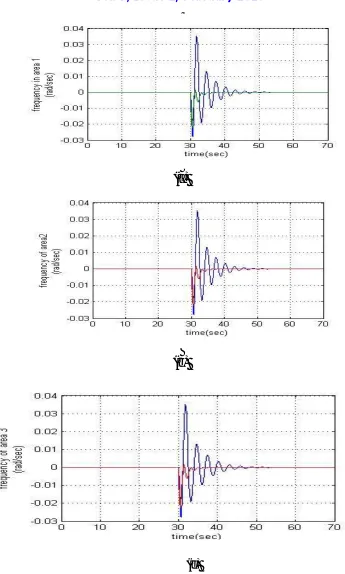
The model of the system under study is developed in MATLAB/SIMULINK.The developed model is simulated in a separate program (by .mfile) considering a 5% step load increase in area-1. The objective function is determined in the .mfile and used in optimization algorithm. A series of experiments was conducted to properly choose the population size and number of iterations of algorithm. In the present study, a population size of NP = 50 and the
ISSN (Print) : 2320 – 3765 ISSN (Online): 2278 – 8875
I
nternational
J
ournal of
A
dvanced
R
esearch in
E
lectrical,
E
lectronics and
I
nstrumentation
E
ngineering
(A High Impact Factor, Monthly, Peer Reviewed Journal)
Website: www.ijareeie.com
Vol. 7, Issue 2, February 2018
(a)
(b)
(c)
ISSN (Print) : 2320 – 3765 ISSN (Online): 2278 – 8875
I
nternational
J
ournal of
A
dvanced
R
esearch in
E
lectrical,
E
lectronics and
I
nstrumentation
E
ngineering
(A High Impact Factor, Monthly, Peer Reviewed Journal)
Website: www.ijareeie.com
Vol. 7, Issue 2, February 2018
(a)
V.CONCLUSION
A new method is implemented in this paper for emulating inertia in a multi-area interconnected AGC system. Here the proposed model is implemented to a three-area interconnected AGC system by using MATLAB software. The proposed formulation can be used for any interconnected power system with different size and characteristics. When the electrical load increases in one area the frequency and tie line power will mismatch, it suffers from the lack of inertia. To clear this problem virtual inertia emulation concept is taken and the feedback of every area is given to the controller to recognize the load changes. Controller will helps to disconnect the area when load changes and it helps to stable the frequency in less time period. The proposed approach is significantly improving the stability of the system.
REFERENCES
1. P. Kundur, Power System Stability and Control, New York: McGrawHill, 1994.
(b)
ISSN (Print) : 2320 – 3765 ISSN (Online): 2278 – 8875
I
nternational
J
ournal of
A
dvanced
R
esearch in
E
lectrical,
E
lectronics and
I
nstrumentation
E
ngineering
(A High Impact Factor, Monthly, Peer Reviewed Journal)
Website: www.ijareeie.com
Vol. 7, Issue 2, February 2018
4. E. Rakhshani, and P. Rodriguez, " Inertia Emulation in AC/DC Interconnected Power Systems Using Derivative Technique Considering
Frequency Measurement Effects," IEEE Transactions on power systems, Vol. 32, Issue 5, pp. 3338 - 3351, 2016.
5. G. Delille, B. Francois, G. Malarange,,"Dynamic Frequency Control Support by Energy Storage to Reduce the Impact of Wind and Solar
Generation on Isolated Power System's Inertia," IEEE Transactions on Sustainable Energy, Vol. 3, Issue 4, pp. 931-939, 2012.
6. H. Bevrani, and S. Shokoohi, "An Intelligent Droop Control for Simultaneous Voltage and Frequency Regulation in Islanded Microgrids,"
IEEE Transactions on Smart Grid, Vol. 4, No. 4, 2013.
7. M. Datta, and T. Senjyu, "Fuzzy Control of Distributed PV Inverters/Energy Storage Systems/Electric Vehicles for Frequency Regulation in a
Large Power System," IEEE Transactions on Smart Grids, vol. 4, No. 1, March 2013.
8. Y.P. Agalgaonkar, B.C. Pal and R.A. Jabr, "Distribution Voltage Control Considering the Impact of PV Generation on Tap Changers and
Autonomous Regulators," IEEE Transactions on Power Systems, vol.29, no.1, pp.182-192, January 2014.
9. E. Rakhshani, A. Luna, K. Rouzbehi, P. Rodriguez, and I. Etxeberia-Otadui, "Effects of VSC-HVDC on Load Frequency Control in
Multi-Area Power System," IEEE Energy Conversion Congress andExposition, ECCE, pp. 4432-4436, 2012.
10. S. Nomura, H. Tsutsui, S. Tsuji-Iio, R. Shimada, "Flexible Power Interconnection With SMES," IEEE Transactions on Applied
Superconductivity, vol. 16, no. 2, pp. 616-619, 2006.
11. Z. Jiebei, C.D. Booth, G.P. Adam, A.J. Roscoe, C.G. Bright, "Inertia Emulation Control Strategy for VSC-HVDC Transmission Systems,"
IEEE Transactions on Power Systems, Vol. 28, Issue 2, 2013.
12. R.A. Jabr, I. Dzafic, B.C. Pal, "Robust Optimization of Storage Investment on Transmission Networks," IEEE Transactions on PowerSystems,
Vol. 30, Issue 1, pp. 531-539, 2015.
13. M.J. Carrizosa, F.D. Navas, G. Dammc, F.L. Lagarrigue, "Optimal power flow in multi-terminal HVDC grids with offshore wind farms and