Enhanced Play Fair Cipher
Naveen KMP
1
P
,
P
1
P
Department of Information Technology, Velammal Engineering College, Chennai, Tamil Nadu, India.
Abstract
The theme of this research work is to design and develop a very strong cryptographic technique, which will be used to provide security for alphanumeric characters, special characters and numbers, when we transmit over the network. This cryptographic technique, very well addresses the problems that were faced by the classical play fair and 3D Play fair techniques and overcomes the problems we faced in those techniques. Here we will consider 4 characters at a time, group them and then use them for encryption. We have a problem in the classical play fair as it uses i and j as same character. Here we eliminate this problem and we also eliminate the problem with 3D play fair which will use only certain limited character sets for encryption and that is not case sensitive. In our proposed method, we take into consideration all the 256 ASCII characters for encryption and it is also a complex algorithm when compared to previous replacement techniques.
Keywords: 25TEnhanced Play fair.
1. Introduction
The best know multiple-letter encryption cipher is the Playfair, which treats diagrams in plain text as a single unit and translates it into cipher text. This cipher was invented by the British scientist Sir Charles Wheatstone in 1854. But it bears the name of his friend Baron Play-fair of St.Andrews, who championed the cipher at the British foreign office [1]. It had the drawback that a digraph and its reverse will encrypt in the same fashion. i.e., if A and B are plain text that produces X and Y , then B and A will produce Y and X. 3D- Play-fair cipher is a multiple letter encryption cipher, which encrypts a trigraph of plain text into its corresponding cipher text trigraph. For that purpose it requires a 4 X 4 X 4 matrix to store 26 alphabets, 10 numerals and 28 special symbols [2].Keeping in mind that, all the characters are ASCII characters which we use, in general, for the data transmission and almost all the alphabets, both upper case and lower case, are widely used along with numerals and special characters, here we are considering 256 ASCII characters which also includes the
extended ASCII values for framing the secret key word matrix and then for obtaining the encrypted messages. Here our main concern is to create an encryption algorithm which uses the substitution technique and considers all the ASCII characters for encryption and decryption.
2. Enhanced Play Fair Cipher
Enhanced play fair is a multiple-letter encryption technique based on the substitution mechanism which will consider 3 characters of plain text to convert them in corresponding cipher text of 3 characters. To achieve this type of encryption we are need to have 4 X 4 bigger matrixes like structure again which will have in each cell of a 4 X 4 matrix. So each small 4 X 4 matrix will have 16 character and then we have similarly 16 such matrix which all together form 256 characters. In previous play fair cipher techniques we usually had key matrix generation, encryption and decryption algorithms which will be discussed below in detail. The main contribution in this research is finding the new encryption algorithm which is based on replacement technique and the introduction of all the 256 character in that process for more confusion.
2.1 Algorithm with an example
Let us consider the keyword to be Passion.
STEP 1: Transform the keyword into required form.
• Exclude the repetitive letters
• Exclude the space.
Note: Both caps and small letters are accepted. Passion Pasion
STEP 2: Convert the resultant keyword letters into their respective hexadecimal values.
P a s i o n 50 61 73 69 6F 6E
STEP 3: Key Matrix Generation:
Table 1: key Matrix Generation
Row
/col
Col1
Col2
Col3
Col4
Row 1
50 61 73 69
6F 6E 00 01
02 03 04 05
06 07 08 09
6D 70 71 72
74 75 76 77
78 79 7A 7B
7C 7D 7E 7F
A0 A1 A2 A3
A4 A5 A6 A7
A8 A9 AA AB
AC AD AE AF
D0 D1 D2 D3
D4 D5 D6 D7
D8 D9 DA DB
DC DD DE DF
Row 2
3A 3B 3C 3D
3E 3F 40 41
42 43 44 45
46 47 48 49
0A 0B 0C 0D
0E 0F 10 11
12 13 14 15
16 17 18 19
B0 B1 B2 B3
B4 B5 B6 B7
B8 B9 BA BB
BC BD BE BF
E0 E1 E2 E3
E4 E5 E6 E7
E8 E9 EA EB
EC ED EE EF
Row 3
4A 4B 4C 4D
4E 4F 51 52
53 54 55 56
57 58 59 5A
80 81 82 83
84 85 86 87
88 89 8A 8B
8C 8D 8E 8F
1A 1B 1C 1D
1E 1F 20 21
22 23 24 25
26 27 28 29
F0 F1 F2 F3
F4 F5 F6 F7
F8 F9 FA FB
FC FD FE FF
Row 4
5B 5C 5D 5E
5F 60 62 63
64 65 66 67
68 6A 6B 6C
90 91 92 93
94 95 96 97
98 99 9A 9B
9C 9D 9E 9F
C0 C1 C2 C3
C4 C5 C6 C7
C8 C9 CA CB
CC CD CE CF
2A 2B 2C 2D
2E 2F 30 31
32 33 34 35
The above key matrix is a 4*4 matrix each cell in this matrix contains another 4*4 sub matrix .This will lead to 16 units in each cell which will lead to a total of 256 units. These 256 units will have a range of hexadecimal values (00-FF).
STEP 3.1: Fill the diagonals of the matrix first using the hexadecimal values of keyword first and the rest with the remaining hexadecimal values.
STEP 3.2: Followed by the diagonal boxes we have to fill the columns accordingly. Fill the hexadecimal values in the 1st row 1st column and then 2nd row 2nd column and so on (ie) diagonal wise.
STEP 3.3: Now fill the remaining hexadecimal values excluding those we have filled previously from 1st empty space in a vertical fashion, continuously from 2nd column to 3rd and from 3rd column to 4th.The matrix thus obtained will be of the form as below. It will have 4 columns and 4 rows each box of the bigger matrix will have a separate 4*4 matrix in it which consist of 4 columns and 4 rows each.
STEP 4: Plain text encryption, Let us consider the plain text :“Decide the Destiny”.
STEP 4.1: Split the text into groups of three. In accordance with plain text we can include space and special characters. Repeated letters are accepted in this case. If any letter is left single or double then use filler letters x or y in order to make it three.
Dec ide _th e_D est iny
Note: Here space is denoted as ‘_’
STEP 4.2: Convert into hexadecimal values
D e c i d e 44 65 63 69 64 65
_ t h e _ D 20 74 68 65 20 44
e s t i n y 65 73 74 69 65 79
Thus the hexadecimal value of the plain text will be given as
44 65 63 69 64 65 20 74 68 65 20 44 65 73 74 69 6E 79
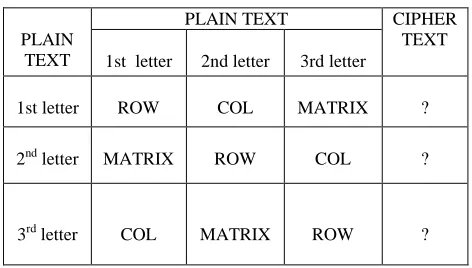
STEP 4.3 : Now we would draw a separate table for each of the three hexadecimal letters. The encryption table will be of the below form.
Table 2: Encryption Table
STEP 4.4 : The cipher text in the above table is generated by the following steps.
For the cipher text of the 1st letter:
The row in which the 1st letter is present in its own matrix is assumed as ‘k’. The column in which the 2nd letter is
present in its own matrix is assumed as ’l’.
We should consider the matrix in which the 3rd letter is present.
Now the letter in the kth row lth column of the 3rd matrix will be the cipher value of 1st letter.
Similarly, for all the letters the cipher values are identified.
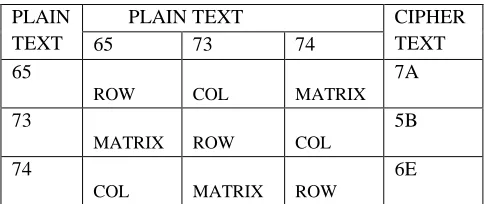
Table 3: Encryption table for 44,65,63. PLAIN
TEXT
PLAIN TEXT CIPHER
TEXT 1st letter 2nd letter 3rd letter
1st letter ROW COL MATRIX ?
2P nd
P
letter MATRIX ROW COL ?
3P rd
P
letter COL MATRIX ROW ?
PLAIN TEXT
PLAIN TEXT CIPHER TEXT
44 65 63
44 ROW COL MATRIX 65
65 MATRIX ROW COL 45
Table 4: Encryption table for 69, 64, 65
Table 5: Encryption table for 20, 74, 68
Table 6: Encryption table for 65, 20, 44
Table 7: Encryption table for 65, 73, 74
Table 8: Encryption table for 69,6E,79
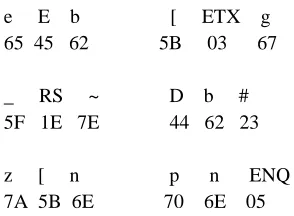
Thus the cipher text (in the form of hexadecimal values) of the plain text is obtained as
65 45 62 5B 03 67 5F 1E 7E 44 62 23 7A 5B 6E 70 6E 05
The corresponding ASCII values for those hexadecimal values are obtained and listed.
65 45 62 5B 03 67 5F 1E 7E e E b [ ETX g _ RS ~
44 62 23 7A 5B 6E 70 6E 05 D b # z [ n p n ENQ
Thus the resultant cipher text is
eEb[ETXg_RS~Db#z[npnENQ
where,
ETXEnd of text. RS record separator.
ENQ enquiry are some of the available keypad functions.
STEP 5: CIPHER TEXT DECRYPTION
Let us take the obtained cipher text: “eEb[ETXg_RS~Db#z[npnENQ”.
STEP 5.1: Split the cipher text into groups of three.
eEb [ETXg _RS~ Db# z[n pnENQ
where,
ETXEnd of text. RS record separator.
ENQ enquiry are some of the available keypad functions.
PLAIN TEXT
PLAIN TEXT CIPHER TEXT
69 64 65
69 ROW COL MATRIX
5B
64 MATRIX ROW COL
03
65 COL MATRIX ROW
67
PLAIN TEXT
PLAIN TEXT CIPHER TEXT
20 74 68
20 ROW COL MATRIX
5F
74 MATRIX ROW COL
1E
68 COL MATRIX ROW
7E
PLAIN TEXT
PLAIN TEXT CIPHER TEXT
65 20 44
65
ROW COL MATRIX
44
20
MATRIX ROW COL
62
44
COL MATRIX ROW
23
PLAIN TEXT
PLAIN TEXT CIPHER TEXT
65 73 74
65
ROW COL MATRIX
7A
73
MATRIX ROW COL
5B
74
COL MATRIX ROW
6E
PLAIN TEXT
PLAIN TEXT CIPHER TEXT
69 6E 79
69
ROW COL MATRIX
70
6E
MATRIX ROW COL
6E
79
COL MATRIX ROW
STEP 5.2: Convert into hexadecimal values
e E b [ ETX g 65 45 62 5B 03 67
_ RS ~ D b # 5F 1E 7E 44 62 23
z [ n p n ENQ 7A 5B 6E 70 6E 05
Thus the hexa-decimal value of the cipher text will be given as
65 45 62 5B 03 67 5F 1E 7E 44 62 23 7A 5B 6E 70 6E 05
STEP 5.3: Now we would draw a separate table for each of the hexadecimal letters. The decryption table will be of the below form.
Table 9: Decryption Table
STEP 5.4 : The plain text in the above table is generated by the following steps.
For the cipher text of the 1st letter:
The row in which the 1st letter is present in its own matrix is assumed as ‘k’.
The column in which the 3rd letter is present in its own matrix is assumed as ’l’.
We should consider the matrix in which the 2nd letter is present.
Now the letter in the kth row lth column of the 2nd letter matrix will be the plain text of 1st letter.
Similarly, for all the letters the plain text values are identified.
Table 10: Decryption table for 65, 42, 62
Table 11: Decryption table for 5B, 03, 67
Table 12: Decryption table for 5F, 1E, 7E
Table 13: Decryption table for 44, 62, 23 CIPHER
TEXT
CIPHER TEXT PLAIN
TEXT 1st letter 2nd letter 3rd letter
1st letter ROW MATRIX COL ?
2P nd
P
letter COL ROW MATRIX ?
3P rd
P
letter MATRIX COL ROW ?
CIPHER TEXT
CIPHER TEXT PLAIN TEXT
65 45 62
65
ROW MATRIX COL
44
45
COL ROW MATRIX
65
62
MATRIX COL ROW
63
CIPHER TEXT
CIPHER TEXT PLAIN TEXT
5B 03 67
5B
ROW MATRIX COL
69
03
COL ROW MATRIX
64
67
MATRIX COL ROW
65
CIPHER TEXT
CIPHER TEXT PLAIN TEXT
5F 1E 7E
5F
ROW MATRIX COL
20
1E
COL ROW MATRIX
74
7E
MATRIX COL ROW
68
CIPHER TEXT
CIPHER TEXT PLAIN TEXT
44 62 23
44
ROW MATRIX COL
65
62
COL ROW MATRIX
20
23
MATRIX COL ROW
Table 14: Decryption table for 7A, 5B, 6E
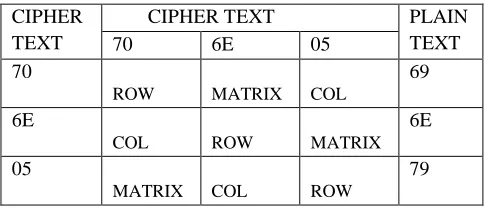
Table 15: Decryption table for 70, 6E, 05
Thus the plain text (in the form of hexadecimal values) of the cipher text is obtained as
44 65 63 69 64 65 20 74 68 65 20 44 65 73 74 69 6E 79
The corresponding ASCII values for those hexadecimal values are obtained and listed.
44 65 63 69 64 65 20 74 68 D E C I D E _ T H
65 20 44 65 73 74 69 6E 79 E _ D E S T I N Y
Note: change back the underscore ( _ ) as space.
Thus the resultant plain text is “Decide the destiny”.
3. Properties of enhanced Play Fair
The proposed play fair cipher has lot of advantages when compared it to the classical play fair cipher and the 3D play fair cipher, which are as follows:
1. Cubic Play fair can be considered as the greatest achievement in the mono-alphabetic ciphers and in substitution techniques.
2. This is highly case sensitive and so it is hard to determine the encrypted message and we will have the correct message encrypted without missing out on anything.
3. Classical Play fair cipher considers only 25 characters where we will make ‘i’ and ‘j’ as a single character and in 3D play fair we use only 64 characters. But in cubic play fair we will be using all the 256 characters as we do in the algorithms like AES, MD5.
4. Security Aspects of the enhanced Play Fair
Security is one of the main aspects for any encryption algorithm. While time complexity and space complexity also play major roles in the selection of any cryptographic algorithm, security is the sole parameter. So some security aspects are discussed below [4].
4.1
Brute Force Attack
A brute force attack systematically attempts every possible key. It is most often used in a known plaintext or cipher text-only attack [4].
In our proposed system we are using 16 4 X 4 matrix for encryption and decryption purposes. So we will be having 1048576 polygraph instead of 4096 trigraph from the 3D play fair cipher[2].
4.2
Frequency Analysis
It refers to the study of the frequency of each and every character depending upon their occurrence in the context. The frequency of letters in text messages has often been studied for use in cryptography, and frequency analysis, in particular. An exact analysis of this is not possible, as each person writes slightly different; however, an approximate ordering of English letters by frequency of use is ETAOIN SHRDL UCMFG YPWBV KXJQZ [5].
The probability of occurrence of a particular letter in the 3D play fair cipher techniques is 1/4*1/4*1/4= 1/64= 0.0156 [2].
Whereas, in enhanced play fair cipher technique it is 1/3*1/3*1/16=1/144=0.00694.
CIPHER TEXT
CIPHER TEXT PLAIN TEXT
7A 5B 6E
7A
ROW MATRIX COL
65
5B
COL ROW MATRIX
73
6E
MATRIX COL ROW
74
CIPHER TEXT
CIPHER TEXT PLAIN TEXT
70 6E 05
70
ROW MATRIX COL
69
6E
COL ROW MATRIX
6E
05
MATRIX COL ROW
4.3
Confusion and Diffusion
Confusion involves making the statistical relation between plaintext and ciphertext as complex as possible. Diffusion refers to the property that the redundancy in the statistics of the plaintext is dissipated in the statistics of the ciphertext [6]. The enhanced play fair cipher is most secured when compared to the previous techniques on play fair. It is uses 3 characters at the same time to give one character. So finding the character is not an easy task.
5. CONCLUSION
The Enhanced Play fair cipher is the symmetric encryption technique which uses all the alphabets, numerals, special characters and also non printable characters for encryption and decryption making the users to get more confused. It is eliminates the limitation which we had in the 3D play fair like, restriction to case sensitivity, special characters and then limitation of including all the ASCII characters. Here we have made the approach where we can easily add all the ASCII character sets and there is no restriction in case sensitivity also.
REFERENCES
[1] William Stallings, Cryptography and Network Security Principles and Practices, Fourth edition, Pearson Edition.
[2]Amandeep Kaur, Harsh Kumar Verma, Ravindra Kumar Singh ,Internatinal Journal of Computer Applications (0975 – 8887) Volume 51– No.2, August 2012 1048576
[3]Radix 64 Converter:
http://www.oktay.de/decode/base64.htm
[4]. Behrouz A. Forouzan, Cryptography and Network Security. Special Indian Edition, The
McGraw- Hill companies, New Delhi, 2007.